Learnings from the International Teachers Program
at
CEIBS, Shanghai
11-16 Jan 2015
12 Feb 2015
Sudhir Voleti
Presentation Outline
• ITP Background and Objectives
• Cohort Profile
• Learnings from the Sessions
• Learnings from the In Situ Micro Teaching Module
• Conclusion
Program Background and Objectives
About the ITP
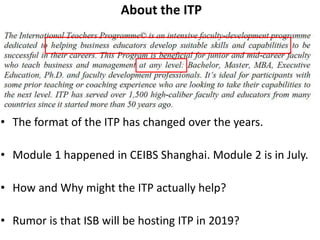
• The format of the ITP has changed over the years.
• Module 1 happened in CEIBS Shanghai. Module 2 is in July.
• How and Why might the ITP actually help?
• Rumor is that ISB will be hosting ITP in 2019?
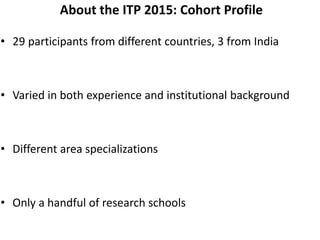
About the ITP 2015: Cohort Profile
• 29 participants from different countries, 3 from India
• Varied in both experience and institutional background
• Different area specializations
• Only a handful of research schools
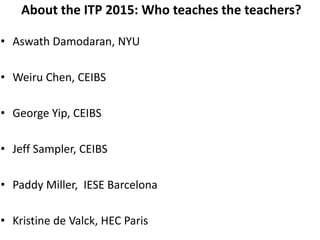
About the ITP 2015: Who teaches the teachers?
• Aswath Damodaran, NYU
• Weiru Chen, CEIBS
• George Yip, CEIBS
• Jeff Sampler, CEIBS
• Paddy Miller, IESE Barcelona
• Kristine de Valck, HEC Paris
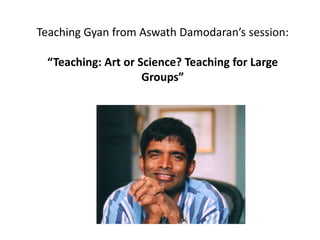
Teaching Gyan from Aswath Damodaran’s session:
“Teaching: Art or Science? Teaching for Large
Groups”
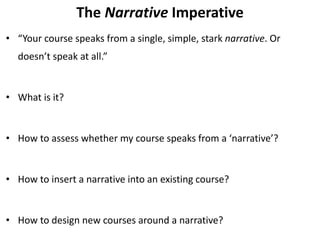
The Narrative Imperative
• “Your course speaks from a single, simple, stark narrative. Or
doesn’t speak at all.”
• What is it?
• How to assess whether my course speaks from a ‘narrative’?
• How to insert a narrative into an existing course?
• How to design new courses around a narrative?
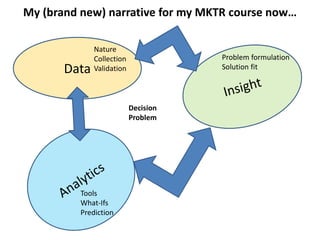
My (brand new) narrative for my MKTR course now…
Data
Nature
Collection
Validation
Tools
What-Ifs
Prediction
Problem formulation
Solution fit
Decision
Problem
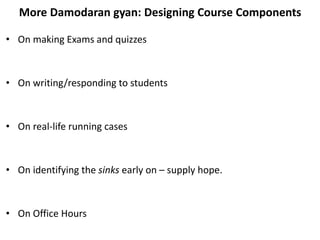
More Damodaran gyan: Designing Course Components
• On making Exams and quizzes
• On writing/responding to students
• On real-life running cases
• On identifying the sinks early on – supply hope.
• On Office Hours
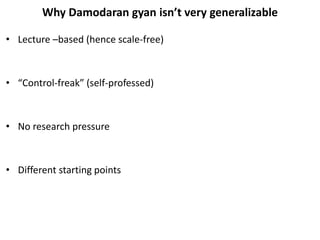
Why Damodaran gyan isn’t very generalizable
• Lecture –based (hence scale-free)
• “Control-freak” (self-professed)
• No research pressure
• Different starting points
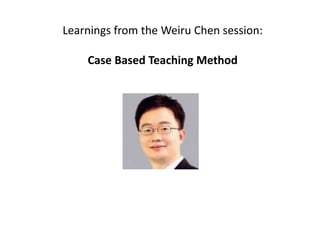
Learnings from the Weiru Chen session:
Case Based Teaching Method
Weiru Chen’s Session Gyan
• How the session started
• Case facts were tabulated and summarized (just as well)
• Case teaching components were all deployed – slowly.
• Preparation. Board-plan. Knowledge of Class background.
• Classroom interaction. Q&A.
Weiru Chen’s Session Gyan
• Maybe under-emphatic starts are helpful?
• “First impressions are over-rated” ?
• Mastery over a case shows.
• Multiple well-timed Aha! Moments were there.
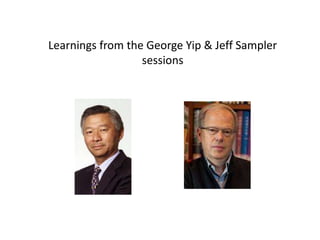
Learnings from the George Yip & Jeff Sampler
sessions
George Yip Session Gyan
• Session was titled “Case based teaching method”
• Comparison with the “classic HBS” case method.
• Only question is/should be “What should the central actor in the
case do?”
• Talked about how things have evolved since then. Varying cases,
lengths, objectives etc. How to incorporate research into teaching.
• “Lead by questions or lead by answers?”
Jeff Sampler Session Gyan
• Session title was “Technology-Enhanced Teaching and Learning”.
• “Education industry is primed for disruption”.
• Why MOOC 2.0 will devastate our profession
• Live demo from some disruptors in the field
• “What will the future classroom look like in an era of always-on
information?”
Jeff Sampler Session Gyan
• Future course material will be:
– Distributed/ fractionalized
– Google-ized (“Search” perspective to answer-finding and problem solving)
– Perforce rich in User-generated content. Co-creation in learning?
– Full of data mining possibilities, assurance of learning assessment
possibilities
• Other trends in the classroom(?) of the future:
– Gamification, peer comparisons, incentives, taped lectures, shared solutions
• “What is our value-addition as teachers inside the classroom?”
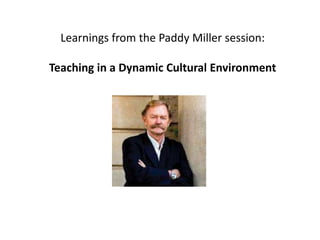
Learnings from the Paddy Miller session:
Teaching in a Dynamic Cultural Environment
Paddy Miller Session Gyan
• Why it was so useful…
• Cold calling?
• Energy-level management
• Body language and what it says
• Sources of inspiration
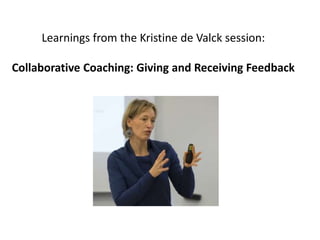
Learnings from the Kristine de Valck session:
Collaborative Coaching: Giving and Receiving Feedback
Kristine de Valck Session Gyan
• What she did
– Used an old 10 minute video of her teaching
– Asked the class to dissect it. Specifically, what it is that could be improved
• Found it Underwhelming. Until I did the same with my own vid…
• Insights flooded in. Rare perspective emerges when you see
yourself .
• So maybe Aha! moments in-class aren’t the end-all really?
In-situ Micro Teaching
In-Situ Teaching Feedback
• What it was all about
• Feedback I figured out for myself:
• No narrative
• Poor Time management
• Poor energy management
• Didn’t start well and couldn’t end well
• Lack of interactivity/ engagement
In-Situ Teaching Feedback
• Feedback I got:
• Overload of information. Lecture felt too long.
• Expectation from class unclear. Objectives unclear
• “Pause post-question is NOT an awkward moment.”
• Attitude and body-language are defensive  becomes self-
fulfilling
• “Not authentic. Not yourself.”
• “Intimidating.” Not Likeable.
Conclusion
Intended Changes in my Teaching Going Forward
• Narrative led course design
– Revamped content. Even more application focused.
• Better Time management
– Rehearsals. Uncluttered slides.
– Flipped classroom with smart pre-reads
• Better Energy Management
– Part Lecture, Q&A, in-class readings, writing-based group activity (Quick-
checks)
Intended Changes in my Teaching Going Forward
• Questions-led classes
– Friendly cold-calling
– Inductive learning drive  Basic board-plan for discussion
• Responsiveness
– Will actually try to write to students who made good points in class
– And to likely sinks offering hope.
• Practiced Slowness
– Will try to make haste slowly.
Thank You
Q & A

Learnings summarized from the International Teachers Program workshop

  • 1.
    Learnings from theInternational Teachers Program at CEIBS, Shanghai 11-16 Jan 2015 12 Feb 2015 Sudhir Voleti
  • 2.
    Presentation Outline • ITPBackground and Objectives • Cohort Profile • Learnings from the Sessions • Learnings from the In Situ Micro Teaching Module • Conclusion
  • 3.
  • 4.
    About the ITP •The format of the ITP has changed over the years. • Module 1 happened in CEIBS Shanghai. Module 2 is in July. • How and Why might the ITP actually help? • Rumor is that ISB will be hosting ITP in 2019?
  • 5.
    About the ITP2015: Cohort Profile • 29 participants from different countries, 3 from India • Varied in both experience and institutional background • Different area specializations • Only a handful of research schools
  • 6.
    About the ITP2015: Who teaches the teachers? • Aswath Damodaran, NYU • Weiru Chen, CEIBS • George Yip, CEIBS • Jeff Sampler, CEIBS • Paddy Miller, IESE Barcelona • Kristine de Valck, HEC Paris
  • 7.
    Teaching Gyan fromAswath Damodaran’s session: “Teaching: Art or Science? Teaching for Large Groups”
  • 8.
    The Narrative Imperative •“Your course speaks from a single, simple, stark narrative. Or doesn’t speak at all.” • What is it? • How to assess whether my course speaks from a ‘narrative’? • How to insert a narrative into an existing course? • How to design new courses around a narrative?
  • 9.
    My (brand new)narrative for my MKTR course now… Data Nature Collection Validation Tools What-Ifs Prediction Problem formulation Solution fit Decision Problem
  • 10.
    More Damodaran gyan:Designing Course Components • On making Exams and quizzes • On writing/responding to students • On real-life running cases • On identifying the sinks early on – supply hope. • On Office Hours
  • 11.
    Why Damodaran gyanisn’t very generalizable • Lecture –based (hence scale-free) • “Control-freak” (self-professed) • No research pressure • Different starting points
  • 12.
    Learnings from theWeiru Chen session: Case Based Teaching Method
  • 13.
    Weiru Chen’s SessionGyan • How the session started • Case facts were tabulated and summarized (just as well) • Case teaching components were all deployed – slowly. • Preparation. Board-plan. Knowledge of Class background. • Classroom interaction. Q&A.
  • 14.
    Weiru Chen’s SessionGyan • Maybe under-emphatic starts are helpful? • “First impressions are over-rated” ? • Mastery over a case shows. • Multiple well-timed Aha! Moments were there.
  • 15.
    Learnings from theGeorge Yip & Jeff Sampler sessions
  • 16.
    George Yip SessionGyan • Session was titled “Case based teaching method” • Comparison with the “classic HBS” case method. • Only question is/should be “What should the central actor in the case do?” • Talked about how things have evolved since then. Varying cases, lengths, objectives etc. How to incorporate research into teaching. • “Lead by questions or lead by answers?”
  • 17.
    Jeff Sampler SessionGyan • Session title was “Technology-Enhanced Teaching and Learning”. • “Education industry is primed for disruption”. • Why MOOC 2.0 will devastate our profession • Live demo from some disruptors in the field • “What will the future classroom look like in an era of always-on information?”
  • 18.
    Jeff Sampler SessionGyan • Future course material will be: – Distributed/ fractionalized – Google-ized (“Search” perspective to answer-finding and problem solving) – Perforce rich in User-generated content. Co-creation in learning? – Full of data mining possibilities, assurance of learning assessment possibilities • Other trends in the classroom(?) of the future: – Gamification, peer comparisons, incentives, taped lectures, shared solutions • “What is our value-addition as teachers inside the classroom?”
  • 19.
    Learnings from thePaddy Miller session: Teaching in a Dynamic Cultural Environment
  • 20.
    Paddy Miller SessionGyan • Why it was so useful… • Cold calling? • Energy-level management • Body language and what it says • Sources of inspiration
  • 21.
    Learnings from theKristine de Valck session: Collaborative Coaching: Giving and Receiving Feedback
  • 22.
    Kristine de ValckSession Gyan • What she did – Used an old 10 minute video of her teaching – Asked the class to dissect it. Specifically, what it is that could be improved • Found it Underwhelming. Until I did the same with my own vid… • Insights flooded in. Rare perspective emerges when you see yourself . • So maybe Aha! moments in-class aren’t the end-all really?
  • 23.
  • 24.
    In-Situ Teaching Feedback •What it was all about • Feedback I figured out for myself: • No narrative • Poor Time management • Poor energy management • Didn’t start well and couldn’t end well • Lack of interactivity/ engagement
  • 25.
    In-Situ Teaching Feedback •Feedback I got: • Overload of information. Lecture felt too long. • Expectation from class unclear. Objectives unclear • “Pause post-question is NOT an awkward moment.” • Attitude and body-language are defensive  becomes self- fulfilling • “Not authentic. Not yourself.” • “Intimidating.” Not Likeable.
  • 26.
  • 27.
    Intended Changes inmy Teaching Going Forward • Narrative led course design – Revamped content. Even more application focused. • Better Time management – Rehearsals. Uncluttered slides. – Flipped classroom with smart pre-reads • Better Energy Management – Part Lecture, Q&A, in-class readings, writing-based group activity (Quick- checks)
  • 28.
    Intended Changes inmy Teaching Going Forward • Questions-led classes – Friendly cold-calling – Inductive learning drive  Basic board-plan for discussion • Responsiveness – Will actually try to write to students who made good points in class – And to likely sinks offering hope. • Practiced Slowness – Will try to make haste slowly.
  • 29.

Editor's Notes

  • #2 Analyzing Unstructured Data without Dimension Reduction: A Graph-based Approach
  • #5 Talk about why it might help?
  • #9 The results indicate that semantic space of firms’ stated intention information is a relevant factor in explaining its profits.
  • #10 The results indicate that semantic space of firms’ stated intention information is a relevant factor in explaining its profits.
  • #11 The results indicate that semantic space of firms’ stated intention information is a relevant factor in explaining its profits.
  • #12 The results indicate that semantic space of firms’ stated intention information is a relevant factor in explaining its profits.
  • #14 The results indicate that semantic space of firms’ stated intention information is a relevant factor in explaining its profits.
  • #15 The results indicate that semantic space of firms’ stated intention information is a relevant factor in explaining its profits.
  • #17 The results indicate that semantic space of firms’ stated intention information is a relevant factor in explaining its profits.
  • #18  Technology-Enhanced Teaching and Learning
  • #19 The results indicate that semantic space of firms’ stated intention information is a relevant factor in explaining its profits.
  • #21 The results indicate that semantic space of firms’ stated intention information is a relevant factor in explaining its profits.
  • #23 The results indicate that semantic space of firms’ stated intention information is a relevant factor in explaining its profits.
  • #25 The results indicate that semantic space of firms’ stated intention information is a relevant factor in explaining its profits.
  • #26 The results indicate that semantic space of firms’ stated intention information is a relevant factor in explaining its profits.
  • #28 The results indicate that semantic space of firms’ stated intention information is a relevant factor in explaining its profits.
  • #29 The results indicate that semantic space of firms’ stated intention information is a relevant factor in explaining its profits.