External Moderation of School Practice
By
Ndawula Stephen (PhD)
Filda Ojok
Mary Kakeeto(PhD)
Elizabeth Opit(PhD)
Background
• This presentation comes after our team carries out external moderation of School
Practice of student teachers in Uganda.
• Assessment of school practice is an essential component of the teacher training
curriculum.
• During this time, the student teacher is assigned to an internal supervisor and an
external supervisor, all of whom form a supervisory team.
• Educators consider school Practice to be an important, highly valued experience.
The university internal supervisors and external supervisors share the goal of
preparing students to be effective teachers.
Areas of Concern for Supervision
The team was guided by areas of Concern as reflected in the
supervision instrument issued by the University
These are aspects that our team put specific attention during
Supervision of school practice 2017.
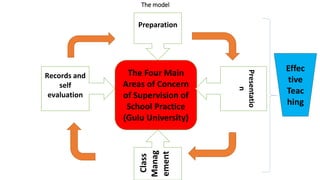
The came out with a model based on the given areas of
concern
The model
The Four Main
Areas of Concern
of Supervision of
School Practice
(Gulu University)
Preparation
Effec
tive
Teac
hing
Students’ Preparation
According to Benjamin Franklin, Failing to plan is planning to fail.
Therefore, Success of a lesson is highly dependent on adequate preparation
Positives : -
• Most students seen were found with schemes
of work (SoW)
• Most SoW were in line with the syllabus
• Majority used correct format.
• Good breakdown of the topic exhibited.
• Content appropriately matched with
objectives.
• Majority indicated selection of relevant
Instructional media
• The lesson plans in progress had pointers
indicated in files
• Cleanliness of classrooms, even where the
floor was of mud
• Adequate reference materials.
Challenges: -
• A case of student whose SoW was starting
from week 4
• There was no indication that SoW were
approved
• Wrong identification of topics and subtopics in
SoW
• Illogical order of information in some SoW
• Inclusion of too much/ too little content in a
given SoW.
• A few cases wrong lesson objectives indicated
• A few cases of repetition of lesson objectives.
• Hardly any classes with well arranged materials
to facilitate incidental learning
• Cases of vaguely stated teaching/ learning aids
• Poorly made charts; grammatical errors, no
underlined headings, untidy hand writing
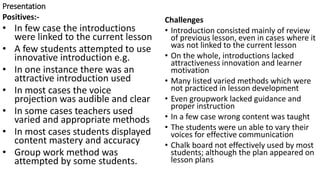
Presentation
Positives:-
• In few case the introductions
were linked to the current lesson
• A few students attempted to use
innovative introduction e.g.
• In one instance there was an
attractive introduction used
• In most cases the voice
projection was audible and clear
• In some cases teachers used
varied and appropriate methods
• In most cases students displayed
content mastery and accuracy
• Group work method was
attempted by some students.
Challenges
• Introduction consisted mainly of review
of previous lesson, even in cases where it
was not linked to the current lesson
• On the whole, introductions lacked
attractiveness innovation and learner
motivation
• Many listed varied methods which were
not practiced in lesson development
• Even groupwork lacked guidance and
proper instruction
• In a few case wrong content was taught
• The students were un able to vary their
voices for effective communication
• Chalk board not effectively used by most
students; although the plan appeared on
lesson plans
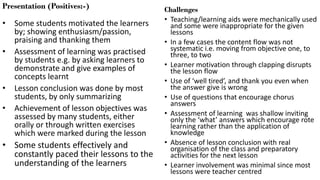
Presentation (Positives:-)
• Some students motivated the learners
by; showing enthusiasm/passion,
praising and thanking them
• Assessment of learning was practised
by students e.g. by asking learners to
demonstrate and give examples of
concepts learnt
• Lesson conclusion was done by most
students, by only summarizing
• Achievement of lesson objectives was
assessed by many students, either
orally or through written exercises
which were marked during the lesson
• Some students effectively and
constantly paced their lessons to the
understanding of the learners
Challenges
• Teaching/learning aids were mechanically used
and some were inappropriate for the given
lessons
• In a few cases the content flow was not
systematic i.e. moving from objective one, to
three, to two
• Learner motivation through clapping disrupts
the lesson flow
• Use of ‘well tired’, and thank you even when
the answer give is wrong
• Use of questions that encourage chorus
answers
• Assessment of learning was shallow inviting
only the ‘what’ answers which encourage rote
learning rather than the application of
knowledge
• Absence of lesson conclusion with real
organisation of the class and preparatory
activities for the next lesson
• Learner involvement was minimal since most
lessons were teacher centred
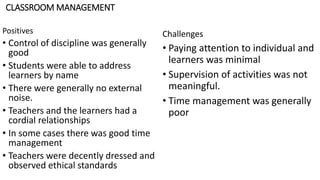
CLASSROOM MANAGEMENT
Positives
• Control of discipline was generally
good
• Students were able to address
learners by name
• There were generally no external
noise.
• Teachers and the learners had a
cordial relationships
• In some cases there was good time
management
• Teachers were decently dressed and
observed ethical standards
Challenges
• Paying attention to individual and
learners was minimal
• Supervision of activities was not
meaningful.
• Time management was generally
poor
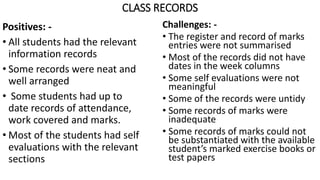
CLASS RECORDS
Positives: -
• All students had the relevant
information records
• Some records were neat and
well arranged
• Some students had up to
date records of attendance,
work covered and marks.
• Most of the students had self
evaluations with the relevant
sections
Challenges: -
• The register and record of marks
entries were not summarised
• Most of the records did not have
dates in the week columns
• Some self evaluations were not
meaningful
• Some of the records were untidy
• Some records of marks were
inadequate
• Some records of marks could not
be substantiated with the available
student’s marked exercise books or
test papers
Thank you
Asante
Apwoyo Matek
Aligato

External moderation of School Practice 2017

  • 1.
    External Moderation ofSchool Practice By Ndawula Stephen (PhD) Filda Ojok Mary Kakeeto(PhD) Elizabeth Opit(PhD)
  • 2.
    Background • This presentationcomes after our team carries out external moderation of School Practice of student teachers in Uganda. • Assessment of school practice is an essential component of the teacher training curriculum. • During this time, the student teacher is assigned to an internal supervisor and an external supervisor, all of whom form a supervisory team. • Educators consider school Practice to be an important, highly valued experience. The university internal supervisors and external supervisors share the goal of preparing students to be effective teachers.
  • 3.
    Areas of Concernfor Supervision The team was guided by areas of Concern as reflected in the supervision instrument issued by the University These are aspects that our team put specific attention during Supervision of school practice 2017. The came out with a model based on the given areas of concern
  • 4.
    The model The FourMain Areas of Concern of Supervision of School Practice (Gulu University) Preparation Effec tive Teac hing
  • 5.
    Students’ Preparation According toBenjamin Franklin, Failing to plan is planning to fail. Therefore, Success of a lesson is highly dependent on adequate preparation Positives : - • Most students seen were found with schemes of work (SoW) • Most SoW were in line with the syllabus • Majority used correct format. • Good breakdown of the topic exhibited. • Content appropriately matched with objectives. • Majority indicated selection of relevant Instructional media • The lesson plans in progress had pointers indicated in files • Cleanliness of classrooms, even where the floor was of mud • Adequate reference materials. Challenges: - • A case of student whose SoW was starting from week 4 • There was no indication that SoW were approved • Wrong identification of topics and subtopics in SoW • Illogical order of information in some SoW • Inclusion of too much/ too little content in a given SoW. • A few cases wrong lesson objectives indicated • A few cases of repetition of lesson objectives. • Hardly any classes with well arranged materials to facilitate incidental learning • Cases of vaguely stated teaching/ learning aids • Poorly made charts; grammatical errors, no underlined headings, untidy hand writing
  • 6.
    Presentation Positives:- • In fewcase the introductions were linked to the current lesson • A few students attempted to use innovative introduction e.g. • In one instance there was an attractive introduction used • In most cases the voice projection was audible and clear • In some cases teachers used varied and appropriate methods • In most cases students displayed content mastery and accuracy • Group work method was attempted by some students. Challenges • Introduction consisted mainly of review of previous lesson, even in cases where it was not linked to the current lesson • On the whole, introductions lacked attractiveness innovation and learner motivation • Many listed varied methods which were not practiced in lesson development • Even groupwork lacked guidance and proper instruction • In a few case wrong content was taught • The students were un able to vary their voices for effective communication • Chalk board not effectively used by most students; although the plan appeared on lesson plans
  • 7.
    Presentation (Positives:-) • Somestudents motivated the learners by; showing enthusiasm/passion, praising and thanking them • Assessment of learning was practised by students e.g. by asking learners to demonstrate and give examples of concepts learnt • Lesson conclusion was done by most students, by only summarizing • Achievement of lesson objectives was assessed by many students, either orally or through written exercises which were marked during the lesson • Some students effectively and constantly paced their lessons to the understanding of the learners Challenges • Teaching/learning aids were mechanically used and some were inappropriate for the given lessons • In a few cases the content flow was not systematic i.e. moving from objective one, to three, to two • Learner motivation through clapping disrupts the lesson flow • Use of ‘well tired’, and thank you even when the answer give is wrong • Use of questions that encourage chorus answers • Assessment of learning was shallow inviting only the ‘what’ answers which encourage rote learning rather than the application of knowledge • Absence of lesson conclusion with real organisation of the class and preparatory activities for the next lesson • Learner involvement was minimal since most lessons were teacher centred
  • 8.
    CLASSROOM MANAGEMENT Positives • Controlof discipline was generally good • Students were able to address learners by name • There were generally no external noise. • Teachers and the learners had a cordial relationships • In some cases there was good time management • Teachers were decently dressed and observed ethical standards Challenges • Paying attention to individual and learners was minimal • Supervision of activities was not meaningful. • Time management was generally poor
  • 9.
    CLASS RECORDS Positives: - •All students had the relevant information records • Some records were neat and well arranged • Some students had up to date records of attendance, work covered and marks. • Most of the students had self evaluations with the relevant sections Challenges: - • The register and record of marks entries were not summarised • Most of the records did not have dates in the week columns • Some self evaluations were not meaningful • Some of the records were untidy • Some records of marks were inadequate • Some records of marks could not be substantiated with the available student’s marked exercise books or test papers
  • 10.