
Learning YOUR Way There's many ways to be intelligent..... By ReadWriteLearnWell
What does 'INTELLIGENCE' mean to you?
Is it somebody who wears glasses?
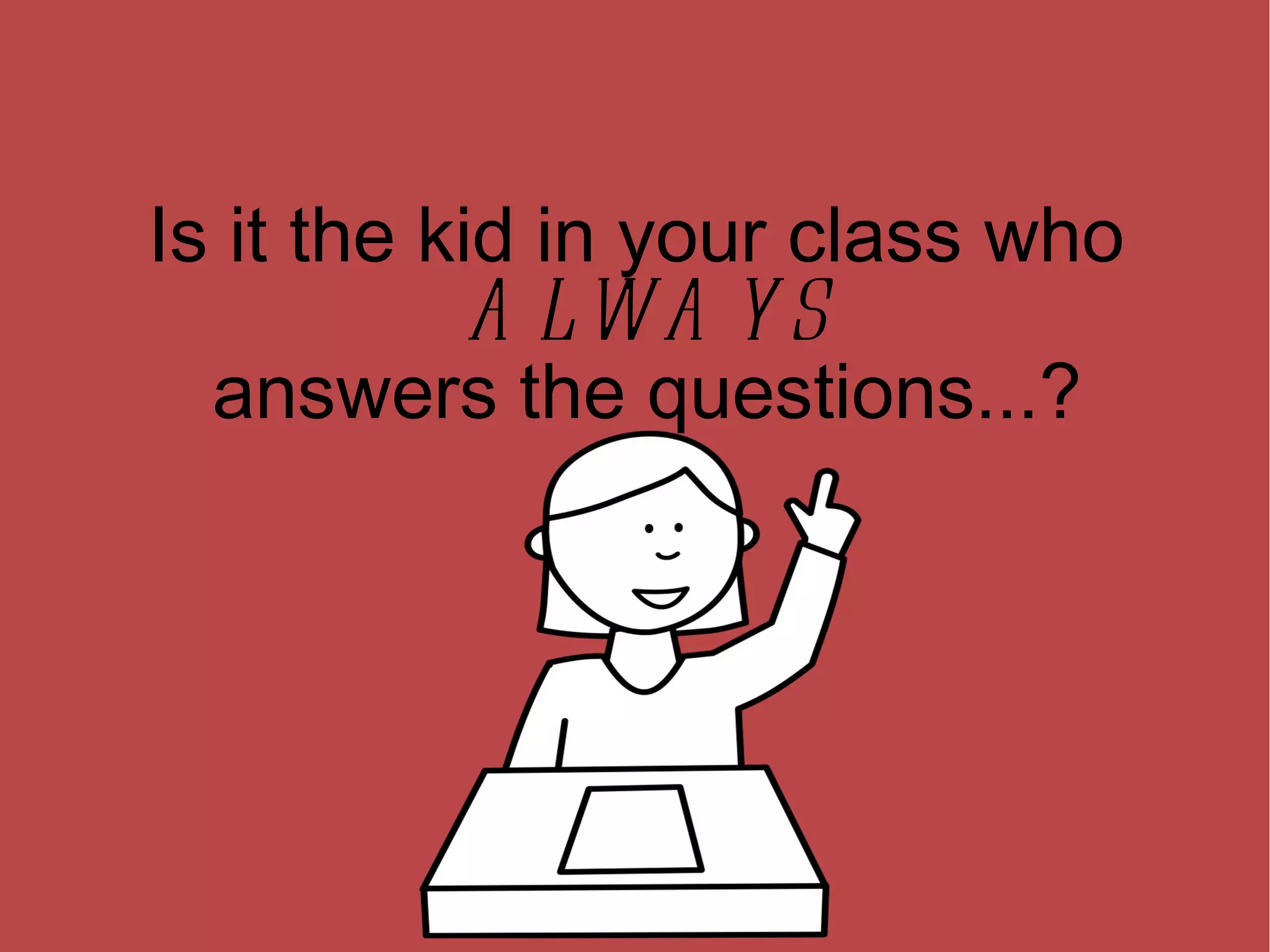
Is it the kid in your class who ALWAYS answers the questions...?
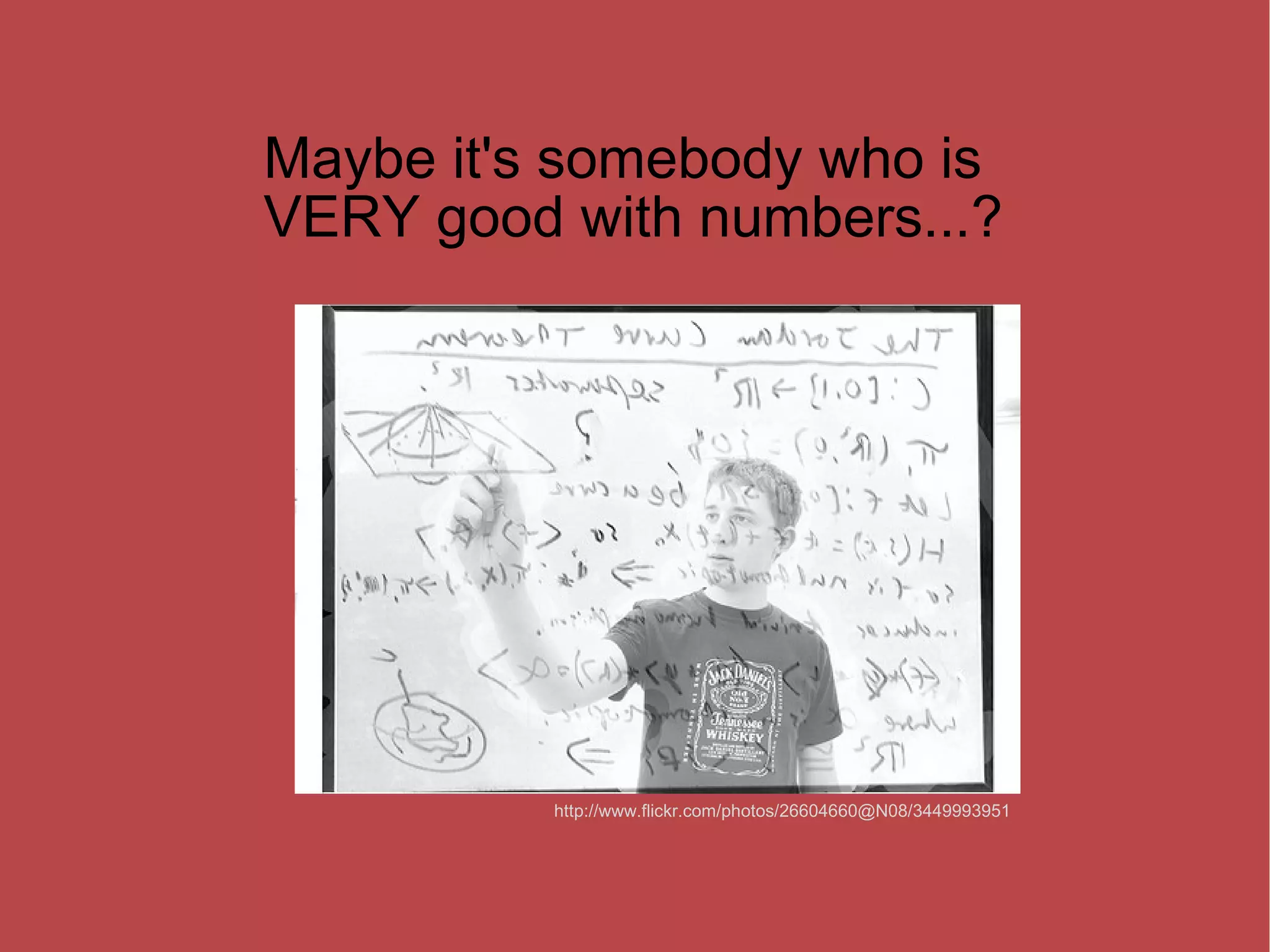
Maybe it's somebody who is VERY good with numbers...? http://www.flickr.com/photos/26604660@N08/3449993951
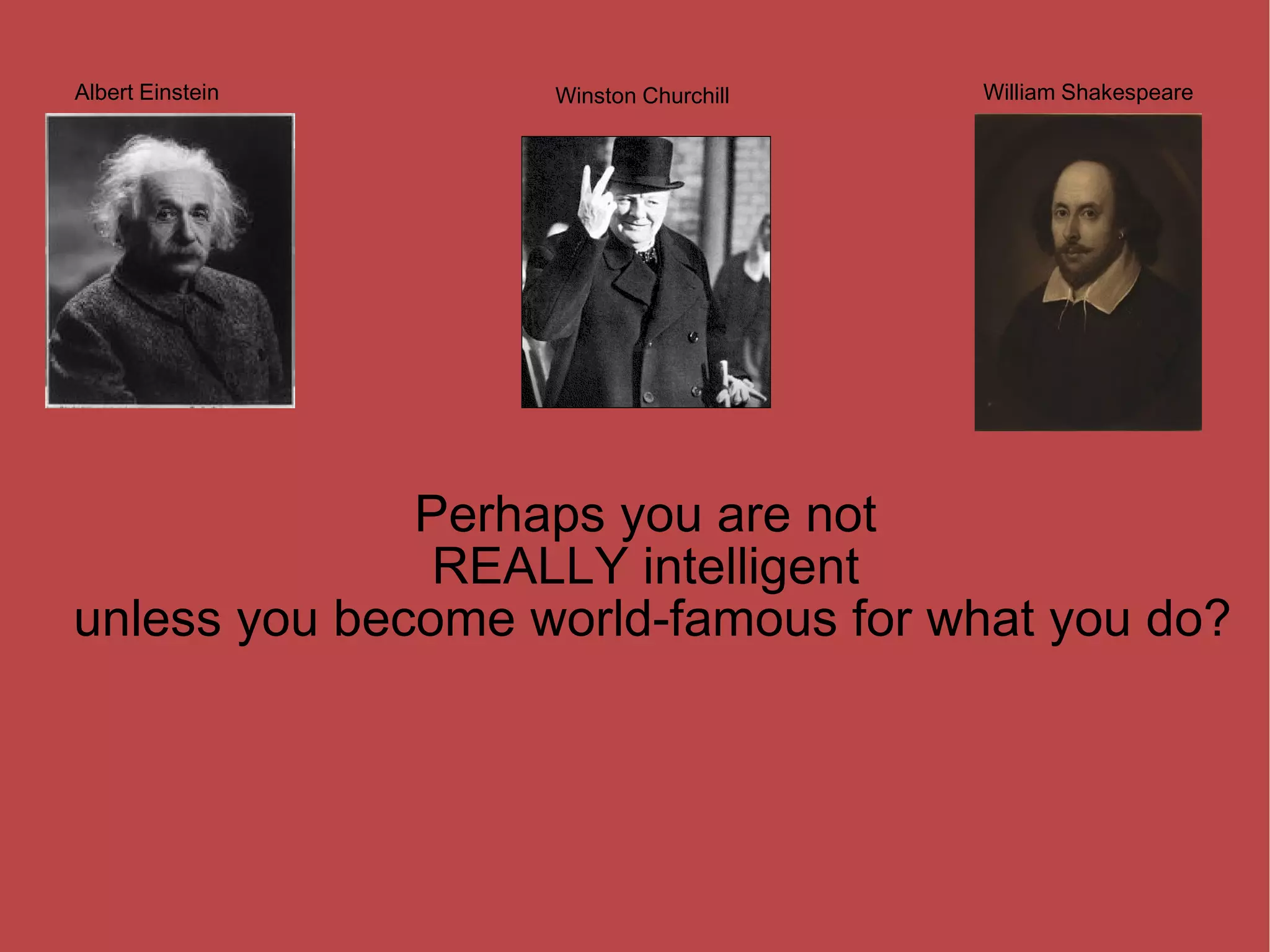
Perhaps you are not REALLY intelligent unless you become world-famous for what you do? Albert Einstein William Shakespeare Winston Churchill
And what was that IQ thing again???
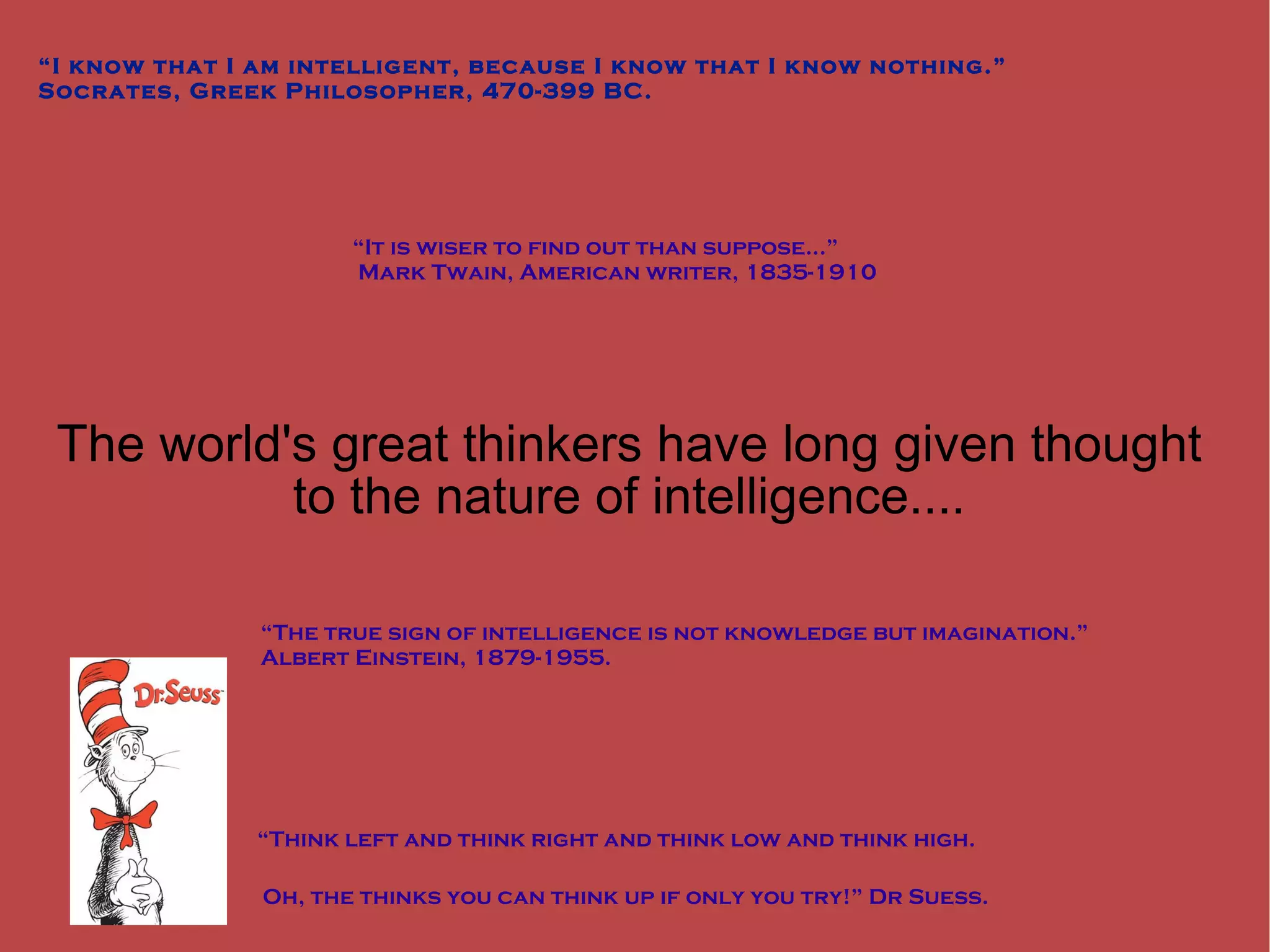
The world's great thinkers have long given thought to the nature of intelligence.... “ I know that I am intelligent, because I know that I know nothing.” Socrates, Greek Philosopher, 470-399 BC. “ It is wiser to find out than suppose...” Mark Twain, American writer, 1835-1910 “ Think left and think right and think low and think high. Oh, the thinks you can think up if only you try!” Dr Suess. “ The true sign of intelligence is not knowledge but imagination.” Albert Einstein, 1879-1955.
But today we recognise that there are many different ways to be intelligent.
In fact, there are   EIGHT .
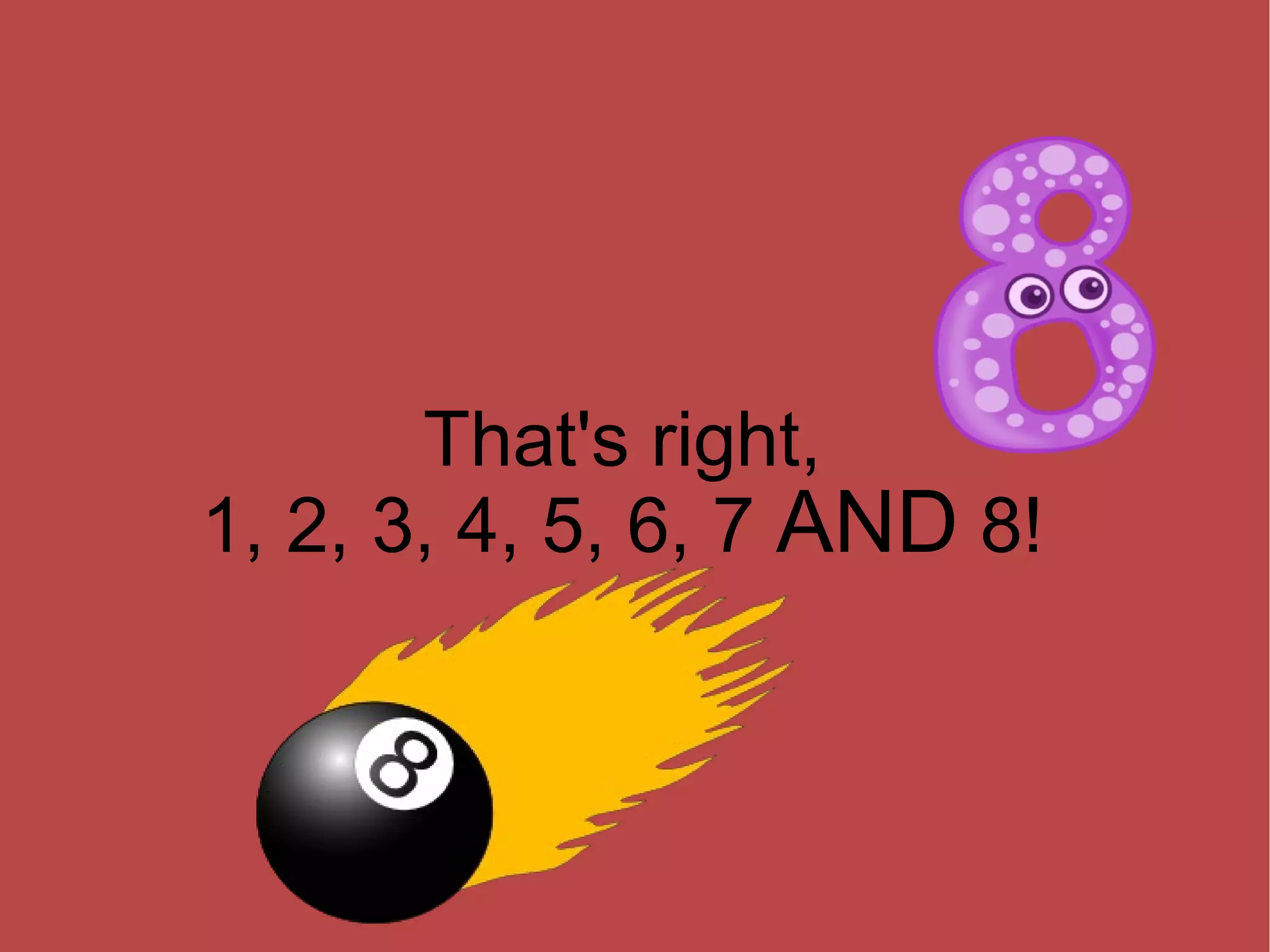
That's right, 1, 2, 3, 4, 5, 6, 7  AND  8!
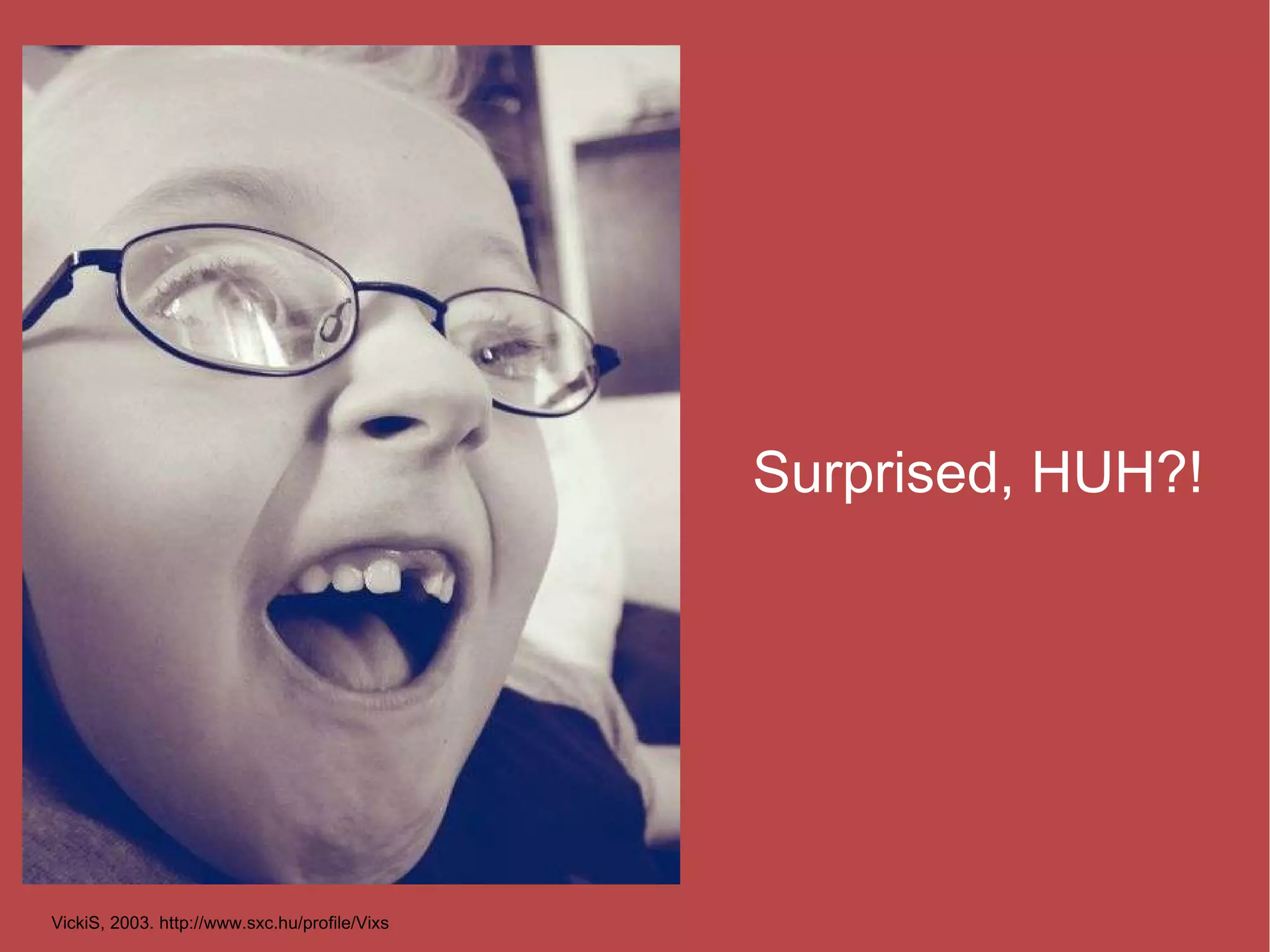
Surprised, HUH?! VickiS, 2003. http://www.sxc.hu/profile/Vixs
So what sort of  Super-smart capable bright brainy brilliant INTELLIGENT person are YOU?
Verbal-linguistic Learner Do you like reading? Writing stories? Speaking? Talking in front of people? Telling jokes? Arguing, debating and persuading others? Reading poetry?
Then you should try.... Taking notes while you listen Reading aloud to others Making written summaries of class notes Get information by reading, rather than viewing or listening Use a dictionary and thesaurus
Logical-mathematical learner Do you enjoy Maths and Science? Playing computer games? Playing games and puzzles that test your logic? Graphs and diagrams always make sense to you? Researching facts and figures? Estimating? Measuring? Predicting, analysing, calculating and assessing?
Then take advantage of this by.... When reading, predict what will happen next Use mind maps to summarise notes and readings Write your notes using bullet points, rather than sentences.
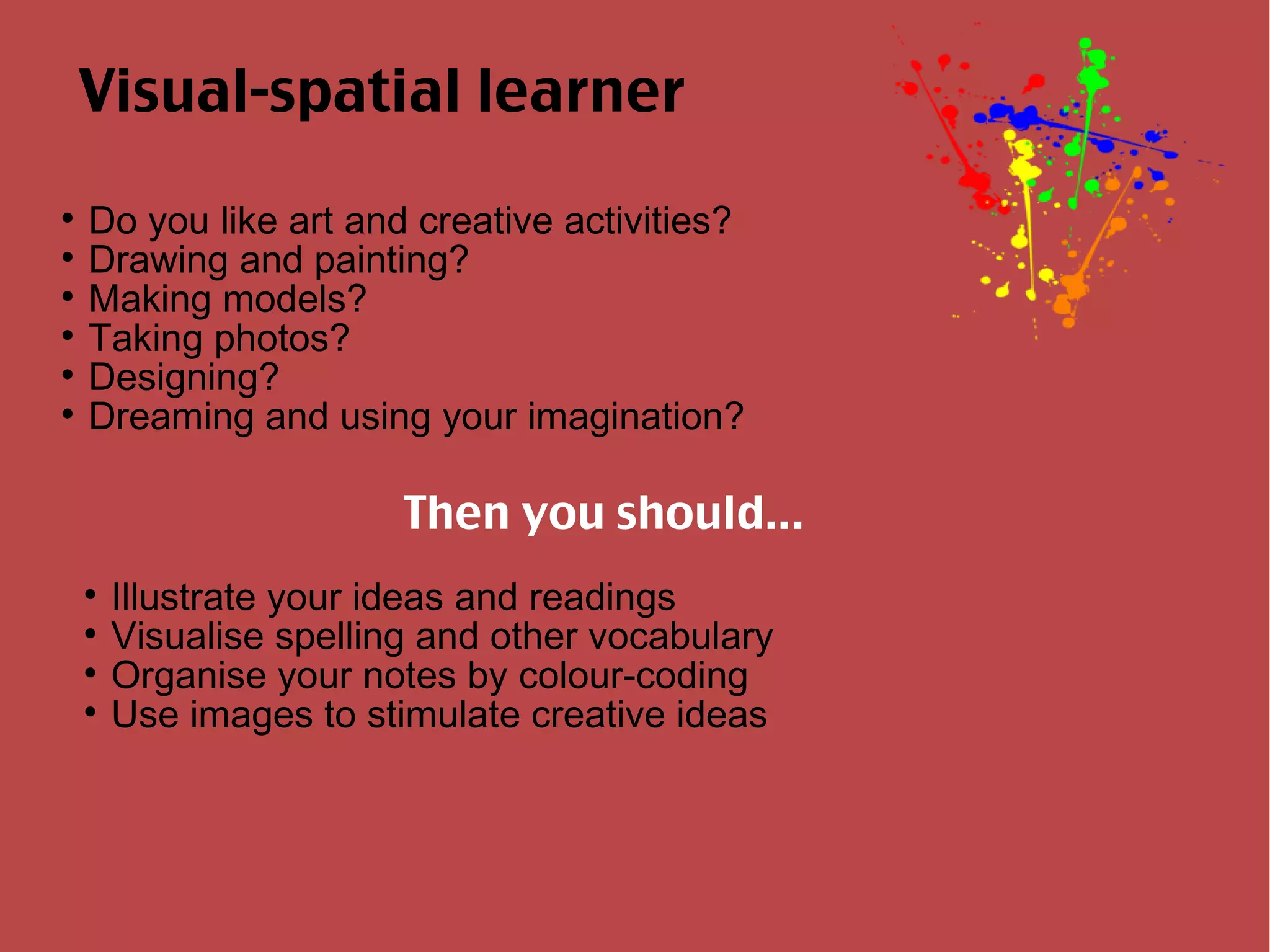
Visual-spatial learner Do you like art and creative activities? Drawing and painting? Making models? Taking photos? Designing? Dreaming and using your imagination? Then you should... Illustrate your ideas and readings Visualise spelling and other vocabulary Organise your notes by colour-coding Use images to stimulate creative ideas
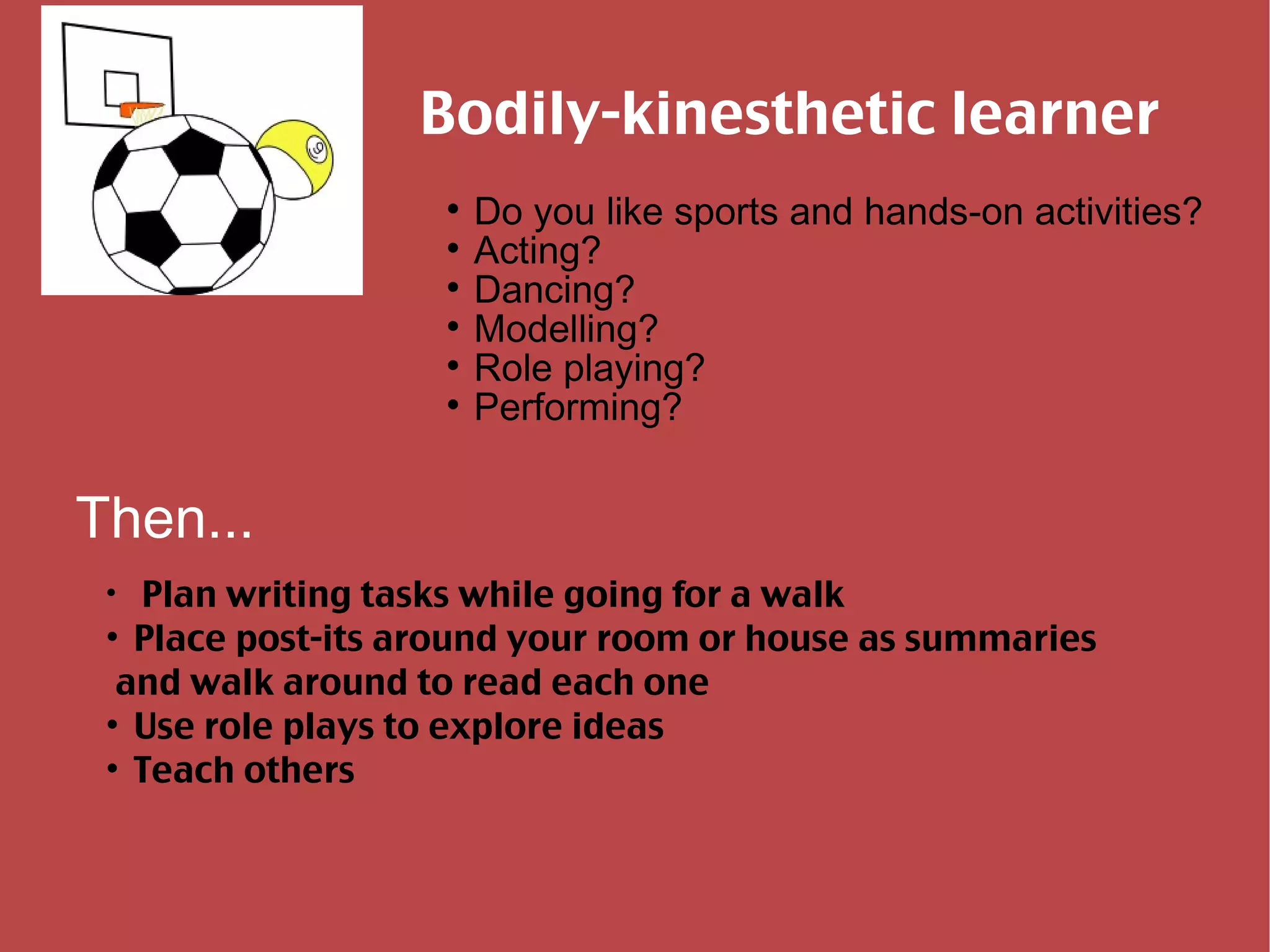
Bodily-kinesthetic learner Do you like sports and hands-on activities? Acting? Dancing? Modelling? Role playing? Performing? Then... Plan writing tasks while going for a walk Place post-its around your room or house as summaries and walk around to read each one Use role plays to explore ideas Teach others
Musical-rhythmic learner Do you like listening to music? Making music? Writing song lyrics? Humming? Playing a musical instrument? Tapping, clapping or dancing? Try... Making jingles or songs out of your study notes Listen to music while you study
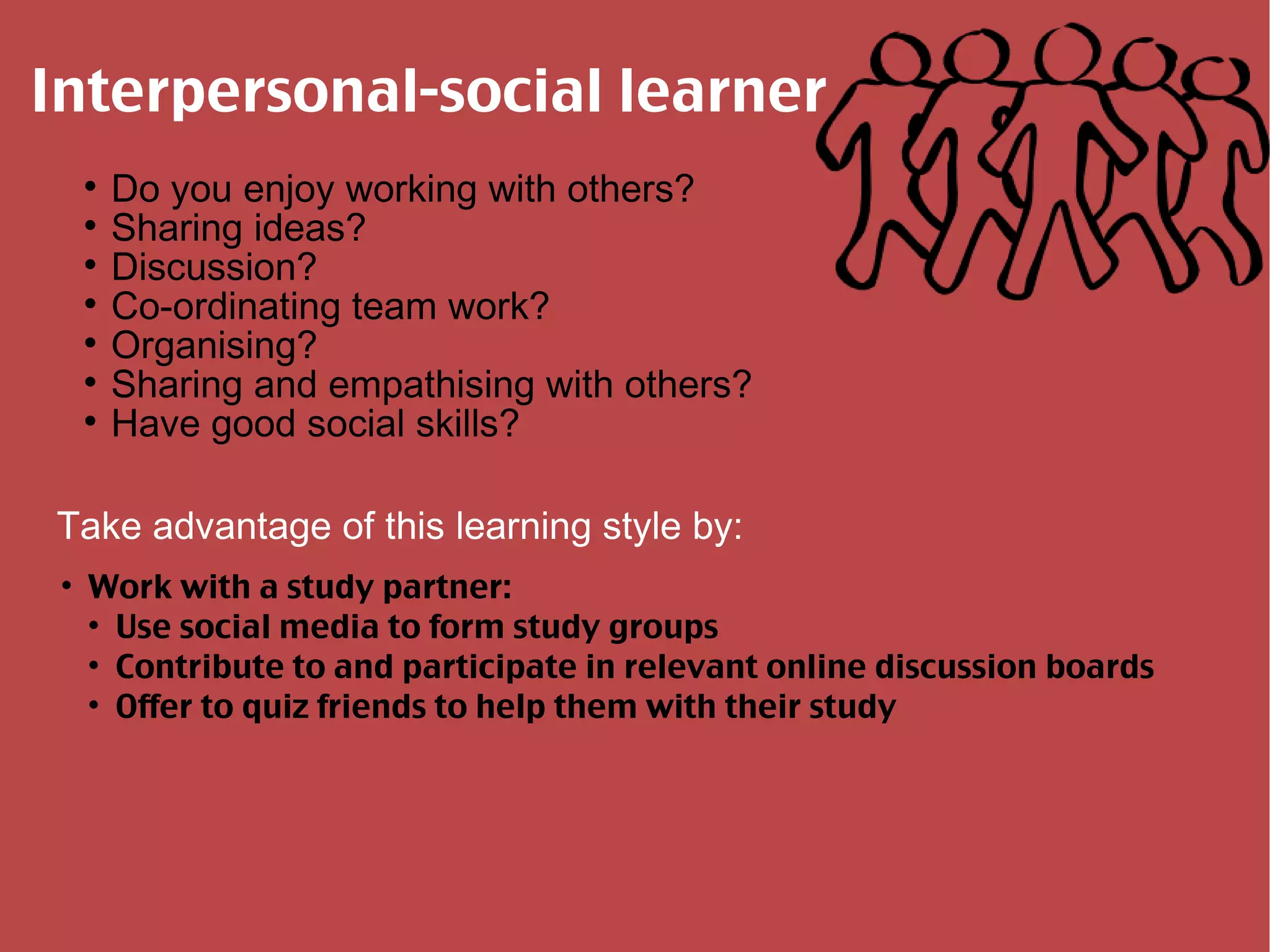
Interpersonal-social learner Do you enjoy working with others? Sharing ideas? Discussion? Co-ordinating team work? Organising? Sharing and empathising with others? Have good social skills? Take advantage of this learning style by: Work with a study partner: Use social media to form study groups Contribute to and participate in relevant online discussion boards Offer to quiz friends to help them with their study
Intrapersonal intuitive learner Do you prefer to work on your own? Like to spend time thinking and reflecting? Setting goals and working towards them? Enjoy writing personal stories including: Memoirs Anecdotes Diaries Journals? Then, make your learning more efficient by: Brainstorm writing and other tasks Keep a journal Allow time for reflection – avoid last minute deadlines Use the '4 W's and H' approach to thinking more deeply, What Where When Why How
Naturalist Learners Do you enjoy caring for plants and animals? Being outside? Camping? Gardening? Excursions? Observing? Collecting? Think about.... Using outdoor breaks to think tasks through
Want some more good news?
You can be more than ONE type of learning style? In fact, you will most likely have strengths in more than one of these areas.
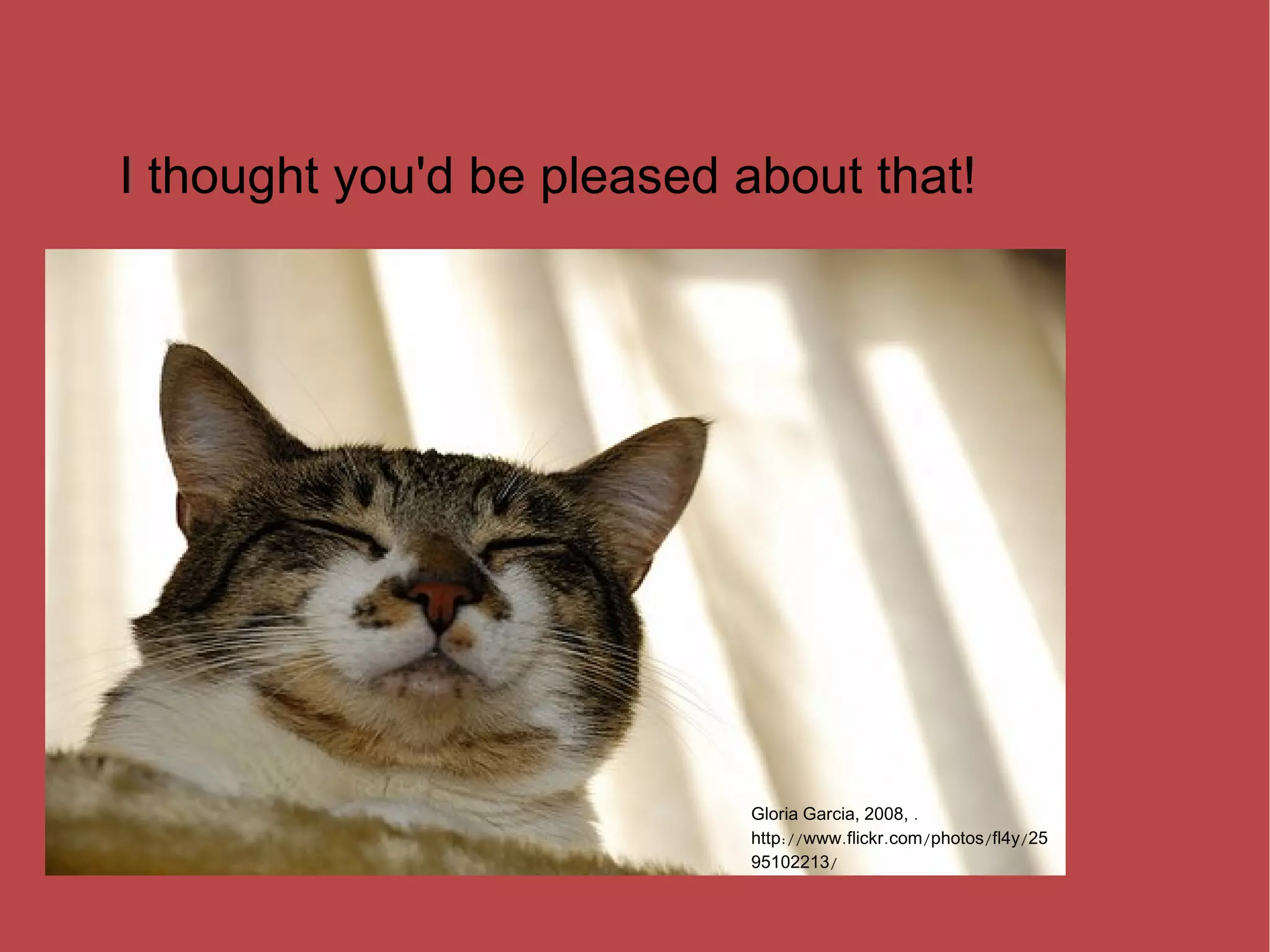
I thought you'd be pleased about that! Gloria Garcia, 2008, . http://www.flickr.com/photos/fl4y/2595102213/
So now it is up to you.... YOU are a smart, capable person, who is most definitely INTELLIGENT! Play to your strengths; be proud of who YOU are. Use YOUR preferred learning style to achieve success in school!
References : Pirozzo, R.  Improving Thinking in the Classroom , Harker Brownlow Education, 2005. Literacy Works website,  http://literacyworks.org/lw/home.html?flash , March 2011. IMAGES http://www.clker.com/ Public Domain Clip Art,  http://www.pdclipart.org/ Webweavers Free Clip Art,  http://www.webweaver.nu/clipart/ http://www.flickr.com/ Stock.XCHNG,  http://www.sxc.hu/

Learning styles presentation

  • 1.
    Learning YOUR WayThere's many ways to be intelligent..... By ReadWriteLearnWell
  • 2.
  • 3.
    Is it somebodywho wears glasses?
  • 4.
    Is it thekid in your class who ALWAYS answers the questions...?
  • 5.
    Maybe it's somebodywho is VERY good with numbers...? http://www.flickr.com/photos/26604660@N08/3449993951
  • 6.
    Perhaps you arenot REALLY intelligent unless you become world-famous for what you do? Albert Einstein William Shakespeare Winston Churchill
  • 7.
    And what wasthat IQ thing again???
  • 8.
    The world's greatthinkers have long given thought to the nature of intelligence.... “ I know that I am intelligent, because I know that I know nothing.” Socrates, Greek Philosopher, 470-399 BC. “ It is wiser to find out than suppose...” Mark Twain, American writer, 1835-1910 “ Think left and think right and think low and think high. Oh, the thinks you can think up if only you try!” Dr Suess. “ The true sign of intelligence is not knowledge but imagination.” Albert Einstein, 1879-1955.
  • 9.
    But today werecognise that there are many different ways to be intelligent.
  • 10.
    In fact, thereare EIGHT .
  • 11.
    That's right, 1,2, 3, 4, 5, 6, 7 AND 8!
  • 12.
    Surprised, HUH?! VickiS,2003. http://www.sxc.hu/profile/Vixs
  • 13.
    So what sortof Super-smart capable bright brainy brilliant INTELLIGENT person are YOU?
  • 14.
    Verbal-linguistic Learner Doyou like reading? Writing stories? Speaking? Talking in front of people? Telling jokes? Arguing, debating and persuading others? Reading poetry?
  • 15.
    Then you shouldtry.... Taking notes while you listen Reading aloud to others Making written summaries of class notes Get information by reading, rather than viewing or listening Use a dictionary and thesaurus
  • 16.
    Logical-mathematical learner Doyou enjoy Maths and Science? Playing computer games? Playing games and puzzles that test your logic? Graphs and diagrams always make sense to you? Researching facts and figures? Estimating? Measuring? Predicting, analysing, calculating and assessing?
  • 17.
    Then take advantageof this by.... When reading, predict what will happen next Use mind maps to summarise notes and readings Write your notes using bullet points, rather than sentences.
  • 18.
    Visual-spatial learner Doyou like art and creative activities? Drawing and painting? Making models? Taking photos? Designing? Dreaming and using your imagination? Then you should... Illustrate your ideas and readings Visualise spelling and other vocabulary Organise your notes by colour-coding Use images to stimulate creative ideas
  • 19.
    Bodily-kinesthetic learner Doyou like sports and hands-on activities? Acting? Dancing? Modelling? Role playing? Performing? Then... Plan writing tasks while going for a walk Place post-its around your room or house as summaries and walk around to read each one Use role plays to explore ideas Teach others
  • 20.
    Musical-rhythmic learner Doyou like listening to music? Making music? Writing song lyrics? Humming? Playing a musical instrument? Tapping, clapping or dancing? Try... Making jingles or songs out of your study notes Listen to music while you study
  • 21.
    Interpersonal-social learner Doyou enjoy working with others? Sharing ideas? Discussion? Co-ordinating team work? Organising? Sharing and empathising with others? Have good social skills? Take advantage of this learning style by: Work with a study partner: Use social media to form study groups Contribute to and participate in relevant online discussion boards Offer to quiz friends to help them with their study
  • 22.
    Intrapersonal intuitive learnerDo you prefer to work on your own? Like to spend time thinking and reflecting? Setting goals and working towards them? Enjoy writing personal stories including: Memoirs Anecdotes Diaries Journals? Then, make your learning more efficient by: Brainstorm writing and other tasks Keep a journal Allow time for reflection – avoid last minute deadlines Use the '4 W's and H' approach to thinking more deeply, What Where When Why How
  • 23.
    Naturalist Learners Doyou enjoy caring for plants and animals? Being outside? Camping? Gardening? Excursions? Observing? Collecting? Think about.... Using outdoor breaks to think tasks through
  • 24.
    Want some moregood news?
  • 25.
    You can bemore than ONE type of learning style? In fact, you will most likely have strengths in more than one of these areas.
  • 26.
    I thought you'dbe pleased about that! Gloria Garcia, 2008, . http://www.flickr.com/photos/fl4y/2595102213/
  • 27.
    So now itis up to you.... YOU are a smart, capable person, who is most definitely INTELLIGENT! Play to your strengths; be proud of who YOU are. Use YOUR preferred learning style to achieve success in school!
  • 28.
    References : Pirozzo,R. Improving Thinking in the Classroom , Harker Brownlow Education, 2005. Literacy Works website, http://literacyworks.org/lw/home.html?flash , March 2011. IMAGES http://www.clker.com/ Public Domain Clip Art, http://www.pdclipart.org/ Webweavers Free Clip Art, http://www.webweaver.nu/clipart/ http://www.flickr.com/ Stock.XCHNG, http://www.sxc.hu/