Y E S H I VA U N I V E R S I T Y
O F F I C E O F A C A D E M I C S U P P O RT
6 4 6 - 5 9 2 - 4 2 8 5
F U R S T H A L L 4 1 2
A C A D E M I C S U P P O RT. W I L F @ Y U . E D U
LEARNING STYLES
WHAT ARE LEARNING STYLES?
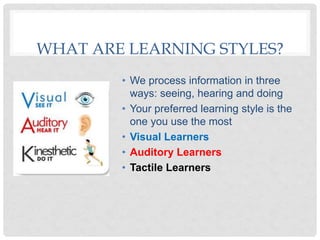
• We process information in three
ways: seeing, hearing and doing
• Your preferred learning style is the
one you use the most
• Visual Learners
• Auditory Learners
• Tactile Learners
VISUAL LEARNERS
• Prefer to see information such as graphics,
charts, and power-points
• Visualize what they hear
• Can become distracted in lectures when
visual aids are not used
VISUAL LEARNERS MAY BENEFIT
FROM:
 Visiting textbook on-line companion sites, bringing power
point presentations to class, and taking notes along side
them
 Reading the chapter ahead of time and taking notes
while reading
 Taking notes during class and revising them as soon as
possible after class
 Color coding main ideas and sub-topics
 Creating study aides such as note cards, drawing
diagrams, making charts
AUDITORY LEARNERS
• Prefer to hear information out loud
• Prefer lecture style classes
• May not need extensive notes
• May read aloud
AUDITORY LEARNERS MAY BENEFIT FROM:
• Lecture style class
• Study groups in order to hear others discuss concepts
• Taping lectures and listening to them after class
• Reading aloud
TACTILE OR KINESTHETIC
LEARNERS
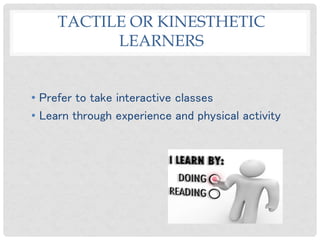
• Prefer to take interactive classes
• Learn through experience and physical activity
TACTILE OR KINESTHETIC LEARNERS
BENEFIT FROM:
• Creating charts, diagrams and graphs
• Taking notes
• Making flash cards
• Transcribing hand-written notes onto the computer
• Completing practice problems when applicable
• Participating in demonstrations such as labs and group
presentations
 Visual and tactile learners should take detailed notes during a
lecture
 Tactile learners may also benefit from rewriting/typing notes, or
making flashcards.
 Auditory learners who prefer lecture classes should work on
strengthening their visual and tactile skills by taking notes.
APPLYING YOUR PREFERRED LEARNING STYLE TO
LECTURE CLASSES
• Tactile and auditory learners may benefit by sitting in the
front of the class
• They should also take notes during the presentation, and
soon after class make additions to class notes
• Auditory learners may benefit from study groups to
reinforce information that was delivered through visual
presentations
• Tactile learners could recreate visuals as a way to connect
with new material
APPLYING YOUR PREFERRED LEARNING STYLE TO
VISUAL PRESENTATIONS
• Works well for tactile learners
• Visual and auditory learners can enhance their
abilities by taking notes on class procedures and
using lab time for additional practice
APPLYING YOUR PREFERRED LEARNING STYLE
TO LABS
BUILD YOUR SKILLS ACROSS THE LEARNING
STYLES
 Maximize your learning style
 Practice skills that do not come easily
to you
 Try new things and new ways to learn
 Use multiple modalities to enhance
learning
IF YOU WOULD LIKE TO LEARN MORE
ABOUT LEARNING STYLES…
Visit the Office of Academic Support
Furst Hall 412
646-592-4285
academicsupport.wilf@yu.edu
SOURCES
Hopper, Carolyn H. "7." Practicing College Learning Strategies.
Boston: Houghton Mifflin, 2004. N. Print.
Marks-Beale, Abby. "2." Success Skills: Strategies for Study and
Lifelong Learning. Mason, OH: Thomson South-Western, 2007. N.
McWhorter, Kathleen T. "2." College Reading and Study Skills.
Boston: Little, Brown, 1980. N. pag.

Learning_Styles 2.ppt

  • 1.
    Y E SH I VA U N I V E R S I T Y O F F I C E O F A C A D E M I C S U P P O RT 6 4 6 - 5 9 2 - 4 2 8 5 F U R S T H A L L 4 1 2 A C A D E M I C S U P P O RT. W I L F @ Y U . E D U LEARNING STYLES
  • 2.
    WHAT ARE LEARNINGSTYLES? • We process information in three ways: seeing, hearing and doing • Your preferred learning style is the one you use the most • Visual Learners • Auditory Learners • Tactile Learners
  • 3.
    VISUAL LEARNERS • Preferto see information such as graphics, charts, and power-points • Visualize what they hear • Can become distracted in lectures when visual aids are not used
  • 4.
    VISUAL LEARNERS MAYBENEFIT FROM:  Visiting textbook on-line companion sites, bringing power point presentations to class, and taking notes along side them  Reading the chapter ahead of time and taking notes while reading  Taking notes during class and revising them as soon as possible after class  Color coding main ideas and sub-topics  Creating study aides such as note cards, drawing diagrams, making charts
  • 5.
    AUDITORY LEARNERS • Preferto hear information out loud • Prefer lecture style classes • May not need extensive notes • May read aloud
  • 6.
    AUDITORY LEARNERS MAYBENEFIT FROM: • Lecture style class • Study groups in order to hear others discuss concepts • Taping lectures and listening to them after class • Reading aloud
  • 7.
    TACTILE OR KINESTHETIC LEARNERS •Prefer to take interactive classes • Learn through experience and physical activity
  • 8.
    TACTILE OR KINESTHETICLEARNERS BENEFIT FROM: • Creating charts, diagrams and graphs • Taking notes • Making flash cards • Transcribing hand-written notes onto the computer • Completing practice problems when applicable • Participating in demonstrations such as labs and group presentations
  • 9.
     Visual andtactile learners should take detailed notes during a lecture  Tactile learners may also benefit from rewriting/typing notes, or making flashcards.  Auditory learners who prefer lecture classes should work on strengthening their visual and tactile skills by taking notes. APPLYING YOUR PREFERRED LEARNING STYLE TO LECTURE CLASSES
  • 10.
    • Tactile andauditory learners may benefit by sitting in the front of the class • They should also take notes during the presentation, and soon after class make additions to class notes • Auditory learners may benefit from study groups to reinforce information that was delivered through visual presentations • Tactile learners could recreate visuals as a way to connect with new material APPLYING YOUR PREFERRED LEARNING STYLE TO VISUAL PRESENTATIONS
  • 11.
    • Works wellfor tactile learners • Visual and auditory learners can enhance their abilities by taking notes on class procedures and using lab time for additional practice APPLYING YOUR PREFERRED LEARNING STYLE TO LABS
  • 12.
    BUILD YOUR SKILLSACROSS THE LEARNING STYLES  Maximize your learning style  Practice skills that do not come easily to you  Try new things and new ways to learn  Use multiple modalities to enhance learning
  • 13.
    IF YOU WOULDLIKE TO LEARN MORE ABOUT LEARNING STYLES… Visit the Office of Academic Support Furst Hall 412 646-592-4285 academicsupport.wilf@yu.edu
  • 14.
    SOURCES Hopper, Carolyn H."7." Practicing College Learning Strategies. Boston: Houghton Mifflin, 2004. N. Print. Marks-Beale, Abby. "2." Success Skills: Strategies for Study and Lifelong Learning. Mason, OH: Thomson South-Western, 2007. N. McWhorter, Kathleen T. "2." College Reading and Study Skills. Boston: Little, Brown, 1980. N. pag.