Lean Thinking for Marketing
Building a customer centric organisation
Lean Thinking for Marketing
Apply LeanThinking to eliminate waste in sales & marketing and
continuously add value to customers
Lean Thinking for Marketing
Waste adds cost and adding cost that does not add any value will
lead to higher price and lower profits
Our world continues to change!
Complexity is increasing
Big data
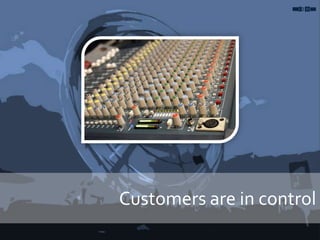
Customers are in control
Research among hundred American
managers who suffer from the
recession shows that 61 percent of
them never involves customers when in
trouble.While the solution lies with the
customer.
Lisa Nirell
Digital darwinism
Mass marketing is dead
Interuption versus engagement
Creating a sustainable business –
true competitive advantage
Stop wasting my time
We need to reengineer companies to
focus on figuring out who the customer
is, what's the market and what kind of
product we should build
Eric Ries
Contrast
90% of all work is drudge work
Working with the same old gang
Well defined organizational borders
Products last for years
Technology helps link parts of the organization
We are proud of being close to our customer
We sell rigorously engineered "great product"
Procedure centric
Passive: performs tasks as requested
"Silos & Stovepipes"
Product or Service
It works
I'm glad I bought it
Satisfied customer
Agrees with your wallet
You get what you pay for
Microprocessors do most drudge work
Constantly expanding one's network of teammates
Shifting organizational alliances
Products last for weeks
The network is the organization
We are proudly "at one" with our customer
We sell information-enabled "awesome experiences"
Client centric
Active: createsWOW projects as inspired
One seamless enterprise
Experience
It leaves an indelible memory
I want more!
Member of the Club
Agrees with your psyche
You are surprised and delighted at every turn
WAS IS
The 7 challenges marketing is facing today
Challenge 7: increaseAGILITY, be more FLUID & RESPONSIVE
Challenge 6: CUSTOMER centricity
Challenge 5: RESULTS driven (accountable)
Challenge 4: little or no DIFFERENTIATION
Challenge 3: SILO’d approach & LONG planning cycles
Challenge 2: COLLABORATION
Challenge 1: we build something NOBODY wanted
Note: all are equally important!
Writing a marketing- or business plan is
a waste of time.The chance that your
original plan survives first contact with
your customer is very small
Alexander Osterwalder
What is Lean?
From mass production To just in time
Conventional wisdom
How it is done traditionally
Business plan Great men theory Waterfall
Sell as hard as we
can
Linear process
• We know
• We have the expertise
• We have the experience
• We understand
• We can help
• We have the knowledge
• Traditional product
development
Failure is an issue
Lean principles
The five-step thought process for guiding the implementation of lean
techniques:
1. Specify value from the standpoint of the end customer by product
family.
2. Identify all the steps in the value stream for each product
family, eliminating whenever possible those steps that do not
create value.
3. Make the value-creating steps occur in tight sequence so the
product will flow smoothly toward the customer.
4. As flow is introduced, let customers pull value from the next
upstream activity.
5. As value is specified, value streams are identified, wasted steps are
removed, and flow and pull are introduced, begin the process again
and continue it until a state of perfection is reached in which
perfect value is created with no waste.
1. identify
value
2. map the
value
stream
3. create
flow
4.establish
pull
5. seek
perfection
Lean steps:
easy to remember not always easy to achieve!
Learnings fromToyota – “theToyota way”
• Customer focused
• People – centered
• Safety Quality DeliveryCost Morale
• Process oriented
Accountability
• Daily, Weekly, Monthly checks
• Total involvement
Urgency
• Escalation System
• Speed of response
Leadership
• Zone control
• Teams
Standard work
• 5S &
• Job Instruction
• Visual Management
Stability
• 4 M
• Deman & Volume (Heijunka)
• Long term philosophy
Kaizen
• GO see
• PDCA
• 7 waste
Just in time
• Takt time
• One piece flow
• Downstream pull
SMED
Kanban
3P
Jidoka
• Build in quality
• Harmony of
human & machine
Stop the line
5 why
Pokayoke
Thinking
• How to think – 12 paradigms
• Reflection – face the facts
• Ideas – creativity & craft
The philosophy behind “theToyota way”
Customers first
The complete
elimination of all
waste
Testing is part of
our DNA
Continuous
improvement
Why Lean is changing everything
We life in a world of extreme uncertainty
DifferencesLeanandtraditionalsystem
Lean approach Traditional System approach
Strategy
• Business model
• Hypothesis driven
• Business plan
• Implementation driven
New product process
• Customer development
• Get out of the office and test hypothesis
• Product management
• Prepare offering for market following a linear step
by step plan
Engineering
• Agile & Scrum development
• Build the product iteratively and incrementally
• Agile & Waterfall development
• Build the product iteratively or fully specify the
product before building it
Organization
• Podular organization customer focused
• Hire for learning, nimbleness and speed
• Departments by function
• Hire for experience and ability to execute
Financial reporting
• Metrics that matter
• Customer acquisition cost, lifetime customer value,
churn, viralness, share of wallet
• Accounting
• Income statement, balance sheet, cash flow
statement
Failure
• Expected
• Fixed by iterating on ideas and pivoting away from
ones that don’t work
• Exception
• Fix by firing executives
Speed
• Rapid
• Operates on good enough data
• “calculated risk”
• Measured
• Operates on complete data
• “risk averse”
Lean favors
Experimentation
Customer feedback
Iterative design & developement
over
over
over
Elaborate planning
Intuition
Tradtional “Waterfall” development
LeanThinking for Marketing
Key is to start listening, reduce
complexity, be less fragmented, and be more
relevant
Marketing today
To much fluff in a 4D
enterprise matrix
organisation!
Different channels
Online
Business 2
Business (B2B)
Direct
In-direct
Business 2
Consumer (B2C)
People 2 People
(peer 2 peer networks)
Different target audiences
For decades we have been bucketing people using
generational classifications
End of demographics!We need to understand
people.Their interests, behaviors, beliefs and values
always trump demographics.
Using different data:
• Social profile data
• Behavioral data
• Customer life cycle data
Different roles (the modern marketer)
Business
Creative
Performance
Social
• Written content
• Visual assets
• Video
• Social Media
• Viral marketing
• Storytelling
• Tracking & Monitoring
• Operations
• Analytics
• Data management
• Technology usage & procurement
• Marketing automation
• Sharing
• Character
• Personal
• Authentic
• Social
• Engaging
• Leadership
• Strategy
• Commercial
• Entrepreneurship
• Business Development
• Business model
Different objectives (purpose of marketing)
Proposition &
Portfolio
Development
Customer
Experience
Customer
Retention
LeadGeneration
& Nurturing
Positioning
Customer
Acquisition
Channel Synergy
& Readiness
Different marketing activities & media (mix)
Content
Marketing
Online & Email
Marketing
Event
Marketing
Social Media
Marketing
Mobile
Marketing
Print Radio
TV
Direct Mail
LeanThinking for Marketing
From working in silo’s to integrated marketing
Marketing working in silo’s Integrated marketing
Channels
Audience
Roles
Objectives
Activities&Media
Linear thinking and to much focus on planning
Linear process
Idea
Launch
Data
Learn
Pivot
Measure Build
MVR*
Continuous process
Customer
* MVR = Minimal Viable Requirement (product or activity)
Customer
JUST DO IT!
Where to apply Lean thinking?
• Create and share
meaningful and relevant
information to attract and
retain customers
• Start a dialogue, fuel your
conversations and be
more engaging
• Create new opportunities
for up-, deep-, and cross
selling
• Deliver exactly what
customers want for a price
they will pay
Proposition &
Portfolio
Development
Lead Generation &
Lead Nurturing
• Reduce time 2 market
• Collect better feedback
faster
• Increase agilty within your
organisation
• Connect the inside and
outside world
• Better and faster decision
making
• Improved business case and
better ROI
• Treat customers as life time
partners
• Co-create the next
proposition
Because these two
processes are better
aligned and joined up
this will lead to:
• Better qualified
leads
• Improve share of
wallet
• Shortening lead
times
• Improve win rates
• Improve margin
And in the end you will
build trust, loyalty, and
long term strategic
relationships
LeanThinking will lead to more responsive
marketing?
An agile and adaptive mentality is badly
needed in the marketing arm of
organizations—one that is less dependent on
historical data to make decisions and is
inclined to parse data inputs as they come in
daily
David Armano
Foundation & critical succes factors
• Cross border virtual collaboration
• Social business
• Highly connective people
• Organizing for agility
• Leadership
• Data driven marketing
Cross border virtual collaboration
Empower people to engage & participate
The inside world The outside world
Social Business
Social the fabric that links your whole
organization?
Connected Collaboration Customised Conversations
Community Collective Content
Highly Connective People
People make a difference (DNA)
• Think knowledge as a service
• Take risks & have a point of view
• Keep their promises and never over promise
• Say it another way & write it down
• Show it – demonstrating works better
• Connect actively
• Let them know you thought of them
• Be present to opportunities
• Think beyond their closed circle
• Talk “partnerships”
• Wire the organisation internal and external
Organizing for Agility
Podular organization
• Working in the open by default
• From sharing to collaboration
• Creation of boundaryless tribalism
• Create a network of linchpins (gamechangers)
• Small agile virtual autonomous teams, self managed
• Leadership – practice hostmanship
• Self assembling dynamic networks
• Rapid scaling
Leadership
Enable people to
do more
Give up control
Respect the real
power shift
Master
transparency
Reach out to
customers
Share
Use social
technologies
Learn, relearn &
unlearn
Listen actively
Develop a flat &
open
organisation
Practice
hostmanship
Make mistakes
and admit when
you are wrong
Data driven marketing
Actionable intelligence & insight
• Customer data
• End user data (usage)
• Service data
• Social Media
• DMU
• Buyer journey & Buyer persona’s
• Customer maturity
• Sentiment
• Behaviour
• Web harvesting &Web mining
Research reports
are
rear view mirrors
A special thank you:
In order for me to develop this manifest I have used knowledge, experiences, and
information from other professionals.Thanks for all the inspiration!
David Armano - @armano
Lisa Nirell - @lisa_nirell
Eric Ries - @ericries
Alexander Osterwalder - @alexanderosterw
Brian Solis - @briansolis
Tom Peters - @tom_peters
Steven Blank - @sgblank
Toyota – www.toyota-global.com
Key wording “theToyota way”
Heijunka – production smoothing
Jidoka – automation with human intelligence
Kaizen – continiuous improvement
Kanban – sign, index card
Pokayoka – fail safing, avoid errors
Genchi Genbutsu - go to the source to find the facts to make correct
decisions
Takt time - work time between two consecutive units
The photos were found on
Alex de Carvalho - @alexdc
Sarah Joy - @RanPanda
Johan Larsson - @kottkrig
Bex Ross
KenTeegardin
Jon Candy - @jonrcandy
Please contact me to continue the discussion:
jacspierings@gmail.com
www.twitter.com/jeroenspierings
www.linkedin.com/in/jeroenspierings
www.jeroenspierings.nl

Lean Thinking for Marketing

  • 1.
    Lean Thinking forMarketing Building a customer centric organisation
  • 2.
    Lean Thinking forMarketing Apply LeanThinking to eliminate waste in sales & marketing and continuously add value to customers
  • 3.
    Lean Thinking forMarketing Waste adds cost and adding cost that does not add any value will lead to higher price and lower profits
  • 4.
  • 5.
  • 6.
  • 7.
  • 8.
    Research among hundredAmerican managers who suffer from the recession shows that 61 percent of them never involves customers when in trouble.While the solution lies with the customer. Lisa Nirell
  • 9.
  • 10.
  • 11.
  • 12.
    Creating a sustainablebusiness – true competitive advantage
  • 13.
  • 14.
    We need toreengineer companies to focus on figuring out who the customer is, what's the market and what kind of product we should build Eric Ries
  • 15.
    Contrast 90% of allwork is drudge work Working with the same old gang Well defined organizational borders Products last for years Technology helps link parts of the organization We are proud of being close to our customer We sell rigorously engineered "great product" Procedure centric Passive: performs tasks as requested "Silos & Stovepipes" Product or Service It works I'm glad I bought it Satisfied customer Agrees with your wallet You get what you pay for Microprocessors do most drudge work Constantly expanding one's network of teammates Shifting organizational alliances Products last for weeks The network is the organization We are proudly "at one" with our customer We sell information-enabled "awesome experiences" Client centric Active: createsWOW projects as inspired One seamless enterprise Experience It leaves an indelible memory I want more! Member of the Club Agrees with your psyche You are surprised and delighted at every turn WAS IS
  • 16.
    The 7 challengesmarketing is facing today
  • 17.
    Challenge 7: increaseAGILITY,be more FLUID & RESPONSIVE Challenge 6: CUSTOMER centricity Challenge 5: RESULTS driven (accountable) Challenge 4: little or no DIFFERENTIATION Challenge 3: SILO’d approach & LONG planning cycles Challenge 2: COLLABORATION Challenge 1: we build something NOBODY wanted Note: all are equally important!
  • 18.
    Writing a marketing-or business plan is a waste of time.The chance that your original plan survives first contact with your customer is very small Alexander Osterwalder
  • 19.
    What is Lean? Frommass production To just in time
  • 20.
    Conventional wisdom How itis done traditionally Business plan Great men theory Waterfall Sell as hard as we can Linear process • We know • We have the expertise • We have the experience • We understand • We can help • We have the knowledge • Traditional product development Failure is an issue
  • 21.
    Lean principles The five-stepthought process for guiding the implementation of lean techniques: 1. Specify value from the standpoint of the end customer by product family. 2. Identify all the steps in the value stream for each product family, eliminating whenever possible those steps that do not create value. 3. Make the value-creating steps occur in tight sequence so the product will flow smoothly toward the customer. 4. As flow is introduced, let customers pull value from the next upstream activity. 5. As value is specified, value streams are identified, wasted steps are removed, and flow and pull are introduced, begin the process again and continue it until a state of perfection is reached in which perfect value is created with no waste.
  • 22.
    1. identify value 2. mapthe value stream 3. create flow 4.establish pull 5. seek perfection Lean steps: easy to remember not always easy to achieve!
  • 23.
    Learnings fromToyota –“theToyota way” • Customer focused • People – centered • Safety Quality DeliveryCost Morale • Process oriented Accountability • Daily, Weekly, Monthly checks • Total involvement Urgency • Escalation System • Speed of response Leadership • Zone control • Teams Standard work • 5S & • Job Instruction • Visual Management Stability • 4 M • Deman & Volume (Heijunka) • Long term philosophy Kaizen • GO see • PDCA • 7 waste Just in time • Takt time • One piece flow • Downstream pull SMED Kanban 3P Jidoka • Build in quality • Harmony of human & machine Stop the line 5 why Pokayoke Thinking • How to think – 12 paradigms • Reflection – face the facts • Ideas – creativity & craft
  • 24.
    The philosophy behind“theToyota way” Customers first The complete elimination of all waste Testing is part of our DNA Continuous improvement
  • 25.
    Why Lean ischanging everything We life in a world of extreme uncertainty
  • 26.
    DifferencesLeanandtraditionalsystem Lean approach TraditionalSystem approach Strategy • Business model • Hypothesis driven • Business plan • Implementation driven New product process • Customer development • Get out of the office and test hypothesis • Product management • Prepare offering for market following a linear step by step plan Engineering • Agile & Scrum development • Build the product iteratively and incrementally • Agile & Waterfall development • Build the product iteratively or fully specify the product before building it Organization • Podular organization customer focused • Hire for learning, nimbleness and speed • Departments by function • Hire for experience and ability to execute Financial reporting • Metrics that matter • Customer acquisition cost, lifetime customer value, churn, viralness, share of wallet • Accounting • Income statement, balance sheet, cash flow statement Failure • Expected • Fixed by iterating on ideas and pivoting away from ones that don’t work • Exception • Fix by firing executives Speed • Rapid • Operates on good enough data • “calculated risk” • Measured • Operates on complete data • “risk averse”
  • 27.
    Lean favors Experimentation Customer feedback Iterativedesign & developement over over over Elaborate planning Intuition Tradtional “Waterfall” development
  • 28.
    LeanThinking for Marketing Keyis to start listening, reduce complexity, be less fragmented, and be more relevant
  • 29.
    Marketing today To muchfluff in a 4D enterprise matrix organisation!
  • 30.
    Different channels Online Business 2 Business(B2B) Direct In-direct Business 2 Consumer (B2C) People 2 People (peer 2 peer networks)
  • 31.
    Different target audiences Fordecades we have been bucketing people using generational classifications End of demographics!We need to understand people.Their interests, behaviors, beliefs and values always trump demographics. Using different data: • Social profile data • Behavioral data • Customer life cycle data
  • 32.
    Different roles (themodern marketer) Business Creative Performance Social • Written content • Visual assets • Video • Social Media • Viral marketing • Storytelling • Tracking & Monitoring • Operations • Analytics • Data management • Technology usage & procurement • Marketing automation • Sharing • Character • Personal • Authentic • Social • Engaging • Leadership • Strategy • Commercial • Entrepreneurship • Business Development • Business model
  • 33.
    Different objectives (purposeof marketing) Proposition & Portfolio Development Customer Experience Customer Retention LeadGeneration & Nurturing Positioning Customer Acquisition Channel Synergy & Readiness
  • 34.
    Different marketing activities& media (mix) Content Marketing Online & Email Marketing Event Marketing Social Media Marketing Mobile Marketing Print Radio TV Direct Mail
  • 35.
    LeanThinking for Marketing Fromworking in silo’s to integrated marketing
  • 36.
    Marketing working insilo’s Integrated marketing Channels Audience Roles Objectives Activities&Media Linear thinking and to much focus on planning Linear process Idea Launch Data Learn Pivot Measure Build MVR* Continuous process Customer * MVR = Minimal Viable Requirement (product or activity) Customer JUST DO IT!
  • 37.
    Where to applyLean thinking? • Create and share meaningful and relevant information to attract and retain customers • Start a dialogue, fuel your conversations and be more engaging • Create new opportunities for up-, deep-, and cross selling • Deliver exactly what customers want for a price they will pay Proposition & Portfolio Development Lead Generation & Lead Nurturing • Reduce time 2 market • Collect better feedback faster • Increase agilty within your organisation • Connect the inside and outside world • Better and faster decision making • Improved business case and better ROI • Treat customers as life time partners • Co-create the next proposition Because these two processes are better aligned and joined up this will lead to: • Better qualified leads • Improve share of wallet • Shortening lead times • Improve win rates • Improve margin And in the end you will build trust, loyalty, and long term strategic relationships
  • 38.
    LeanThinking will leadto more responsive marketing? An agile and adaptive mentality is badly needed in the marketing arm of organizations—one that is less dependent on historical data to make decisions and is inclined to parse data inputs as they come in daily David Armano
  • 39.
    Foundation & criticalsucces factors • Cross border virtual collaboration • Social business • Highly connective people • Organizing for agility • Leadership • Data driven marketing
  • 40.
    Cross border virtualcollaboration Empower people to engage & participate The inside world The outside world
  • 41.
    Social Business Social thefabric that links your whole organization? Connected Collaboration Customised Conversations Community Collective Content
  • 42.
    Highly Connective People Peoplemake a difference (DNA) • Think knowledge as a service • Take risks & have a point of view • Keep their promises and never over promise • Say it another way & write it down • Show it – demonstrating works better • Connect actively • Let them know you thought of them • Be present to opportunities • Think beyond their closed circle • Talk “partnerships” • Wire the organisation internal and external
  • 43.
    Organizing for Agility Podularorganization • Working in the open by default • From sharing to collaboration • Creation of boundaryless tribalism • Create a network of linchpins (gamechangers) • Small agile virtual autonomous teams, self managed • Leadership – practice hostmanship • Self assembling dynamic networks • Rapid scaling
  • 44.
    Leadership Enable people to domore Give up control Respect the real power shift Master transparency Reach out to customers Share Use social technologies Learn, relearn & unlearn Listen actively Develop a flat & open organisation Practice hostmanship Make mistakes and admit when you are wrong
  • 45.
    Data driven marketing Actionableintelligence & insight • Customer data • End user data (usage) • Service data • Social Media • DMU • Buyer journey & Buyer persona’s • Customer maturity • Sentiment • Behaviour • Web harvesting &Web mining Research reports are rear view mirrors
  • 46.
    A special thankyou: In order for me to develop this manifest I have used knowledge, experiences, and information from other professionals.Thanks for all the inspiration! David Armano - @armano Lisa Nirell - @lisa_nirell Eric Ries - @ericries Alexander Osterwalder - @alexanderosterw Brian Solis - @briansolis Tom Peters - @tom_peters Steven Blank - @sgblank Toyota – www.toyota-global.com
  • 47.
    Key wording “theToyotaway” Heijunka – production smoothing Jidoka – automation with human intelligence Kaizen – continiuous improvement Kanban – sign, index card Pokayoka – fail safing, avoid errors Genchi Genbutsu - go to the source to find the facts to make correct decisions Takt time - work time between two consecutive units
  • 48.
    The photos werefound on Alex de Carvalho - @alexdc Sarah Joy - @RanPanda Johan Larsson - @kottkrig Bex Ross KenTeegardin Jon Candy - @jonrcandy
  • 49.
    Please contact meto continue the discussion: jacspierings@gmail.com www.twitter.com/jeroenspierings www.linkedin.com/in/jeroenspierings www.jeroenspierings.nl

Editor's Notes

  • #6 Alex de Carvalho - @alexdc – photo 5
  • #8 Sarah Joy - @RanPanda – photo 7
  • #11 Johan Larsson - @kottkrig – photo 10
  • #12 Bex Ross – Photo 11
  • #13 Ken Teegardin – photo 12
  • #14 Jon Candy - @jonrcandy – photo 13
  • #38 Because these twoprocesses are betteralignedandjoined up thiswill lead to:Improve share of walletShortening lead timesImprove win ratesImprovemarginAnd in the end youwillbuild trust, loyalty, and long term strategicrelationship. In short: lean thinking will help youdeliver HAPPY CUSTOMERS