Unique Value Proposition                      Minimum Viable Product


  Product/Market Fit                       Continuous Deployment


                              Freemium                              What should I measure?


     Building a Lean Startup
                           Case-study: CloudFire

     Lean startup                                 Eliminate waste                 Business Model


                             Five Whys                                   Split-testing


Customer Development                              Landing Pages
What is a
       Lean Startup?

New Product
 or Service       +              Eliminate
                                  Waste

            Low-burn startup


 Speed of iterations is the key to success
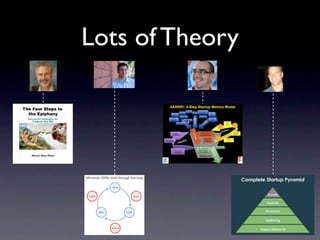
Lots of Theory
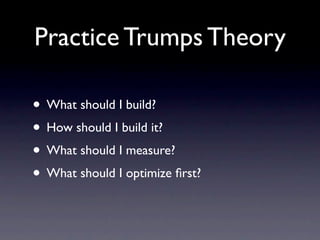
Practice Trumps Theory

• What should I build?
• How should I build it?
• What should I measure?
• What should I optimize first?
Case Study
Product 1            Product 2
Case Study
       Product 1                     Product 2


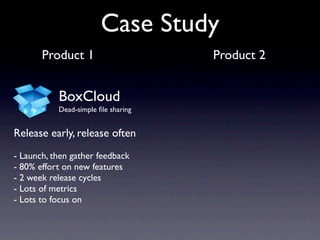
           BoxCloud
           Dead-simple file sharing


Release early, release often
- Launch, then gather feedback
- 80% effort on new features
- 2 week release cycles
- Lots of metrics
- Lots to focus on
Case Study
       Product 1                          Product 2


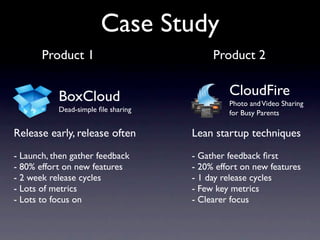
           BoxCloud                           CloudFire
                                              Photo and Video Sharing
           Dead-simple file sharing            for Busy Parents

Release early, release often         Lean startup techniques
- Launch, then gather feedback       - Gather feedback first
- 80% effort on new features         - 20% effort on new features
- 2 week release cycles              - 1 day release cycles
- Lots of metrics                    - Few key metrics
- Lots to focus on                   - Clearer focus
What should
 I build ?
What should
 I build ?
Get out of the building
What should
                     I build ?
                        Get out of the building

                                  Top 3
Problem Presentations                             Minimum Viable Product
                                problems
What should
                     I build ?
                        Get out of the building

                                  Top 3
Problem Presentations                             Minimum Viable Product
                                problems
      Blog

 Landing Pages
How should
 I build it ?
How should
          I build it ?
        Maximize validated learning


BUILD             MEASURE             LEARN
How should
               I build it ?
             Maximize validated learning


  BUILD                MEASURE             LEARN
Continuous
Deployment
How should
               I build it ?
             Maximize validated learning


  BUILD                MEASURE             LEARN
Continuous             Split Tests
Deployment            Usability Tests
What should
I measure ?
What should
              I measure ?
              5 key actionable metrics

Acquisition        Analytics tools       Conversion Dashboard
Activation
Retention
 Referral
 Revenue
What should
I optimize (first) ?
What should
I optimize (first) ?
  Product/Market Fit is the
   first thing that matters
What should
         I optimize (first) ?
              Product/Market Fit is the
               first thing that matters
Acquisition
Activation
Retention           Product/Market Fit    Then scale
 Referral
 Revenue
What should
              I optimize (first) ?
                        Product/Market Fit is the
                         first thing that matters
    Acquisition
    Activation
    Retention                 Product/Market Fit    Then scale
     Referral
     Revenue


 20% new features
80% existing features
What have
I learned ?
What have
I learned ?
  Test everything
you think you know
What have
               I learned ?
                 Test everything
               you think you know

lean startup       Less code            More learning
                  Less delusion      More reality checks
                   Less burn        More chance of success
What have
                   I learned ?
                      Test everything
                    you think you know

lean startup            Less code            More learning
                       Less delusion      More reality checks
                        Less burn        More chance of success


               blog: http://www.ashmaurya.com
                      twitter: ashmaurya

Building a Lean Startup

  • 1.
    Unique Value Proposition Minimum Viable Product Product/Market Fit Continuous Deployment Freemium What should I measure? Building a Lean Startup Case-study: CloudFire Lean startup Eliminate waste Business Model Five Whys Split-testing Customer Development Landing Pages
  • 2.
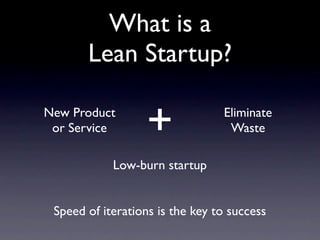
    What is a Lean Startup? New Product or Service + Eliminate Waste Low-burn startup Speed of iterations is the key to success
  • 3.
  • 4.
    Practice Trumps Theory •What should I build? • How should I build it? • What should I measure? • What should I optimize first?
  • 5.
  • 6.
    Case Study Product 1 Product 2 BoxCloud Dead-simple file sharing Release early, release often - Launch, then gather feedback - 80% effort on new features - 2 week release cycles - Lots of metrics - Lots to focus on
  • 7.
    Case Study Product 1 Product 2 BoxCloud CloudFire Photo and Video Sharing Dead-simple file sharing for Busy Parents Release early, release often Lean startup techniques - Launch, then gather feedback - Gather feedback first - 80% effort on new features - 20% effort on new features - 2 week release cycles - 1 day release cycles - Lots of metrics - Few key metrics - Lots to focus on - Clearer focus
  • 8.
  • 9.
    What should Ibuild ? Get out of the building
  • 10.
    What should I build ? Get out of the building Top 3 Problem Presentations Minimum Viable Product problems
  • 11.
    What should I build ? Get out of the building Top 3 Problem Presentations Minimum Viable Product problems Blog Landing Pages
  • 12.
    How should Ibuild it ?
  • 13.
    How should I build it ? Maximize validated learning BUILD MEASURE LEARN
  • 14.
    How should I build it ? Maximize validated learning BUILD MEASURE LEARN Continuous Deployment
  • 15.
    How should I build it ? Maximize validated learning BUILD MEASURE LEARN Continuous Split Tests Deployment Usability Tests
  • 16.
  • 17.
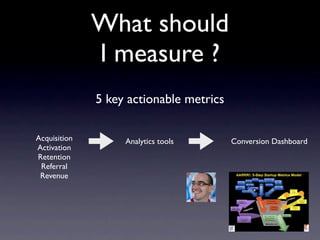
    What should I measure ? 5 key actionable metrics Acquisition Analytics tools Conversion Dashboard Activation Retention Referral Revenue
  • 18.
  • 19.
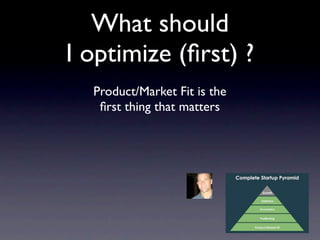
    What should I optimize(first) ? Product/Market Fit is the first thing that matters
  • 20.
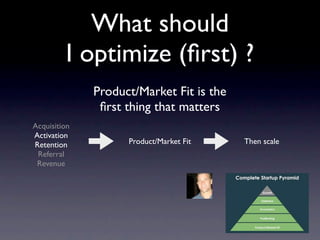
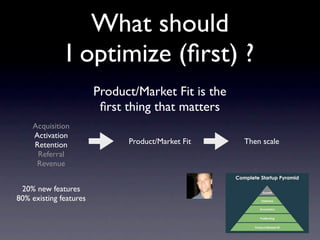
    What should I optimize (first) ? Product/Market Fit is the first thing that matters Acquisition Activation Retention Product/Market Fit Then scale Referral Revenue
  • 21.
    What should I optimize (first) ? Product/Market Fit is the first thing that matters Acquisition Activation Retention Product/Market Fit Then scale Referral Revenue 20% new features 80% existing features
  • 22.
  • 23.
    What have I learned? Test everything you think you know
  • 24.
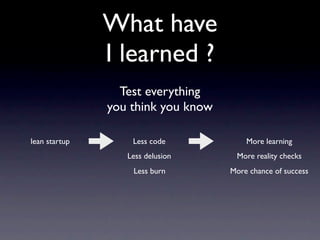
    What have I learned ? Test everything you think you know lean startup Less code More learning Less delusion More reality checks Less burn More chance of success
  • 25.
    What have I learned ? Test everything you think you know lean startup Less code More learning Less delusion More reality checks Less burn More chance of success blog: http://www.ashmaurya.com twitter: ashmaurya

Editor's Notes

  • #2 I would like to spend some time talking about why we are all here and how we can best structure these meetups.
  • #3 Instead I’d like us to share specific applications of lean startup techniques: case-studies, best practices tools. Does anyone disagree?
  • #4 I feel there already is a lot of lean startup material available online and don’t think we want to simply regurgitate all that here.
  • #5 Instead I’d like us to share specific applications of lean startup techniques: case-studies, best practices tools. Does anyone disagree?
  • #6 With that I’d like to jump right into the first case-study of how I have been applying these techniques in my startup. There isn’t enough time to go into all the details but I think it will serve as a good introduction. I have been in business for several years and have launched 2 products. The first product was built using release early, release often… It started out as a very simple application but quickly grew out of hand because we were trying to be all things to all people. I eventually hit the reset button and stripped about 60% of the features that weren’t getting used. I had started reading about customer development and lean startup and decided to apply those techniques to my second product. You can see some of the differences but the biggest payoff for me was being able to define and prioritize my success metrics more clearly.
  • #7 With that I’d like to jump right into the first case-study of how I have been applying these techniques in my startup. There isn’t enough time to go into all the details but I think it will serve as a good introduction. I have been in business for several years and have launched 2 products. The first product was built using release early, release often… It started out as a very simple application but quickly grew out of hand because we were trying to be all things to all people. I eventually hit the reset button and stripped about 60% of the features that weren’t getting used. I had started reading about customer development and lean startup and decided to apply those techniques to my second product. You can see some of the differences but the biggest payoff for me was being able to define and prioritize my success metrics more clearly.
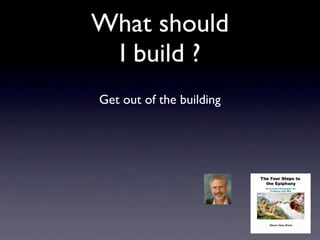
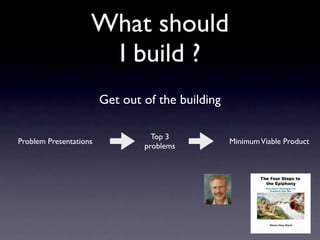
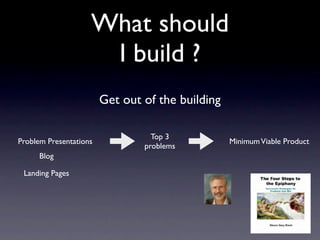
  • #8 The approach I had taken with the first product was building something I thought people wanted and then testing it. Keeping it small helped but a lot of my underlying assumptions were wrong and had to be reworked over time. Steve Blank literally wrote a book on customer development where he asserts that all the answers lie outside the building and emphasizes engaging customers even before the product is built. I used a problem presentation to identify the top 3 problems most important to my customers which helped me define what needed to go into a minimum viable product.
  • #9 The approach I had taken with the first product was building something I thought people wanted and then testing it. Keeping it small helped but a lot of my underlying assumptions were wrong and had to be reworked over time. Steve Blank literally wrote a book on customer development where he asserts that all the answers lie outside the building and emphasizes engaging customers even before the product is built. I used a problem presentation to identify the top 3 problems most important to my customers which helped me define what needed to go into a minimum viable product.
  • #10 The approach I had taken with the first product was building something I thought people wanted and then testing it. Keeping it small helped but a lot of my underlying assumptions were wrong and had to be reworked over time. Steve Blank literally wrote a book on customer development where he asserts that all the answers lie outside the building and emphasizes engaging customers even before the product is built. I used a problem presentation to identify the top 3 problems most important to my customers which helped me define what needed to go into a minimum viable product.
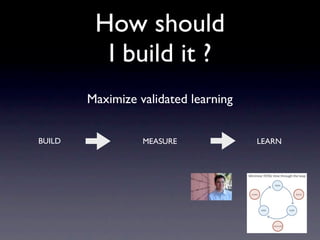
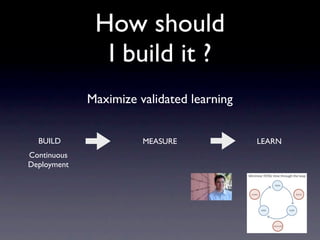
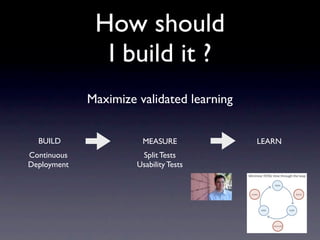
  • #11 We released BoxCloud on a biweekly schedule and used feature requests as the primary means to drive the product. Unused features are a form of waste and Eric Ries emphasizes the importance of validated learning through fast build/measure/learn loops. In CloudFire, we use Continuous Deployment to release software almost daily and incorporate both qualitative and quantitative metrics to measure, learn, and occasionally kill features that don’t measure up.
  • #12 We released BoxCloud on a biweekly schedule and used feature requests as the primary means to drive the product. Unused features are a form of waste and Eric Ries emphasizes the importance of validated learning through fast build/measure/learn loops. In CloudFire, we use Continuous Deployment to release software almost daily and incorporate both qualitative and quantitative metrics to measure, learn, and occasionally kill features that don’t measure up.
  • #13 We released BoxCloud on a biweekly schedule and used feature requests as the primary means to drive the product. Unused features are a form of waste and Eric Ries emphasizes the importance of validated learning through fast build/measure/learn loops. In CloudFire, we use Continuous Deployment to release software almost daily and incorporate both qualitative and quantitative metrics to measure, learn, and occasionally kill features that don’t measure up.
  • #14 Anyone who has used google analytics knows it’s very easy to get lost in a sea of numbers. Dave McClure built a model using just 5 key metrics which I’ve implemented using home-grown and off-the-shelf tools.
  • #15 Of those 5 metrics, not all of them need to be optimized day 1. Product/Market fit is the first thing that matters. But how do you measure it? Sean Ellis measures it using surveys to gauge initial user gratification. In Dave’s model, those translate to Activation and Retention. It is only after product/market fit that you scale up user acquisition.
  • #16 Of those 5 metrics, not all of them need to be optimized day 1. Product/Market fit is the first thing that matters. But how do you measure it? Sean Ellis measures it using surveys to gauge initial user gratification. In Dave’s model, those translate to Activation and Retention. It is only after product/market fit that you scale up user acquisition.
  • #17 Of those 5 metrics, not all of them need to be optimized day 1. Product/Market fit is the first thing that matters. But how do you measure it? Sean Ellis measures it using surveys to gauge initial user gratification. In Dave’s model, those translate to Activation and Retention. It is only after product/market fit that you scale up user acquisition.
  • #18 The fundamental mind shift in applying lean startup is going from thinking you know something to testing everything you know.
  • #19 The fundamental mind shift in applying lean startup is going from thinking you know something to testing everything you know.
  • #20 The fundamental mind shift in applying lean startup is going from thinking you know something to testing everything you know.