Logistics
Planning and
Strategy
LEAN
LOGISTICS
PRESENTED BY: SAGAR DUTT PHULORIA
POINTERS FOR THE
PRESENTATION
Lean Management Systems
Part 1:
Lean Logistics
Part 2:
Making changes using
Lean Logistics
Part 3:
Importance and
Implemenetation of Lean
Logistics
Part 4:
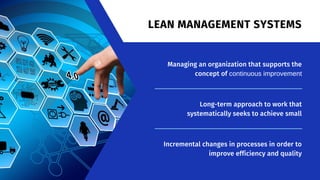
Managing an organization that supports the
concept of continuous improvement
Long-term approach to work that
systematically seeks to achieve small
Incremental changes in processes in order to
improve efficiency and quality
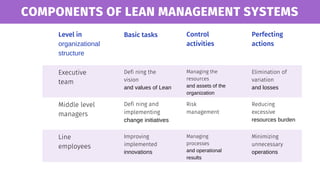
LEAN MANAGEMENT SYSTEMS
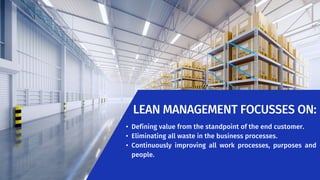
LEAN MANAGEMENT FOCUSSES ON:
• Defining value from the standpoint of the end customer.
• Eliminating all waste in the business processes.
• Continuously improving all work processes, purposes and
people.
Executive
team
Defi ning the
vision
and values of Lean
Managing the
resources
and assets of the
organization
Elimination of
variation
and losses
Perfecting
actions
Middle level
managers
Defi ning and
implementing
change initiatives
Risk
management
Reducing
excessive
resources burden
Line
employees
Improving
implemented
innovations
Managing
processes
and operational
results
Minimizing
unnecessary
operations
Control
activities
Basic tasks
Level in
organizational
structure
COMPONENTS OF LEAN MANAGEMENT SYSTEMS
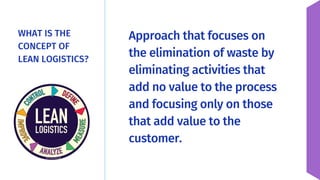
WHAT IS THE
CONCEPT OF
LEAN LOGISTICS?
Approach that focuses on
the elimination of waste by
eliminating activities that
add no value to the process
and focusing only on those
that add value to the
customer.
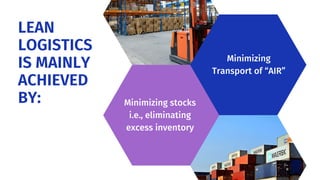
LEAN
LOGISTICS
IS MAINLY
ACHIEVED
BY: Minimizing stocks
i.e., eliminating
excess inventory
Minimizing
Transport of “AIR”
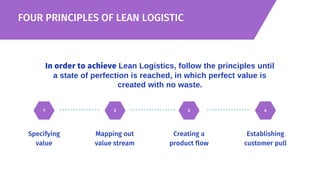
FOUR PRINCIPLES OF LEAN LOGISTIC
In order to achieve Lean Logistics, follow the principles until
a state of perfection is reached, in which perfect value is
created with no waste.
1
Specifying
value
2
Mapping out
value stream
3
Creating a
product flow
4
Establishing
customer pull
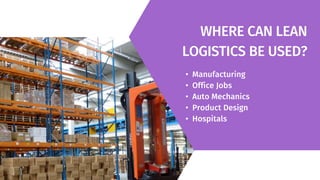
WHERE CAN LEAN
LOGISTICS BE USED?
• Manufacturing
• Office Jobs
• Auto Mechanics
• Product Design
• Hospitals
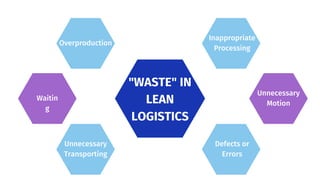
"WASTE" IN
LEAN
LOGISTICS
Overproduction
Waitin
g
Inappropriate
Processing
Unnecessary
Motion
Defects or
Errors
Unnecessary
Transporting
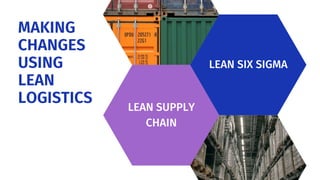
MAKING
CHANGES
USING
LEAN
LOGISTICS LEAN SUPPLY
CHAIN
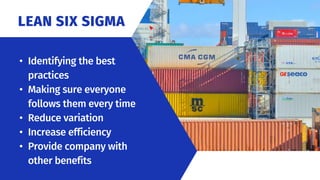
LEAN SIX SIGMA
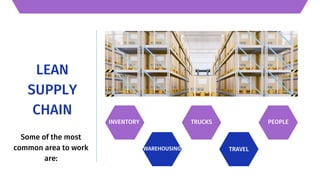
LEAN
SUPPLY
CHAIN
INVENTORY
WAREHOUSING
TRUCKS
TRAVEL
PEOPLE
Some of the most
common area to work
are:
• Identifying the best
practices
• Making sure everyone
follows them every time
• Reduce variation
• Increase efficiency
• Provide company with
other benefits
LEAN SIX SIGMA
WHY TO USE LEAN LOGISTICS?
50%+ of those who adopt lean logistics
practices report immediate improvement
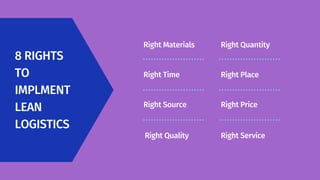
8 RIGHTS
TO
IMPLMENT
LEAN
LOGISTICS
Right Materials
Right Time
Right Source
Right Quantity
Right Place
Right Price
Right Quality Right Service
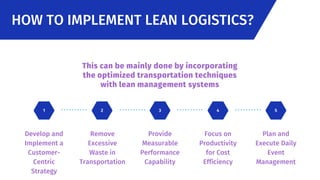
HOW TO IMPLEMENT LEAN LOGISTICS?
This can be mainly done by incorporating
the optimized transportation techniques
with lean management systems
1
Develop and
Implement a
Customer-
Centric
Strategy
2
Remove
Excessive
Waste in
Transportation
3
Provide
Measurable
Performance
Capability
4
Focus on
Productivity
for Cost
Efficiency
5
Plan and
Execute Daily
Event
Management
CONCLUSION
In today’s market, logistics companies are embracing
Lean initiatives to uncover and deal with waste and
inefficiencies. Implementing Lean Logistics into your
business brings significant improvements not only to
one specific area of the supply chain, but to the
entire value chain as a whole. It enables you to
respond to fast-changing consumer demands with
higher quality, lower cost, less need of working
capital, and faster throughput times.
REFERENCES
https://www.elangham.com/2018/05/10/what-is-lean-logistics-and-how-
can-it-benefit-your-
business/#:~:text=Lean%20logistics%20is%20a%20great,product%20at%20a
%20measured%20rate.
https://www.creativesafetysupply.com/articles/lean-logistics/
https://www.educba.com/lean-logistics/
https://www.idashboards.com/blog/2016/12/01/lean-logistics-are-you-
tracking-the-right-stats/
Lean Logistics, Article in Journal of Positive Management · May 2017 DOI:
10.12775/JPM.2016.012; by Anna Wronka

Lean logistics