VSM AND FLOW IMPROVEMENT AT THE
                                                                  MEDICAL ONCOLOGY UNIT
                                                                       HOSPITAL REGIONAL
http://www.hospitalregional.org.br                             VALE DO PARAIBA (HRVP/IOV)
        Authors: Marcelo Taborda MD, Evelin Marotta MD, Camila Santos Pharm., Sheila Reis RN, Fernanda Paim,
                                                                        Stela Maris Coelho, Carlos F Pinto MD.
HRVP Oncology Unit Backgrounds. The Value Stream Mapping (VSM) involved doctors, nurses, pharmacists, and attendants working at
Instituto de Oncologia do Vale’s Medical Oncology Unit inside HRVP (State Regional Hospital) and was part of our Lean Implementation
Project. The process involved the chemotherapy prescription, authorization, filling and billing processes that usually required two days to be
completed (from prescribing to billing). 110 prescriptions are filled daily and consume a lot of movement and energy. Clients (internal and
external) frequently complain about long queues, billing errors, reprocessing and delays. The complete VSM (planning and executing
phases) took place in early 2009, motivated by our poor performance at the 2008’s Internal Customer Satisfaction Survey.

Initial problem analysis clearly                                                                    Assessment of problem and root
stated that patient prescription and                                                                causes: We used the VSM (as
patient chart flows are different.                                                                  proposed by Rother and Shook in
The information needed to fill and                                                                  “Learning to See”: current state, future
bill prescriptions (chemo treatment)                                                                state and value stream plan) to access,
is not available to all involved. This                                                              identify root causes, quantify and solve
problem         imposes        nurses,                                                              problems. While designing the current
pharmacists and attendants to                                                                       state, several broken processes were
frequently request patient chart to                                                                 identified, and possible solutions were
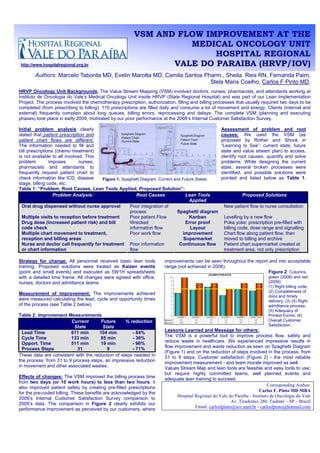
check information like ICD, disease     Figure 1: Spaghetti Diagram: Current and Future States      pointed and listed below as Table 1.
stage, billing code, etc.
Table 1: “Problem, Root Causes, Lean Tools Applied, Proposed Solution”:
                  Problem Analysis:                      Root Causes               Lean Tools                 Proposed Solutions
                                                                                     Applied
  Oral drug dispensed without nurse approval         Poor integration of                             New patient flow to nurse consultation
                                                     process                   Spaghetti diagram
  Multiple visits to reception before treatment      Poor patient Flow               Kanban          Levelling by a new flow
  Drug dose (increased patient risk) and bill        Wrecked                       Error proof       Poka yoke: prescription pre-filled with
  code check                                         information flow                Layout          billing code, dose range and signalling
  Multiple chart movement to treatment,              Poor work flow              improvement         Chart flow along patient flow, then
  reception and billing areas                                                     Supermarket        moved to billing and archive
  Nurse and doctor call frequently for treatment Poor information               Continuous flow      Patient chart supermarket created at
  or chart information                               flow                                            treatment area, not only prescription

Strategy for change: All personnel received basic lean tools           improvements can be seen throughout the report and into acceptable
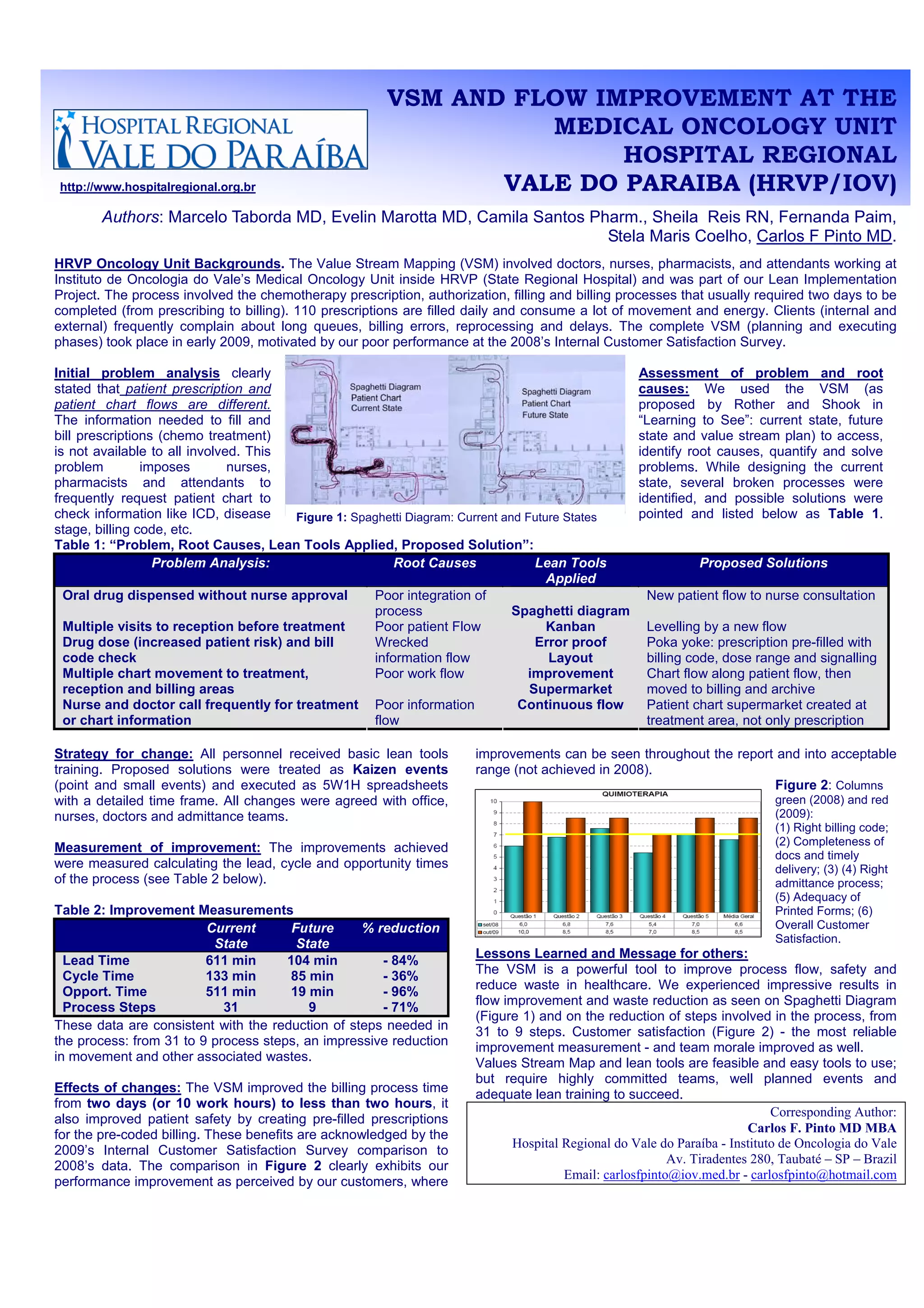
training. Proposed solutions were treated as Kaizen events             range (not achieved in 2008).
(point and small events) and executed as 5W1H spreadsheets                                                           Figure 2: Columns
with a detailed time frame. All changes were agreed with office,                                                            green (2008) and red
nurses, doctors and admittance teams.                                                                                       (2009):
                                                                                                                            (1) Right billing code;
                                                                                                                            (2) Completeness of
Measurement of improvement: The improvements achieved
                                                                                                                            docs and timely
were measured calculating the lead, cycle and opportunity times                                                             delivery; (3) (4) Right
of the process (see Table 2 below).                                                                                         admittance process;
                                                                                                                            (5) Adequacy of
Table 2: Improvement Measurements                                                                                           Printed Forms; (6)
                         Current       Future     % reduction                                                               Overall Customer
                          State         State                                                                               Satisfaction.
                                                                       Lessons Learned and Message for others:
  Lead Time              611 min      104 min        - 84%
                                                                       The VSM is a powerful tool to improve process flow, safety and
  Cycle Time             133 min      85 min         - 36%
  Opport. Time           511 min      19 min         - 96%             reduce waste in healthcare. We experienced impressive results in
  Process Steps             31            9          - 71%             flow improvement and waste reduction as seen on Spaghetti Diagram
                                                                       (Figure 1) and on the reduction of steps involved in the process, from
These data are consistent with the reduction of steps needed in        31 to 9 steps. Customer satisfaction (Figure 2) - the most reliable
the process: from 31 to 9 process steps, an impressive reduction       improvement measurement - and team morale improved as well.
in movement and other associated wastes.                               Values Stream Map and lean tools are feasible and easy tools to use;
                                                                       but require highly committed teams, well planned events and
Effects of changes: The VSM improved the billing process time          adequate lean training to succeed.
from two days (or 10 work hours) to less than two hours, it
                                                                                                                            Corresponding Author:
also improved patient safety by creating pre-filled prescriptions
                                                                                                                       Carlos F. Pinto MD MBA
for the pre-coded billing. These benefits are acknowledged by the
                                                                             Hospital Regional do Vale do Paraíba - Instituto de Oncologia do Vale
2009’s Internal Customer Satisfaction Survey comparison to
                                                                                                         Av. Tiradentes 280, Taubaté – SP – Brazil
2008’s data. The comparison in Figure 2 clearly exhibits our
                                                                                      Email: carlosfpinto@iov.med.br - carlosfpinto@hotmail.com
performance improvement as perceived by our customers, where

Value Stream Mapping at HRVP case report

  • 1.
    VSM AND FLOWIMPROVEMENT AT THE MEDICAL ONCOLOGY UNIT HOSPITAL REGIONAL http://www.hospitalregional.org.br VALE DO PARAIBA (HRVP/IOV) Authors: Marcelo Taborda MD, Evelin Marotta MD, Camila Santos Pharm., Sheila Reis RN, Fernanda Paim, Stela Maris Coelho, Carlos F Pinto MD. HRVP Oncology Unit Backgrounds. The Value Stream Mapping (VSM) involved doctors, nurses, pharmacists, and attendants working at Instituto de Oncologia do Vale’s Medical Oncology Unit inside HRVP (State Regional Hospital) and was part of our Lean Implementation Project. The process involved the chemotherapy prescription, authorization, filling and billing processes that usually required two days to be completed (from prescribing to billing). 110 prescriptions are filled daily and consume a lot of movement and energy. Clients (internal and external) frequently complain about long queues, billing errors, reprocessing and delays. The complete VSM (planning and executing phases) took place in early 2009, motivated by our poor performance at the 2008’s Internal Customer Satisfaction Survey. Initial problem analysis clearly Assessment of problem and root stated that patient prescription and causes: We used the VSM (as patient chart flows are different. proposed by Rother and Shook in The information needed to fill and “Learning to See”: current state, future bill prescriptions (chemo treatment) state and value stream plan) to access, is not available to all involved. This identify root causes, quantify and solve problem imposes nurses, problems. While designing the current pharmacists and attendants to state, several broken processes were frequently request patient chart to identified, and possible solutions were check information like ICD, disease Figure 1: Spaghetti Diagram: Current and Future States pointed and listed below as Table 1. stage, billing code, etc. Table 1: “Problem, Root Causes, Lean Tools Applied, Proposed Solution”: Problem Analysis: Root Causes Lean Tools Proposed Solutions Applied Oral drug dispensed without nurse approval Poor integration of New patient flow to nurse consultation process Spaghetti diagram Multiple visits to reception before treatment Poor patient Flow Kanban Levelling by a new flow Drug dose (increased patient risk) and bill Wrecked Error proof Poka yoke: prescription pre-filled with code check information flow Layout billing code, dose range and signalling Multiple chart movement to treatment, Poor work flow improvement Chart flow along patient flow, then reception and billing areas Supermarket moved to billing and archive Nurse and doctor call frequently for treatment Poor information Continuous flow Patient chart supermarket created at or chart information flow treatment area, not only prescription Strategy for change: All personnel received basic lean tools improvements can be seen throughout the report and into acceptable training. Proposed solutions were treated as Kaizen events range (not achieved in 2008). (point and small events) and executed as 5W1H spreadsheets Figure 2: Columns with a detailed time frame. All changes were agreed with office, green (2008) and red nurses, doctors and admittance teams. (2009): (1) Right billing code; (2) Completeness of Measurement of improvement: The improvements achieved docs and timely were measured calculating the lead, cycle and opportunity times delivery; (3) (4) Right of the process (see Table 2 below). admittance process; (5) Adequacy of Table 2: Improvement Measurements Printed Forms; (6) Current Future % reduction Overall Customer State State Satisfaction. Lessons Learned and Message for others: Lead Time 611 min 104 min - 84% The VSM is a powerful tool to improve process flow, safety and Cycle Time 133 min 85 min - 36% Opport. Time 511 min 19 min - 96% reduce waste in healthcare. We experienced impressive results in Process Steps 31 9 - 71% flow improvement and waste reduction as seen on Spaghetti Diagram (Figure 1) and on the reduction of steps involved in the process, from These data are consistent with the reduction of steps needed in 31 to 9 steps. Customer satisfaction (Figure 2) - the most reliable the process: from 31 to 9 process steps, an impressive reduction improvement measurement - and team morale improved as well. in movement and other associated wastes. Values Stream Map and lean tools are feasible and easy tools to use; but require highly committed teams, well planned events and Effects of changes: The VSM improved the billing process time adequate lean training to succeed. from two days (or 10 work hours) to less than two hours, it Corresponding Author: also improved patient safety by creating pre-filled prescriptions Carlos F. Pinto MD MBA for the pre-coded billing. These benefits are acknowledged by the Hospital Regional do Vale do Paraíba - Instituto de Oncologia do Vale 2009’s Internal Customer Satisfaction Survey comparison to Av. Tiradentes 280, Taubaté – SP – Brazil 2008’s data. The comparison in Figure 2 clearly exhibits our Email: carlosfpinto@iov.med.br - carlosfpinto@hotmail.com performance improvement as perceived by our customers, where