


LEAN LAUNCHPAD:
CUSTOMER DISCOVERY +
DESIGN RESEARCH
JUNE 2014
JEN VAN DER MEER
NYU ITP | SVA POD
@JENVANDERMEER
JENVANDERMEER.ORG
2
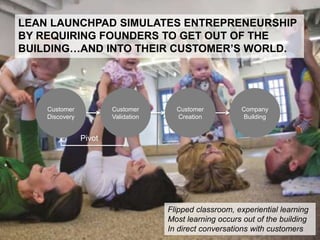
LEAN LAUNCHPAD SIMULATES ENTREPRENEURSHIP
BY REQUIRING FOUNDERS TO GET OUT OF THE
BUILDING…AND INTO THEIR CUSTOMER’S WORLD.
Customer
Discovery
Customer
Creation
Customer
Validation
Company
Building
Flipped classroom, experiential learning
Most learning occurs out of the building
In direct conversations with customers3
Pivot
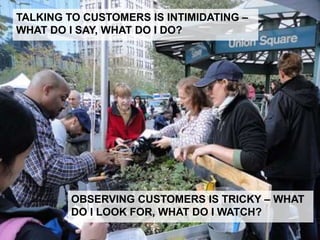
TALKING TO CUSTOMERS IS INTIMIDATING –
WHAT DO I SAY, WHAT DO I DO?
4
OBSERVING CUSTOMERS IS TRICKY – WHAT
DO I LOOK FOR, WHAT DO I WATCH?
TEAMS GET OVER THE HUMP, BUT FIND ITS VERY
HARD TO GET TO A TRUE PAIN POINT
“I think I only scratched the surface, and never really got to the
core problems.”
“I don’t know if my customers really understand what they need
enough to articulate it to me.”
“Customers said they would pay, but then they didn’t when it
came time to pay.”
5
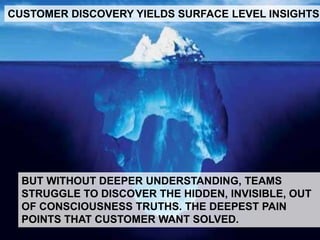
CUSTOMER DISCOVERY YIELDS SURFACE LEVEL INSIGHTS
BUT WITHOUT DEEPER UNDERSTANDING, TEAMS
STRUGGLE TO DISCOVER THE HIDDEN, INVISIBLE, OUT
OF CONSCIOUSNESS TRUTHS. THE DEEPEST PAIN
POINTS THAT CUSTOMER WANT SOLVED.
CUSTOMER DISCOVERY YIELDS SURFACE LEVEL INSIGHTS
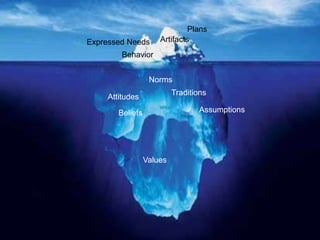
PAIN DRIVEN DESIGN
Artifacts
Behavior
Expressed Needs
Norms
Beliefs Assumptions
Values
Plans
Traditions
Attitudes
9
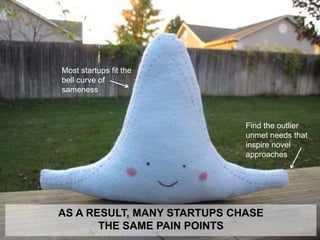
Find the outlier
unmet needs that
inspire novel
approaches
Most startups fit the
bell curve of
sameness
AS A RESULT, MANY STARTUPS CHASE
THE SAME PAIN POINTS
10
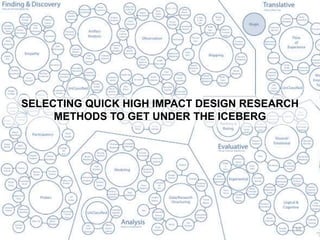
SELECTING QUICK HIGH IMPACT DESIGN RESEARCH
METHODS TO GET UNDER THE ICEBERG
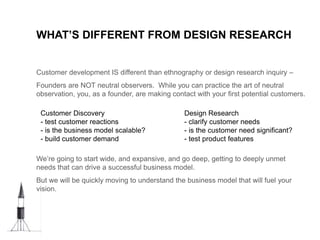
WHAT’S DIFFERENT FROM DESIGN RESEARCH
Customer development IS different than ethnography or design research inquiry –
Founders are NOT neutral observers. While you can practice the art of neutral
observation, you, as a founder, are making contact with your first potential customers.
We’re going to start wide, and expansive, and go deep, getting to deeply unmet
needs that can drive a successful business model.
But we will be quickly moving to understand the business model that will fuel your
vision.
Customer Discovery
- test customer reactions
- is the business model scalable?
- build customer demand
Design Research
- clarify customer needs
- is the customer need significant?
- test product features
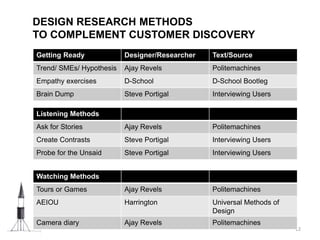
DESIGN RESEARCH METHODS
TO COMPLEMENT CUSTOMER DISCOVERY
12
Getting Ready Designer/Researcher Text/Source
Trend/ SMEs/ Hypothesis Ajay Revels Politemachines
Empathy exercises D-School D-School Bootleg
Brain Dump Steve Portigal Interviewing Users
Listening Methods
Ask for Stories Ajay Revels Politemachines
Create Contrasts Steve Portigal Interviewing Users
Probe for the Unsaid Steve Portigal Interviewing Users
Watching Methods
Tours or Games Ajay Revels Politemachines
AEIOU Harrington Universal Methods of
Design
Camera diary Ajay Revels Politemachines
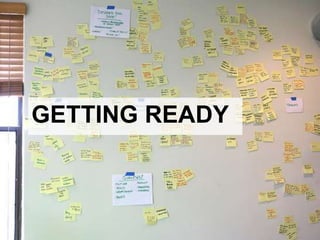
GETTING READY
13
Gather what is known about the problem and your proposed customer.
Current trends. Familiarize yourself with current trends that may be
driving the problems for your proposed customer.
SMEs. Learn what subject matter experts (SMEs) know about your
problem or your proposed customer. Pick their brain, look for early
insights and key questions.
Hypothesis. Write out an hypothesis or problem statement to help
frame your exploration.
“Prepare your mind to see the unmet needs and customer problems by
learning as much as you can about what is already known. Use the time
you spend in the field to explore what is unknown.”
– Ajay Revels, Politemachines
GETTING READY: TRENDS / SMES / HYPOTHESIS
14
GETTING READY: DEVELOPING EMPATHY
The problems you are trying to solve are rarely your own – and you won’t
find a market until you can understand the needs that other have. Make
sure you are not just getting out of the building, but getting into the context
of your customers’ lives.
Observe: View users and their behavior in the context of their lives.
Engage: interact and interview users through scheduled and short
“intercept” encounters.
Immerse: Experience what your user experiences.
From: D-School Bootcamp Bootleg:
Convene a brain dump.
Get what’s in everyone’s heads out on the table. Assumptions,
expectations, closely held beliefs, perspectives, hypotheses.
Contradictions are inevitable, and become great fodder for
hypotheses to test on your business model canvas.
“Think about it as a transitional ritual of unburdening, like men emptying
their pockets of keys, change, and wallet as soon as they return home.”
– Adapted from Steve Portigal, Interviewing Users.
GETTING READY: BRAIN DUMP
16
LISTENING METHODS
17
LISTENING METHOD:
EXPLAIN YOUR PURPOSE & ASK FOR STORIES
18
Strangers are generally happy to provide quick feedback on a product idea or
talk about their pain points around a particular topic. Ensure a good interaction
by being upfront about your request;
 Purpose: I’d like to learn about…
 Time: I’d like 10 minutes of your time…
 Freedoms: You can decline to answer any question or end the
conversation at any time…
 Method: I will show you XYZ, I will watch you do XYZ, I will ask about
XYZ..
People communicate naturally by using stories, anecdotes and jokes.
Encourage this. Introduce a topic you’re interested in and let them tell you a
story about it. Smile. Make eye contact. Nod. Say very little. This will break the
ice and will get you closer to the answers you’re looking for.
-- Ajay Revels, Politemachines
To check against a “cover story” or get underneath the obvious truths:
Compare processes: “How is applying for preschool different than applying
for pre-k.”
Compare to others: “Do you learning habits differ from your fellow grad
students in your program”
Compare across time: “How have your shopping habits changed from the
time you lived with roommate, to living alone, to living with a partner.”
• Adapted from Interviewing Users, by Steve Portigal
LISTENING METHOD:
CREATE CONTRASTS
19
To get underneath to values, latent needs, reasons why:
Ask for clarification: “When you said everything changed after
September, what happened then.”
Ask about code words: “What does that acronym stand for.”
Ask about emotional cues: “Why do you laugh when you mention Seven
Eleven.”
Probe delicately: “You mentioned that changes in your organization led
to a different decision – can you tell me what that situation was.”
Probe without presuming: “Some people have strong opinions about
teaching children to read before they enter first grade, while other’s
don’t. What is your take.”
• Adapted from Interviewing Users, by Steve Portigal
LISTENING METHOD:
PROBE FOR THE UNSAID
20
WATCHING METHODS
Tours are a form of immersive observation that allow you to experience the
whole context of the customer problem you’re interested in. Tours can be as
broad as “shopping for shoes” or as specific as sending a message to a family
member.
Games or simulations are a playful form of interactive observation that allow
you to experiment with different aspects of the customer problem.
Your mission is to capture:
Who (who are we observing)
What (what are they doing)
How (how are they doing it)
Why (are they doing it)
When (are they doing it)
Where (are they doing it)
-- Ajay Revels, Polite Machines
WATCHING METHOD:
TOURS & GAMES
22
WATCHING METHOD:
CAMERA STUDY
23
Camera studies or photo sorts are a quick and easy way to get proposed
customers to SHOW you aspects of a particular topic you’re interested in
understanding. Photos also help spark conversations that illuminate the roots of the
customer problem and uncover their unmet needs.
Topic: ask for photos around a specific activity. “Please take a few quick photos
while you are shopping for shoes.” Or…”Go online and find photos of people
shopping for shoes.”
Number: ask for a specific number of images. 3-4. If people have more that’s fine.
Send: to keep the activity as simple and pain free as possible, ask people to email
you photos from their smartphone.
Busy people who don’t have time to talk to you will often agree to snap photos as
they go about their daily lives.
-- Ajay Revels, Politemachines
WATCHING METHOD:
AEIOU
24
AEIOU is an organizational framework when you get into the natural habitat of the
person you are interviewing, and gives you a construct to look, listen, and observe
(rather than talk, and hear):
Activities: goal directed sets of actions. What are the pathways that people take
toward the things they want to accomplish, including specific actions and processes?
Environments: include the entire arena in which activities take place.
Interactions: between a person and someone, or something else, and are the
building blocks of activities.
Objects: Building blocks of the environments, key elements put to complex or even
unintended uses, possibly changing their function, meaning, and context.
Users: people whose behaviors, preferences, and needs are bing observed. Who is
present? What are their roles and relationships? What are their values and biases.
From: Universal Methods of Design. Bella Harrington, Bruce Hanington.
DESIGN RESEARCH IS
FUN, WHEN DO WE
STOP?
25
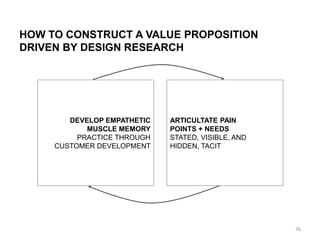
HOW TO CONSTRUCT A VALUE PROPOSITION
DRIVEN BY DESIGN RESEARCH
DEVELOP EMPATHETIC
MUSCLE MEMORY
PRACTICE THROUGH
CUSTOMER DEVELOPMENT
ARTICULTATE PAIN
POINTS + NEEDS
STATED, VISIBLE, AND
HIDDEN, TACIT
26
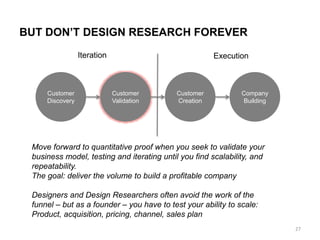
BUT DON’T DESIGN RESEARCH FOREVER
Customer
Discovery
Customer
Creation
Customer
Validation
Company
Building
Move forward to quantitative proof when you seek to validate your
business model, testing and iterating until you find scalability, and
repeatability.
The goal: deliver the volume to build a profitable company
Designers and Design Researchers often avoid the work of the
funnel – but as a founder – you have to test your ability to scale:
Product, acquisition, pricing, channel, sales plan
Iteration Execution
27
WHAT CAME BEFORE STEVE AND ERIC
28
29
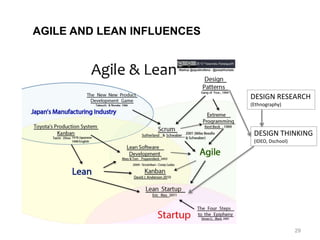
AGILE AND LEAN INFLUENCES
DESIGN RESEARCH
(Ethnography)
DESIGN THINKING
(IDEO, Dschool)
Interviewing Users: How to Uncover Compelling
Insights: Steve Portigal
Universal Methods of Design: Bella Harrington, Bruce
Hanington.
DSchool Bootcamp Bootleg
Ajay Revels Polite Machines
DESIGN RESEARCH CONTRIBUTORS
30
Syllabus and updates here on the class blog – and all
work herein is based on adaptations and lessons
learned teaching Lean LaunchPad at NYU ITP.
To add to this list of resources and tools for students,
contact Jen van der Meer: @jenvandermeer
ABOUT THE CLASS
31

Lean Customer Discovery Needs Deep Empathy

  • 1.
    LEAN LAUNCHPAD: CUSTOMER DISCOVERY+ DESIGN RESEARCH JUNE 2014 JEN VAN DER MEER NYU ITP | SVA POD @JENVANDERMEER JENVANDERMEER.ORG 2
  • 2.
    LEAN LAUNCHPAD SIMULATESENTREPRENEURSHIP BY REQUIRING FOUNDERS TO GET OUT OF THE BUILDING…AND INTO THEIR CUSTOMER’S WORLD. Customer Discovery Customer Creation Customer Validation Company Building Flipped classroom, experiential learning Most learning occurs out of the building In direct conversations with customers3 Pivot
  • 3.
    TALKING TO CUSTOMERSIS INTIMIDATING – WHAT DO I SAY, WHAT DO I DO? 4 OBSERVING CUSTOMERS IS TRICKY – WHAT DO I LOOK FOR, WHAT DO I WATCH?
  • 4.
    TEAMS GET OVERTHE HUMP, BUT FIND ITS VERY HARD TO GET TO A TRUE PAIN POINT “I think I only scratched the surface, and never really got to the core problems.” “I don’t know if my customers really understand what they need enough to articulate it to me.” “Customers said they would pay, but then they didn’t when it came time to pay.” 5
  • 5.
    CUSTOMER DISCOVERY YIELDSSURFACE LEVEL INSIGHTS
  • 6.
    BUT WITHOUT DEEPERUNDERSTANDING, TEAMS STRUGGLE TO DISCOVER THE HIDDEN, INVISIBLE, OUT OF CONSCIOUSNESS TRUTHS. THE DEEPEST PAIN POINTS THAT CUSTOMER WANT SOLVED. CUSTOMER DISCOVERY YIELDS SURFACE LEVEL INSIGHTS
  • 7.
    PAIN DRIVEN DESIGN Artifacts Behavior ExpressedNeeds Norms Beliefs Assumptions Values Plans Traditions Attitudes
  • 8.
    9 Find the outlier unmetneeds that inspire novel approaches Most startups fit the bell curve of sameness AS A RESULT, MANY STARTUPS CHASE THE SAME PAIN POINTS
  • 9.
    10 SELECTING QUICK HIGHIMPACT DESIGN RESEARCH METHODS TO GET UNDER THE ICEBERG
  • 10.
    WHAT’S DIFFERENT FROMDESIGN RESEARCH Customer development IS different than ethnography or design research inquiry – Founders are NOT neutral observers. While you can practice the art of neutral observation, you, as a founder, are making contact with your first potential customers. We’re going to start wide, and expansive, and go deep, getting to deeply unmet needs that can drive a successful business model. But we will be quickly moving to understand the business model that will fuel your vision. Customer Discovery - test customer reactions - is the business model scalable? - build customer demand Design Research - clarify customer needs - is the customer need significant? - test product features
  • 11.
    DESIGN RESEARCH METHODS TOCOMPLEMENT CUSTOMER DISCOVERY 12 Getting Ready Designer/Researcher Text/Source Trend/ SMEs/ Hypothesis Ajay Revels Politemachines Empathy exercises D-School D-School Bootleg Brain Dump Steve Portigal Interviewing Users Listening Methods Ask for Stories Ajay Revels Politemachines Create Contrasts Steve Portigal Interviewing Users Probe for the Unsaid Steve Portigal Interviewing Users Watching Methods Tours or Games Ajay Revels Politemachines AEIOU Harrington Universal Methods of Design Camera diary Ajay Revels Politemachines
  • 12.
  • 13.
    Gather what isknown about the problem and your proposed customer. Current trends. Familiarize yourself with current trends that may be driving the problems for your proposed customer. SMEs. Learn what subject matter experts (SMEs) know about your problem or your proposed customer. Pick their brain, look for early insights and key questions. Hypothesis. Write out an hypothesis or problem statement to help frame your exploration. “Prepare your mind to see the unmet needs and customer problems by learning as much as you can about what is already known. Use the time you spend in the field to explore what is unknown.” – Ajay Revels, Politemachines GETTING READY: TRENDS / SMES / HYPOTHESIS 14
  • 14.
    GETTING READY: DEVELOPINGEMPATHY The problems you are trying to solve are rarely your own – and you won’t find a market until you can understand the needs that other have. Make sure you are not just getting out of the building, but getting into the context of your customers’ lives. Observe: View users and their behavior in the context of their lives. Engage: interact and interview users through scheduled and short “intercept” encounters. Immerse: Experience what your user experiences. From: D-School Bootcamp Bootleg:
  • 15.
    Convene a braindump. Get what’s in everyone’s heads out on the table. Assumptions, expectations, closely held beliefs, perspectives, hypotheses. Contradictions are inevitable, and become great fodder for hypotheses to test on your business model canvas. “Think about it as a transitional ritual of unburdening, like men emptying their pockets of keys, change, and wallet as soon as they return home.” – Adapted from Steve Portigal, Interviewing Users. GETTING READY: BRAIN DUMP 16
  • 16.
  • 17.
    LISTENING METHOD: EXPLAIN YOURPURPOSE & ASK FOR STORIES 18 Strangers are generally happy to provide quick feedback on a product idea or talk about their pain points around a particular topic. Ensure a good interaction by being upfront about your request;  Purpose: I’d like to learn about…  Time: I’d like 10 minutes of your time…  Freedoms: You can decline to answer any question or end the conversation at any time…  Method: I will show you XYZ, I will watch you do XYZ, I will ask about XYZ.. People communicate naturally by using stories, anecdotes and jokes. Encourage this. Introduce a topic you’re interested in and let them tell you a story about it. Smile. Make eye contact. Nod. Say very little. This will break the ice and will get you closer to the answers you’re looking for. -- Ajay Revels, Politemachines
  • 18.
    To check againsta “cover story” or get underneath the obvious truths: Compare processes: “How is applying for preschool different than applying for pre-k.” Compare to others: “Do you learning habits differ from your fellow grad students in your program” Compare across time: “How have your shopping habits changed from the time you lived with roommate, to living alone, to living with a partner.” • Adapted from Interviewing Users, by Steve Portigal LISTENING METHOD: CREATE CONTRASTS 19
  • 19.
    To get underneathto values, latent needs, reasons why: Ask for clarification: “When you said everything changed after September, what happened then.” Ask about code words: “What does that acronym stand for.” Ask about emotional cues: “Why do you laugh when you mention Seven Eleven.” Probe delicately: “You mentioned that changes in your organization led to a different decision – can you tell me what that situation was.” Probe without presuming: “Some people have strong opinions about teaching children to read before they enter first grade, while other’s don’t. What is your take.” • Adapted from Interviewing Users, by Steve Portigal LISTENING METHOD: PROBE FOR THE UNSAID 20
  • 20.
  • 21.
    Tours are aform of immersive observation that allow you to experience the whole context of the customer problem you’re interested in. Tours can be as broad as “shopping for shoes” or as specific as sending a message to a family member. Games or simulations are a playful form of interactive observation that allow you to experiment with different aspects of the customer problem. Your mission is to capture: Who (who are we observing) What (what are they doing) How (how are they doing it) Why (are they doing it) When (are they doing it) Where (are they doing it) -- Ajay Revels, Polite Machines WATCHING METHOD: TOURS & GAMES 22
  • 22.
    WATCHING METHOD: CAMERA STUDY 23 Camerastudies or photo sorts are a quick and easy way to get proposed customers to SHOW you aspects of a particular topic you’re interested in understanding. Photos also help spark conversations that illuminate the roots of the customer problem and uncover their unmet needs. Topic: ask for photos around a specific activity. “Please take a few quick photos while you are shopping for shoes.” Or…”Go online and find photos of people shopping for shoes.” Number: ask for a specific number of images. 3-4. If people have more that’s fine. Send: to keep the activity as simple and pain free as possible, ask people to email you photos from their smartphone. Busy people who don’t have time to talk to you will often agree to snap photos as they go about their daily lives. -- Ajay Revels, Politemachines
  • 23.
    WATCHING METHOD: AEIOU 24 AEIOU isan organizational framework when you get into the natural habitat of the person you are interviewing, and gives you a construct to look, listen, and observe (rather than talk, and hear): Activities: goal directed sets of actions. What are the pathways that people take toward the things they want to accomplish, including specific actions and processes? Environments: include the entire arena in which activities take place. Interactions: between a person and someone, or something else, and are the building blocks of activities. Objects: Building blocks of the environments, key elements put to complex or even unintended uses, possibly changing their function, meaning, and context. Users: people whose behaviors, preferences, and needs are bing observed. Who is present? What are their roles and relationships? What are their values and biases. From: Universal Methods of Design. Bella Harrington, Bruce Hanington.
  • 24.
    DESIGN RESEARCH IS FUN,WHEN DO WE STOP? 25
  • 25.
    HOW TO CONSTRUCTA VALUE PROPOSITION DRIVEN BY DESIGN RESEARCH DEVELOP EMPATHETIC MUSCLE MEMORY PRACTICE THROUGH CUSTOMER DEVELOPMENT ARTICULTATE PAIN POINTS + NEEDS STATED, VISIBLE, AND HIDDEN, TACIT 26
  • 26.
    BUT DON’T DESIGNRESEARCH FOREVER Customer Discovery Customer Creation Customer Validation Company Building Move forward to quantitative proof when you seek to validate your business model, testing and iterating until you find scalability, and repeatability. The goal: deliver the volume to build a profitable company Designers and Design Researchers often avoid the work of the funnel – but as a founder – you have to test your ability to scale: Product, acquisition, pricing, channel, sales plan Iteration Execution 27
  • 27.
    WHAT CAME BEFORESTEVE AND ERIC 28
  • 28.
    29 AGILE AND LEANINFLUENCES DESIGN RESEARCH (Ethnography) DESIGN THINKING (IDEO, Dschool)
  • 29.
    Interviewing Users: Howto Uncover Compelling Insights: Steve Portigal Universal Methods of Design: Bella Harrington, Bruce Hanington. DSchool Bootcamp Bootleg Ajay Revels Polite Machines DESIGN RESEARCH CONTRIBUTORS 30
  • 30.
    Syllabus and updateshere on the class blog – and all work herein is based on adaptations and lessons learned teaching Lean LaunchPad at NYU ITP. To add to this list of resources and tools for students, contact Jen van der Meer: @jenvandermeer ABOUT THE CLASS 31

Editor's Notes

  • #4 Inhabitat.com
  • #5 Photo credit: http://www.nydailynews.com/life-style/58-parents-gadgets-babysit-kids-study-article-1.1383009
  • #10 http://image.slidesharecdn.com/drmethodslegalsize-100319105558-phpapp02/95/slide-1-728.jpg?cb=1269014371
  • #11 http://www.trilemon.com/wp-content/uploads/2013/12/Universal-Methods-of-Design.pdf
  • #13 https://www.flickr.com/photos/juhansonin/8009704349/in/photolist-dcMQ3R-ejpNXD-dcMPZa-cNCsnA-7E4o7D-7ydj9U/
  • #15 http://dschool.stanford.edu/wp-content/uploads/2011/03/BootcampBootleg2010v2SLIM.pdf
  • #17 https://www.flickr.com/photos/33392350@N00/5076456621/in/photolist-8JAaGa-m83iBw-a9Q3QZ-7QQrbc-bA3AKD-bPXUSz-8fnCAw-8ozJt3-876czN-g6dUEb-cATtz3-8HFwM8-8ZnpKq-9WGfDZ-dCE6cg-ajDae2-c8DMKC-7zQ7HA-9QBr8b-cpnzmm-fYBuqo-8Yh47a-7ETpwS-7DrZ8J-9Wtvea-9dCtZh-bBYSr7-dw5kXy-ajDaQ2-a1pNe4-bn3uJA-8URn4J-bt8fS6-a6ZrV9-8yoqG8-85Yse9
  • #25 https://www.flickr.com/photos/jeanbaptisteparis/6301697857/
  • #28 http://lifeasahuman.com/files/2011/01/4183278431_9e130bcda5_b.jpg Water goes around a rock
  • #29 http://agilelion.com/agile-kanban-cafe/agile-and-lean-influences-where-did-kanban-scrum-scrumban-come-from