
REBECCA ROSE, INTERACTION DESIGNER, QUICKBOOKS XD TEAM
INTERVIEWING
CUSTOMERS
101
INTRODUCTION
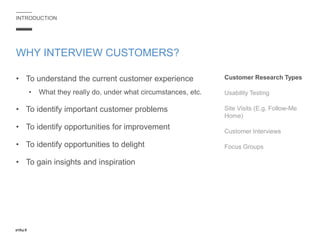
• To understand the current customer experience
• What they really do, under what circumstances, etc.
• To identify important customer problems
• To identify opportunities for improvement
• To identify opportunities to delight
• To gain insights and inspiration
WHY INTERVIEW CUSTOMERS?
Customer Research Types
Usability Testing
Site Visits (E.g. Follow-Me
Home)
Customer Interviews
Focus Groups
INTRODUCTION
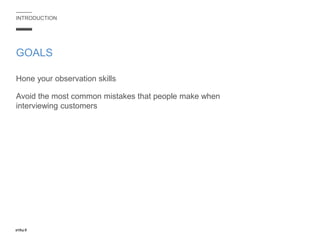
Hone your observation skills
Avoid the most common mistakes that people make when
interviewing customers
GOALS
INTRODUCTION
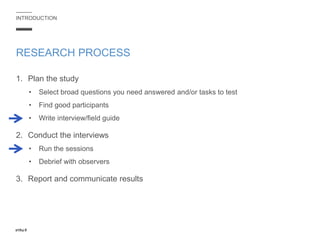
1. Plan the study
• Select broad questions you need answered and/or tasks to test
• Find good participants
• Write interview/field guide
2. Conduct the interviews
• Run the sessions
• Debrief with observers
3. Report and communicate results
RESEARCH PROCESS
FIELD GUIDE
FIELD GUIDE
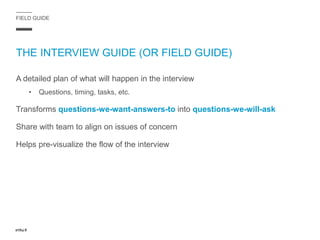
THE INTERVIEW GUIDE (OR FIELD GUIDE)
A detailed plan of what will happen in the interview
• Questions, timing, tasks, etc.
Transforms questions-we-want-answers-to into questions-we-will-ask
Share with team to align on issues of concern
Helps pre-visualize the flow of the interview
RESEARCH ATTITUDE
RESEARCH ATTITUDE
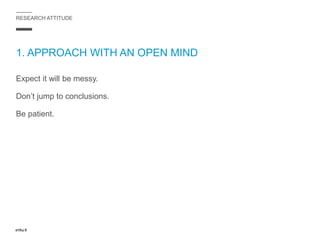
1. APPROACH WITH AN OPEN MIND
Expect it will be messy.
Don’t jump to conclusions.
Be patient.
RESEARCH ATTITUDE
2. HAVE A CONVERSATION
Instead of interviewing the person formally, try to have a conversation.
Remember, we are there to learn from people, not judge.
RESEARCH ATTITUDE
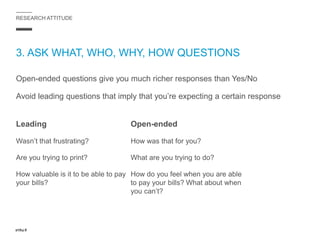
3. ASK WHAT, WHO, WHY, HOW QUESTIONS
Open-ended questions give you much richer responses than Yes/No
Avoid leading questions that imply that you’re expecting a certain response
Leading
Wasn’t that frustrating?
Are you trying to print?
How valuable is it to be able to pay
your bills?
Open-ended
How was that for you?
What are you trying to do?
How do you feel when you are able
to pay your bills? What about when
you can’t?
RESEARCH ATTITUDE
4. TEACH CUSTOMER TO “THINK ALOUD”
“Can you tell me what you’re thinking?”
RESEARCH ATTITUDE
5. SHOW THAT YOU’RE ACTIVELY LISTENING
Repeat the facts that you see.
Reflect the thoughts and beliefs that you hear.
“I heard you say that you would rather visit a large city than go to a beach for
vacation. Did I get that right?”
RESEARCH ATTITUDE
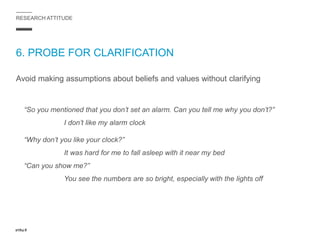
6. PROBE FOR CLARIFICATION
Avoid making assumptions about beliefs and values without clarifying
“So you mentioned that you don’t set an alarm. Can you tell me why you don’t?”
I don’t like my alarm clock
“Why don’t you like your clock?”
It was hard for me to fall asleep with it near my bed
“Can you show me?”
You see the numbers are so bright, especially with the lights off
RESEARCH ATTITUDE
7. MONITOR HOW MUCH YOU ARE TALKING
If you spend too much time asking questions or verbally respond to
everything the participant says, this may make them uncomfortable.
Be comfortable with silence. Sometimes the most interesting stuff comes
when you let things unfold naturally
RESEARCH ATTITUDE
8. HAVE THEM SHOW YOU
When possible, ask them to show you what they are doing, rather than talk
about it.
Don’t be afraid to ask, “Can you show me how you do that?”
RESEARCH ATTITUDE
9. MIND YOUR NON-VERBAL CUES
Non-verbal cues such as eye contact, nodding, and smiling reassure the
person that you are engaged in what they’re saying.
RESEARCH ATTITUDE
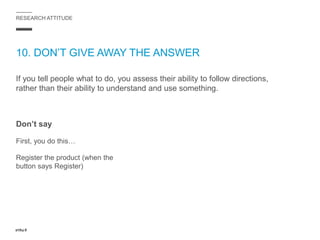
10. DON’T GIVE AWAY THE ANSWER
If you tell people what to do, you assess their ability to follow directions,
rather than their ability to understand and use something.
Don’t say
First, you do this…
Register the product (when the
button says Register)
PRACTICE
PRACTICE
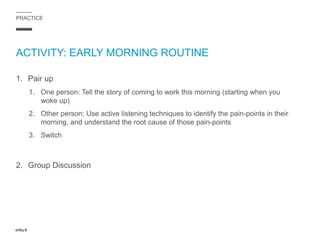
ACTIVITY: EARLY MORNING ROUTINE
1. Pair up
1. One person: Tell the story of coming to work this morning (starting when you
woke up)
2. Other person: Use active listening techniques to identify the pain-points in their
morning, and understand the root cause of those pain-points
3. Switch
2. Group Discussion
COMMITMENTS
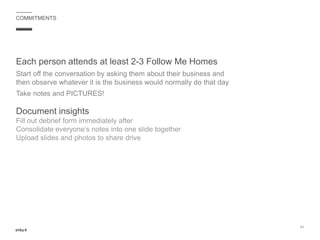
Each person attends at least 2-3 Follow Me Homes
Start off the conversation by asking them about their business and
then observe whatever it is the business would normally do that day
Take notes and PICTURES!
Document insights
Fill out debrief form immediately after
Consolidate everyone’s notes into one slide together
Upload slides and photos to share drive
21
COMMITMENTS
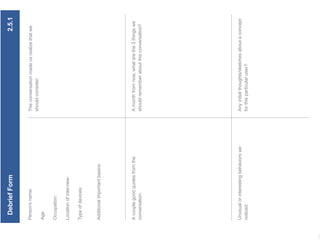
Person’sname:
Age:
Occupation:
Locationofinterview:
Typeofdevices:
Additionalimportantbasics:
Theconversationmadeusrealizethatwe
shouldconsider:
Unusualorinterestingbehaviorswe
noticed:
Amonthfromnow,whatarethe3thingswe
shouldrememberaboutthisconversation?
Anyinitialthoughts/sketchesaboutaconcept
forthisparticularuser?
Acouplegoodquotesfromthe
conversation:
DebriefForm2.5.1
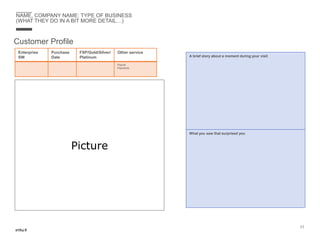
NAME, COMPANY NAME: TYPE OF BUSINESS
(WHAT THEY DO IN A BIT MORE DETAIL…)
Enterprise
SW
Purchase
Date
FSP/Gold/Silver/
Platinum
Other service
Payroll
Payments
Customer Profile
Picture
A brief story about a moment during your visit
What you saw that surprised you
23
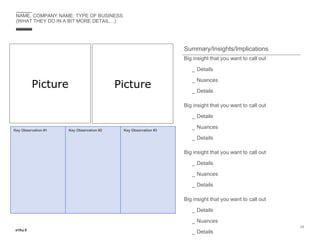
Big insight that you want to call out
_ Details
_ Nuances
_ Details
Big insight that you want to call out
_ Details
_ Nuances
_ Details
Big insight that you want to call out
_ Details
_ Nuances
_ Details
Big insight that you want to call out
_ Details
_ Nuances
_ Details
Summary/Insights/Implications
Picture Picture
Key Observation #1 Key Observation #2 Key Observation #3
24
NAME, COMPANY NAME: TYPE OF BUSINESS
(WHAT THEY DO IN A BIT MORE DETAIL…)

Interviewing customers 101

  • 1.
    REBECCA ROSE, INTERACTIONDESIGNER, QUICKBOOKS XD TEAM INTERVIEWING CUSTOMERS 101
  • 2.
    INTRODUCTION • To understandthe current customer experience • What they really do, under what circumstances, etc. • To identify important customer problems • To identify opportunities for improvement • To identify opportunities to delight • To gain insights and inspiration WHY INTERVIEW CUSTOMERS? Customer Research Types Usability Testing Site Visits (E.g. Follow-Me Home) Customer Interviews Focus Groups
  • 3.
    INTRODUCTION Hone your observationskills Avoid the most common mistakes that people make when interviewing customers GOALS
  • 4.
    INTRODUCTION 1. Plan thestudy • Select broad questions you need answered and/or tasks to test • Find good participants • Write interview/field guide 2. Conduct the interviews • Run the sessions • Debrief with observers 3. Report and communicate results RESEARCH PROCESS
  • 5.
  • 6.
    FIELD GUIDE THE INTERVIEWGUIDE (OR FIELD GUIDE) A detailed plan of what will happen in the interview • Questions, timing, tasks, etc. Transforms questions-we-want-answers-to into questions-we-will-ask Share with team to align on issues of concern Helps pre-visualize the flow of the interview
  • 7.
  • 8.
    RESEARCH ATTITUDE 1. APPROACHWITH AN OPEN MIND Expect it will be messy. Don’t jump to conclusions. Be patient.
  • 9.
    RESEARCH ATTITUDE 2. HAVEA CONVERSATION Instead of interviewing the person formally, try to have a conversation. Remember, we are there to learn from people, not judge.
  • 10.
    RESEARCH ATTITUDE 3. ASKWHAT, WHO, WHY, HOW QUESTIONS Open-ended questions give you much richer responses than Yes/No Avoid leading questions that imply that you’re expecting a certain response Leading Wasn’t that frustrating? Are you trying to print? How valuable is it to be able to pay your bills? Open-ended How was that for you? What are you trying to do? How do you feel when you are able to pay your bills? What about when you can’t?
  • 11.
    RESEARCH ATTITUDE 4. TEACHCUSTOMER TO “THINK ALOUD” “Can you tell me what you’re thinking?”
  • 12.
    RESEARCH ATTITUDE 5. SHOWTHAT YOU’RE ACTIVELY LISTENING Repeat the facts that you see. Reflect the thoughts and beliefs that you hear. “I heard you say that you would rather visit a large city than go to a beach for vacation. Did I get that right?”
  • 13.
    RESEARCH ATTITUDE 6. PROBEFOR CLARIFICATION Avoid making assumptions about beliefs and values without clarifying “So you mentioned that you don’t set an alarm. Can you tell me why you don’t?” I don’t like my alarm clock “Why don’t you like your clock?” It was hard for me to fall asleep with it near my bed “Can you show me?” You see the numbers are so bright, especially with the lights off
  • 14.
    RESEARCH ATTITUDE 7. MONITORHOW MUCH YOU ARE TALKING If you spend too much time asking questions or verbally respond to everything the participant says, this may make them uncomfortable. Be comfortable with silence. Sometimes the most interesting stuff comes when you let things unfold naturally
  • 15.
    RESEARCH ATTITUDE 8. HAVETHEM SHOW YOU When possible, ask them to show you what they are doing, rather than talk about it. Don’t be afraid to ask, “Can you show me how you do that?”
  • 16.
    RESEARCH ATTITUDE 9. MINDYOUR NON-VERBAL CUES Non-verbal cues such as eye contact, nodding, and smiling reassure the person that you are engaged in what they’re saying.
  • 17.
    RESEARCH ATTITUDE 10. DON’TGIVE AWAY THE ANSWER If you tell people what to do, you assess their ability to follow directions, rather than their ability to understand and use something. Don’t say First, you do this… Register the product (when the button says Register)
  • 18.
  • 19.
    PRACTICE ACTIVITY: EARLY MORNINGROUTINE 1. Pair up 1. One person: Tell the story of coming to work this morning (starting when you woke up) 2. Other person: Use active listening techniques to identify the pain-points in their morning, and understand the root cause of those pain-points 3. Switch 2. Group Discussion
  • 20.
  • 21.
    Each person attendsat least 2-3 Follow Me Homes Start off the conversation by asking them about their business and then observe whatever it is the business would normally do that day Take notes and PICTURES! Document insights Fill out debrief form immediately after Consolidate everyone’s notes into one slide together Upload slides and photos to share drive 21 COMMITMENTS
  • 22.
  • 23.
    NAME, COMPANY NAME:TYPE OF BUSINESS (WHAT THEY DO IN A BIT MORE DETAIL…) Enterprise SW Purchase Date FSP/Gold/Silver/ Platinum Other service Payroll Payments Customer Profile Picture A brief story about a moment during your visit What you saw that surprised you 23
  • 24.
    Big insight thatyou want to call out _ Details _ Nuances _ Details Big insight that you want to call out _ Details _ Nuances _ Details Big insight that you want to call out _ Details _ Nuances _ Details Big insight that you want to call out _ Details _ Nuances _ Details Summary/Insights/Implications Picture Picture Key Observation #1 Key Observation #2 Key Observation #3 24 NAME, COMPANY NAME: TYPE OF BUSINESS (WHAT THEY DO IN A BIT MORE DETAIL…)