SPECIALASSIGNMENT
LEANANDPROCESSIMPROVEMENTS(Subway)
Product and inventory control systems
NAME :SIDHARTH JAYANTH KINI
UTA ID :1001241754
CLASS :IE 5329 – 006
DATE : 4/18/2016
CONTENTS :
1. Introduction
2. Flow chart for Ordering
3. Assembly Flow Chart
4. Kanban in Subway
5. JIT in subway
6. Supply chain in Subway
7. Bottleneck
8. WIP and Throughput
9. Lean Process improvement
10. Conclusion
11. References
INTRODUCTION :
Aim of an Industrial Engineer is optimization of existing processes, improvements of involved
methods and looking trying to increase throughput by using minimum effort and cost.
In this assignment the Subway an American fast food restaurant franchise was chosen for the study.
The processes involved in sandwich making starting from taking an order to the billing were
observed from an inventory point of angle.
The Process flowcharts and assembly charts were designed for better understanding of the processes.
Then the concept like Kanban, JIT , supply chain scenario were tried to implicate. The reasons for
bottlenecks were detected and reasons were discussed. To increase the Throughput various lean
process improvements initiatives were suggested.
 Kanban: Kanban is a scheduling system used in lean and JIT manufacturing.
 JIT: Just in time production is also known as Toyota production system (TPS) and
aim of JIT is to reduce the inventories that flow into workstation and to reduce
the response times from suppliers and to customers. Kanban is an element of
JIT.
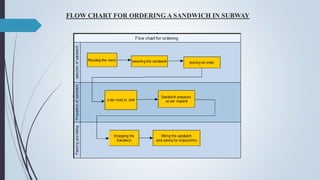
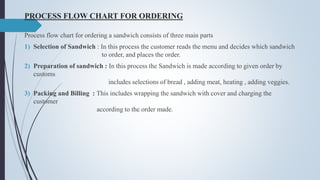
FLOW CHART FOR ORDERING A SANDWICH IN SUBWAY
PROCESS FLOW CHART FOR ORDERING
Process flow chart for ordering a sandwich consists of three main parts
1) Selection of Sandwich : In this process the customer reads the menu and decides which sandwich
to order, and places the order.
2) Preparation of sandwich : In this process the Sandwich is made according to given order by
customs
includes selections of bread , adding meat, heating , adding veggies.
3) Packing and Billing : This includes wrapping the sandwich with cover and charging the
customer
according to the order made.
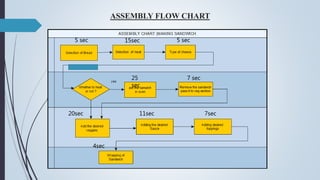
ASSEMBLY FLOW CHART
5 sec 15sec 5 sec
25
sec
7 sec
20sec 11sec 7sec
4sec
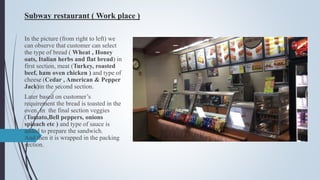
Subway restaurant ( Work place )
In the picture (from right to left) we
can observe that customer can select
the type of bread ( Wheat , Honey
oats, Italian herbs and flat bread) in
first section, meat (Turkey, roasted
beef, ham oven chicken ) and type of
cheese (Cedar , American & Pepper
Jack)in the second section.
Later based on customer’s
requirement the bread is toasted in the
oven. In the final section veggies
(Tomato,Bell peppers, onions
spinach etc ) and type of sauce is
added to prepare the sandwich.
And then it is wrapped in the packing
section.
Possible KANBANs in Subways
 Kanban is a pull system and production is carried out according to the Demand.
 In subway there is a need for constant refilling of bread, meat ,cheese and Veggies at respective
sections
 With One Card Kanban system this can be easily achieved with less time.
 The container size and quantity of product to be filled is pre-decided and once the product gets
empty respective card ( which includes the quantity to be filled ) is removed from that section and
placed in Inventory section. The worker see the requirements and that particular section is
replenished.
 This can be simplified by making 3 different sections for meat , Veggies and Cheese & sauce and
cards are kept in respective sections.
 Kanban thus prevents excess of inventory storage.
JUST IN TIME scenarios
 Just in time concept is producing only what is required. The main Aim is to reduce the wastages
and Inventories (cost related to it )
 Kanban which was proposed in earlier slide is an element of the Just in Time system.
 The Sandwich is always made fresh, only after customer places an order. This helps in reduction
of wastage of uncooked food, as they can be preserved.
 As Kanban system is used and it takes care replenishment of products in each section and hence
no excess inventories.
 Pull systems works on demand ,if there is increase in the demand there should be enough quantity
of products and it should be easily accessed.
 The quality of the Sandwich will also be good because sandwich will be freshly prepared and thus
also results in good customer satisfaction.
SUPPLY CHAIN Scenario in subways
 A supply chain is the network of all the individuals, organizations, resources, activities and
technology involved in the creation and sale of a product, from the delivery of source materials from
the supplier to the manufacturer, through to its eventual delivery to the end user.
 The Raw materials like bread dough, vegetables , meat can be purchased from wholesale dealer at
lower and it can be distributed to restaurants.
 It is planned in such a way that goods are usually delivered one day before the delivery date, to
avoid late deliveries due to uncontrollable situations.
SUPPLY CHAIN scenario in subway
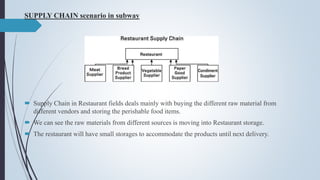
 Supply Chain in Restaurant fields deals mainly with buying the different raw material from
different vendors and storing the perishable food items.
 We can see the raw materials from different sources is moving into Restaurant storage.
 The restaurant will have small storages to accommodate the products until next delivery.
BOTTLENECKS
 Bottleneck of a line is rate of workstation having the highest long term (outages) utilization. In
other words it is nothing but congestion in the assembly/production line. If the bottleneck exists in
a line it causes delay in processes.
 In Subway the bottleneck can be seen during Toasting the bread in oven and during billing.
 There will many orders during peak hours and usually only one oven will be there.
 The oven can toast maximum of two sandwich at a time and thus other orders are kept in waiting.
 During the Billing, there are chances that one person orders more than 5 different type sandwiches
and it will take more time to bill one customer. And there will be congestion.
 Bottlenecks at one section will affect other sections, The veggies section will be idle until the
bread is toasted.
 Thus measures must be taken to avoid Bottlenecks.
WIPAND THROUGHPUT
 Work in process (WIP) : Inventory between the starting point to end point of product routing
 WIP = TH x CT
Where TH= throughput of a system , CT= cycle time.
 Then TH= WIP/ CT. This shows that reducing the cycle time will increase the Throughput.
 Time taken to make one sandwich is 99 secs or 1.65 min. If restaurant is working for 8 hours, then
the capacity of the system in approximately 290 sandwich.
 Throughput = 290/8=36.25 => 36 sandwich per hour
 If the time for make one sandwich is reduced the we will have system with higher throughput.
LEAN PROCESS IMPROVEMENTS
 Lean is process of eliminating the non value added activities and improving the quality of product
and service. It is process of retaining the activities with value for which customer is willing to pay.
 To improve the throughput we should always ensure that process is carried out smoothly.
 This can be done by reducing the bottlenecks and other non value added activities.
 The Bottlenecks is seen in toasting section and during billing . The bottleneck in toasting is
reduced by increasing the size or number of ovens. More the number of ovens , more sandwich
can be toasted together and sent to veggies section.
 The Bottleneck during billing can be reduced by automatic billing system. This can be done by
attaching the sensors/ buttons in each section which will automatically reflect the amount on
screen as sandwich passes through each section.
 The other procedure that can reduce the bottleneck at billing is Standardization of Sandwich ,
once the customers select the particular sandwich , it’s cost will be depicted on the screen. Thus it
will be a quicker and easy process. And by the time sandwich is made bill will be ready. earlier
Standardization of Sandwich will also reduce the wastage of veggies or meat , as amount and
type of meat, veggies and Cheese/ Sauce is pre-determined.
CONCLUSION
 The process of Sandwich making in Subway was thoroughly studied. The Kanban , JIT, Supply
chain management and Bottleneck Scenarios were observed during the process.
 The reason for bottleneck was discovered and suitable lean process improvements like Automatic
billing , Increasing size or number of Oven and Standardization of Sandwich were suggested.
 It was also evident that reducing cycle time will increase the Throughput.
 Thus implementing the modern production strategies in Restaurants will surely make considerable
changes within short span of time.
References
 Factory Physics - Third Edition Wallace J. Hopp, Mark L. Spearman
 www.lean.org
 www.wikipedia.com
THANK YOU !!!!

Lean and Process Improvement Implementation at Subway Restaurant

  • 1.
    SPECIALASSIGNMENT LEANANDPROCESSIMPROVEMENTS(Subway) Product and inventorycontrol systems NAME :SIDHARTH JAYANTH KINI UTA ID :1001241754 CLASS :IE 5329 – 006 DATE : 4/18/2016
  • 2.
    CONTENTS : 1. Introduction 2.Flow chart for Ordering 3. Assembly Flow Chart 4. Kanban in Subway 5. JIT in subway 6. Supply chain in Subway 7. Bottleneck 8. WIP and Throughput 9. Lean Process improvement 10. Conclusion 11. References
  • 3.
    INTRODUCTION : Aim ofan Industrial Engineer is optimization of existing processes, improvements of involved methods and looking trying to increase throughput by using minimum effort and cost. In this assignment the Subway an American fast food restaurant franchise was chosen for the study. The processes involved in sandwich making starting from taking an order to the billing were observed from an inventory point of angle. The Process flowcharts and assembly charts were designed for better understanding of the processes. Then the concept like Kanban, JIT , supply chain scenario were tried to implicate. The reasons for bottlenecks were detected and reasons were discussed. To increase the Throughput various lean process improvements initiatives were suggested.  Kanban: Kanban is a scheduling system used in lean and JIT manufacturing.  JIT: Just in time production is also known as Toyota production system (TPS) and aim of JIT is to reduce the inventories that flow into workstation and to reduce the response times from suppliers and to customers. Kanban is an element of JIT.
  • 4.
    FLOW CHART FORORDERING A SANDWICH IN SUBWAY
  • 5.
    PROCESS FLOW CHARTFOR ORDERING Process flow chart for ordering a sandwich consists of three main parts 1) Selection of Sandwich : In this process the customer reads the menu and decides which sandwich to order, and places the order. 2) Preparation of sandwich : In this process the Sandwich is made according to given order by customs includes selections of bread , adding meat, heating , adding veggies. 3) Packing and Billing : This includes wrapping the sandwich with cover and charging the customer according to the order made.
  • 6.
    ASSEMBLY FLOW CHART 5sec 15sec 5 sec 25 sec 7 sec 20sec 11sec 7sec 4sec
  • 7.
    Subway restaurant (Work place ) In the picture (from right to left) we can observe that customer can select the type of bread ( Wheat , Honey oats, Italian herbs and flat bread) in first section, meat (Turkey, roasted beef, ham oven chicken ) and type of cheese (Cedar , American & Pepper Jack)in the second section. Later based on customer’s requirement the bread is toasted in the oven. In the final section veggies (Tomato,Bell peppers, onions spinach etc ) and type of sauce is added to prepare the sandwich. And then it is wrapped in the packing section.
  • 8.
    Possible KANBANs inSubways  Kanban is a pull system and production is carried out according to the Demand.  In subway there is a need for constant refilling of bread, meat ,cheese and Veggies at respective sections  With One Card Kanban system this can be easily achieved with less time.  The container size and quantity of product to be filled is pre-decided and once the product gets empty respective card ( which includes the quantity to be filled ) is removed from that section and placed in Inventory section. The worker see the requirements and that particular section is replenished.  This can be simplified by making 3 different sections for meat , Veggies and Cheese & sauce and cards are kept in respective sections.  Kanban thus prevents excess of inventory storage.
  • 9.
    JUST IN TIMEscenarios  Just in time concept is producing only what is required. The main Aim is to reduce the wastages and Inventories (cost related to it )  Kanban which was proposed in earlier slide is an element of the Just in Time system.  The Sandwich is always made fresh, only after customer places an order. This helps in reduction of wastage of uncooked food, as they can be preserved.  As Kanban system is used and it takes care replenishment of products in each section and hence no excess inventories.  Pull systems works on demand ,if there is increase in the demand there should be enough quantity of products and it should be easily accessed.  The quality of the Sandwich will also be good because sandwich will be freshly prepared and thus also results in good customer satisfaction.
  • 10.
    SUPPLY CHAIN Scenarioin subways  A supply chain is the network of all the individuals, organizations, resources, activities and technology involved in the creation and sale of a product, from the delivery of source materials from the supplier to the manufacturer, through to its eventual delivery to the end user.  The Raw materials like bread dough, vegetables , meat can be purchased from wholesale dealer at lower and it can be distributed to restaurants.  It is planned in such a way that goods are usually delivered one day before the delivery date, to avoid late deliveries due to uncontrollable situations.
  • 11.
    SUPPLY CHAIN scenarioin subway  Supply Chain in Restaurant fields deals mainly with buying the different raw material from different vendors and storing the perishable food items.  We can see the raw materials from different sources is moving into Restaurant storage.  The restaurant will have small storages to accommodate the products until next delivery.
  • 12.
    BOTTLENECKS  Bottleneck ofa line is rate of workstation having the highest long term (outages) utilization. In other words it is nothing but congestion in the assembly/production line. If the bottleneck exists in a line it causes delay in processes.  In Subway the bottleneck can be seen during Toasting the bread in oven and during billing.  There will many orders during peak hours and usually only one oven will be there.  The oven can toast maximum of two sandwich at a time and thus other orders are kept in waiting.  During the Billing, there are chances that one person orders more than 5 different type sandwiches and it will take more time to bill one customer. And there will be congestion.  Bottlenecks at one section will affect other sections, The veggies section will be idle until the bread is toasted.  Thus measures must be taken to avoid Bottlenecks.
  • 13.
    WIPAND THROUGHPUT  Workin process (WIP) : Inventory between the starting point to end point of product routing  WIP = TH x CT Where TH= throughput of a system , CT= cycle time.  Then TH= WIP/ CT. This shows that reducing the cycle time will increase the Throughput.  Time taken to make one sandwich is 99 secs or 1.65 min. If restaurant is working for 8 hours, then the capacity of the system in approximately 290 sandwich.  Throughput = 290/8=36.25 => 36 sandwich per hour  If the time for make one sandwich is reduced the we will have system with higher throughput.
  • 14.
    LEAN PROCESS IMPROVEMENTS Lean is process of eliminating the non value added activities and improving the quality of product and service. It is process of retaining the activities with value for which customer is willing to pay.  To improve the throughput we should always ensure that process is carried out smoothly.  This can be done by reducing the bottlenecks and other non value added activities.  The Bottlenecks is seen in toasting section and during billing . The bottleneck in toasting is reduced by increasing the size or number of ovens. More the number of ovens , more sandwich can be toasted together and sent to veggies section.  The Bottleneck during billing can be reduced by automatic billing system. This can be done by attaching the sensors/ buttons in each section which will automatically reflect the amount on screen as sandwich passes through each section.  The other procedure that can reduce the bottleneck at billing is Standardization of Sandwich , once the customers select the particular sandwich , it’s cost will be depicted on the screen. Thus it will be a quicker and easy process. And by the time sandwich is made bill will be ready. earlier Standardization of Sandwich will also reduce the wastage of veggies or meat , as amount and type of meat, veggies and Cheese/ Sauce is pre-determined.
  • 15.
    CONCLUSION  The processof Sandwich making in Subway was thoroughly studied. The Kanban , JIT, Supply chain management and Bottleneck Scenarios were observed during the process.  The reason for bottleneck was discovered and suitable lean process improvements like Automatic billing , Increasing size or number of Oven and Standardization of Sandwich were suggested.  It was also evident that reducing cycle time will increase the Throughput.  Thus implementing the modern production strategies in Restaurants will surely make considerable changes within short span of time.
  • 16.
    References  Factory Physics- Third Edition Wallace J. Hopp, Mark L. Spearman  www.lean.org  www.wikipedia.com
  • 17.