Lean Supply Streams
  for the Web Era

     Daniel T Jones
Lean Supply Streams

• The lean FMCG journey began in the 1980s
     Toyota’s parts distribution system
     Seven-Eleven Japan
• Continued in the 1990s
     Unipart parts distribution
     Tesco’s supply chain
     The Discounters
• Built on in the 2000s
     ECR – ICI – GCI – IGD
     Now the Consumer Goods Forum
                                    www.leanuk.org
Major Lessons

• Define value back from the customer
     not forward from our assets or targets
• Look at the whole value stream
     rather than optimising points along it
• Focus on time
     creating flow makes waste visible
• Waste is a symptom of
     forecast errors and batching
     system generated order amplification
     poor cooperation along the stream
                                      www.leanuk.org
IT is not the answer
• Top down control, point optimisation
  systems are very inflexible and expensive
• Optimising horizontal value streams by
  removing buffers means
     making the plan and deviations visible
     knowing how to respond quickly
     good root cause problem solving
• Next generation IT systems must be simpler
  and enable flow
• Don’t schedule every flow the same way
                                    www.leanuk.org
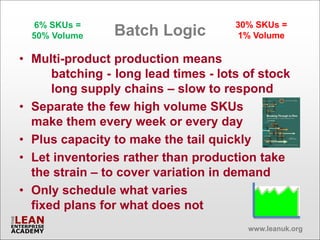
6% SKUs =                          30% SKUs =
  50% Volume    Batch Logic           1% Volume

• Multi-product production means
      batching - long lead times - lots of stock
      long supply chains – slow to respond
• Separate the few high volume SKUs
  make them every week or every day
• Plus capacity to make the tail quickly
• Let inventories rather than production take
  the strain – to cover variation in demand
• Only schedule what varies
  fixed plans for what does not
                                        www.leanuk.org
Global Supply Chains
• The end of the “China price”
  and extended supply chains
• Analysis of the total cost of supply chains is
  bringing production back within region
• Many manufacturers are dramatically
  compressing their supply chains
• Using lean Hugo Boss in Turkey is
  faster and cheaper than China
• Big supply chain development opportunity –
  better, simpler, cheaper and closer!
                                       www.leanuk.org
Barriers to Cooperation

• Synchronising flow works best with a core
  range and with own brand where there is a
  clear win-win to share future growth
• FMGC suppliers are preoccupied with
  maintaining their premiums not cutting waste
• But lean will transform their supply chains
  and non-food supply chains
• But the main problems are still internal –
  working across functions and through HQ

                                     www.leanuk.org
Transformation Design

• Rolling out staff driven training programmes
  from HQ rarely delivers sustained results
• Lean is not just a tool box for eliminating
  waste – but the capabilities to respond and
  solve problems that are learnt by doing
• Lean is a line management responsibility
• Begin proof of concept experiments quickly,
  evaluate and then share practices
• Focus efforts only on what delivers results

                                      www.leanuk.org
Just the Start
• The web is shifting power to consumers –
  now informed, empowered and impatient
• Consumers must now become an integral
  part of the supply stream
• Households are mini-businesses – full of
  complex processes that need to be managed
• What we do is to help them to create value in
  their lives and to manage their consumption
• Consumers will in future manage their own
  data and share it with chosen providers
                                      www.leanuk.org
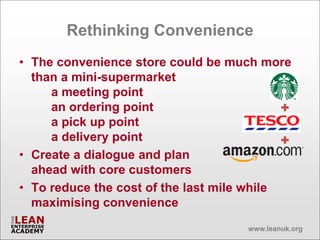
Rethinking Convenience
• The convenience store could be much more
  than a mini-supermarket
     a meeting point
     an ordering point
     a pick up point
     a delivery point
• Create a dialogue and plan
  ahead with core customers
• To reduce the cost of the last mile while
  maximising convenience
                                    www.leanuk.org
Rethinking Supply

• By reversing the trend to big, centralised and
  complex plants serving a whole region
• Exploring distributed production close to
  consolidation centres
• Developing small local suppliers
• Cross docking through other DCs
  to local picking centres and stores
• Possibly using shared production facilities
  and logistics

                                       www.leanuk.org
The Big Lesson

     The is no one best way!

We have to work together and with
consumers to design supply streams
that mirror customer circumstances

           Thank you

                               www.leanuk.org
Lean Supply Streams
  for the Web Era

     Daniel T Jones

Lean Supply Streams for the Web Era by Daniel T Jones

  • 1.
    Lean Supply Streams for the Web Era Daniel T Jones
  • 2.
    Lean Supply Streams •The lean FMCG journey began in the 1980s Toyota’s parts distribution system Seven-Eleven Japan • Continued in the 1990s Unipart parts distribution Tesco’s supply chain The Discounters • Built on in the 2000s ECR – ICI – GCI – IGD Now the Consumer Goods Forum www.leanuk.org
  • 3.
    Major Lessons • Definevalue back from the customer not forward from our assets or targets • Look at the whole value stream rather than optimising points along it • Focus on time creating flow makes waste visible • Waste is a symptom of forecast errors and batching system generated order amplification poor cooperation along the stream www.leanuk.org
  • 4.
    IT is notthe answer • Top down control, point optimisation systems are very inflexible and expensive • Optimising horizontal value streams by removing buffers means making the plan and deviations visible knowing how to respond quickly good root cause problem solving • Next generation IT systems must be simpler and enable flow • Don’t schedule every flow the same way www.leanuk.org
  • 5.
    6% SKUs = 30% SKUs = 50% Volume Batch Logic 1% Volume • Multi-product production means batching - long lead times - lots of stock long supply chains – slow to respond • Separate the few high volume SKUs make them every week or every day • Plus capacity to make the tail quickly • Let inventories rather than production take the strain – to cover variation in demand • Only schedule what varies fixed plans for what does not www.leanuk.org
  • 6.
    Global Supply Chains •The end of the “China price” and extended supply chains • Analysis of the total cost of supply chains is bringing production back within region • Many manufacturers are dramatically compressing their supply chains • Using lean Hugo Boss in Turkey is faster and cheaper than China • Big supply chain development opportunity – better, simpler, cheaper and closer! www.leanuk.org
  • 7.
    Barriers to Cooperation •Synchronising flow works best with a core range and with own brand where there is a clear win-win to share future growth • FMGC suppliers are preoccupied with maintaining their premiums not cutting waste • But lean will transform their supply chains and non-food supply chains • But the main problems are still internal – working across functions and through HQ www.leanuk.org
  • 8.
    Transformation Design • Rollingout staff driven training programmes from HQ rarely delivers sustained results • Lean is not just a tool box for eliminating waste – but the capabilities to respond and solve problems that are learnt by doing • Lean is a line management responsibility • Begin proof of concept experiments quickly, evaluate and then share practices • Focus efforts only on what delivers results www.leanuk.org
  • 9.
    Just the Start •The web is shifting power to consumers – now informed, empowered and impatient • Consumers must now become an integral part of the supply stream • Households are mini-businesses – full of complex processes that need to be managed • What we do is to help them to create value in their lives and to manage their consumption • Consumers will in future manage their own data and share it with chosen providers www.leanuk.org
  • 10.
    Rethinking Convenience • Theconvenience store could be much more than a mini-supermarket a meeting point an ordering point a pick up point a delivery point • Create a dialogue and plan ahead with core customers • To reduce the cost of the last mile while maximising convenience www.leanuk.org
  • 11.
    Rethinking Supply • Byreversing the trend to big, centralised and complex plants serving a whole region • Exploring distributed production close to consolidation centres • Developing small local suppliers • Cross docking through other DCs to local picking centres and stores • Possibly using shared production facilities and logistics www.leanuk.org
  • 12.
    The Big Lesson The is no one best way! We have to work together and with consumers to design supply streams that mirror customer circumstances Thank you www.leanuk.org
  • 13.
    Lean Supply Streams for the Web Era Daniel T Jones