Leadership, Strategy and Performance Management  Prof Erwin Schwella
Orientation Introduction Leadership Approaches: Leading towards the Future Strategy: Context, Vision, Capacity, Competency, Empowerment and Implementation Leadership and Strategy for Performance Leading Learning for Performance Conclusion
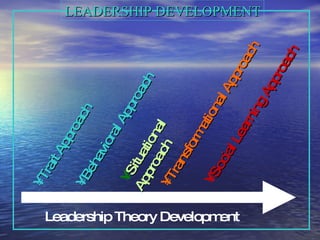
Leadership Theory Development Trait   Approach Behavioral Approach Situational Approach Transformational Approach Social Learning Approach LEADERSHIP DEVELOPMENT
Strategy: From Context to Implementation Strategy:  Context,  Vision,  Capacity,  Competency,  Empowerment, Implementation
Understanding and Analysing Context Macro Trends STEEP Analysis Social Technological Economic Environmental Political Stakeholder Analysis Regulators Suppliers Consumers Competitors
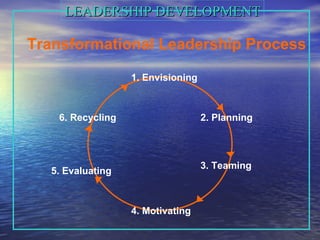
Transformational Leadership Process 1. Envisioning 2. Planning 3. Teaming 4. Motivating 5. Evaluating 6. Recycling LEADERSHIP DEVELOPMENT
Social Learning Approaches Peter Senge’s Learning Organisation Approach Shared vision Team learning Personal mastery Mental models Systems thinking Overcoming Learning Disabilities
Get on the balcony Identify the adaptive challenge Regulate distress Maintain disciplined attention Give the work back to the people Protect the voices of leadership from below Leadership in Situations of Adaptive Problems 6 Principles LEADERSHIP DEVELOPMENT
Leadership and Strategy for Performance Leading Learning for Performance The Importance of Leadership and Learning Strong empowering and facilitating learning leadership Facilitative rather than directive Strategically aimed at creating an improved future Linked to action planning, implementation and continuous evaluation and recycling
Leadership and Strategy for Performance Conducive to creating learning organisations Strong on commitment to vision and purpose Encourage capacity building, learning and empowerment  in the true spirit of a learning organisation; rather than a centralised controlling top down bureaucratic approach
The Four Performance learning Questions What happened? Descriptive qualitative and quantitative assessment Why?  Diagnostic analysis What can I/We learn from this? Deliberative empowerment and team learning How can the learning be used and built back into the system to improve the system? Prognostic capacity building for continuous improvement
Conclusion Strong leadership may call for courageous approaches moving away from power and authority as foundations Discuss and discover rather than leader commands leadership Towards new competencies jointly discovered, applied and tested for continuous improvement

Leadership, Strategy and Performance Management

  • 1.
    Leadership, Strategy andPerformance Management Prof Erwin Schwella
  • 2.
    Orientation Introduction LeadershipApproaches: Leading towards the Future Strategy: Context, Vision, Capacity, Competency, Empowerment and Implementation Leadership and Strategy for Performance Leading Learning for Performance Conclusion
  • 3.
    Leadership Theory DevelopmentTrait Approach Behavioral Approach Situational Approach Transformational Approach Social Learning Approach LEADERSHIP DEVELOPMENT
  • 4.
    Strategy: From Contextto Implementation Strategy: Context, Vision, Capacity, Competency, Empowerment, Implementation
  • 5.
    Understanding and AnalysingContext Macro Trends STEEP Analysis Social Technological Economic Environmental Political Stakeholder Analysis Regulators Suppliers Consumers Competitors
  • 6.
    Transformational Leadership Process1. Envisioning 2. Planning 3. Teaming 4. Motivating 5. Evaluating 6. Recycling LEADERSHIP DEVELOPMENT
  • 7.
    Social Learning ApproachesPeter Senge’s Learning Organisation Approach Shared vision Team learning Personal mastery Mental models Systems thinking Overcoming Learning Disabilities
  • 8.
    Get on thebalcony Identify the adaptive challenge Regulate distress Maintain disciplined attention Give the work back to the people Protect the voices of leadership from below Leadership in Situations of Adaptive Problems 6 Principles LEADERSHIP DEVELOPMENT
  • 9.
    Leadership and Strategyfor Performance Leading Learning for Performance The Importance of Leadership and Learning Strong empowering and facilitating learning leadership Facilitative rather than directive Strategically aimed at creating an improved future Linked to action planning, implementation and continuous evaluation and recycling
  • 10.
    Leadership and Strategyfor Performance Conducive to creating learning organisations Strong on commitment to vision and purpose Encourage capacity building, learning and empowerment in the true spirit of a learning organisation; rather than a centralised controlling top down bureaucratic approach
  • 11.
    The Four Performancelearning Questions What happened? Descriptive qualitative and quantitative assessment Why? Diagnostic analysis What can I/We learn from this? Deliberative empowerment and team learning How can the learning be used and built back into the system to improve the system? Prognostic capacity building for continuous improvement
  • 12.
    Conclusion Strong leadershipmay call for courageous approaches moving away from power and authority as foundations Discuss and discover rather than leader commands leadership Towards new competencies jointly discovered, applied and tested for continuous improvement