The Competing Values Approach to Management Chapter 1 Becoming a Master Manager:  A Competing Values Approach  4 th  Edition
Agenda Evolution of management models Action imperatives supporting the competing values framework Leadership roles and the competing values framework Role expectations How to develop competencies Value added for you and your organization Chapter 1: The competing values approach to management. Quinn et al., (2007).  Becoming a master manager. A competing values approach.  NJ: John Wiley & Sons, Inc.
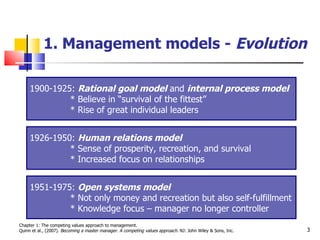
1. Management models -  Evolution Chapter 1: The competing values approach to management. Quinn et al., (2007).  Becoming a master manager. A competing values approach.  NJ: John Wiley & Sons, Inc.  1900-1925:  Rational goal model  and  internal process model   * Believe in “survival of the fittest”   * Rise of great individual leaders 1926-1950:  Human relations model   * Sense of prosperity, recreation, and survival   * Increased focus on relationships  1951-1975:  Open systems model   * Not only money and recreation but also self-fulfillment   * Knowledge focus – manager no longer controller
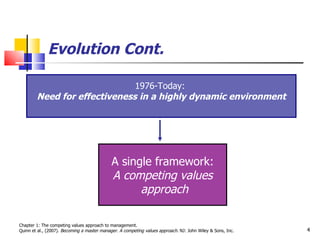
Evolution Cont. Chapter 1: The competing values approach to management. Quinn et al., (2007).  Becoming a master manager. A competing values approach.  NJ: John Wiley & Sons, Inc.  1976-Today:  Need for effectiveness in a highly dynamic environment A single framework: A competing values approach
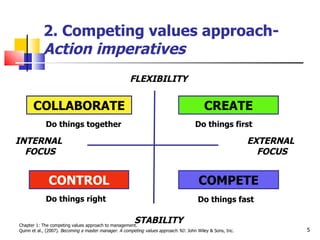
2. Competing values approach-  Action imperatives Chapter 1: The competing values approach to management. Quinn et al., (2007).  Becoming a master manager. A competing values approach.  NJ: John Wiley & Sons, Inc.  INTERNAL  FOCUS EXTERNAL  FOCUS FLEXIBILITY STABILITY COLLABORATE CREATE CONTROL COMPETE Do things together Do things first Do things right Do things fast
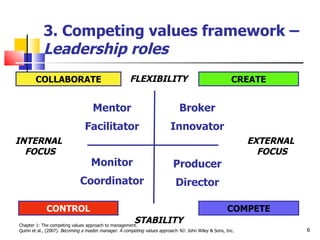
3. Competing values framework –  Leadership roles Chapter 1: The competing values approach to management. Quinn et al., (2007).  Becoming a master manager. A competing values approach.  NJ: John Wiley & Sons, Inc.  INTERNAL  FOCUS EXTERNAL  FOCUS FLEXIBILITY STABILITY COLLABORATE CREATE CONTROL COMPETE Mentor Facilitator Monitor Coordinator Broker Innovator Producer Director
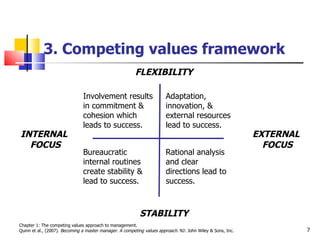
3. Competing values framework Chapter 1: The competing values approach to management. Quinn et al., (2007).  Becoming a master manager. A competing values approach.  NJ: John Wiley & Sons, Inc.  INTERNAL  FOCUS EXTERNAL  FOCUS FLEXIBILITY STABILITY Involvement results in commitment & cohesion which leads to success. Adaptation, innovation, & external resources lead to success. Bureaucratic internal routines create stability & lead to success. Rational analysis and clear directions lead to success.
4. Role expectations Managers are expected to… Clarify expectations, be task oriented, and be self-motivated Care for details and maintain flow of the system Be process oriented and develop the human resource Facilitate adaptation and change, be astute and influential But how can they achieve this??... Chapter 1: The competing values approach to management. Quinn et al., (2007).  Becoming a master manager. A competing values approach.  NJ: John Wiley & Sons, Inc.
5. Developing Leadership Competencies! A ssessment L earning A nalysis P ractice A pplication Excellent communication skills are imperative to become a master manager! Chapter 1: The competing values approach to management. Quinn et al., (2007).  Becoming a master manager. A competing values approach.  NJ: John Wiley & Sons, Inc.  Five-step model based on Whetton and Cameron (1983, “Management skill training:  A needed addition to the management curriculum,”  Organizational Behavior Teaching Journal, 8, 10-15). Reflection
5. Value added Alignment of organizational culture with action imperatives and strategic goals  Alignment of performance criteria with organizational culture Individual development plans can be optimized by reflecting appropriate priorities based on: Assessment of individual competencies Strategic focus of organization Chapter 1: The competing values approach to management. Quinn et al., (2007).  Becoming a master manager. A competing values approach.  NJ: John Wiley & Sons, Inc.
Questions?? Chapter 1: The competing values approach to management. Quinn et al., (2007).  Becoming a master manager. A competing values approach.  NJ: John Wiley & Sons, Inc.

Quinn Introduction (Official)

  • 1.
    The Competing ValuesApproach to Management Chapter 1 Becoming a Master Manager: A Competing Values Approach 4 th Edition
  • 2.
    Agenda Evolution ofmanagement models Action imperatives supporting the competing values framework Leadership roles and the competing values framework Role expectations How to develop competencies Value added for you and your organization Chapter 1: The competing values approach to management. Quinn et al., (2007). Becoming a master manager. A competing values approach. NJ: John Wiley & Sons, Inc.
  • 3.
    1. Management models- Evolution Chapter 1: The competing values approach to management. Quinn et al., (2007). Becoming a master manager. A competing values approach. NJ: John Wiley & Sons, Inc. 1900-1925: Rational goal model and internal process model * Believe in “survival of the fittest” * Rise of great individual leaders 1926-1950: Human relations model * Sense of prosperity, recreation, and survival * Increased focus on relationships 1951-1975: Open systems model * Not only money and recreation but also self-fulfillment * Knowledge focus – manager no longer controller
  • 4.
    Evolution Cont. Chapter1: The competing values approach to management. Quinn et al., (2007). Becoming a master manager. A competing values approach. NJ: John Wiley & Sons, Inc. 1976-Today: Need for effectiveness in a highly dynamic environment A single framework: A competing values approach
  • 5.
    2. Competing valuesapproach- Action imperatives Chapter 1: The competing values approach to management. Quinn et al., (2007). Becoming a master manager. A competing values approach. NJ: John Wiley & Sons, Inc. INTERNAL FOCUS EXTERNAL FOCUS FLEXIBILITY STABILITY COLLABORATE CREATE CONTROL COMPETE Do things together Do things first Do things right Do things fast
  • 6.
    3. Competing valuesframework – Leadership roles Chapter 1: The competing values approach to management. Quinn et al., (2007). Becoming a master manager. A competing values approach. NJ: John Wiley & Sons, Inc. INTERNAL FOCUS EXTERNAL FOCUS FLEXIBILITY STABILITY COLLABORATE CREATE CONTROL COMPETE Mentor Facilitator Monitor Coordinator Broker Innovator Producer Director
  • 7.
    3. Competing valuesframework Chapter 1: The competing values approach to management. Quinn et al., (2007). Becoming a master manager. A competing values approach. NJ: John Wiley & Sons, Inc. INTERNAL FOCUS EXTERNAL FOCUS FLEXIBILITY STABILITY Involvement results in commitment & cohesion which leads to success. Adaptation, innovation, & external resources lead to success. Bureaucratic internal routines create stability & lead to success. Rational analysis and clear directions lead to success.
  • 8.
    4. Role expectationsManagers are expected to… Clarify expectations, be task oriented, and be self-motivated Care for details and maintain flow of the system Be process oriented and develop the human resource Facilitate adaptation and change, be astute and influential But how can they achieve this??... Chapter 1: The competing values approach to management. Quinn et al., (2007). Becoming a master manager. A competing values approach. NJ: John Wiley & Sons, Inc.
  • 9.
    5. Developing LeadershipCompetencies! A ssessment L earning A nalysis P ractice A pplication Excellent communication skills are imperative to become a master manager! Chapter 1: The competing values approach to management. Quinn et al., (2007). Becoming a master manager. A competing values approach. NJ: John Wiley & Sons, Inc. Five-step model based on Whetton and Cameron (1983, “Management skill training: A needed addition to the management curriculum,” Organizational Behavior Teaching Journal, 8, 10-15). Reflection
  • 10.
    5. Value addedAlignment of organizational culture with action imperatives and strategic goals Alignment of performance criteria with organizational culture Individual development plans can be optimized by reflecting appropriate priorities based on: Assessment of individual competencies Strategic focus of organization Chapter 1: The competing values approach to management. Quinn et al., (2007). Becoming a master manager. A competing values approach. NJ: John Wiley & Sons, Inc.
  • 11.
    Questions?? Chapter 1:The competing values approach to management. Quinn et al., (2007). Becoming a master manager. A competing values approach. NJ: John Wiley & Sons, Inc.