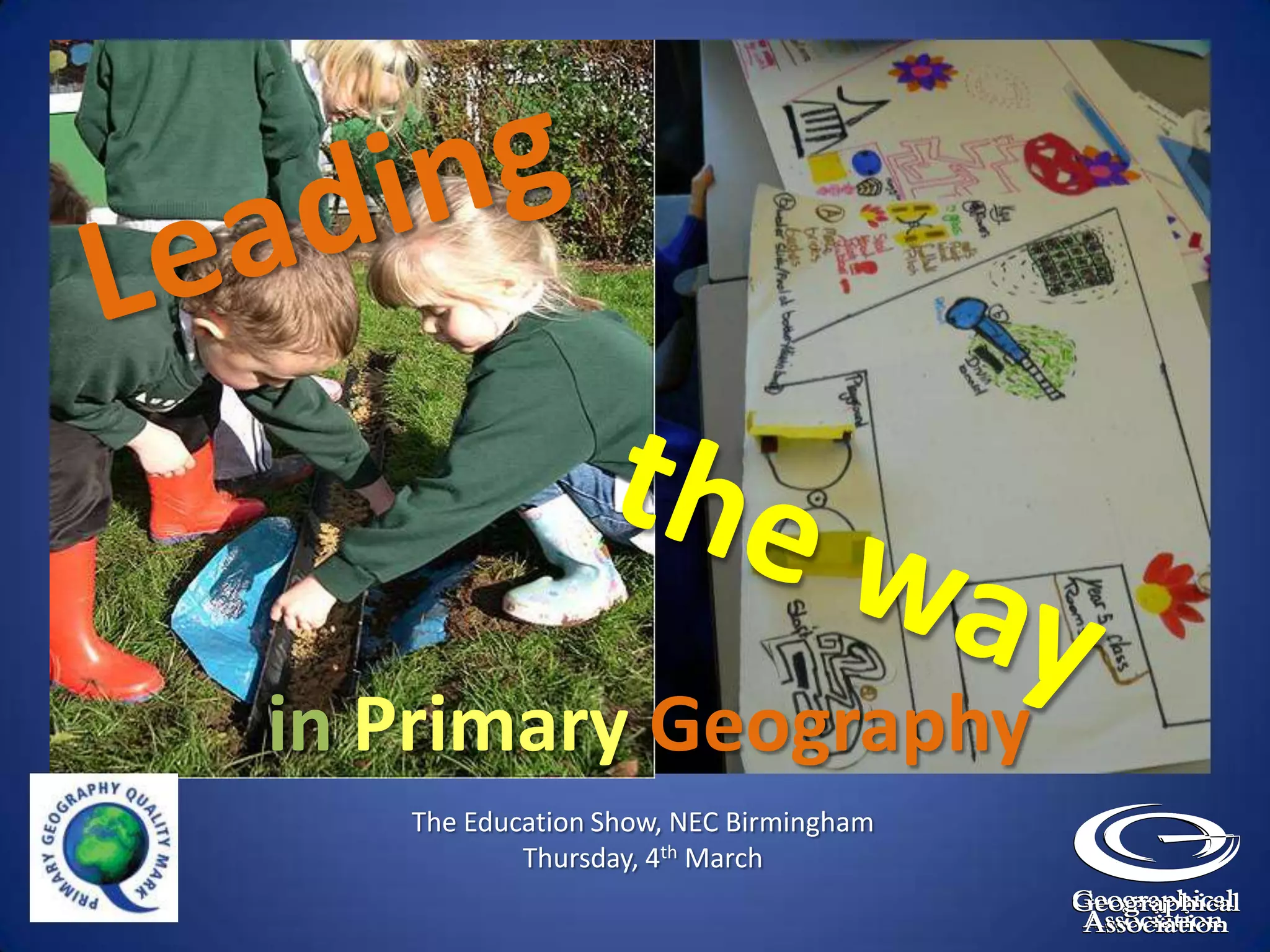
Leadingthe way inPrimary GeographyThe Education Show, NEC BirminghamThursday, 4th March
Seminar Details	The Geographical Association developed the Primary Geography Quality Mark as a tool to support subject leaders who want to develop, evaluate and gain recognition for the quality of their geography curriculum.   Using examples of work that have been submitted by Quality Mark schools, this seminar will focus on some of the key’ areas that underpin effective subject leadership.
What do I want to do in this session?Introduce the framework and PGQM VLE as tools that can be used to support geography subject leadership.Think about:The GA as a leader of geographyYou as a potential leader  of geography in your school (or other institution)You as a leader within your classroom (or sphere of influence)Draw your attention to a new GA website on primary subject leadershiphttp://www.geography.org.uk/cpdevents/onlinecpd/primarysubjectleadership/Conclude by talking about the PGQM registration process.
The Primary Geography Quality MarkAn introduction to the Primary Geography Quality Mark 2010 – can be downloaded from: http://www.geography.org.uk/eyprimary/primaryqualitymark/
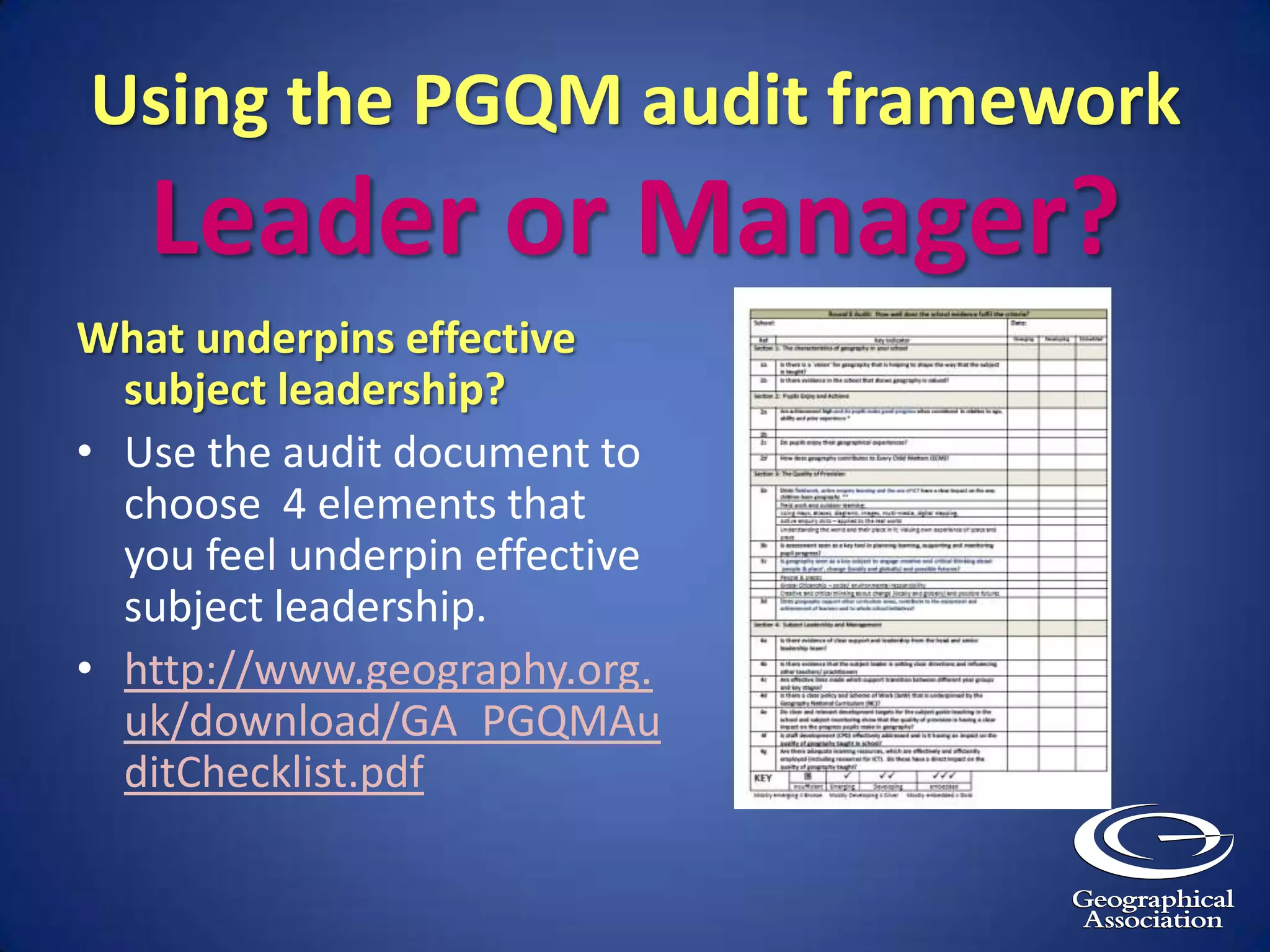
Using the PGQM audit frameworkLeader or Manager?What underpins effective subject leadership?Use the audit document to choose  4 elements that you feel underpin effective subject leadership.http://www.geography.org.uk/download/GA_PGQMAuditChecklist.pdf
My choicesIn this session I intend to focus on the first two:VisionFocusing on distinctly geographical activity & experienceRecognising geographical achievement (knowledge, understanding & skills)Staff development
"The very essence of leadership is that you have to have a vision. It's got to be a vision you articulate clearly and forcefully on every occasion."--Theodore Hesburgh, President of the University of Notre Damehttp://humanresources.about.com/od/leadership/a/leader_vision.htm
Activity: Geography for the 21st Century Think about the content and form of geography in your classroom or school. How might you want to reshape this to make a curriculum fit for the 21st Century? As you view the Animoto slideshow choose two or three ideas in order to persuade colleagues that geography has an important part to play in your school curriculum.
The GA vision for geographyAt a time of change for the primary curriculum why should schools choose to focus on geography?http://www.geography.org.uk/resources/adifferentview
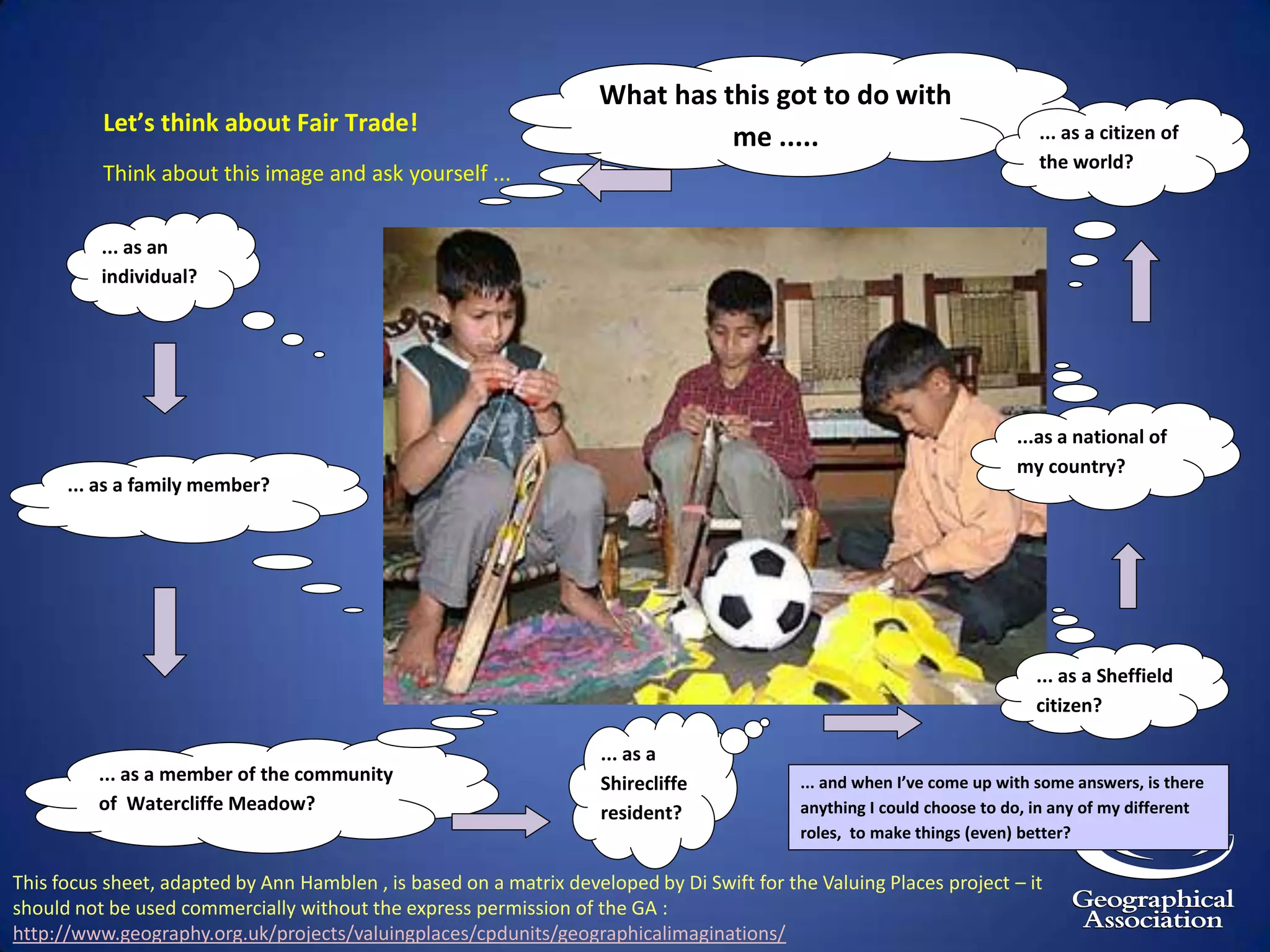
This focus sheet, adapted by Ann Hamblen , is based on a matrix developed by Di Swift for the Valuing Places project – it should not be used commercially without the express permission of the GA : http://www.geography.org.uk/projects/valuingplaces/cpdunits/geographicalimaginations/
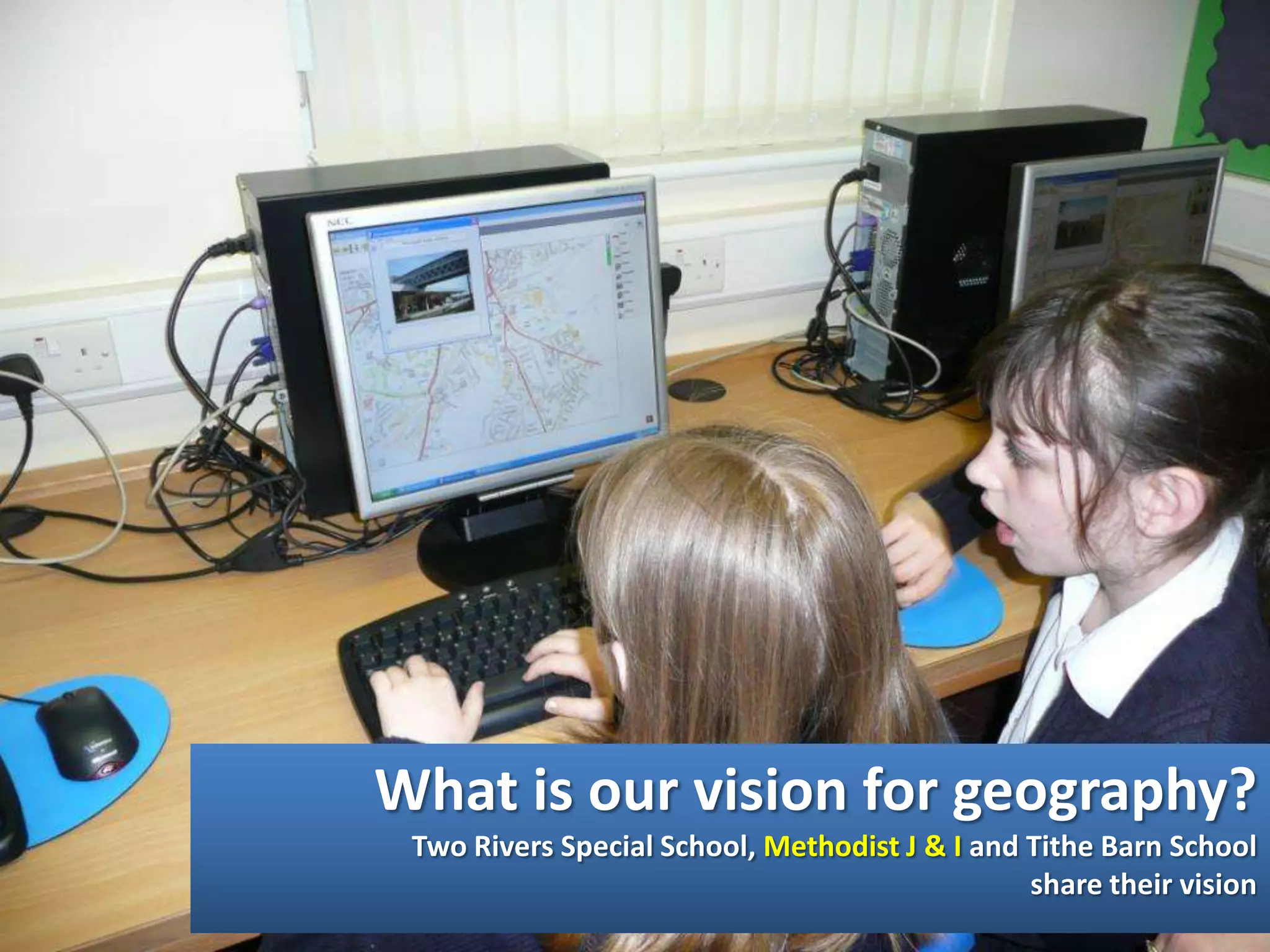
What is our vision for geography?Two Rivers Special School, Methodist J & I and Tithe Barn Schoolshare their vision
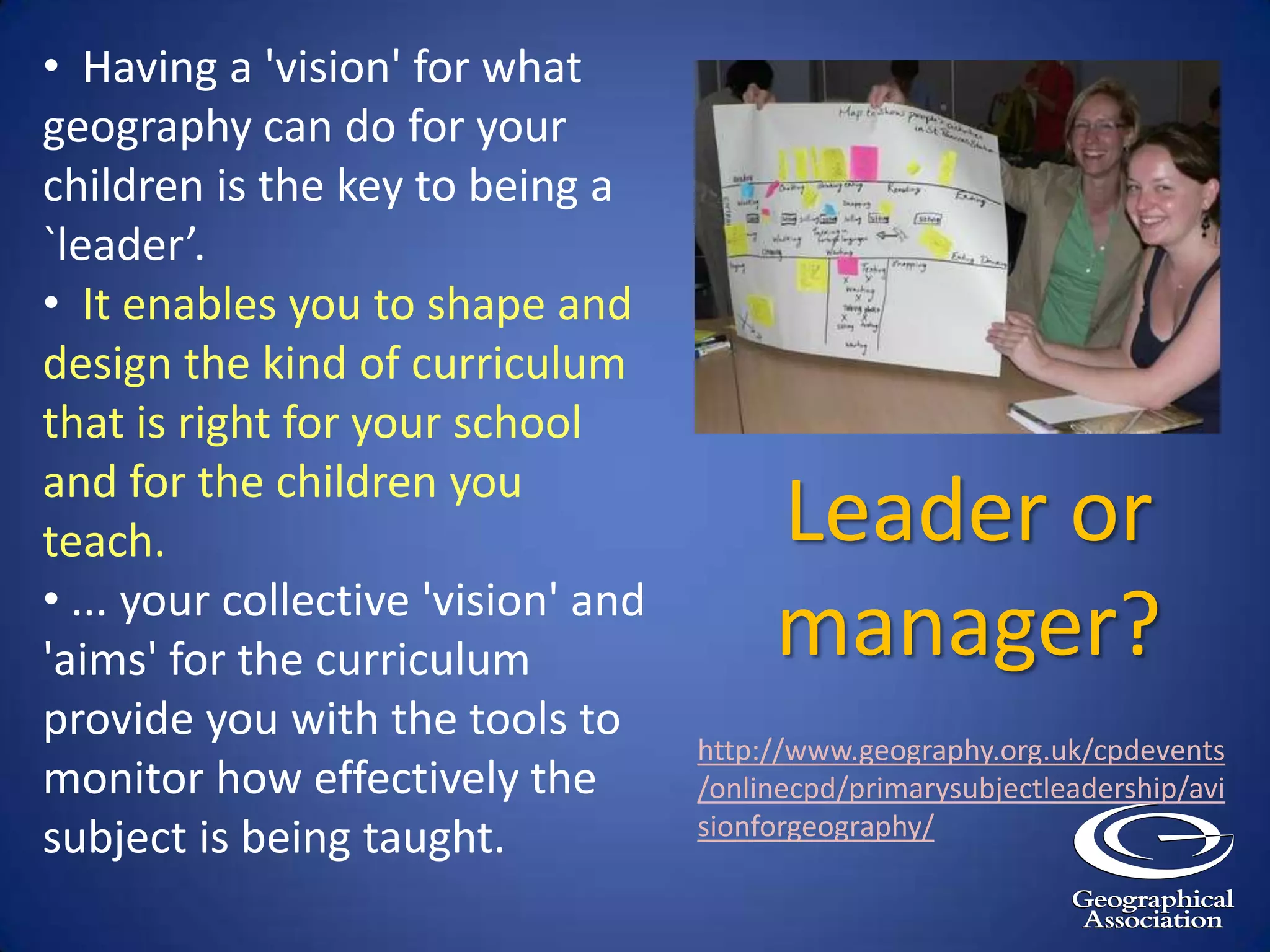
  Having a 'vision' for what geography can do for your children is the key to being a `leader’.
It enables you to shape and design the kind of curriculum that is right for your school and for the children you teach.
 ... your collective 'vision' and 'aims' for the curriculum provide you with the tools to monitor how effectively the subject is being taught.Leader or manager?http://www.geography.org.uk/cpdevents/onlinecpd/primarysubjectleadership/avisionforgeography/
Your starting point may well be a series of questions that you share with staff:What do we want geography to do for our children?  Why is this area of learning important?What if we choose to focus on a particular area of geographical learning, for example the 'global dimension' or 'geographical fieldwork'. How would our children benefit from such an approach?  What would they lose?
PGQM Framework : The characteristics of geography in your school1a. There is a `vision’ for geography that is helping to shape the way that the subject is taught SEF A4.1: the effectiveness of leadership and management in embedding ambition and driving improvement
Activity	As you view the next four slides try to work out how this school sees geography contributing to children’s learning.If you were going to write a `vision’ statement for this school what might you write?We believe that through geography our children will:>>>The examples of geography shared on the following slides were submitted as evidence for the Primary Geography Quality Mark in 2008 & 2009.   See http://pgqm.geography.org.uk/default.asp   you will need to obtain a password for this site.  Contact the Geographical Association  http://www.geography.org.uk/contactus/
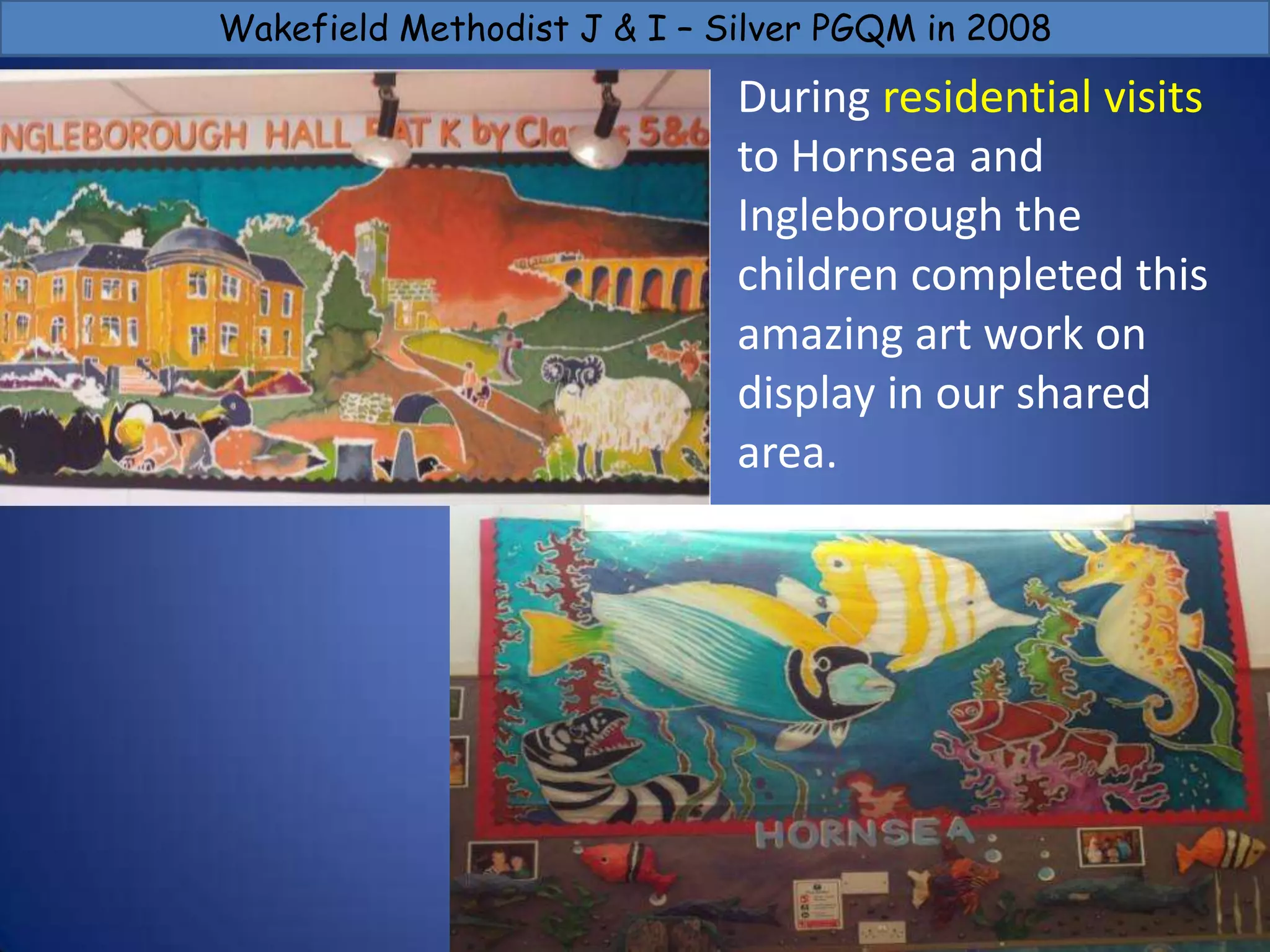
Wakefield Methodist J & I – Silver PGQM in 2008During residential visits to Hornsea and Ingleborough the children completed this amazing art work on display in our shared area.
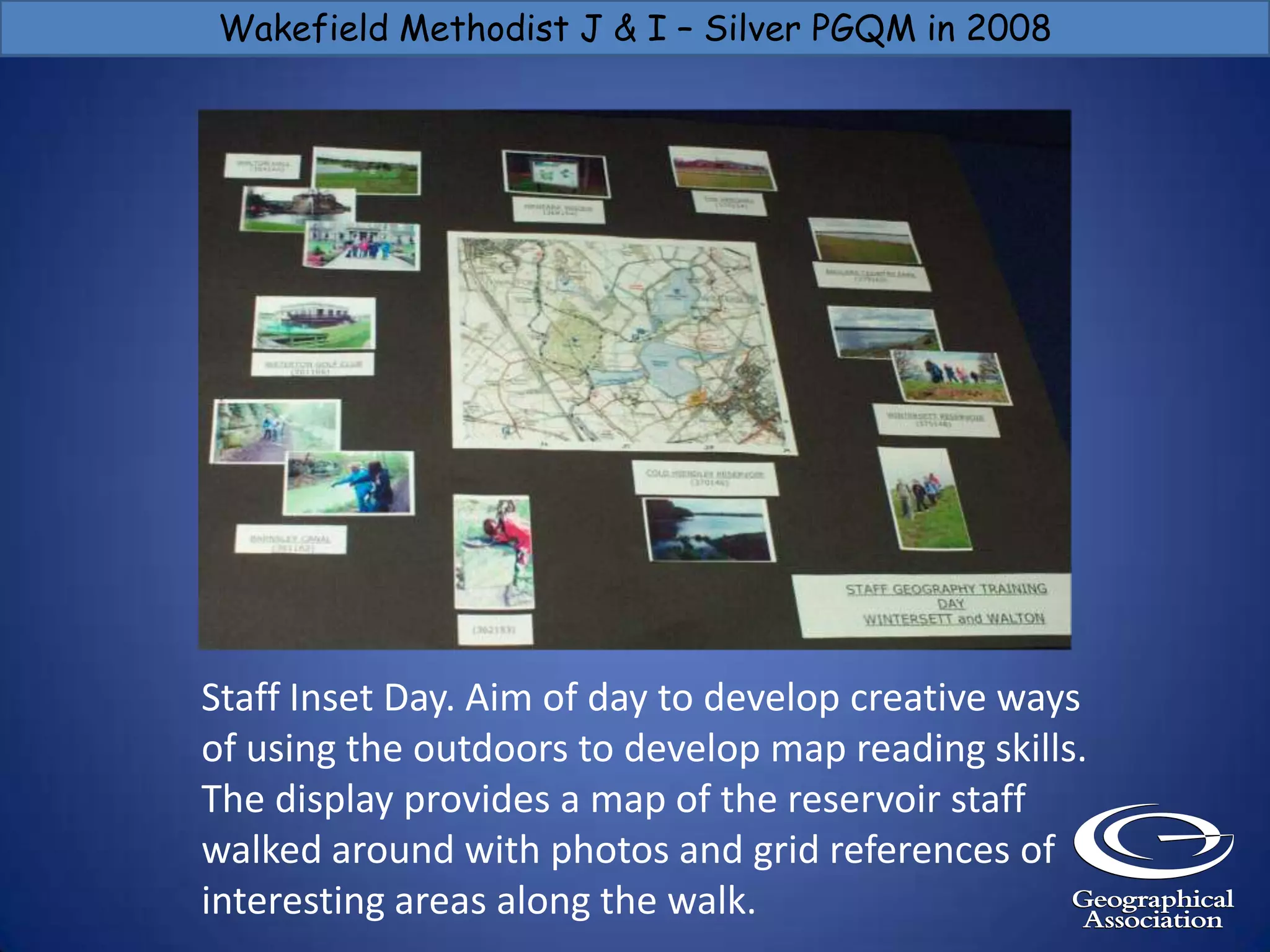
Wakefield Methodist J & I – Silver PGQM in 2008Staff Inset Day. Aim of day to develop creative ways of using the outdoors to develop map reading skills. The display provides a map of the reservoir staff walked around with photos and grid references of interesting areas along the walk.
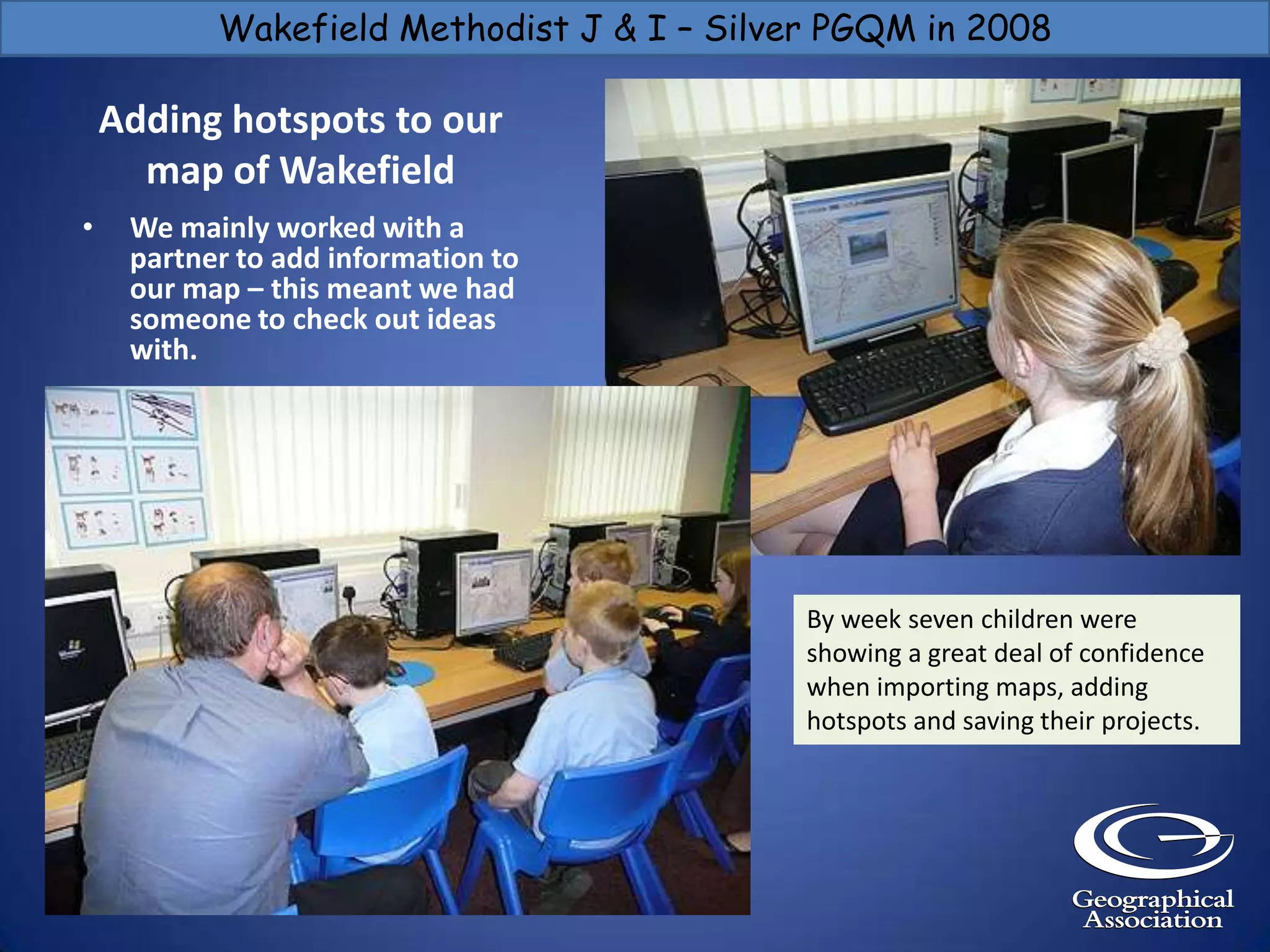
Wakefield Methodist J & I – Silver PGQM in 2008Adding hotspots to our map of WakefieldWe mainly worked with a partner to add information to our map – this meant we had someone to check out ideas with.  By week seven children were showing a great deal of confidence when importing maps, adding hotspots and saving their projects.
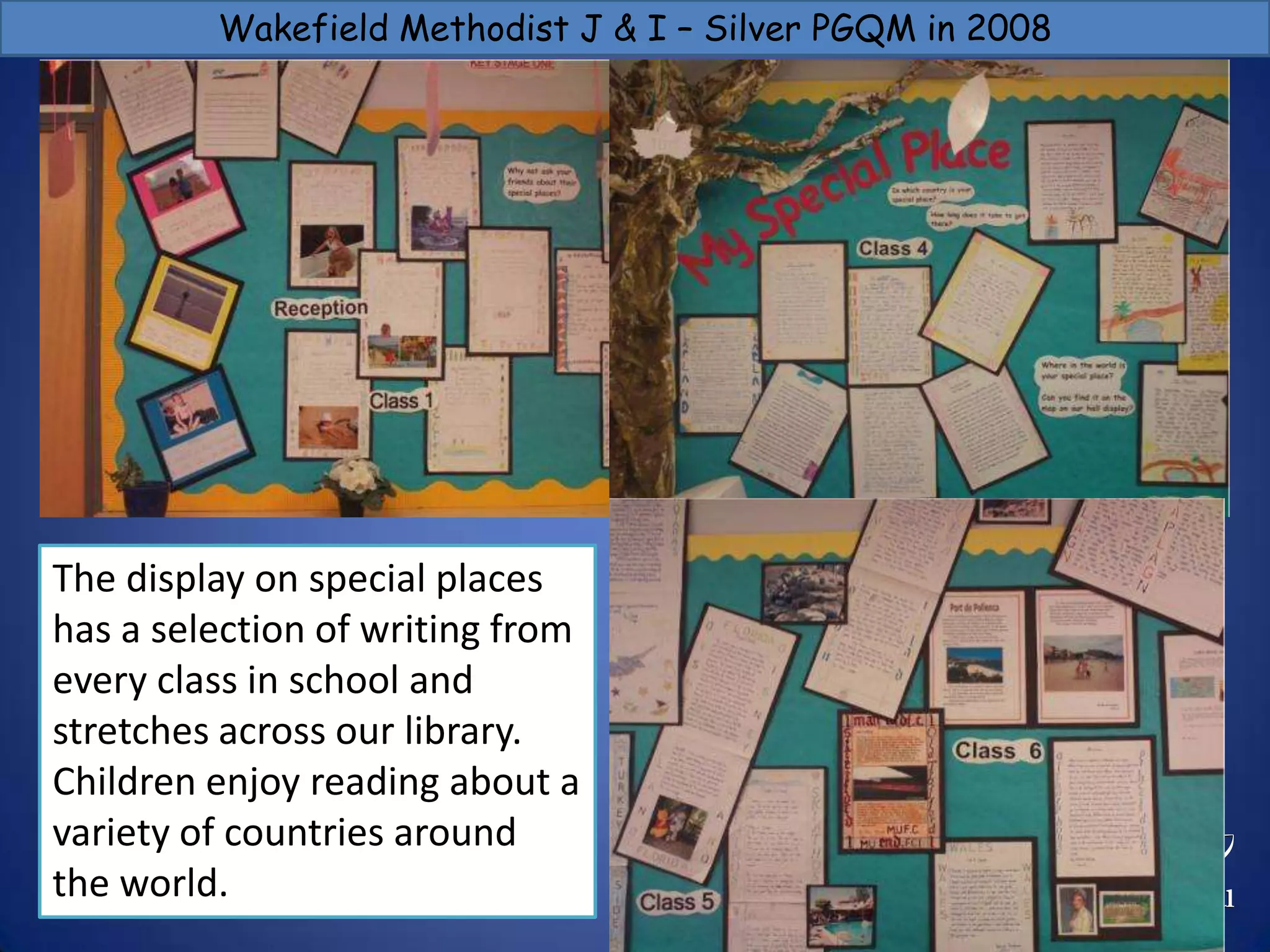
Wakefield Methodist J & I – Silver PGQM in 2008The display on special places has a selection of writing from every class in school and stretches across our library. Children enjoy reading about a variety of countries around the world.
You could think about your `vision’ as a kind of spolight that highlights those areas that reflect your passion and enthusiasms.Different schools = different enthusiasms, e.g.
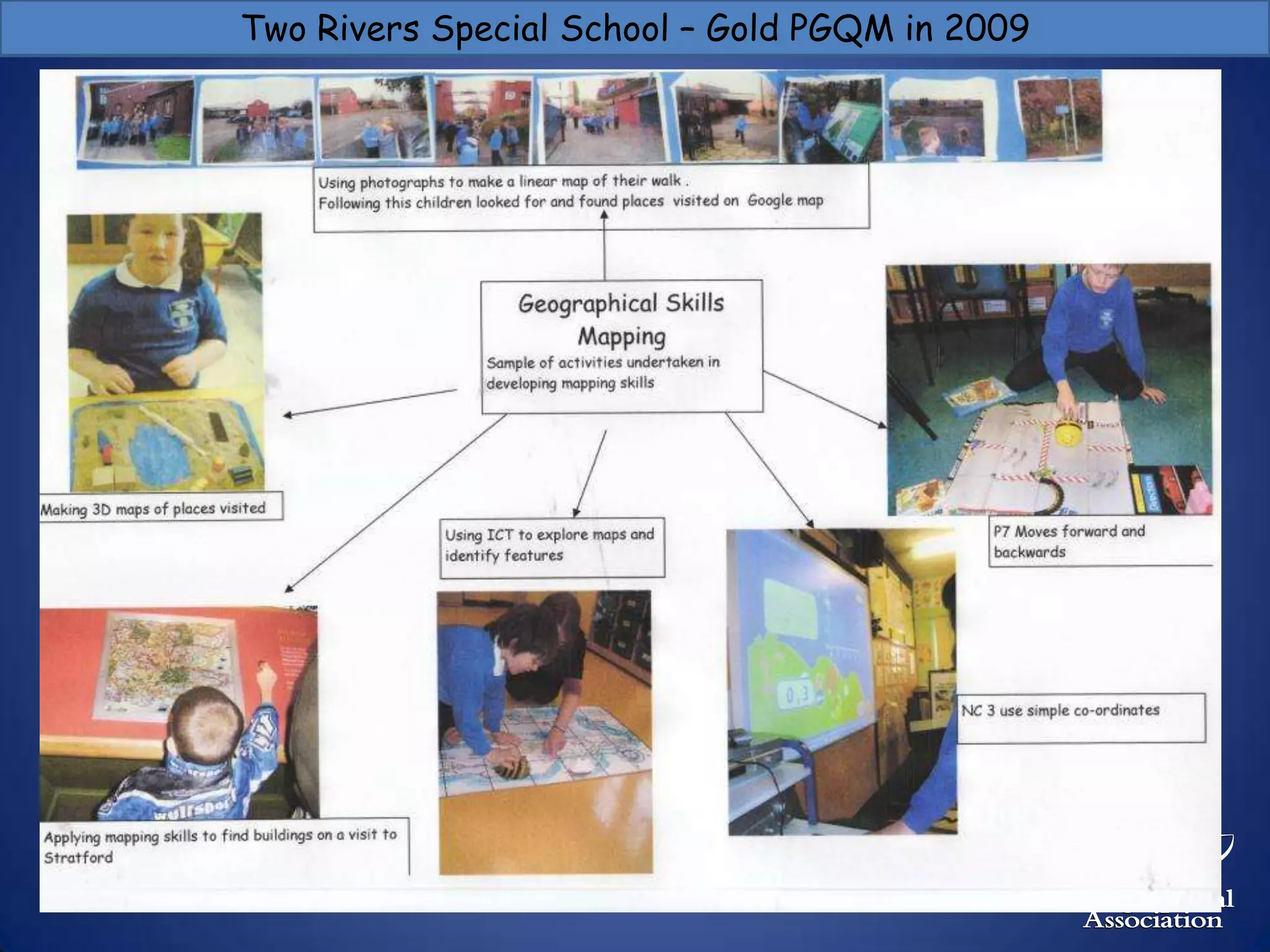
Two Rivers Special School – Gold PGQM in 2009
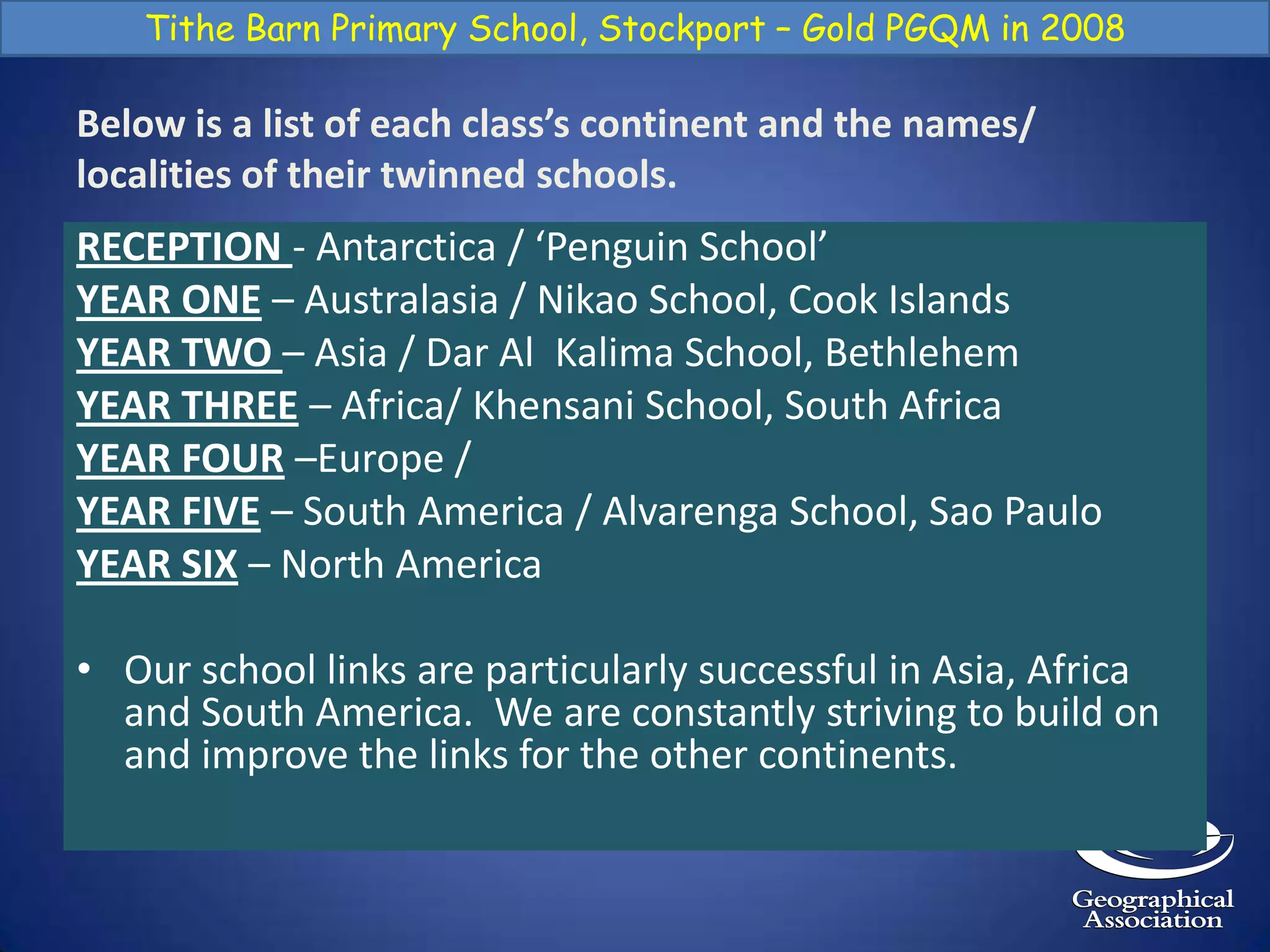
Tithe Barn Primary School, Stockport – Gold PGQM in 2008Below is a list of each class’s continent and the names/ localities of their twinned schools.RECEPTION - Antarctica / ‘Penguin School’YEAR ONE – Australasia / Nikao School, Cook IslandsYEAR TWO – Asia / Dar Al  Kalima School, BethlehemYEAR THREE – Africa/ Khensani School, South AfricaYEAR FOUR –Europe / YEAR FIVE – South America / Alvarenga School, Sao PauloYEAR SIX – North AmericaOur school links are particularly successful in Asia, Africa and South America.  We are constantly striving to build on and improve the links for the other continents.
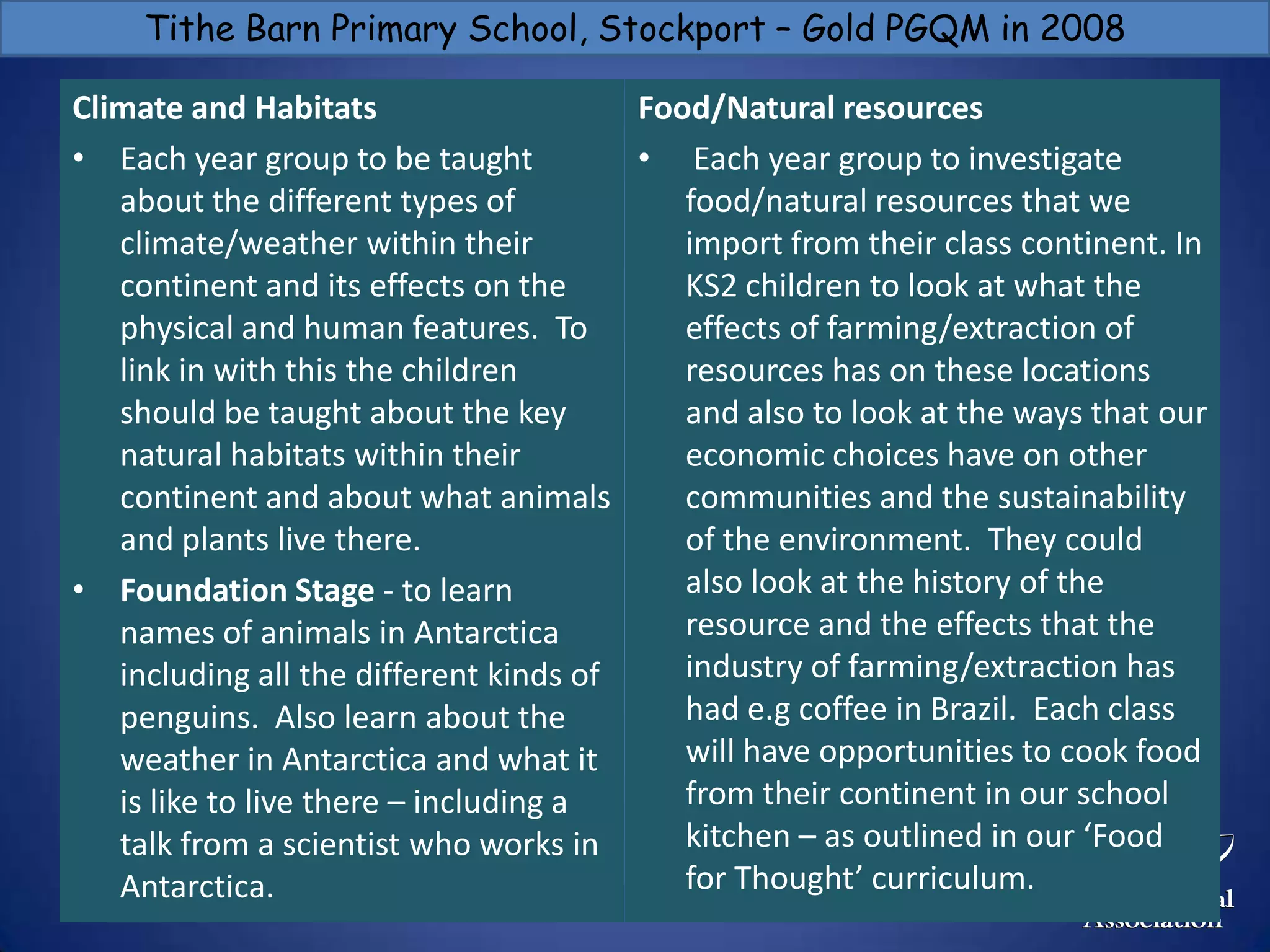
Tithe Barn Primary School, Stockport – Gold PGQM in 2008Climate and HabitatsEach year group to be taught about the different types of climate/weather within their continent and its effects on the physical and human features.  To link in with this the children should be taught about the key natural habitats within their continent and about what animals and plants live there. Foundation Stage - to learn names of animals in Antarctica including all the different kinds of penguins.  Also learn about the weather in Antarctica and what it is like to live there – including a talk from a scientist who works in Antarctica.Food/Natural resources Each year group to investigate food/natural resources that we import from their class continent. In KS2 children to look at what the effects of farming/extraction of resources has on these locations and also to look at the ways that our economic choices have on other communities and the sustainability of the environment.  They could also look at the history of the resource and the effects that the industry of farming/extraction has had e.g coffee in Brazil.  Each class will have opportunities to cook food from their continent in our school kitchen – as outlined in our ‘Food for Thought’ curriculum. 
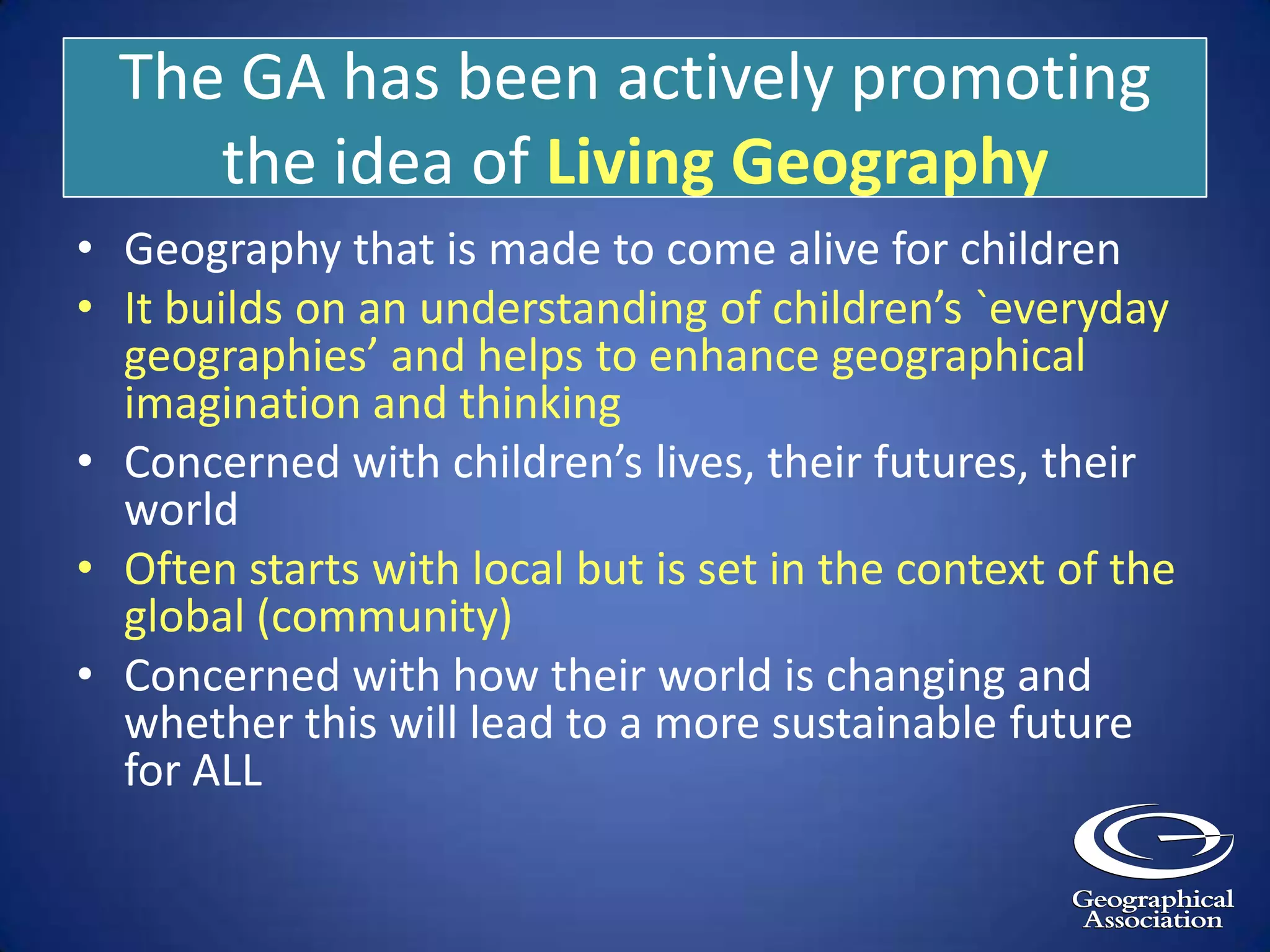
The GA has been actively promoting the idea of Living GeographyGeography that is made to come alive for childrenIt builds on an understanding of children’s `everyday geographies’ and helps to enhance geographical imagination and thinkingConcerned with children’s lives, their futures, their worldOften starts with local but is set in the context of the global (community)Concerned with how their world is changing and whether this will lead to a more sustainable future for ALL
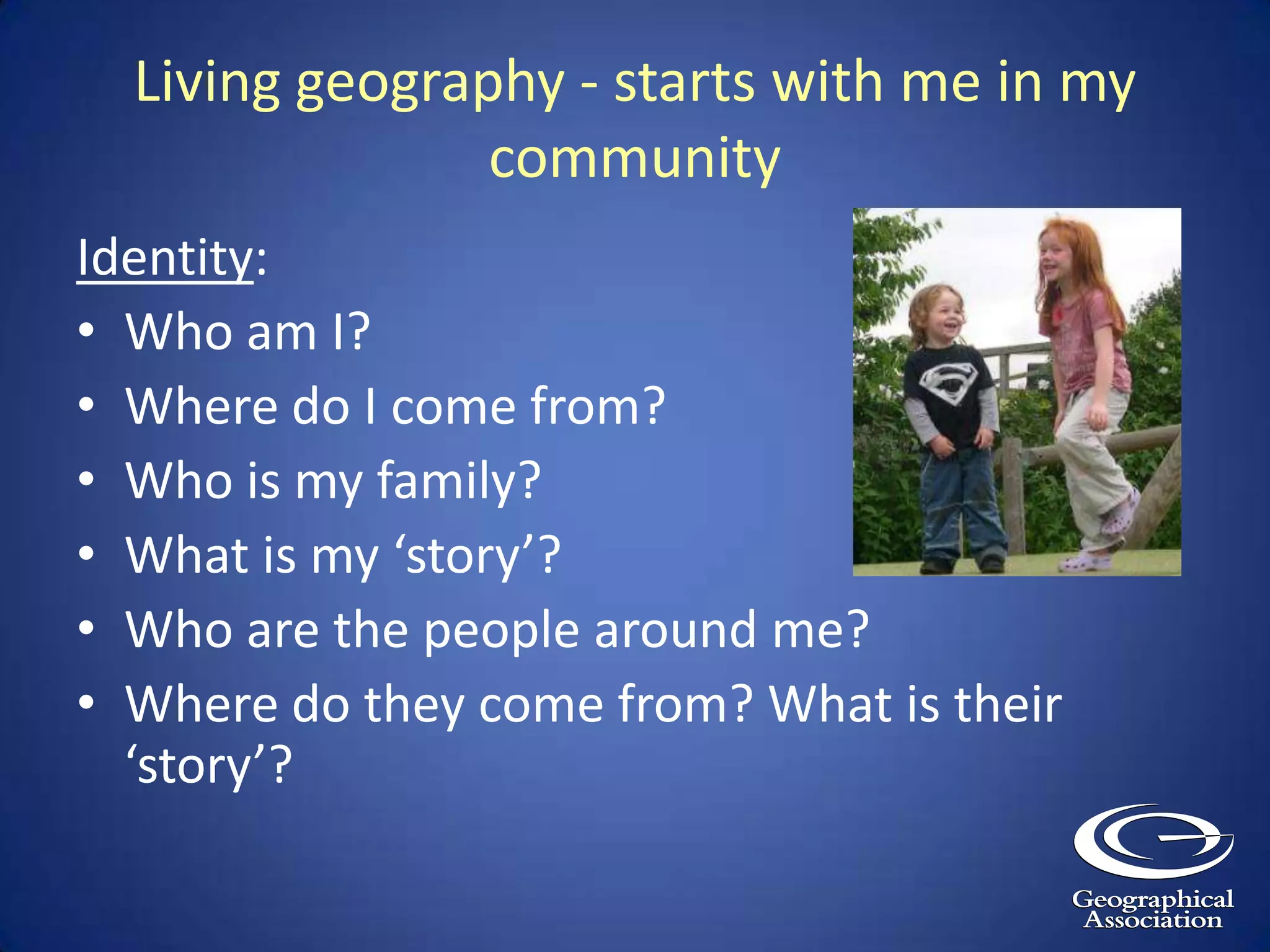
Living geography - starts with me in my communityIdentity: Who am I? Where do I come from? Who is my family? What is my ‘story’? Who are the people around me? Where do they come from? What is their ‘story’?
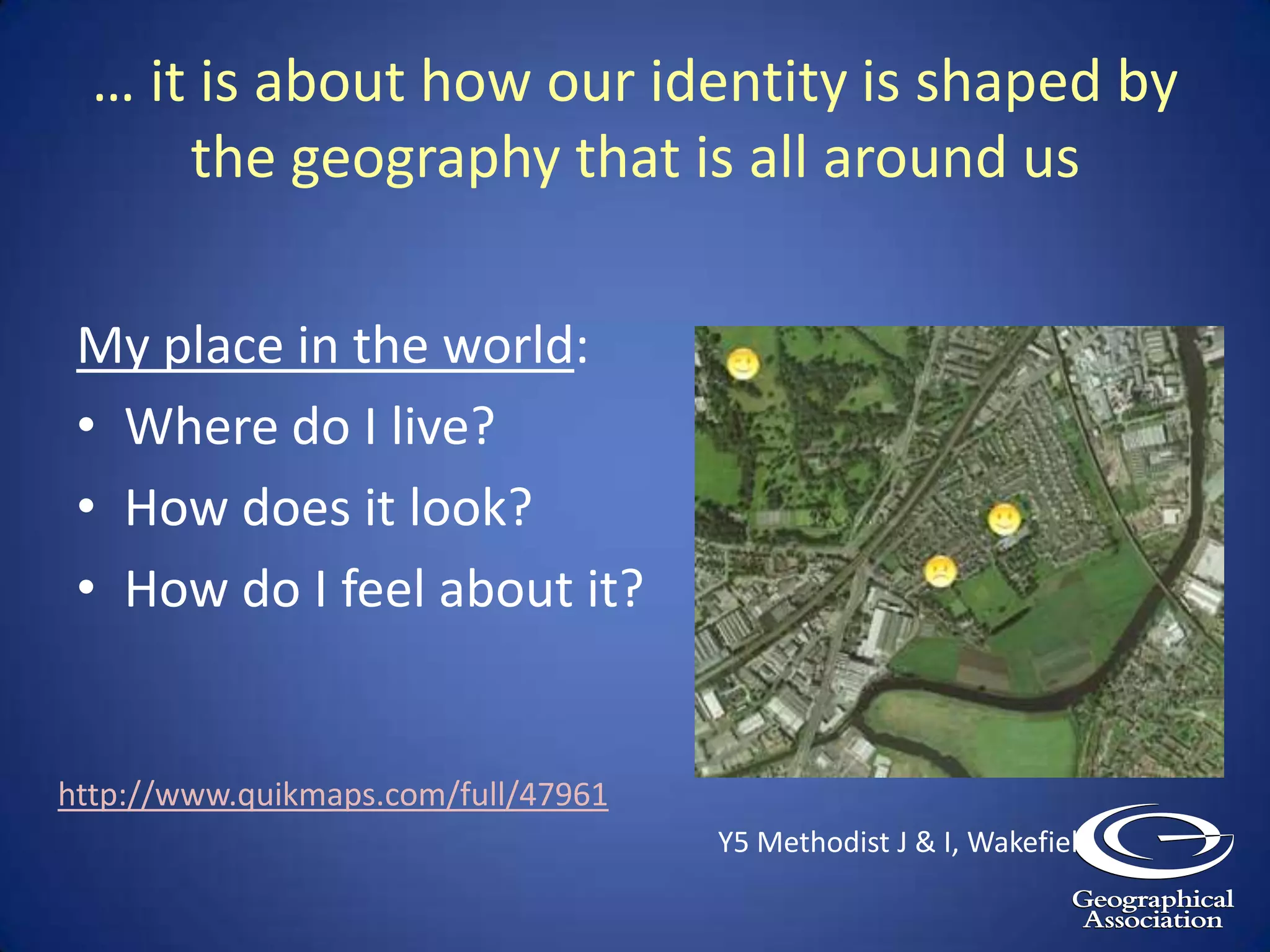
… it is about how our identity is shaped by the geography that is all around usMy place in the world: Where do I live? How does it look? How do I feel about it? http://www.quikmaps.com/full/47961Y5 Methodist J & I, Wakefield
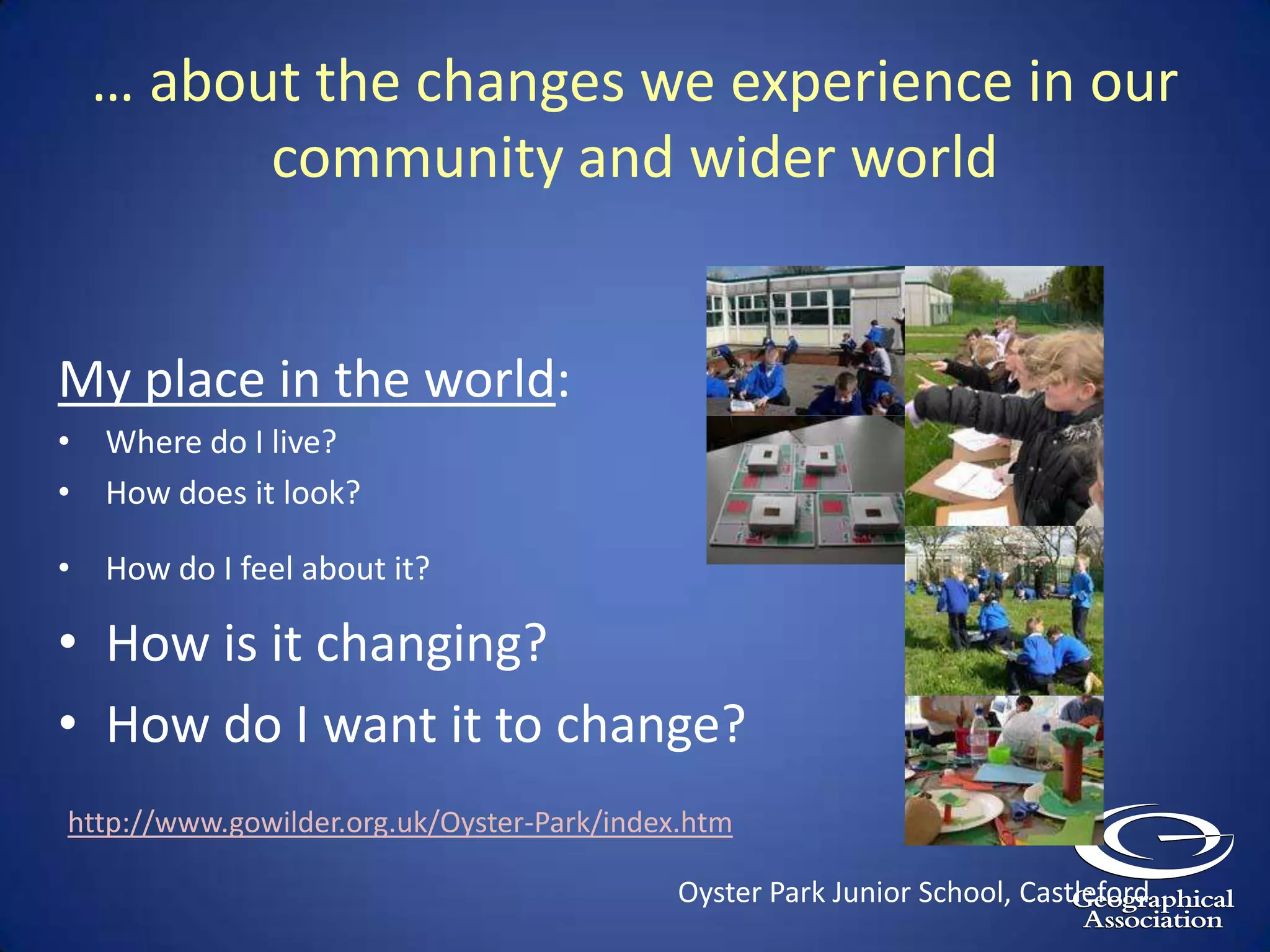
… about the changes we experience in our community and wider worldMy place in the world: Where do I live? How does it look? How do I feel about it?How is it changing? How do I want it to change?http://www.gowilder.org.uk/Oyster-Park/index.htmOyster Park Junior School, Castleford
... and about the world we live inThe Physical world: What is the world (and this place) made of? Why do things move? What becomes of things?The Human world: Who decides on who gets what, and why? What is fair? How do we handle differences of opinion?
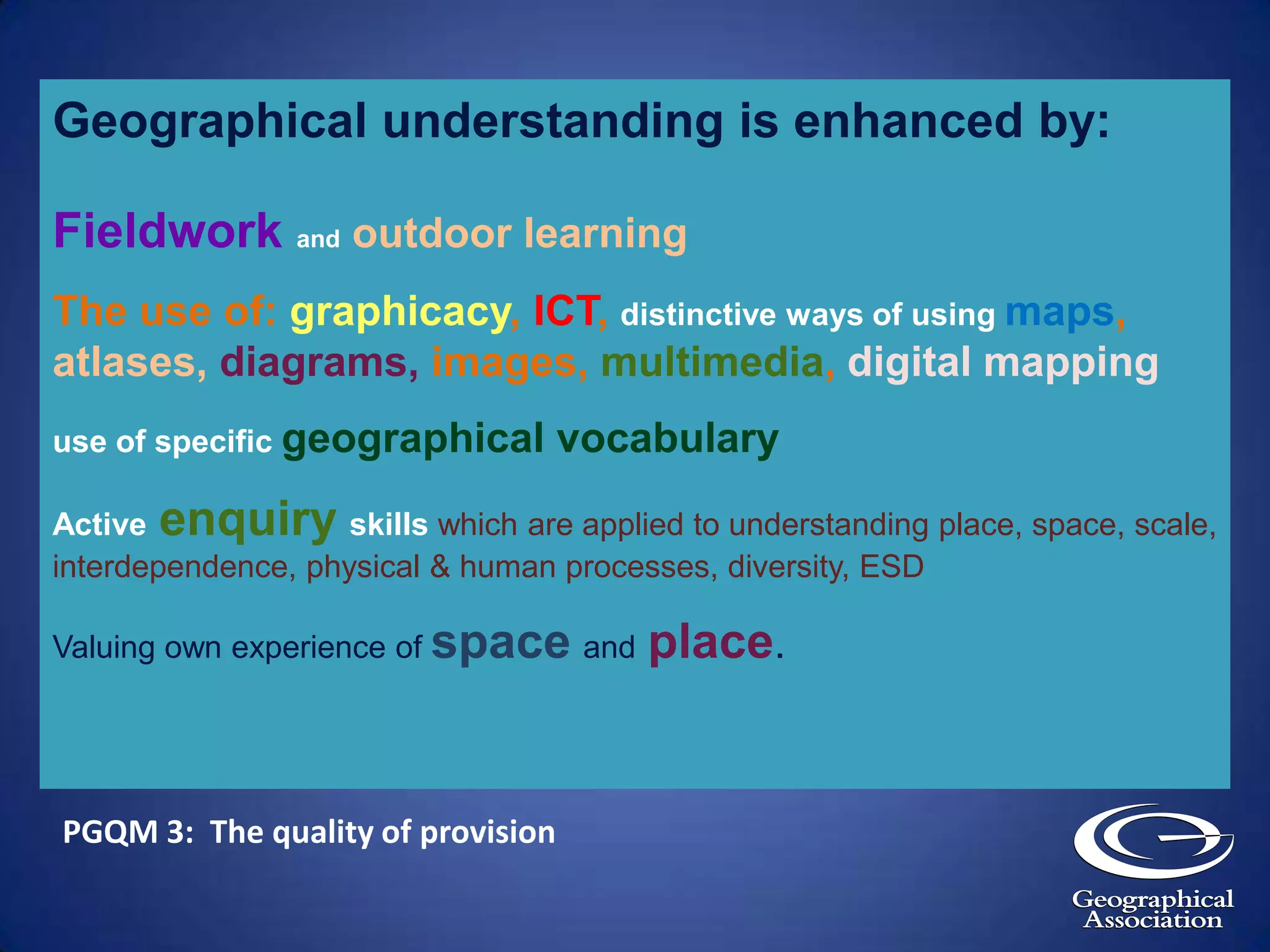
Geographical understanding is enhanced by:Fieldwork andoutdoor learningThe use of: graphicacy, ICT, distinctive ways of usingmaps, atlases,diagrams, images, multimedia, digital mappinguse of specific geographical vocabularyActiveenquiryskills which are applied to understanding place, space, scale, interdependence, physical & human processes, diversity, ESDValuing own experience of spaceandplace. PGQM 3:  The quality of provision
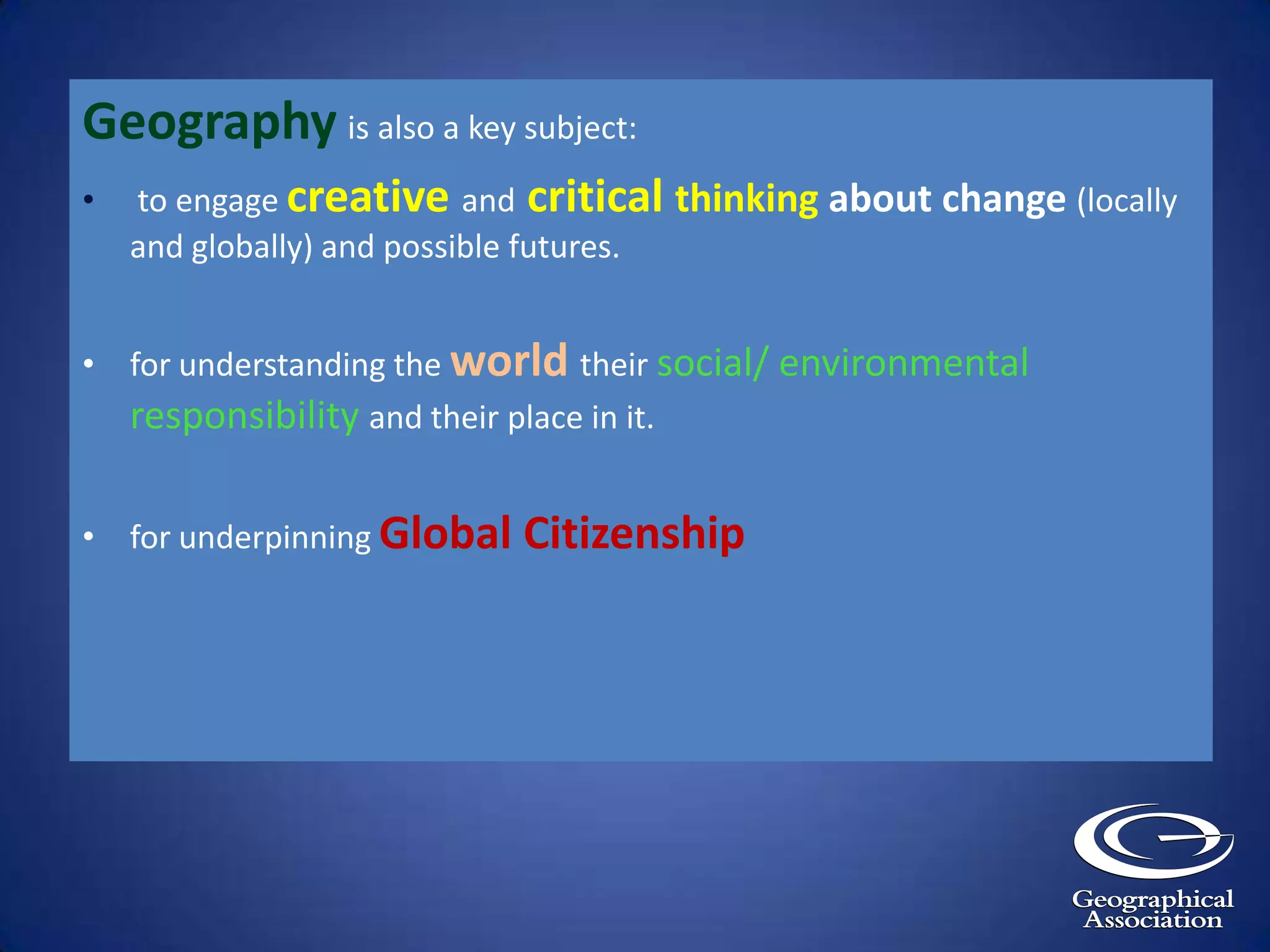
Geographyis also a key subject:to engage creativeandcriticalthinking about change (locally and globally) and possible futures.for understanding the worldtheir social/ environmental responsibilityand their place in it.  for underpinning Global Citizenship
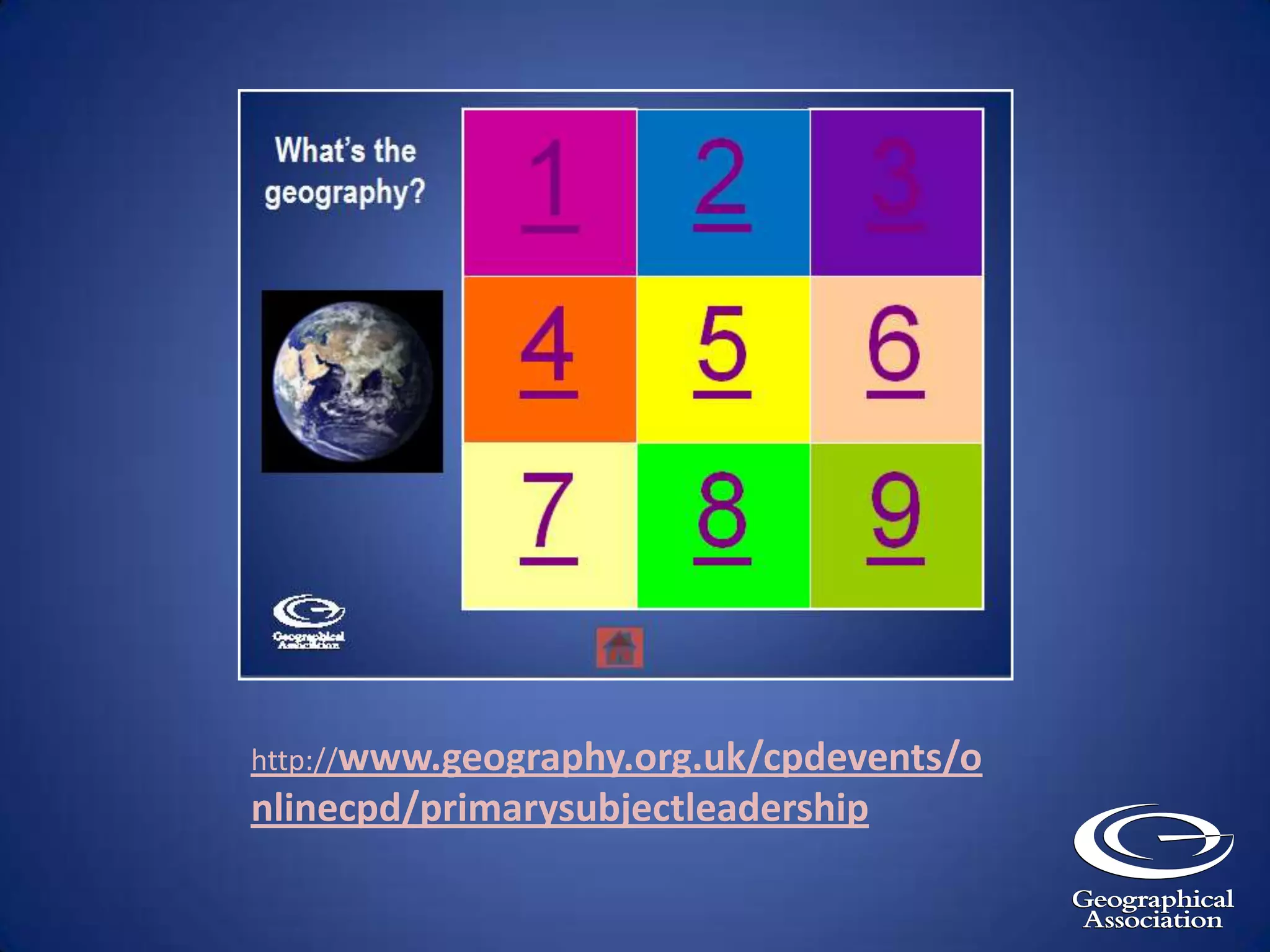
http://www.geography.org.uk/cpdevents/onlinecpd/primarysubjectleadership
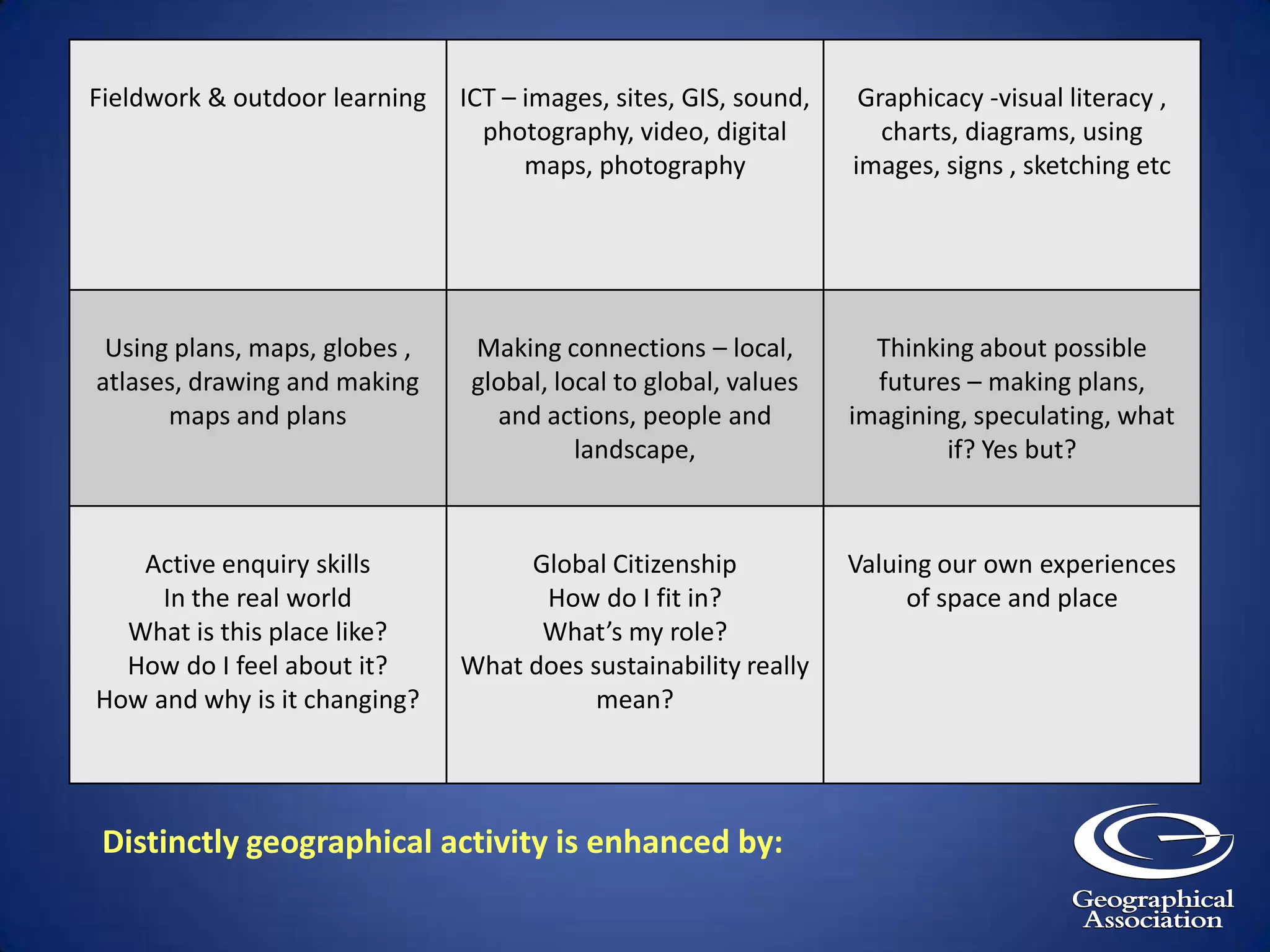
Distinctly geographical activity is enhanced by:
Finding the website: The Primary Geography Quality Mark:http://www.geography.org.uk/eyprimary/primaryqualitymark/CPD Unit:  `Subject leadership in the primary phase’http://www.geography.org.uk/cpdevents/onlinecpd/primarysubjectleadershipEveryday Geographies (my personal blog – I’ll add the 9 number grid activity here)http://primarygeogblog.blogspot.com/

Leading the way in Primary Geography

  • 1.
    Leadingthe way inPrimaryGeographyThe Education Show, NEC BirminghamThursday, 4th March
  • 2.
    Seminar Details The GeographicalAssociation developed the Primary Geography Quality Mark as a tool to support subject leaders who want to develop, evaluate and gain recognition for the quality of their geography curriculum. Using examples of work that have been submitted by Quality Mark schools, this seminar will focus on some of the key’ areas that underpin effective subject leadership.
  • 3.
    What do Iwant to do in this session?Introduce the framework and PGQM VLE as tools that can be used to support geography subject leadership.Think about:The GA as a leader of geographyYou as a potential leader of geography in your school (or other institution)You as a leader within your classroom (or sphere of influence)Draw your attention to a new GA website on primary subject leadershiphttp://www.geography.org.uk/cpdevents/onlinecpd/primarysubjectleadership/Conclude by talking about the PGQM registration process.
  • 4.
    The Primary GeographyQuality MarkAn introduction to the Primary Geography Quality Mark 2010 – can be downloaded from: http://www.geography.org.uk/eyprimary/primaryqualitymark/
  • 5.
    Using the PGQMaudit frameworkLeader or Manager?What underpins effective subject leadership?Use the audit document to choose 4 elements that you feel underpin effective subject leadership.http://www.geography.org.uk/download/GA_PGQMAuditChecklist.pdf
  • 6.
    My choicesIn thissession I intend to focus on the first two:VisionFocusing on distinctly geographical activity & experienceRecognising geographical achievement (knowledge, understanding & skills)Staff development
  • 7.
    "The very essenceof leadership is that you have to have a vision. It's got to be a vision you articulate clearly and forcefully on every occasion."--Theodore Hesburgh, President of the University of Notre Damehttp://humanresources.about.com/od/leadership/a/leader_vision.htm
  • 8.
    Activity: Geography forthe 21st Century Think about the content and form of geography in your classroom or school. How might you want to reshape this to make a curriculum fit for the 21st Century? As you view the Animoto slideshow choose two or three ideas in order to persuade colleagues that geography has an important part to play in your school curriculum.
  • 9.
    The GA visionfor geographyAt a time of change for the primary curriculum why should schools choose to focus on geography?http://www.geography.org.uk/resources/adifferentview
  • 10.
    This focus sheet,adapted by Ann Hamblen , is based on a matrix developed by Di Swift for the Valuing Places project – it should not be used commercially without the express permission of the GA : http://www.geography.org.uk/projects/valuingplaces/cpdunits/geographicalimaginations/
  • 11.
    What is ourvision for geography?Two Rivers Special School, Methodist J & I and Tithe Barn Schoolshare their vision
  • 12.
    Havinga 'vision' for what geography can do for your children is the key to being a `leader’.
  • 13.
    It enables youto shape and design the kind of curriculum that is right for your school and for the children you teach.
  • 14.
    ... yourcollective 'vision' and 'aims' for the curriculum provide you with the tools to monitor how effectively the subject is being taught.Leader or manager?http://www.geography.org.uk/cpdevents/onlinecpd/primarysubjectleadership/avisionforgeography/
  • 15.
    Your starting pointmay well be a series of questions that you share with staff:What do we want geography to do for our children?  Why is this area of learning important?What if we choose to focus on a particular area of geographical learning, for example the 'global dimension' or 'geographical fieldwork'. How would our children benefit from such an approach?  What would they lose?
  • 16.
    PGQM Framework :The characteristics of geography in your school1a. There is a `vision’ for geography that is helping to shape the way that the subject is taught SEF A4.1: the effectiveness of leadership and management in embedding ambition and driving improvement
  • 17.
    Activity As you viewthe next four slides try to work out how this school sees geography contributing to children’s learning.If you were going to write a `vision’ statement for this school what might you write?We believe that through geography our children will:>>>The examples of geography shared on the following slides were submitted as evidence for the Primary Geography Quality Mark in 2008 & 2009. See http://pgqm.geography.org.uk/default.asp you will need to obtain a password for this site. Contact the Geographical Association http://www.geography.org.uk/contactus/
  • 18.
    Wakefield Methodist J& I – Silver PGQM in 2008During residential visits to Hornsea and Ingleborough the children completed this amazing art work on display in our shared area.
  • 19.
    Wakefield Methodist J& I – Silver PGQM in 2008Staff Inset Day. Aim of day to develop creative ways of using the outdoors to develop map reading skills. The display provides a map of the reservoir staff walked around with photos and grid references of interesting areas along the walk.
  • 20.
    Wakefield Methodist J& I – Silver PGQM in 2008Adding hotspots to our map of WakefieldWe mainly worked with a partner to add information to our map – this meant we had someone to check out ideas with. By week seven children were showing a great deal of confidence when importing maps, adding hotspots and saving their projects.
  • 21.
    Wakefield Methodist J& I – Silver PGQM in 2008The display on special places has a selection of writing from every class in school and stretches across our library. Children enjoy reading about a variety of countries around the world.
  • 22.
    You could thinkabout your `vision’ as a kind of spolight that highlights those areas that reflect your passion and enthusiasms.Different schools = different enthusiasms, e.g.
  • 23.
    Two Rivers SpecialSchool – Gold PGQM in 2009
  • 24.
    Tithe Barn PrimarySchool, Stockport – Gold PGQM in 2008Below is a list of each class’s continent and the names/ localities of their twinned schools.RECEPTION - Antarctica / ‘Penguin School’YEAR ONE – Australasia / Nikao School, Cook IslandsYEAR TWO – Asia / Dar Al Kalima School, BethlehemYEAR THREE – Africa/ Khensani School, South AfricaYEAR FOUR –Europe / YEAR FIVE – South America / Alvarenga School, Sao PauloYEAR SIX – North AmericaOur school links are particularly successful in Asia, Africa and South America. We are constantly striving to build on and improve the links for the other continents.
  • 25.
    Tithe Barn PrimarySchool, Stockport – Gold PGQM in 2008Climate and HabitatsEach year group to be taught about the different types of climate/weather within their continent and its effects on the physical and human features. To link in with this the children should be taught about the key natural habitats within their continent and about what animals and plants live there. Foundation Stage - to learn names of animals in Antarctica including all the different kinds of penguins. Also learn about the weather in Antarctica and what it is like to live there – including a talk from a scientist who works in Antarctica.Food/Natural resources Each year group to investigate food/natural resources that we import from their class continent. In KS2 children to look at what the effects of farming/extraction of resources has on these locations and also to look at the ways that our economic choices have on other communities and the sustainability of the environment. They could also look at the history of the resource and the effects that the industry of farming/extraction has had e.g coffee in Brazil. Each class will have opportunities to cook food from their continent in our school kitchen – as outlined in our ‘Food for Thought’ curriculum. 
  • 26.
    The GA hasbeen actively promoting the idea of Living GeographyGeography that is made to come alive for childrenIt builds on an understanding of children’s `everyday geographies’ and helps to enhance geographical imagination and thinkingConcerned with children’s lives, their futures, their worldOften starts with local but is set in the context of the global (community)Concerned with how their world is changing and whether this will lead to a more sustainable future for ALL
  • 27.
    Living geography -starts with me in my communityIdentity: Who am I? Where do I come from? Who is my family? What is my ‘story’? Who are the people around me? Where do they come from? What is their ‘story’?
  • 28.
    … it isabout how our identity is shaped by the geography that is all around usMy place in the world: Where do I live? How does it look? How do I feel about it? http://www.quikmaps.com/full/47961Y5 Methodist J & I, Wakefield
  • 29.
    … about thechanges we experience in our community and wider worldMy place in the world: Where do I live? How does it look? How do I feel about it?How is it changing? How do I want it to change?http://www.gowilder.org.uk/Oyster-Park/index.htmOyster Park Junior School, Castleford
  • 30.
    ... and aboutthe world we live inThe Physical world: What is the world (and this place) made of? Why do things move? What becomes of things?The Human world: Who decides on who gets what, and why? What is fair? How do we handle differences of opinion?
  • 31.
    Geographical understanding isenhanced by:Fieldwork andoutdoor learningThe use of: graphicacy, ICT, distinctive ways of usingmaps, atlases,diagrams, images, multimedia, digital mappinguse of specific geographical vocabularyActiveenquiryskills which are applied to understanding place, space, scale, interdependence, physical & human processes, diversity, ESDValuing own experience of spaceandplace. PGQM 3: The quality of provision
  • 32.
    Geographyis also akey subject:to engage creativeandcriticalthinking about change (locally and globally) and possible futures.for understanding the worldtheir social/ environmental responsibilityand their place in it. for underpinning Global Citizenship
  • 33.
  • 34.
  • 35.
    Finding the website:The Primary Geography Quality Mark:http://www.geography.org.uk/eyprimary/primaryqualitymark/CPD Unit: `Subject leadership in the primary phase’http://www.geography.org.uk/cpdevents/onlinecpd/primarysubjectleadershipEveryday Geographies (my personal blog – I’ll add the 9 number grid activity here)http://primarygeogblog.blogspot.com/
  • 36.
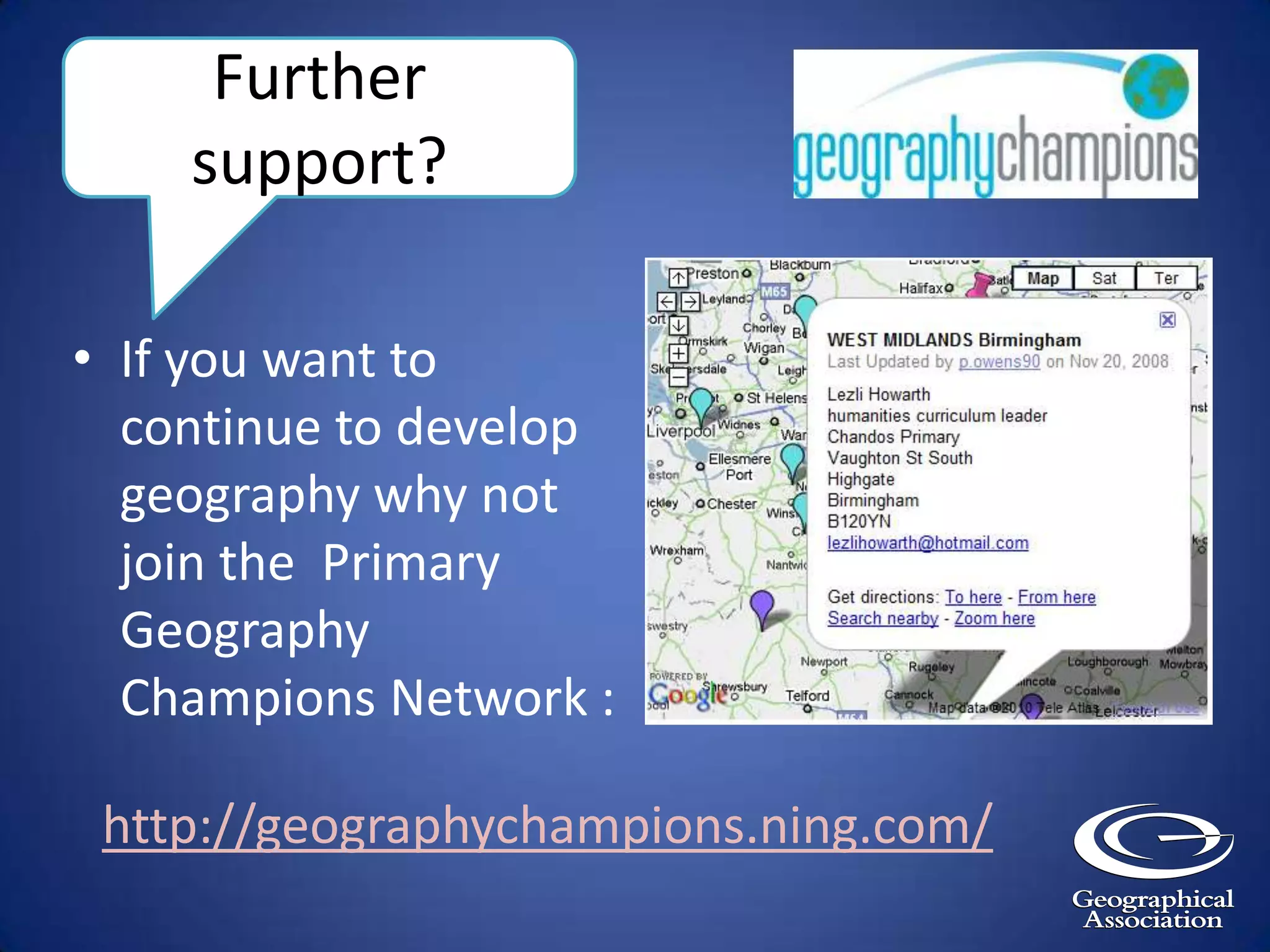
    Further support?If youwant to continue to develop geography why not join the Primary Geography Champions Network :http://geographychampions.ning.com/
  • 37.
    Geography is ...a way of looking at the world that focuses our learning on what places and the environment are like, why they are important to us, how they are changing and how they might develop in the future. Simon Catlin (2004) Primary Geography Handbook

Editor's Notes

  • #30 Brainstorm a list of distinctly geographical activities, approaches and skills. How does it compare to the above? What has been left off?
  • #33 Print this slide off and give to groups as a Bingo card – can they show how each boxed statement might apply to teaching and learning by matching them up with the images in the quiz? Can they explain why? Or, give a practical example of something they have done?