Peninsula
geographysouthwest’s
Primary Newsbites
Issue 2 - October 2022
“Everything is held together with stories. That is all that is holding
us together, stories and compassion.”
Barry Lopez
Welcome to the second of our monthly newsletters, which is aimed at providing ideas and
inspiration for primary geography colleagues whether you are based in the south-west of
England or elsewhere.
Compiled by Alan Parkinson and Emma Espley.
#1022.01
Using maps and the value of maps
Maps are a key tool for geographers, and it is important that those produced
by the Ordnance Survey (OS) are placed into students’ hands as often as
possible. In the recent Teachwire journal article linked to below, Anthony
Barlow of Roehampton University explored some of the tools that can help
bring these maps to life.
https://www.teachwire.net/news/map-skills-ks1-ks2-google/
In the article, there is reference to the BBC’s Regeneratorswebsite, which has
a wealth of games and activities suitable for Early Years and above. They cover
a whole range of themes, often with an environmental stance.
https://www.bbc.co.uk/bitesize/articles/zppx2v4
There is a GreenClassroom focus with an engaging range of animations, which
are shortin length and introducesome interesting concepts and ideas. The
Early Years resources can be found here:
https://www.bbc.co.uk/bitesize/collections/regenerators-lessons-age-5-to-7/1
Your geography southwest newsletter editors were involved in the creation of
these resources too if that gives you extra confidence in their quality!
#1022.02:Become anAntarctica2041School
Oddizzi is a subscription-based website, which has been around for many
years, and provides a rangeof resources and activities for primary teachers.
They are currently inviting pupils, teachers, and schools to join a special
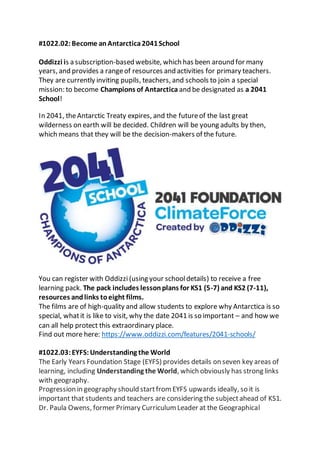
mission: to become Champions of Antarctica and be designated as a 2041
School!
In 2041, theAntarctic Treaty expires, and the futureof the last great
wilderness on earth will be decided. Children will be young adults by then,
which means that they will be the decision-makers of the future.
You can register with Oddizzi (using your schooldetails) to receive a free
learning pack. The pack includes lessonplans for KS1 (5-7) and KS2 (7-11),
resources andlinks toeight films.
The films are of high-quality and allow students to explore why Antarctica is so
special, whatit is like to visit, why the date 2041 is so important – and how we
can all help protect this extraordinary place.
Find out more here: https://www.oddizzi.com/features/2041-schools/
#1022.03:EYFS: Understanding the World
The Early Years Foundation Stage (EYFS) provides details on seven key areas of
learning, including Understanding the World, which obviously has strong links
with geography.
Progression in geography should startfrom EYFS upwards ideally, so it is
important that students and teachers are considering the subjectahead of KS1.
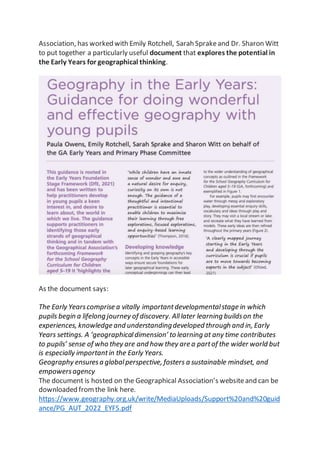
Dr. Paula Owens, former Primary Curriculum Leader at the Geographical
Association, has worked with Emily Rotchell, Sarah Sprakeand Dr. Sharon Witt
to put together a particularly useful document that explores the potential in
the Early Years for geographical thinking.
As the document says:
The Early Yearscomprise a vitally importantdevelopmentalstage in which
pupils begin a lifelong journey of discovery. Alllater learning buildson the
experiences, knowledge and understandingdeveloped through and in, Early
Years settings. A ‘geographicaldimension’ to learning at any time contributes
to pupils’ sense of who they are and how they are a partof the wider world but
is especially importantin the Early Years.
Geography ensuresa globalperspective, fosters a sustainable mindset, and
empowersagency
The document is hosted on the Geographical Association’s websiteand can be
downloaded fromthe link here.
https://www.geography.org.uk/write/MediaUploads/Support%20and%20guid
ance/PG_AUT_2022_EYFS.pdf
The document itself is a four-pagePDF with illustrated examples.
Itwould makea usefulbasis for a discussion between all those responsiblefor
teaching geography within the school and could also form part of
communications home to parents to explain approaches to teaching and
learning. Itmakes a substantialcontribution to discussions around theneed to
take geography seriously very early in a young person’s education.
We hope that the primary section of the geographysouthwestwebsite will also
contribute to those debates as the site develops.
#1022.04 - National Poetry Day 2022
https://nationalpoetryday.co.uk/
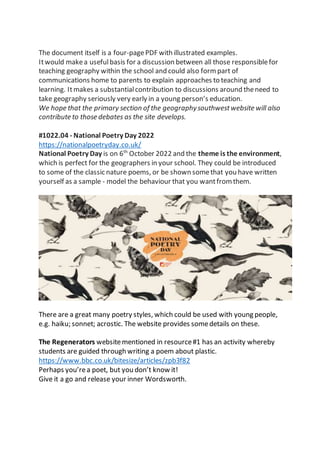
National Poetry Day is on 6th
October 2022 and the theme is the environment,
which is perfect for the geographers in your school. They could be introduced
to some of the classic nature poems, or be shown somethat you have written
yourself as a sample - model the behaviour that you wantfrom them.
There are a great many poetry styles, which could be used with young people,
e.g. haiku; sonnet; acrostic. The website provides somedetails on these.
The Regenerators websitementioned in resource#1 has an activity whereby
students are guided through writing a poem about plastic.
https://www.bbc.co.uk/bitesize/articles/zpb3f82
Perhaps you’rea poet, but you don’t know it!
Give it a go and release your inner Wordsworth.
#1022.05: Get FloodReady
https://wp.lancs.ac.uk/cyp-floodrecovery/our-outputs/get-flood-ready/
In the past, wemight havereferred to flooding, hurricanes, etc. as natural
hazards, butthe current trend is to removethe word ‘natural’ as all of these
events are partly influenced by human activity and decision-making: whether
that is to makethe event more severe, or to providesupport, which reduces
the impact. Decisions to live in certain locations, or to remove vegetation, for
example, can increase the likelihood of being affected.
Of all the hazards thatmight affect people, flooding is the one that is most
likely, and this website offers agame, which can introduce young people to
the needto plan carefully if they live withina zone that has a degree of flood
risk.
#1022.06: Why not take the Slow Way?
The Slow Ways website provides hundreds of routes, which havebeen created
by people to provide an alternative way to travel between locations without
needing to get in the car. They are designed to be accessibleand remove
people frombusy routes to providea quieter means of travel. Each route
needs to be checked and verified by other users beforeit is finally approved for
the website, and this is whereyou (or families of students you teach) might be
persuaded to put on their walking boots and head out into the quieter parts of
your local area.
The website is here: https://beta.slowways.org/
The project has featured on the BBC’s Countryfileprogrammeand large maps
of the country can also be purchased, slowing someof the 8000+routes that
have been created.
Twitter Suggestions
Account Who they are What they tweet about
@stephenscoffham Dr. Stephen
Scoffham:
Visiting
Reader
(Sustainability
and
Education)
Canterbury
ChristChurch
University
UK. GA
President
2018-19.
Primary geography matters, including the
Meaningful Maps project
http://meaningfulmaps.org/
@BenBallin Ben Ballin:
works in the
area of
primary
geography
and
development
education.
A range of issues which are of relevance to
development education and sustainability.
Ben is also leading a Chartered College of
Teaching event on embedding fieldwork,
which is free to attend in early November.
https://my.chartered.college/event/ecseries-
primary-geography-embedding-fieldwork-in-
practice/
@pauliesprigeog Paulie’s
Primary
Geography
A new accounttweeting a selection of items
that are of relevance to primary
geographers, somebased on their own
experiences.
Reading List
A new Oliver Jeffers book is always worth a mention, and this week sees the
publication of the 3rd
in a trilogy of books aboutthe Earth and our relationship
with it (https://www.oliverjeffers.com/). Thefirst, published in 2017 and
entitled Here we are: notes for living on Planet Earth, was an attempt to
explain the world to his new-born, and beautifully describes the planet - this is
a fantastic picture book for lower KS1. Oliver also recorded a TED talk, which
uses some of the images, and provides an excellent summary of his thinking. It
is called An ode to living on Earth.
https://www.ted.com/talks/oliver_jeffers_an_ode_to_living_on_earth?langua
ge=en
The second, published in 2020 and named Whatwe’ll build: plansfor our
together future. Oliver says this book “is all aboutthe pure potentialof what
will come, both good and bad, and how, ultimately, people need each other.
Even if that is just for someone to listen to all your plans.”
The final in the trilogy is called
Meanwhile back on Earth.
A father takes his two children on a
thrilling out-of-this-world adventureinto
spaceand invites them to look back at
Earth and the conflicts that have taken
place since the beginning of time. This
becomes a brief history of the world and
a whistle-stop guide to the universe, all
rolled into one,
There are some further book suggestions here:
https://www.booksfortopics.com/printable-booklists
We also loved the non-fiction
suggestions pictured by
Rosemary Burkehere:
What’s On
Within each issue of Primary Newsbites, we will sharedetails of at least one
event or film/TV programmethat we think you may find interesting.
Many primary schools study SouthAmerica, particularly Brazil. The popular
author, presenter and traveller Simon Reeves has justfinished exploring the
continent. All episodes can be viewed on iPlayer, and while the clips need to be
used with care, there are a few shortsequences in locations, such as Machu
Picchu and the Salar de Uyunisalt flats in Bolivia, that are worth showing. The
latter is incredible when flooded, reflecting the sky and anything that moves
along it. There is also a trip to the Peruvian desert, which became a dumping
ground for clothes recently.
The iPlayer link to the series is here:
https://www.bbc.co.uk/iplayer/episodes/m001c2mn/simon-reeves-south-
america
With HarvestFestivalcoming up, you may also be interested in a BBC Live
Lesson on the theme of Harvest andfood, which has a selection of supporting
resources to download for free. Food is an issue for many families currently,
given the pressureon household budgets, so this may be a topic that needs to
be treated with somesensitivity.
https://www.bbc.co.uk/teach/live-lessons/harvest-live-lesson
If you have an idea that you wish to contribute, then please get in touch and
tell us morevia Twitter @GeoBlogs or email: aparkinson@gmail.com
The deadline for Issue 3 is the 27thof October 2022.
Moreover, we would love to showcase your workin future issues, so please feel
free to provide feedback relating to anything thatyou were inspired to trial or
explore after reading this post.

Primary Newsbites - October 2022

  • 1.
    Peninsula geographysouthwest’s Primary Newsbites Issue 2- October 2022 “Everything is held together with stories. That is all that is holding us together, stories and compassion.” Barry Lopez Welcome to the second of our monthly newsletters, which is aimed at providing ideas and inspiration for primary geography colleagues whether you are based in the south-west of England or elsewhere. Compiled by Alan Parkinson and Emma Espley. #1022.01 Using maps and the value of maps Maps are a key tool for geographers, and it is important that those produced by the Ordnance Survey (OS) are placed into students’ hands as often as possible. In the recent Teachwire journal article linked to below, Anthony Barlow of Roehampton University explored some of the tools that can help bring these maps to life. https://www.teachwire.net/news/map-skills-ks1-ks2-google/ In the article, there is reference to the BBC’s Regeneratorswebsite, which has a wealth of games and activities suitable for Early Years and above. They cover a whole range of themes, often with an environmental stance. https://www.bbc.co.uk/bitesize/articles/zppx2v4 There is a GreenClassroom focus with an engaging range of animations, which are shortin length and introducesome interesting concepts and ideas. The Early Years resources can be found here: https://www.bbc.co.uk/bitesize/collections/regenerators-lessons-age-5-to-7/1 Your geography southwest newsletter editors were involved in the creation of these resources too if that gives you extra confidence in their quality!
  • 2.
    #1022.02:Become anAntarctica2041School Oddizzi isa subscription-based website, which has been around for many years, and provides a rangeof resources and activities for primary teachers. They are currently inviting pupils, teachers, and schools to join a special mission: to become Champions of Antarctica and be designated as a 2041 School! In 2041, theAntarctic Treaty expires, and the futureof the last great wilderness on earth will be decided. Children will be young adults by then, which means that they will be the decision-makers of the future. You can register with Oddizzi (using your schooldetails) to receive a free learning pack. The pack includes lessonplans for KS1 (5-7) and KS2 (7-11), resources andlinks toeight films. The films are of high-quality and allow students to explore why Antarctica is so special, whatit is like to visit, why the date 2041 is so important – and how we can all help protect this extraordinary place. Find out more here: https://www.oddizzi.com/features/2041-schools/ #1022.03:EYFS: Understanding the World The Early Years Foundation Stage (EYFS) provides details on seven key areas of learning, including Understanding the World, which obviously has strong links with geography. Progression in geography should startfrom EYFS upwards ideally, so it is important that students and teachers are considering the subjectahead of KS1. Dr. Paula Owens, former Primary Curriculum Leader at the Geographical
  • 3.
    Association, has workedwith Emily Rotchell, Sarah Sprakeand Dr. Sharon Witt to put together a particularly useful document that explores the potential in the Early Years for geographical thinking. As the document says: The Early Yearscomprise a vitally importantdevelopmentalstage in which pupils begin a lifelong journey of discovery. Alllater learning buildson the experiences, knowledge and understandingdeveloped through and in, Early Years settings. A ‘geographicaldimension’ to learning at any time contributes to pupils’ sense of who they are and how they are a partof the wider world but is especially importantin the Early Years. Geography ensuresa globalperspective, fosters a sustainable mindset, and empowersagency The document is hosted on the Geographical Association’s websiteand can be downloaded fromthe link here. https://www.geography.org.uk/write/MediaUploads/Support%20and%20guid ance/PG_AUT_2022_EYFS.pdf
  • 4.
    The document itselfis a four-pagePDF with illustrated examples. Itwould makea usefulbasis for a discussion between all those responsiblefor teaching geography within the school and could also form part of communications home to parents to explain approaches to teaching and learning. Itmakes a substantialcontribution to discussions around theneed to take geography seriously very early in a young person’s education. We hope that the primary section of the geographysouthwestwebsite will also contribute to those debates as the site develops. #1022.04 - National Poetry Day 2022 https://nationalpoetryday.co.uk/ National Poetry Day is on 6th October 2022 and the theme is the environment, which is perfect for the geographers in your school. They could be introduced to some of the classic nature poems, or be shown somethat you have written yourself as a sample - model the behaviour that you wantfrom them. There are a great many poetry styles, which could be used with young people, e.g. haiku; sonnet; acrostic. The website provides somedetails on these. The Regenerators websitementioned in resource#1 has an activity whereby students are guided through writing a poem about plastic. https://www.bbc.co.uk/bitesize/articles/zpb3f82 Perhaps you’rea poet, but you don’t know it! Give it a go and release your inner Wordsworth.
  • 5.
    #1022.05: Get FloodReady https://wp.lancs.ac.uk/cyp-floodrecovery/our-outputs/get-flood-ready/ Inthe past, wemight havereferred to flooding, hurricanes, etc. as natural hazards, butthe current trend is to removethe word ‘natural’ as all of these events are partly influenced by human activity and decision-making: whether that is to makethe event more severe, or to providesupport, which reduces the impact. Decisions to live in certain locations, or to remove vegetation, for example, can increase the likelihood of being affected. Of all the hazards thatmight affect people, flooding is the one that is most likely, and this website offers agame, which can introduce young people to the needto plan carefully if they live withina zone that has a degree of flood risk. #1022.06: Why not take the Slow Way? The Slow Ways website provides hundreds of routes, which havebeen created by people to provide an alternative way to travel between locations without needing to get in the car. They are designed to be accessibleand remove people frombusy routes to providea quieter means of travel. Each route needs to be checked and verified by other users beforeit is finally approved for the website, and this is whereyou (or families of students you teach) might be persuaded to put on their walking boots and head out into the quieter parts of your local area. The website is here: https://beta.slowways.org/ The project has featured on the BBC’s Countryfileprogrammeand large maps of the country can also be purchased, slowing someof the 8000+routes that have been created.
  • 6.
    Twitter Suggestions Account Whothey are What they tweet about @stephenscoffham Dr. Stephen Scoffham: Visiting Reader (Sustainability and Education) Canterbury ChristChurch University UK. GA President 2018-19. Primary geography matters, including the Meaningful Maps project http://meaningfulmaps.org/ @BenBallin Ben Ballin: works in the area of primary geography and development education. A range of issues which are of relevance to development education and sustainability. Ben is also leading a Chartered College of Teaching event on embedding fieldwork, which is free to attend in early November. https://my.chartered.college/event/ecseries- primary-geography-embedding-fieldwork-in- practice/ @pauliesprigeog Paulie’s Primary Geography A new accounttweeting a selection of items that are of relevance to primary geographers, somebased on their own experiences. Reading List A new Oliver Jeffers book is always worth a mention, and this week sees the publication of the 3rd in a trilogy of books aboutthe Earth and our relationship with it (https://www.oliverjeffers.com/). Thefirst, published in 2017 and entitled Here we are: notes for living on Planet Earth, was an attempt to explain the world to his new-born, and beautifully describes the planet - this is a fantastic picture book for lower KS1. Oliver also recorded a TED talk, which uses some of the images, and provides an excellent summary of his thinking. It is called An ode to living on Earth.
  • 7.
    https://www.ted.com/talks/oliver_jeffers_an_ode_to_living_on_earth?langua ge=en The second, publishedin 2020 and named Whatwe’ll build: plansfor our together future. Oliver says this book “is all aboutthe pure potentialof what will come, both good and bad, and how, ultimately, people need each other. Even if that is just for someone to listen to all your plans.” The final in the trilogy is called Meanwhile back on Earth. A father takes his two children on a thrilling out-of-this-world adventureinto spaceand invites them to look back at Earth and the conflicts that have taken place since the beginning of time. This becomes a brief history of the world and a whistle-stop guide to the universe, all rolled into one, There are some further book suggestions here: https://www.booksfortopics.com/printable-booklists
  • 8.
    We also lovedthe non-fiction suggestions pictured by Rosemary Burkehere: What’s On Within each issue of Primary Newsbites, we will sharedetails of at least one event or film/TV programmethat we think you may find interesting. Many primary schools study SouthAmerica, particularly Brazil. The popular author, presenter and traveller Simon Reeves has justfinished exploring the continent. All episodes can be viewed on iPlayer, and while the clips need to be used with care, there are a few shortsequences in locations, such as Machu Picchu and the Salar de Uyunisalt flats in Bolivia, that are worth showing. The latter is incredible when flooded, reflecting the sky and anything that moves along it. There is also a trip to the Peruvian desert, which became a dumping ground for clothes recently. The iPlayer link to the series is here: https://www.bbc.co.uk/iplayer/episodes/m001c2mn/simon-reeves-south- america With HarvestFestivalcoming up, you may also be interested in a BBC Live Lesson on the theme of Harvest andfood, which has a selection of supporting resources to download for free. Food is an issue for many families currently,
  • 9.
    given the pressureonhousehold budgets, so this may be a topic that needs to be treated with somesensitivity. https://www.bbc.co.uk/teach/live-lessons/harvest-live-lesson If you have an idea that you wish to contribute, then please get in touch and tell us morevia Twitter @GeoBlogs or email: aparkinson@gmail.com The deadline for Issue 3 is the 27thof October 2022. Moreover, we would love to showcase your workin future issues, so please feel free to provide feedback relating to anything thatyou were inspired to trial or explore after reading this post.