Leading Teams For
Health-Care Providers
Eng. Abdel-Halim Mahmoud
TeamSTEPPS 2.0 Certified Master Trainer
Performance Excellence Coach
Examiner @ the Baldrige Performance Excellence
Award, MN, USA
CEO, Egypt Excellence Center
The 4th Module of
TeamSTEPPS Fundamental Course
TEAMSTEPPS 05.2
Mod 4 2.0 Page 2
Leading Teams
2
Objectives
 Describe how leadership affects team
processes and outcomes
 Identify different types of team leaders
 Describe the activities involved in successfully
leading teams
 Describe the tools for leading teams, including
briefs, huddles, and debriefs
 Apply the tools for leading teams to specific
clinical scenarios
TEAMSTEPPS 05.2
Mod 4 2.0 Page 3
Leading Teams
3
TeamStepps Fundamental Couse
 Module 1 – Introduction
 Module 2 – Team Structure
 Module 3 – Communication
 Module 4 – Leading Teams
 Module 5 – Situation Monitoring
 Module 6 – Mutual Support
 Module 7 – Summary
TEAMSTEPPS 05.2
Mod 4 2.0 Page 4
Leading Teams
4
Material You will Use
http://www.ahrq.gov/professionals/education/curriculum-
tools/teamstepps/instructor/fundamentals/index.html
TEAMSTEPPS 05.2
Mod 4 2.0 Page 5
Leading Teams
5
Team Strategies & Tools to Enhance
Teamwork Performance
& Patient Safety
 Based on more than 30 years of research and evidence
 Team training programs have been shown to improve attitudes,
increase knowledge, and improve behavioral skills
 Salas, et al. (2008) meta-analysis provided evidence that team
training had a moderate, positive effect on team outcomes
(ρ = .38)
What is
TEAMSTEPPS 05.2
Mod 4 2.0 Page 6
Leading Teams
6
Outcomes of Team Competencies
 Knowledge
 Shared Mental Model
 Attitudes
 Mutual Trust
 Team Orientation
 Performance
 Adaptability
 Accuracy
 Productivity
 Efficiency
 Safety
TEAMSTEPPS 05.2
Mod 4 2.0 Page 7
Leading Teams
7
Leadership Exercise
1. What characteristics, attitudes, or skills made the
leaders that you have known effective and
successful?
2. If there was room for improvement, what could they
have done to be more effective?
3. Do you feel that leadership can be learned or
taught, or is it an innate skill?
4. What one characteristic is most important to the
success of effective leaders?
TEAMSTEPPS 05.2
Mod 4 2.0 Page 8
Leading Teams
8
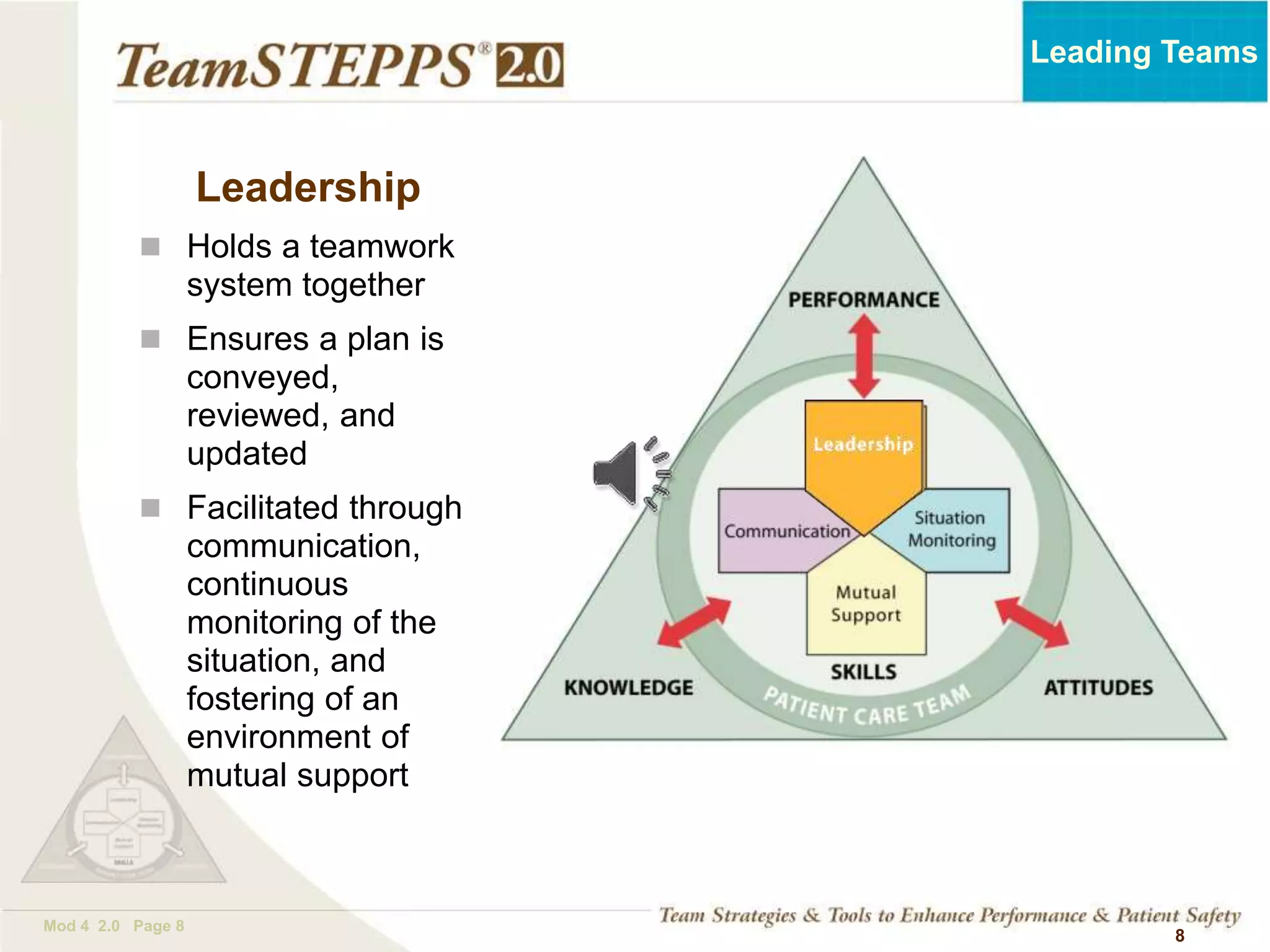
Leadership
 Holds a teamwork
system together
 Ensures a plan is
conveyed,
reviewed, and
updated
 Facilitated through
communication,
continuous
monitoring of the
situation, and
fostering of an
environment of
mutual support
TEAMSTEPPS 05.2
Mod 4 2.0 Page 9
Leading Teams
9
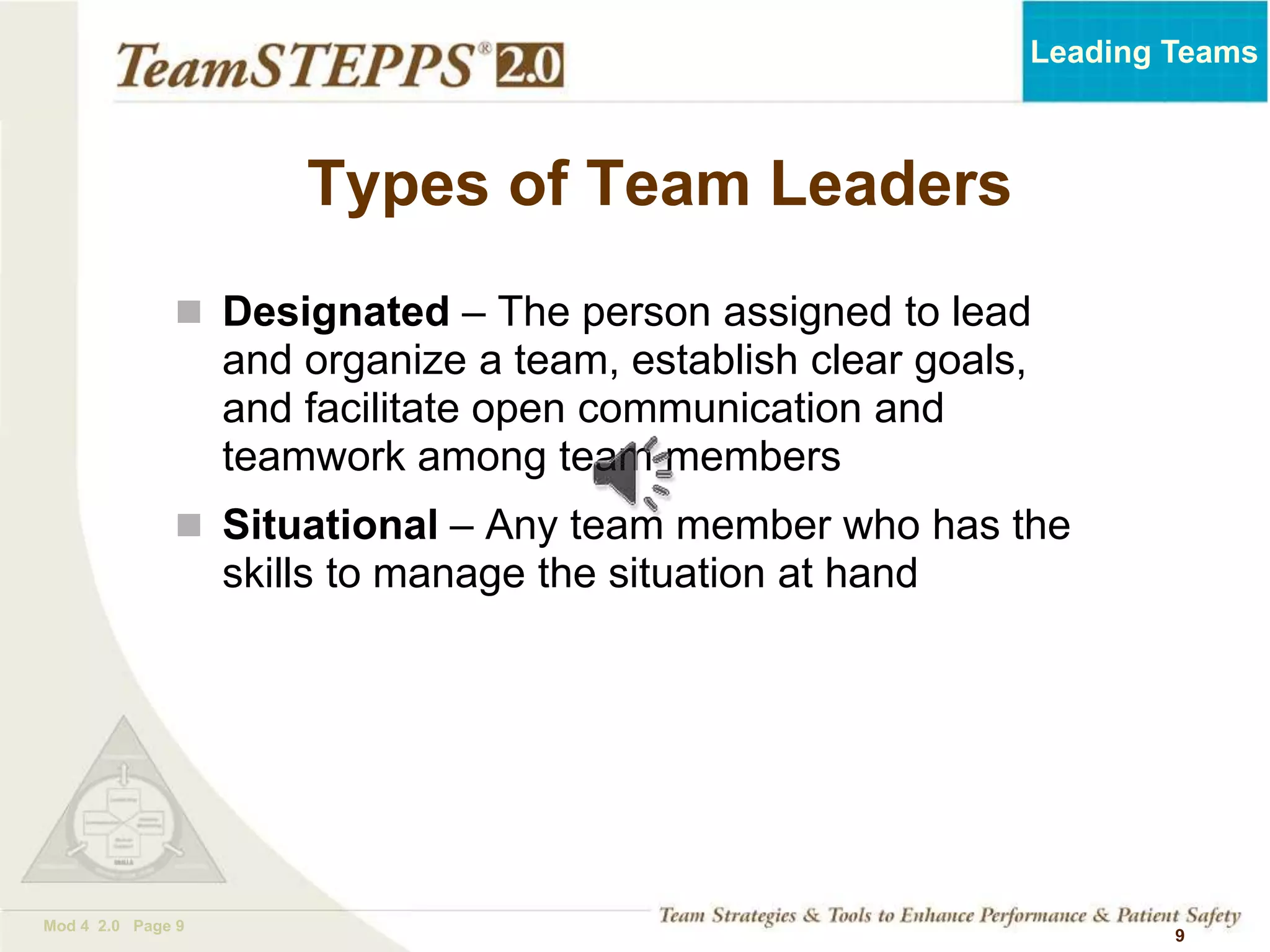
Types of Team Leaders
 Designated – The person assigned to lead
and organize a team, establish clear goals,
and facilitate open communication and
teamwork among team members
 Situational – Any team member who has the
skills to manage the situation at hand
TEAMSTEPPS 05.2
Mod 4 2.0 Page 10
Leading Teams
10
Types of Team Leaders
Thinking in your work unit
 Who are the designated team leaders on your unit?
 Is the role of the designated team leader
acknowledged and understood by team members?
 Can you describe a case in which someone
assumed the role of the situational team leader?
 Can the roles of the designated leader and
situational leader be better defined on your unit?
TEAMSTEPPS 05.2
Mod 4 2.0 Page 11
Leading Teams
11
 Define, assign, share, monitor, and modify a plan
 Review the team’s performance
 Establish “rules of engagement”
 Manage and allocate resources effectively
 Provide feedback regarding assigned responsibilities
and progress toward the goal
 Facilitate information sharing
 Encourage team members to assist one another
 Facilitate conflict resolution
 Model effective teamwork
Effective Team Leaders
TEAMSTEPPS 05.2
Mod 4 2.0 Page 12
Leading Teams
12
Defining the Plan
 When developing a plan, team leaders should
consider:
 Time – How much time is available to complete all the
necessary tasks and activities?
 People – Do the available staff have the necessary
knowledge and skills to perform their roles?
 Equipment – Is the necessary equipment available and
working?
 Information – Has all of the necessary information been
collected and reviewed?
TEAMSTEPPS 05.2
Mod 4 2.0 Page 13
Leading Teams
13
Defining the Plan
in your work unit
 How do your team leaders communicate a plan
of care to the care team?
 Which strategies have been effective and which
have not been effective?
 How do your team leaders communicate
changes to the plan of care to the care team?
TEAMSTEPPS 05.2
Mod 4 2.0 Page 14
Leading Teams
Case Study Discussion
After attending TeamSTEPPS Master Training, a physician and
nurse leader in a Level I Trauma Center decide that trauma
resuscitations could be more effectively conducted. Currently,
when a trauma alert is called to indicate the pending arrival of a
severely injured patient, more staff show up to the trauma bay
than needed, necessary equipment is sometimes missing or not
functioning properly, and the lead trauma physician often shows
up just as EMS is bringing the patient into the trauma bay. The
newly trained Master Trainers observe that these practices have
led to confusion and chaos that put patients at risk and result in
valuable time being lost.
What changes would you recommend to improve performance in
the trauma bay?
14
TEAMSTEPPS 05.2
Mod 4 2.0 Page 15
Leading Teams
15
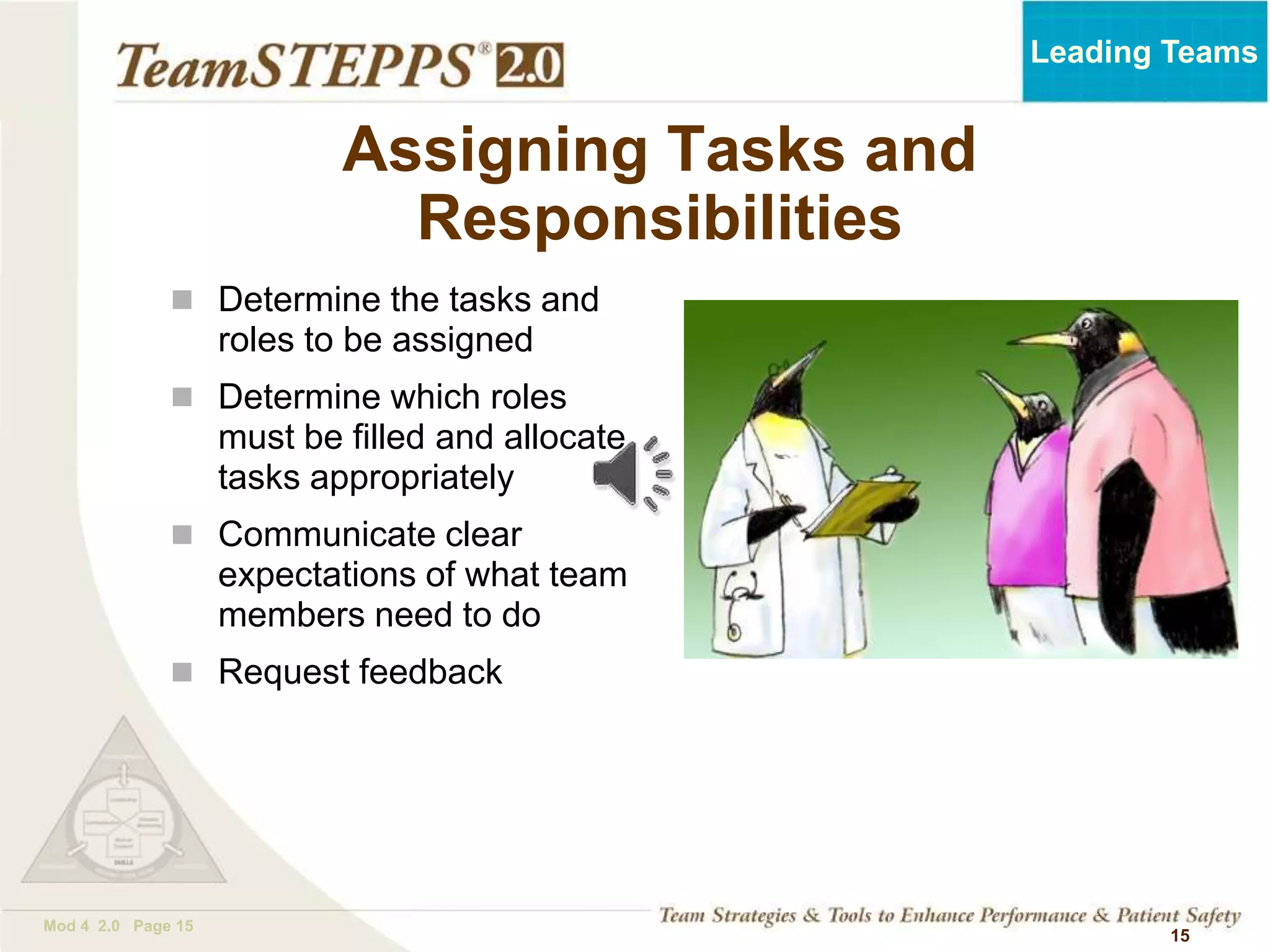
 Determine the tasks and
roles to be assigned
 Determine which roles
must be filled and allocate
tasks appropriately
 Communicate clear
expectations of what team
members need to do
 Request feedback
Assigning Tasks and
Responsibilities
TEAMSTEPPS 05.2
Mod 4 2.0 Page 16
Leading Teams
16
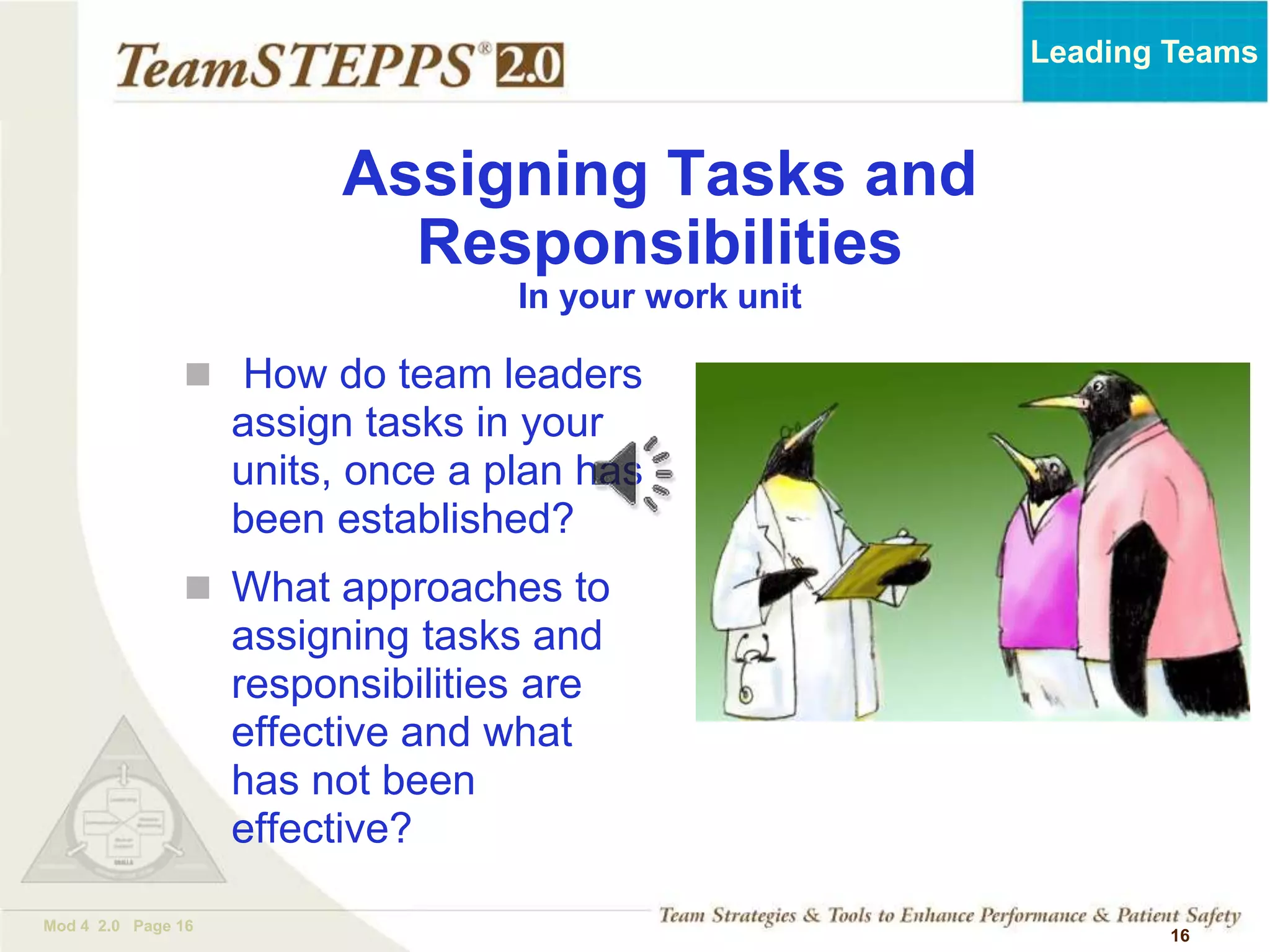
 How do team leaders
assign tasks in your
units, once a plan has
been established?
 What approaches to
assigning tasks and
responsibilities are
effective and what
has not been
effective?
Assigning Tasks and
Responsibilities
In your work unit
TEAMSTEPPS 05.2
Mod 4 2.0 Page 17
Leading Teams
17
Sharing the Plan:
Briefs
 A team briefing is an
effective strategy for
sharing the plan
 Briefs should help:
 Form the team
 Designate team roles and
responsibilities
 Establish climate and
goals
 Engage team in short-
and long-term planning
TEAMSTEPPS 05.2
Mod 4 2.0 Page 18
Leading Teams
18
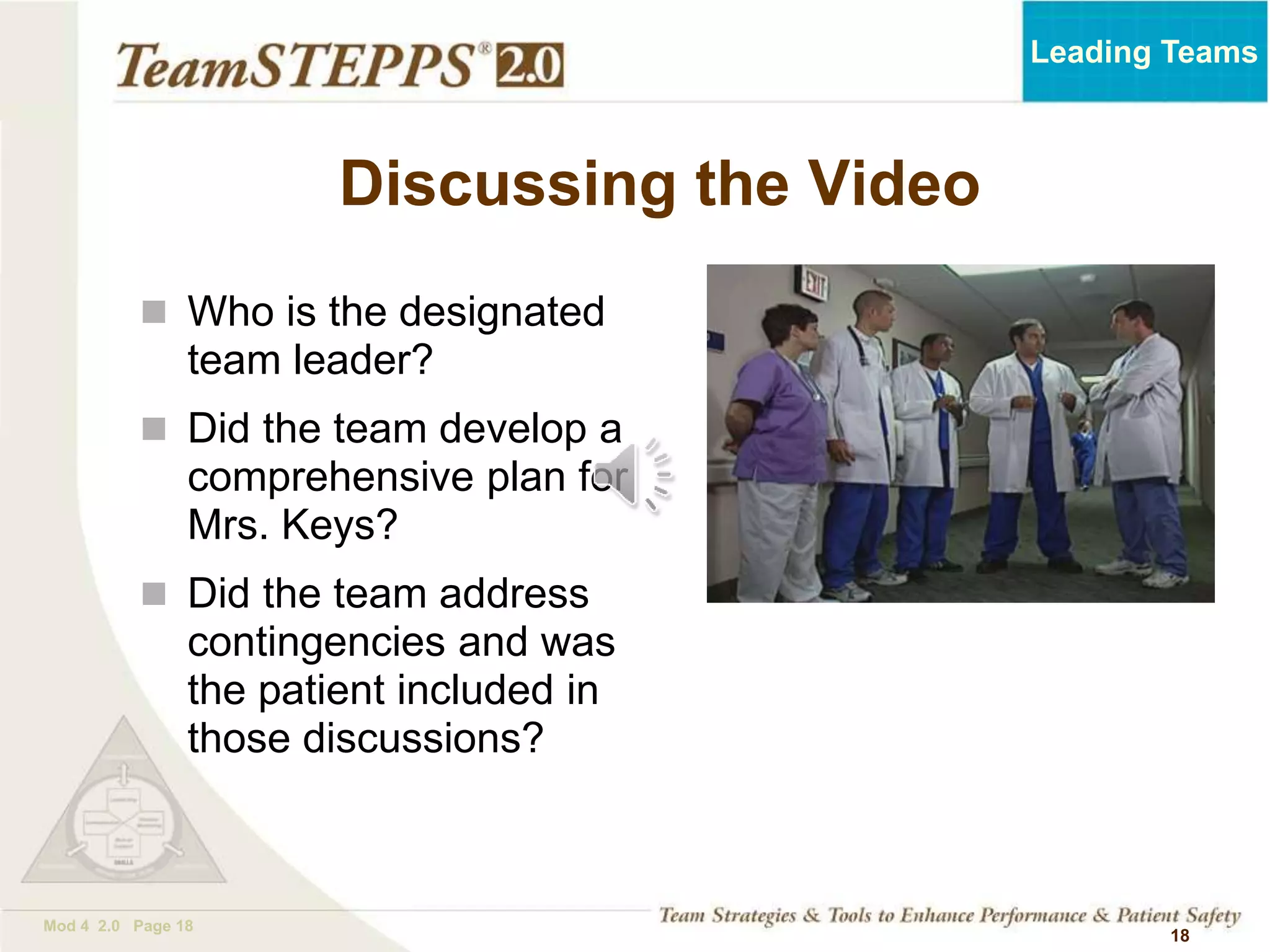
Discussing the Video
 Who is the designated
team leader?
 Did the team develop a
comprehensive plan for
Mrs. Keys?
 Did the team address
contingencies and was
the patient included in
those discussions?
TEAMSTEPPS 05.2
Mod 4 2.0 Page 19
Leading Teams
19
TOPIC
Who is on core team?
All members understand
and agree upon goals?
Roles and responsibilities
understood?
Plan of care?
Staff availability?
Workload?
Available resources?
Briefing Checklist Tool
TEAMSTEPPS 05.2
Mod 4 2.0 Page 20
Leading Teams
20
Briefing Checklist Discussion
 Have you participated in a brief?
Did the items on this checklist
occur? If not, what was not
done?
 If you were designing a briefing
checklist for your unit, what items
would you include?
 When would the briefing occur?
 Who would be expected to
attend?
TEAMSTEPPS 05.2
Mod 4 2.0 Page 21
Leading Teams
21
1. Break into small groups with others from your
unit, work area, or organization.
2. Identify when, why, and where briefings might
be conducted. Note who should lead the brief
and who should participate.
3. Develop a checklist for guiding the brief.
4. Discuss what outcomes you expect to see as
a result of implementing briefs.
5. At the end of the exercise, present and
discuss your plans with the group.
Briefing & Checklist
Exercise in your work unit
TEAMSTEPPS 05.2
Mod 4 2.0 Page 22
Leading Teams
22
Monitoring & Modifying the Plan:
Huddle
Problem Solving
 Hold ad hoc, “touch base”
meetings to regain
situation awareness
 Discuss critical issues
and emerging events
 Anticipate outcomes
and likely contingencies
 Assign resources
 Express concerns
TEAMSTEPPS 05.2
Mod 4 2.0 Page 23
Leading Teams
23
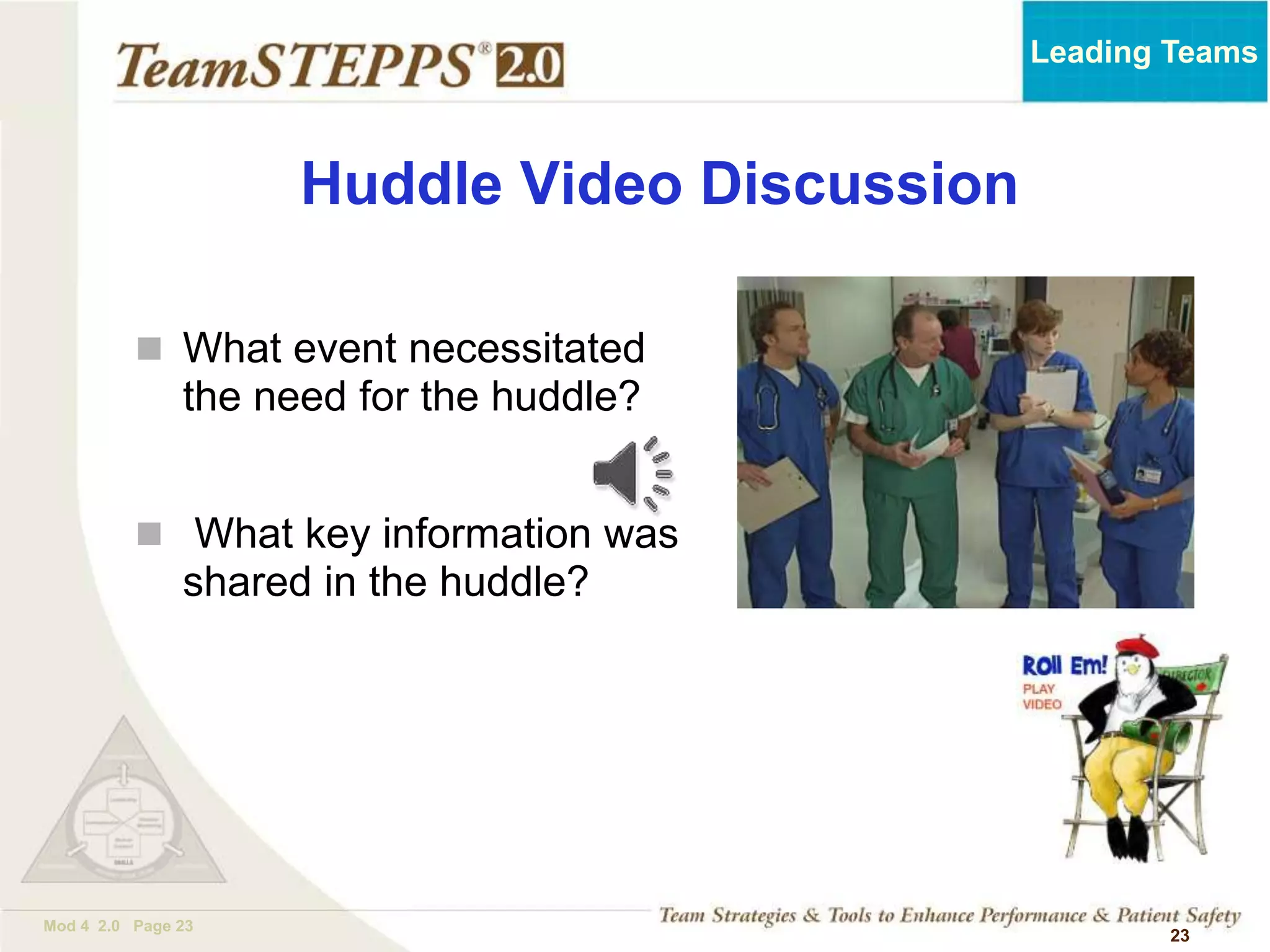
Huddle Video Discussion
 What event necessitated
the need for the huddle?
 What key information was
shared in the huddle?
TEAMSTEPPS 05.2
Mod 4 2.0 Page 24
Leading Teams
24
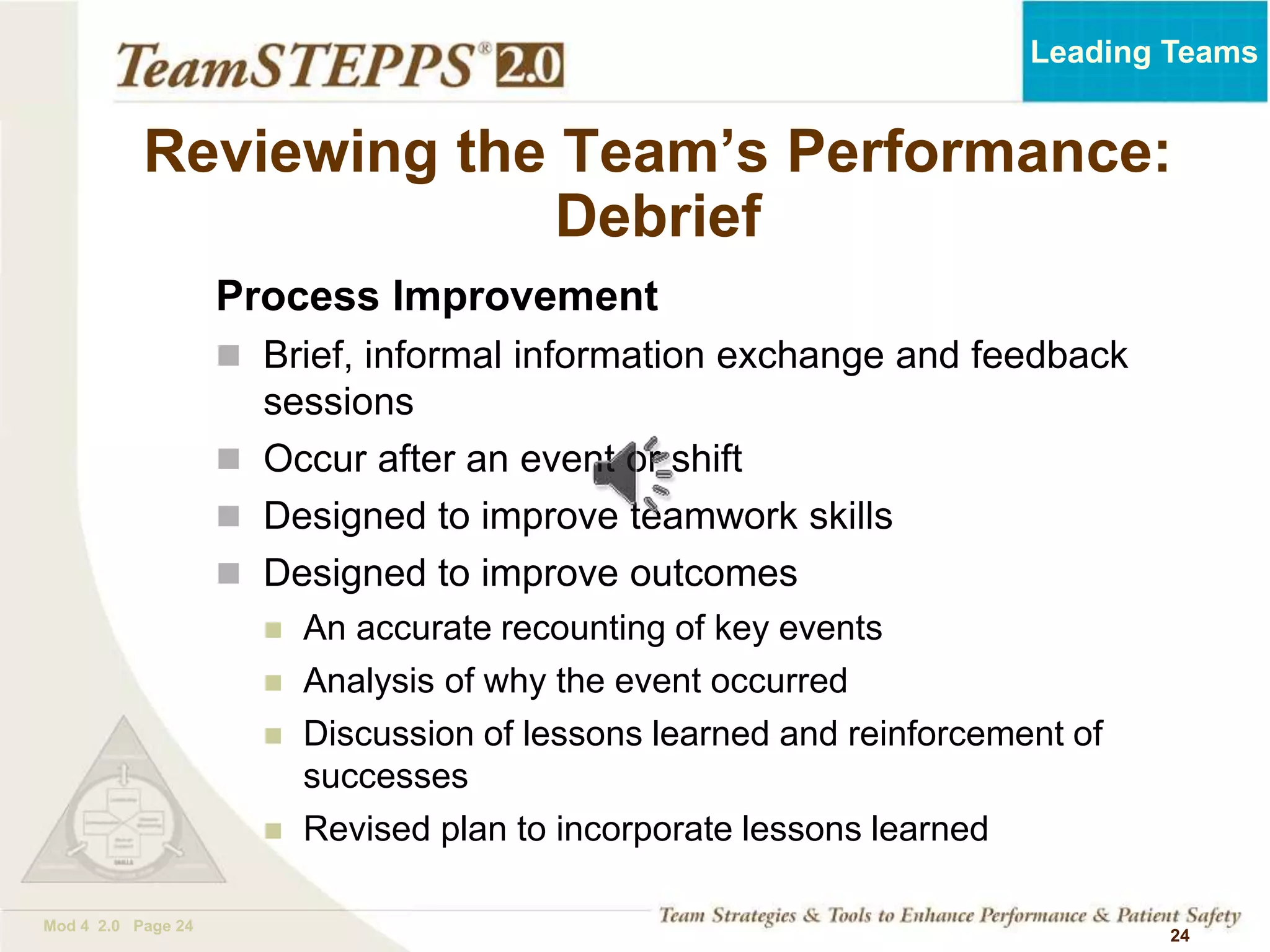
Reviewing the Team’s Performance:
Debrief
Process Improvement
 Brief, informal information exchange and feedback
sessions
 Occur after an event or shift
 Designed to improve teamwork skills
 Designed to improve outcomes
 An accurate recounting of key events
 Analysis of why the event occurred
 Discussion of lessons learned and reinforcement of
successes
 Revised plan to incorporate lessons learned
TEAMSTEPPS 05.2
Mod 4 2.0 Page 25
Leading Teams
25
TOPIC
Communication clear?
Roles and responsibilities
understood?
Situation awareness
maintained?
Workload distribution?
Did we ask for or offer
assistance?
Were errors made or
avoided?
What went well, what
should change, what
can improve?
Debrief Checklist
TEAMSTEPPS 05.2
Mod 4 2.0 Page 26
Leading Teams
26
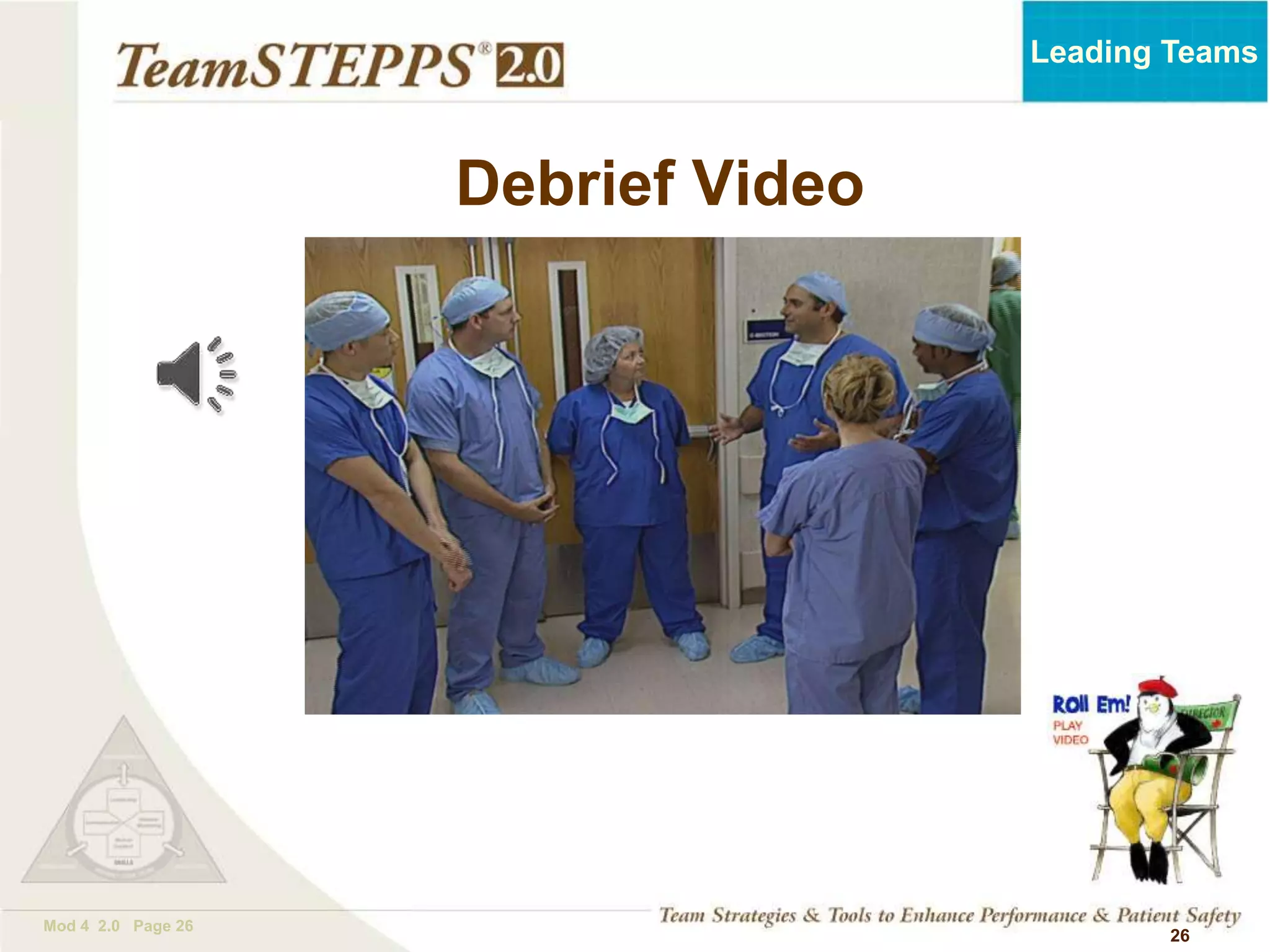
Debrief Video
TEAMSTEPPS 05.2
Mod 4 2.0 Page 27
Leading Teams
27
Debrief Video Discussion
• What were some of the
positive effects from this
debrief?
• Describe the tone Dr.
Upton set for the debrief.
TEAMSTEPPS 05.2
Mod 4 2.0 Page 28
Leading Teams
28
Facilitating Conflict Resolution
 Effective leaders:
 Facilitate conflict resolution to avoid compromising
patient safety and quality of care
 Do not allow interpersonal or irrelevant issues to
negatively affect the team
 Help team members master conflict resolution
techniques
 DOD Professional Conduct Toolkit:
http://www.health.mil/dodpatientsafety/ProductsandServices/Toolk its.aspx
TEAMSTEPPS 05.2
Mod 4 2.0 Page 29
Leading Teams
29
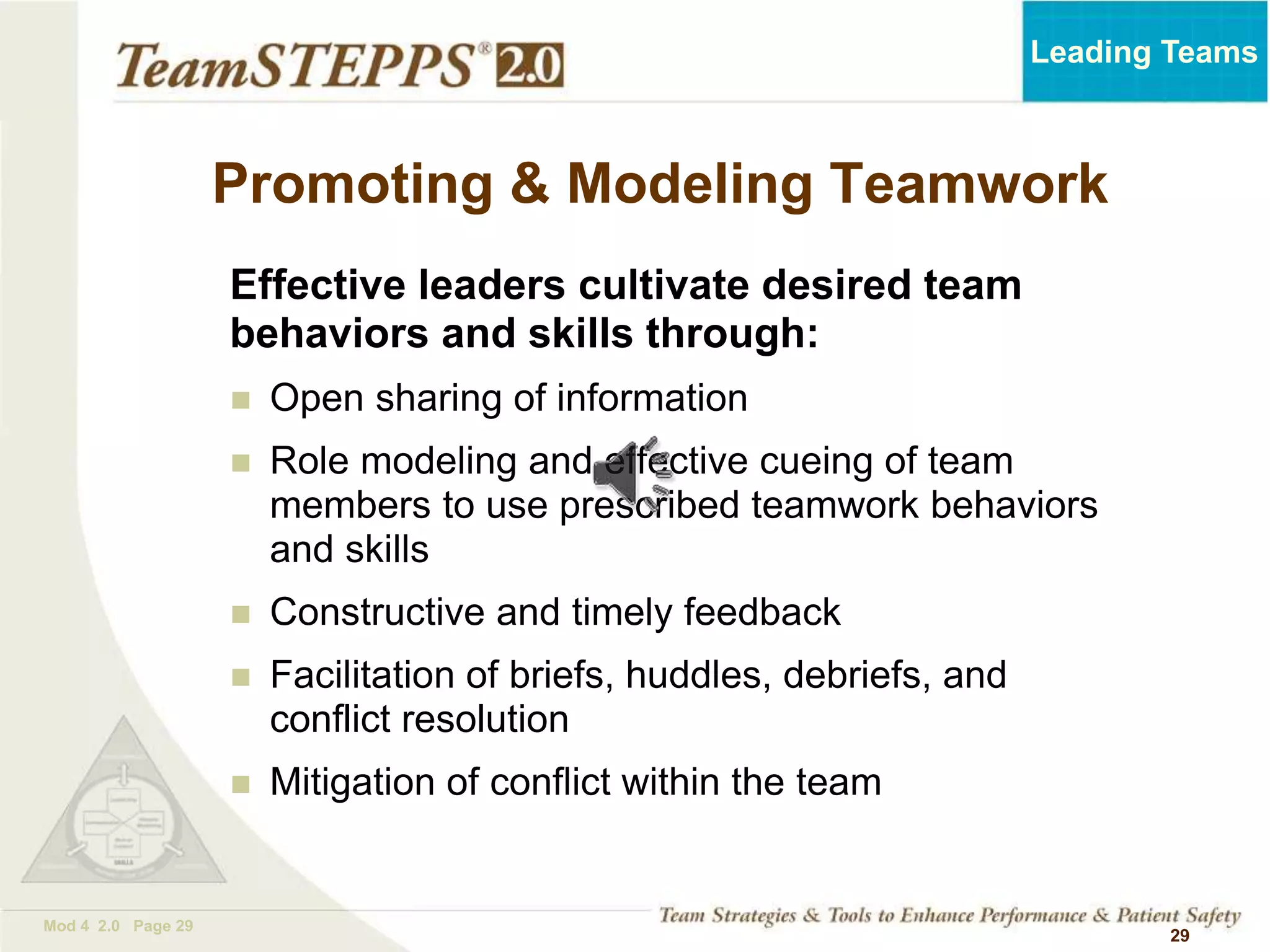
Effective leaders cultivate desired team
behaviors and skills through:
 Open sharing of information
 Role modeling and effective cueing of team
members to use prescribed teamwork behaviors
and skills
 Constructive and timely feedback
 Facilitation of briefs, huddles, debriefs, and
conflict resolution
 Mitigation of conflict within the team
Promoting & Modeling Teamwork
TEAMSTEPPS 05.2
Mod 4 2.0 Page 30
Leading Teams
30
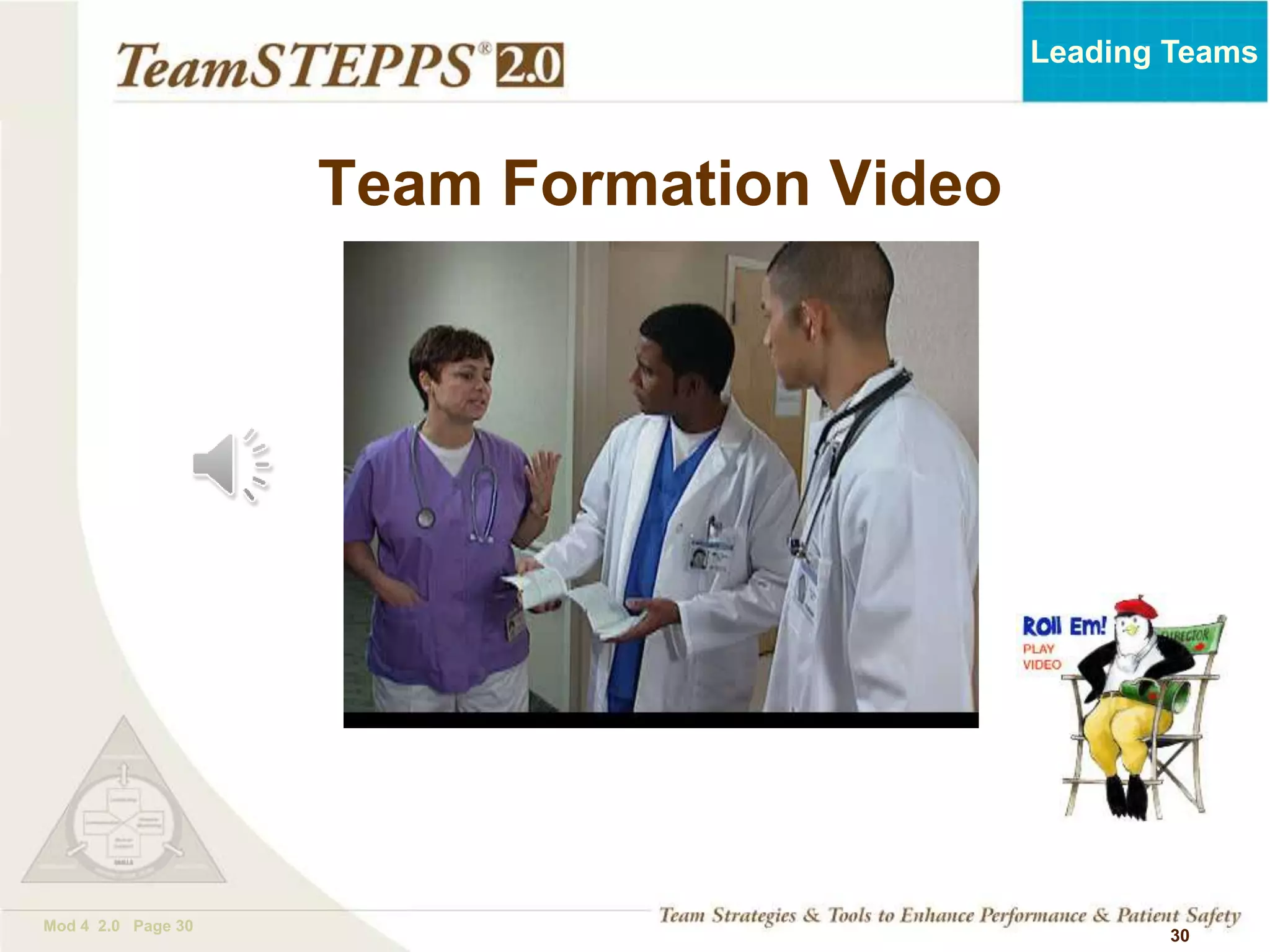
Team Formation Video
TEAMSTEPPS 05.2
Mod 4 2.0 Page 31
Leading Teams
31
Video Discussion
• What leadership tools and
strategies did Dr. Dean use?
• How did the nurses
demonstrate leadership?
• What leadership tools and
strategies did Dr. Upton use?
TEAMSTEPPS 05.2
Mod 4 2.0 Page 32
Leading Teams
32
Tools & Strategies Summary
TOOLS and
STRATEGIES
Communication
• SBAR
• Call-Out
• Check-Back
• Handoff
Leading Teams
• Brief
• Huddle
• Debrief
OUTCOMES
 Shared Mental Model
 Adaptability
 Team Orientation
 Mutual Trust
 Team Performance
 Patient Safety!!
BARRIERS
 Inconsistency in Team
Membership
 Lack of Time
 Lack of Information Sharing
 Hierarchy
 Defensiveness
 Conventional Thinking
 Complacency
 Varying Communication Styles
 Conflict
 Lack of Coordination and
Followup With Coworkers
 Distractions
 Fatigue
 Workload
 Misinterpretation of Cues
 Lack of Role Clarity
TEAMSTEPPS 05.2
Mod 4 2.0 Page 33
Leading Teams
33
Applying TeamSTEPPS Exercise
1. Does the team experiencing the issue in your
organization have a designated leader? Who is it?
2. Is your teamwork issue related to the team’s
leadership?
3. If yes, what is the leadership issue?
4. Which of the tools and/or strategies for leading
teams might you consider implementing to address
the issue?
TEAMSTEPPS 05.2
Mod 4 2.0 Page 34
Leading Teams
34
Applying TeamSTEPPS Exercise
1. Does the team experiencing the issue in
your organization have a designated
leader? Who is it?
2. Is your teamwork issue related to the
team’s leadership?
3. If yes, what is the leadership issue?
4. Which of the tools and/or strategies for
leading teams might you consider
implementing to address the issue?
TEAMSTEPPS 05.2
Mod 4 2.0 Page 35
Leading Teams
35
TEAMSTEPPS 05.2
Mod 4 2.0 Page 36
Leading Teams
36
THANK YOU
Engineer Abdel- Halim Mahmoud
 Performance Excellence Coach; Organizations, Projects & Teams
 Member, Board of Evaluators 2015, Baldrige-Based Performance
Excellence Award. Performance Excellence Network, MN, USA
 CEO, Egypt Excellence Center, Cairo, Egypt
www.EgyptExcellence.com
ceo@EgyptExcellence.com
Mobile: +20.102.5151290

Leading Teams in Healthcare

  • 1.
    Leading Teams For Health-CareProviders Eng. Abdel-Halim Mahmoud TeamSTEPPS 2.0 Certified Master Trainer Performance Excellence Coach Examiner @ the Baldrige Performance Excellence Award, MN, USA CEO, Egypt Excellence Center The 4th Module of TeamSTEPPS Fundamental Course
  • 2.
    TEAMSTEPPS 05.2 Mod 42.0 Page 2 Leading Teams 2 Objectives  Describe how leadership affects team processes and outcomes  Identify different types of team leaders  Describe the activities involved in successfully leading teams  Describe the tools for leading teams, including briefs, huddles, and debriefs  Apply the tools for leading teams to specific clinical scenarios
  • 3.
    TEAMSTEPPS 05.2 Mod 42.0 Page 3 Leading Teams 3 TeamStepps Fundamental Couse  Module 1 – Introduction  Module 2 – Team Structure  Module 3 – Communication  Module 4 – Leading Teams  Module 5 – Situation Monitoring  Module 6 – Mutual Support  Module 7 – Summary
  • 4.
    TEAMSTEPPS 05.2 Mod 42.0 Page 4 Leading Teams 4 Material You will Use http://www.ahrq.gov/professionals/education/curriculum- tools/teamstepps/instructor/fundamentals/index.html
  • 5.
    TEAMSTEPPS 05.2 Mod 42.0 Page 5 Leading Teams 5 Team Strategies & Tools to Enhance Teamwork Performance & Patient Safety  Based on more than 30 years of research and evidence  Team training programs have been shown to improve attitudes, increase knowledge, and improve behavioral skills  Salas, et al. (2008) meta-analysis provided evidence that team training had a moderate, positive effect on team outcomes (ρ = .38) What is
  • 6.
    TEAMSTEPPS 05.2 Mod 42.0 Page 6 Leading Teams 6 Outcomes of Team Competencies  Knowledge  Shared Mental Model  Attitudes  Mutual Trust  Team Orientation  Performance  Adaptability  Accuracy  Productivity  Efficiency  Safety
  • 7.
    TEAMSTEPPS 05.2 Mod 42.0 Page 7 Leading Teams 7 Leadership Exercise 1. What characteristics, attitudes, or skills made the leaders that you have known effective and successful? 2. If there was room for improvement, what could they have done to be more effective? 3. Do you feel that leadership can be learned or taught, or is it an innate skill? 4. What one characteristic is most important to the success of effective leaders?
  • 8.
    TEAMSTEPPS 05.2 Mod 42.0 Page 8 Leading Teams 8 Leadership  Holds a teamwork system together  Ensures a plan is conveyed, reviewed, and updated  Facilitated through communication, continuous monitoring of the situation, and fostering of an environment of mutual support
  • 9.
    TEAMSTEPPS 05.2 Mod 42.0 Page 9 Leading Teams 9 Types of Team Leaders  Designated – The person assigned to lead and organize a team, establish clear goals, and facilitate open communication and teamwork among team members  Situational – Any team member who has the skills to manage the situation at hand
  • 10.
    TEAMSTEPPS 05.2 Mod 42.0 Page 10 Leading Teams 10 Types of Team Leaders Thinking in your work unit  Who are the designated team leaders on your unit?  Is the role of the designated team leader acknowledged and understood by team members?  Can you describe a case in which someone assumed the role of the situational team leader?  Can the roles of the designated leader and situational leader be better defined on your unit?
  • 11.
    TEAMSTEPPS 05.2 Mod 42.0 Page 11 Leading Teams 11  Define, assign, share, monitor, and modify a plan  Review the team’s performance  Establish “rules of engagement”  Manage and allocate resources effectively  Provide feedback regarding assigned responsibilities and progress toward the goal  Facilitate information sharing  Encourage team members to assist one another  Facilitate conflict resolution  Model effective teamwork Effective Team Leaders
  • 12.
    TEAMSTEPPS 05.2 Mod 42.0 Page 12 Leading Teams 12 Defining the Plan  When developing a plan, team leaders should consider:  Time – How much time is available to complete all the necessary tasks and activities?  People – Do the available staff have the necessary knowledge and skills to perform their roles?  Equipment – Is the necessary equipment available and working?  Information – Has all of the necessary information been collected and reviewed?
  • 13.
    TEAMSTEPPS 05.2 Mod 42.0 Page 13 Leading Teams 13 Defining the Plan in your work unit  How do your team leaders communicate a plan of care to the care team?  Which strategies have been effective and which have not been effective?  How do your team leaders communicate changes to the plan of care to the care team?
  • 14.
    TEAMSTEPPS 05.2 Mod 42.0 Page 14 Leading Teams Case Study Discussion After attending TeamSTEPPS Master Training, a physician and nurse leader in a Level I Trauma Center decide that trauma resuscitations could be more effectively conducted. Currently, when a trauma alert is called to indicate the pending arrival of a severely injured patient, more staff show up to the trauma bay than needed, necessary equipment is sometimes missing or not functioning properly, and the lead trauma physician often shows up just as EMS is bringing the patient into the trauma bay. The newly trained Master Trainers observe that these practices have led to confusion and chaos that put patients at risk and result in valuable time being lost. What changes would you recommend to improve performance in the trauma bay? 14
  • 15.
    TEAMSTEPPS 05.2 Mod 42.0 Page 15 Leading Teams 15  Determine the tasks and roles to be assigned  Determine which roles must be filled and allocate tasks appropriately  Communicate clear expectations of what team members need to do  Request feedback Assigning Tasks and Responsibilities
  • 16.
    TEAMSTEPPS 05.2 Mod 42.0 Page 16 Leading Teams 16  How do team leaders assign tasks in your units, once a plan has been established?  What approaches to assigning tasks and responsibilities are effective and what has not been effective? Assigning Tasks and Responsibilities In your work unit
  • 17.
    TEAMSTEPPS 05.2 Mod 42.0 Page 17 Leading Teams 17 Sharing the Plan: Briefs  A team briefing is an effective strategy for sharing the plan  Briefs should help:  Form the team  Designate team roles and responsibilities  Establish climate and goals  Engage team in short- and long-term planning
  • 18.
    TEAMSTEPPS 05.2 Mod 42.0 Page 18 Leading Teams 18 Discussing the Video  Who is the designated team leader?  Did the team develop a comprehensive plan for Mrs. Keys?  Did the team address contingencies and was the patient included in those discussions?
  • 19.
    TEAMSTEPPS 05.2 Mod 42.0 Page 19 Leading Teams 19 TOPIC Who is on core team? All members understand and agree upon goals? Roles and responsibilities understood? Plan of care? Staff availability? Workload? Available resources? Briefing Checklist Tool
  • 20.
    TEAMSTEPPS 05.2 Mod 42.0 Page 20 Leading Teams 20 Briefing Checklist Discussion  Have you participated in a brief? Did the items on this checklist occur? If not, what was not done?  If you were designing a briefing checklist for your unit, what items would you include?  When would the briefing occur?  Who would be expected to attend?
  • 21.
    TEAMSTEPPS 05.2 Mod 42.0 Page 21 Leading Teams 21 1. Break into small groups with others from your unit, work area, or organization. 2. Identify when, why, and where briefings might be conducted. Note who should lead the brief and who should participate. 3. Develop a checklist for guiding the brief. 4. Discuss what outcomes you expect to see as a result of implementing briefs. 5. At the end of the exercise, present and discuss your plans with the group. Briefing & Checklist Exercise in your work unit
  • 22.
    TEAMSTEPPS 05.2 Mod 42.0 Page 22 Leading Teams 22 Monitoring & Modifying the Plan: Huddle Problem Solving  Hold ad hoc, “touch base” meetings to regain situation awareness  Discuss critical issues and emerging events  Anticipate outcomes and likely contingencies  Assign resources  Express concerns
  • 23.
    TEAMSTEPPS 05.2 Mod 42.0 Page 23 Leading Teams 23 Huddle Video Discussion  What event necessitated the need for the huddle?  What key information was shared in the huddle?
  • 24.
    TEAMSTEPPS 05.2 Mod 42.0 Page 24 Leading Teams 24 Reviewing the Team’s Performance: Debrief Process Improvement  Brief, informal information exchange and feedback sessions  Occur after an event or shift  Designed to improve teamwork skills  Designed to improve outcomes  An accurate recounting of key events  Analysis of why the event occurred  Discussion of lessons learned and reinforcement of successes  Revised plan to incorporate lessons learned
  • 25.
    TEAMSTEPPS 05.2 Mod 42.0 Page 25 Leading Teams 25 TOPIC Communication clear? Roles and responsibilities understood? Situation awareness maintained? Workload distribution? Did we ask for or offer assistance? Were errors made or avoided? What went well, what should change, what can improve? Debrief Checklist
  • 26.
    TEAMSTEPPS 05.2 Mod 42.0 Page 26 Leading Teams 26 Debrief Video
  • 27.
    TEAMSTEPPS 05.2 Mod 42.0 Page 27 Leading Teams 27 Debrief Video Discussion • What were some of the positive effects from this debrief? • Describe the tone Dr. Upton set for the debrief.
  • 28.
    TEAMSTEPPS 05.2 Mod 42.0 Page 28 Leading Teams 28 Facilitating Conflict Resolution  Effective leaders:  Facilitate conflict resolution to avoid compromising patient safety and quality of care  Do not allow interpersonal or irrelevant issues to negatively affect the team  Help team members master conflict resolution techniques  DOD Professional Conduct Toolkit: http://www.health.mil/dodpatientsafety/ProductsandServices/Toolk its.aspx
  • 29.
    TEAMSTEPPS 05.2 Mod 42.0 Page 29 Leading Teams 29 Effective leaders cultivate desired team behaviors and skills through:  Open sharing of information  Role modeling and effective cueing of team members to use prescribed teamwork behaviors and skills  Constructive and timely feedback  Facilitation of briefs, huddles, debriefs, and conflict resolution  Mitigation of conflict within the team Promoting & Modeling Teamwork
  • 30.
    TEAMSTEPPS 05.2 Mod 42.0 Page 30 Leading Teams 30 Team Formation Video
  • 31.
    TEAMSTEPPS 05.2 Mod 42.0 Page 31 Leading Teams 31 Video Discussion • What leadership tools and strategies did Dr. Dean use? • How did the nurses demonstrate leadership? • What leadership tools and strategies did Dr. Upton use?
  • 32.
    TEAMSTEPPS 05.2 Mod 42.0 Page 32 Leading Teams 32 Tools & Strategies Summary TOOLS and STRATEGIES Communication • SBAR • Call-Out • Check-Back • Handoff Leading Teams • Brief • Huddle • Debrief OUTCOMES  Shared Mental Model  Adaptability  Team Orientation  Mutual Trust  Team Performance  Patient Safety!! BARRIERS  Inconsistency in Team Membership  Lack of Time  Lack of Information Sharing  Hierarchy  Defensiveness  Conventional Thinking  Complacency  Varying Communication Styles  Conflict  Lack of Coordination and Followup With Coworkers  Distractions  Fatigue  Workload  Misinterpretation of Cues  Lack of Role Clarity
  • 33.
    TEAMSTEPPS 05.2 Mod 42.0 Page 33 Leading Teams 33 Applying TeamSTEPPS Exercise 1. Does the team experiencing the issue in your organization have a designated leader? Who is it? 2. Is your teamwork issue related to the team’s leadership? 3. If yes, what is the leadership issue? 4. Which of the tools and/or strategies for leading teams might you consider implementing to address the issue?
  • 34.
    TEAMSTEPPS 05.2 Mod 42.0 Page 34 Leading Teams 34 Applying TeamSTEPPS Exercise 1. Does the team experiencing the issue in your organization have a designated leader? Who is it? 2. Is your teamwork issue related to the team’s leadership? 3. If yes, what is the leadership issue? 4. Which of the tools and/or strategies for leading teams might you consider implementing to address the issue?
  • 35.
    TEAMSTEPPS 05.2 Mod 42.0 Page 35 Leading Teams 35
  • 36.
    TEAMSTEPPS 05.2 Mod 42.0 Page 36 Leading Teams 36 THANK YOU Engineer Abdel- Halim Mahmoud  Performance Excellence Coach; Organizations, Projects & Teams  Member, Board of Evaluators 2015, Baldrige-Based Performance Excellence Award. Performance Excellence Network, MN, USA  CEO, Egypt Excellence Center, Cairo, Egypt www.EgyptExcellence.com ceo@EgyptExcellence.com Mobile: +20.102.5151290