

Leading Learning Behaviour and
Attendance - the what, why and
             how
                 Nick Burnett
   Asia Pacific Director of Northampton Centre for
               Learning Behaviour (NCfLB)
– LinkedIn – Nick Burnett
– Twitter – nick_burnett
– Facebook – Nick Burnett CCP
THE ‘WHY’ OF LEARNING
      BEHAVIOUR
3
The importance of improving Learning
           Behaviour and Attendance
•Despite continued improvement in academic
standards across most of the Asia Pacific Region,
an unacceptable proportion of children become
disaffected with school, resulting in poor
learning behaviour, lack of progress, declining
attendance or lack of inclusion in school.
• Bullying and other anti-social and/or violent
  behaviours affect children’s well-being. They
  impact on their ability to learn and their
  inclusion in school.
• There is a growing demand, amongst trainee
  and serving teachers, for training and support
  to improve the learning behaviour of children
  and to create a climate of harmony and
  wellbeing in their schools
Latest research
  In Australian schools, both novice and experienced
teachers increasingly raise concerns that they are not
   able to teach effectively because of the recurrent
incidence of disruptive behaviours of some students.

Teachers state that managing children with behavior
 problems is a major source of stress to them. This
results in less work satisfaction and teachers leaving
                   the profession.
                                              6
Latest research
  Research shows that improving the learning behaviour of
 children whose behaviour is challenging is one of the most
   effective ways of raising standards of attainment for all
                   children in our schools.

 It also benefits society at large by helping children learn the
  social and emotional skills they need for citizenship and by
preventing behaviours that disrupt teaching from developing
    into behaviours that disrupt the lives of others and cost
society dearly (e.g. violence, vandalism, addiction and crime).
                                                      7
THE ‘WHAT’ OF LEARNING
      BEHAVIOUR
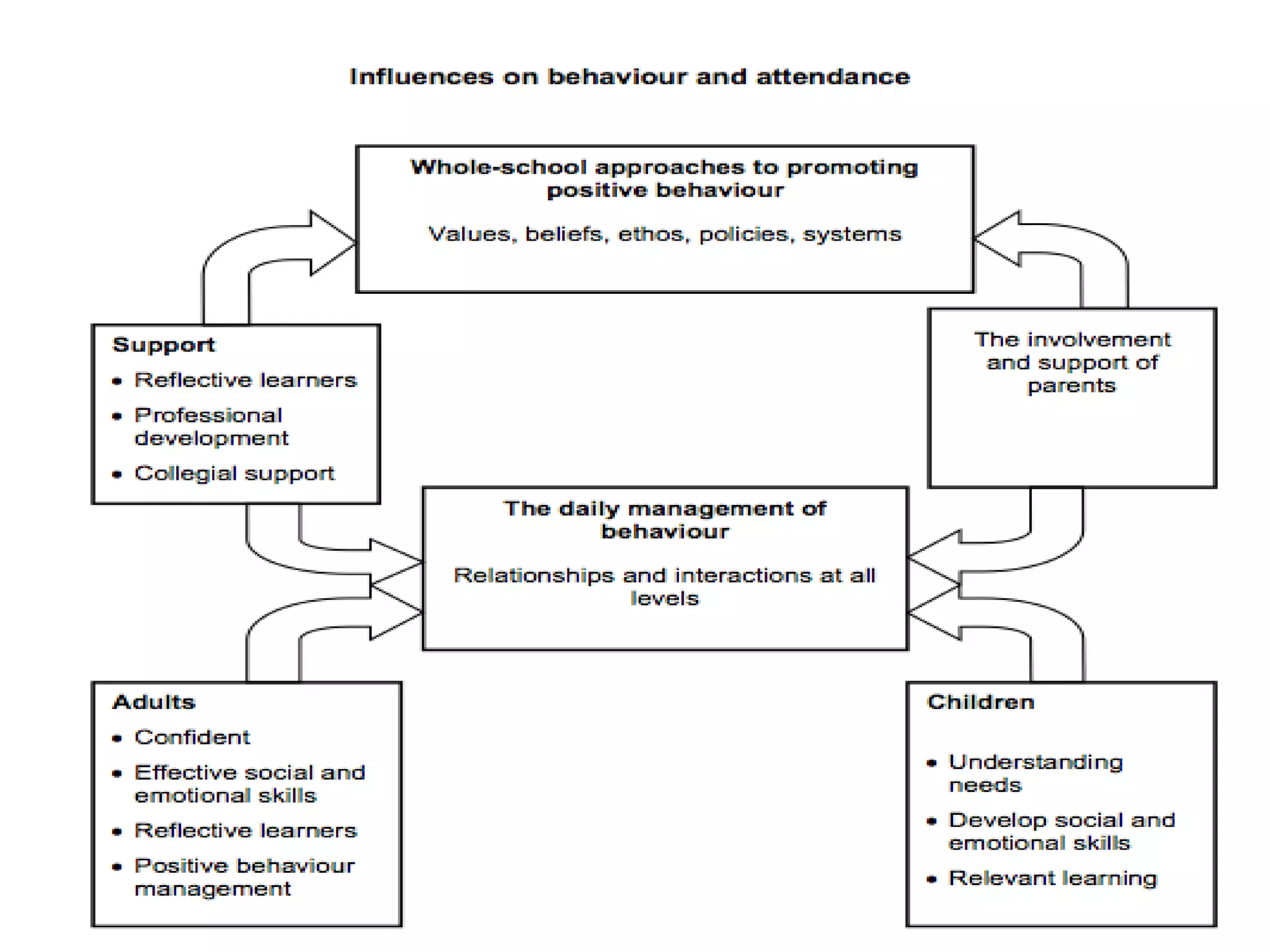
Effective lesson organisation results in
        improved Learning Behaviour

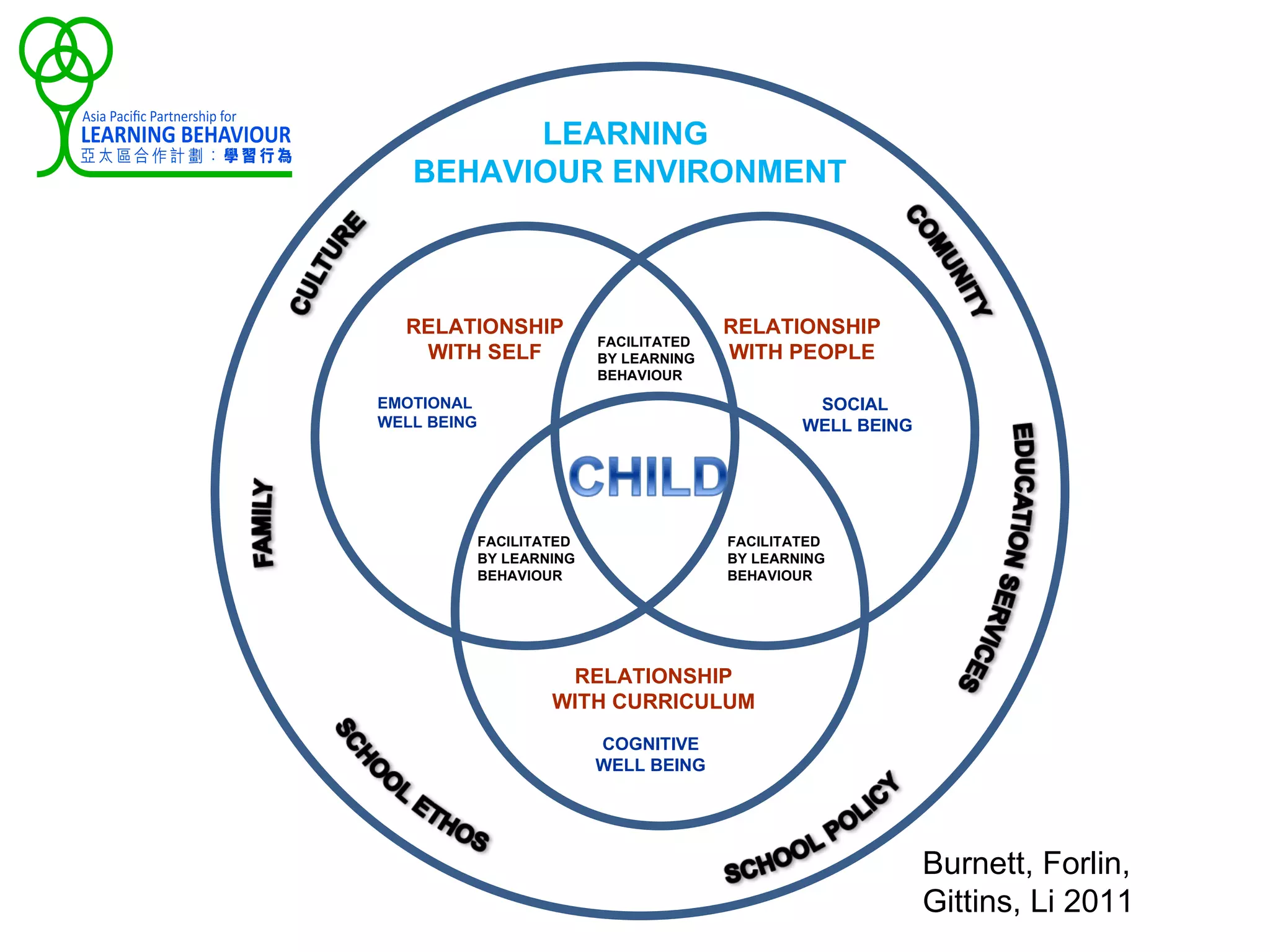
Specific planning/structuring of lessons that promotes Learning
Behaviour relationships for all pupils involves paying attention
to three drivers linked to the three relationship domains of the
Behaviour for Learning model:
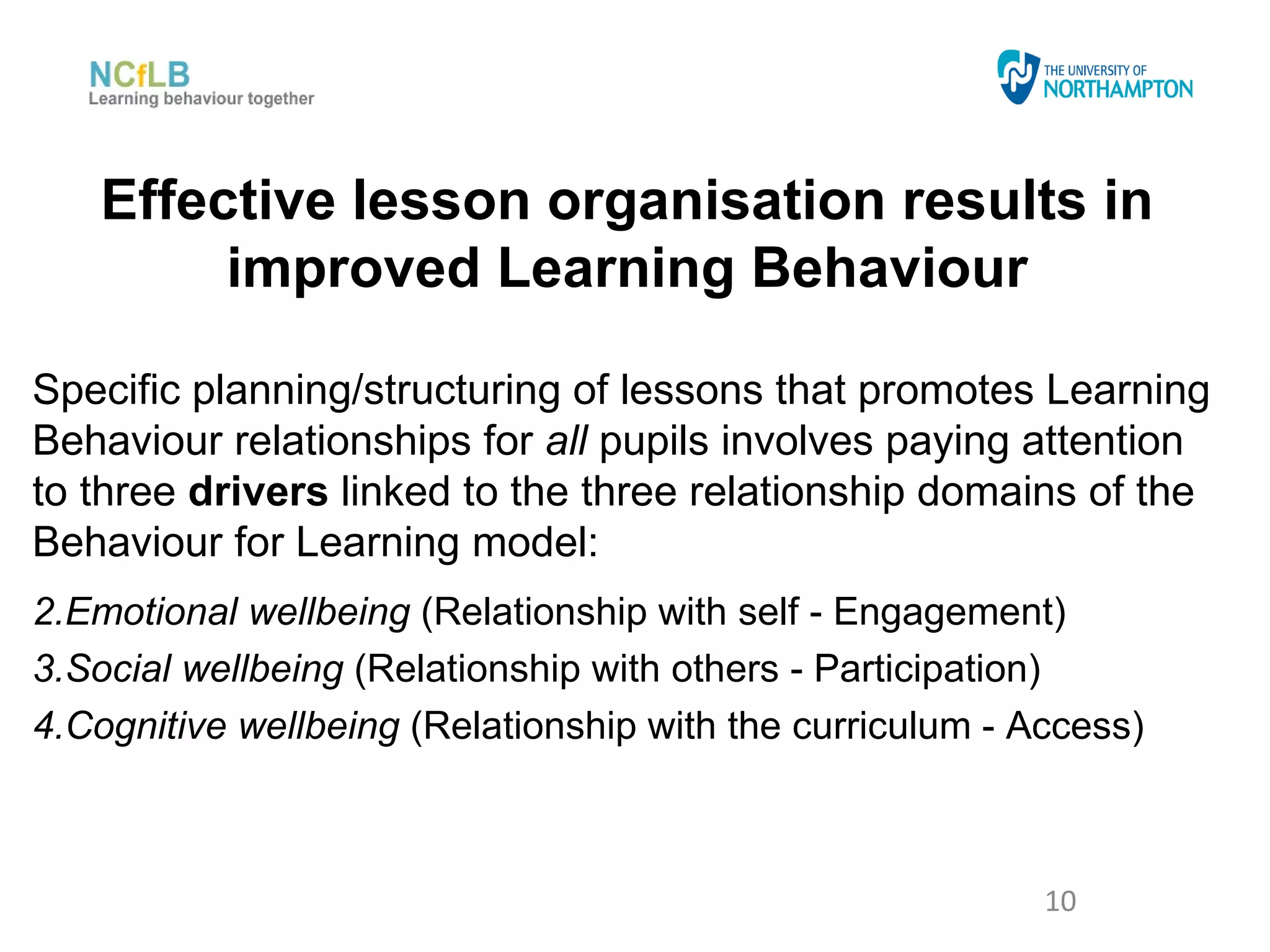
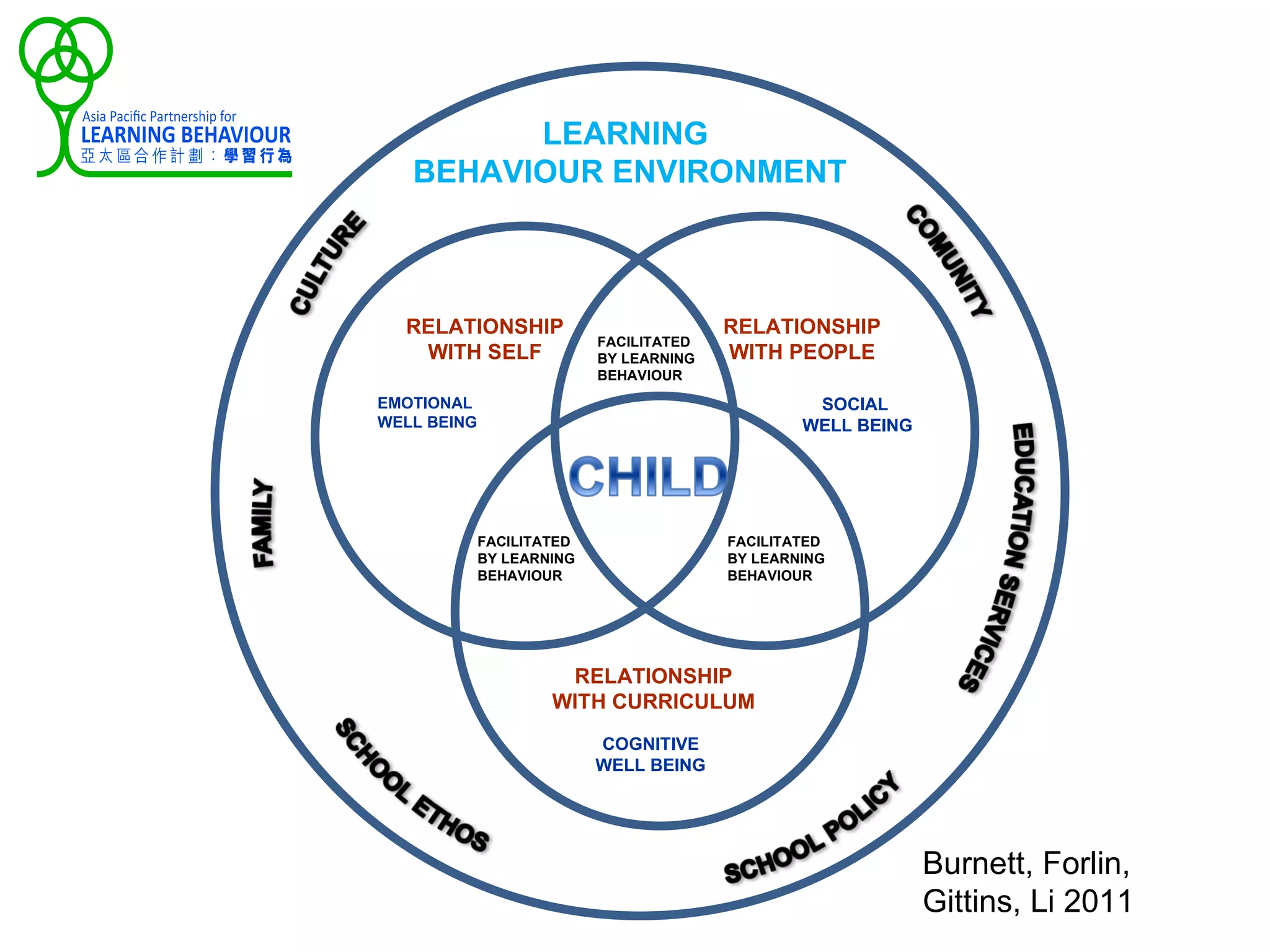
2.Emotional wellbeing (Relationship with self - Engagement)
3.Social wellbeing (Relationship with others - Participation)
4.Cognitive wellbeing (Relationship with the curriculum - Access)


                                                           10
LEARNING
   BEHAVIOUR ENVIRONMENT


  RELATIONSHIP                           RELATIONSHIP
                           FACILITATED
   WITH SELF               BY LEARNING   WITH PEOPLE
                           BEHAVIOUR

EMOTIONAL                                         SOCIAL
WELL BEING                                       WELL BEING


             FACILITATED                 FACILITATED
             BY LEARNING                 BY LEARNING
             BEHAVIOUR                   BEHAVIOUR


                      RELATIONSHIP
                     WITH CURRICULUM
                           COGNITIVE
                           WELL BEING


                                                              Burnett, Forlin,
                                                              Gittins, Li 2011
• The circle of Relationship with Self is
  undoubtedly the most important relationship
  for learning behaviour. It signifies the positive
  self identity of the child and a growing self
  reliance that will build steadily during the
  stages of transition from childhood to
  adulthood
An appreciation of self is typified by the child’s
growing:
•self belief and self determination and confidence
to learn new things
•self motivation and a thirst for learning and
interest in the process
•understanding of personal strengths and
weaknesses
•resourcefulness, responsibility and willingness to
admit and correct mistakes
•and most important of all - emotional wellbeing
and happiness
• The circle of Relationship with People is
  woven by the interactions between the child
  and others such as teachers, parents and
  peers. The interactions lead to the
  development of a range of interpersonal skills
  as the child becomes more socially and
  emotionally adept.
Their learning is promoted as they learn the value
of and can express their growing:
•empathy and respect for others and acceptance
and understanding of differences
•friendship and harmony in the presence of others
and a feeling of belonging
•participation, and willingness to join in activities
and learning experiences
•cooperation and collaborative working, recognizing
that learning behaviour involves working
harmoniously with others.
•and most important of all - social wellbeing
• The circle of Relationship with the Curriculum
  includes the way the child engages with
  learning and develops an interest in
  continuing and continuous education and a
  love for learning.
Factors which promote this relationship between
the child and the formal and informal curriculum
in the school include their growing:
•access to a curriculum which is relevant and meets
the developing needs of the child.
•ability to focus and maintain attention on the task
of learning.
•inspiration by inspiring teaching
•ability to communicate and express interest.
•and most important of all - cognitive wellbeing
LEARNING
   BEHAVIOUR ENVIRONMENT


  RELATIONSHIP                           RELATIONSHIP
                           FACILITATED
   WITH SELF               BY LEARNING   WITH PEOPLE
                           BEHAVIOUR

EMOTIONAL                                         SOCIAL
WELL BEING                                       WELL BEING


             FACILITATED                 FACILITATED
             BY LEARNING                 BY LEARNING
             BEHAVIOUR                   BEHAVIOUR


                      RELATIONSHIP
                     WITH CURRICULUM
                           COGNITIVE
                           WELL BEING


                                                              Burnett, Forlin,
                                                              Gittins, Li 2011
THE ‘HOW’ OF LEARNING
      BEHAVIOUR
The importance of Leading Learning Behaviour
                and Attendance
•Challenging behaviour and poor attendance are
the single biggest factors affecting the
attainment of our children in Australian schools.
•The evidence is unequivocal that effective
school leadership is the most influential factor in
generating change.
• There is a growing body of knowledge and
  experience, validated by research, in leading
  effective whole school approaches to
  improving learning behaviour and attendance.
• The factors influencing learning behaviour and
  regular attendance are almost identical
• The solutions require the same skilful
  leadership and organisation in schools to
  achieve the necessary conditions where pro-
  social learning behaviour and willing
  attendance are promoted through the
  engagement, participation and access of all
  pupils to the curriculum.
Leading Learning Behaviour and
         Attendance
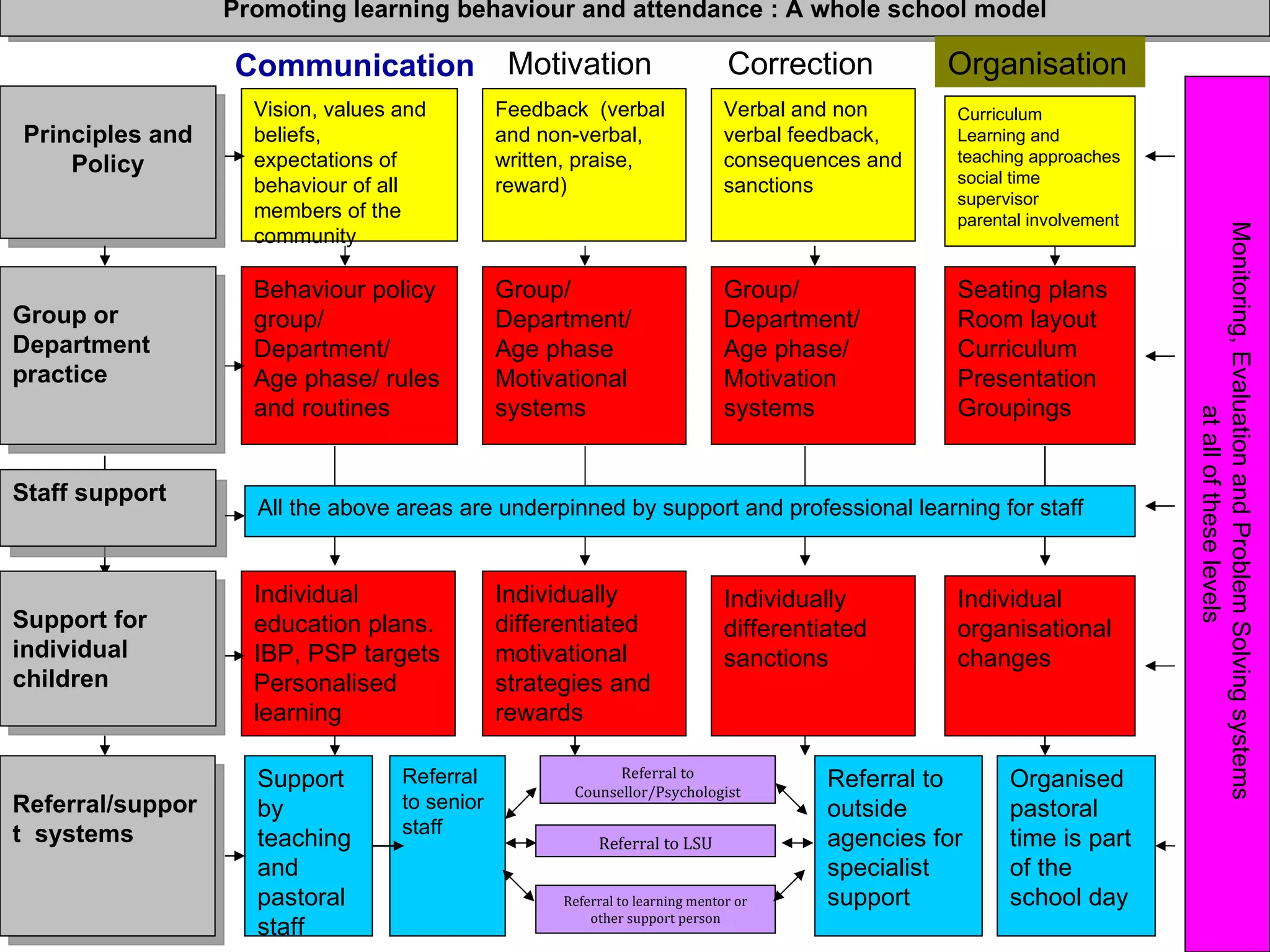
  The LLB&A Program – a partnership
       between ACEL and NCfLB
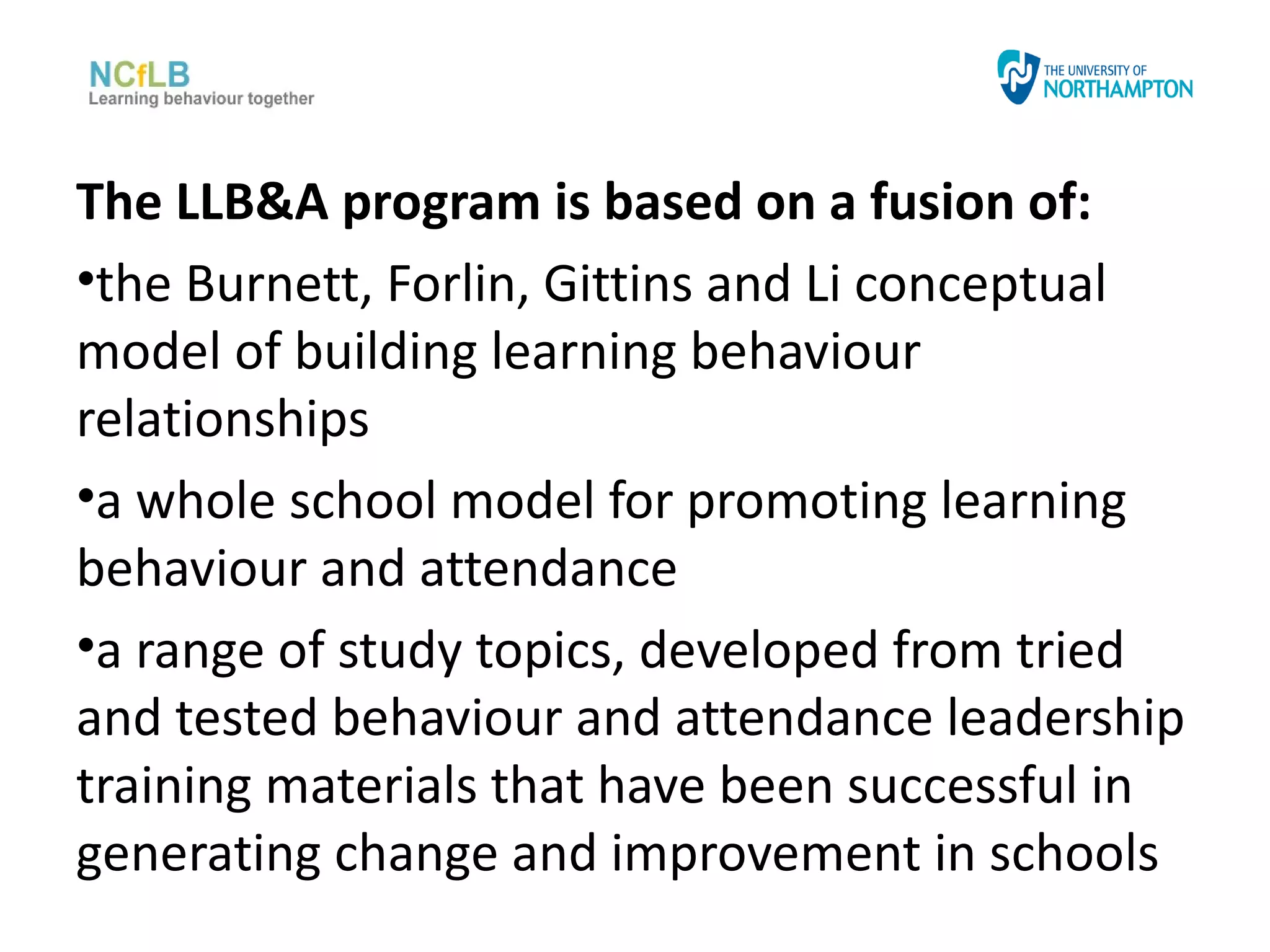
The LLB&A program is based on a fusion of:
•the Burnett, Forlin, Gittins and Li conceptual
model of building learning behaviour
relationships
•a whole school model for promoting learning
behaviour and attendance
•a range of study topics, developed from tried
and tested behaviour and attendance leadership
training materials that have been successful in
generating change and improvement in schools
Promoting learning behaviour and attendance : A whole school model

                  Communication                 Motivation                     Correction          Organisation
                    Vision, values and         Feedback (verbal                Verbal and non       Curriculum
Principles and      beliefs,                   and non-verbal,                 verbal feedback,     Learning and
                    expectations of            written, praise,                consequences and     teaching approaches
    Policy                                                                                          social time
                    behaviour of all           reward)                         sanctions
                                                                                                    supervisor
                    members of the                                                                  parental involvement


                                                                                                                           Monitoring, Evaluation and Problem Solving systems
                    community

                    Behaviour policy           Group/                          Group/               Seating plans
Group or            group/                     Department/                     Department/          Room layout
Department          Department/                Age phase                       Age phase/           Curriculum
practice            Age phase/ rules           Motivational                    Motivation           Presentation
                    and routines               systems                         systems              Groupings


                                                                                                                                           at all of these levels
Staff support
                    All the above areas are underpinned by support and professional learning for staff


                    Individual                 Individually                    Individually         Individual
Support for         education plans.           differentiated                  differentiated       organisational
individual          IBP, PSP targets           motivational                    sanctions            changes
children            Personalised               strategies and
                    learning                   rewards

                                   Referral                 Referral to
                    Support                           Counsellor/Psychologist
                                                                                         Referral to      Organised
Referral/suppor     by             to senior                                             outside          pastoral
t systems                          staff
                    teaching                              Referral to LSU                agencies for     time is part
                    and                                                                  specialist       of the
                    pastoral                         Referral to learning mentor or      support 26       school day
                                                         other support person
                    staff
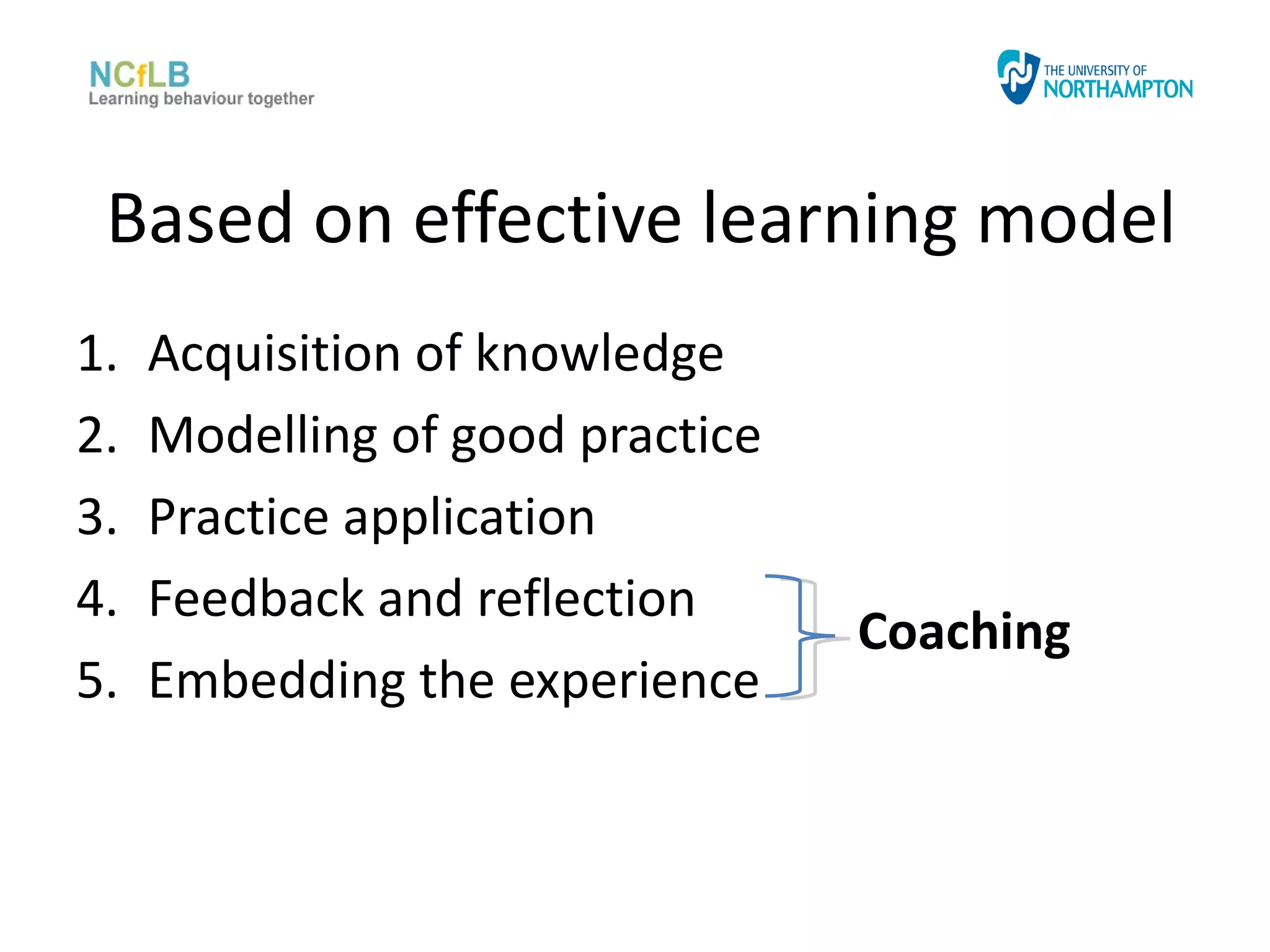
Based on effective learning model
1.   Acquisition of knowledge
2.   Modelling of good practice
3.   Practice application
4.   Feedback and reflection
                                  Coaching
5.   Embedding the experience
The LLB&A offers:
• an opportunity for emerging and middle leaders
  to develop and enhance their leadership skills
  within the context of learning behaviour and
  attendance improvement, building on a
  distributed leadership model.
• support for ongoing professional development in
  a longer term learning community.
• an opportunity to gain qualifications and to
  extend learning from the program into further
  accreditation routes.
LLB&A Learning Outcomes
• An increased understanding of the leadership
  styles, qualities and skills required for the
  effective leadership of learning behaviour and
  attendance improvement in schools.
• Practice in leading the whole school approaches
  which are explored in the program and are
  drivers for change.
• Enhanced skills in organising and implementing
  interventions to improve learning behaviour and
  attendance.
The full program outline
• Program takes place over a period of 6 months
  minimum
• 3 x 2 day group workshops – activity based
  learning using a modular program of study
  materials
• In between the tutored sessions participants can
  select from a range of practical work-based
  activities to carry out in-school supported by:
     • On-line tutorials
     • Study materials including background reading
     • Behaviour scenarios – self tutored interactive on-line
       sessions
     • Learning Behaviour DVD and other video materials
     • Webinar and web-site access
     • Optional coaching sessions
Additional Options:
•If you are still not sure whether to commit to the
six month program we can run:
  – A one day introductory session where participants:
      • can explore some of the underlying rationale of the program
        in relation to fundamental issues for their school
      • experience the training methodology we use, and;
      • help us respond to their needs when tailoring the program
        for an interested group in their region
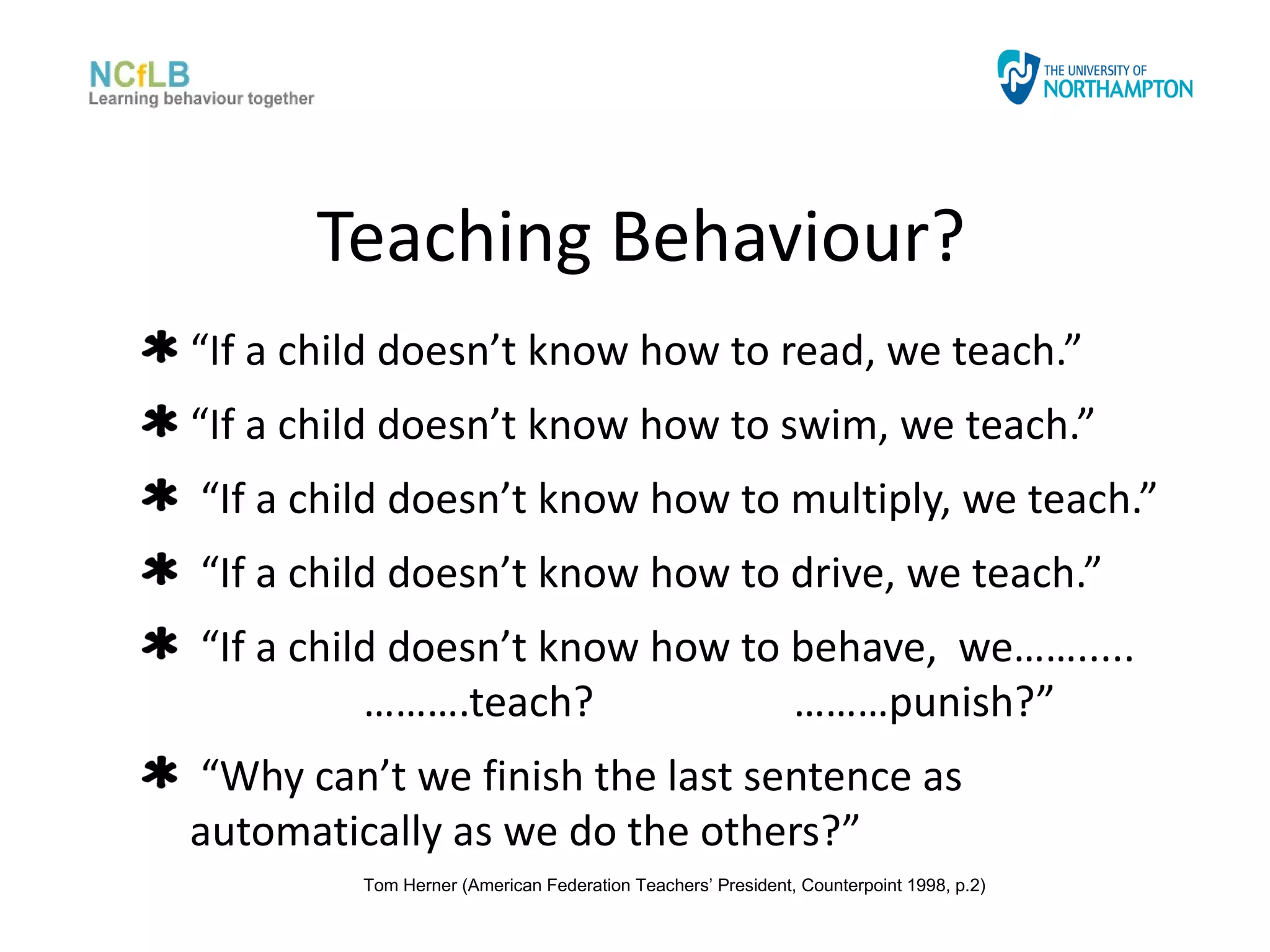
Teaching Behaviour?
“If a child doesn’t know how to read, we teach.”
“If a child doesn’t know how to swim, we teach.”
“If a child doesn’t know how to multiply, we teach.”
“If a child doesn’t know how to drive, we teach.”
“If a child doesn’t know how to behave, we…….....
          ……….teach?            ………punish?”
“Why can’t we finish the last sentence as
automatically as we do the others?”
         Tom Herner (American Federation Teachers’ President, Counterpoint 1998, p.2)
• Please leave your email on the sheets:
  – for a copy of the PowerPoint
  – further info on the current LLB&A programs
  – to discuss the possibility of running an
    individualised LLB&A program for your area
• Stay in touch through:
  – LinkedIn – Nick Burnett
  – Twitter – nick_burnett
  – Facebook – Nick Burnett CCP

Leading Learning Behaviour and Attendance

  • 1.
    Leading Learning Behaviourand Attendance - the what, why and how Nick Burnett Asia Pacific Director of Northampton Centre for Learning Behaviour (NCfLB) – LinkedIn – Nick Burnett – Twitter – nick_burnett – Facebook – Nick Burnett CCP
  • 2.
    THE ‘WHY’ OFLEARNING BEHAVIOUR
  • 3.
  • 4.
    The importance ofimproving Learning Behaviour and Attendance •Despite continued improvement in academic standards across most of the Asia Pacific Region, an unacceptable proportion of children become disaffected with school, resulting in poor learning behaviour, lack of progress, declining attendance or lack of inclusion in school.
  • 5.
    • Bullying andother anti-social and/or violent behaviours affect children’s well-being. They impact on their ability to learn and their inclusion in school. • There is a growing demand, amongst trainee and serving teachers, for training and support to improve the learning behaviour of children and to create a climate of harmony and wellbeing in their schools
  • 6.
    Latest research In Australian schools, both novice and experienced teachers increasingly raise concerns that they are not able to teach effectively because of the recurrent incidence of disruptive behaviours of some students. Teachers state that managing children with behavior problems is a major source of stress to them. This results in less work satisfaction and teachers leaving the profession. 6
  • 7.
    Latest research Research shows that improving the learning behaviour of children whose behaviour is challenging is one of the most effective ways of raising standards of attainment for all children in our schools. It also benefits society at large by helping children learn the social and emotional skills they need for citizenship and by preventing behaviours that disrupt teaching from developing into behaviours that disrupt the lives of others and cost society dearly (e.g. violence, vandalism, addiction and crime). 7
  • 8.
    THE ‘WHAT’ OFLEARNING BEHAVIOUR
  • 10.
    Effective lesson organisationresults in improved Learning Behaviour Specific planning/structuring of lessons that promotes Learning Behaviour relationships for all pupils involves paying attention to three drivers linked to the three relationship domains of the Behaviour for Learning model: 2.Emotional wellbeing (Relationship with self - Engagement) 3.Social wellbeing (Relationship with others - Participation) 4.Cognitive wellbeing (Relationship with the curriculum - Access) 10
  • 11.
    LEARNING BEHAVIOUR ENVIRONMENT RELATIONSHIP RELATIONSHIP FACILITATED WITH SELF BY LEARNING WITH PEOPLE BEHAVIOUR EMOTIONAL SOCIAL WELL BEING WELL BEING FACILITATED FACILITATED BY LEARNING BY LEARNING BEHAVIOUR BEHAVIOUR RELATIONSHIP WITH CURRICULUM COGNITIVE WELL BEING Burnett, Forlin, Gittins, Li 2011
  • 12.
    • The circleof Relationship with Self is undoubtedly the most important relationship for learning behaviour. It signifies the positive self identity of the child and a growing self reliance that will build steadily during the stages of transition from childhood to adulthood
  • 13.
    An appreciation ofself is typified by the child’s growing: •self belief and self determination and confidence to learn new things •self motivation and a thirst for learning and interest in the process •understanding of personal strengths and weaknesses •resourcefulness, responsibility and willingness to admit and correct mistakes •and most important of all - emotional wellbeing and happiness
  • 14.
    • The circleof Relationship with People is woven by the interactions between the child and others such as teachers, parents and peers. The interactions lead to the development of a range of interpersonal skills as the child becomes more socially and emotionally adept.
  • 15.
    Their learning ispromoted as they learn the value of and can express their growing: •empathy and respect for others and acceptance and understanding of differences •friendship and harmony in the presence of others and a feeling of belonging •participation, and willingness to join in activities and learning experiences •cooperation and collaborative working, recognizing that learning behaviour involves working harmoniously with others. •and most important of all - social wellbeing
  • 16.
    • The circleof Relationship with the Curriculum includes the way the child engages with learning and develops an interest in continuing and continuous education and a love for learning.
  • 17.
    Factors which promotethis relationship between the child and the formal and informal curriculum in the school include their growing: •access to a curriculum which is relevant and meets the developing needs of the child. •ability to focus and maintain attention on the task of learning. •inspiration by inspiring teaching •ability to communicate and express interest. •and most important of all - cognitive wellbeing
  • 18.
    LEARNING BEHAVIOUR ENVIRONMENT RELATIONSHIP RELATIONSHIP FACILITATED WITH SELF BY LEARNING WITH PEOPLE BEHAVIOUR EMOTIONAL SOCIAL WELL BEING WELL BEING FACILITATED FACILITATED BY LEARNING BY LEARNING BEHAVIOUR BEHAVIOUR RELATIONSHIP WITH CURRICULUM COGNITIVE WELL BEING Burnett, Forlin, Gittins, Li 2011
  • 19.
    THE ‘HOW’ OFLEARNING BEHAVIOUR
  • 20.
    The importance ofLeading Learning Behaviour and Attendance •Challenging behaviour and poor attendance are the single biggest factors affecting the attainment of our children in Australian schools. •The evidence is unequivocal that effective school leadership is the most influential factor in generating change.
  • 21.
    • There isa growing body of knowledge and experience, validated by research, in leading effective whole school approaches to improving learning behaviour and attendance. • The factors influencing learning behaviour and regular attendance are almost identical
  • 22.
    • The solutionsrequire the same skilful leadership and organisation in schools to achieve the necessary conditions where pro- social learning behaviour and willing attendance are promoted through the engagement, participation and access of all pupils to the curriculum.
  • 23.
    Leading Learning Behaviourand Attendance The LLB&A Program – a partnership between ACEL and NCfLB
  • 25.
    The LLB&A programis based on a fusion of: •the Burnett, Forlin, Gittins and Li conceptual model of building learning behaviour relationships •a whole school model for promoting learning behaviour and attendance •a range of study topics, developed from tried and tested behaviour and attendance leadership training materials that have been successful in generating change and improvement in schools
  • 26.
    Promoting learning behaviourand attendance : A whole school model Communication Motivation Correction Organisation Vision, values and Feedback (verbal Verbal and non Curriculum Principles and beliefs, and non-verbal, verbal feedback, Learning and expectations of written, praise, consequences and teaching approaches Policy social time behaviour of all reward) sanctions supervisor members of the parental involvement Monitoring, Evaluation and Problem Solving systems community Behaviour policy Group/ Group/ Seating plans Group or group/ Department/ Department/ Room layout Department Department/ Age phase Age phase/ Curriculum practice Age phase/ rules Motivational Motivation Presentation and routines systems systems Groupings at all of these levels Staff support All the above areas are underpinned by support and professional learning for staff Individual Individually Individually Individual Support for education plans. differentiated differentiated organisational individual IBP, PSP targets motivational sanctions changes children Personalised strategies and learning rewards Referral Referral to Support Counsellor/Psychologist Referral to Organised Referral/suppor by to senior outside pastoral t systems staff teaching Referral to LSU agencies for time is part and specialist of the pastoral Referral to learning mentor or support 26 school day other support person staff
  • 27.
    Based on effectivelearning model 1. Acquisition of knowledge 2. Modelling of good practice 3. Practice application 4. Feedback and reflection Coaching 5. Embedding the experience
  • 28.
    The LLB&A offers: •an opportunity for emerging and middle leaders to develop and enhance their leadership skills within the context of learning behaviour and attendance improvement, building on a distributed leadership model. • support for ongoing professional development in a longer term learning community. • an opportunity to gain qualifications and to extend learning from the program into further accreditation routes.
  • 29.
    LLB&A Learning Outcomes •An increased understanding of the leadership styles, qualities and skills required for the effective leadership of learning behaviour and attendance improvement in schools. • Practice in leading the whole school approaches which are explored in the program and are drivers for change. • Enhanced skills in organising and implementing interventions to improve learning behaviour and attendance.
  • 30.
    The full programoutline • Program takes place over a period of 6 months minimum • 3 x 2 day group workshops – activity based learning using a modular program of study materials • In between the tutored sessions participants can select from a range of practical work-based activities to carry out in-school supported by: • On-line tutorials • Study materials including background reading • Behaviour scenarios – self tutored interactive on-line sessions • Learning Behaviour DVD and other video materials • Webinar and web-site access • Optional coaching sessions
  • 33.
    Additional Options: •If youare still not sure whether to commit to the six month program we can run: – A one day introductory session where participants: • can explore some of the underlying rationale of the program in relation to fundamental issues for their school • experience the training methodology we use, and; • help us respond to their needs when tailoring the program for an interested group in their region
  • 34.
    Teaching Behaviour? “If achild doesn’t know how to read, we teach.” “If a child doesn’t know how to swim, we teach.” “If a child doesn’t know how to multiply, we teach.” “If a child doesn’t know how to drive, we teach.” “If a child doesn’t know how to behave, we……..... ……….teach? ………punish?” “Why can’t we finish the last sentence as automatically as we do the others?” Tom Herner (American Federation Teachers’ President, Counterpoint 1998, p.2)
  • 35.
    • Please leaveyour email on the sheets: – for a copy of the PowerPoint – further info on the current LLB&A programs – to discuss the possibility of running an individualised LLB&A program for your area • Stay in touch through: – LinkedIn – Nick Burnett – Twitter – nick_burnett – Facebook – Nick Burnett CCP

Editor's Notes

  • #27 Ask participants to explore the model using the questions on page 26