WIDA IMPLEMENTATION:
CHALLENGES AND SUCCESSES
ACROSS MULTIPLE DISTRICTS
Ashley Karlsson - MELED CONFERENCE
Friday, November 6, 2015
“As anyone knows who has worked in
the field, implementation of new
practice is the biggest challenge of all.”
Hollin & McMurran (as cited in Fixsen & Blase, 2009)
Objective And Agenda
• By the end of this
session, participants
will understand:
i. theWIDA Standards
Framework
ii. the challenges of
implementation
iii. strategies for
moving
implementation
forward
• Research Context
• Overview ofWIDA
Framework
• Research Methodology
• Major Findings
• Implementation Strategies
Research Context
• Implementation ofWIDA
Standards is required, but
what does that look like on a
practical level?
•How does implementation
look different in different
settings?
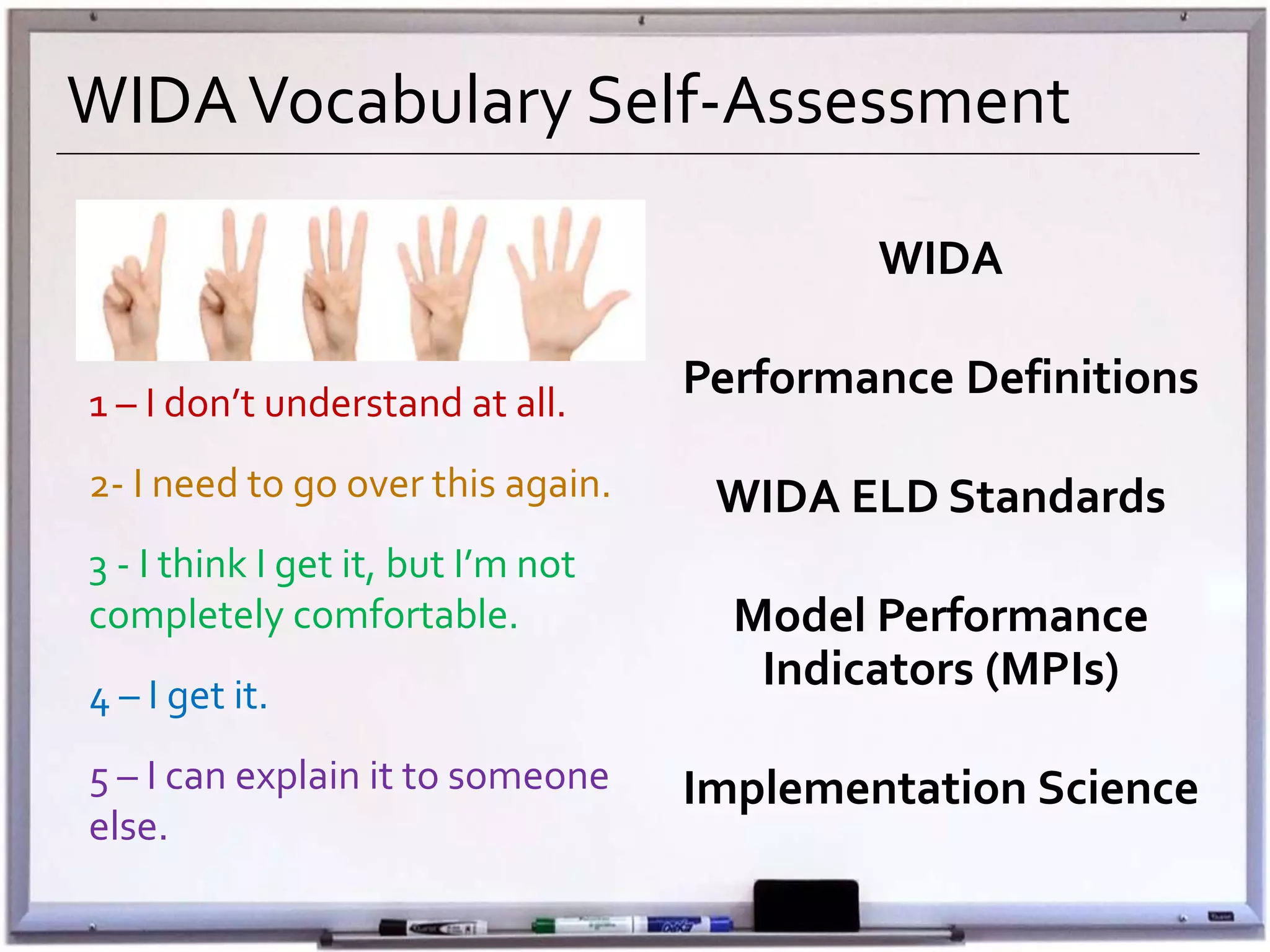
WIDAVocabulary Self-Assessment
WIDA
Performance Definitions
WIDA ELD Standards
Model Performance
Indicators (MPIs)
Implementation Science
1 – I don’t understand at all.
2- I need to go over this again.
3 - I think I get it, but I’m not
completely comfortable.
4 – I get it.
5 – I can explain it to someone
else.
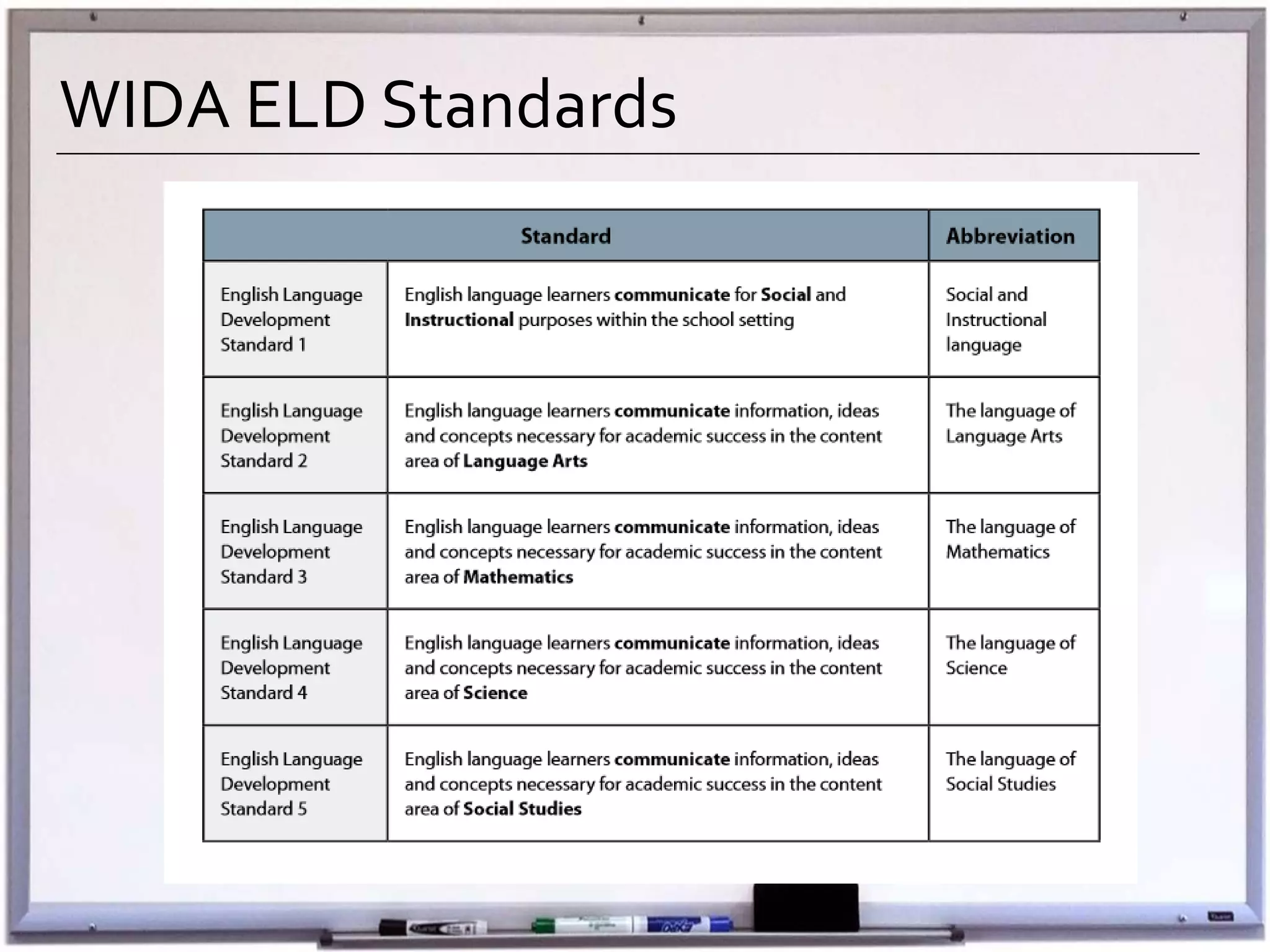
WIDA ELD Standards
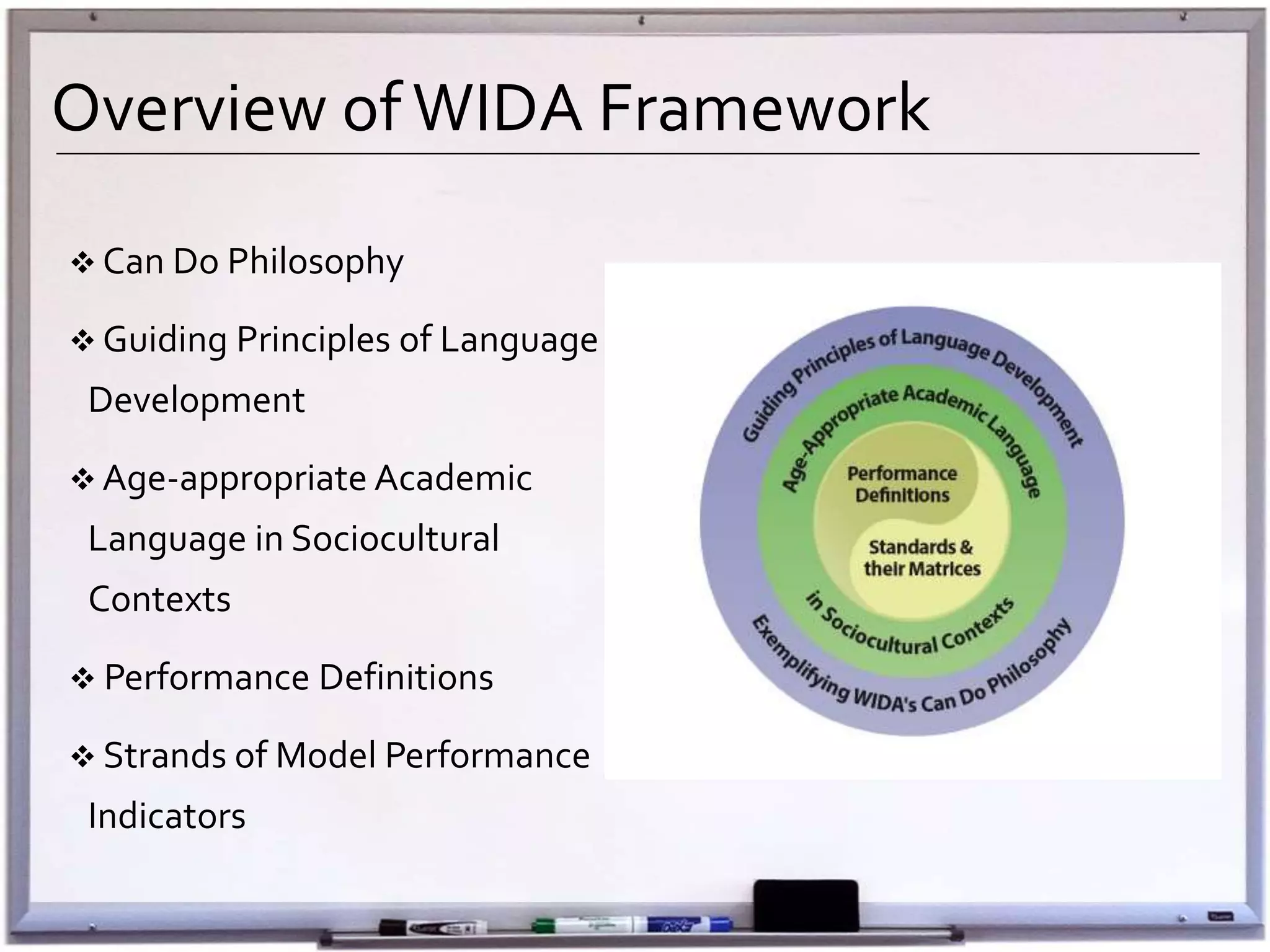
Overview ofWIDA Framework
 Can Do Philosophy
 Guiding Principles of Language
Development
 Age-appropriate Academic
Language in Sociocultural
Contexts
 Performance Definitions
 Strands of Model Performance
Indicators
How is theWIDA Standards Framework
being used in your school?
Turn andTalk
- Introduce yourself to a neighbor.
- Share your one word.
Share-Out
Think of one word that describes your school or district’s
implementation ofWIDA Standards.
Research Design and Methodology
•Semi-structured interviews
with 12 participants from
different districts
•Anonymous and
confidential
•Interviews were recorded,
transcribed and coded
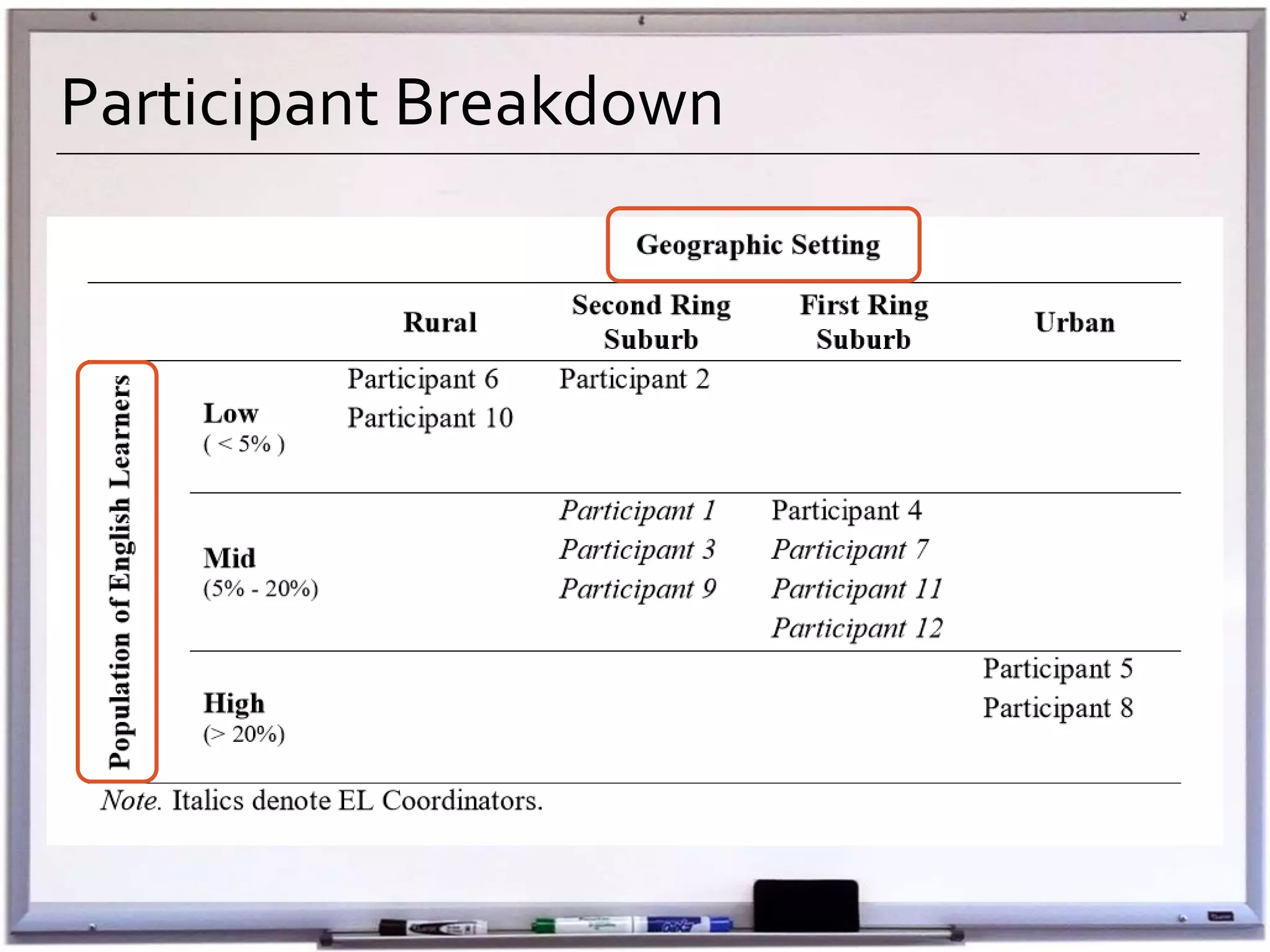
Participant Breakdown
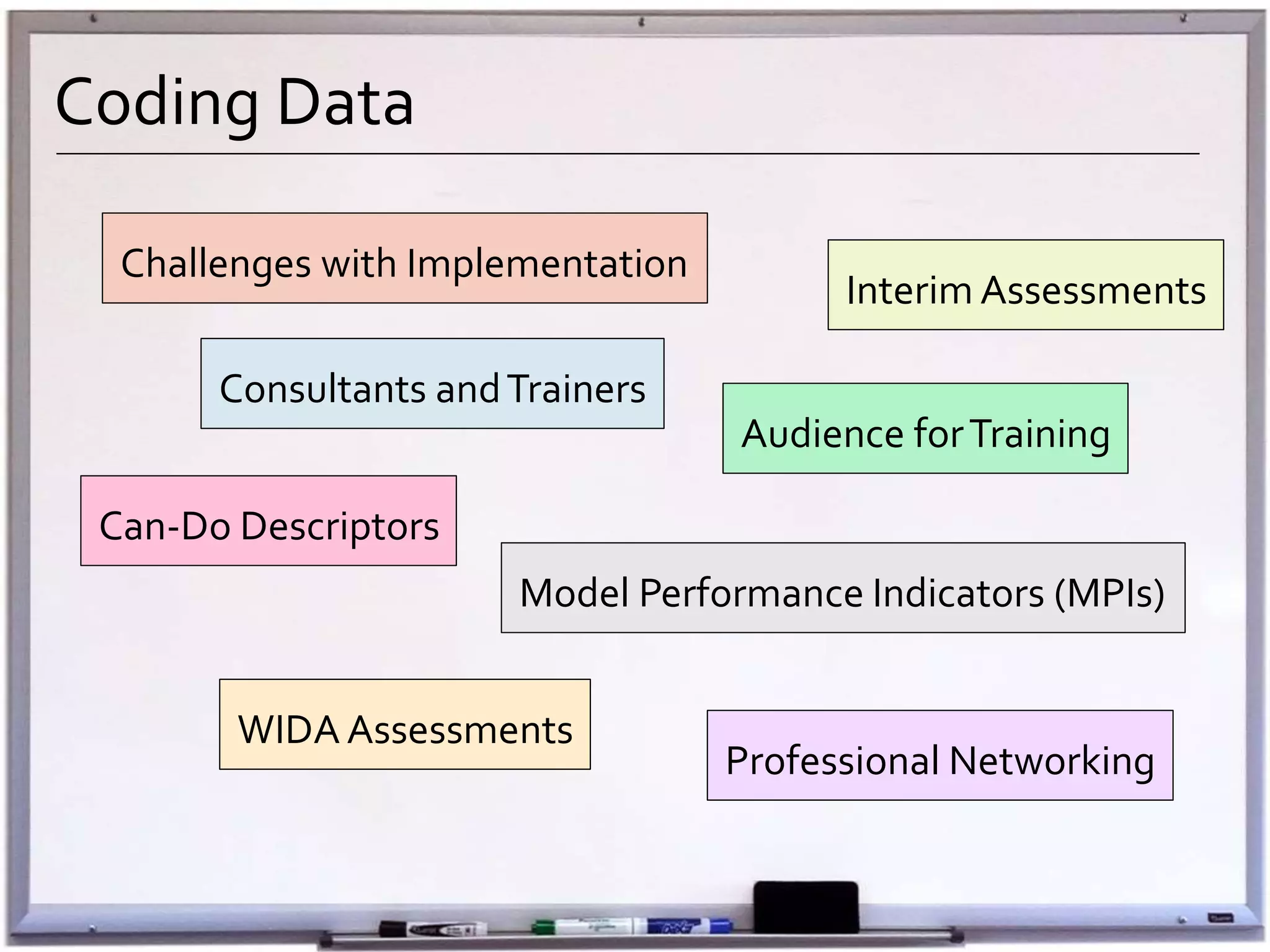
Coding Data
Challenges with Implementation
Consultants andTrainers
Model Performance Indicators (MPIs)
Can-Do Descriptors
WIDA Assessments
Interim Assessments
Professional Networking
Audience forTraining
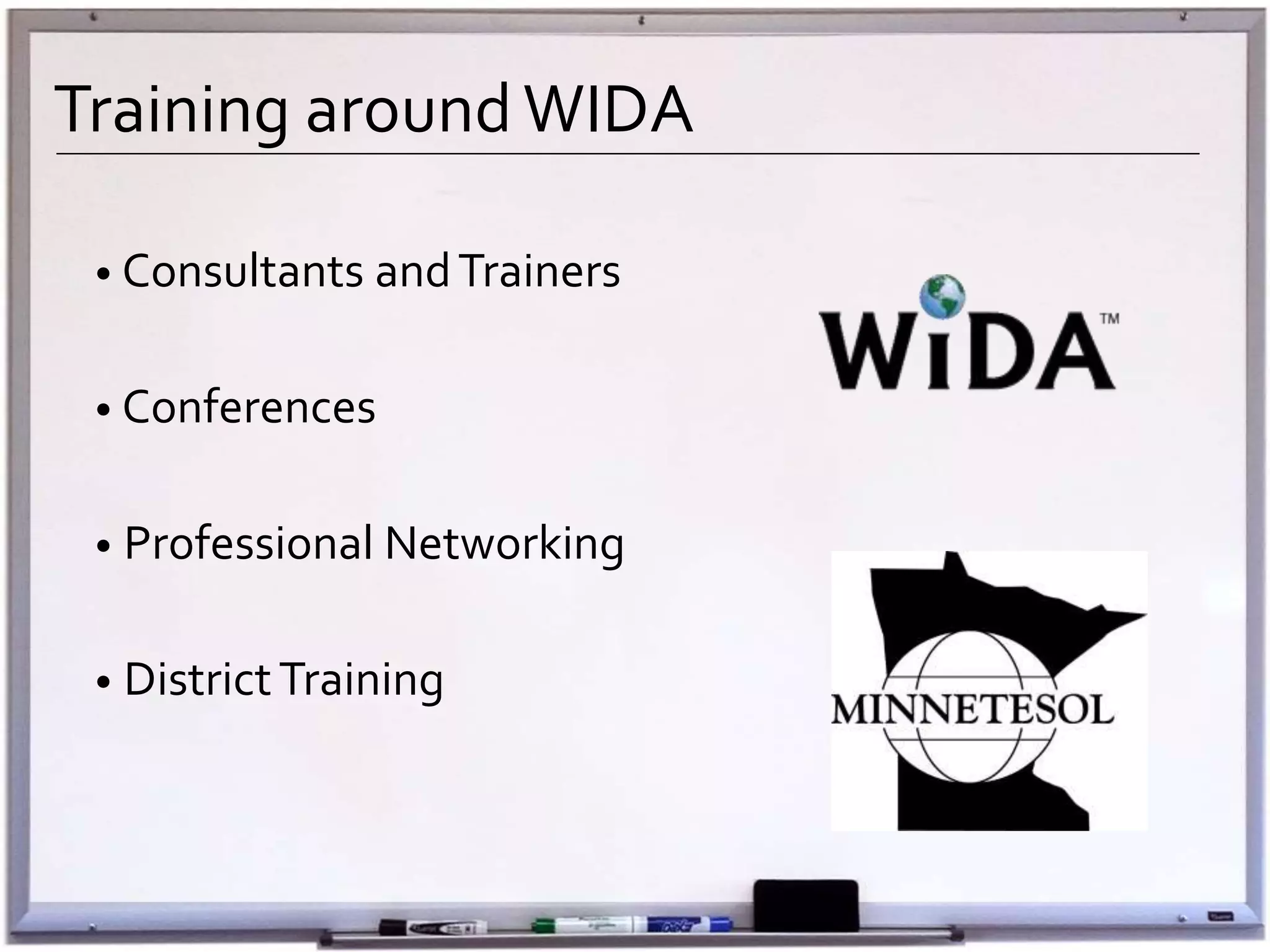
Training aroundWIDA
• Consultants andTrainers
• Conferences
• Professional Networking
• DistrictTraining
Challenges with Implementation
Participant Quotes:
 I would be curious to know what implementation means and
looks like in other districts. Are there things being done
besides writing up an indeterminable list of MPIs?
 It’s basically like, here’s a really nice framework, now spend a
hundred hours creating your own standards, and who has
time for that?”
 I feel like in my district the implementation ofWIDA has
been very minimal. […]We haven’t really talked about it. It
kind of gets ignored.
Challenges with Implementation
Participant Quotes:
 We had a lot of questions, like, ‘How are we going to do
this?’ and ‘Where do we even start?’ and ‘When?’ And, ‘Do we
have to bring in a trainer?’ And we got absolutely nowhere.
 No matter what timeline you put together, what really
happens will always look different because there’s real life
and there are other initiatives from the federal government
and state and from your own district that will have to balance.
Can-Do Descriptors
Participant Quotes:
 I do think Can Do Descriptors have helped people in
this building, but I think it’s something they get and
then put aside.
 I feel like they got set aside or tossed in the trash and
nobody really used them or looked at them anyway.
 Unlike some districts that are really digging into that
and applying it to particular classes, for us, it is more of
a guiding document.
Model Performance Indicators (MPIs)
Participant Qu0tes:
 MPI writing is really stressful for my teachers.
 I don’t know much about using the MPIs, just because I
haven’t had much exposure to it and it kind of gets ignored.
 I’m not using them. I attempt to, but like I said, in the end, it
just gets [to be] too much, with how much we have to do.
 We did a fair amount of work in MPI writing. What we wound
up seeing is that it wasn’t necessarily used.
Model Performance Indicators (MPIs)
Participant Qu0tes:
 We’ve noticed it has been a good place for
conversation about what mediating or differentiating
instruction would look like. So while the teachers may
not actually write MPIs for their lessons or units, it has
named supports and language expectations for us in
our conversations. It sort of brought those
conversations up.
What role do MPIs play in the
implementation process?
Turn andTalk
• Were there any
quotes that stood out
to you?
• Did any of the quotes
connect with your
own experiences?
Major Findings
(1) Nature ofWIDA Framework
(2) Guidelines for Implementation
(3) Complexity of MPIs
(4) Role of ELTeacher
Nature ofWIDA Standards Framework
 WIDA Standards are distinct
from other academic standards
in that they are generative and
transformative
 Lack of understanding
perpetuates difficulties with
implementation
 Effective implementation
involves more than just EL
Teachers
Guidelines for Implementation
 No definite formula for
implementation
 Lack of accountability in
implementation process
 The tools that do exist are
often unknown or
underutilized
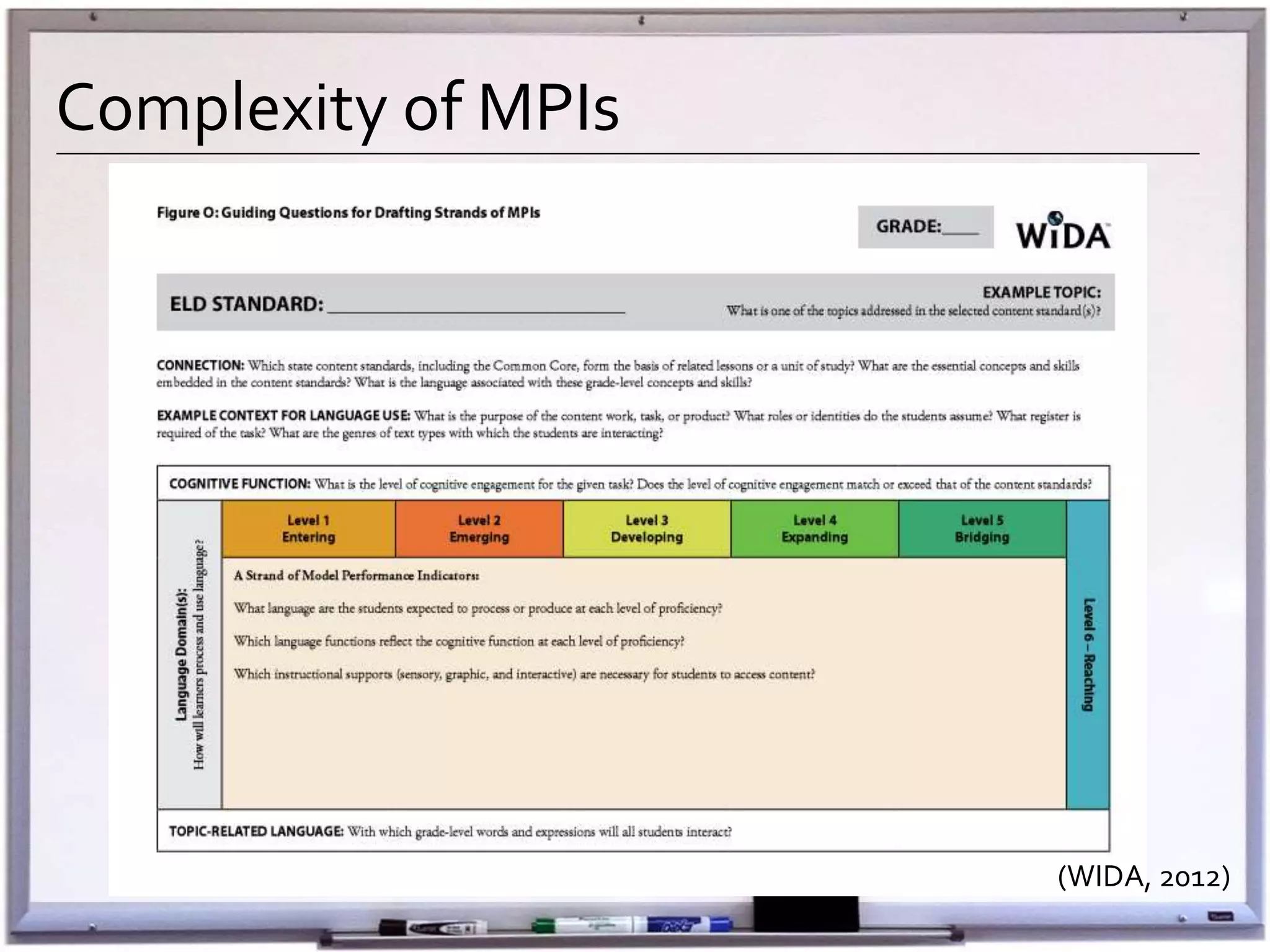
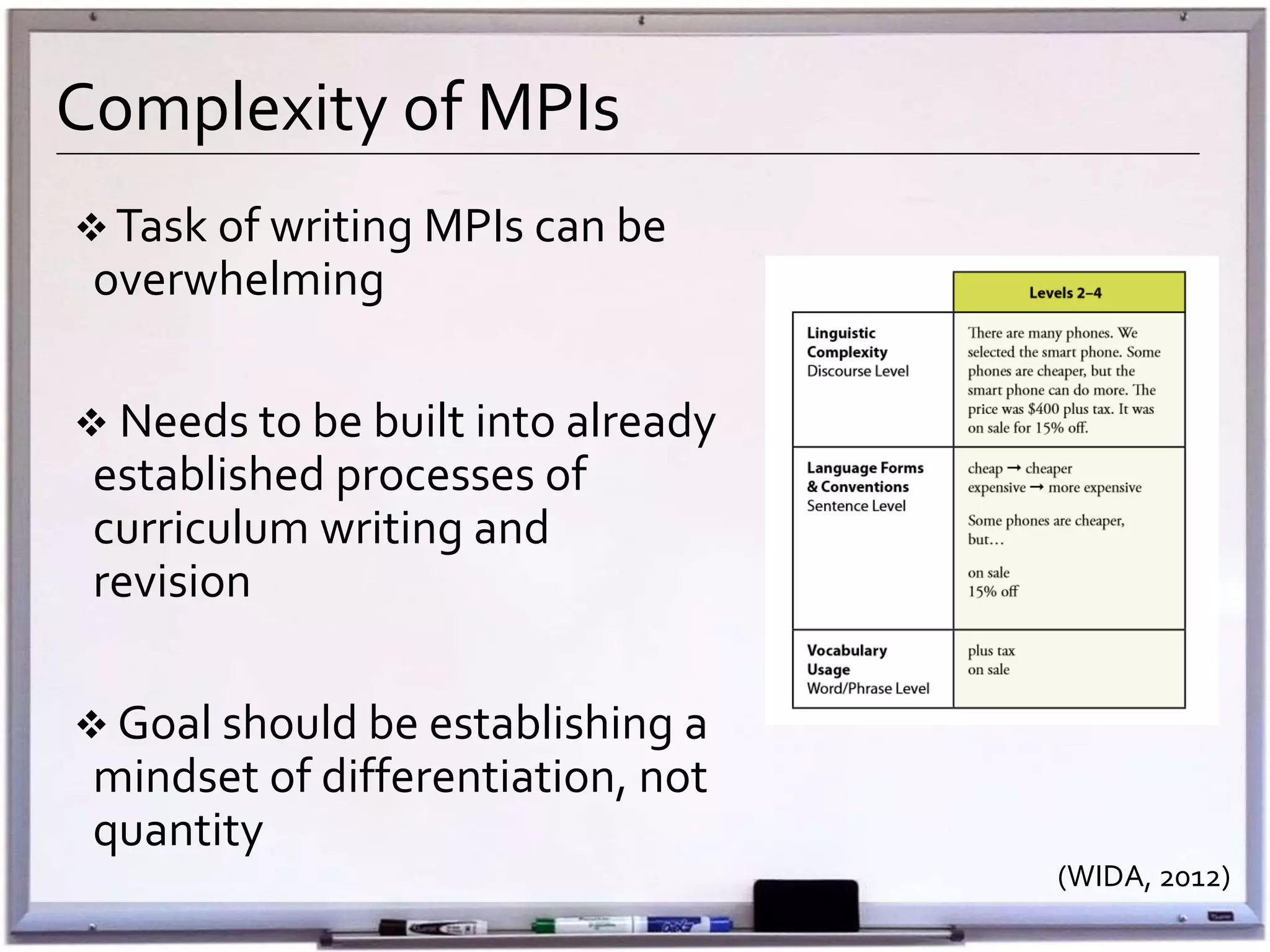
Complexity of MPIs
(WIDA, 2012)
Complexity of MPIs
 Task of writing MPIs can be
overwhelming
 Needs to be built into already
established processes of
curriculum writing and
revision
 Goal should be establishing a
mindset of differentiation, not
quantity
(WIDA, 2012)
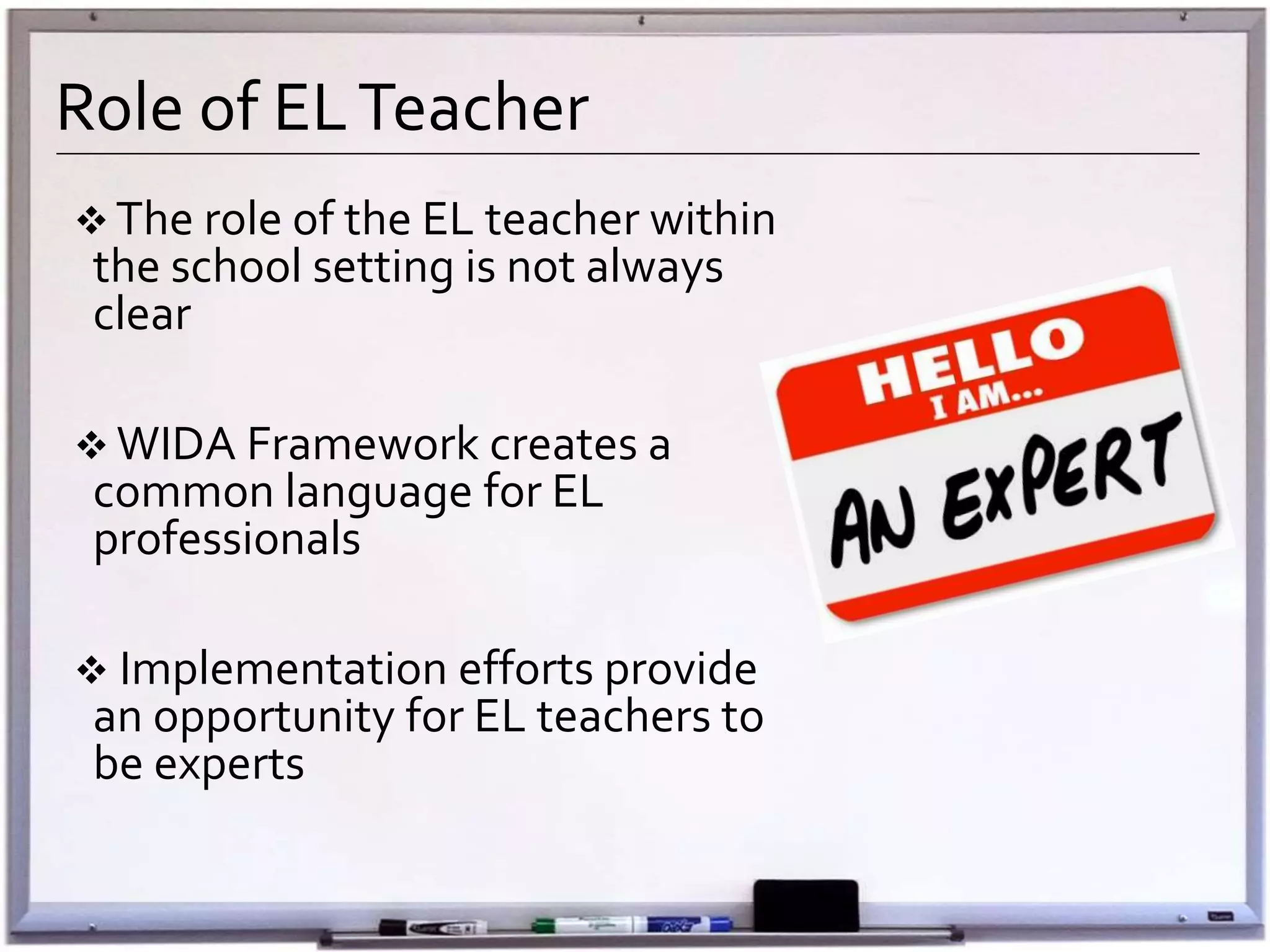
Role of ELTeacher
 The role of the EL teacher within
the school setting is not always
clear
 WIDA Framework creates a
common language for EL
professionals
 Implementation efforts provide
an opportunity for EL teachers to
be experts
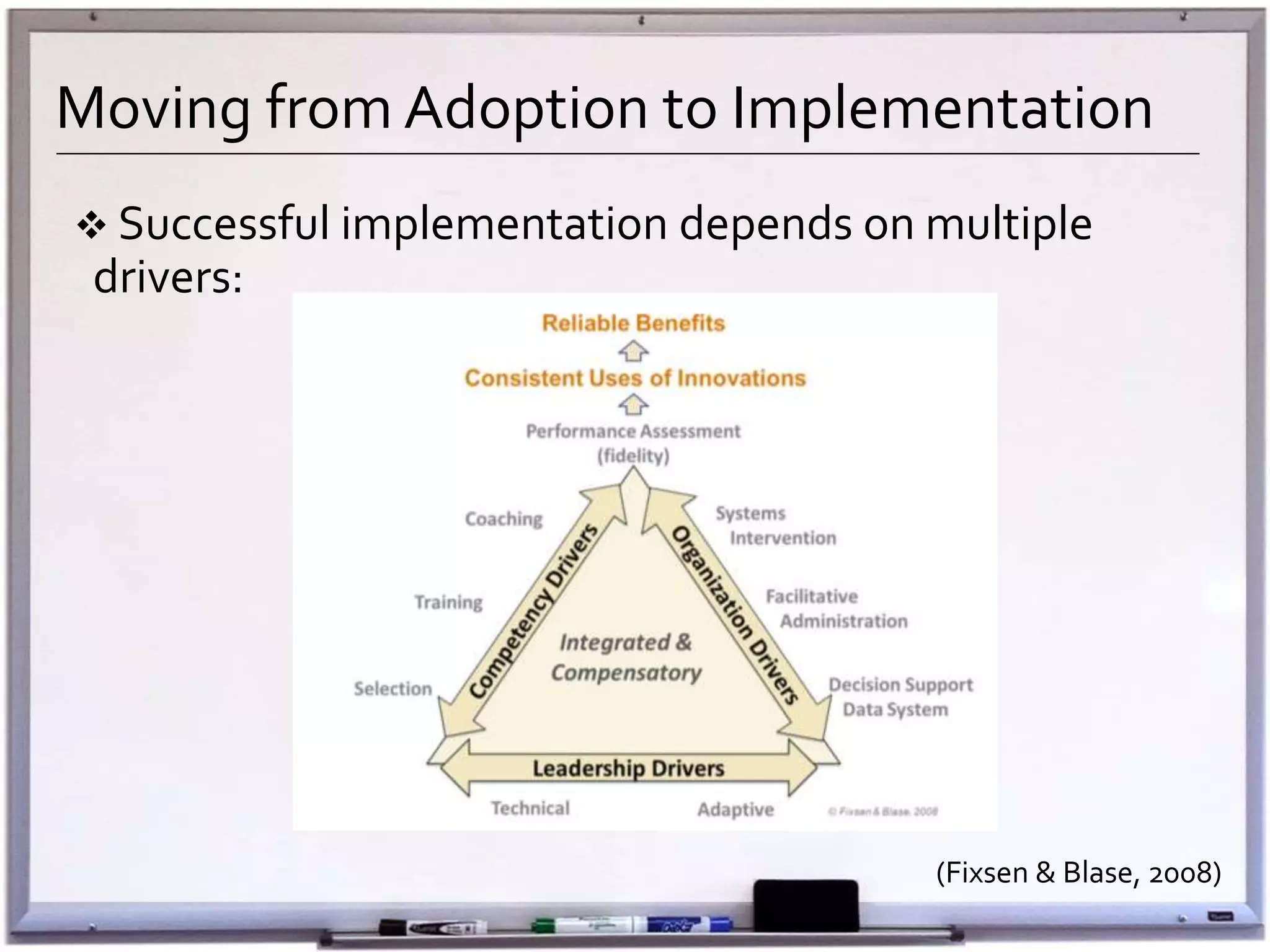
Moving from Adoption to Implementation
 Successful implementation depends on multiple
drivers:
(Fixsen & Blase, 2008)
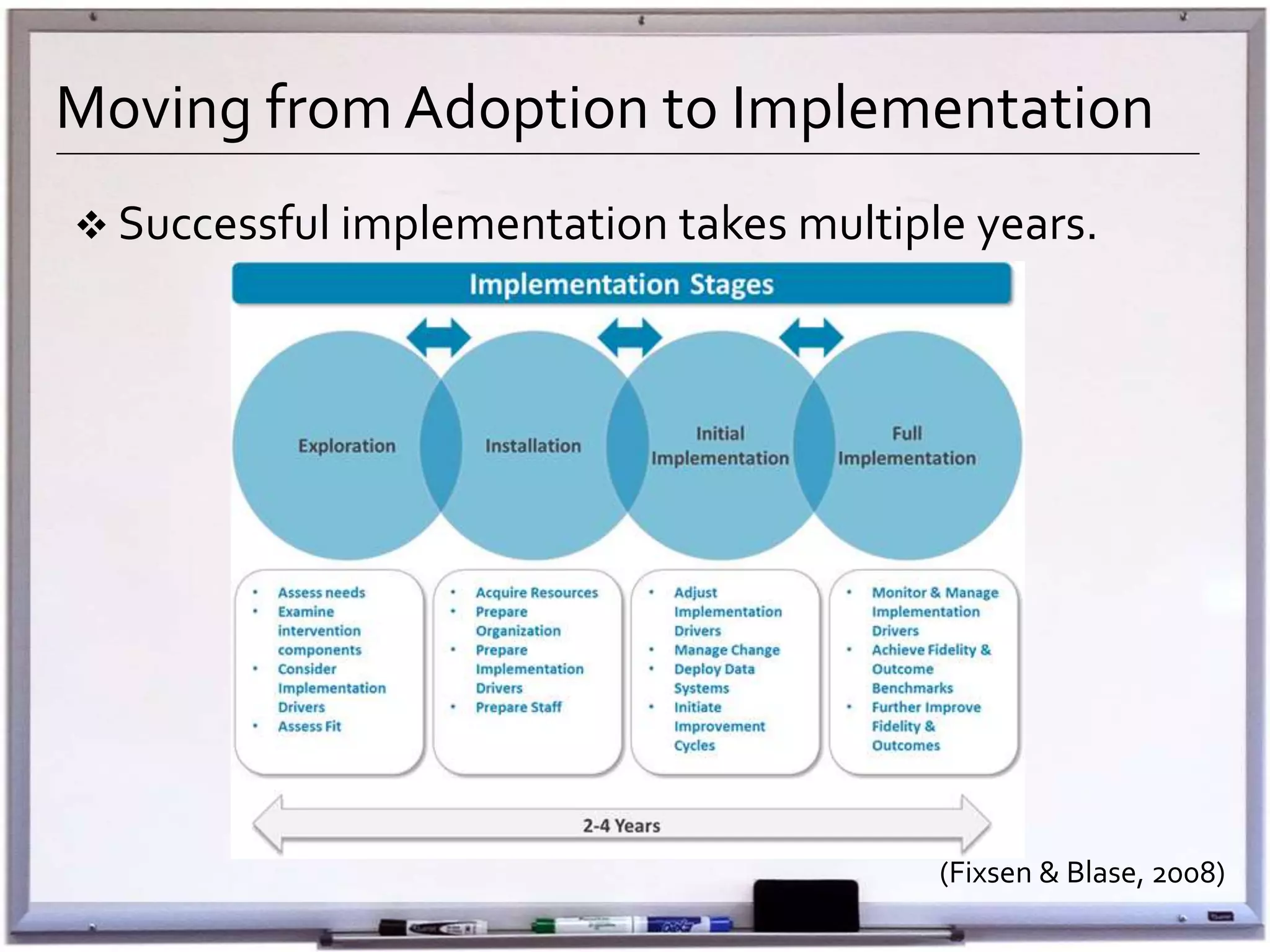
Moving from Adoption to Implementation
 Successful implementation takes multiple years.
(Fixsen & Blase, 2008)
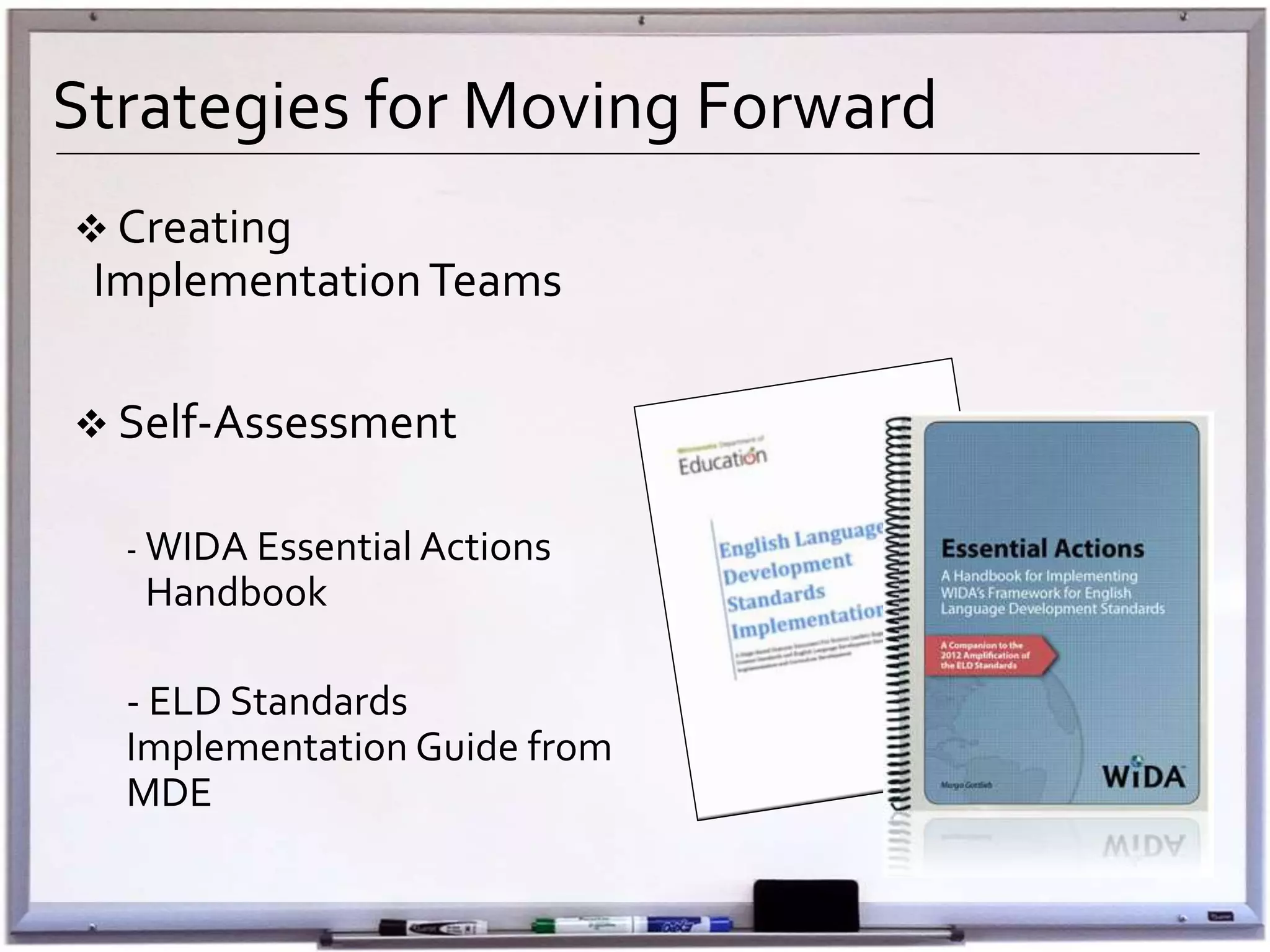
Strategies for Moving Forward
 Creating
ImplementationTeams
 Self-Assessment
- WIDA Essential Actions
Handbook
- ELD Standards
Implementation Guide from
MDE
Extending the Conversation
• If you’re interested in continuing to discuss issues around
implementation, add your name and contact information
to the session Google Doc.
https://goo.gl/ZgvU6y
• You will also find links to the slides from this presentation
and access to the complete research results.
ClosingThoughts
• You are not alone.
• Supporting each other will help support ELs across the
state.
• We need to be advocates, not just for our students, but
also for ourselves.
• We need to be intentional about finding what works in
our schools.
Questions and Answers

Karlsson_WIDA standards implementation

  • 1.
    WIDA IMPLEMENTATION: CHALLENGES ANDSUCCESSES ACROSS MULTIPLE DISTRICTS Ashley Karlsson - MELED CONFERENCE Friday, November 6, 2015
  • 2.
    “As anyone knowswho has worked in the field, implementation of new practice is the biggest challenge of all.” Hollin & McMurran (as cited in Fixsen & Blase, 2009)
  • 3.
    Objective And Agenda •By the end of this session, participants will understand: i. theWIDA Standards Framework ii. the challenges of implementation iii. strategies for moving implementation forward • Research Context • Overview ofWIDA Framework • Research Methodology • Major Findings • Implementation Strategies
  • 4.
    Research Context • ImplementationofWIDA Standards is required, but what does that look like on a practical level? •How does implementation look different in different settings?
  • 5.
    WIDAVocabulary Self-Assessment WIDA Performance Definitions WIDAELD Standards Model Performance Indicators (MPIs) Implementation Science 1 – I don’t understand at all. 2- I need to go over this again. 3 - I think I get it, but I’m not completely comfortable. 4 – I get it. 5 – I can explain it to someone else.
  • 6.
  • 7.
    Overview ofWIDA Framework Can Do Philosophy  Guiding Principles of Language Development  Age-appropriate Academic Language in Sociocultural Contexts  Performance Definitions  Strands of Model Performance Indicators
  • 8.
    How is theWIDAStandards Framework being used in your school? Turn andTalk - Introduce yourself to a neighbor. - Share your one word. Share-Out Think of one word that describes your school or district’s implementation ofWIDA Standards.
  • 9.
    Research Design andMethodology •Semi-structured interviews with 12 participants from different districts •Anonymous and confidential •Interviews were recorded, transcribed and coded
  • 10.
  • 11.
    Coding Data Challenges withImplementation Consultants andTrainers Model Performance Indicators (MPIs) Can-Do Descriptors WIDA Assessments Interim Assessments Professional Networking Audience forTraining
  • 12.
    Training aroundWIDA • ConsultantsandTrainers • Conferences • Professional Networking • DistrictTraining
  • 13.
    Challenges with Implementation ParticipantQuotes:  I would be curious to know what implementation means and looks like in other districts. Are there things being done besides writing up an indeterminable list of MPIs?  It’s basically like, here’s a really nice framework, now spend a hundred hours creating your own standards, and who has time for that?”  I feel like in my district the implementation ofWIDA has been very minimal. […]We haven’t really talked about it. It kind of gets ignored.
  • 14.
    Challenges with Implementation ParticipantQuotes:  We had a lot of questions, like, ‘How are we going to do this?’ and ‘Where do we even start?’ and ‘When?’ And, ‘Do we have to bring in a trainer?’ And we got absolutely nowhere.  No matter what timeline you put together, what really happens will always look different because there’s real life and there are other initiatives from the federal government and state and from your own district that will have to balance.
  • 15.
    Can-Do Descriptors Participant Quotes: I do think Can Do Descriptors have helped people in this building, but I think it’s something they get and then put aside.  I feel like they got set aside or tossed in the trash and nobody really used them or looked at them anyway.  Unlike some districts that are really digging into that and applying it to particular classes, for us, it is more of a guiding document.
  • 16.
    Model Performance Indicators(MPIs) Participant Qu0tes:  MPI writing is really stressful for my teachers.  I don’t know much about using the MPIs, just because I haven’t had much exposure to it and it kind of gets ignored.  I’m not using them. I attempt to, but like I said, in the end, it just gets [to be] too much, with how much we have to do.  We did a fair amount of work in MPI writing. What we wound up seeing is that it wasn’t necessarily used.
  • 17.
    Model Performance Indicators(MPIs) Participant Qu0tes:  We’ve noticed it has been a good place for conversation about what mediating or differentiating instruction would look like. So while the teachers may not actually write MPIs for their lessons or units, it has named supports and language expectations for us in our conversations. It sort of brought those conversations up. What role do MPIs play in the implementation process?
  • 18.
    Turn andTalk • Werethere any quotes that stood out to you? • Did any of the quotes connect with your own experiences?
  • 19.
    Major Findings (1) NatureofWIDA Framework (2) Guidelines for Implementation (3) Complexity of MPIs (4) Role of ELTeacher
  • 20.
    Nature ofWIDA StandardsFramework  WIDA Standards are distinct from other academic standards in that they are generative and transformative  Lack of understanding perpetuates difficulties with implementation  Effective implementation involves more than just EL Teachers
  • 21.
    Guidelines for Implementation No definite formula for implementation  Lack of accountability in implementation process  The tools that do exist are often unknown or underutilized
  • 22.
  • 23.
    Complexity of MPIs Task of writing MPIs can be overwhelming  Needs to be built into already established processes of curriculum writing and revision  Goal should be establishing a mindset of differentiation, not quantity (WIDA, 2012)
  • 24.
    Role of ELTeacher The role of the EL teacher within the school setting is not always clear  WIDA Framework creates a common language for EL professionals  Implementation efforts provide an opportunity for EL teachers to be experts
  • 25.
    Moving from Adoptionto Implementation  Successful implementation depends on multiple drivers: (Fixsen & Blase, 2008)
  • 26.
    Moving from Adoptionto Implementation  Successful implementation takes multiple years. (Fixsen & Blase, 2008)
  • 27.
    Strategies for MovingForward  Creating ImplementationTeams  Self-Assessment - WIDA Essential Actions Handbook - ELD Standards Implementation Guide from MDE
  • 28.
    Extending the Conversation •If you’re interested in continuing to discuss issues around implementation, add your name and contact information to the session Google Doc. https://goo.gl/ZgvU6y • You will also find links to the slides from this presentation and access to the complete research results.
  • 29.
    ClosingThoughts • You arenot alone. • Supporting each other will help support ELs across the state. • We need to be advocates, not just for our students, but also for ourselves. • We need to be intentional about finding what works in our schools.
  • 30.