STRUCTURAL
IMPLEMENTATION
STRUCTURE
Structure refers to how the workers within a business are organised and how they relate to each other.
 Structure defines how activities such as task allocation, coordination and supervision are directed toward
the achievement of organizational aims.
An organisation structure specifies three key components that are enumerated below:
1. It identifies the relationships between the number of steps in the hierarchy and the span of control of
managers.
2. It specifies the grouping of individuals into departments and of departments into total organisation.
3. It consists of plan of activities in order to ensure effective communication, harmonization and integration
of goals and objectives across departments.
KINDS OF STRUCTURE
Vertical Structure
Horizontal Structure
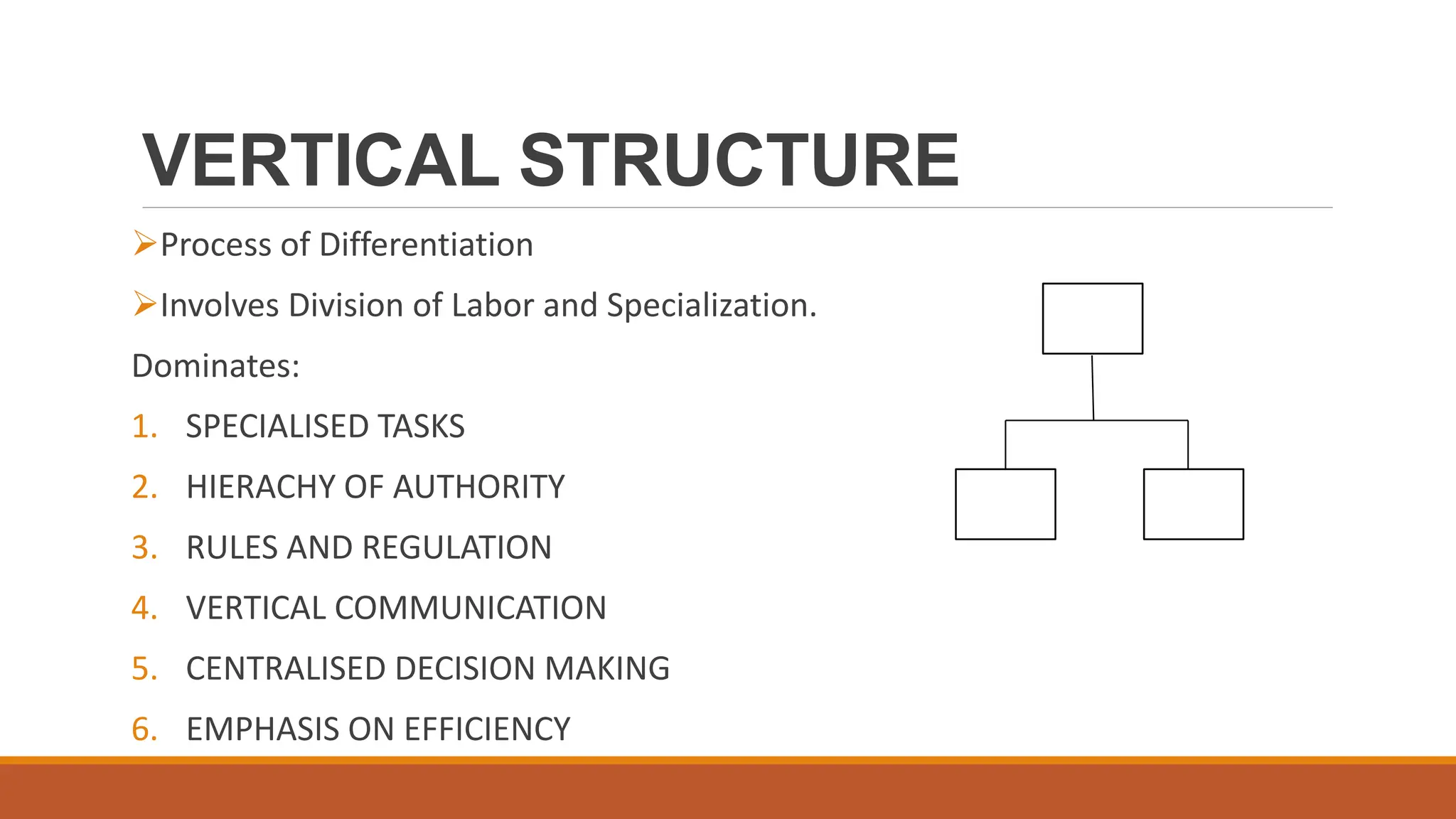
VERTICAL STRUCTURE
Process of Differentiation
Involves Division of Labor and Specialization.
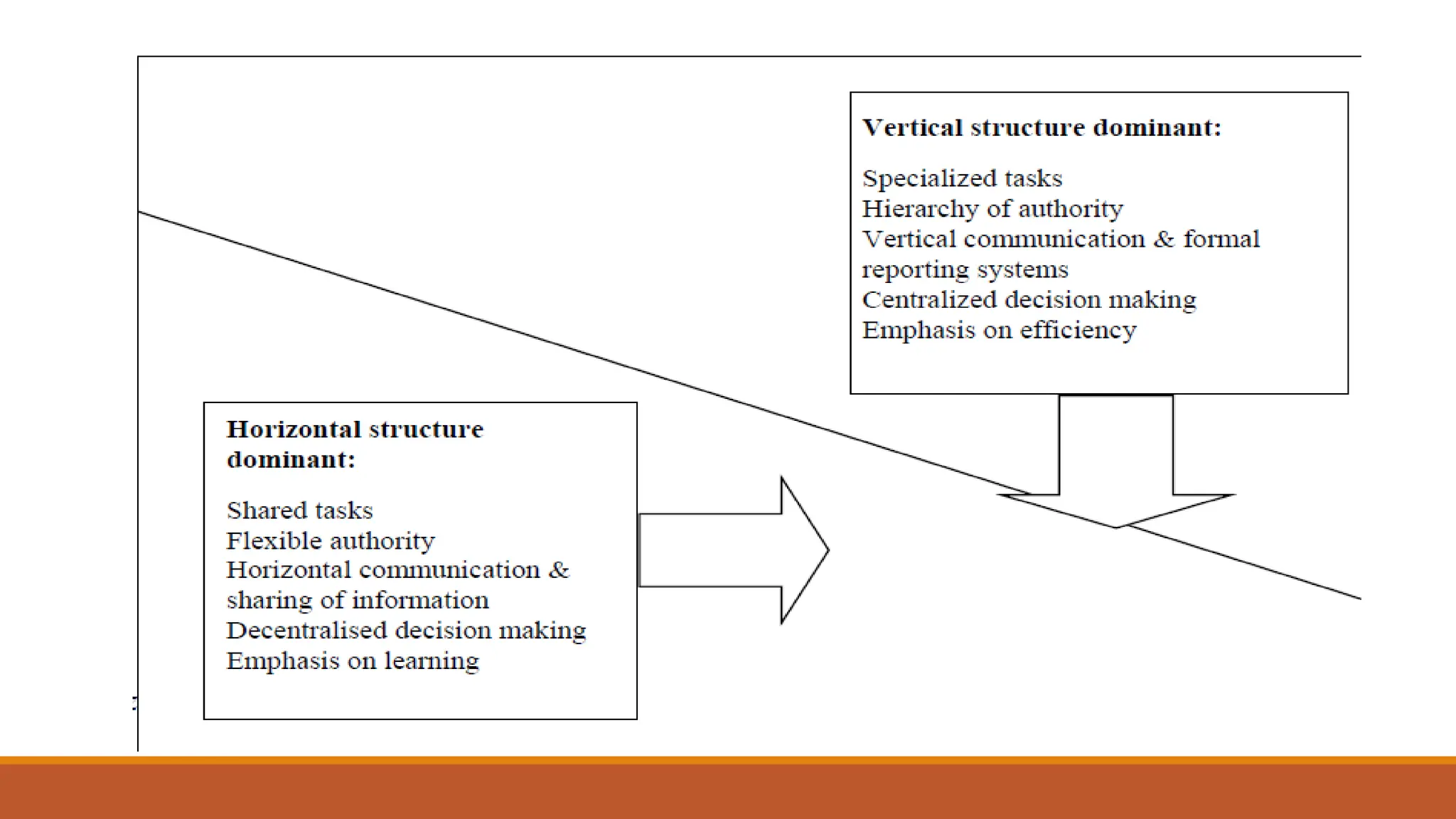
Dominates:
1. SPECIALISED TASKS
2. HIERACHY OF AUTHORITY
3. RULES AND REGULATION
4. VERTICAL COMMUNICATION
5. CENTRALISED DECISION MAKING
6. EMPHASIS ON EFFICIENCY
-continue
 Also called as Tall structure.
Best suited for standardized products and services in large volumes.
Established technologies, wide market, seeking customer on
undifferentiated items.
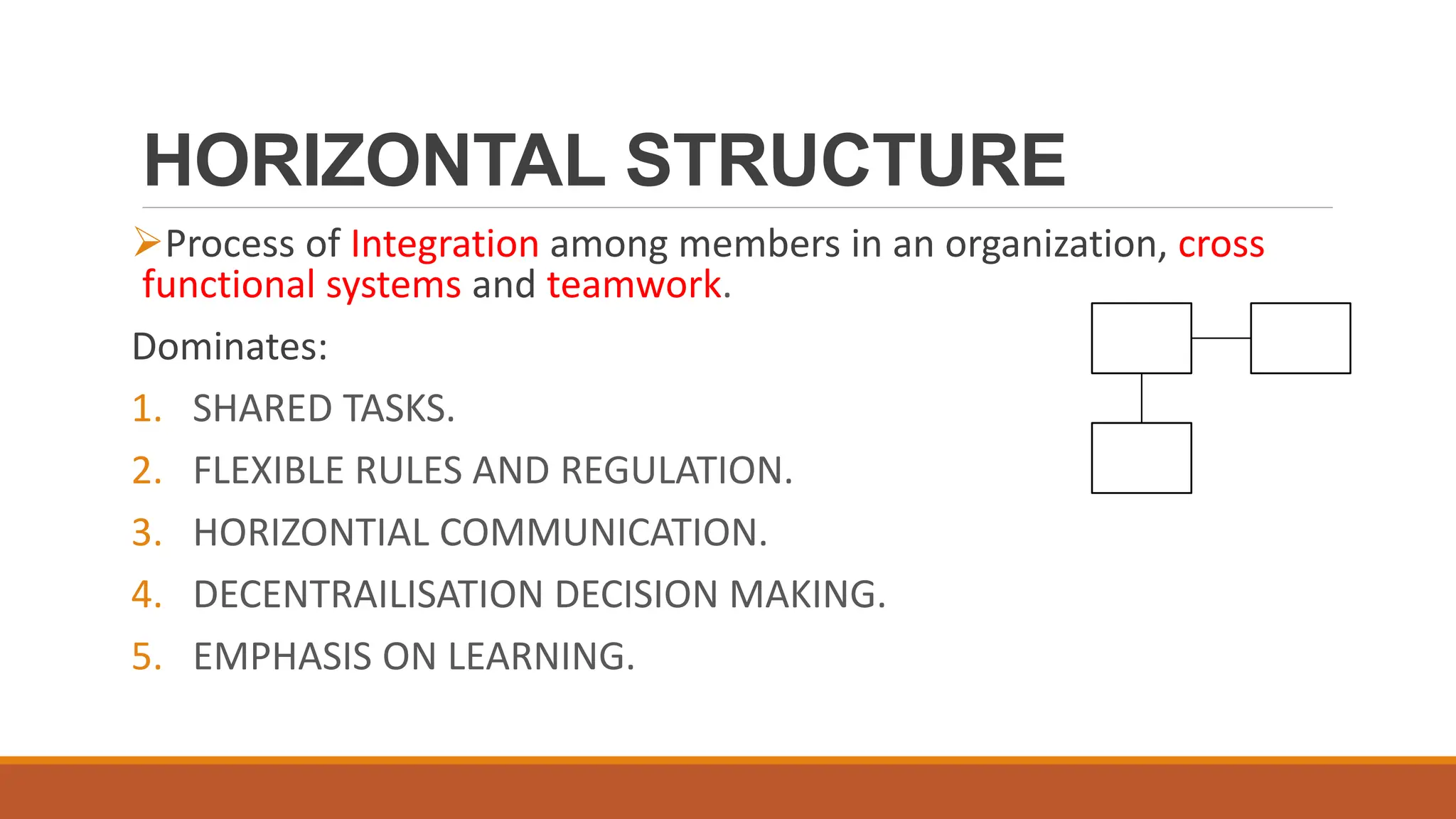
HORIZONTAL STRUCTURE
Process of Integration among members in an organization, cross
functional systems and teamwork.
Dominates:
1. SHARED TASKS.
2. FLEXIBLE RULES AND REGULATION.
3. HORIZONTIAL COMMUNICATION.
4. DECENTRAILISATION DECISION MAKING.
5. EMPHASIS ON LEARNING.
-continue
Its also called lean and mean organization or flat structure.
Liberal exchange of information among different layers and across
departments.
On Negative side, such structure has loss of control and high cost in
coordination.
STRUCTURE AND STRATEGY
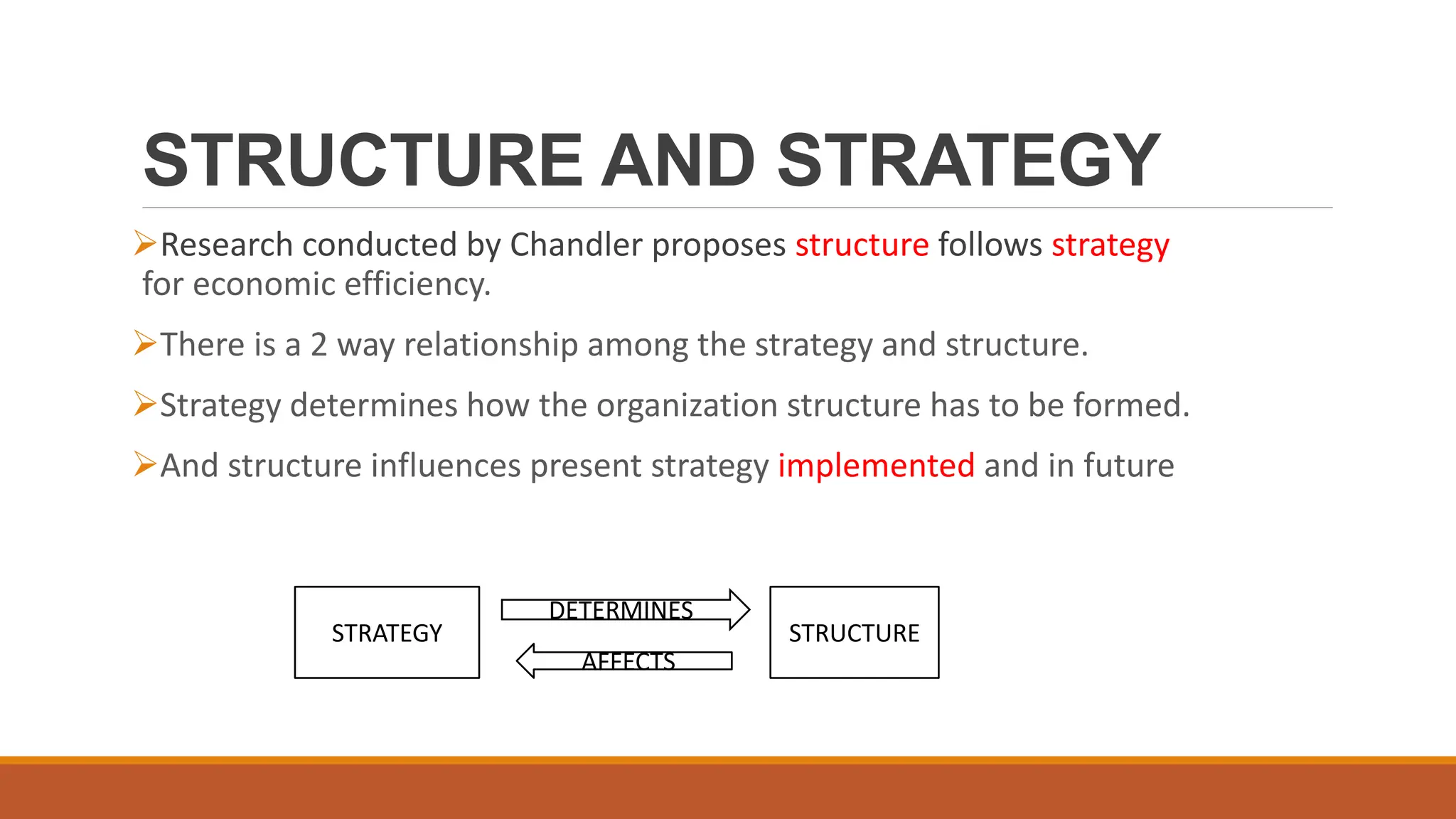
Research conducted by Chandler proposes structure follows strategy
for economic efficiency.
There is a 2 way relationship among the strategy and structure.
Strategy determines how the organization structure has to be formed.
And structure influences present strategy implemented and in future
STRATEGY STRUCTURE
DETERMINES
AFFECTS
STAGES OF DEVELOPMENT OF
ORGANISATION
STAGE I:
Organization are Small scale enterprise
CHARACTESTICS:-
1. Single Owner
2. Simplicity In Objective, Operations and Management.
3. Termed as Entrepreneurial
4. Strategy is generally Expansion type.
-continue
STAGE II:
Organization bigger than Stage I
CHARACTERSTICS:-
1. Functional Specialization or Process Oriented.
2. Strategy ranges from stability to expansion
-continue
STAGE III:
Organization is Large and widely scattered
CHARACTERSTICS:-
1. Units or Plants at different places.
2. Each units is linked to its Headquarters but functionally Independent.
3. Divisions on functional forms for particular needs.
4. Strategy is much the same stability or expansion.
-continue
STAGE IV:
Organization are most complex.
CHARACTERSTICS:
1. Generally Large, Multi-Plant, Multi-Product organization.
2. Cooperate Headquarters provided strategic directions and policies
3. Division formulate business level strategies.
TYPES OF ORGANISATIONAL
STRUCTURES
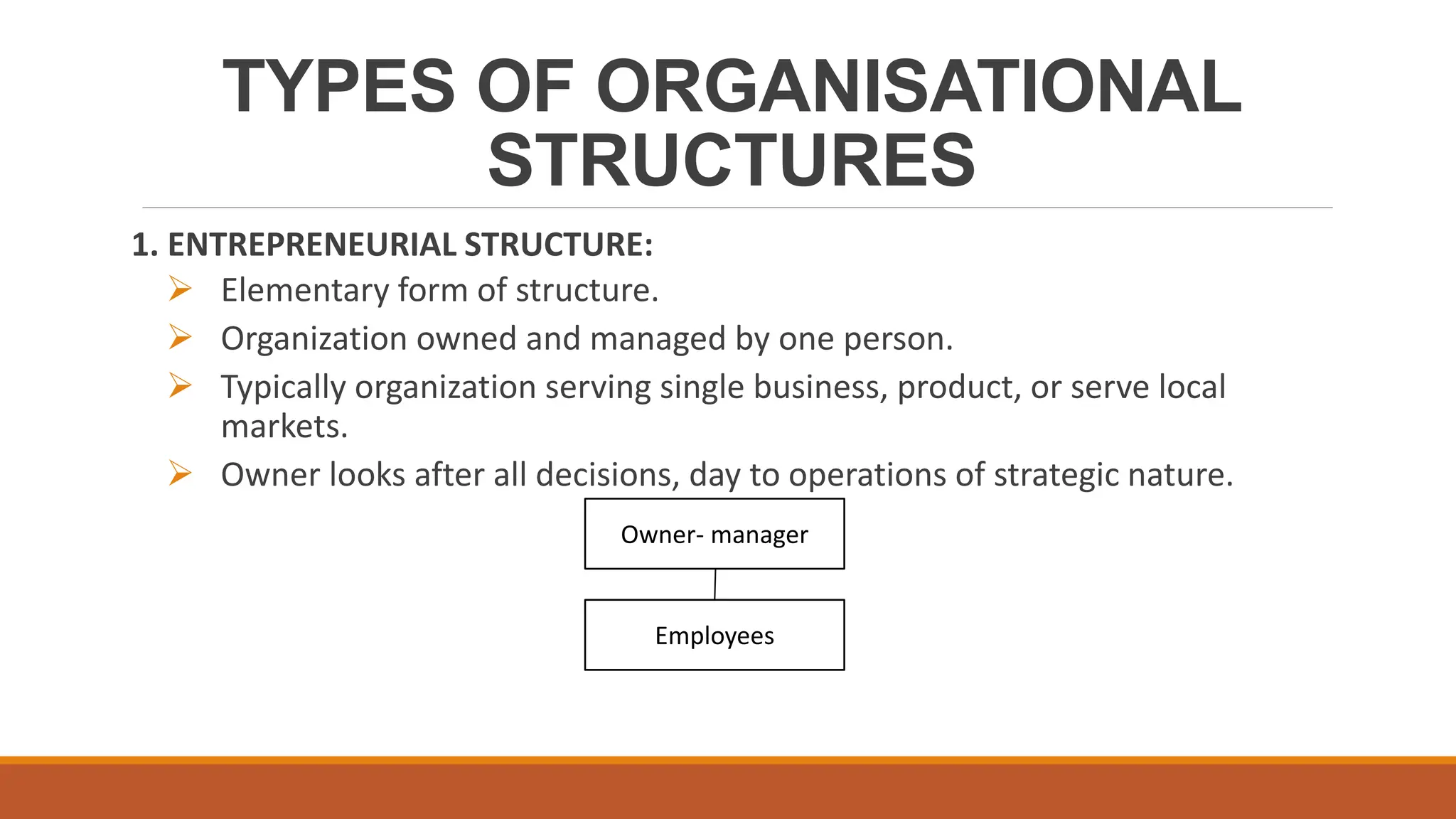
1. ENTREPRENEURIAL STRUCTURE:
 Elementary form of structure.
 Organization owned and managed by one person.
 Typically organization serving single business, product, or serve local
markets.
 Owner looks after all decisions, day to operations of strategic nature.
Owner- manager
Employees
-continue
ADVANTAGES OF ENTERPRENEURIAL STRUCTURE
1. Quick Decision- Making
2. Timely response to environmental changes.
3. Informal and simple organization systems.
DISADVANATGES OF ENTERPRENEURIAL STRUCTURE
1. Excessive Reliance
2. Many divert attention.
3. Increasing Inadequate for future requirement if business expands.
-continue
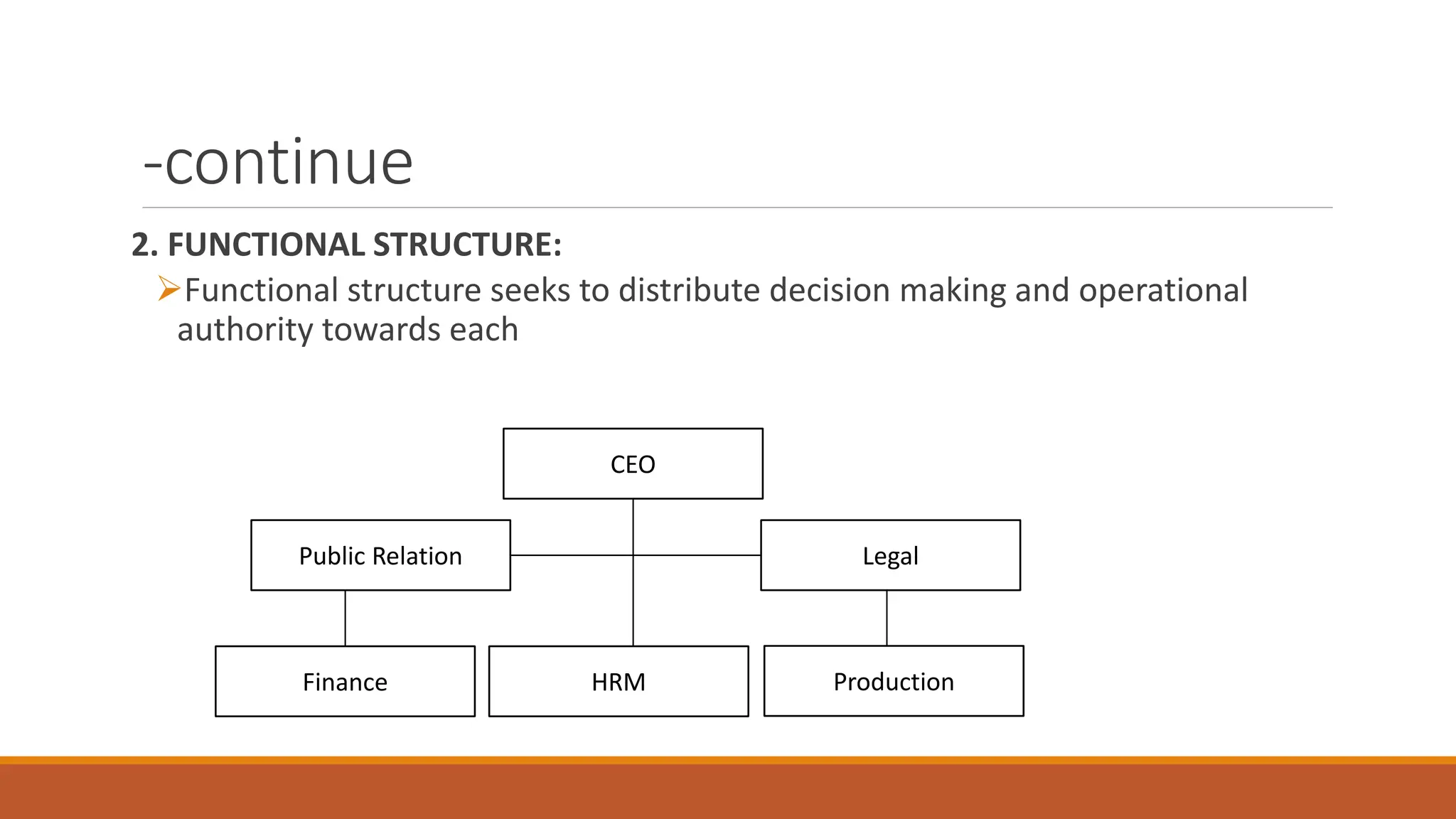
2. FUNCTIONAL STRUCTURE:
Functional structure seeks to distribute decision making and operational
authority towards each
CEO
Public Relation Legal
Finance HRM Production
-continue
BENEFITS OF FUNCTIONAL STRUCTURE
1. Efficient Distribution of work through Specialization.
2. Delegation of day to day operational functions.
3. Provides time for top management to focus on strategic decisions.
DISADVATAGES OF FUNCTIONAL STRUCTURE
1. Creates difficulty in Coordination –Functions
2. Create only narrow specialization.
3. Leads to conflicts among Line, functional and staff.
3. DIVISIONAL STRUCTRUE
In divisional structure work is divided on basis of product lines, type of customers
served and geographical area covered.
Each separate divisions or units are created and placed under divisional-level
management under which functional structure may still operate.
ADVANTAGES OF DIVISIONAL STRUCTURE
1. Enables grouping of Functions.
2. Generate Quick Response
3. Enable top management to focus on strategic matters.
-continue
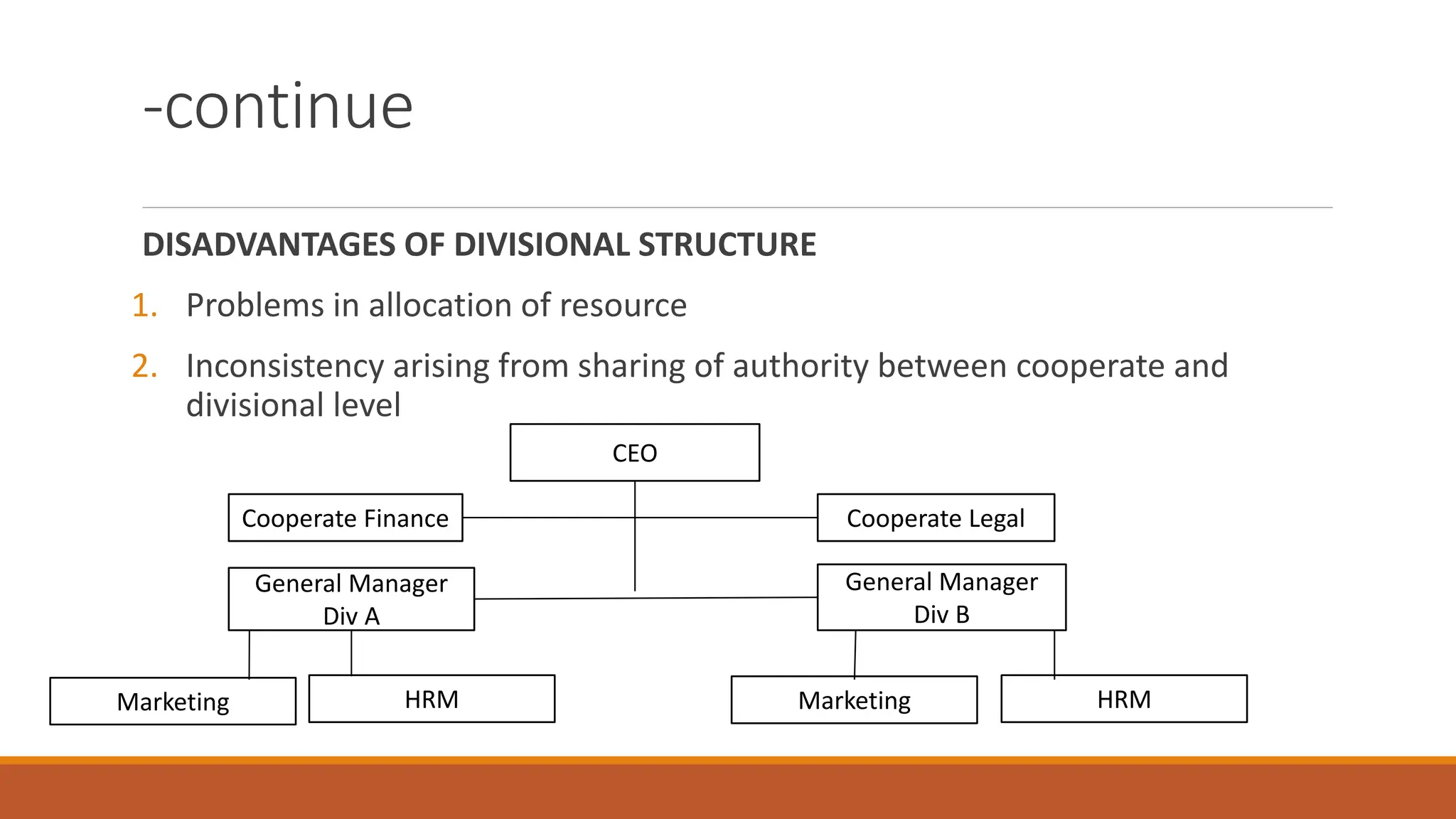
DISADVANTAGES OF DIVISIONAL STRUCTURE
1. Problems in allocation of resource
2. Inconsistency arising from sharing of authority between cooperate and
divisional level
CEO
Cooperate Legal
Cooperate Finance
General Manager
Div B
General Manager
Div A
HRM
Marketing HRM
Marketing
4. SBU Structure
Strategic Business Unit
Defined as “any part of a business organization which is treated separately for
strategic management purpose”.
SBU created due to difficulty in top management to exercise strategic control over a
division.
ADVANTAGES OF SBU STRUCTURE
1. Establishes coordination between divisions.
2. Facilitates strategic management and control of large, diverse organization.
3. Fixes accountability at level of distinct business units.
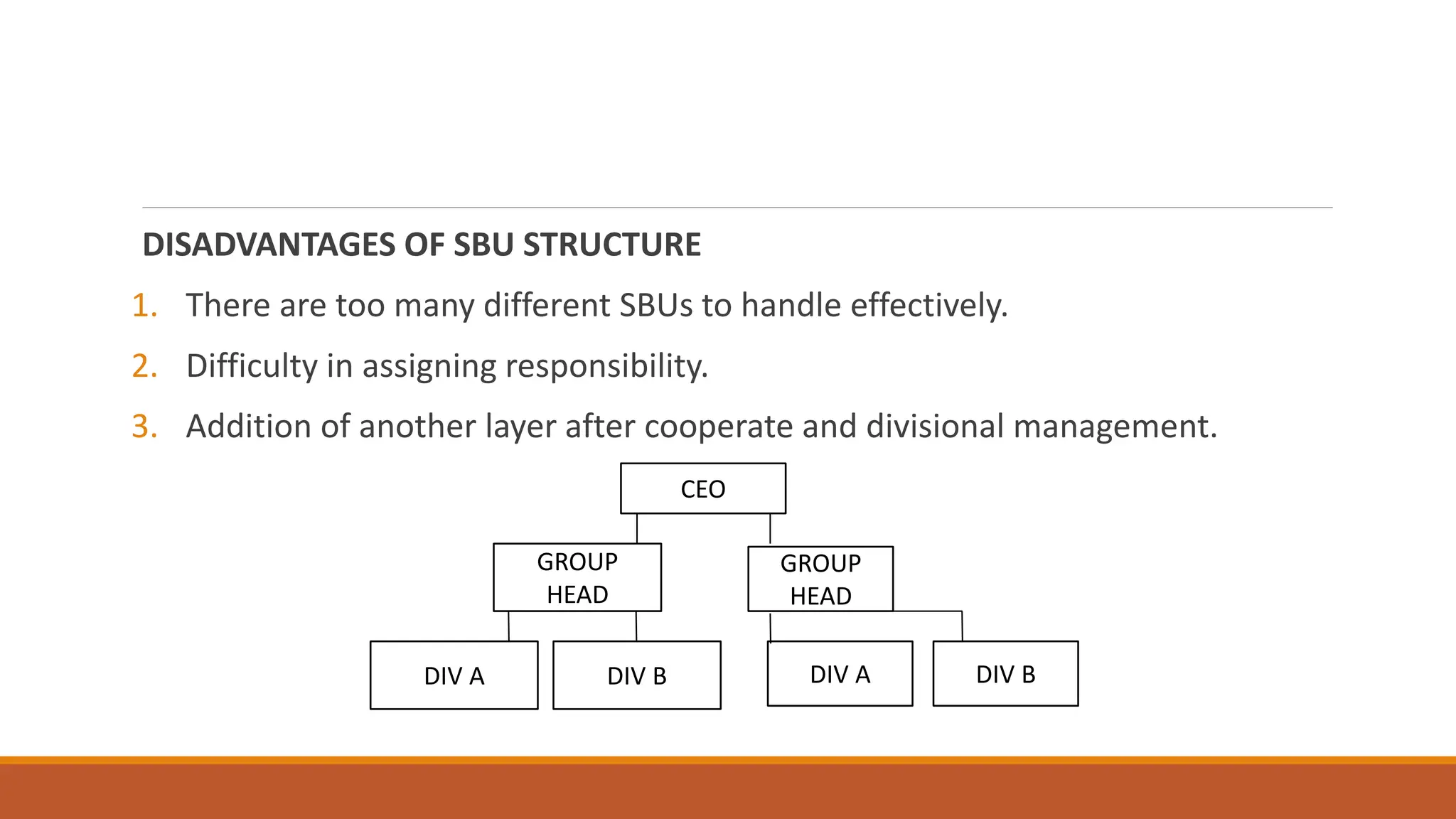
DISADVANTAGES OF SBU STRUCTURE
1. There are too many different SBUs to handle effectively.
2. Difficulty in assigning responsibility.
3. Addition of another layer after cooperate and divisional management.
CEO
GROUP
HEAD
GROUP
HEAD
DIV B
DIV A DIV A DIV B
5. MATRIX STRUCTURE
In large organization, there will handling more than one project.
For each project or product will be strategically significant.
Such kind of structure is created by assigning functional specialists to special projects
or new product or service.
During the duration of project specialists from different areas form group or team
reporting to a team leader.
These specialists will be working under there project and in their parent department
simultaneously
ADVANTAGE OF MATRIX STRUCTURE
1. Allows individual specialists to be assigned; in accordance on their talent.
2. Foster creativity on diverse talents.
3. Provides good exposure to specialists in general management.
DISADVAVANTAGE OF MATRIX STRUCTURE
1. Dual accountability creates confusion among employees.
2. Requires a high level of vertical and horizontal contribution.
3. Shared authority may create communication problems.
6. NETWORK STRUCTURE
Its is also called as ‘ Spider Web Structure’ or ‘Virtual organization’
Network structure is ‘composed of a series of project groups or collaboration
linked by constantly changing non-hierarchical, cobweb like network.’
Structure is highly decentralized and organized around customer groups or
geographical regions.
Core organization is only shell a shell with one small headquarter acting as
‘broker’ for integrating suppliers and specialized functions performed by
autonomous teams or workforce.
Applicable for organization facing continues changes in environment, require
quick response, high level of adaptability and strong innovation skill
ADVANTAGES OF NETWORK STRUCTURE
1. High Level of Flexibility
2. Permits Concentration on core competencies of firm.
3. Adaptability to cope with the changes in environment.
DISADVANTAGE OF NETWORK STRUCTURE
1. Loss of Control and lack of coordination as there are several partners.
2. Risks of Overspecialization.
3. High cost of duplication of resources could exist.
OTHER TYPES OF STRUCTURE
1. PRODUCT BASED STRUCTURE
2. COSNSUMER BASED STRUCTURE
3. GEOGRAPHICAL STRUCTURE
4. INTRAPRENURIAL STRUCTURE
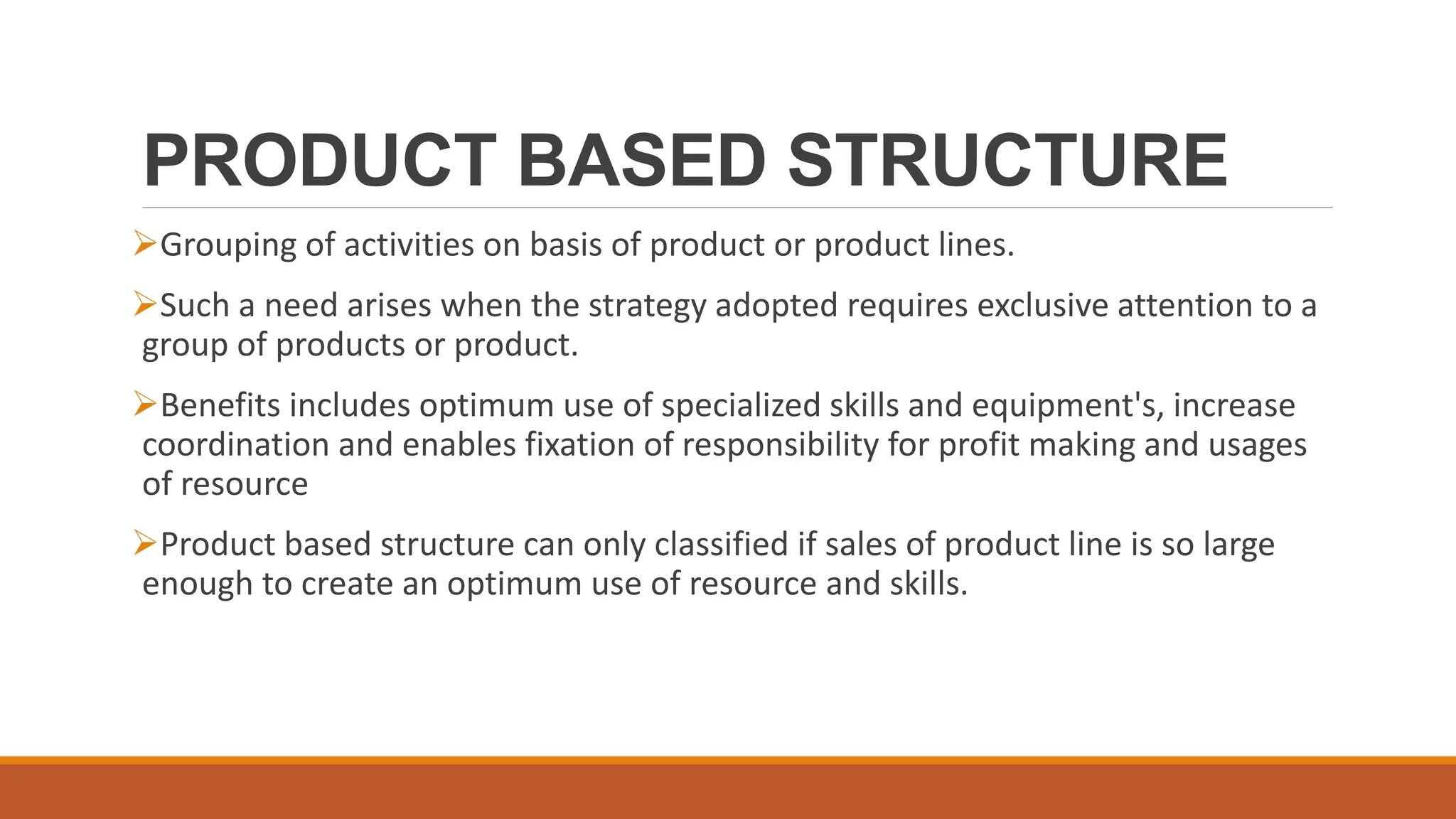
PRODUCT BASED STRUCTURE
Grouping of activities on basis of product or product lines.
Such a need arises when the strategy adopted requires exclusive attention to a
group of products or product.
Benefits includes optimum use of specialized skills and equipment's, increase
coordination and enables fixation of responsibility for profit making and usages
of resource
Product based structure can only classified if sales of product line is so large
enough to create an optimum use of resource and skills.
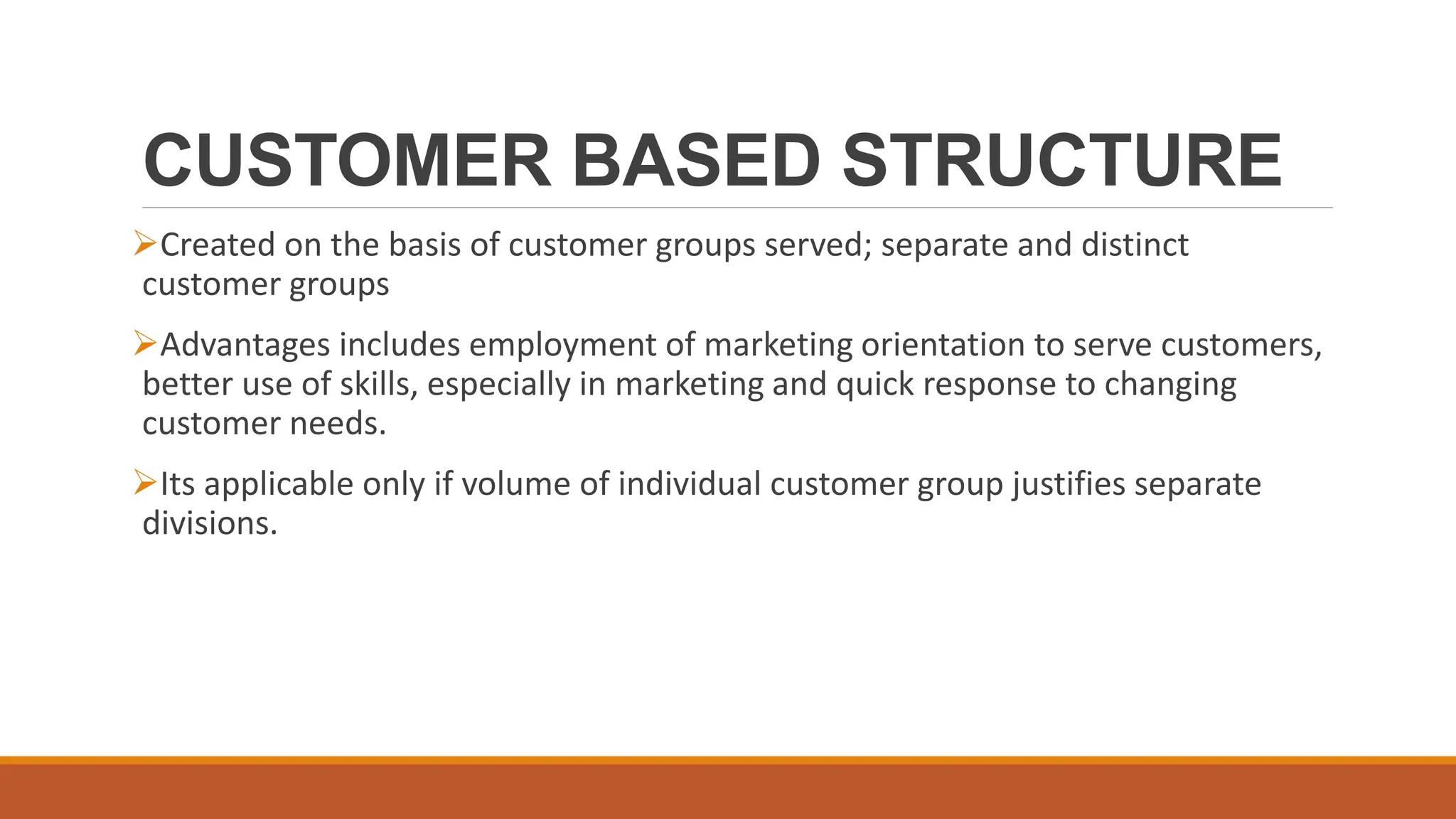
CUSTOMER BASED STRUCTURE
Created on the basis of customer groups served; separate and distinct
customer groups
Advantages includes employment of marketing orientation to serve customers,
better use of skills, especially in marketing and quick response to changing
customer needs.
Its applicable only if volume of individual customer group justifies separate
divisions.
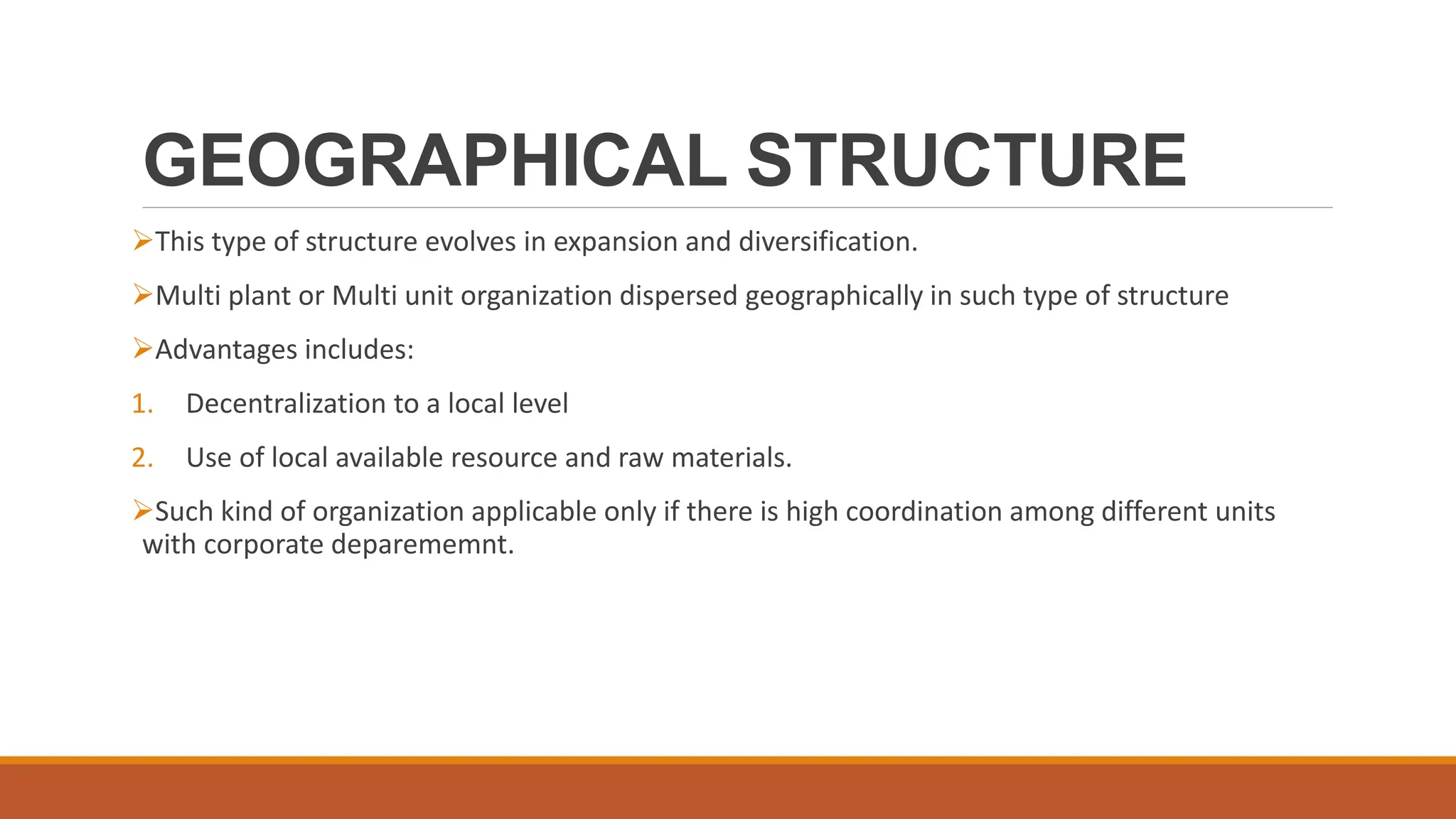
GEOGRAPHICAL STRUCTURE
This type of structure evolves in expansion and diversification.
Multi plant or Multi unit organization dispersed geographically in such type of structure
Advantages includes:
1. Decentralization to a local level
2. Use of local available resource and raw materials.
Such kind of organization applicable only if there is high coordination among different units
with corporate deparememnt.
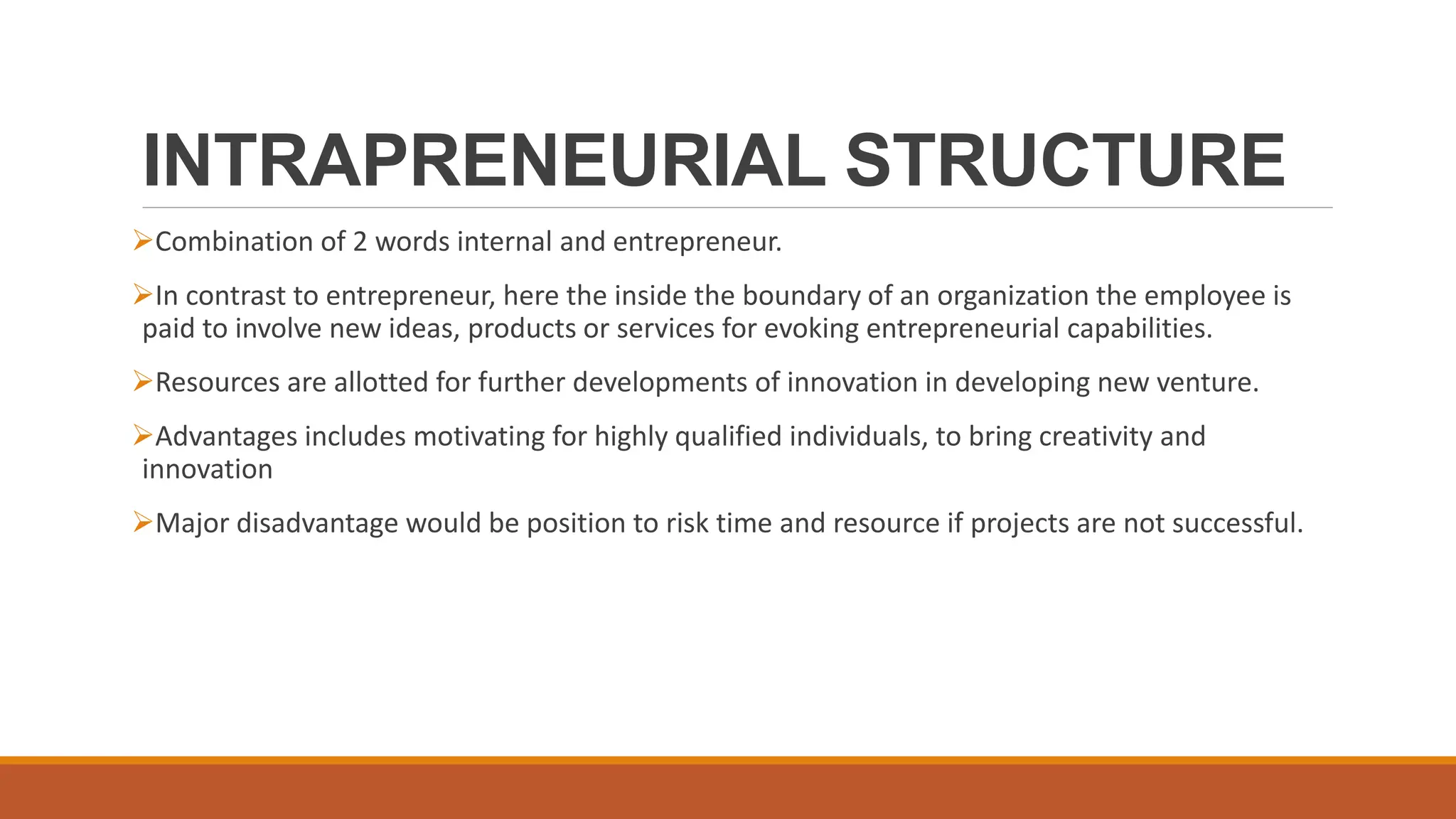
INTRAPRENEURIAL STRUCTURE
Combination of 2 words internal and entrepreneur.
In contrast to entrepreneur, here the inside the boundary of an organization the employee is
paid to involve new ideas, products or services for evoking entrepreneurial capabilities.
Resources are allotted for further developments of innovation in developing new venture.
Advantages includes motivating for highly qualified individuals, to bring creativity and
innovation
Major disadvantage would be position to risk time and resource if projects are not successful.

structural implication - Strategic Management

  • 1.
  • 2.
    STRUCTURE Structure refers tohow the workers within a business are organised and how they relate to each other.  Structure defines how activities such as task allocation, coordination and supervision are directed toward the achievement of organizational aims. An organisation structure specifies three key components that are enumerated below: 1. It identifies the relationships between the number of steps in the hierarchy and the span of control of managers. 2. It specifies the grouping of individuals into departments and of departments into total organisation. 3. It consists of plan of activities in order to ensure effective communication, harmonization and integration of goals and objectives across departments.
  • 4.
    KINDS OF STRUCTURE VerticalStructure Horizontal Structure
  • 5.
    VERTICAL STRUCTURE Process ofDifferentiation Involves Division of Labor and Specialization. Dominates: 1. SPECIALISED TASKS 2. HIERACHY OF AUTHORITY 3. RULES AND REGULATION 4. VERTICAL COMMUNICATION 5. CENTRALISED DECISION MAKING 6. EMPHASIS ON EFFICIENCY
  • 6.
    -continue  Also calledas Tall structure. Best suited for standardized products and services in large volumes. Established technologies, wide market, seeking customer on undifferentiated items.
  • 7.
    HORIZONTAL STRUCTURE Process ofIntegration among members in an organization, cross functional systems and teamwork. Dominates: 1. SHARED TASKS. 2. FLEXIBLE RULES AND REGULATION. 3. HORIZONTIAL COMMUNICATION. 4. DECENTRAILISATION DECISION MAKING. 5. EMPHASIS ON LEARNING.
  • 8.
    -continue Its also calledlean and mean organization or flat structure. Liberal exchange of information among different layers and across departments. On Negative side, such structure has loss of control and high cost in coordination.
  • 9.
    STRUCTURE AND STRATEGY Researchconducted by Chandler proposes structure follows strategy for economic efficiency. There is a 2 way relationship among the strategy and structure. Strategy determines how the organization structure has to be formed. And structure influences present strategy implemented and in future STRATEGY STRUCTURE DETERMINES AFFECTS
  • 10.
    STAGES OF DEVELOPMENTOF ORGANISATION STAGE I: Organization are Small scale enterprise CHARACTESTICS:- 1. Single Owner 2. Simplicity In Objective, Operations and Management. 3. Termed as Entrepreneurial 4. Strategy is generally Expansion type.
  • 11.
    -continue STAGE II: Organization biggerthan Stage I CHARACTERSTICS:- 1. Functional Specialization or Process Oriented. 2. Strategy ranges from stability to expansion
  • 12.
    -continue STAGE III: Organization isLarge and widely scattered CHARACTERSTICS:- 1. Units or Plants at different places. 2. Each units is linked to its Headquarters but functionally Independent. 3. Divisions on functional forms for particular needs. 4. Strategy is much the same stability or expansion.
  • 13.
    -continue STAGE IV: Organization aremost complex. CHARACTERSTICS: 1. Generally Large, Multi-Plant, Multi-Product organization. 2. Cooperate Headquarters provided strategic directions and policies 3. Division formulate business level strategies.
  • 14.
    TYPES OF ORGANISATIONAL STRUCTURES 1.ENTREPRENEURIAL STRUCTURE:  Elementary form of structure.  Organization owned and managed by one person.  Typically organization serving single business, product, or serve local markets.  Owner looks after all decisions, day to operations of strategic nature. Owner- manager Employees
  • 15.
    -continue ADVANTAGES OF ENTERPRENEURIALSTRUCTURE 1. Quick Decision- Making 2. Timely response to environmental changes. 3. Informal and simple organization systems. DISADVANATGES OF ENTERPRENEURIAL STRUCTURE 1. Excessive Reliance 2. Many divert attention. 3. Increasing Inadequate for future requirement if business expands.
  • 16.
    -continue 2. FUNCTIONAL STRUCTURE: Functionalstructure seeks to distribute decision making and operational authority towards each CEO Public Relation Legal Finance HRM Production
  • 17.
    -continue BENEFITS OF FUNCTIONALSTRUCTURE 1. Efficient Distribution of work through Specialization. 2. Delegation of day to day operational functions. 3. Provides time for top management to focus on strategic decisions. DISADVATAGES OF FUNCTIONAL STRUCTURE 1. Creates difficulty in Coordination –Functions 2. Create only narrow specialization. 3. Leads to conflicts among Line, functional and staff.
  • 18.
    3. DIVISIONAL STRUCTRUE Indivisional structure work is divided on basis of product lines, type of customers served and geographical area covered. Each separate divisions or units are created and placed under divisional-level management under which functional structure may still operate. ADVANTAGES OF DIVISIONAL STRUCTURE 1. Enables grouping of Functions. 2. Generate Quick Response 3. Enable top management to focus on strategic matters.
  • 19.
    -continue DISADVANTAGES OF DIVISIONALSTRUCTURE 1. Problems in allocation of resource 2. Inconsistency arising from sharing of authority between cooperate and divisional level CEO Cooperate Legal Cooperate Finance General Manager Div B General Manager Div A HRM Marketing HRM Marketing
  • 20.
    4. SBU Structure StrategicBusiness Unit Defined as “any part of a business organization which is treated separately for strategic management purpose”. SBU created due to difficulty in top management to exercise strategic control over a division. ADVANTAGES OF SBU STRUCTURE 1. Establishes coordination between divisions. 2. Facilitates strategic management and control of large, diverse organization. 3. Fixes accountability at level of distinct business units.
  • 21.
    DISADVANTAGES OF SBUSTRUCTURE 1. There are too many different SBUs to handle effectively. 2. Difficulty in assigning responsibility. 3. Addition of another layer after cooperate and divisional management. CEO GROUP HEAD GROUP HEAD DIV B DIV A DIV A DIV B
  • 22.
    5. MATRIX STRUCTURE Inlarge organization, there will handling more than one project. For each project or product will be strategically significant. Such kind of structure is created by assigning functional specialists to special projects or new product or service. During the duration of project specialists from different areas form group or team reporting to a team leader. These specialists will be working under there project and in their parent department simultaneously
  • 23.
    ADVANTAGE OF MATRIXSTRUCTURE 1. Allows individual specialists to be assigned; in accordance on their talent. 2. Foster creativity on diverse talents. 3. Provides good exposure to specialists in general management. DISADVAVANTAGE OF MATRIX STRUCTURE 1. Dual accountability creates confusion among employees. 2. Requires a high level of vertical and horizontal contribution. 3. Shared authority may create communication problems.
  • 24.
    6. NETWORK STRUCTURE Itsis also called as ‘ Spider Web Structure’ or ‘Virtual organization’ Network structure is ‘composed of a series of project groups or collaboration linked by constantly changing non-hierarchical, cobweb like network.’ Structure is highly decentralized and organized around customer groups or geographical regions. Core organization is only shell a shell with one small headquarter acting as ‘broker’ for integrating suppliers and specialized functions performed by autonomous teams or workforce. Applicable for organization facing continues changes in environment, require quick response, high level of adaptability and strong innovation skill
  • 25.
    ADVANTAGES OF NETWORKSTRUCTURE 1. High Level of Flexibility 2. Permits Concentration on core competencies of firm. 3. Adaptability to cope with the changes in environment. DISADVANTAGE OF NETWORK STRUCTURE 1. Loss of Control and lack of coordination as there are several partners. 2. Risks of Overspecialization. 3. High cost of duplication of resources could exist.
  • 26.
    OTHER TYPES OFSTRUCTURE 1. PRODUCT BASED STRUCTURE 2. COSNSUMER BASED STRUCTURE 3. GEOGRAPHICAL STRUCTURE 4. INTRAPRENURIAL STRUCTURE
  • 27.
    PRODUCT BASED STRUCTURE Groupingof activities on basis of product or product lines. Such a need arises when the strategy adopted requires exclusive attention to a group of products or product. Benefits includes optimum use of specialized skills and equipment's, increase coordination and enables fixation of responsibility for profit making and usages of resource Product based structure can only classified if sales of product line is so large enough to create an optimum use of resource and skills.
  • 28.
    CUSTOMER BASED STRUCTURE Createdon the basis of customer groups served; separate and distinct customer groups Advantages includes employment of marketing orientation to serve customers, better use of skills, especially in marketing and quick response to changing customer needs. Its applicable only if volume of individual customer group justifies separate divisions.
  • 29.
    GEOGRAPHICAL STRUCTURE This typeof structure evolves in expansion and diversification. Multi plant or Multi unit organization dispersed geographically in such type of structure Advantages includes: 1. Decentralization to a local level 2. Use of local available resource and raw materials. Such kind of organization applicable only if there is high coordination among different units with corporate deparememnt.
  • 30.
    INTRAPRENEURIAL STRUCTURE Combination of2 words internal and entrepreneur. In contrast to entrepreneur, here the inside the boundary of an organization the employee is paid to involve new ideas, products or services for evoking entrepreneurial capabilities. Resources are allotted for further developments of innovation in developing new venture. Advantages includes motivating for highly qualified individuals, to bring creativity and innovation Major disadvantage would be position to risk time and resource if projects are not successful.

Editor's Notes

  • #3 The first two components constitute the structural framework, which is vertical structure created through the process of differentiation that involves division of labour and specialization. The third component refers to the pattern of interactions among various constituents of the organisation and is the horizontal structure, created through the process of integration that involves cross-functional information systems and teamwork.