Leadership to Drive Growth & Value
Exit Planning Institute 5th Annual NYC Owners Forum
October 23, 2019
“Sunrise Medical Laboratories – A Short Story”
Background Information
Commercial Medical Laboratory Company in NY
In 2007
450 Employees
1.4 Million Patients (Transactions) Annually
$72 Million Revenue
Privately–Held Company
Sunrise’s National Competitors are:
Quest Diagnostics
Sunrise’s Competitors
In 2007 Quest was over $6.7 billion
93 x the size of Sunrise
Lab Corp
In 2007 LabCorp was over $4.0 billion
55 x the size of Sunrise
2007 Market Shares - New York City Region
62%
7%
6%
12%
3%
10%
Quest Other labs Enzo Bio-Reference Sunrise LabCorp
2007 Productivity Metric - Transactions/FTE
Performance Metrics
Sunrise vs. National Competitors
Lab Corp 3,820
Sunrise 3,776
Quest 3,639
2007 Financial Metric – Revenue/FTE
Sunrise $206,220
Quest $151,053
Lab Corp $143,632
EBITDA similar to massively larger National Lab Companies
High Organic Growth
High Performance Leadership & Culture
Impact on Staff & Company Performance
Low Staff Turn-Over
High Customer Retention Rate
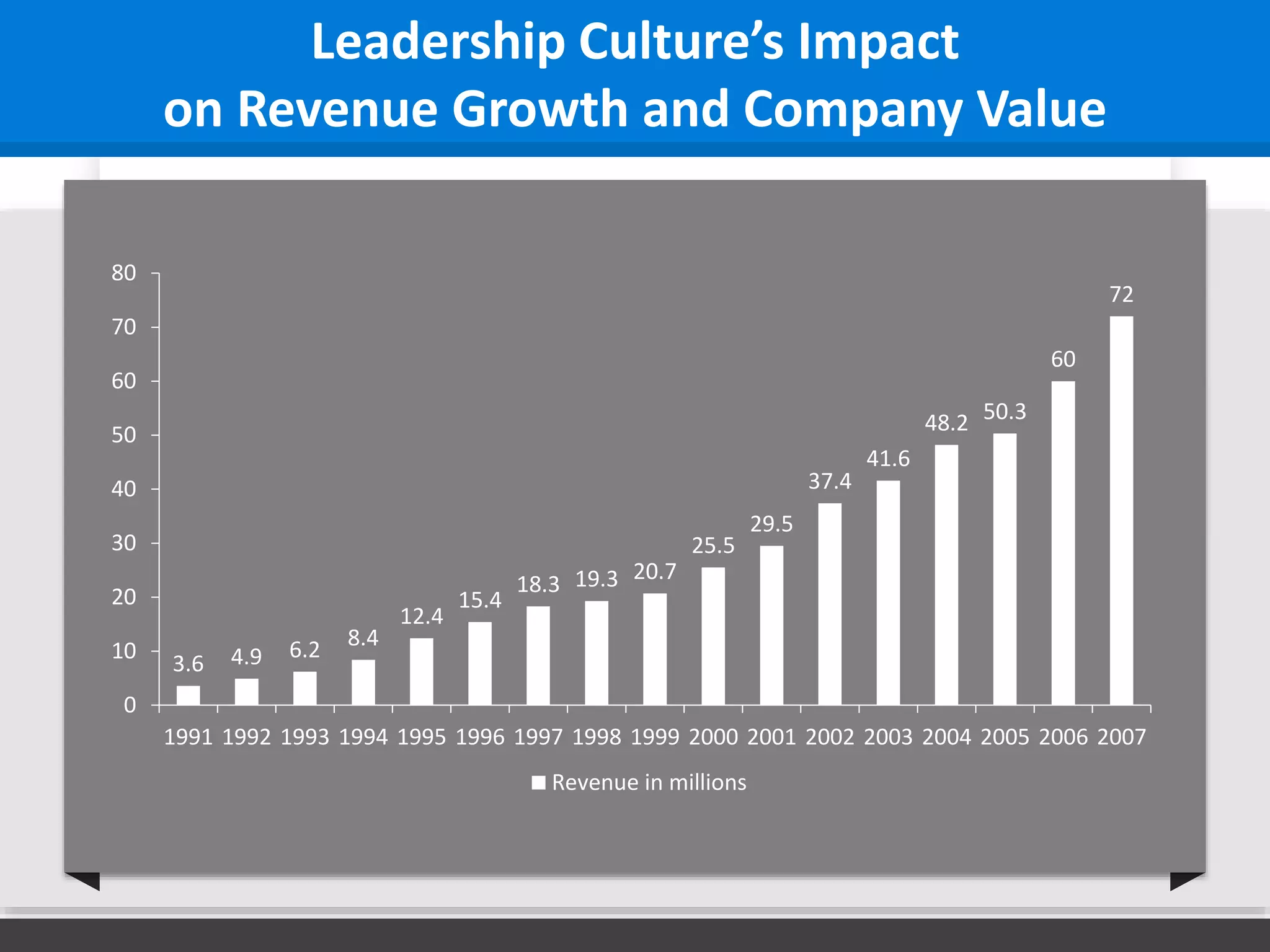
Leadership Culture’s Impact
on Revenue Growth and Company Value
3.6 4.9 6.2 8.4
12.4
15.4
18.3 19.3 20.7
25.5
29.5
37.4
41.6
48.2 50.3
60
72
0
10
20
30
40
50
60
70
80
1991 1992 1993 1994 1995 1996 1997 1998 1999 2000 2001 2002 2003 2004 2005 2006 2007
Revenue in millions
The Leadership Development Story
“How I developed a successful business and personal
development leadership strategy by stealing every idea,
word, thought and concept from every person I ever met.”
Some Challenges Facing Business Leadership
Commoditization of Products/Services
Could mean only price matters
Less Financial Resources
Doing more with less
Changing Customer Relationships
Who is the customer?
Customers are more demanding
Labor Shortages - Shrinking Talent Pool
Generational/Cultural Differences of Staff
Improve delivery of the service
Developing Organization-wide Customer Experience Culture
How to ask staff for a higher level of performance while
maintaining quality
Business Leadership Defined
(for Today’s Discussion)
The ability to guide, direct, or influence
people to perform at a higher level
than previously believed possible.
Today’s Goal
“Scratch the Surface of Understanding”
How Leadership Connects to High Performance
How Leadership Culture Drives Value/Profits
Leadership Philosophy, Responsibilities, Characteristics and
Competencies
Perception vs. Reality
And, of course, What is the “Meaning of Life?”
And other small stuff you probably already know
“What is the Meaning of Life?”
Building Cathedrals and Temples
What was Our PURPOSE?
“We provide advanced laboratory services that prevent, diagnose and
treat medical diseases to positively impact human health.”
What is our organization’s purpose?
Not to be confused with “what we do”
For Example
“What We DID” at Sunrise Medical Laboratories
– We do lab tests on blood, body fluids or tissues samples to check for
the presence of disease
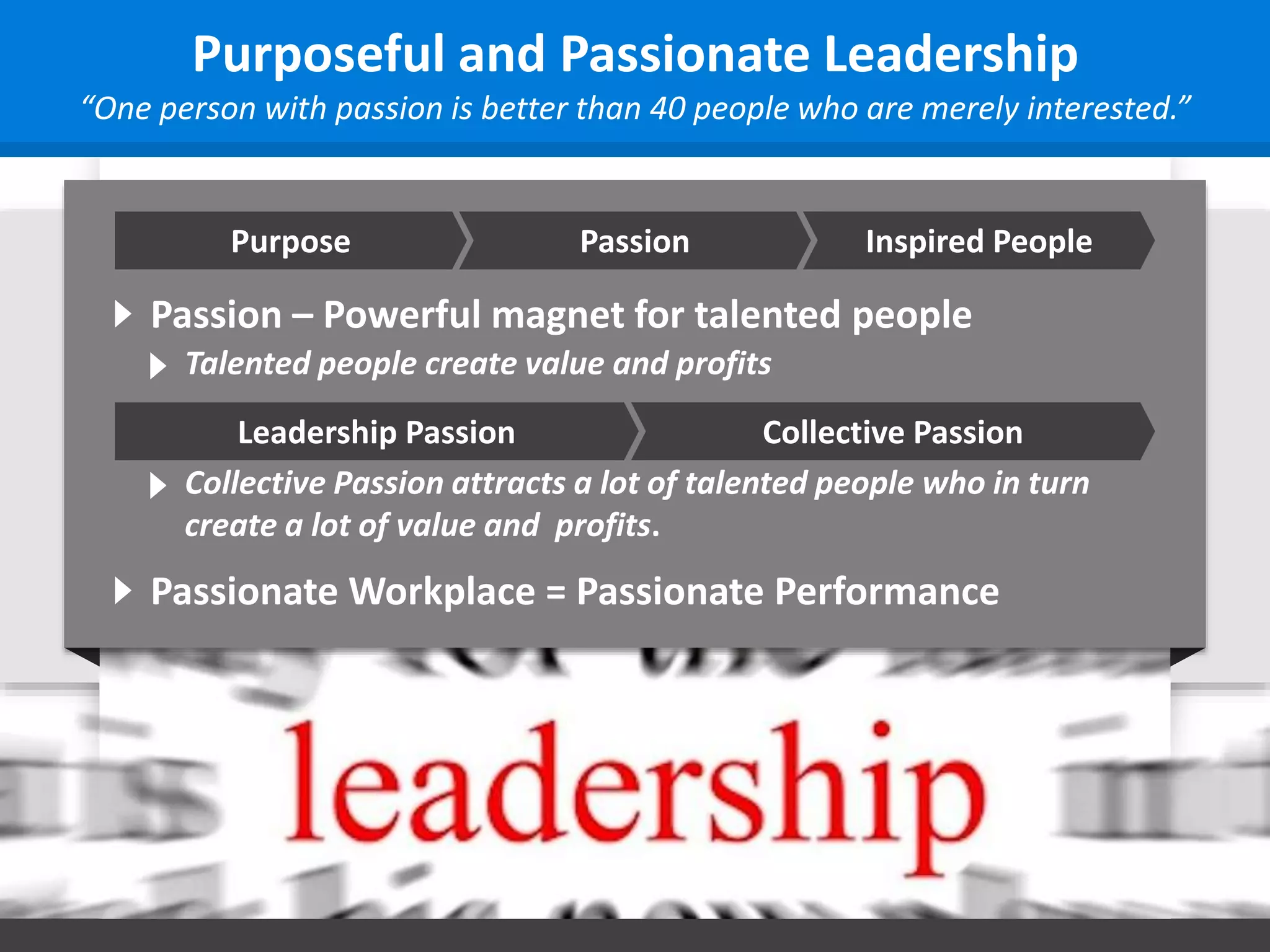
Purposeful and Passionate Leadership
“One person with passion is better than 40 people who are merely interested.”
Purpose Passion Inspired People
Passion – Powerful magnet for talented people
Talented people create value and profits
Leadership Passion Collective Passion
Collective Passion attracts a lot of talented people who in turn
create a lot of value and profits.
Passionate Workplace = Passionate Performance
“Nothing great in the world has been
accomplished without passion.” - George Wilhelm Hegel
Introspection – step back and remind ourselves what our
company’s purpose is
What do we do if our passion is lost?
Define, in words, what we are passionate about because
we are language beings
“Languaging passion” makes clear in our own minds what
we are up to, and we are then able to articulate it to
others.
“My passion is to revolutionize leadership in a way
that would allow us to significantly alter the future.”
“Languaging” My Passion
Perhaps a leader's most significant function - the good
news and the bad
“Intent vs. Impact” - Leaders choose and deliver their
words CAREFULLY
High Performance Leadership Communication
“Everything is Subject to Interpretation”
Punctuate these 6 words: "woman without her man is nothing“
Men wrote: "Woman, without her man, is nothing."
Women wrote: "Woman! Without her, man is nothing."
Leadership’s Challenges
Survey of 300 CEOs Worldwide
“ What they considered to be the most important aspects
-- and the most difficult -- of being a leader? ”
Most Important: Having the right people was second only to
creating vision
Most Difficult: Having the right people just behind maintaining
momentum and developing people
Leadership for Hiring the Right Team
“Hiring for Dummies”
Customer Minded/Hard Work are NOT learned skills –
they are personality traits
Most organizations hire people for what they know… then
they fire them for who they are
Spend more time in the hiring process finding out who
people are
Hire for behavior; train for performance
“To select the wrong person for a job is a common mistake;
not to remove them is a fatal weakness.”
How do we help our people get to
“Professional High Performance”?
By Leadership that is …
Effective
Passionate
Emotionally Intelligent
Key Traits of High Emotional Intelligence
Optimism
Self-Awareness
Empathy
Emotionally Intelligence Leadership
“With Apologies to Daniel Goleman”
Impulse Control
Reality Check
Know ourselves (Self Awareness)
Leaders remind people what is most important, but first we must
know what's important to us
Competencies for
High Performance Leadership
Be optimistic and empathetic (Social Awareness)
We set the tone for those around us
Connect with others (Relationship Management)
Understand what makes our staff perform at their best and
what they need to help the organization succeed
Self Control of, and responsibility for, our actions
(Self Management)
Assume responsibility for ourselves
Leadership to Cultivate
High Performance Team
“Top Down Philosophy”
#1 Priority is the Internal Customers
Recognizes the staff as customers
Strong emphasis on both teamwork and responsiveness to
individuals
All levels of management are accessible and place strong emphasis
on the actual work environment and conditions
“Perception is Reality”
Your staff’s perception of culture is their reality – no matter
what we think.
Say what we mean - Be straightforward and credible
Understanding what the leader wants = people working things out
Empathize, don't disdain
Understand a person's circumstances and help them develop a
plan to improve the situation.
Leading the Change to High Performance
“Change is good – you go first.” - Dilbert
Guide people toward the desired objective:
Have respect
People should feel responsible for their own actions and ideas
Respect their personal values, rather than forcing our own
upon them.
Strategist for Future
Look 3 years out into the future and share with staff
“The future ain’t what it used to be.” – Yogi Berra
The Role of a Leader in High Performance Organizations
“How will our organization survive and improve in the future?”
Ambassador to important staff and customers
Increases staff’s trust in us and establishes our credibility
Inventor
Find staff /customer’s pain and develop (invent) new processes
or services to relieve it
Inventor function ensures that the strategic direction of the
company aligns around the staff’s and customer’s pain
Coach, teacher to our direct reports
Culture of learning at all levels
Teach the big picture perspective
Teach some basic financial/budget facts to staff
Investor
Treat our organization/career as an investment of a life time
The Role of a Leader in High
Performance Organizations
Strive to constantly increase its value
Striving to increase value leads us to good decisions and creates a
stable work environment for people
Student
Stay active in some form of continued professional development
Staff accepts and executes decisions even if they don't
fully understand them
Staff gives up short-term benefits for long-term, mutually
beneficial rewards
Staff shares the burden in difficult times
Staff responds with understanding to work emergencies
Staff invests their ideas and suggestions in the future
Organizational Trust Theorem
“The level of inspiration* in an organization can never rise
above the level of trust.” (*formerly motivation)
An Inspiring Purpose
A “sense of urgency” that is shared by all
Harness Our Team‘s Creative Energy
Conditions Necessary for Creative Energy
A "we're all in this together" attitude
Goals that broaden people‘s abilities
A belief that teamwork can meet these goals
Know what our team really wants
“For 25 years you’ve paid only for my hands when you could
have had my brain for free.” – Retiring General Motors Worker
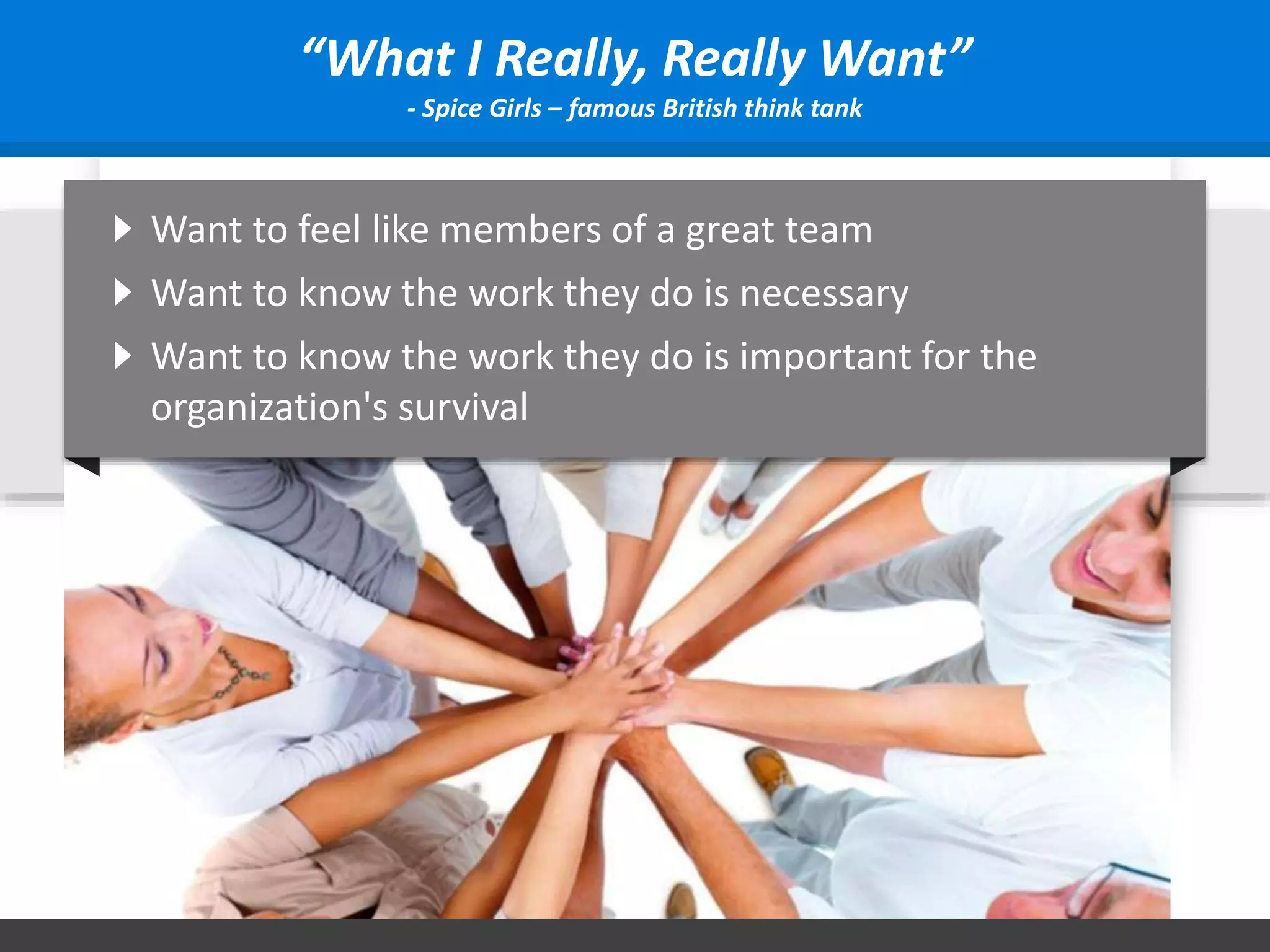
Want to feel like members of a great team
Want to know the work they do is necessary
“What I Really, Really Want”
- Spice Girls – famous British think tank
Want to know the work they do is important for the
organization's survival
“The quality of a person’s life is in direct proportion to
their commitment to excellence, regardless of their
chosen field of endeavor.”
One Final Theory
“The Ultimate Metric”
– Vince Lombardi, US Football Coach
Contact Information
Larry Siedlick
Email: LS@TheMBH.com

Leadership to Drive Growth & Value

  • 1.
    Leadership to DriveGrowth & Value Exit Planning Institute 5th Annual NYC Owners Forum October 23, 2019
  • 2.
    “Sunrise Medical Laboratories– A Short Story”
  • 3.
    Background Information Commercial MedicalLaboratory Company in NY In 2007 450 Employees 1.4 Million Patients (Transactions) Annually $72 Million Revenue Privately–Held Company
  • 4.
    Sunrise’s National Competitorsare: Quest Diagnostics Sunrise’s Competitors In 2007 Quest was over $6.7 billion 93 x the size of Sunrise Lab Corp In 2007 LabCorp was over $4.0 billion 55 x the size of Sunrise
  • 5.
    2007 Market Shares- New York City Region 62% 7% 6% 12% 3% 10% Quest Other labs Enzo Bio-Reference Sunrise LabCorp
  • 6.
    2007 Productivity Metric- Transactions/FTE Performance Metrics Sunrise vs. National Competitors Lab Corp 3,820 Sunrise 3,776 Quest 3,639 2007 Financial Metric – Revenue/FTE Sunrise $206,220 Quest $151,053 Lab Corp $143,632
  • 7.
    EBITDA similar tomassively larger National Lab Companies High Organic Growth High Performance Leadership & Culture Impact on Staff & Company Performance Low Staff Turn-Over High Customer Retention Rate
  • 8.
    Leadership Culture’s Impact onRevenue Growth and Company Value 3.6 4.9 6.2 8.4 12.4 15.4 18.3 19.3 20.7 25.5 29.5 37.4 41.6 48.2 50.3 60 72 0 10 20 30 40 50 60 70 80 1991 1992 1993 1994 1995 1996 1997 1998 1999 2000 2001 2002 2003 2004 2005 2006 2007 Revenue in millions
  • 9.
    The Leadership DevelopmentStory “How I developed a successful business and personal development leadership strategy by stealing every idea, word, thought and concept from every person I ever met.”
  • 10.
    Some Challenges FacingBusiness Leadership Commoditization of Products/Services Could mean only price matters Less Financial Resources Doing more with less Changing Customer Relationships Who is the customer? Customers are more demanding Labor Shortages - Shrinking Talent Pool Generational/Cultural Differences of Staff Improve delivery of the service Developing Organization-wide Customer Experience Culture How to ask staff for a higher level of performance while maintaining quality
  • 11.
    Business Leadership Defined (forToday’s Discussion) The ability to guide, direct, or influence people to perform at a higher level than previously believed possible.
  • 12.
    Today’s Goal “Scratch theSurface of Understanding” How Leadership Connects to High Performance How Leadership Culture Drives Value/Profits Leadership Philosophy, Responsibilities, Characteristics and Competencies Perception vs. Reality And, of course, What is the “Meaning of Life?” And other small stuff you probably already know
  • 13.
    “What is theMeaning of Life?” Building Cathedrals and Temples What was Our PURPOSE? “We provide advanced laboratory services that prevent, diagnose and treat medical diseases to positively impact human health.” What is our organization’s purpose? Not to be confused with “what we do” For Example “What We DID” at Sunrise Medical Laboratories – We do lab tests on blood, body fluids or tissues samples to check for the presence of disease
  • 14.
    Purposeful and PassionateLeadership “One person with passion is better than 40 people who are merely interested.” Purpose Passion Inspired People Passion – Powerful magnet for talented people Talented people create value and profits Leadership Passion Collective Passion Collective Passion attracts a lot of talented people who in turn create a lot of value and profits. Passionate Workplace = Passionate Performance
  • 15.
    “Nothing great inthe world has been accomplished without passion.” - George Wilhelm Hegel Introspection – step back and remind ourselves what our company’s purpose is What do we do if our passion is lost? Define, in words, what we are passionate about because we are language beings “Languaging passion” makes clear in our own minds what we are up to, and we are then able to articulate it to others.
  • 16.
    “My passion isto revolutionize leadership in a way that would allow us to significantly alter the future.” “Languaging” My Passion
  • 17.
    Perhaps a leader'smost significant function - the good news and the bad “Intent vs. Impact” - Leaders choose and deliver their words CAREFULLY High Performance Leadership Communication “Everything is Subject to Interpretation” Punctuate these 6 words: "woman without her man is nothing“ Men wrote: "Woman, without her man, is nothing." Women wrote: "Woman! Without her, man is nothing."
  • 18.
    Leadership’s Challenges Survey of300 CEOs Worldwide “ What they considered to be the most important aspects -- and the most difficult -- of being a leader? ” Most Important: Having the right people was second only to creating vision Most Difficult: Having the right people just behind maintaining momentum and developing people
  • 19.
    Leadership for Hiringthe Right Team “Hiring for Dummies” Customer Minded/Hard Work are NOT learned skills – they are personality traits Most organizations hire people for what they know… then they fire them for who they are Spend more time in the hiring process finding out who people are Hire for behavior; train for performance “To select the wrong person for a job is a common mistake; not to remove them is a fatal weakness.”
  • 20.
    How do wehelp our people get to “Professional High Performance”? By Leadership that is … Effective Passionate Emotionally Intelligent
  • 21.
    Key Traits ofHigh Emotional Intelligence Optimism Self-Awareness Empathy Emotionally Intelligence Leadership “With Apologies to Daniel Goleman” Impulse Control Reality Check
  • 22.
    Know ourselves (SelfAwareness) Leaders remind people what is most important, but first we must know what's important to us Competencies for High Performance Leadership Be optimistic and empathetic (Social Awareness) We set the tone for those around us Connect with others (Relationship Management) Understand what makes our staff perform at their best and what they need to help the organization succeed Self Control of, and responsibility for, our actions (Self Management) Assume responsibility for ourselves
  • 23.
    Leadership to Cultivate HighPerformance Team “Top Down Philosophy” #1 Priority is the Internal Customers Recognizes the staff as customers Strong emphasis on both teamwork and responsiveness to individuals All levels of management are accessible and place strong emphasis on the actual work environment and conditions “Perception is Reality” Your staff’s perception of culture is their reality – no matter what we think.
  • 24.
    Say what wemean - Be straightforward and credible Understanding what the leader wants = people working things out Empathize, don't disdain Understand a person's circumstances and help them develop a plan to improve the situation. Leading the Change to High Performance “Change is good – you go first.” - Dilbert Guide people toward the desired objective: Have respect People should feel responsible for their own actions and ideas Respect their personal values, rather than forcing our own upon them.
  • 25.
    Strategist for Future Look3 years out into the future and share with staff “The future ain’t what it used to be.” – Yogi Berra The Role of a Leader in High Performance Organizations “How will our organization survive and improve in the future?” Ambassador to important staff and customers Increases staff’s trust in us and establishes our credibility Inventor Find staff /customer’s pain and develop (invent) new processes or services to relieve it Inventor function ensures that the strategic direction of the company aligns around the staff’s and customer’s pain
  • 26.
    Coach, teacher toour direct reports Culture of learning at all levels Teach the big picture perspective Teach some basic financial/budget facts to staff Investor Treat our organization/career as an investment of a life time The Role of a Leader in High Performance Organizations Strive to constantly increase its value Striving to increase value leads us to good decisions and creates a stable work environment for people Student Stay active in some form of continued professional development
  • 27.
    Staff accepts andexecutes decisions even if they don't fully understand them Staff gives up short-term benefits for long-term, mutually beneficial rewards Staff shares the burden in difficult times Staff responds with understanding to work emergencies Staff invests their ideas and suggestions in the future Organizational Trust Theorem “The level of inspiration* in an organization can never rise above the level of trust.” (*formerly motivation)
  • 28.
    An Inspiring Purpose A“sense of urgency” that is shared by all Harness Our Team‘s Creative Energy Conditions Necessary for Creative Energy A "we're all in this together" attitude Goals that broaden people‘s abilities A belief that teamwork can meet these goals Know what our team really wants “For 25 years you’ve paid only for my hands when you could have had my brain for free.” – Retiring General Motors Worker
  • 29.
    Want to feellike members of a great team Want to know the work they do is necessary “What I Really, Really Want” - Spice Girls – famous British think tank Want to know the work they do is important for the organization's survival
  • 30.
    “The quality ofa person’s life is in direct proportion to their commitment to excellence, regardless of their chosen field of endeavor.” One Final Theory “The Ultimate Metric” – Vince Lombardi, US Football Coach Contact Information Larry Siedlick Email: LS@TheMBH.com

Editor's Notes

  • #5 Economies of Scale Industry: More volume = cheaper Cost of Goods Sold Same labor pool Use similar equipment & technology Continuous downward pressure on what we were paid for each service
  • #6 All publicly traded companies except Sunrise Sunrise had an almost equal market share to LabCorp which was 55x SML
  • #7 People Centered Culture vs. Production Centered Culture Organizational Culture has significant impact on performance
  • #9 0$ long term debt at sale Not Bragging - but rather to encourage every person here THAT ANYTHING IS POSSIBLE. ARx – 45 people processing over $800 million in Gross Billings and collecting almost 20% more much larger firms with less people The MBH – Double digit revenue growth last 5 years. Average Daily Rate in US for independent luxury boutique hotel is $324 – MBH is $564 Average RevPar $236 – MBH is $385
  • #10 Stealing from one person is PLAGIARISM. - From many is called RESEARCH. 40 years of street level “Research” in business – Apparently I’m a slow learner with a Really LONG learning curve Hopefully I can share some things from my very long curve that might shorten your learning curve – that’s my goal. PPT – either fastest 45 minutes or the slowest “Death by PowerPoint” you’ve ever experienced in your life. Google “PPT Advice for Professional Speakers” - see there are all kinds of rules. I’m really only a Pretend-Professional speaker so I’ll probably violate most of those rules for reasons I’m happy to explain after today’s meeting. I’m going to try today to give you an executive summary version of what is a much longer interactive presentation.   2 successful exits - Never intended to sell – both business cycle reality as well as the sudden realization that all this news about MORTALITY probably wasn’t “fake news” All agree – Accelerate Revenue Growth + Increase Productivity = Increased profit………Increased bottom lines = Increased Enterprise Value
  • #11 Last 25 years - HYPER-TRANSPARENT and HYPER-CONNECTED COMMODITIZATION - Virtually any product/service can be quickly imitated and therefore COMMODITIZED Human behavior (“HOW we do WHAT we do”) can’t be commoditized
  • #12 Leadership vs. Management. When Noah heard the weather forecast he ordered the building of the ark and loaded it with all the Almighty’s creatures. - that was Leadership. Then he looked around and said, "Make sure the elephants don't see what the rabbits are up to." --- that was Management My Belief – as far down in your management team you can push what I am discussing the more likely the company succeeds.
  • #13 Different perspective - Human behaviour based, our own and our staff’s, and HOW leadership can impact that behaviour. Not “PROCESS” but rather “LEADERSHIP PHILOSOPHY to affect PROCESS” People-Centered Culture vs. Production-Centered Culture. Rules (and Rules-based companies) are generally less successful - You can’t write a rule to contain every possible behavior in the vast spectrum of human behavior. How do you write a rule for fairness? How do you write a rule that you must delight a customer? How do write a rule for hard work?   RULES are the floor – the minimum standard for behavior   ”I don’t want to lead or work at a “RULES-BASED COMPANY”
  • #14 Ancient Parable A traveler came upon three men working. He asked the first man what he was doing and the man said he was laying bricks. He asked the second man the same question and he said he was putting up a wall. When he got to the third man and asked him what he was doing he said he was building a cathedral. They were all doing the same thing. The first man had a JOB. The second man had a CAREER. The third man had a CALLING. Want all of you and your staffs to have a CALLING!! ARx Purpose – to provide healthcare professionals with the financial resources to provide for the continuing improvement of healthcare in America. MBH Purpose – to create an amazing experience for our guests that allow them to escape the stress of everyday life and one that will be remembered for a life time.
  • #15 Purpose precedes Passion - Can’t have passion without purpose. Values precedes Profit New Organizations /Projects are rarely without Passion Mature Organizations/People - Passion can be lost in the “Operationalization Is our leadership style "passion-challenged?“ 50% of senior executives struggle with maintaining the passion Question: “Can we really evoke a strategy, a compelling saga, if our leadership is passionless? “
  • #16 Introspection – some people pay therapist $250 an hour for that advice – I’m giving it to you for FREE “Languaging” – completely obscure term – might not even be a word. What good is passion if we don’t communicate it
  • #17 It’s clear in my mind what I am up to and I have just communicated it to you.
  • #18 Staff hangs on your every word at the C Level whether you know it or not. People are listening and INTERPRETING (Reading between the lines) everything you say. You had a meeting – You were extremely clear on what you said and meant – Later you hear about someone who explained to someone else COMPLETELY WRONG 10% of conflicts are differences in opinion – 90% are due to wrong or misinterpreted tone of voice. Tone just as important as words. Emails/Memos: people assign their own tone to yours This is why emails and memos are worst form of communication ever invented. Cute way of highlighting that ALL words do matter especially from a leader
  • #20 HOW does this drive successful companies? Great people = More Productivity More Productivity = More Profits A True Service Culture leads to More new business and less lost business “Do you like working with people?” - What potential candidate doesn’t know the answer to that question? Personality: the totality of an individual's behavioral and emotional characteristics Turnover Cost is an immensely underestimated cost to your business Pay attention to it Why New Hires Fail. Leadership IQ Press Release, 2005 The study found that 26% of new hires fail because they can't accept feedback, 23% because they're unable to understand and manage emotions, 17% because they lack the necessary motivation to excel, 15% because they have the wrong temperament for the job, and only 11% because they lack the necessary technical skills.
  • #21 FIRST – Leadership requires an understanding of these the complex organisms we call “Humans” Good starting point: Understanding HOW the “Certainty Gap” (between ideal state and the realities of life) effects us and our organization All have a vision of ideal stability and security in our minds/hearts Physical Security Material Prosperity Emotional Well-being
  • #22 Daniel Goleman wrote volumes about this subject and I’ve reduced his life’s work to a few PowerPoint slides
  • #23 KNOW: Surprised at how many leaders in business are unable to prioritize & focus on what’s MOST important. SOCIAL: Empathy: an ability to understand and share the feelings of another.   Sympathy - feelings of pity and sorrow for someone else's misfortune. Anyone here think that personal problems are left at home and don’t effect the workplace? Let me get you drug tested!!!!! If we know it does why don’t we just accept that fact, deal with it, and move on. Relationship Management – always thought I’m pretty good at that. (Ex-wife disputes)
  • #24 Done something positive or a really nice thing and thought: “I can’t believe they don’t seem to appreciate what I’ve done for them?” The reason is there is a misalignment between what you perceive should be important to them and what the recipient perceives is important to them. Spend time learning what’s important to staff
  • #25 We all know how excited we “human beings” are about CHANGE!
  • #26 Leaders must understand how important these roles are and how many people depend on you to do them well.
  • #28 Who follows someone they don’t trust into the unknown of the future?
  • #29 We want to encourage people to take some risk and not be afraid to fail. If you’re not making mistakes – you’re not making decisions. Communicate “Purpose” Regularly Communicate “Urgency” Regularly – you need to get to the next level before they are able to get to your level.
  • #30 Leadership’s role is to make sure they emphasize and verbalize these things
  • #31 Genuinely hope that something I shared today is helpful to you in adding to your own personal and professional success and calling. Thank you so much