SIKM Leaders: Collaboration and
the Four Discussion Disciplines
Katrina Pugh
President, AlignConsulting
Academic Director, Columbia University, Information & Knowledge Strategy
October 17, 2017
Agenda
• What the research says about collaboration
• Structure, shared purpose, and psychological safety
• One approach to building psychological safety: Four
Discussion Disciplines
• Discussion
2Pugh Collab & Four Discussion Disciplines
What does the
research say about
collaboration?
3
Pugh Collab & Four Discussion Disciplines
Gallop poll: Employee engagement
 Participation in decisions, sharing in the
rewards.
 Developing abilities and putting them to
productive use.
 “Palpable sense of community,” fairness, and
reciprocity.
Gallop, 2013 quoted by Otoole, James, “U.S. Employees Are Disengaged—and Mismanaged,” Strategy + Business
http://www.strategy-business.com/blog/US-Employees-Are-Disengaged-and-Mismanaged?gko=af848
Employees want:
4
Pugh Collab & Four Discussion Disciplines
Yet, team investment is rare…
 Majority of organizations value
team collaboration.
 Yet less than 1 in 3
organizations actually provide
the proper framework for it.
*www.esi-intl.ca/teamcollaborationstudy
ESI Research:
5Pugh Collab & Four Discussion Disciplines
We must bring our whole selves
Pugh Collab & Four Discussion Disciplines
6
Comply Be inter-
dependent
Be ready
to change
Coordination CollaborationCooperation
Source: Columbia University Information and Knowledge Strategy Master’s Program, 2016
7
Collaboration dynamic
Pugh, KM 2.0 Conversation 7
Get
(Demonstrate
measurable
value)
Feel (Build
confidence,
trust, get
“networked”)
Act (e.g.,
Transfer
knowledge)
Management
Strategy
Source: Katrina Pugh, “Sustainable Communities: 10 CSFs for Keeping the Faith,” IBM Syn.chrono.us blog,
2010 http://synch.rono.us/social/blog.nsf/dx/07192010091946AMSLIHMX.htm
7
Research:
Popular misperceptions about teams
1. Harmony helps.
2. It's good to mix it up.
3. Bigger is better (magic 6).
4. Face-to-face interaction is passé.
5. It all depends on the leader.
6. Teamwork is magical.
Hackman, Richard, “Six common misperceptions about teams” HBR Blog http://blogs.hbr.org/cs/2011/06/six_common_misperceptions_abou.html.
Pugh Collab & Four Discussion Disciplines
8 8Pugh Collab & Four Discussion Disciplines
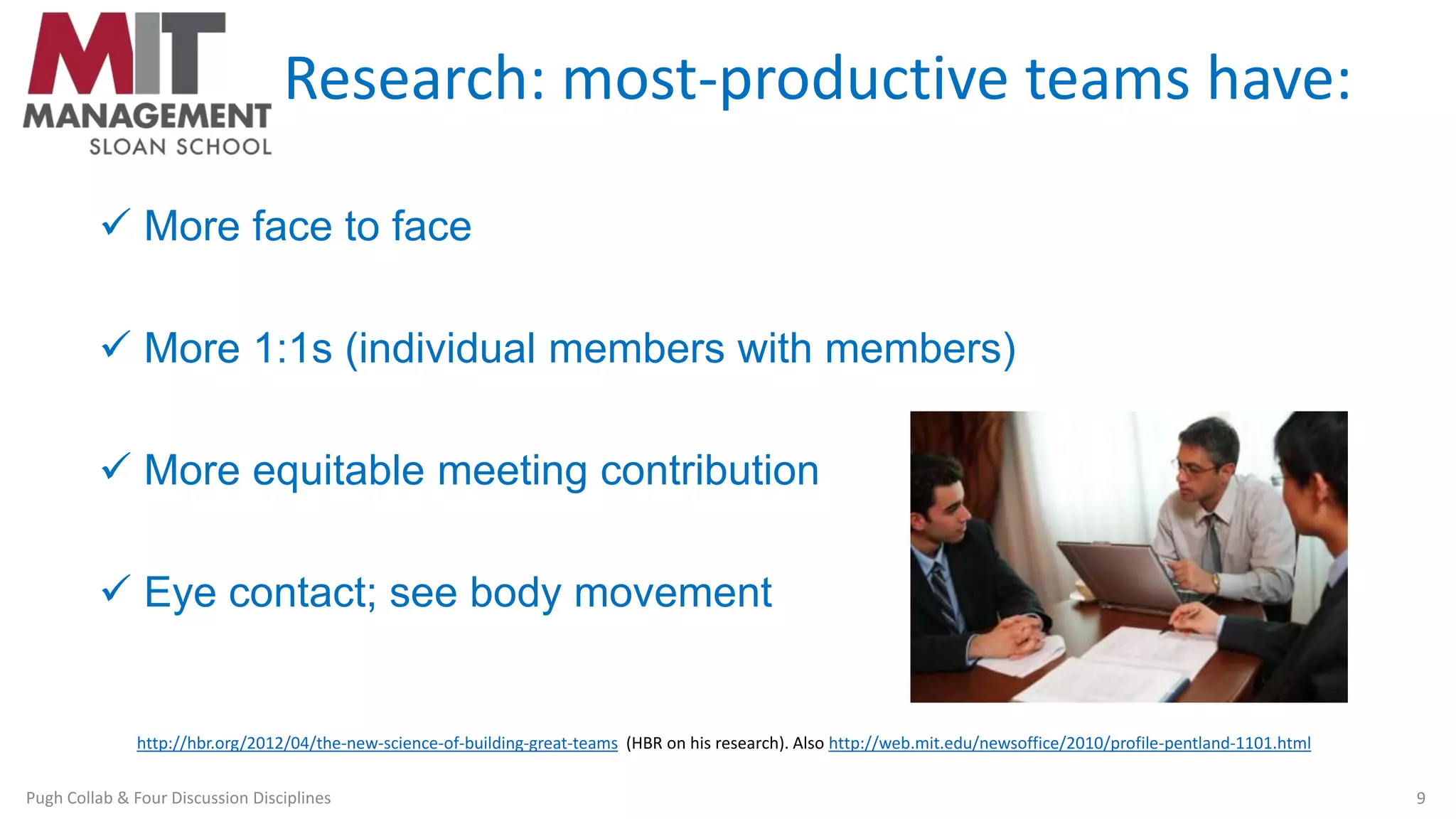
Research: most-productive teams have:
 More face to face
 More 1:1s (individual members with members)
 More equitable meeting contribution
 Eye contact; see body movement
http://hbr.org/2012/04/the-new-science-of-building-great-teams (HBR on his research). Also http://web.mit.edu/newsoffice/2010/profile-pentland-1101.html
Pugh Collab & Four Discussion Disciplines 9
Research:
Source The five keys to a successful
Google Team by Julie Rozovsky,
Analyst, Google People Operations,
Nov 17, 2015
http://rework.withgoogle.com
Pugh Collab & Four Discussion Disciplines
12
“Quest for the
perfect team”
10
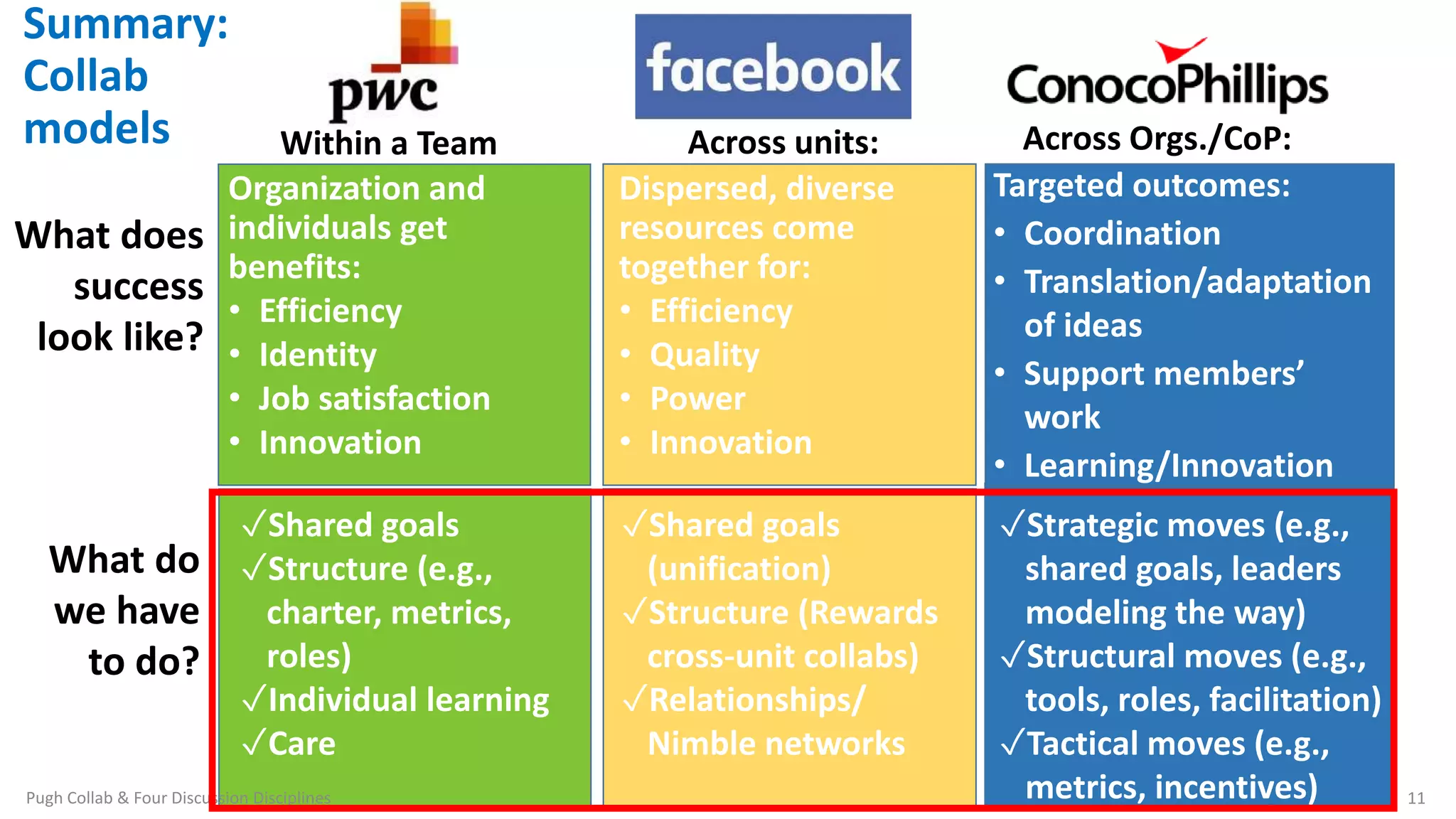
Organization and
individuals get
benefits:
• Efficiency
• Identity
• Job satisfaction
• Innovation
Across units:
Dispersed, diverse
resources come
together for:
• Efficiency
• Quality
• Power
• Innovation
What do
we have
to do?
What does
success
look like?
Across Orgs./CoP:
Targeted outcomes:
• Coordination
• Translation/adaptation
of ideas
• Support members’
work
• Learning/Innovation
✓Strategic moves (e.g.,
shared goals, leaders
modeling the way)
✓Structural moves (e.g.,
tools, roles, facilitation)
✓Tactical moves (e.g.,
metrics, incentives)
✓Shared goals
(unification)
✓Structure (Rewards
cross-unit collabs)
✓Relationships/
Nimble networks
✓Shared goals
✓Structure (e.g.,
charter, metrics,
roles)
✓Individual learning
✓Care
Within a Team
Summary:
Collab
models
Pugh Collab & Four Discussion Disciplines 11
“Design-in” psychological safety
Pugh Collab & Four Discussion Disciplines 12
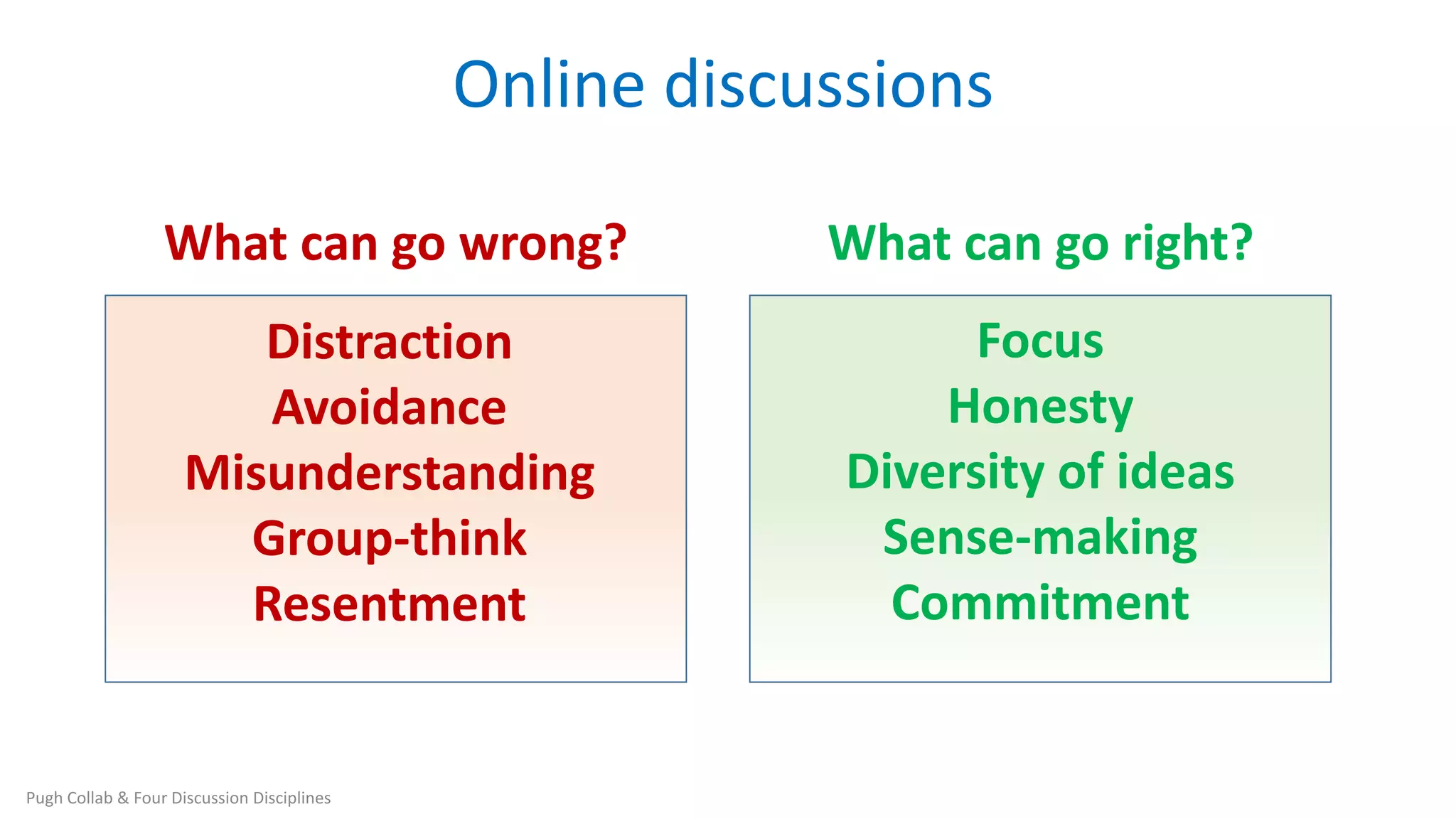
Online discussions
What can go wrong? What can go right?
Pugh Collab & Four Discussion Disciplines
Focus
Honesty
Diversity of ideas
Sense-making
Commitment
Distraction
Avoidance
Misunderstanding
Group-think
Resentment
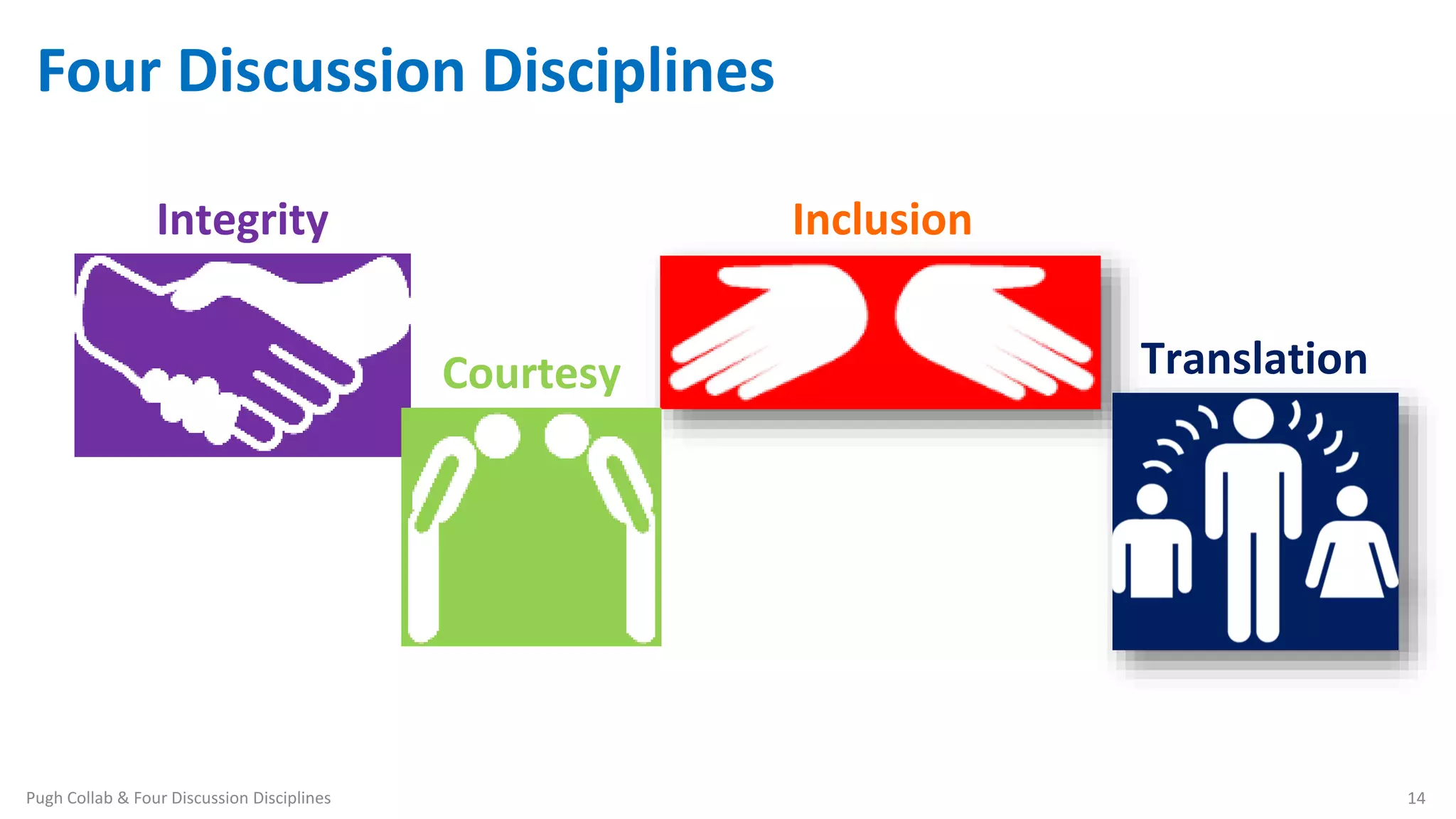
Four Discussion Disciplines
Inclusion
Translation
Integrity
Courtesy
Pugh Collab & Four Discussion Disciplines 14
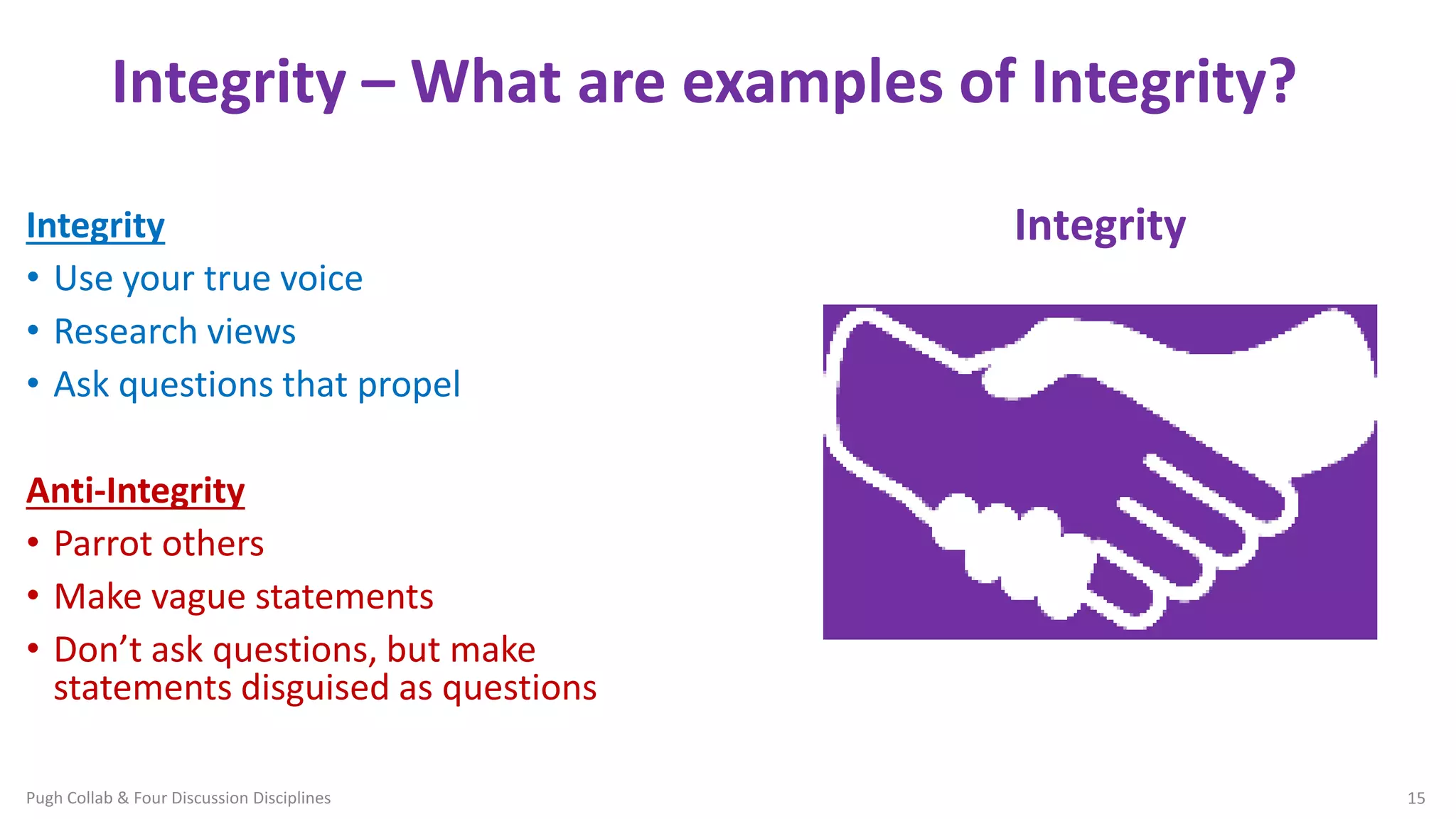
Integrity – What are examples of Integrity?
Integrity
• Use your true voice
• Research views
• Ask questions that propel
Anti-Integrity
• Parrot others
• Make vague statements
• Don’t ask questions, but make
statements disguised as questions
Four Discussion Disciplines
Pugh Collab & Four Discussion Disciplines 15
Integrity
Courtesy – What are examples of Courtesy?
Courtesy
• Respect others, with appreciation,
gratitude (“thank you!”)
• Respect the forum. Keep the
discussion in the forum
Anti-Courtesy
• Let a nice deed (e.g., shared
knowledge) go un-thanked.
• Take the conversation “offline,” e.g.,
into email.
Four Discussion Disciplines
16
Courtesy
Pugh Collab & Four Discussion Disciplines
Courtesy: Different Views
Pugh, KM 2.0 Conversation 17
[C]ourtesy to me includes seeking first to understand before making
myself understood.
Retired Navy, Consultant
Further, I showed courtesy in my discussion posts, yet I cannot say it
was engaging. The most courteous comments from my group
acknowledged another’s influence on his or her thinking.
Social Media Lead
Inclusion – What are examples of Inclusion?
Inclusion
• Broaden the perspective (“This
could also be called X.”)
• Explain terms, and don’t use
acronyms
• Call others in (“@Jimmy, your
view?”)
Anti-Inclusion
• Be exclusive
• Use jargon
Four Discussion Disciplines
18
Inclusion
Pugh Collab & Four Discussion Disciplines
Inclusion: Different views
Pugh, KM 2.0 Conversation 19
When I was not translating, I tended to restrict my inclusion to a single
person, which hijacks the conversation and excludes others. Going
forward, I will be more inclusive to the entire group.
Author, Project Mgr
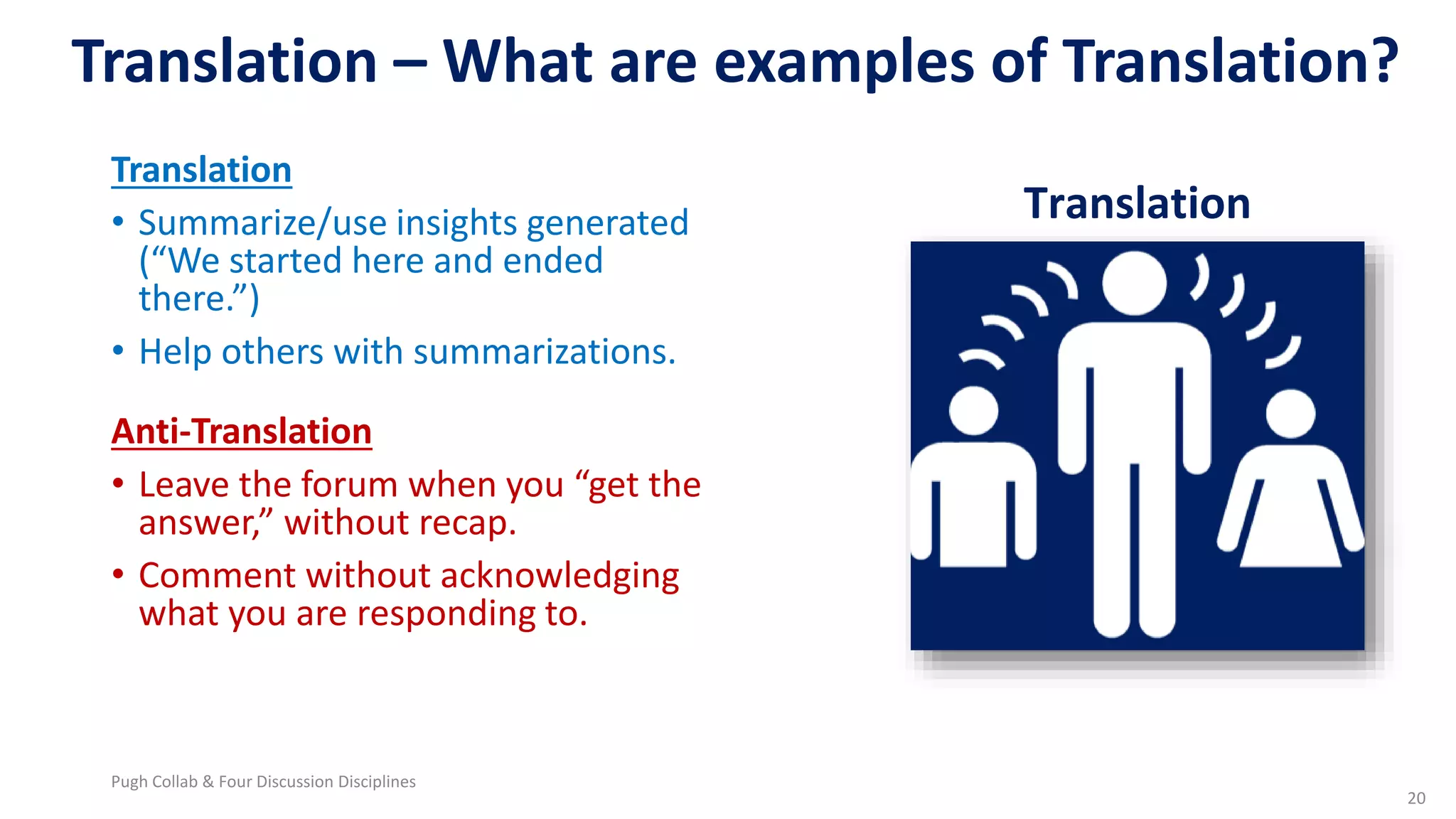
Translation – What are examples of Translation?
Translation
• Summarize/use insights generated
(“We started here and ended
there.”)
• Help others with summarizations.
Anti-Translation
• Leave the forum when you “get the
answer,” without recap.
• Comment without acknowledging
what you are responding to.
Four Discussion Disciplines
20
Translation
Pugh Collab & Four Discussion Disciplines
Translation: Different Views
Pugh, KM 2.0 Conversation 21
Translation is the most difficult discipline to exercise. It required that I pull
back from my thoughts and ideas, and away from advocacy, to succinctly
represent other’s views. I tried to build bridges between similar and diverse
ideas.
Analytics Mgr, Education Sector
Translating is not just a condensed recap; meeting minutes are definitely not
in vogue. Instead it should weave a narrative of the conversation and open
the door for further discussion.
Author, Project Mgr
Four Discussion Disciplines:
Which ones do you need to work on?
Inclusion
Translation
Integrity
Courtesy
Pugh Collab & Four Discussion Disciplines 22
Students self-assess on four discussion disciplines
15
17
23
25
0 5 10 15 20 25 30
Translation
Inclusion
Courtesy
integrity
Self Assessed Good Performance
26
26
19
17
0 5 10 15 20 25 30
Translation
Inclusion
Courtesy
integrity
Self-Assessed Poor Performance
23
Pugh Collab & Four Discussion Disciplines
”...Before knowing about the four disciplines, I thought
those phrases were just buzzwords…now I'm honing
those skills on purpose instead of being on autopilot.”
Large Health Network Project Mgr.
24Pugh Collab & Four Discussion Disciplines
2013: Columbia/Motorola Research: 4 Discussion disciplines drive innovation
Skifstad and Pugh, “Beyond netiquette: Discussion discipline drives innovation” (In Smarter Innovation, Ark Group, 2014).
Discussion
discipline Description
1. Integrity Use true voice, research views,
Ask questions that propel
2. Courtesy Respect others and forum.
3. Inclusion Broaden the perspective.
Explain terms, call others in.
4. Translation Summarize/use insights
generated, and help others
with summarizations.
Benefit to
Collaboration
Primarily tonal;
builds community
and social capital.
Primarily content-
related; drives
innovation.
25Four Discussion DisciplinesPugh, KM 2.0 Conversation 25
We’ve come a long way, baby…
Pugh Collab & Four Discussion
Disciplines 26
1990s
Organizational
Learning
2000s
Networked
organization
2010s
Collaborative
ecosystem
Rob Cross
University of Virginia
Peter Senge
MIT
Example
thought-
leader:
Charlene Li
Altimeter Group
2016
Conversational
Firms
Catherine Turco
MIT Sloan School
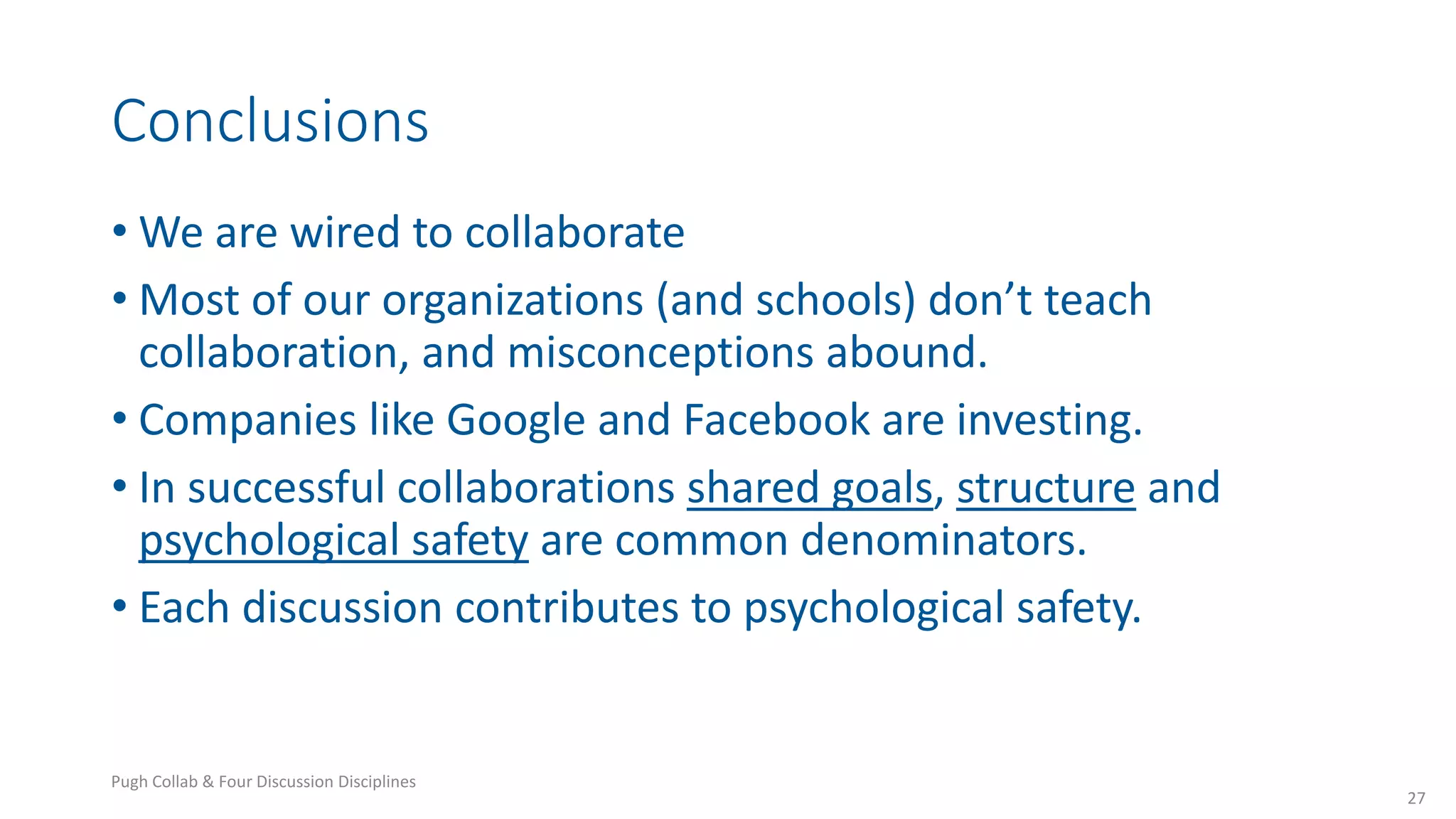
Conclusions
• We are wired to collaborate
• Most of our organizations (and schools) don’t teach
collaboration, and misconceptions abound.
• Companies like Google and Facebook are investing.
• In successful collaborations shared goals, structure and
psychological safety are common denominators.
• Each discussion contributes to psychological safety.
27
Pugh Collab & Four Discussion Disciplines
Discussion and Reflection
28
Pugh Collab & Four Discussion Disciplines
Kate Pugh, Columbia University
katepugh@alum.mit.edu
www.sps.columbia.edu/ikns
www.alignconsultinginc.com
Twitter: katrinapugh
• KM and the Internet of Things (KMWorld, 2016, with Ralph Poole)
• Smarter Innovation (Ark Group)
• Designing Effective Knowledge Networks (MIT Sloan Management
Review)
• Sharing Hidden Know-How (Wiley/Jossey-Bass)
29
Pugh Collab & Four Discussion Disciplines

Pugh collaboration and four discussion disciplines for sikm 171017

  • 1.
    SIKM Leaders: Collaborationand the Four Discussion Disciplines Katrina Pugh President, AlignConsulting Academic Director, Columbia University, Information & Knowledge Strategy October 17, 2017
  • 2.
    Agenda • What theresearch says about collaboration • Structure, shared purpose, and psychological safety • One approach to building psychological safety: Four Discussion Disciplines • Discussion 2Pugh Collab & Four Discussion Disciplines
  • 3.
    What does the researchsay about collaboration? 3 Pugh Collab & Four Discussion Disciplines
  • 4.
    Gallop poll: Employeeengagement  Participation in decisions, sharing in the rewards.  Developing abilities and putting them to productive use.  “Palpable sense of community,” fairness, and reciprocity. Gallop, 2013 quoted by Otoole, James, “U.S. Employees Are Disengaged—and Mismanaged,” Strategy + Business http://www.strategy-business.com/blog/US-Employees-Are-Disengaged-and-Mismanaged?gko=af848 Employees want: 4 Pugh Collab & Four Discussion Disciplines
  • 5.
    Yet, team investmentis rare…  Majority of organizations value team collaboration.  Yet less than 1 in 3 organizations actually provide the proper framework for it. *www.esi-intl.ca/teamcollaborationstudy ESI Research: 5Pugh Collab & Four Discussion Disciplines
  • 6.
    We must bringour whole selves Pugh Collab & Four Discussion Disciplines 6 Comply Be inter- dependent Be ready to change Coordination CollaborationCooperation Source: Columbia University Information and Knowledge Strategy Master’s Program, 2016
  • 7.
    7 Collaboration dynamic Pugh, KM2.0 Conversation 7 Get (Demonstrate measurable value) Feel (Build confidence, trust, get “networked”) Act (e.g., Transfer knowledge) Management Strategy Source: Katrina Pugh, “Sustainable Communities: 10 CSFs for Keeping the Faith,” IBM Syn.chrono.us blog, 2010 http://synch.rono.us/social/blog.nsf/dx/07192010091946AMSLIHMX.htm 7
  • 8.
    Research: Popular misperceptions aboutteams 1. Harmony helps. 2. It's good to mix it up. 3. Bigger is better (magic 6). 4. Face-to-face interaction is passé. 5. It all depends on the leader. 6. Teamwork is magical. Hackman, Richard, “Six common misperceptions about teams” HBR Blog http://blogs.hbr.org/cs/2011/06/six_common_misperceptions_abou.html. Pugh Collab & Four Discussion Disciplines 8 8Pugh Collab & Four Discussion Disciplines
  • 9.
    Research: most-productive teamshave:  More face to face  More 1:1s (individual members with members)  More equitable meeting contribution  Eye contact; see body movement http://hbr.org/2012/04/the-new-science-of-building-great-teams (HBR on his research). Also http://web.mit.edu/newsoffice/2010/profile-pentland-1101.html Pugh Collab & Four Discussion Disciplines 9
  • 10.
    Research: Source The fivekeys to a successful Google Team by Julie Rozovsky, Analyst, Google People Operations, Nov 17, 2015 http://rework.withgoogle.com Pugh Collab & Four Discussion Disciplines 12 “Quest for the perfect team” 10
  • 11.
    Organization and individuals get benefits: •Efficiency • Identity • Job satisfaction • Innovation Across units: Dispersed, diverse resources come together for: • Efficiency • Quality • Power • Innovation What do we have to do? What does success look like? Across Orgs./CoP: Targeted outcomes: • Coordination • Translation/adaptation of ideas • Support members’ work • Learning/Innovation ✓Strategic moves (e.g., shared goals, leaders modeling the way) ✓Structural moves (e.g., tools, roles, facilitation) ✓Tactical moves (e.g., metrics, incentives) ✓Shared goals (unification) ✓Structure (Rewards cross-unit collabs) ✓Relationships/ Nimble networks ✓Shared goals ✓Structure (e.g., charter, metrics, roles) ✓Individual learning ✓Care Within a Team Summary: Collab models Pugh Collab & Four Discussion Disciplines 11
  • 12.
    “Design-in” psychological safety PughCollab & Four Discussion Disciplines 12
  • 13.
    Online discussions What cango wrong? What can go right? Pugh Collab & Four Discussion Disciplines Focus Honesty Diversity of ideas Sense-making Commitment Distraction Avoidance Misunderstanding Group-think Resentment
  • 14.
  • 15.
    Integrity – Whatare examples of Integrity? Integrity • Use your true voice • Research views • Ask questions that propel Anti-Integrity • Parrot others • Make vague statements • Don’t ask questions, but make statements disguised as questions Four Discussion Disciplines Pugh Collab & Four Discussion Disciplines 15 Integrity
  • 16.
    Courtesy – Whatare examples of Courtesy? Courtesy • Respect others, with appreciation, gratitude (“thank you!”) • Respect the forum. Keep the discussion in the forum Anti-Courtesy • Let a nice deed (e.g., shared knowledge) go un-thanked. • Take the conversation “offline,” e.g., into email. Four Discussion Disciplines 16 Courtesy Pugh Collab & Four Discussion Disciplines
  • 17.
    Courtesy: Different Views Pugh,KM 2.0 Conversation 17 [C]ourtesy to me includes seeking first to understand before making myself understood. Retired Navy, Consultant Further, I showed courtesy in my discussion posts, yet I cannot say it was engaging. The most courteous comments from my group acknowledged another’s influence on his or her thinking. Social Media Lead
  • 18.
    Inclusion – Whatare examples of Inclusion? Inclusion • Broaden the perspective (“This could also be called X.”) • Explain terms, and don’t use acronyms • Call others in (“@Jimmy, your view?”) Anti-Inclusion • Be exclusive • Use jargon Four Discussion Disciplines 18 Inclusion Pugh Collab & Four Discussion Disciplines
  • 19.
    Inclusion: Different views Pugh,KM 2.0 Conversation 19 When I was not translating, I tended to restrict my inclusion to a single person, which hijacks the conversation and excludes others. Going forward, I will be more inclusive to the entire group. Author, Project Mgr
  • 20.
    Translation – Whatare examples of Translation? Translation • Summarize/use insights generated (“We started here and ended there.”) • Help others with summarizations. Anti-Translation • Leave the forum when you “get the answer,” without recap. • Comment without acknowledging what you are responding to. Four Discussion Disciplines 20 Translation Pugh Collab & Four Discussion Disciplines
  • 21.
    Translation: Different Views Pugh,KM 2.0 Conversation 21 Translation is the most difficult discipline to exercise. It required that I pull back from my thoughts and ideas, and away from advocacy, to succinctly represent other’s views. I tried to build bridges between similar and diverse ideas. Analytics Mgr, Education Sector Translating is not just a condensed recap; meeting minutes are definitely not in vogue. Instead it should weave a narrative of the conversation and open the door for further discussion. Author, Project Mgr
  • 22.
    Four Discussion Disciplines: Whichones do you need to work on? Inclusion Translation Integrity Courtesy Pugh Collab & Four Discussion Disciplines 22
  • 23.
    Students self-assess onfour discussion disciplines 15 17 23 25 0 5 10 15 20 25 30 Translation Inclusion Courtesy integrity Self Assessed Good Performance 26 26 19 17 0 5 10 15 20 25 30 Translation Inclusion Courtesy integrity Self-Assessed Poor Performance 23 Pugh Collab & Four Discussion Disciplines
  • 24.
    ”...Before knowing aboutthe four disciplines, I thought those phrases were just buzzwords…now I'm honing those skills on purpose instead of being on autopilot.” Large Health Network Project Mgr. 24Pugh Collab & Four Discussion Disciplines
  • 25.
    2013: Columbia/Motorola Research:4 Discussion disciplines drive innovation Skifstad and Pugh, “Beyond netiquette: Discussion discipline drives innovation” (In Smarter Innovation, Ark Group, 2014). Discussion discipline Description 1. Integrity Use true voice, research views, Ask questions that propel 2. Courtesy Respect others and forum. 3. Inclusion Broaden the perspective. Explain terms, call others in. 4. Translation Summarize/use insights generated, and help others with summarizations. Benefit to Collaboration Primarily tonal; builds community and social capital. Primarily content- related; drives innovation. 25Four Discussion DisciplinesPugh, KM 2.0 Conversation 25
  • 26.
    We’ve come along way, baby… Pugh Collab & Four Discussion Disciplines 26 1990s Organizational Learning 2000s Networked organization 2010s Collaborative ecosystem Rob Cross University of Virginia Peter Senge MIT Example thought- leader: Charlene Li Altimeter Group 2016 Conversational Firms Catherine Turco MIT Sloan School
  • 27.
    Conclusions • We arewired to collaborate • Most of our organizations (and schools) don’t teach collaboration, and misconceptions abound. • Companies like Google and Facebook are investing. • In successful collaborations shared goals, structure and psychological safety are common denominators. • Each discussion contributes to psychological safety. 27 Pugh Collab & Four Discussion Disciplines
  • 28.
    Discussion and Reflection 28 PughCollab & Four Discussion Disciplines
  • 29.
    Kate Pugh, ColumbiaUniversity katepugh@alum.mit.edu www.sps.columbia.edu/ikns www.alignconsultinginc.com Twitter: katrinapugh • KM and the Internet of Things (KMWorld, 2016, with Ralph Poole) • Smarter Innovation (Ark Group) • Designing Effective Knowledge Networks (MIT Sloan Management Review) • Sharing Hidden Know-How (Wiley/Jossey-Bass) 29 Pugh Collab & Four Discussion Disciplines