Leadership & Change MGT Chapter 1 to 6
1
CHAPTER ONE
INTRODUCTION
Introduction
An organization has the greatest chance of being successful when all of the employees work
toward achieving its goals. Since leadership involves the exercise of influence by one person
over others, the quality of leadership exhibited by supervisors is a critical determinant of
organizational success. Thus, supervisors study leadership in order to influence the actions of
employees toward the achievement of the goals of the organization.
Supervisors can learn about leadership through research. Leadership studies can be classified as
trait, behavioral, contingency, and transformational. Earliest theories assumed that the primary
source of leadership effectiveness lay in the personal traits of the leaders themselves. Yet, traits
alone cannot explain leadership effectiveness. Thus, later research focused on what the leader
actually did when dealing with employees. These behavioral theories of leadership sought to
explain the relationship between what the leaders did and how the employees reacted, both
emotionally and behaviorally. Yet, behavior can't always account for leadership in different
situations. Thus, contingency theories of leadership studied leadership style in different
environments. Transactional leaders, such as those identified in contingency theories, clarify role
and task requirements for employees. Yet, contingency can't account for the inspiration and
innovation that leaders need to compete in today's global marketplace. Newer transformational
leadership studies have shown that leaders, who are charismatic and visionary, can inspire
followers to transcend their own self-interest for the good of the organization.
5.1. MEANING AND NEED FOR LEADERSHIP
Definition ofLeadership
A traditional definition of leadership: Leadership is an interpersonal influence directed toward
the achievement of a goal or goals. Three important parts of this definition are the terms
interpersonal, influence, and goal. Interpersonal means between persons. Thus, a leader has
more than one person (group) to lead. Influence is the power to affect others. .
Goal is the end one strives to attain.
Basically, this traditional definition of leadership says that a leader influences more than one
person toward a goal. The definition of leadership used in this course follows. Leadership is a
dynamic relationship based on mutual influence and common purpose between leaders and
collaborators in which both are moved to higher levels of motivation and moral development as
they affect real, intended change. (Kevin Freiberg and Jackie Freiberg, , 1996, p. 298)
Three important parts of this definition are the terms relationship, mutual, and collaborators.
Relationship is the connection between people. Mutual means shared in common. Collaborators
cooperate or work together. This definition of leadership says that the leader is influenced by the
collaborators while they work together to achieve an important goal. Leadership-is the process
of influencing employees to work toward the achievements of organizational objectives.
Leadership & Change MGT Chapter 1 to 6
2
 Is the process by which a person exerts influence over other people; and inspires,
motivates, and directs their activities to help achieve group or organizational goals.
 Is the process of influencing individuals to set and achieve goals.
Leadership is the art of inspiring subordinates to perform their duties willingly, competently and
enthusiastically. Leaders are examples or symbols to their subordinates. Therefore, they are
expected to lead subordinates by their talent and skill. A leader is one who plays a directing role
and imposes a commanding influence over others. Leaders can be chosen or appointed.
Managers are appointed leaders.
Chosen leaders are those chosen from among members. The leader is chosen by members; i.e.
members chose their leader. The leader is chosen on the basis of dominance physically or
psychologically.
Appointed leaders are those that are not chosen by members. They may or may not be members
of the group. They are appointed by someone outside the group. This is practical in formal
organizations.
Managers should have an ability to lead which is not of course written on the job description but
simply an implied one. Leaders are more likely to arise during crises such as war, or depression
than when conditions are stable. When people feel threatened they are eager to follow someone
who appears able to protect them and return conditions to normal.
5.1.2. The need for leadership
Leading is needed in an organization to influence, direct and guide activities of individuals and
groups so as to help the organization achieve its objectives.
Management and Leadership
Management and leadership are not the same. A leader can be a manager, but a manager is not
necessarily a leader. The leader of the work group may emerge informally as the choice of the
group. If a manager is able to influence people to achieve the goals of the organization, without
using his or her formal authority to do so, then the manager is demonstrating leadership.
According to John P. Kotter in his book, A Force for Change: How Leadership Differs From
Management (The Free Press, 1990), managers must know how to lead as well as manage.
Without leading as well as managing, today's organizations face the threat of extinction.
Leadership & Change MGT Chapter 1 to 6
3
Management is the process of setting and achieving the goals of the organization through the
functions of management: planning, organizing, directing (or leading), and controlling. A
manager is hired by the organization and is given formal authority to direct the activity of others
in fulfilling organization goals. Thus, leading is a major part of a manager's job. Yet a manager
must also plan, organize, and control. Generally speaking, leadership deals with the interpersonal
aspects of a manager's job, whereas planning, organizing, and controlling deal with the
administrative aspects. Leadership deals with change, inspiration, motivation, and influence.
Management deals more with carrying out the organization's goals and maintaining equilibrium.
The key point in differentiating between leadership and management is the idea that employees
willingly follow leaders because they want to, not because they have to. Leaders may not possess
the formal power to reward or sanction performance. However, employees give the leader power
by complying with what he or she requests. On the other hand, managers may have to rely on
formal authority to get employees to accomplish goals.
Managers plan, organize, staff, lead, and control. They may or may not be effective in
influencing their subordinates or team members to set and achieve goals. Leaders, on the other
hand are involved in single function of management that is leading they are individuals who are
able to exert influence over other people to achieve organizational objectives. Leadership
involves creating and sharing of visions, generating strategies to bring visions to realize. There
fore, leaders and managers are not necessarily the same; it is mainly because leading perform
only one aspect of management functions. Managers can be leader because they can perform
leading function. But may not be effective leaders since they may not have enough ability to
influence others.
Assignment
A. What makes effective leader
B. Importance of leadership for good governance and development
Leadership & Change MGT Chapter 1 to 6
4
CHAPTER TWO
LEADERSHIP STYLE AND STYLES
2.2. Leadership Theories
A. Trait Theory
The trait theory or leadership focused on identifying the personal characteristics that are
responsible for effective leadership. It is based on the assumption that leaders are born not made.
That is good leaders are born naturally, not made.
In the 1920's and 1930's, leadership research focused on trying to identify the traits that
differentiated leaders from non-leaders. These early leadership theories were content theories,
focusing on "what" an effective leader is, not on 'how' to effectively lead. The trait approach to
understanding leadership assumes that certain physical, social, and personal characteristics are
inherent in leaders. Sets of traits and characteristics were identified to assist in selecting the right
people to become leaders. Physical traits include being young to middle-aged, energetic, tall, and
handsome. Social background traits include being educated at the "right" schools and being
socially prominent or upwardly mobile. Social characteristics include being charismatic,
charming, tactful, popular, cooperative, and diplomatic. Personality traits include being self-
confident, adaptable, assertive, and emotionally stable. Task-related characteristics include being
driven to excel, accepting of responsibility, having initiative, and being results-oriented.
Trait theories intended to identify traits to assist in selecting leaders since traits are related to
leadership effectiveness in many situations. The trait approach to understanding leadership
supports the use of tests and interviews in the selection of managers. The interviewer is typically
attempting to match the traits and characteristics of the applicant to the position. For example,
most interviewers attempt to evaluate how well the applicant can work with people.
Trait theory has not been able to identify a set of traits that will consistently distinguish leaders
from followers. Trait theory posits key traits for successful leadership (drive, desire to lead,
integrity, self-confidence, intelligence, and job-relevant knowledge) yet does not make a
judgment as to whether these traits are inherent to individuals or whether they can be developed
through training and education. No two leaders are alike. Furthermore, no leader possesses all of
the traits. Comparing leaders in different situations suggests that the traits of leaders depend on
the situation. Thus, traits were de-emphasized to take into account situational conditions
(contingency perspective).
To sum up, according to this theory effective leaders must have the following traits
 intelligence-helps managers understand complex issues and solve problem
 Self confidence-contributes to managers effectively influencing subordinates and
persisting when faced with difficulties.
Leadership & Change MGT Chapter 1 to 6
5
 Integrity and honesty-helps managers behave ethically and earn their subordinates trust
and confidence.
 Physical traits-such as height, appearances etc.
 Social traits such as cooperativeness skill etc.
Traits alone however, are not the key to understand leader effectiveness. Some effective leaders
do not possess all of these traits, are some leaders who do possess them but not effective in their
leadership roles.
B. The Behavioral Theory
 Behavioral studies had their roots in the Ohio Sate University and university of Michigan
by careful study of the behaviors of specific leaders.
Ohio State and University of Michigan
Studies conducted at the Ohio State University and the University of Michigan identified two
leadership styles and two types of leader behaviors. The Ohio State study identified two
leadership styles: considerate and initiating structure. The University of Michigan study
classified leaders' behaviors as being production- or employee-centered. The primary concern of
leaders with considerate and employee-centered style is the employee's welfare. The primary
concern of leaders with initiating-structure and production-centered styles are achieving goals.
Research findings on which dimension are most important for satisfaction and productivity are
inconclusive. However, employee oriented leaders appear to be associated with high group
productivity and job satisfaction.
This theory tried to identify the behaviors shown by leaders in the work environment and they
were generally able to identify two sets of leaders.
Work centered (concerned for task) leaders
 This approach is also refereed to as initiating structure, job centeredness and task orientation.
 This considers leaders who are authoritarian, autocratic, production oriented and activity
focused.
 A leader with such behavior mostly tends to
- plan and define work
- Assign task responsibilities
- set clear work standards
- Urges for tasks completion
- Monitors performance results persistently,
Etc
Employee centered(people centered)leaders
Leadership & Change MGT Chapter 1 to 6
6
 Such leaders are also known as democratic, considerate, consultative and participative
leaders.
 They tend to share decisions with subordinates, encourage participation, and support the
team work needed for high levels of task accomplishment.
 A leader with such behavior tends to
- Act warmly and supportive to followers
- Develops social rapport with followers
- Respects the feeling of followers
- Is highly sensitive to the needs of followers
- Shows trust and confidence in followers.
C. Situational Theory
Situational leadership theory attempts to determine the appropriate leadership style for various
situations. Successful leaders must be able to identify clues in an environment and adapt their
leader behavior to meet the needs of their followers and of the particular situation. Even with
good diagnostic skills, leaders may not be effective unless they can adapt their leadership style to
meet the demands of their environment.
Fiedler's Contingency Model
Leadership Theory and Research: Perspectives and Directions (Academic Press Inc (HBJ),
1993) was a tribute to Fred Fiedler's 40 year study of leadership and organizational effectiveness.
The editors, Martin M. Chemers and Roya Ayman, write of Fiedler's contribution: "The
realization that leadership effectiveness depends on the interaction of qualities of the leader with
demands of the situation in which the leader functions, made the simplistic "one best way"
approach of earlier eras obsolete."
Fred E. Fiedler's contingency theory postulates that there is no best way for managers to lead.
Situations will create different leadership style requirements for a manager. The solution to a
managerial situation is contingent on the factors that impinge on the situation. For example, in a
highly reutilized (mechanistic) environment where repetitive tasks are the norm, a certain
leadership style may result in the best performance. The same leadership style may not work in a
very dynamic environment.
Fiddler’s contingency model suggests that managers should choose task or employee focus
depending on the interaction of three situation variables: leader member relation, task structure,
and leader position power.
Leader-Member relations: - How well do the manager and the employees get along? The
extent to which followers like, trust, and are loyal to their leader is determinant of how favorable
a situation for leading. If leader-member relations are good situations are good for leading.
If relation is poor, the manager may have to resort to negotiation or to promising favors to get
performance. Leader-member relations are the amount of loyalty, dependability, and support that
Leadership & Change MGT Chapter 1 to 6
7
the leader receives from employees. It is a measure of how the manager perceives him or her and
the group of employees is getting along together. In a favorable relationship the manager has a
high task structure and is able to reward and or punish employees without any problems. In an
unfavorable relationship the task is usually unstructured and the leader possesses limited
authority. The spelling out in detail (favorable) of what is required of subordinates affects task
structure.
Task structure: - Is the job highly structured, fairly unstructured, or somewhere in between?
The extent to which the work to be performed is clear-cut. When task structure is high,
situations are favorable for leading. When task structure are low, goals may be vague,
subordinates may be unsure of what they should be doing or how they should do it, and the
situation is unfavorable for leading.
Position power: How much authority does the manager possess?
Theory X and Theory Y-assumptions
Are assumptions about human nature developed by Douglas Mc Gregor. He developed the
assumptions based on the attitude that managers have about workers. Theory X and Theory Y
each represent different ways in which leaders view employees. Theory X managers believe that
employees are motivated mainly by money, are lazy, uncooperative, and have poor work habits.
Theory Y managers believe that subordinates work hard, are cooperative, and have positive
attitudes.
Theory - X assumes the following
 The average worker is lazy, dislikes job, and will avoid work whenever possible
 Because most people dislike work, they have to be closely supervised and threatened
with punishment to reach objectives.
 Above all people want security
 Average people prefer to be directed, wish to avoid responsibilities and they have
little ambition.
Theory X leads naturally to an emphasis on the tactics of control - to procedures and techniques
for telling people what to do, for determining whether they are doing it, and for administering
rewards and punishment. Theory X explains the consequences of a particular managerial
strategy. Because its assumptions are so unnecessarily limiting, it prevents managers from seeing
the possibilities inherent in other managerial strategies. As long as the assumptions of Theory X
influence managerial strategy, organizations will fail to discover, let alone utilize, the
potentialities of the average human being.
Theory- Y assumes the following
 Most people find work as natural as play or rest and develop an attitude toward work
based on their experience with it.
Leadership & Change MGT Chapter 1 to 6
8
 People do not need to be threatened with punishment; they will work voluntarily toward
organizational objectives to which they are committed.
 The average person working under proper condition not only to accept but also to seek
responsibility.
 Managers should decentralize authority to employees and make sure employees have the
resources necessary to achieve organizational goals
Theory Y's purpose is to encourage integration, to create a situation in which an employee can
achieve his or her own goals best by directing his or her efforts toward the objectives of the
organization. It is a deliberate attempt to link improvement in managerial competence with the
satisfaction of higher-level ego and self-actualization needs. Theory Y leads to a preoccupation
with the nature of relationships, with the creation of an environment which will encourage
commitment to organizational objectives and which will provide opportunities for the maximum
exercise of initiative, ingenuity, and self-direction in achieving them.
Leadership styles
Based on the degree to which managers share decision making authority with subordinates
leadership styles can be classified in to three: Autocratic, democratic , and laissez-faire.
Autocratic Style- a leadership style in which a manager does not share decision-making
authority with subordinates.
 Managers, who tend to be heavily work – centered, placing most of their emphasis on
task accomplishment and little on the human elements.
 Autocratic leadership style is characterized by the following points:
 Managers’ emphasis on close control
 Managers’ willingness to delegate a very little decision-making authority.
 No flow of information from subordinates (Leader- subordinate relation ship
is characterized by order giving on the leader’s part)
 Sensitivity of managers about their authority.
 Leader’s assumption that payment is a just reward for working
Democratic Leadership style- is a leadership approach in which a manager shares decision –
making authority with subordinates. Managers who have high concern for both people and work
practice it.
In democratic leadership managers:
 are not much sensitive about their authority
 participate employees in decision making
 Appreciate suggestions from subordinates
 Exercise broad supervision
 Motivate subordinates with rewards
Laissez-Faire(Free-Rein Style) - is leadership approach in which a manager develops a frame
work for subordinates in which they can act and leave decision making authority to the
subordinates and remain for consultation. It is employed by managers who are basically
Leadership & Change MGT Chapter 1 to 6
9
uninvolved in the operations of the unit. This type of leadership is mostly applied in
organizations with highly skilled and well-trained professional.
Situational Leadership style-is leadership approach in which managers utilize the combination
of the above style depending on the situation in external environment.
2.3. Motivation Concepts and Theories
Motivation- is an inner desire to satisfy an unsatisfied need. Defined as the psychological forces
within a person that determine:
 Direction of behavior in an organization;
 The effort or how hard people work;
 The persistence displayed in meeting goals.
- Is the result of the interaction of a person’s internal needs and external influences that
determine behavior.
- Is willingness to achieve organizational objectives
- Is psychological force that determines the direction of a person’s behavior in an
organization, a person’s level of effort and a person’s level of persistence.
Motivation can be internal or external type
Intrinsic Motivation: behavior performed for its own sake. Motivation comes from performing
the work. Extrinsic Motivation: behavior performed to acquire rewards. Motivation source is
the consequence of an action.
Theories ofMotivation
Many methods of employee motivation have been developed. The study of work motivation has
focused on the motivator (supervisor) as well as the motivatee (employee). Motivation theories
are important to supervisors attempting to be effective leaders. Two primary approaches to
motivation are content and process.
The content approach to motivation focuses on the assumption that individuals are motivated
by the desire to fulfill inner needs. Content theories focus on the needs that motivate people.
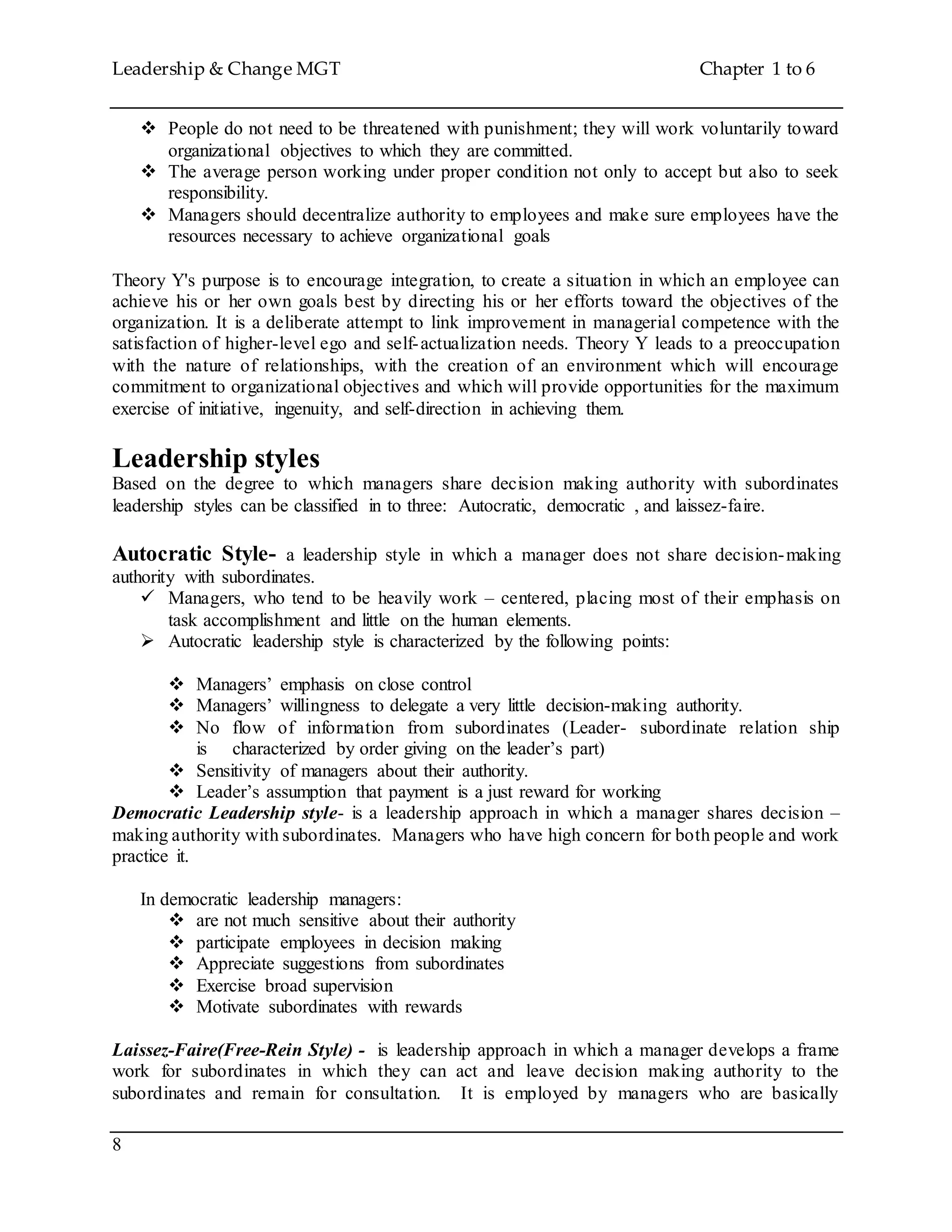
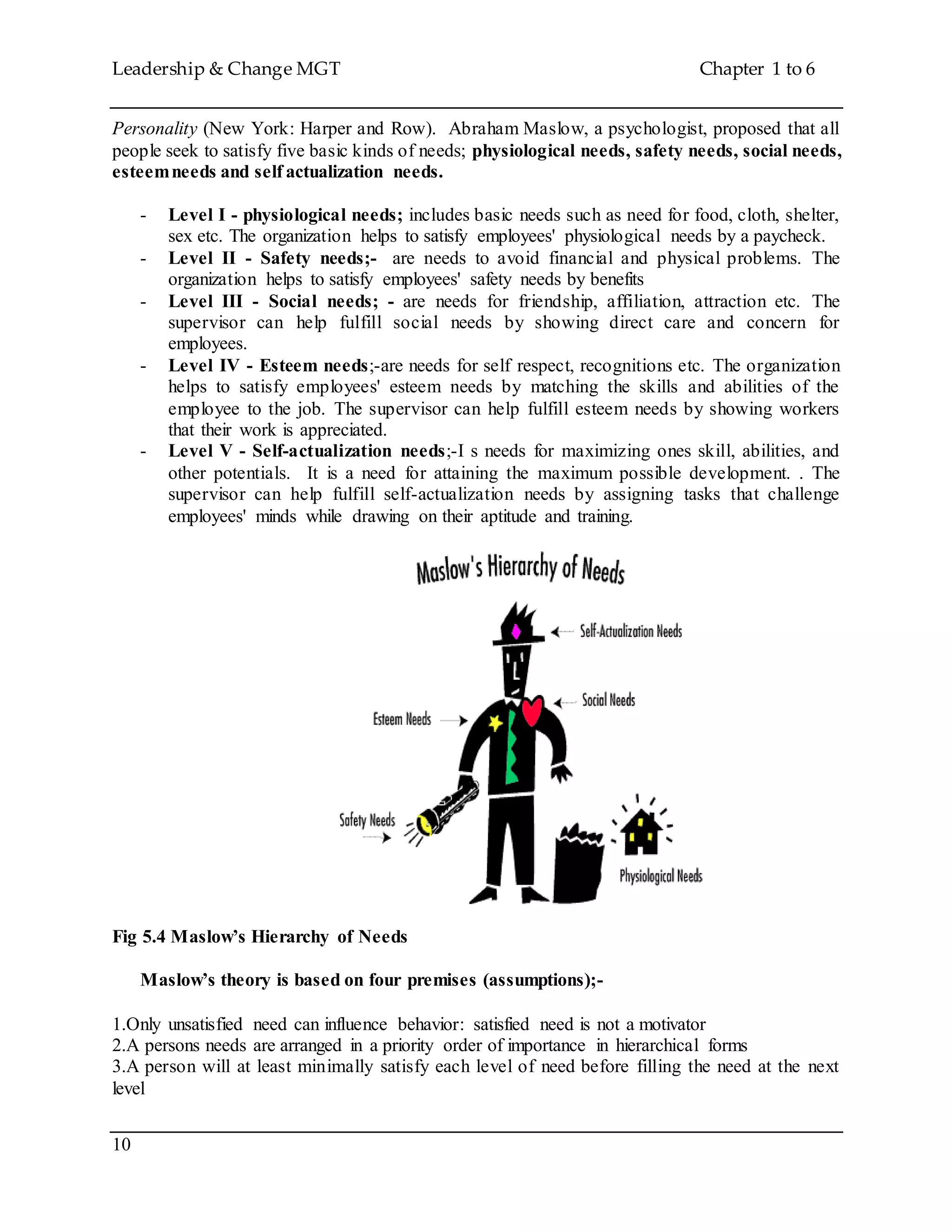
A. Maslow’s Hierarchy of Needs- · Maslow's Hierarchy of Needs identifies five levels of
needs, which are best seen as a hierarchy with the most basic need emerging first and the most
sophisticated need last. People move up the hierarchy one level at a time. Gratified needs lose
their strength and the next level of needs is activated. As basic or lower-level needs are satisfied,
higher-level needs become operative. A satisfied need is not a motivator. The most powerful
employee need is the one that has not been satisfied. Abraham Maslow first presented the five-
tier hierarchy in 1942 to a psychoanalytic society and published it in 1954 in Motivation and
Leadership & Change MGT Chapter 1 to 6
10
Personality (New York: Harper and Row). Abraham Maslow, a psychologist, proposed that all
people seek to satisfy five basic kinds of needs; physiological needs, safety needs, social needs,
esteemneeds and self actualization needs.
- Level I - physiological needs; includes basic needs such as need for food, cloth, shelter,
sex etc. The organization helps to satisfy employees' physiological needs by a paycheck.
- Level II - Safety needs;- are needs to avoid financial and physical problems. The
organization helps to satisfy employees' safety needs by benefits
- Level III - Social needs; - are needs for friendship, affiliation, attraction etc. The
supervisor can help fulfill social needs by showing direct care and concern for
employees.
- Level IV - Esteem needs;-are needs for self respect, recognitions etc. The organization
helps to satisfy employees' esteem needs by matching the skills and abilities of the
employee to the job. The supervisor can help fulfill esteem needs by showing workers
that their work is appreciated.
- Level V - Self-actualization needs;-I s needs for maximizing ones skill, abilities, and
other potentials. It is a need for attaining the maximum possible development. . The
supervisor can help fulfill self-actualization needs by assigning tasks that challenge
employees' minds while drawing on their aptitude and training.
Fig 5.4 Maslow’s Hierarchy of Needs
Maslow’s theory is based on four premises (assumptions);-
1.Only unsatisfied need can influence behavior: satisfied need is not a motivator
2.A persons needs are arranged in a priority order of importance in hierarchical forms
3.A person will at least minimally satisfy each level of need before filling the need at the next
level
Leadership & Change MGT Chapter 1 to 6
11
4.If need satisfaction is not maintained at any level the unsatisfied need will become priority
ones again.
How managers fulfill needs to the employees?
Types of Needs Ways of Fulfilling Needs
Fig 5.5 Hierarchy of Needs
• Physiologica
l needs
• Safety
Needs
• Social Needs
• Esteem
Needs
•
 Paying adequate wage and
salaries so that employee
can buy basic necessities.
 Providing quality work life,
making work environment
smart, keep in pension
plans, purchasing
protection clothes
(gloves)
 Allowing employees to
strengthen informal
groups and to
communicateeach other
at work place
 Increasing responsibilities
to workers and
appreciating them on their
performances
 Training employees whose
challenging duties and
making environment
Leadership & Change MGT Chapter 1 to 6
12
Fig.
5.6 Abraham Maslow’s hierarchy of needs.
B. Alderfer's ERG;- identified three categories of needs. The most important contribution of
the ERG model is the addition of the frustration-regression hypothesis, which holds that
when individuals are frustrated in meeting higher level needs, the next lower level needs
reemerge.
Existence; - needs are the desires for material and physical well being. These needs are
satisfied with food, water, air, shelter, working conditions, pay, and andfringe benefits.
Relatedness; - needs are the desires to establish and maintain interpersonal relationships.
These needs are satisfied with relationships with family, friends, supervisors, subordinates,
and co-workers.
Growth;- needs are the desires to be creative, to make useful and productive contributions
and to have opportunities for personal development.
Self Actualization
Esteem Needs
Social Needs
Safety Needs
Physiological
Needs
Leadership & Change MGT Chapter 1 to 6
13
Fig 5.7 Alderfer's ERG
C. McClelland's Learned Needs divides motivation into needs for power, affiliation,
and achievement.
Achievement;- motivated people thrive on pursuing and attaining goals. They like to be able
to control the situations in which they are involved. They take moderate risks. They like to
get immediate feedback on how they have done. They tend to be preoccupied with a task-
orientation towards the job to be done.
Power; - motivated individuals see almost every situation as an opportunity to seize control
Alderfer’s ERG
After lower level needs
satisfied, personseeks higher
needs. When
unable to satisfyhigher needs,
lower needs motivationis
Growt
h
Self-development,
creative work
Worker
continually
improves skills
Relatedness
Interpersonal
relations,feelings
Good relations,
feedback
Existence
Food, water,
shelter
Basicpay level
to buy items
Lowest
Highest
Need
Level
Descr
iption
Exa
mple
Leadership & Change MGT Chapter 1 to 6
14
or dominate others. They love to influence others. They like to change situations whether or
not it is needed. They are willing to assert themselves when a decision needs to be made.
Affiliation; - motivated people are usually friendly and like to socialize with others. This
may distract them from their performance requirements. They will usually respond to an
appeal for cooperation.
D. Herzberg’s two-factor theory
Psychologist F.Hertzberg developed needs theory called two-factor or hygiene-motivator
theory. According to this theory there are two sets of factors where one set of factors lead to job
dissatisfaction; these are called hygiene factors. The other set of factors that produce job
satisfaction and motivations; these are called motivators.
Hygiene factors are extrinsic to the job i.e., they don’t relate directly to a person’s actual work
activity. Hygiene factors are part of a job’s environment; they are part of context of the job, not
its content. According to Hertzberg, when hygiene factors that an employee provides are not
sufficient, workers will be dissatisfied. When the factors are of sufficient finally they don’t
necessarily act as motivators. Hygiene factors include: salary, job security, working condition,
company policies, quality of interpersonal relationship among peers, supervisors, subordinates,
etc.
Motivations Factors- are the primary cause of job satisfaction according to Hertzberg. They
are intrinsic to a job and relate directly to the real nature of the work people perform. In other
words, motivation factors relate to the job content. When an employer fails to provide
motivation factors, employees will be dissatisfied. With quality motivation factors, employees
enjoy job satisfaction and provide high performance. Different people require different kinds
and degree of motivation factors – what stimulates one worker may not affect another.
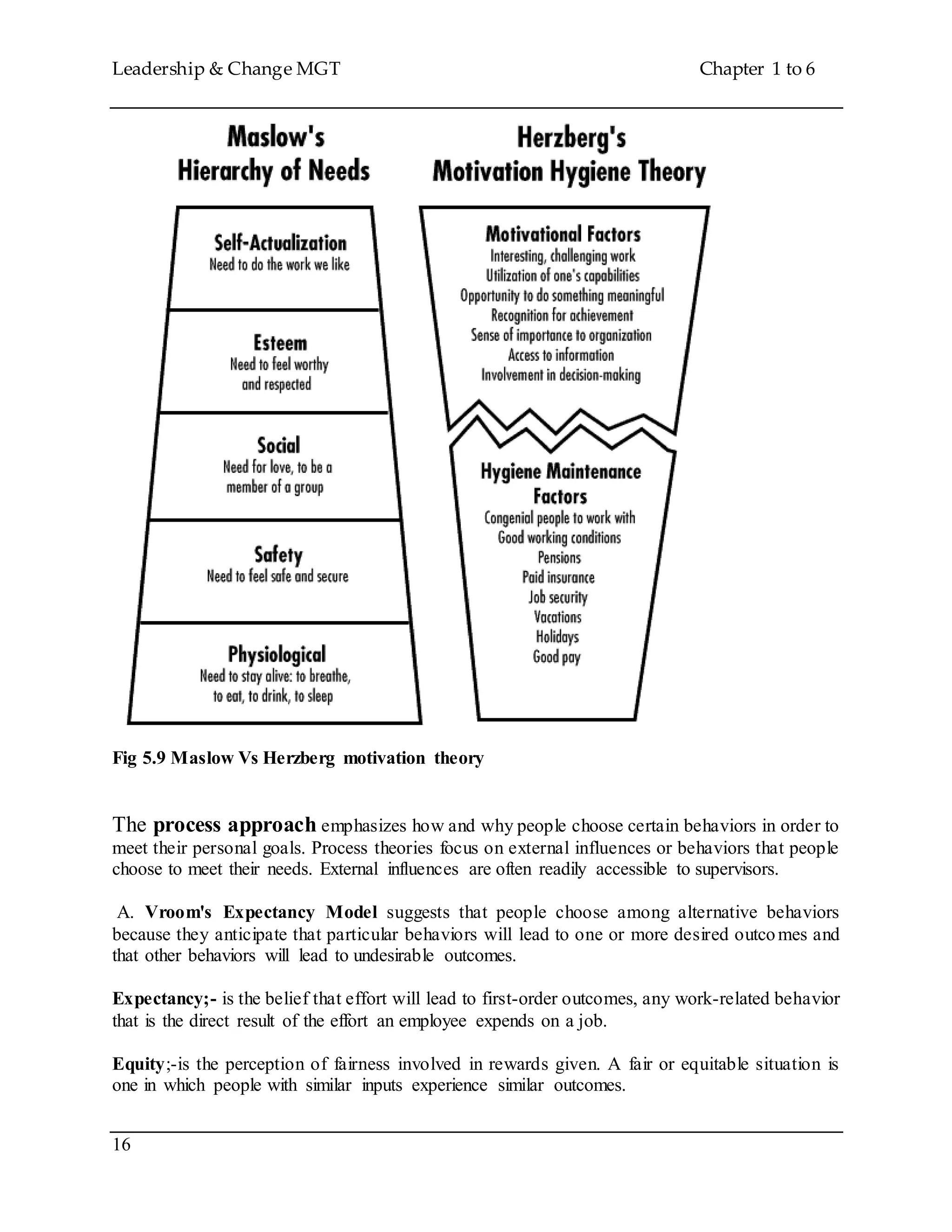
Motivators correspond to Maslow's higher-level needs of esteem and self-actualization.
Generally, managers can use their knowledge to ensure that hygiene factors are there in the
environment as foundation on which to build motivation. Once top management has provided
satisfactory hygiene factors, they can focus on motivation factors. Moreover, according to
Hertzberg, hygiene factors will not motivate workers but their absence de motivates them.
Satisfaction comes from motivators that are intrinsic or job content, such as achievement,
recognition, advancement, responsibility, the work itself, and growth possibilities. Herzberg uses
the term motivators for job satisfiers since they involve job content and the satisfaction that
results from them.
Motivators are considered job turn-on. They are necessary for substantial improvements in
work performance and move the employee beyond satisfaction to superior performance.
Motivators correspond to Maslow's higher-level needs of esteem and self-actualization.
Dissatisfaction occurs when the following hygiene factors, extrinsic or job context, are not
present on the job: pay, status, job security, working conditions, company policy, peer relations,
Leadership & Change MGT Chapter 1 to 6
15
and supervision. Herzberg uses the term hygiene for these factors because they are preventive in
nature. They will not produce motivation, but they can prevent motivation from occurring.
Hygiene factors can be considered job stay-on because they encourage an employee to stay on a
job. Once these factors are provided, they do not necessarily promote motivation; but their
absence can create employee dissatisfaction. Hygiene factors correspond to Maslow's
physiological, safety, and social needs in that they are extrinsic, or peripheral, to the job. They
are present in the work environment of job context. Motivation comes from the employee's
feelings of accomplishment or job content rather than from the environmental factors or job
context. Motivators encourage an employee to strive to do his or her best. Job enrichment can be
used to meet higher-level needs. To enrich a job, a supervisor can introduce new or more
difficult tasks, assign individuals specialized tasks that enable them to become experts, or grant
additional authority to employees.
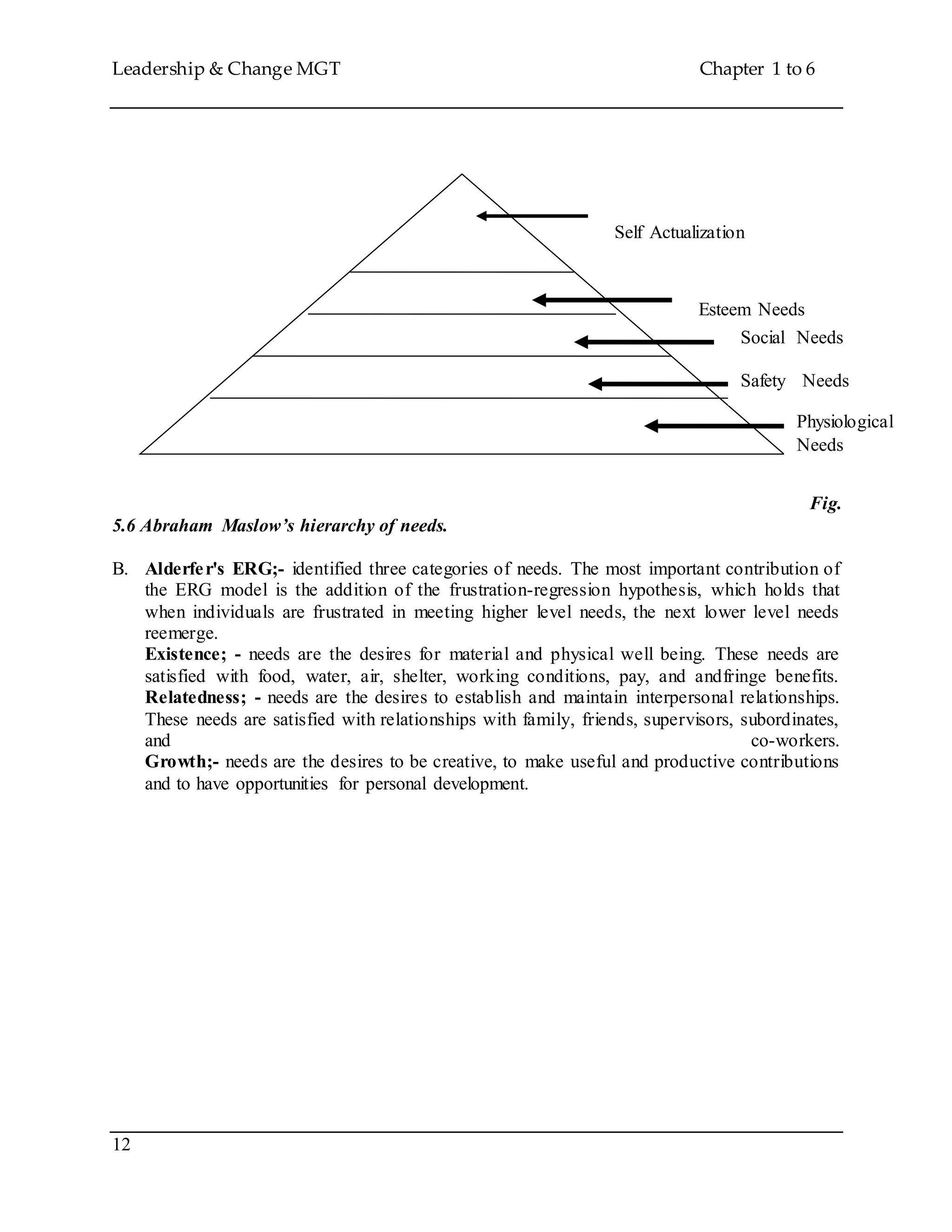
Fig 5.8 Herzberg Theory of Motivation
Leadership & Change MGT Chapter 1 to 6
16
Fig 5.9 Maslow Vs Herzberg motivation theory
The process approach emphasizes how and why people choose certain behaviors in order to
meet their personal goals. Process theories focus on external influences or behaviors that people
choose to meet their needs. External influences are often readily accessible to supervisors.
A. Vroom's Expectancy Model suggests that people choose among alternative behaviors
because they anticipate that particular behaviors will lead to one or more desired outcomes and
that other behaviors will lead to undesirable outcomes.
Expectancy;- is the belief that effort will lead to first-order outcomes, any work-related behavior
that is the direct result of the effort an employee expends on a job.
Equity;-is the perception of fairness involved in rewards given. A fair or equitable situation is
one in which people with similar inputs experience similar outcomes.
Leadership & Change MGT Chapter 1 to 6
17
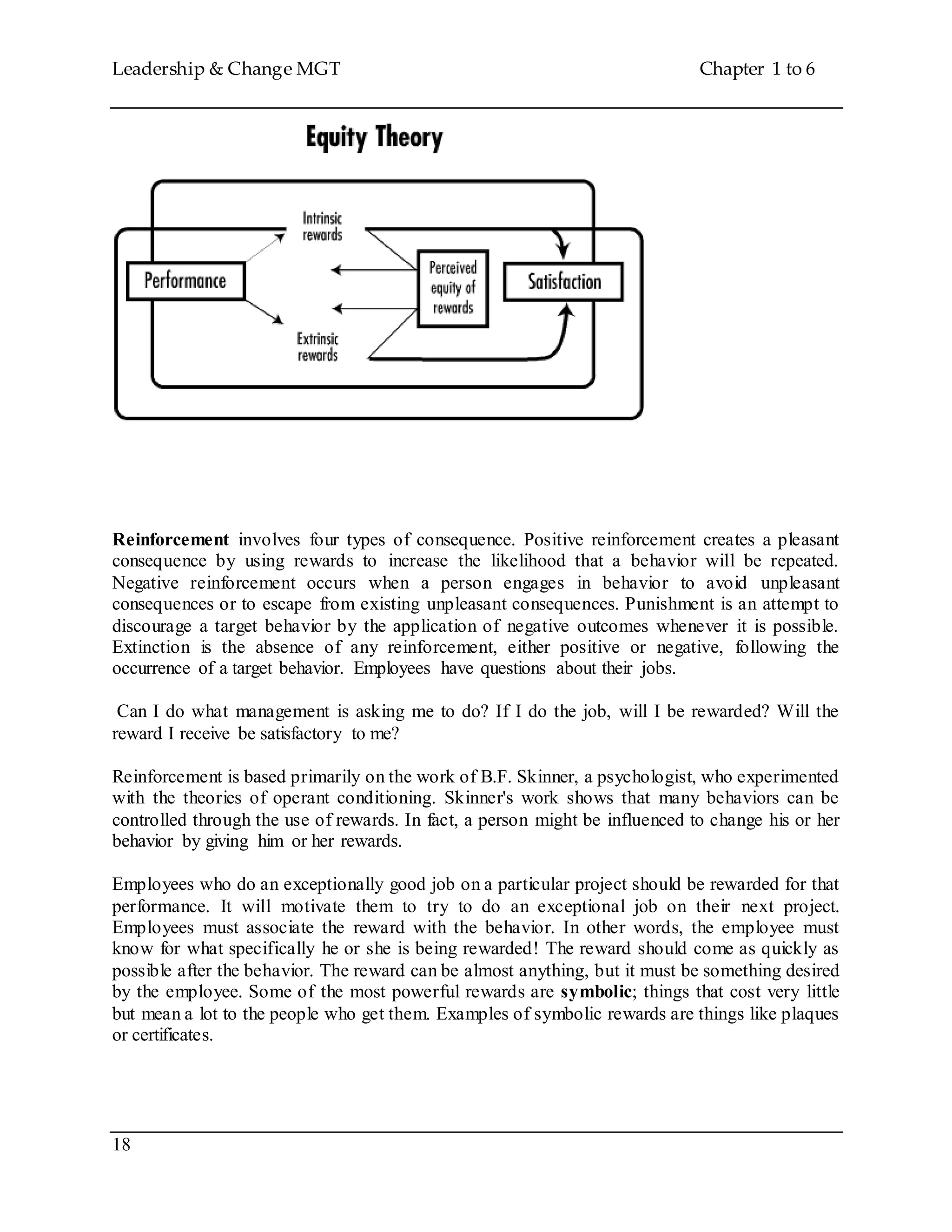
Fig 5.10 Equity Theory
Employees will compare their rewards with the rewards received by others for their efforts. If
employees perceive that an inequity exists, they are likely to withhold some of their
contributions, either consciously or unconsciously, to bring a situation into better balance.
Equity Theory
Condition Person Referent Example
Equity
Outcomes = Outcomes
Inputs Inputs
Worker contr
more inputs b
gets more ou
than refer
Underpaymen
t
Equity
Outcomes < Outcomes
Inputs Inputs
Worker contr
more inputs b
gets the same
as refere
Overpaymen
t
Equity
Outcomes > Outcomes
Inputs Inputs
Worker contr
same inputs
also
gets more ou
than refer
Leadership & Change MGT Chapter 1 to 6
18
Reinforcement involves four types of consequence. Positive reinforcement creates a pleasant
consequence by using rewards to increase the likelihood that a behavior will be repeated.
Negative reinforcement occurs when a person engages in behavior to avoid unpleasant
consequences or to escape from existing unpleasant consequences. Punishment is an attempt to
discourage a target behavior by the application of negative outcomes whenever it is possible.
Extinction is the absence of any reinforcement, either positive or negative, following the
occurrence of a target behavior. Employees have questions about their jobs.
Can I do what management is asking me to do? If I do the job, will I be rewarded? Will the
reward I receive be satisfactory to me?
Reinforcement is based primarily on the work of B.F. Skinner, a psychologist, who experimented
with the theories of operant conditioning. Skinner's work shows that many behaviors can be
controlled through the use of rewards. In fact, a person might be influenced to change his or her
behavior by giving him or her rewards.
Employees who do an exceptionally good job on a particular project should be rewarded for that
performance. It will motivate them to try to do an exceptional job on their next project.
Employees must associate the reward with the behavior. In other words, the employee must
know for what specifically he or she is being rewarded! The reward should come as quickly as
possible after the behavior. The reward can be almost anything, but it must be something desired
by the employee. Some of the most powerful rewards are symbolic; things that cost very little
but mean a lot to the people who get them. Examples of symbolic rewards are things like plaques
or certificates.
Leadership & Change MGT Chapter 1 to 6
19
Assignment
1. Transformational, transactional and servant leaders.
2. Leadership skills and competencies
3. Good Vs. Bad leaders.
Leadership & Change MGT Chapter 1 to 6
20
CHAPTER THREE
OVERVIEW OF CHANGE MANAGEMENT
3.1. Introduction
The only constant in business today is change. Change is something old that is stop and
something new that is started. It is a sequence of activities to make changes based on timing to
create a different state or condition. Change management is defined as the process of achieving
the smooth implementation of change by planning and introducing it systematically, taking into
account the likelihood of it being resisted (Armstrong, 2009). According to Kanter (1992, p.
279): Change involves the crystallization of new possibilities (new policies, new behaviors, new
patterns, new methodologies, new products or new market ideas) based on the re-conceptualized
patterns in the institution. The architecture of change involves the design and construction of
new patterns, or the re-conceptualization of old ones, to make new, and hopefully more
productive actions possible.
Change, it is often said, is the only thing that remains constant in organizations. As A P Sloan
(1967) wrote ‘The circumstances of an ever-changing market and an ever-changing product are
capable of breaking any business organization if that organization is unprepared for change.”
Change cannot just be allowed to happen. It needs to be managed.
Managing change is the instruments (tools) and strategies (directions) used to manage issues and
challenges to ensure success or failure of business. Change management is the mastering or gain
control of changes (Kanter 1983). According to Nickols (2004) the term ‘managing change’ has
two meanings, both ‘the making of changes in a planned and managed or systematic fashion’ and
‘the response to changes over which the organization exercises little or no control’. In this sense,
the need to identify organization-wide change has become one of the most critical and
challenging responsibilities of organizations. Key Terminologies in Managing Change:
 Intervention: Stop something OLD, start something NEW
 Drivers: Internal and external catalyst of change
 Phenomenon: Trend, perspective, future
 Paradigm: Change in thinking & mindset
Leadership & Change MGT Chapter 1 to 6
21
History of managing change shows that management practices and systems have changed over
centuries of understand change intervention
1. Industrial resolution – the old paradigms of think of that led to scientific theory of
management by Federick W. Taylor that believe people are part of the “mechanism” of a factory
operation systems. Eg: manufacturing, reduction – people robotics
2. Classical school – developed in the 18th century by Chester I. Barnard to emphasize
mechanistic structure and division of labour and specialization and bureaucracy system of
operation. Eg: Departments divisions, levels of management, Red Tape within organization
3. Human relations school – developed by Elton Mayo of Hawthorne experiment to emphasis
the importance of informed working group and the theory X and Y types of employees. Eg:
friendship, informal groups, work environment. Eg: Maslow hierarchy, social norms, belonging
needs
4. Japanese management system: emphasize a different paradigm of employment of the theory
Z worker that believes in collective agreement, lifetime employment, seniority based system of
promotion and top level decision making.
3.2.Change Forces
Modern organizations are highly dynamic, versatile and adaptive to the multiplication of change
basically results from stimuli from both outside and inside the organization. Change takes place
in all organizations but at varying rates of speed and degrees of significance. Organizational
change can be done in several ways. Its technology can be changed. It structure, its people and
other elements can be changed.
Why change? According to McMillan (2004, p. 1), ‘too many current approaches to
organizational change are drawn from a world view that is no longer consonant with the early
twenty-first century’. Whilst conventional definitions of organizations and the manner of
managing them suited stable conditions, the same cannot be said for current times. Presently,
most organizations are faced with uncertainties that are synonymous with the modern world
brought about by globalization and modern technology. McMillan (2004) described six factors
that are responsible for the changes occurring in the modern world and organizations, namely:
Leadership & Change MGT Chapter 1 to 6
22
1. New technologies that have transformed communications, electronics, consumer markets
and speeded up industries;
2. Globalization, which has resulted in a world that is evermore connected and
interdependent as information, money and goods move around the planet;
3. Globalization and new technologies, which together have sharpened competition and
precipitated the rise and fall of market leaders;
4. New change processes and practices, which are now happening faster than ever before in
our known history;
5. Speed – an incredible increase in technological speed is matched in business (product life
cycles are measured in months not years) and in people’s lives (most of us feel we are
running as fast as we can merely to stay in place); and
6. Complexity and paradox which are increasing as a result of all these changes and are
making more and more difficult demands on managers used to seeking certainties and
‘either/or’ type solutions in order to bring about the ideals of stability and order.
Today’s organizational domain includes unpredictable and uncontrollable domestic and
international forces. Discussions and writings of merger’s, regulation, privatization, downsizing,
union-management collaboration, high-involvement participation, plant closings, technological
re-engineering, managing culturally diverse workers, and environmental protection fill the
library shelves, boardrooms, and airways. These and many other forces from outside and inside
the organization demand attention.
i. Internal Forces
Internal change forces are pressure that comes from a worker, a group, or a department.
Sometimes the pressure is the cost of production a microchip or car. For example unit cost
increases; therefore pricing the product at a reasonable amount to make a sale is a force that may
signal a need for change. If the product costs too much to produce, it can’t be priced
competitively. Poor worker morale over some inequity in the reward system could be an internal
pressure point that a manager becomes aware of and must address. Although attitudes may be
difficult to observe directly, increased grievance rates, absenteeism, or turnover may suggest
poor of decreasing morale. Identifying internally driven forces for change is sometimes difficult.
Leadership & Change MGT Chapter 1 to 6
23
Is the poor morale caused by the culture, the structure, or the manager, or does the worker bring
this attitude to work? It’s difficult question to answer.
i. External Forces
External (outside-the-organization) forces can signal us that change is needed. Government
regulations could suggest the need to change a firm’s work area layout or recruitment and
selection program. Health care costs, suggest that organizations may need to change their health
care coverage program or the type of fringe benefits provided to employees. Market competitors
and how they reward employees, distribute products, service customers, or form alliances with
foreign partners may signal the need to change.
The wave of cultural diversity is a powerful external force that necessitates change. Integrating
and utilizing the talents of a more diverse work force, and effectively rewarding this culturally
diverse work force will require changes in attitude, interpersonal interaction, and perception.
Changes in manger’s cultural awareness are also needed.
The economic environment also has a key influence on the type and nature of change. Here,
‘economic rationalism’, a regulated market economy, privatization and private sector
competition have a profound influence on change.
According to Harris (1997, p. 42), social factors as well as technological forces also play an
influential role regarding change. The use of computer technology, global communications, out-
sourcing of services and new methods of shopping via cable, satellite and the Internet impact
upon change.
3.3. The Change Process
The change process starts with an awareness of the need for change. An analysis of this situation
and the factors that have created it leads to a diagnosis of their distinctive characteristics and an
indication of the direction in which action needs to be taken. Possible courses of action can then
be identified and evaluated and a choice made of the preferred action.
1. The Planned Approach to Organizational Change (Kurt Lewin’s Model of Change)
The planned approach to organizational change emerged through the work of Kurt Lewin (1951)
relating to group decision-making, implementation and social change. For Lewin, a major
Leadership & Change MGT Chapter 1 to 6
24
concern was the issue of group conduct. He observed that the behavior of individuals differed
from group to group. Thus, in an attempt to understand the uniformity of some groups’ behavior
against others, he was able to argue that people may come to a group with very different reasons,
but if they share a common objective, they are more likely to act together to achieve it.
Assuming that an organization has uncovered a need for change, how does it engage in the
change process? Kurt Lewin argued that successful change in organizations should follow three
steps, which are illustrated in Figure 1: unfreezing the status quo, moving to a new state, and
refreezing the new change to make it permanent.
Figure1: Lewin’s Three-Step Change Model
The value of this model can be seen in the following example, where the management of a large
company decided to reorganize its marketing function in Western Canada. The oil company had
three regional offices in the West, located in Winnipeg, Calgary, and Vancouver. The decision
was made to consolidate the marketing divisions of the three regional offices into a single
regional office to be located in Calgary. The reorganization meant transferring more than 150
employees, eliminating some duplicate managerial positions, and instituting a new hierarchy of
command. As you might guess, such a huge move was difficult to keep secret. The rumours
preceded the announcement by several months. The decision itself was made unilaterally. It
came from the executive offices in Toronto. Those people affected had no say whatsoever in the
choice. For anyone in Vancouver or Winnipeg who might have disliked the decision and its
consequences—the problems involved in transferring to another city, pulling youngsters out of
school, making new friends, having new co-workers, undergoing the reassignment of
responsibilities—the only recourse was to quit. The status quo was about to change. The status
quo can be considered an equilibrium state. To move from this equilibrium—to overcome the
pressures of both individual resistance and group conformity—unfreezing is necessary. Figure 2
shows that unfreezing can occur in one of three ways. The driving forces, which direct
behaviour away from the status quo, can be increased. The restraining forces, which hinder
Leadership & Change MGT Chapter 1 to 6
25
movement from the existing equilibrium, can be decreased. A third alternative is to combine the
first two approaches.
Figure 2: Unfreezing the Status Quo
Kurt Lewin devised a strategy of successful change that requires understanding of individuals
groups based on group dynamics and field theory.
Figure 3: Kurt Lewin Change Strategy (1940)
The oil company’s management expected employee resistance to the consolidation and outlined
its alternatives. Management could use positive incentives to encourage employees to accept the
change. For instance, the company could offer pay increases to those who accept the transfer. It
Leadership & Change MGT Chapter 1 to 6
26
could also offer to pay all moving expenses. Management might offer low-cost mortgage funds
to allow employees to buy new homes in Calgary. Of course, management might also consider
unfreezing acceptance of the status quo by removing restraining forces. Employees could be
counselled individually. Each employee’s concerns and apprehensions could be heard and
specifically clarified. Assuming that most of the fears are unjustified, the counsellor could assure
the employees that there was nothing to fear and then demonstrate, through tangible evidence,
that restraining forces are unwarranted. If resistance is extremely high, management may have to
resort to both reducing resistance and increasing the attractiveness of the alternative so the
unfreezing can succeed. Once the consolidation change has been implemented, if it is to be
successful, the new situation must be refrozen so that it can be sustained over time. Unless this
last step is taken, there is a very high chance that the change will be short-lived and that
employees will try to revert to the previous state of equilibrium. The objective of refreezing,
then, is to stabilize the new situation by balancing the driving and restraining forces. How could
the oil company’s management refreeze its consolidation change? It could systematically replace
temporary forces with permanent ones. For instance, management might impose a new bonus
system tied to the specific changes desired. The formal rules and regulations governing
behaviour of those affected by the change could also be revised to reinforce the new situation.
Over time, of course, the work group’s own norms will evolve to sustain the new equilibrium.
But until that point is reached, management will have to rely on more formal mechanisms. The
Working With Others Exercise on page 360 gives you the opportunity to identify driving and
restraining forces for another company experiencing problems with change and to make some
recommendations for change. A key feature of Lewin’s three-step model is its conception of
change as an episodic activity, with a beginning, a middle, and an end. However, the structure of
today’s workplaces requires change to take place as an ongoing, if not chaotic, process. Certainly
the adjustment that companies have made to the realities of e-commerce indicates a more chaotic
change, rather than a controlled and planned change.
To elaborate, in the unfreezing step, employees break away from the way things have been done.
In organizations, for effective change to occur, employees must embrace new work practices
with a sense of urgency. In order to achieve this, employees are encouraged or are forced to
distance themselves from comfort zones that they were accustomed to so that they acclimatize to
new work practices, even if there is uncertainty regarding their future. Similarly, Harper (2001,
Leadership & Change MGT Chapter 1 to 6
27
p. 10) argued that organizations that are implementing change management should encourage
employees to abide by a plan that allows for the ‘sloughing of yesterday’ because ‘it will force
thinking and action … make available men and money for new things … create a willingness to
act’.
In step two (initiating the change), employees engage in activities that identify and implement
new ways of doing things or engage in new activities in order to bring about change. In this
respect, Harper (2001) proposed that for effective change to take place, management must ensure
that all relevant stakeholders are given the opportunity to be engaged in decision making and
problem solving in a collaborative manner. Whilst the latter was predominantly the role of
management, the current thinking is that employees who become involved are most likely to
accept change and become committed to making change a success. A better understanding of the
needs and benefits of change may result in little or no resistance on the part of change recipients.
In the third and final step (refreezing), the emphasis is on the reinforcing of new processes and
tasks in the organization by the employer. For this step to be successful, employees must be
acknowledged, as reward is an important consideration. Reward is crucial for behavior
modification. Employees should receive appropriate recognition for changes in behavior if they
embrace or accept the change. In this instance, reward serves to recognize that the new behavior
is valued and prevents previous behavior from reoccurring (Harper 2001).
According to Branch (2002, p. 4), Lewin’s model of organizational change can be accomplished
in three ways:
 Changing the individuals who work in the organization (their skills, values, attitudes, and
eventually behavior) – with an eye to instrumental organizational change;
 Changing various organizational structures and systems – reward systems, reporting
relationships, work designs; or
 Directly changing the organizational climate or interpersonal style – how often people are
with each other, how conflict is managed, how decisions are made.
2. The emergentapproach to organisationalchange Kotter ’ s
modelof change
The emergent model of change was the response to criticisms leveled against the planned model
of change. This approach has been given a number of different labels, such as continuous
Leadership & Change MGT Chapter 1 to 6
28
improvement or organizational learning (Burnes 1996). The model views ‘change as driven from
the bottom up rather than from the top down, and stresses that change is an open-ended and
continuous process of adaptation to changing conditions and circumstances. The approach
suggests change to be so rapid that it is impossible for senior change initiators to effectively
identify, plan and implement the necessary organizational changes. The emergent approach
promotes ‘extensive and in-depth understanding of strategy, structure, systems, people, style and
culture, and how these can function either as sources of inertia that can block change, or
alternatively, as levers to encourage an effective change process.
John Kotter, professor of leadership at Harvard Business School, built on Lewin’s three step
model to create a more detailed approach for implementing change. Kotter began by listing
common failures that occur when managers try to initiate change. These include the inability to
create a sense of urgency about the need for change; failure to create a coalition for managing the
change process; the absence of a vision for change and to effectively communicate that vision;
not removing obstacles that could impede the achievement of the vision; failure to provide short-
term and achievable goals; the tendency to declare victory too soon; and not anchoring the
changes in the organization’s culture. Kotter then established eight sequential steps to overcome
these problems. These steps are listed in the Table 2. Notice how Kotter list in Table 2 builds on
Lewin’s model. Kotter’s first four steps essentially represent the “unfreezing” stage. Steps 5
through 7 represent “moving.” The final step works on “refreezing.” Kotter’s contribution lies in
providing managers and change agents with a more detailed guide for implementing change
successfully.
Table 1: Kotter’s Eight-Step Plan for Implementing Change
1. Establish a sense of urgency by creating a compelling reason for why change is needed.
2. Form a coalition with enough power to lead the change.
3. Create a new vision to direct the change and strategies for achieving the vision.
4. Communicate the vision throughout the organization.
5. Empower others to act on the vision by removing barriers to change and encouraging risk-
taking and creative problem solving.
Leadership & Change MGT Chapter 1 to 6
29
6. Plan for, create, and reward short-term “wins” that move the organization toward the new
vision.
7. Consolidate improvements, reassess changes, and make necessary adjustments in the new
programs.
8. Reinforce the changes by demonstrating the relationship between new behaviours and
organizational success.
Figure 4: Modified Kotter’s for Implementing Change
Furthermore, Kotter claimed that most major change efforts consist of a variety of small and
medium-sized change projects. He also maintained that the emergent approach is a result of the
assumption that ‘change is a continuous, open minded and unpredictable process of aligning and
realigning an organization to its changing environment’. As a result of this, the emergent
approach to change has become very popular among organizations in the contemporary world
because it recognizes the fact that organizations must adapt their internal practices and behaviors
to meet changing external conditions (Burnes 2001).
However, Kotter’s model is not devoid of criticism, and the Eight-Step Change Model has many
disadvantages as well as benefits. It has the advantage of being a step-by-step model, which is
easy to implement. However, for the model to be successfully implemented, all of the eight
stages must be worked through in order, and to completion. Skipping even a single step or
getting too far ahead without a solid base almost always creates problems. Failing to reinforce
earlier stages results in the sense of urgency dissipating, or the guiding coalition breaking up.
Leadership & Change MGT Chapter 1 to 6
30
Without the follow-through which takes place in the final step, the organization may never get to
the finish line and make changes stick (Rose 2002).
Key Roles in the Change Process
During this stage of planning, it is useful to distinguish the different roles associated with the
change process. These roles must remain distinctive in order to implement planned change
effectively. However, within different settings or systems, a judicial educator may play more
than one role. The various roles that individuals can play, as described by Conner (1990), are:
 Change Sponsor: Individual or group who legitimizes the change.
 Change Advocate: Individual or group who wants to achieve a change but does not
possess legitimization power.
 Change Agent: Individual or group who is responsible for implementing the change.
 Change Target: Individual or group who must actually change.
One of the most critical tasks for the educator in implementing change is to harness the support
of an effective change sponsor. The sponsor is in a position to legitimize the change.
Sponsorship is critical to implementing the desired change. Directly or indirectly, pain can
motivate the sponsor to foster the planned change. Within the state judicial system, this sponsor
may be the chief justice, the head of the education committee, or the state court administrator.
Conner (1990) argues that weak sponsors should be educated or replaced, even by someone at a
lower level in the organization, or, he emphasizes, failure will be inevitable. Educators and
managers are often in the position of change advocates, who perceive the need for change and
desire and advocate the change, but who do not have the necessary organizational power to
implement the change. Alternatively, these individuals may function as the change agent, with
the responsibility (but again, not the power) to implement change. And, of course, in an
organizational change effort, educators and managers may be part of the group affected by the
change, or the change target. It is useful to consider each of these roles in planning strategies not
only for implementation, but for gathering support for the change effort.
2.4. RESISTANCE TO CHANGE
One of the most well-documented findings from studies of individual and organizational
behaviour is that organizations and their members resist change. In a sense, this is positive. It
Leadership & Change MGT Chapter 1 to 6
31
provides a degree of stability and predictability to behaviour. If there were no resistance,
organizational behavior would take on characteristics of chaotic randomness. Resistance to
change can also be a source of functional conflict. For example, resistance to a reorganization
plan or a change in a product line can stimulate a healthy debate over the merits of the idea and
result in a better decision. However, there is a definite downside to resistance to change: It
hinders adaptation and progress. Resistance to change does not necessarily surface in standard
ways. Resistance can be overt, implicit, immediate, or deferred. It is easiest for management to
deal with resistance when it is overt and immediate. For instance, a change is proposed, and
employees respond immediately by voicing complaints, engaging in work slowdowns,
threatening to go on strike, or the like. The greater challenge is managing resistance that is
implicit or deferred. Implicit resistance efforts are more subtle—loss of loyalty to the
organization, loss of motivation to work, increased errors or mistakes, increased absenteeism due
to “sickness”—and hence more difficult to recognize. Similarly, deferred actions cloud the link
between the source of resistance and the reaction to it. A change may produce what appears to be
only a minimal reaction at the time it is initiated, but then resistance surfaces weeks, months, or
even years later. Or a single change that in and of itself might have little impact becomes the
straw that breaks the camel’s back. Reactions to change can build up and then explode in some
response that seems totally out of proportion to the change action it follows. The resistance, of
course, has merely been deferred and stockpiled. What surfaces is a response to the accumulation
of previous changes. Let’s look at the sources of resistance.
Armstrong (2009) identified the main reasons for resisting charge are as follows:
 The shock of the new – people are suspicious of anything that they perceive will upset
their established routines, methods of working or conditions of employment. They do not
want to lose the security of what is familiar to them. They may not believe statements by
management that the change is for their benefit as well as that of the organization;
sometimes with good reason. They may feel that management has ulterior motives and
sometimes, the louder the protestations of management, the less they will be believed.
 Economic fears – loss of money, threats to job security
 Inconvenience – the change will make life more difficult.
 Uncertainty – change can be worrying because of uncertainty about its likely impact.
Leadership & Change MGT Chapter 1 to 6
32
 Symbolic fears – a small change that may affect some treasured symbol, such as a
separate office or a reserved parking space, may symbolize big ones, especially when
employees are uncertain about how extensive the programme of change will be.
 Threat to interpersonal relationships – anything that disrupts the customary social
relationships and standards of the group will be resisted.
 Threat to status or skill – the change is perceived as reducing the status of individuals or
as de-skilling them.
 Competence fears – concern about the ability to cope with new demands or to acquire
new skills.
For analytical purposes, we have categorized them as individual and organizational sources. In
the real world, the sources often overlap.
IndividualResistance
Individual sources of resistance to change reside in basic human characteristics such as
perceptions, personalities, and needs.
• Habit. To cope with life’s complexities, we rely on habits or programmed responses. But
when confronted with change, this tendency to respond in our accustomed ways becomes
a source of resistance.
• Security. People with a high need for security are likely to resist change because it
threatens their feelings of safety.
• Economic factors. Changes in job tasks or established work routines can arouse
economic fears if people are concerned that they will not be able to perform the new tasks
or routines to their previous standards, especially when pay is closely tied to productivity.
• Fear of the unknown. Change substitutes ambiguity and uncertainty for the known. This
is also referred to as the “status quo bias,” in which individuals assume that their current
state is better than whatever the changed state might be.
• Selective information processing. Individuals are guilty of selectively processing
information in order to keep their perceptions intact. They hear what they want to hear,
and they ignore information that challenges the world they have created.
Leadership & Change MGT Chapter 1 to 6
33
• Cynicism. In addition to simple resistance to change, employees often feel cynical about
the change process, particularly if they have been through several rounds of change, and
nothing appears (to them) to have changed. Three researchers from Ohio State University
identified sources of cynicism in the change process of a large unionized manufacturing
plant. The major elements contributing to the cynicism were as follows:
o Feeling uninformed about what was happening
o Lack of communication and respect from one’s manager
o Lack of communication and respect from one’s union representative
o Lack of opportunity for meaningful participation in decision making
The researchers also found that employees with negative personalities were more likely to be
cynical about change. While organizations might not be able to change an individual’s
personality, they certainly have the ability to provide greater communication and respect, as well
as opportunities to take part in decision making. The researchers found that cynicism about
change led to such outcomes as lower commitment, less satisfaction, and reduced motivation to
work hard. Figure 3 illustrates why some employees, may have reason to feel cynical about
organizational change.
Figure 4: Individual Cynical Feeling
OrganizationalResistance
Organizations, by their very nature, are conservative. They actively resist change. You do not
have to look far to see evidence of this phenomenon. Government agencies want to continue
Leadership & Change MGT Chapter 1 to 6
34
doing what they have been doing for years, whether the need for their service changes or remains
the same. Organized religions are deeply entrenched in their history. Attempts to change church
doctrine require great persistence and patience. Educational institutions, which exist to open
minds and challenge established ways of thinking, are themselves extremely resistant to change.
Most school systems are using essentially the same teaching technologies today that they were
50 years ago. Similarly, most business firms appear highly resistant to change. Half of the 309
human resource executives of Canadian firms who took part in a 1998 survey rated their
companies’ ability to manage change as “fair.” One-third of them said that their ability to
manage change was their weakest skill, and only 25 percent of the companies made a strong
effort to train leaders in the change process. When organizations refuse to change with the times,
they can fail, as was the case with Eaton’s, which never really adjusted to the arrival of Wal-
Mart.
Six major sources of organizational resistance to change have been identified:
• Structural inertia. Organizations have built-in mechanisms—such as their selection
processes and formal regulations—to produce stability. When an organization is
confronted with change, this structural inertia acts as a counterbalance to sustain stability.
• Limited focus of change. Organizations are made up of a number of interdependent
subsystems. One cannot be changed without affecting the others. So limited changes in
subsystems tend to be nullified by the larger system.
• Group inertia. Even if individuals want to change their behaviour, group norms may act
as a constraint.
• Threat to expertise. Changes in organizational patterns may threaten the expertise of
specialized groups.
• Threat to established power relationships. Any redistribution of decision-making
authority can threaten long-established power relationships within the organization.
• Threat to established resource allocations. Groups in the organization that control
sizable resources often see change as a threat. They tend to be content with the way
things are.
OvercomingResistance to Change
Leadership & Change MGT Chapter 1 to 6
35
Michael Adams, president of Environics Research Group in Toronto, has noted that Canadians
have become more resistant to change in recent years. Between 1983 and the mid-1990s,
Canadians reported that they “felt confident in their ability to cope with change.” This trend has
reversed in recent years. Half of Canadians aged 15 to 33 now “feel left behind and
overwhelmed by the pace of life and the prevalence of technology.” Those who feel left behind
tend to be those who are not college- or university-educated, highly skilled, or adaptive. It
probably cannot be emphasized enough that in order to break down resistance to change, it is
essential to communicate a sense of urgency in the need for change. Doing so provides a
framework for people to understand why the change is occurring.
Also, it is important to communicate and celebrate early successes to keep the momentum going,
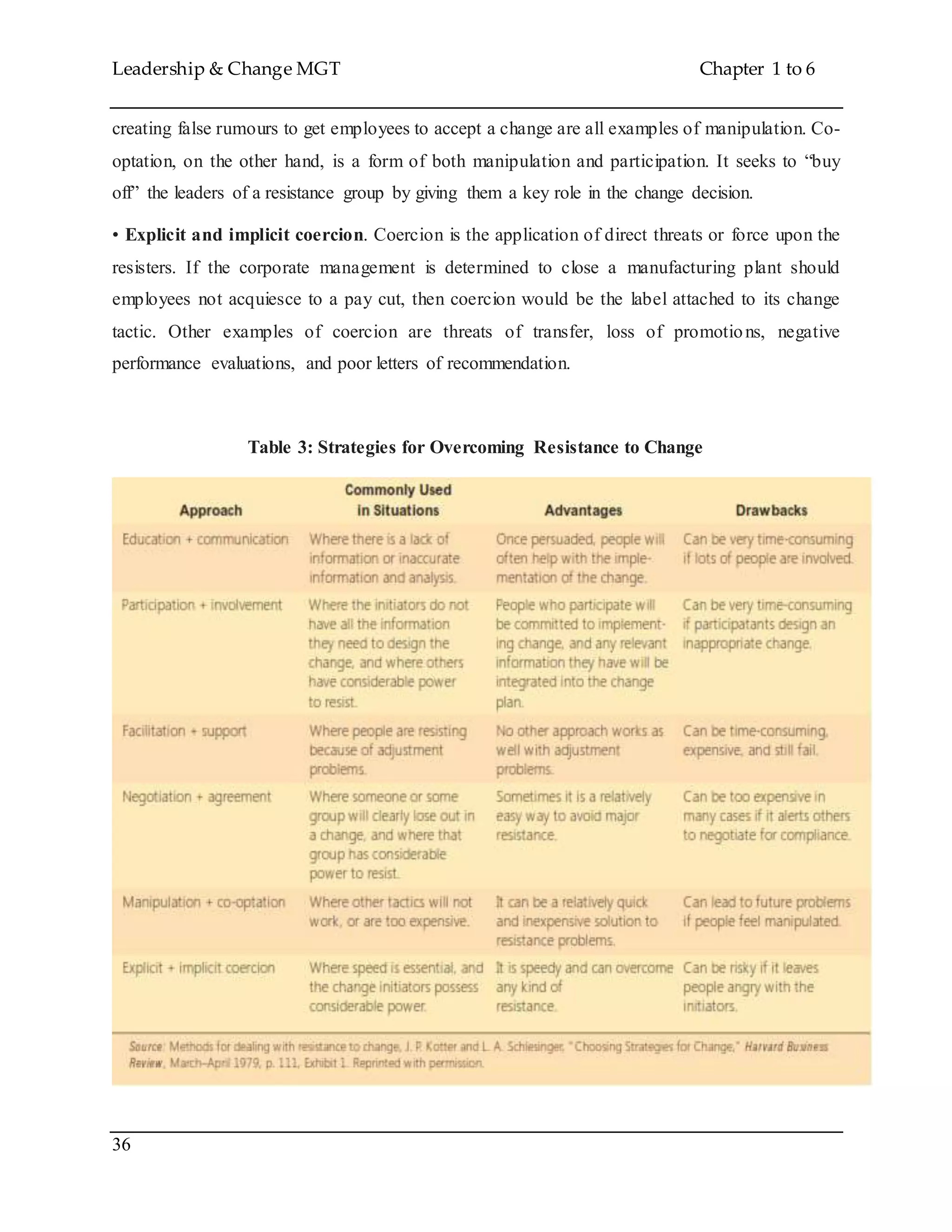
as change is a lengthy process. Kotter and Schlesinger have identified six tactics organizations
use to deal with resistance to change:
• Education and communication. Resistance can be reduced through communicating with
employees to help them see the logic of a change. Communication can be achieved through one-
on-one discussions, memos, group presentations, or reports.
• Participation and involvement. It is difficult for individuals to resist a change decision in
which they have participated. Before making a change, those opposed can be brought into the
decision process. Assuming that the participants have the expertise to make a meaningful
contribution, their involvement can reduce resistance, obtain commitment, and increase the
quality of the change decision.
• Facilitation and support. Organizations undergoing change can offer a range of supportive
efforts to reduce resistance such as employee counseling and therapy, new-skills training, or a
short paid leave of absence.
• Negotiation and agreement. Another way for organizations to deal with potential resistance to
change is to exchange something of value for less resistance. For instance, if the resistance is
centred in a few powerful individuals, a specific reward package can be negotiated that will meet
their individual needs.
• Manipulation and co-optation. Manipulation refers to covert influence attempts. Twisting and
distorting facts to make them appear more attractive, withholding undesirable information, and
Leadership & Change MGT Chapter 1 to 6
36
creating false rumours to get employees to accept a change are all examples of manipulation. Co-
optation, on the other hand, is a form of both manipulation and participation. It seeks to “buy
off” the leaders of a resistance group by giving them a key role in the change decision.
• Explicit and implicit coercion. Coercion is the application of direct threats or force upon the
resisters. If the corporate management is determined to close a manufacturing plant should
employees not acquiesce to a pay cut, then coercion would be the label attached to its change
tactic. Other examples of coercion are threats of transfer, loss of promotions, negative
performance evaluations, and poor letters of recommendation.
Table 3: Strategies for Overcoming Resistance to Change
Leadership & Change MGT Chapter 1 to 6
37
To substantiate, Kotter (1996, p. 16) elaborates eight errors that have significantly contributed to
the downside of change management, namely:
 Allowing too much complacency in the organization;
 Failure to create clear and powerful guidelines;
 Restricted vision in terms of future planning;
 Lack of communication in the organization;
 Failure to deal with problems immediately as and when they arise; concentration on long
term gains at the expense of short term benefits;
 Acknowledging change victory sooner than it is achieved; and
 A failure to firmly anchor changes in the corporate culture of the organization.
Leadership & Change MGT Chapter 1 to 6
38
CHAPTER 4
TYPES OF CHANGE
According to Armstrong (2009) there are three types of change: strategic, operational and
transformational.
1. Strategic change
Strategic change is concerned with broad, long-term and organization-wide issues involving
change. It is about moving to a future state that has been defined generally in terms of strategic
vision and scope. It will cover the purpose and mission of the organization, its corporate
philosophy on such matters as growth, quality, innovation and values concerning employees and
customers, competitive positioning and strategic goals for achieving and maintaining competitive
advantage and for product-market development. These goals are supported by policies
concerning marketing, sales, manufacturing, product and process development, finance and
human resource management.
Strategic change takes place within the context of the external competitive, economic and social
environment, and the organization’s internal resources, capabilities, culture, structure and
systems. Its successful implementation requires thorough analysis and understanding of these
factors in the formulation and planning stages. The ultimate achievement of sustainable
competitive advantage relies on the qualities defined by Pettigrew and Whipp (1991), namely
‘The capacity of the firm to identify and understand the competitive forces in play and how they
change over time, linked to the competence of a business to mobilize and manage the resources
necessary for the chosen competitive response through time.’ Strategic change, however, should
not be treated simplistically as a linear process of getting from A to B that can be planned and
executed as a logical sequence of events
2. Operational change
Leadership & Change MGT Chapter 1 to 6
39
Operational change relates to new systems, procedures, structures or technology that will have an
immediate effect on working arrangements within a part of the organization. But its impact on
people can be more signifi cant than broader strategic change and it has to be handled just as
carefully.
3. Transformational change
Transformational change takes place when there are fundamental and comprehensive changes in
structures, processes and behaviours that have a dramatic effect on the ways in which the
organization functions.
1. The contingency model of change -Dunphy and Stace’ s model of change
Dunphy and Stace (1988, 1992, 1993) investigated change from an organizational transformation
perspective. Within this perspective, Dunphy and Stace (1993) maintained that organizations
needed a model of change that was essentially a ‘situational’ or ‘contingency model’. This model
should be one that indicated how to vary change strategies to achieve ‘optimum fit’ with the
changing environment. Furthermore, these writers state that the contingency model to change is
based on the theory that situational variables determine the structure and performance of
organizations and because no two organizations are alike, they will not face the same situational
variables.The model developed by Dunphy and Stace includes both the formulation and
implementation requirements of various types of change and leadership styles. Their typology
of change and conditions for use is shown in Figure 5.
Figure 5: Dunphy and Stace’s Typology of Change (1992)
Leadership & Change MGT Chapter 1 to 6
40
Dunphy and Stace’s (1992) model of change is more situational in design and supportive of the
view that ‘that the selection of appropriate types of change depends entirely on a strategic
analysis of the situation’. These authors also maintained that change does not always occur on
an incremental basis, but can also occur on a discontinuous basis. They also suggested that
transformational change is not only consultative but is also coercive in nature.
A major criticism of this model, in this researcher’s view, is its dependency on the interpretation
of the model by change initiators and implementation, in that change may be influenced more by
the style of the ‘change driver’ than by an effective organizational change analysis. If the
‘change driver’ has a collaborative leadership style, then employees would be allowed power,
either through formal or informal process, significant enough to influence both the goals and
means of change. If the ‘change driver’ is characterized by a consultative style of leadership,
power would be placed more firmly in the hands of managers and would involve managers
consulting widely among employees and being open to influence from employees about how
change is affected. If the ‘change driver’ is characterized by a directive style of leadership, this
would involve the use of legitimate authority to bring about organizational change, being most
effective when subordinates respect this authority.. If the ‘change driver’ adopts a coercive style
of leadership, this would involve using explicit or implicit force by managers on employees, and
an autocratic mode of decision-making.
Leadership & Change MGT Chapter 1 to 6
41
Business Process Reengineering
Business process reengineering (also known as business process redesign, business
transformation, or business process change management) is originally pioneered in the early
1990s, focusing on the analysis and design of workflows and business processes within an
organization. BPR involves discovering how business processes currently operate, how to
redesign these processes to eliminate the wasted or redundant effort and improve efficiency, and
how to implement the process changes to gain competitiveness.
Reengineering is the fundamental rethinking and radical redesign of business processes to
achieve dramatic improvements in critical, contemporary measures of performance, such as cost,
quality, service and speed. (p. 32)
Another BPR father, Davenport (1993), describes ‘business process redesign’ as: ... the analysis
and design of workflows and processes within and between organizations. Business activities
should be viewed as more than a collection of individual or even functional tasks; they should be
broken down into processes that can be designed for maximum effectiveness, in both
manufacturing and service environment.
Problems Facing BPR
In 1996 Davenport published an article entitled Why Re-engineering Failed: The Fad that Forgot
People in which he reports:
To most business people in the United States, re-engineering has become a word
that stands for restructuring, lay-offs, and too often, failed change programs ...
companies that embraced [re-engineering] as the silver bullet are now looking for
ways to re-build the organization’s torn fabric. (Davenport, 1996)
Also in 1998 it was reported that only around 30% of BPR projects were regarded as a success
(Galliers, 1998). The earlier promise of BPR had not been fulfilled. There are many reasons for
the limited success of BPR. Some explanation of such high rates of failure for BPR projects have
been discussed in BPR literature. For example, employees’ resistance of change as they consider
BPR as threats to their jobs (i.e. the increase in short-term contracts and lack of promotion);
Galliers (1998) and Gerrits (1994) point out that currently BPR approaches lack detailed
guidance and support for the actual implementation of reengineering: many publications describe
Leadership & Change MGT Chapter 1 to 6
42
the situation before and after BPR but do not discuss the path to reach the final situation; Chen et
al. (2000a) explain that one reaction to this failure was to retain faith in IT as a dominant support
and just admit that since it could not adapt – or at least not at acceptable levels of cost – then
business activities must adapt to IT. For example:
The pendulum has swung from ‘continuous reengineering and re-inventing’ to
‘pick an application package and force our business processes to comply with the
package’. (Riemer, 1998)
Reading Assignment
 BPR process
 BPR techniques and tools
 Implementation of BPR
CHAPTER 5
CONFLICTS AND CONFLICT MANAGEMENT
5.1. Conflict Defined
Several common themes underlie most definitions of conflict. Conflict must be perceived by the
parties to it; if no one is aware of a conflict, it is generally agreed that no conflict exists. Conflict
also involves opposition or incompatibility, and some form of interaction between the parties.
These factors set the conditions that determine the beginning point of the conflict process. We
can define conflict, then, as a process that begins when one party perceives that another party has
negatively affected, or is about to negatively affect, something that the first party cares about.
This definition is deliberately broad. It describes that point in any ongoing activity when an
interaction “crosses over” to become conflict. It includes the wide range of conflicts that people
experience in groups and organizations—incompatibility of goals, differences over
interpretations of facts, disagreements based on behavioural expectations, and the like. Finally,
our definition is flexible enough to cover the full range of conflict levels—from subtle forms of
Leadership & Change MGT Chapter 1 to 6
43
disagreement to overt and violent acts. Conflict has positive sides and negative sides, which we
will discuss further when we cover functional and dysfunctional conflict. For more on this debate,
refer to the
5.2. Functional vs. Dysfunctional Conflict
Not all conflict is bad. Some conflicts support the goals of the group and improve its
performance; these are functional, or constructive, forms of conflict. But there are conflicts that
hinder group performance; these are dysfunctional, or destructive, forms of conflict. The
criterion that differentiates functional from dysfunctional conflict is group performance. If a
group is unable to achieve its goals because of conflict, then the conflict is dysfunctional.
Figure 5.1., provides a way of visualizing conflict behavior. All conflicts exist somewhere along
this continuum. At the lower part of the continuum, we have conflicts characterized by subtle,
indirect, and highly controlled forms of tension. An illustration might be a student politely
objecting to a point the instructor has just made in class. Conflict intensities escalate as they
move upward along the continuum, until they become highly destructive. Strikes and lockouts,
riots, and wars clearly fall into this upper range. For the most part, you should assume that
conflicts that reach the upper ranges of the continuum are almost always dysfunctional.
Functional conflicts are typically confined to the lower range of the continuum.
Figure 5.1. Conflict Intensity Continuum
Leadership & Change MGT Chapter 1 to 6
44
5.3. CONFLICT RESOLUTION
Conflict in the workplace can affect the effectiveness of individuals, teams, and the entire
organization. One study found 20 percent of managers’ time is spent managing conflict. Once
conflict arises, what can be done to resolve it? The way a conflict is defined goes a long way
toward establishing the sort of outcomes that might settle it. For instance, if I define our salary
disagreement as a zero-sum or win-lose situation - that is, if you get the increase in pay you want,
there will be just that amount less for me - I am going to be far less willing to look for mutual
solutions than if I frame the conflict as a potential win-win situation. So, individual attitudes
toward a conflict are important, because attitudes typically define the set of possible settlements.
5.4. Conflict Management Strategies
Conflict researchers often use dual concern theory to describe people’s conflict management
strategies. Dual concern theory considers how one’s degree of cooperativeness (the degree to
which one tries to satisfy the other person’s concerns) and assertiveness (the degree to which one
tries to satisfy one’s own concerns) determine how a conflict is handled.
The five conflict-handling strategies identified by the theory are as follows:
• Forcing. Imposing one’s will on the other party.
Leadership & Change MGT Chapter 1 to 6
45
• Problem solving. Trying to reach an agreement that satisfies both one’s own and the other
party’s aspirations as much as possible.
• Avoiding. Ignoring or minimizing the importance of the issues creating the conflict.
• Yielding. Accepting and incorporating the will of the other party.
• Compromising. Balancing concern for oneself with concern for the other party in order to reach
a solution.
Forcing is a win-lose solution, as is yielding, while problem solving seeks a win-win solution.
Avoiding conflict and pretending it does not exist, and compromising, so that neither person gets
what they want, can yield lose-lose solutions. Exhibit 6-6 illustrates these five strategies, along
with specific actions that one might take when using them. Choosing a particular strategy for
resolving conflict depends on a variety of factors. Research shows that while people may choose
among the strategies, they have an underlying disposition to handle conflicts in certain ways. In
addition, some situations call for particular strategies. For instance, when a small child insists on
trying to run into the street, a parent may need a forcing strategy to restrain the child. Co-workers
who are having a conflict over setting deadlines to complete a project on time may decide that
problem solving is the best strategy to use.
5.5. What Can Individuals Do to Manage Conflict?
There are a number of conflict resolution techniques that individuals can use to try to defuse
conflict inside and outside the workplace. These include the following:
• Problem solving. Requesting a face-to-face meeting to identify the problem and resolve it
through open discussion.
• Developing superordinate goals. Creating a shared goal that requires both parties to work
together, and motivates them to do so.
• Smoothing. Playing down differences while emphasizing common interests with the other party.
• Compromising. Agreeing with the other party that each
will give up something of value to reach an accord.
Leadership & Change MGT Chapter 1 to 6
46
• Avoidance. Withdrawing from, or suppressing, the conflict. The choice of technique may
depend on how serious the issue is to you, whether you take a win-win or a win-lose approach,
and your preferred conflict management style When the conflict is specifically work-related,
there are additional techniques that might be used:
• Expansion of resources. The scarcity of a resource—say, money, promotion opportunities,
office space—can create conflict. Expansion of the resource can create a win win solution.
• Authoritative command. Management can use its formal authority to resolve the conflict and
then communicate its desires to the parties involved.
• Altering the human variable. Behavioral change techniques such as human relations training
can alter attitudes and behaviors that cause conflict.
• Altering the structural variables. The formal organization structure and the interaction patterns
of conflicting parties can be changed through job redesign, transfers, creation of coordinating
positions, and the like.
5.6. Resolving Personality Conflicts
Personality conflicts are an everyday occurrence in the workplace. While there is no available
data for Canada, supervisors in the United States spend about 18 percent of their time handling
personality conflicts among employees.
A variety of factors leads to personality conflicts, including the following:
• Misunderstandings based on age, race, or cultural differences
• Intolerance, prejudice, discrimination, or bigotry
• Perceived inequities
• Misunderstandings, rumours, or falsehoods about an individual or group
• Blaming for mistakes or mishaps (finger-pointing)
Personality conflicts can result in lowered productivity when people find it difficult to work
together. The individuals experiencing the conflict may seek sympathy from other members of
the work group, causing co-workers to take sides. The ideal solution would be for the two people
in conflict to work it out between themselves, without involving others, but this does not always
Leadership & Change MGT Chapter 1 to 6
47
happen. However, it is not always possible for people to talk things out, and it may be a Western
cultural bias to expect that individuals should generally be able to do so.
5.7. Negotiation
When parties are potentially in conflict, they may choose to negotiate a resolution. Negotiation
occurs in the interactions of almost everyone in groups and organizations: Labour bargains with
management; managers negotiate with employees, peers, and senior management; salespeople
negotiate with customers; purchasing agents negotiate with suppliers; employees agree to answer
a colleague’s phone for a few minutes in exchange for some past or future benefit. In today’s
team-based organizations, negotiation skills become critical so that teams can work together
effectively.
We define negotiation as a process in which two or more parties try to agree on the exchange
rate for goods or services they are trading
Bargaining Strategies
There are two general approaches to negotiation—distributive bargaining and integrative
bargaining.
Distributive bargaining
It is a negotiating strategy that operates under zero-sum (win-lose) conditions. That is, any gain I
make is at your expense, and vice versa. Probably the most widely cited example of distributive
bargaining is in labor management negotiations over wages. Typically, management comes to
the bargaining table determined to keep its labor costs as low as possible. Since every cent more
that labor negotiates increases management’s costs, each party bargains aggressively and treats
the other as an opponent who must be defeated. When engaged in distributive bargaining, a party
focuses on trying to get the opponent to agree to a specific target point, or to get as close to it as
possible. Examples of such tactics are persuading your opponent of the impossibility of reaching
his or her target point and the advisability of accepting a settlement near yours; arguing that your
target is fair, while your opponent’s is not; and trying to get your opponent to feel emotionally
generous toward you and thus accept an outcome close to your target point.
Integrative Bargaining
Leadership & Change MGT Chapter 1 to 6
48
In contrast to distributive bargaining, integrative bargaining operates under the assumption that
there exists one or more settlements that can create a win-win solution. In terms of intra-
organizational behavior, all things being equal, integrative bargaining is preferable to distributive
bargaining. Why? Because the former builds long-term relationships and makes working
together in the future easier. It bonds negotiators and allows both sides to leave the bargaining
table feeling that they have achieved a victory. For instance, in union-management negotiations,
both sides might sit down to figure out other ways to reduce costs within an organization, so that
it is possible to have greater wage increases. Distributive bargaining, on the other hand, leaves
one party a loser. It tends to build animosities and deepen divisions when people must work
together on an ongoing basis.
Figure 2: Conflict Handling Strategies and Accompanying Behaviors
How to Negotiate
Leadership & Change MGT Chapter 1 to 6
49
Figure 3 provides a simplified model of the negotiation process. It views negotiation as made up
of five steps: (1) developing a strategy; (2) defining ground rules; (3) clarification and
justification; (4) bargaining and problem solving; and (5) closure and implementation.
Figure 3: The Negotiation Process
Leadership & Change MGT Chapter 1 to 6
50
CHAPTER 6
LONG- TERM FINANCING
6.1. Long Term Finance
Long-term finance can be defined as any financial instrument with maturity exceeding one year
(such as bank loans, bonds, leasing and other forms of debt finance), and public and private
equity instruments. Maturity refers to the length of time between origination of a financial claim
(loan, bond, or other financial instrument) and the final payment date, at which point the
remaining principal and interest are due to be paid. Equity, which has no final repayment date of
a principal, can be seen as an instrument with nonfinite maturity. The one year cut-off maturity
corresponds to the definition of fixed investment in national accounts.
6.1.1. Importance of long-term finance
Extending the maturity structure of finance is often considered to be at the core of sustainable
financial development. Long-term finance contributes to faster growth, greater welfare, shared
prosperity, and enduring stability in two important ways: by reducing rollover risks for
borrowers, thereby lengthening the horizon of investments and improving performance, and by
increasing the availability of long-term financial instruments, thereby allowing households and
firms to address their life-cycle challenges (Demirgüç-Kunt and Maksimovic 1998, 1999; Caprio
and Demirgüç-Kunt 1998; de la Torre, Ize, and Schmukler, 2012).
The term of the financing reflects the risk-sharing contract between providers and users of
finance. Long-term finance shifts risk to the providers because they have to bear the fluctuations
in the probability of default and other changing conditions in financial markets, such as interest
rate risk. Often providers require a premium as part of the compensation for the higher risk this
type of financing implies. On the other hand, short-term finance shifts risk to users as it forces
them to roll over financing constantly.
The amount of long-term finance that is optimal for the economy as a whole is not clear. In
well-functioning markets, borrowers and lenders will enter short- or long-term contracts
depending on their financing needs and how they agree to share the risk involved at different
maturities. What matters for the economic efficiency of the financing arrangements is that
Leadership & Change MGT Chapter 1 to 6
51
borrowers have access to financial instruments that allow them to match the time horizons of
their investment opportunities with the time horizons of their financing, conditional on economic
risks and volatility in the economy (for which long-term financing may provide a partial
insurance mechanism). At the same time, savers would need to be compensated for the extra risk
they might take.
Where it exists, the bulk of long-term finance is provided by banks; use of equity, including
private equity, is limited for firms of all sizes. As financial systems develop, the maturity of
external finance also lengthens. Banks’ share of lending that is long term increases with a
country’s income and the development of banking, capital markets, and institutional investors.
Long-term finance for firms through issuances of equity, bonds, and syndicated loans has also
grown significantly over the past decades, but only very few large firms access long-term finance
through equity or bond markets. The promotion of nonbank intermediaries (pension funds and
mutual funds) in developing countries such as Chile has not always guaranteed an increased
demand for long-term assets (Opazo, Raddatz and Schmukler, 2015; Stewart, 2014).
6.2. SOURCES OF LONG TERM FINANCE
The nature of such finance can be ownership as well as borrowing or a hybrid of the two. Some
of the main sources of long term finance are listed below
 EQUITY
Equity is the foremost requirement at the time of floatation of any company. They represent the
ownership funds of the company and are permanent to the capital structure of the firm. The
equity can be private or public. Private equity is raised from institutional or high net worth
individuals. Public equity is raised by issuing shares to the public at large which are subscribed
to by retail investors, mutual funds, banks and a pool of other investors. On the flipside, equity is
an expensive variant of long term finance. The investors expect a high return due to the extent of
risk involved.
 BONDS
Leadership & Change MGT Chapter 1 to 6
52
Bonds are debt instruments involving two parties- the borrower and the lender. The borrower can
be the government, a local body or a corporation. They provide fixed interest payments at
periodic intervals and are redeemable at a predetermined date in future. Bonds are normally
issued against collateral and are therefore a highly secured form of long term finance. Bonds may
prove to be a very cost effective source of funds in a bullish market.
 TERM LOANS
term loans are borrowings made from banks and financial institutions. Such term loans may be
for the medium to long term with repayment period ranging from 1 to 30 years. Such long term
finance is generally procured to fund specific projects (expansion, diversification, capital
expenditure etc) and is, therefore, also known as project finance. Term loans can be sourced by
both small as well as established businesses. Also, the interest rates are relatively low and are
negotiated depending upon the duration of the loan, nature of security furnished, the risk
involved etc.
 INTERNAL ACCRUALS
Internal accruals are nothing but the reserve of profits or retention of earnings that the firm has
created over the years. They represent one of the most essential sources of long term finance
since they are not injected into the business from external sources. Rather it is self-generated and
highlights the sustainability and profitability of the entity Also internal accruals are owner’s
funds and therefore create no charge on the assets of the company.
 VENTURE CAPITAL
This form of financing has emerged with the growing popularity of start-up culture worldwide.
VC firms invest into companies at their inception or seed stage. They are constantly on a watch
out for firms demonstrating high growth potential. Their investment takes the form of ownership
funds and forms a part of the permanent capital of the firm. Venture capitalists also have a
predetermined exit strategy before they invest. This results in the target company being listed or
a secondary sale to another VC firm
Leadership & Change MGT Chapter 1 to 6
53
6.3. Raising funds in capital Market
How does the company raise funds in capital market?
Capital market is the market in which financial securities have been traded between the
individuals and the institutions. These institutions sell securities on capital markets in public and
private sectors to raise funds. This market is composed of both primary and secondary markets.
The parts of capital markets are both stock and bond markets. Large Corporation grow by doing
innovations and by raising the capital to finance expansion. Corporations have five primary
methods which are used to raise funds in capital market.
1) Issue of bonds : - Bond is an amount of money which has to be given at a certain date or
dates in future. Bondholders receive interest payments at fixed rate and specific dates. Corporate
issues bonds because interest rates which must pay investors are lower than rates of borrowing
and holders can sell bonds to someone else before they due.
2) Issue of preferred stock : - company choose this to raise capital. If a company have financial
trouble the buyers of shares gets special status. If profits are limited then owners will be paid the
dividend after bondholders receive the interest payments.
3) Sell of common stock : - if financial condition of the company is good then it can raise the
capital issue the common stock. Bank helps the companies to do the investment and issue stock.
Investors’ gets interested if the company pays large dividends and offers steady income. Value of
shares increases if investor expects the corporate earning to rise.
4) Borrowing:- companies used to raise short term capital by getting the loans from banks or
other sources. After good market run the profits which the company gets can be used to finance
their operating by retaining their earnings.

Leadership & Change MGT ch1-6.docx

  • 1.
    Leadership & ChangeMGT Chapter 1 to 6 1 CHAPTER ONE INTRODUCTION Introduction An organization has the greatest chance of being successful when all of the employees work toward achieving its goals. Since leadership involves the exercise of influence by one person over others, the quality of leadership exhibited by supervisors is a critical determinant of organizational success. Thus, supervisors study leadership in order to influence the actions of employees toward the achievement of the goals of the organization. Supervisors can learn about leadership through research. Leadership studies can be classified as trait, behavioral, contingency, and transformational. Earliest theories assumed that the primary source of leadership effectiveness lay in the personal traits of the leaders themselves. Yet, traits alone cannot explain leadership effectiveness. Thus, later research focused on what the leader actually did when dealing with employees. These behavioral theories of leadership sought to explain the relationship between what the leaders did and how the employees reacted, both emotionally and behaviorally. Yet, behavior can't always account for leadership in different situations. Thus, contingency theories of leadership studied leadership style in different environments. Transactional leaders, such as those identified in contingency theories, clarify role and task requirements for employees. Yet, contingency can't account for the inspiration and innovation that leaders need to compete in today's global marketplace. Newer transformational leadership studies have shown that leaders, who are charismatic and visionary, can inspire followers to transcend their own self-interest for the good of the organization. 5.1. MEANING AND NEED FOR LEADERSHIP Definition ofLeadership A traditional definition of leadership: Leadership is an interpersonal influence directed toward the achievement of a goal or goals. Three important parts of this definition are the terms interpersonal, influence, and goal. Interpersonal means between persons. Thus, a leader has more than one person (group) to lead. Influence is the power to affect others. . Goal is the end one strives to attain. Basically, this traditional definition of leadership says that a leader influences more than one person toward a goal. The definition of leadership used in this course follows. Leadership is a dynamic relationship based on mutual influence and common purpose between leaders and collaborators in which both are moved to higher levels of motivation and moral development as they affect real, intended change. (Kevin Freiberg and Jackie Freiberg, , 1996, p. 298) Three important parts of this definition are the terms relationship, mutual, and collaborators. Relationship is the connection between people. Mutual means shared in common. Collaborators cooperate or work together. This definition of leadership says that the leader is influenced by the collaborators while they work together to achieve an important goal. Leadership-is the process of influencing employees to work toward the achievements of organizational objectives.
  • 2.
    Leadership & ChangeMGT Chapter 1 to 6 2  Is the process by which a person exerts influence over other people; and inspires, motivates, and directs their activities to help achieve group or organizational goals.  Is the process of influencing individuals to set and achieve goals. Leadership is the art of inspiring subordinates to perform their duties willingly, competently and enthusiastically. Leaders are examples or symbols to their subordinates. Therefore, they are expected to lead subordinates by their talent and skill. A leader is one who plays a directing role and imposes a commanding influence over others. Leaders can be chosen or appointed. Managers are appointed leaders. Chosen leaders are those chosen from among members. The leader is chosen by members; i.e. members chose their leader. The leader is chosen on the basis of dominance physically or psychologically. Appointed leaders are those that are not chosen by members. They may or may not be members of the group. They are appointed by someone outside the group. This is practical in formal organizations. Managers should have an ability to lead which is not of course written on the job description but simply an implied one. Leaders are more likely to arise during crises such as war, or depression than when conditions are stable. When people feel threatened they are eager to follow someone who appears able to protect them and return conditions to normal. 5.1.2. The need for leadership Leading is needed in an organization to influence, direct and guide activities of individuals and groups so as to help the organization achieve its objectives. Management and Leadership Management and leadership are not the same. A leader can be a manager, but a manager is not necessarily a leader. The leader of the work group may emerge informally as the choice of the group. If a manager is able to influence people to achieve the goals of the organization, without using his or her formal authority to do so, then the manager is demonstrating leadership. According to John P. Kotter in his book, A Force for Change: How Leadership Differs From Management (The Free Press, 1990), managers must know how to lead as well as manage. Without leading as well as managing, today's organizations face the threat of extinction.
  • 3.
    Leadership & ChangeMGT Chapter 1 to 6 3 Management is the process of setting and achieving the goals of the organization through the functions of management: planning, organizing, directing (or leading), and controlling. A manager is hired by the organization and is given formal authority to direct the activity of others in fulfilling organization goals. Thus, leading is a major part of a manager's job. Yet a manager must also plan, organize, and control. Generally speaking, leadership deals with the interpersonal aspects of a manager's job, whereas planning, organizing, and controlling deal with the administrative aspects. Leadership deals with change, inspiration, motivation, and influence. Management deals more with carrying out the organization's goals and maintaining equilibrium. The key point in differentiating between leadership and management is the idea that employees willingly follow leaders because they want to, not because they have to. Leaders may not possess the formal power to reward or sanction performance. However, employees give the leader power by complying with what he or she requests. On the other hand, managers may have to rely on formal authority to get employees to accomplish goals. Managers plan, organize, staff, lead, and control. They may or may not be effective in influencing their subordinates or team members to set and achieve goals. Leaders, on the other hand are involved in single function of management that is leading they are individuals who are able to exert influence over other people to achieve organizational objectives. Leadership involves creating and sharing of visions, generating strategies to bring visions to realize. There fore, leaders and managers are not necessarily the same; it is mainly because leading perform only one aspect of management functions. Managers can be leader because they can perform leading function. But may not be effective leaders since they may not have enough ability to influence others. Assignment A. What makes effective leader B. Importance of leadership for good governance and development
  • 4.
    Leadership & ChangeMGT Chapter 1 to 6 4 CHAPTER TWO LEADERSHIP STYLE AND STYLES 2.2. Leadership Theories A. Trait Theory The trait theory or leadership focused on identifying the personal characteristics that are responsible for effective leadership. It is based on the assumption that leaders are born not made. That is good leaders are born naturally, not made. In the 1920's and 1930's, leadership research focused on trying to identify the traits that differentiated leaders from non-leaders. These early leadership theories were content theories, focusing on "what" an effective leader is, not on 'how' to effectively lead. The trait approach to understanding leadership assumes that certain physical, social, and personal characteristics are inherent in leaders. Sets of traits and characteristics were identified to assist in selecting the right people to become leaders. Physical traits include being young to middle-aged, energetic, tall, and handsome. Social background traits include being educated at the "right" schools and being socially prominent or upwardly mobile. Social characteristics include being charismatic, charming, tactful, popular, cooperative, and diplomatic. Personality traits include being self- confident, adaptable, assertive, and emotionally stable. Task-related characteristics include being driven to excel, accepting of responsibility, having initiative, and being results-oriented. Trait theories intended to identify traits to assist in selecting leaders since traits are related to leadership effectiveness in many situations. The trait approach to understanding leadership supports the use of tests and interviews in the selection of managers. The interviewer is typically attempting to match the traits and characteristics of the applicant to the position. For example, most interviewers attempt to evaluate how well the applicant can work with people. Trait theory has not been able to identify a set of traits that will consistently distinguish leaders from followers. Trait theory posits key traits for successful leadership (drive, desire to lead, integrity, self-confidence, intelligence, and job-relevant knowledge) yet does not make a judgment as to whether these traits are inherent to individuals or whether they can be developed through training and education. No two leaders are alike. Furthermore, no leader possesses all of the traits. Comparing leaders in different situations suggests that the traits of leaders depend on the situation. Thus, traits were de-emphasized to take into account situational conditions (contingency perspective). To sum up, according to this theory effective leaders must have the following traits  intelligence-helps managers understand complex issues and solve problem  Self confidence-contributes to managers effectively influencing subordinates and persisting when faced with difficulties.
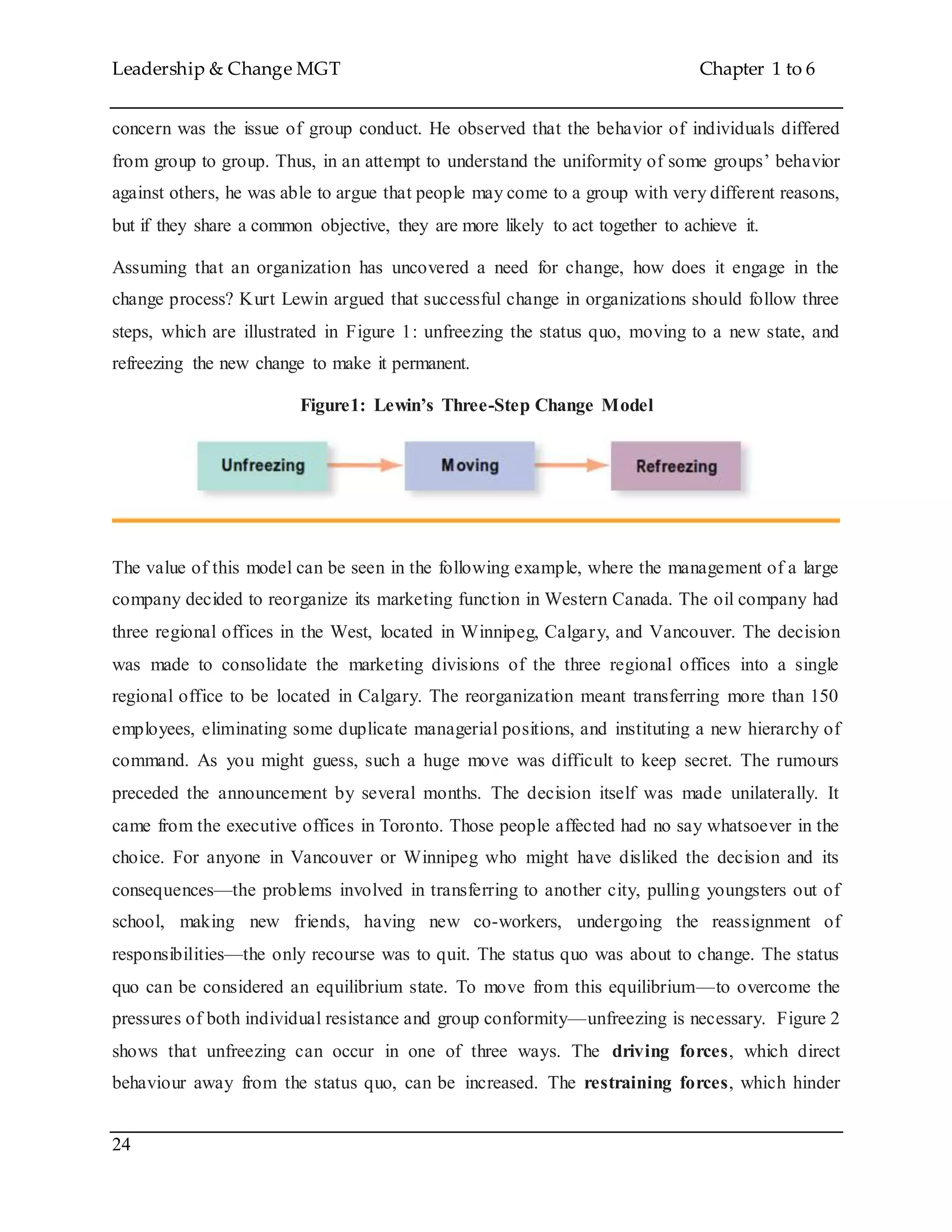
  • 5.
    Leadership & ChangeMGT Chapter 1 to 6 5  Integrity and honesty-helps managers behave ethically and earn their subordinates trust and confidence.  Physical traits-such as height, appearances etc.  Social traits such as cooperativeness skill etc. Traits alone however, are not the key to understand leader effectiveness. Some effective leaders do not possess all of these traits, are some leaders who do possess them but not effective in their leadership roles. B. The Behavioral Theory  Behavioral studies had their roots in the Ohio Sate University and university of Michigan by careful study of the behaviors of specific leaders. Ohio State and University of Michigan Studies conducted at the Ohio State University and the University of Michigan identified two leadership styles and two types of leader behaviors. The Ohio State study identified two leadership styles: considerate and initiating structure. The University of Michigan study classified leaders' behaviors as being production- or employee-centered. The primary concern of leaders with considerate and employee-centered style is the employee's welfare. The primary concern of leaders with initiating-structure and production-centered styles are achieving goals. Research findings on which dimension are most important for satisfaction and productivity are inconclusive. However, employee oriented leaders appear to be associated with high group productivity and job satisfaction. This theory tried to identify the behaviors shown by leaders in the work environment and they were generally able to identify two sets of leaders. Work centered (concerned for task) leaders  This approach is also refereed to as initiating structure, job centeredness and task orientation.  This considers leaders who are authoritarian, autocratic, production oriented and activity focused.  A leader with such behavior mostly tends to - plan and define work - Assign task responsibilities - set clear work standards - Urges for tasks completion - Monitors performance results persistently, Etc Employee centered(people centered)leaders
  • 6.
    Leadership & ChangeMGT Chapter 1 to 6 6  Such leaders are also known as democratic, considerate, consultative and participative leaders.  They tend to share decisions with subordinates, encourage participation, and support the team work needed for high levels of task accomplishment.  A leader with such behavior tends to - Act warmly and supportive to followers - Develops social rapport with followers - Respects the feeling of followers - Is highly sensitive to the needs of followers - Shows trust and confidence in followers. C. Situational Theory Situational leadership theory attempts to determine the appropriate leadership style for various situations. Successful leaders must be able to identify clues in an environment and adapt their leader behavior to meet the needs of their followers and of the particular situation. Even with good diagnostic skills, leaders may not be effective unless they can adapt their leadership style to meet the demands of their environment. Fiedler's Contingency Model Leadership Theory and Research: Perspectives and Directions (Academic Press Inc (HBJ), 1993) was a tribute to Fred Fiedler's 40 year study of leadership and organizational effectiveness. The editors, Martin M. Chemers and Roya Ayman, write of Fiedler's contribution: "The realization that leadership effectiveness depends on the interaction of qualities of the leader with demands of the situation in which the leader functions, made the simplistic "one best way" approach of earlier eras obsolete." Fred E. Fiedler's contingency theory postulates that there is no best way for managers to lead. Situations will create different leadership style requirements for a manager. The solution to a managerial situation is contingent on the factors that impinge on the situation. For example, in a highly reutilized (mechanistic) environment where repetitive tasks are the norm, a certain leadership style may result in the best performance. The same leadership style may not work in a very dynamic environment. Fiddler’s contingency model suggests that managers should choose task or employee focus depending on the interaction of three situation variables: leader member relation, task structure, and leader position power. Leader-Member relations: - How well do the manager and the employees get along? The extent to which followers like, trust, and are loyal to their leader is determinant of how favorable a situation for leading. If leader-member relations are good situations are good for leading. If relation is poor, the manager may have to resort to negotiation or to promising favors to get performance. Leader-member relations are the amount of loyalty, dependability, and support that
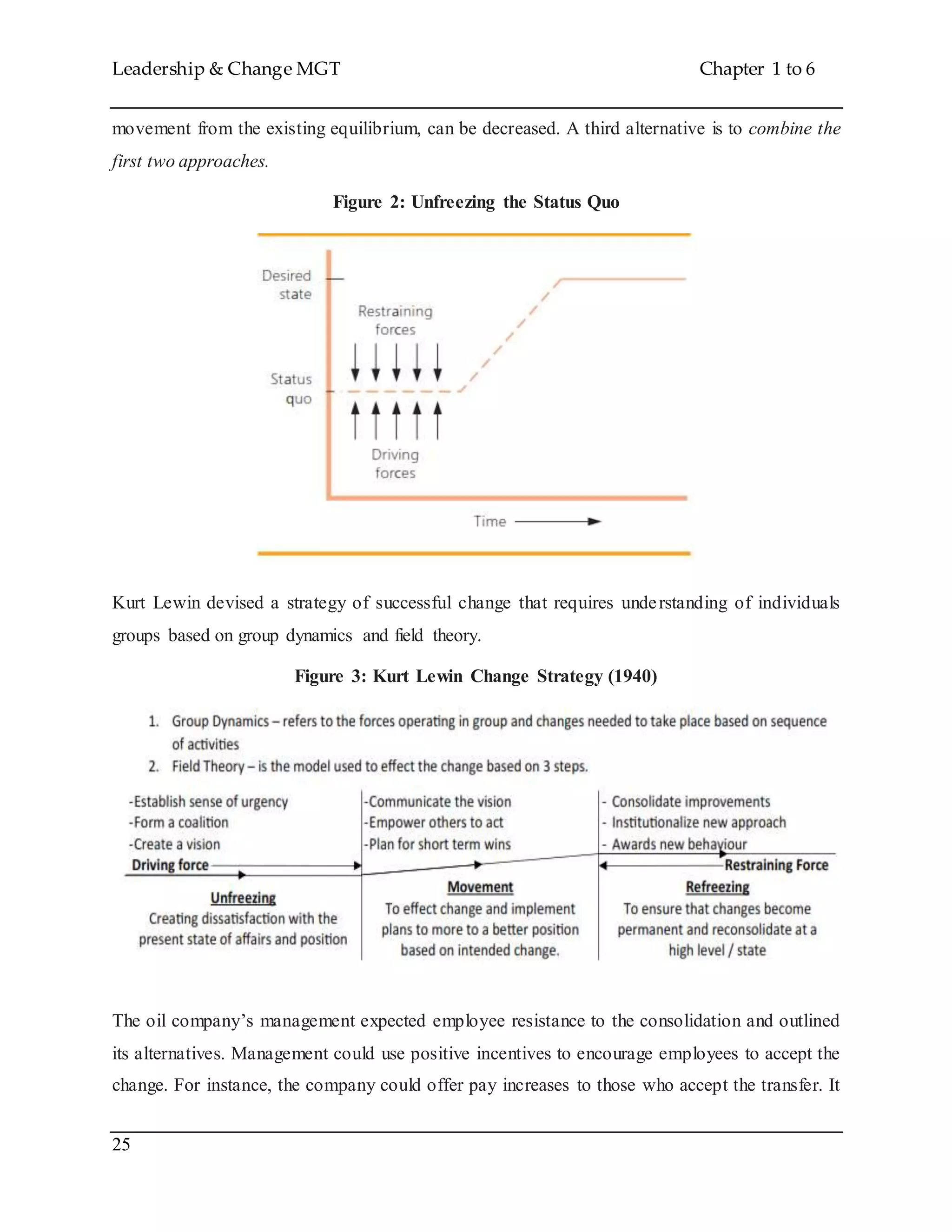
  • 7.
    Leadership & ChangeMGT Chapter 1 to 6 7 the leader receives from employees. It is a measure of how the manager perceives him or her and the group of employees is getting along together. In a favorable relationship the manager has a high task structure and is able to reward and or punish employees without any problems. In an unfavorable relationship the task is usually unstructured and the leader possesses limited authority. The spelling out in detail (favorable) of what is required of subordinates affects task structure. Task structure: - Is the job highly structured, fairly unstructured, or somewhere in between? The extent to which the work to be performed is clear-cut. When task structure is high, situations are favorable for leading. When task structure are low, goals may be vague, subordinates may be unsure of what they should be doing or how they should do it, and the situation is unfavorable for leading. Position power: How much authority does the manager possess? Theory X and Theory Y-assumptions Are assumptions about human nature developed by Douglas Mc Gregor. He developed the assumptions based on the attitude that managers have about workers. Theory X and Theory Y each represent different ways in which leaders view employees. Theory X managers believe that employees are motivated mainly by money, are lazy, uncooperative, and have poor work habits. Theory Y managers believe that subordinates work hard, are cooperative, and have positive attitudes. Theory - X assumes the following  The average worker is lazy, dislikes job, and will avoid work whenever possible  Because most people dislike work, they have to be closely supervised and threatened with punishment to reach objectives.  Above all people want security  Average people prefer to be directed, wish to avoid responsibilities and they have little ambition. Theory X leads naturally to an emphasis on the tactics of control - to procedures and techniques for telling people what to do, for determining whether they are doing it, and for administering rewards and punishment. Theory X explains the consequences of a particular managerial strategy. Because its assumptions are so unnecessarily limiting, it prevents managers from seeing the possibilities inherent in other managerial strategies. As long as the assumptions of Theory X influence managerial strategy, organizations will fail to discover, let alone utilize, the potentialities of the average human being. Theory- Y assumes the following  Most people find work as natural as play or rest and develop an attitude toward work based on their experience with it.
  • 8.
    Leadership & ChangeMGT Chapter 1 to 6 8  People do not need to be threatened with punishment; they will work voluntarily toward organizational objectives to which they are committed.  The average person working under proper condition not only to accept but also to seek responsibility.  Managers should decentralize authority to employees and make sure employees have the resources necessary to achieve organizational goals Theory Y's purpose is to encourage integration, to create a situation in which an employee can achieve his or her own goals best by directing his or her efforts toward the objectives of the organization. It is a deliberate attempt to link improvement in managerial competence with the satisfaction of higher-level ego and self-actualization needs. Theory Y leads to a preoccupation with the nature of relationships, with the creation of an environment which will encourage commitment to organizational objectives and which will provide opportunities for the maximum exercise of initiative, ingenuity, and self-direction in achieving them. Leadership styles Based on the degree to which managers share decision making authority with subordinates leadership styles can be classified in to three: Autocratic, democratic , and laissez-faire. Autocratic Style- a leadership style in which a manager does not share decision-making authority with subordinates.  Managers, who tend to be heavily work – centered, placing most of their emphasis on task accomplishment and little on the human elements.  Autocratic leadership style is characterized by the following points:  Managers’ emphasis on close control  Managers’ willingness to delegate a very little decision-making authority.  No flow of information from subordinates (Leader- subordinate relation ship is characterized by order giving on the leader’s part)  Sensitivity of managers about their authority.  Leader’s assumption that payment is a just reward for working Democratic Leadership style- is a leadership approach in which a manager shares decision – making authority with subordinates. Managers who have high concern for both people and work practice it. In democratic leadership managers:  are not much sensitive about their authority  participate employees in decision making  Appreciate suggestions from subordinates  Exercise broad supervision  Motivate subordinates with rewards Laissez-Faire(Free-Rein Style) - is leadership approach in which a manager develops a frame work for subordinates in which they can act and leave decision making authority to the subordinates and remain for consultation. It is employed by managers who are basically
  • 9.
    Leadership & ChangeMGT Chapter 1 to 6 9 uninvolved in the operations of the unit. This type of leadership is mostly applied in organizations with highly skilled and well-trained professional. Situational Leadership style-is leadership approach in which managers utilize the combination of the above style depending on the situation in external environment. 2.3. Motivation Concepts and Theories Motivation- is an inner desire to satisfy an unsatisfied need. Defined as the psychological forces within a person that determine:  Direction of behavior in an organization;  The effort or how hard people work;  The persistence displayed in meeting goals. - Is the result of the interaction of a person’s internal needs and external influences that determine behavior. - Is willingness to achieve organizational objectives - Is psychological force that determines the direction of a person’s behavior in an organization, a person’s level of effort and a person’s level of persistence. Motivation can be internal or external type Intrinsic Motivation: behavior performed for its own sake. Motivation comes from performing the work. Extrinsic Motivation: behavior performed to acquire rewards. Motivation source is the consequence of an action. Theories ofMotivation Many methods of employee motivation have been developed. The study of work motivation has focused on the motivator (supervisor) as well as the motivatee (employee). Motivation theories are important to supervisors attempting to be effective leaders. Two primary approaches to motivation are content and process. The content approach to motivation focuses on the assumption that individuals are motivated by the desire to fulfill inner needs. Content theories focus on the needs that motivate people. A. Maslow’s Hierarchy of Needs- · Maslow's Hierarchy of Needs identifies five levels of needs, which are best seen as a hierarchy with the most basic need emerging first and the most sophisticated need last. People move up the hierarchy one level at a time. Gratified needs lose their strength and the next level of needs is activated. As basic or lower-level needs are satisfied, higher-level needs become operative. A satisfied need is not a motivator. The most powerful employee need is the one that has not been satisfied. Abraham Maslow first presented the five- tier hierarchy in 1942 to a psychoanalytic society and published it in 1954 in Motivation and
  • 10.
    Leadership & ChangeMGT Chapter 1 to 6 10 Personality (New York: Harper and Row). Abraham Maslow, a psychologist, proposed that all people seek to satisfy five basic kinds of needs; physiological needs, safety needs, social needs, esteemneeds and self actualization needs. - Level I - physiological needs; includes basic needs such as need for food, cloth, shelter, sex etc. The organization helps to satisfy employees' physiological needs by a paycheck. - Level II - Safety needs;- are needs to avoid financial and physical problems. The organization helps to satisfy employees' safety needs by benefits - Level III - Social needs; - are needs for friendship, affiliation, attraction etc. The supervisor can help fulfill social needs by showing direct care and concern for employees. - Level IV - Esteem needs;-are needs for self respect, recognitions etc. The organization helps to satisfy employees' esteem needs by matching the skills and abilities of the employee to the job. The supervisor can help fulfill esteem needs by showing workers that their work is appreciated. - Level V - Self-actualization needs;-I s needs for maximizing ones skill, abilities, and other potentials. It is a need for attaining the maximum possible development. . The supervisor can help fulfill self-actualization needs by assigning tasks that challenge employees' minds while drawing on their aptitude and training. Fig 5.4 Maslow’s Hierarchy of Needs Maslow’s theory is based on four premises (assumptions);- 1.Only unsatisfied need can influence behavior: satisfied need is not a motivator 2.A persons needs are arranged in a priority order of importance in hierarchical forms 3.A person will at least minimally satisfy each level of need before filling the need at the next level
  • 11.
    Leadership & ChangeMGT Chapter 1 to 6 11 4.If need satisfaction is not maintained at any level the unsatisfied need will become priority ones again. How managers fulfill needs to the employees? Types of Needs Ways of Fulfilling Needs Fig 5.5 Hierarchy of Needs • Physiologica l needs • Safety Needs • Social Needs • Esteem Needs •  Paying adequate wage and salaries so that employee can buy basic necessities.  Providing quality work life, making work environment smart, keep in pension plans, purchasing protection clothes (gloves)  Allowing employees to strengthen informal groups and to communicateeach other at work place  Increasing responsibilities to workers and appreciating them on their performances  Training employees whose challenging duties and making environment
  • 12.
    Leadership & ChangeMGT Chapter 1 to 6 12 Fig. 5.6 Abraham Maslow’s hierarchy of needs. B. Alderfer's ERG;- identified three categories of needs. The most important contribution of the ERG model is the addition of the frustration-regression hypothesis, which holds that when individuals are frustrated in meeting higher level needs, the next lower level needs reemerge. Existence; - needs are the desires for material and physical well being. These needs are satisfied with food, water, air, shelter, working conditions, pay, and andfringe benefits. Relatedness; - needs are the desires to establish and maintain interpersonal relationships. These needs are satisfied with relationships with family, friends, supervisors, subordinates, and co-workers. Growth;- needs are the desires to be creative, to make useful and productive contributions and to have opportunities for personal development. Self Actualization Esteem Needs Social Needs Safety Needs Physiological Needs
  • 13.
    Leadership & ChangeMGT Chapter 1 to 6 13 Fig 5.7 Alderfer's ERG C. McClelland's Learned Needs divides motivation into needs for power, affiliation, and achievement. Achievement;- motivated people thrive on pursuing and attaining goals. They like to be able to control the situations in which they are involved. They take moderate risks. They like to get immediate feedback on how they have done. They tend to be preoccupied with a task- orientation towards the job to be done. Power; - motivated individuals see almost every situation as an opportunity to seize control Alderfer’s ERG After lower level needs satisfied, personseeks higher needs. When unable to satisfyhigher needs, lower needs motivationis Growt h Self-development, creative work Worker continually improves skills Relatedness Interpersonal relations,feelings Good relations, feedback Existence Food, water, shelter Basicpay level to buy items Lowest Highest Need Level Descr iption Exa mple
  • 14.
    Leadership & ChangeMGT Chapter 1 to 6 14 or dominate others. They love to influence others. They like to change situations whether or not it is needed. They are willing to assert themselves when a decision needs to be made. Affiliation; - motivated people are usually friendly and like to socialize with others. This may distract them from their performance requirements. They will usually respond to an appeal for cooperation. D. Herzberg’s two-factor theory Psychologist F.Hertzberg developed needs theory called two-factor or hygiene-motivator theory. According to this theory there are two sets of factors where one set of factors lead to job dissatisfaction; these are called hygiene factors. The other set of factors that produce job satisfaction and motivations; these are called motivators. Hygiene factors are extrinsic to the job i.e., they don’t relate directly to a person’s actual work activity. Hygiene factors are part of a job’s environment; they are part of context of the job, not its content. According to Hertzberg, when hygiene factors that an employee provides are not sufficient, workers will be dissatisfied. When the factors are of sufficient finally they don’t necessarily act as motivators. Hygiene factors include: salary, job security, working condition, company policies, quality of interpersonal relationship among peers, supervisors, subordinates, etc. Motivations Factors- are the primary cause of job satisfaction according to Hertzberg. They are intrinsic to a job and relate directly to the real nature of the work people perform. In other words, motivation factors relate to the job content. When an employer fails to provide motivation factors, employees will be dissatisfied. With quality motivation factors, employees enjoy job satisfaction and provide high performance. Different people require different kinds and degree of motivation factors – what stimulates one worker may not affect another. Motivators correspond to Maslow's higher-level needs of esteem and self-actualization. Generally, managers can use their knowledge to ensure that hygiene factors are there in the environment as foundation on which to build motivation. Once top management has provided satisfactory hygiene factors, they can focus on motivation factors. Moreover, according to Hertzberg, hygiene factors will not motivate workers but their absence de motivates them. Satisfaction comes from motivators that are intrinsic or job content, such as achievement, recognition, advancement, responsibility, the work itself, and growth possibilities. Herzberg uses the term motivators for job satisfiers since they involve job content and the satisfaction that results from them. Motivators are considered job turn-on. They are necessary for substantial improvements in work performance and move the employee beyond satisfaction to superior performance. Motivators correspond to Maslow's higher-level needs of esteem and self-actualization. Dissatisfaction occurs when the following hygiene factors, extrinsic or job context, are not present on the job: pay, status, job security, working conditions, company policy, peer relations,
  • 15.
    Leadership & ChangeMGT Chapter 1 to 6 15 and supervision. Herzberg uses the term hygiene for these factors because they are preventive in nature. They will not produce motivation, but they can prevent motivation from occurring. Hygiene factors can be considered job stay-on because they encourage an employee to stay on a job. Once these factors are provided, they do not necessarily promote motivation; but their absence can create employee dissatisfaction. Hygiene factors correspond to Maslow's physiological, safety, and social needs in that they are extrinsic, or peripheral, to the job. They are present in the work environment of job context. Motivation comes from the employee's feelings of accomplishment or job content rather than from the environmental factors or job context. Motivators encourage an employee to strive to do his or her best. Job enrichment can be used to meet higher-level needs. To enrich a job, a supervisor can introduce new or more difficult tasks, assign individuals specialized tasks that enable them to become experts, or grant additional authority to employees. Fig 5.8 Herzberg Theory of Motivation
  • 16.
    Leadership & ChangeMGT Chapter 1 to 6 16 Fig 5.9 Maslow Vs Herzberg motivation theory The process approach emphasizes how and why people choose certain behaviors in order to meet their personal goals. Process theories focus on external influences or behaviors that people choose to meet their needs. External influences are often readily accessible to supervisors. A. Vroom's Expectancy Model suggests that people choose among alternative behaviors because they anticipate that particular behaviors will lead to one or more desired outcomes and that other behaviors will lead to undesirable outcomes. Expectancy;- is the belief that effort will lead to first-order outcomes, any work-related behavior that is the direct result of the effort an employee expends on a job. Equity;-is the perception of fairness involved in rewards given. A fair or equitable situation is one in which people with similar inputs experience similar outcomes.
  • 17.
    Leadership & ChangeMGT Chapter 1 to 6 17 Fig 5.10 Equity Theory Employees will compare their rewards with the rewards received by others for their efforts. If employees perceive that an inequity exists, they are likely to withhold some of their contributions, either consciously or unconsciously, to bring a situation into better balance. Equity Theory Condition Person Referent Example Equity Outcomes = Outcomes Inputs Inputs Worker contr more inputs b gets more ou than refer Underpaymen t Equity Outcomes < Outcomes Inputs Inputs Worker contr more inputs b gets the same as refere Overpaymen t Equity Outcomes > Outcomes Inputs Inputs Worker contr same inputs also gets more ou than refer
  • 18.
    Leadership & ChangeMGT Chapter 1 to 6 18 Reinforcement involves four types of consequence. Positive reinforcement creates a pleasant consequence by using rewards to increase the likelihood that a behavior will be repeated. Negative reinforcement occurs when a person engages in behavior to avoid unpleasant consequences or to escape from existing unpleasant consequences. Punishment is an attempt to discourage a target behavior by the application of negative outcomes whenever it is possible. Extinction is the absence of any reinforcement, either positive or negative, following the occurrence of a target behavior. Employees have questions about their jobs. Can I do what management is asking me to do? If I do the job, will I be rewarded? Will the reward I receive be satisfactory to me? Reinforcement is based primarily on the work of B.F. Skinner, a psychologist, who experimented with the theories of operant conditioning. Skinner's work shows that many behaviors can be controlled through the use of rewards. In fact, a person might be influenced to change his or her behavior by giving him or her rewards. Employees who do an exceptionally good job on a particular project should be rewarded for that performance. It will motivate them to try to do an exceptional job on their next project. Employees must associate the reward with the behavior. In other words, the employee must know for what specifically he or she is being rewarded! The reward should come as quickly as possible after the behavior. The reward can be almost anything, but it must be something desired by the employee. Some of the most powerful rewards are symbolic; things that cost very little but mean a lot to the people who get them. Examples of symbolic rewards are things like plaques or certificates.
  • 19.
    Leadership & ChangeMGT Chapter 1 to 6 19 Assignment 1. Transformational, transactional and servant leaders. 2. Leadership skills and competencies 3. Good Vs. Bad leaders.
  • 20.
    Leadership & ChangeMGT Chapter 1 to 6 20 CHAPTER THREE OVERVIEW OF CHANGE MANAGEMENT 3.1. Introduction The only constant in business today is change. Change is something old that is stop and something new that is started. It is a sequence of activities to make changes based on timing to create a different state or condition. Change management is defined as the process of achieving the smooth implementation of change by planning and introducing it systematically, taking into account the likelihood of it being resisted (Armstrong, 2009). According to Kanter (1992, p. 279): Change involves the crystallization of new possibilities (new policies, new behaviors, new patterns, new methodologies, new products or new market ideas) based on the re-conceptualized patterns in the institution. The architecture of change involves the design and construction of new patterns, or the re-conceptualization of old ones, to make new, and hopefully more productive actions possible. Change, it is often said, is the only thing that remains constant in organizations. As A P Sloan (1967) wrote ‘The circumstances of an ever-changing market and an ever-changing product are capable of breaking any business organization if that organization is unprepared for change.” Change cannot just be allowed to happen. It needs to be managed. Managing change is the instruments (tools) and strategies (directions) used to manage issues and challenges to ensure success or failure of business. Change management is the mastering or gain control of changes (Kanter 1983). According to Nickols (2004) the term ‘managing change’ has two meanings, both ‘the making of changes in a planned and managed or systematic fashion’ and ‘the response to changes over which the organization exercises little or no control’. In this sense, the need to identify organization-wide change has become one of the most critical and challenging responsibilities of organizations. Key Terminologies in Managing Change:  Intervention: Stop something OLD, start something NEW  Drivers: Internal and external catalyst of change  Phenomenon: Trend, perspective, future  Paradigm: Change in thinking & mindset
  • 21.
    Leadership & ChangeMGT Chapter 1 to 6 21 History of managing change shows that management practices and systems have changed over centuries of understand change intervention 1. Industrial resolution – the old paradigms of think of that led to scientific theory of management by Federick W. Taylor that believe people are part of the “mechanism” of a factory operation systems. Eg: manufacturing, reduction – people robotics 2. Classical school – developed in the 18th century by Chester I. Barnard to emphasize mechanistic structure and division of labour and specialization and bureaucracy system of operation. Eg: Departments divisions, levels of management, Red Tape within organization 3. Human relations school – developed by Elton Mayo of Hawthorne experiment to emphasis the importance of informed working group and the theory X and Y types of employees. Eg: friendship, informal groups, work environment. Eg: Maslow hierarchy, social norms, belonging needs 4. Japanese management system: emphasize a different paradigm of employment of the theory Z worker that believes in collective agreement, lifetime employment, seniority based system of promotion and top level decision making. 3.2.Change Forces Modern organizations are highly dynamic, versatile and adaptive to the multiplication of change basically results from stimuli from both outside and inside the organization. Change takes place in all organizations but at varying rates of speed and degrees of significance. Organizational change can be done in several ways. Its technology can be changed. It structure, its people and other elements can be changed. Why change? According to McMillan (2004, p. 1), ‘too many current approaches to organizational change are drawn from a world view that is no longer consonant with the early twenty-first century’. Whilst conventional definitions of organizations and the manner of managing them suited stable conditions, the same cannot be said for current times. Presently, most organizations are faced with uncertainties that are synonymous with the modern world brought about by globalization and modern technology. McMillan (2004) described six factors that are responsible for the changes occurring in the modern world and organizations, namely:
  • 22.
    Leadership & ChangeMGT Chapter 1 to 6 22 1. New technologies that have transformed communications, electronics, consumer markets and speeded up industries; 2. Globalization, which has resulted in a world that is evermore connected and interdependent as information, money and goods move around the planet; 3. Globalization and new technologies, which together have sharpened competition and precipitated the rise and fall of market leaders; 4. New change processes and practices, which are now happening faster than ever before in our known history; 5. Speed – an incredible increase in technological speed is matched in business (product life cycles are measured in months not years) and in people’s lives (most of us feel we are running as fast as we can merely to stay in place); and 6. Complexity and paradox which are increasing as a result of all these changes and are making more and more difficult demands on managers used to seeking certainties and ‘either/or’ type solutions in order to bring about the ideals of stability and order. Today’s organizational domain includes unpredictable and uncontrollable domestic and international forces. Discussions and writings of merger’s, regulation, privatization, downsizing, union-management collaboration, high-involvement participation, plant closings, technological re-engineering, managing culturally diverse workers, and environmental protection fill the library shelves, boardrooms, and airways. These and many other forces from outside and inside the organization demand attention. i. Internal Forces Internal change forces are pressure that comes from a worker, a group, or a department. Sometimes the pressure is the cost of production a microchip or car. For example unit cost increases; therefore pricing the product at a reasonable amount to make a sale is a force that may signal a need for change. If the product costs too much to produce, it can’t be priced competitively. Poor worker morale over some inequity in the reward system could be an internal pressure point that a manager becomes aware of and must address. Although attitudes may be difficult to observe directly, increased grievance rates, absenteeism, or turnover may suggest poor of decreasing morale. Identifying internally driven forces for change is sometimes difficult.
  • 23.
    Leadership & ChangeMGT Chapter 1 to 6 23 Is the poor morale caused by the culture, the structure, or the manager, or does the worker bring this attitude to work? It’s difficult question to answer. i. External Forces External (outside-the-organization) forces can signal us that change is needed. Government regulations could suggest the need to change a firm’s work area layout or recruitment and selection program. Health care costs, suggest that organizations may need to change their health care coverage program or the type of fringe benefits provided to employees. Market competitors and how they reward employees, distribute products, service customers, or form alliances with foreign partners may signal the need to change. The wave of cultural diversity is a powerful external force that necessitates change. Integrating and utilizing the talents of a more diverse work force, and effectively rewarding this culturally diverse work force will require changes in attitude, interpersonal interaction, and perception. Changes in manger’s cultural awareness are also needed. The economic environment also has a key influence on the type and nature of change. Here, ‘economic rationalism’, a regulated market economy, privatization and private sector competition have a profound influence on change. According to Harris (1997, p. 42), social factors as well as technological forces also play an influential role regarding change. The use of computer technology, global communications, out- sourcing of services and new methods of shopping via cable, satellite and the Internet impact upon change. 3.3. The Change Process The change process starts with an awareness of the need for change. An analysis of this situation and the factors that have created it leads to a diagnosis of their distinctive characteristics and an indication of the direction in which action needs to be taken. Possible courses of action can then be identified and evaluated and a choice made of the preferred action. 1. The Planned Approach to Organizational Change (Kurt Lewin’s Model of Change) The planned approach to organizational change emerged through the work of Kurt Lewin (1951) relating to group decision-making, implementation and social change. For Lewin, a major
  • 24.
    Leadership & ChangeMGT Chapter 1 to 6 24 concern was the issue of group conduct. He observed that the behavior of individuals differed from group to group. Thus, in an attempt to understand the uniformity of some groups’ behavior against others, he was able to argue that people may come to a group with very different reasons, but if they share a common objective, they are more likely to act together to achieve it. Assuming that an organization has uncovered a need for change, how does it engage in the change process? Kurt Lewin argued that successful change in organizations should follow three steps, which are illustrated in Figure 1: unfreezing the status quo, moving to a new state, and refreezing the new change to make it permanent. Figure1: Lewin’s Three-Step Change Model The value of this model can be seen in the following example, where the management of a large company decided to reorganize its marketing function in Western Canada. The oil company had three regional offices in the West, located in Winnipeg, Calgary, and Vancouver. The decision was made to consolidate the marketing divisions of the three regional offices into a single regional office to be located in Calgary. The reorganization meant transferring more than 150 employees, eliminating some duplicate managerial positions, and instituting a new hierarchy of command. As you might guess, such a huge move was difficult to keep secret. The rumours preceded the announcement by several months. The decision itself was made unilaterally. It came from the executive offices in Toronto. Those people affected had no say whatsoever in the choice. For anyone in Vancouver or Winnipeg who might have disliked the decision and its consequences—the problems involved in transferring to another city, pulling youngsters out of school, making new friends, having new co-workers, undergoing the reassignment of responsibilities—the only recourse was to quit. The status quo was about to change. The status quo can be considered an equilibrium state. To move from this equilibrium—to overcome the pressures of both individual resistance and group conformity—unfreezing is necessary. Figure 2 shows that unfreezing can occur in one of three ways. The driving forces, which direct behaviour away from the status quo, can be increased. The restraining forces, which hinder
  • 25.
    Leadership & ChangeMGT Chapter 1 to 6 25 movement from the existing equilibrium, can be decreased. A third alternative is to combine the first two approaches. Figure 2: Unfreezing the Status Quo Kurt Lewin devised a strategy of successful change that requires understanding of individuals groups based on group dynamics and field theory. Figure 3: Kurt Lewin Change Strategy (1940) The oil company’s management expected employee resistance to the consolidation and outlined its alternatives. Management could use positive incentives to encourage employees to accept the change. For instance, the company could offer pay increases to those who accept the transfer. It
  • 26.
    Leadership & ChangeMGT Chapter 1 to 6 26 could also offer to pay all moving expenses. Management might offer low-cost mortgage funds to allow employees to buy new homes in Calgary. Of course, management might also consider unfreezing acceptance of the status quo by removing restraining forces. Employees could be counselled individually. Each employee’s concerns and apprehensions could be heard and specifically clarified. Assuming that most of the fears are unjustified, the counsellor could assure the employees that there was nothing to fear and then demonstrate, through tangible evidence, that restraining forces are unwarranted. If resistance is extremely high, management may have to resort to both reducing resistance and increasing the attractiveness of the alternative so the unfreezing can succeed. Once the consolidation change has been implemented, if it is to be successful, the new situation must be refrozen so that it can be sustained over time. Unless this last step is taken, there is a very high chance that the change will be short-lived and that employees will try to revert to the previous state of equilibrium. The objective of refreezing, then, is to stabilize the new situation by balancing the driving and restraining forces. How could the oil company’s management refreeze its consolidation change? It could systematically replace temporary forces with permanent ones. For instance, management might impose a new bonus system tied to the specific changes desired. The formal rules and regulations governing behaviour of those affected by the change could also be revised to reinforce the new situation. Over time, of course, the work group’s own norms will evolve to sustain the new equilibrium. But until that point is reached, management will have to rely on more formal mechanisms. The Working With Others Exercise on page 360 gives you the opportunity to identify driving and restraining forces for another company experiencing problems with change and to make some recommendations for change. A key feature of Lewin’s three-step model is its conception of change as an episodic activity, with a beginning, a middle, and an end. However, the structure of today’s workplaces requires change to take place as an ongoing, if not chaotic, process. Certainly the adjustment that companies have made to the realities of e-commerce indicates a more chaotic change, rather than a controlled and planned change. To elaborate, in the unfreezing step, employees break away from the way things have been done. In organizations, for effective change to occur, employees must embrace new work practices with a sense of urgency. In order to achieve this, employees are encouraged or are forced to distance themselves from comfort zones that they were accustomed to so that they acclimatize to new work practices, even if there is uncertainty regarding their future. Similarly, Harper (2001,
  • 27.
    Leadership & ChangeMGT Chapter 1 to 6 27 p. 10) argued that organizations that are implementing change management should encourage employees to abide by a plan that allows for the ‘sloughing of yesterday’ because ‘it will force thinking and action … make available men and money for new things … create a willingness to act’. In step two (initiating the change), employees engage in activities that identify and implement new ways of doing things or engage in new activities in order to bring about change. In this respect, Harper (2001) proposed that for effective change to take place, management must ensure that all relevant stakeholders are given the opportunity to be engaged in decision making and problem solving in a collaborative manner. Whilst the latter was predominantly the role of management, the current thinking is that employees who become involved are most likely to accept change and become committed to making change a success. A better understanding of the needs and benefits of change may result in little or no resistance on the part of change recipients. In the third and final step (refreezing), the emphasis is on the reinforcing of new processes and tasks in the organization by the employer. For this step to be successful, employees must be acknowledged, as reward is an important consideration. Reward is crucial for behavior modification. Employees should receive appropriate recognition for changes in behavior if they embrace or accept the change. In this instance, reward serves to recognize that the new behavior is valued and prevents previous behavior from reoccurring (Harper 2001). According to Branch (2002, p. 4), Lewin’s model of organizational change can be accomplished in three ways:  Changing the individuals who work in the organization (their skills, values, attitudes, and eventually behavior) – with an eye to instrumental organizational change;  Changing various organizational structures and systems – reward systems, reporting relationships, work designs; or  Directly changing the organizational climate or interpersonal style – how often people are with each other, how conflict is managed, how decisions are made. 2. The emergentapproach to organisationalchange Kotter ’ s modelof change The emergent model of change was the response to criticisms leveled against the planned model of change. This approach has been given a number of different labels, such as continuous
  • 28.
    Leadership & ChangeMGT Chapter 1 to 6 28 improvement or organizational learning (Burnes 1996). The model views ‘change as driven from the bottom up rather than from the top down, and stresses that change is an open-ended and continuous process of adaptation to changing conditions and circumstances. The approach suggests change to be so rapid that it is impossible for senior change initiators to effectively identify, plan and implement the necessary organizational changes. The emergent approach promotes ‘extensive and in-depth understanding of strategy, structure, systems, people, style and culture, and how these can function either as sources of inertia that can block change, or alternatively, as levers to encourage an effective change process. John Kotter, professor of leadership at Harvard Business School, built on Lewin’s three step model to create a more detailed approach for implementing change. Kotter began by listing common failures that occur when managers try to initiate change. These include the inability to create a sense of urgency about the need for change; failure to create a coalition for managing the change process; the absence of a vision for change and to effectively communicate that vision; not removing obstacles that could impede the achievement of the vision; failure to provide short- term and achievable goals; the tendency to declare victory too soon; and not anchoring the changes in the organization’s culture. Kotter then established eight sequential steps to overcome these problems. These steps are listed in the Table 2. Notice how Kotter list in Table 2 builds on Lewin’s model. Kotter’s first four steps essentially represent the “unfreezing” stage. Steps 5 through 7 represent “moving.” The final step works on “refreezing.” Kotter’s contribution lies in providing managers and change agents with a more detailed guide for implementing change successfully. Table 1: Kotter’s Eight-Step Plan for Implementing Change 1. Establish a sense of urgency by creating a compelling reason for why change is needed. 2. Form a coalition with enough power to lead the change. 3. Create a new vision to direct the change and strategies for achieving the vision. 4. Communicate the vision throughout the organization. 5. Empower others to act on the vision by removing barriers to change and encouraging risk- taking and creative problem solving.
  • 29.
    Leadership & ChangeMGT Chapter 1 to 6 29 6. Plan for, create, and reward short-term “wins” that move the organization toward the new vision. 7. Consolidate improvements, reassess changes, and make necessary adjustments in the new programs. 8. Reinforce the changes by demonstrating the relationship between new behaviours and organizational success. Figure 4: Modified Kotter’s for Implementing Change Furthermore, Kotter claimed that most major change efforts consist of a variety of small and medium-sized change projects. He also maintained that the emergent approach is a result of the assumption that ‘change is a continuous, open minded and unpredictable process of aligning and realigning an organization to its changing environment’. As a result of this, the emergent approach to change has become very popular among organizations in the contemporary world because it recognizes the fact that organizations must adapt their internal practices and behaviors to meet changing external conditions (Burnes 2001). However, Kotter’s model is not devoid of criticism, and the Eight-Step Change Model has many disadvantages as well as benefits. It has the advantage of being a step-by-step model, which is easy to implement. However, for the model to be successfully implemented, all of the eight stages must be worked through in order, and to completion. Skipping even a single step or getting too far ahead without a solid base almost always creates problems. Failing to reinforce earlier stages results in the sense of urgency dissipating, or the guiding coalition breaking up.
  • 30.
    Leadership & ChangeMGT Chapter 1 to 6 30 Without the follow-through which takes place in the final step, the organization may never get to the finish line and make changes stick (Rose 2002). Key Roles in the Change Process During this stage of planning, it is useful to distinguish the different roles associated with the change process. These roles must remain distinctive in order to implement planned change effectively. However, within different settings or systems, a judicial educator may play more than one role. The various roles that individuals can play, as described by Conner (1990), are:  Change Sponsor: Individual or group who legitimizes the change.  Change Advocate: Individual or group who wants to achieve a change but does not possess legitimization power.  Change Agent: Individual or group who is responsible for implementing the change.  Change Target: Individual or group who must actually change. One of the most critical tasks for the educator in implementing change is to harness the support of an effective change sponsor. The sponsor is in a position to legitimize the change. Sponsorship is critical to implementing the desired change. Directly or indirectly, pain can motivate the sponsor to foster the planned change. Within the state judicial system, this sponsor may be the chief justice, the head of the education committee, or the state court administrator. Conner (1990) argues that weak sponsors should be educated or replaced, even by someone at a lower level in the organization, or, he emphasizes, failure will be inevitable. Educators and managers are often in the position of change advocates, who perceive the need for change and desire and advocate the change, but who do not have the necessary organizational power to implement the change. Alternatively, these individuals may function as the change agent, with the responsibility (but again, not the power) to implement change. And, of course, in an organizational change effort, educators and managers may be part of the group affected by the change, or the change target. It is useful to consider each of these roles in planning strategies not only for implementation, but for gathering support for the change effort. 2.4. RESISTANCE TO CHANGE One of the most well-documented findings from studies of individual and organizational behaviour is that organizations and their members resist change. In a sense, this is positive. It
  • 31.
    Leadership & ChangeMGT Chapter 1 to 6 31 provides a degree of stability and predictability to behaviour. If there were no resistance, organizational behavior would take on characteristics of chaotic randomness. Resistance to change can also be a source of functional conflict. For example, resistance to a reorganization plan or a change in a product line can stimulate a healthy debate over the merits of the idea and result in a better decision. However, there is a definite downside to resistance to change: It hinders adaptation and progress. Resistance to change does not necessarily surface in standard ways. Resistance can be overt, implicit, immediate, or deferred. It is easiest for management to deal with resistance when it is overt and immediate. For instance, a change is proposed, and employees respond immediately by voicing complaints, engaging in work slowdowns, threatening to go on strike, or the like. The greater challenge is managing resistance that is implicit or deferred. Implicit resistance efforts are more subtle—loss of loyalty to the organization, loss of motivation to work, increased errors or mistakes, increased absenteeism due to “sickness”—and hence more difficult to recognize. Similarly, deferred actions cloud the link between the source of resistance and the reaction to it. A change may produce what appears to be only a minimal reaction at the time it is initiated, but then resistance surfaces weeks, months, or even years later. Or a single change that in and of itself might have little impact becomes the straw that breaks the camel’s back. Reactions to change can build up and then explode in some response that seems totally out of proportion to the change action it follows. The resistance, of course, has merely been deferred and stockpiled. What surfaces is a response to the accumulation of previous changes. Let’s look at the sources of resistance. Armstrong (2009) identified the main reasons for resisting charge are as follows:  The shock of the new – people are suspicious of anything that they perceive will upset their established routines, methods of working or conditions of employment. They do not want to lose the security of what is familiar to them. They may not believe statements by management that the change is for their benefit as well as that of the organization; sometimes with good reason. They may feel that management has ulterior motives and sometimes, the louder the protestations of management, the less they will be believed.  Economic fears – loss of money, threats to job security  Inconvenience – the change will make life more difficult.  Uncertainty – change can be worrying because of uncertainty about its likely impact.
  • 32.
    Leadership & ChangeMGT Chapter 1 to 6 32  Symbolic fears – a small change that may affect some treasured symbol, such as a separate office or a reserved parking space, may symbolize big ones, especially when employees are uncertain about how extensive the programme of change will be.  Threat to interpersonal relationships – anything that disrupts the customary social relationships and standards of the group will be resisted.  Threat to status or skill – the change is perceived as reducing the status of individuals or as de-skilling them.  Competence fears – concern about the ability to cope with new demands or to acquire new skills. For analytical purposes, we have categorized them as individual and organizational sources. In the real world, the sources often overlap. IndividualResistance Individual sources of resistance to change reside in basic human characteristics such as perceptions, personalities, and needs. • Habit. To cope with life’s complexities, we rely on habits or programmed responses. But when confronted with change, this tendency to respond in our accustomed ways becomes a source of resistance. • Security. People with a high need for security are likely to resist change because it threatens their feelings of safety. • Economic factors. Changes in job tasks or established work routines can arouse economic fears if people are concerned that they will not be able to perform the new tasks or routines to their previous standards, especially when pay is closely tied to productivity. • Fear of the unknown. Change substitutes ambiguity and uncertainty for the known. This is also referred to as the “status quo bias,” in which individuals assume that their current state is better than whatever the changed state might be. • Selective information processing. Individuals are guilty of selectively processing information in order to keep their perceptions intact. They hear what they want to hear, and they ignore information that challenges the world they have created.
  • 33.
    Leadership & ChangeMGT Chapter 1 to 6 33 • Cynicism. In addition to simple resistance to change, employees often feel cynical about the change process, particularly if they have been through several rounds of change, and nothing appears (to them) to have changed. Three researchers from Ohio State University identified sources of cynicism in the change process of a large unionized manufacturing plant. The major elements contributing to the cynicism were as follows: o Feeling uninformed about what was happening o Lack of communication and respect from one’s manager o Lack of communication and respect from one’s union representative o Lack of opportunity for meaningful participation in decision making The researchers also found that employees with negative personalities were more likely to be cynical about change. While organizations might not be able to change an individual’s personality, they certainly have the ability to provide greater communication and respect, as well as opportunities to take part in decision making. The researchers found that cynicism about change led to such outcomes as lower commitment, less satisfaction, and reduced motivation to work hard. Figure 3 illustrates why some employees, may have reason to feel cynical about organizational change. Figure 4: Individual Cynical Feeling OrganizationalResistance Organizations, by their very nature, are conservative. They actively resist change. You do not have to look far to see evidence of this phenomenon. Government agencies want to continue
  • 34.
    Leadership & ChangeMGT Chapter 1 to 6 34 doing what they have been doing for years, whether the need for their service changes or remains the same. Organized religions are deeply entrenched in their history. Attempts to change church doctrine require great persistence and patience. Educational institutions, which exist to open minds and challenge established ways of thinking, are themselves extremely resistant to change. Most school systems are using essentially the same teaching technologies today that they were 50 years ago. Similarly, most business firms appear highly resistant to change. Half of the 309 human resource executives of Canadian firms who took part in a 1998 survey rated their companies’ ability to manage change as “fair.” One-third of them said that their ability to manage change was their weakest skill, and only 25 percent of the companies made a strong effort to train leaders in the change process. When organizations refuse to change with the times, they can fail, as was the case with Eaton’s, which never really adjusted to the arrival of Wal- Mart. Six major sources of organizational resistance to change have been identified: • Structural inertia. Organizations have built-in mechanisms—such as their selection processes and formal regulations—to produce stability. When an organization is confronted with change, this structural inertia acts as a counterbalance to sustain stability. • Limited focus of change. Organizations are made up of a number of interdependent subsystems. One cannot be changed without affecting the others. So limited changes in subsystems tend to be nullified by the larger system. • Group inertia. Even if individuals want to change their behaviour, group norms may act as a constraint. • Threat to expertise. Changes in organizational patterns may threaten the expertise of specialized groups. • Threat to established power relationships. Any redistribution of decision-making authority can threaten long-established power relationships within the organization. • Threat to established resource allocations. Groups in the organization that control sizable resources often see change as a threat. They tend to be content with the way things are. OvercomingResistance to Change
  • 35.
    Leadership & ChangeMGT Chapter 1 to 6 35 Michael Adams, president of Environics Research Group in Toronto, has noted that Canadians have become more resistant to change in recent years. Between 1983 and the mid-1990s, Canadians reported that they “felt confident in their ability to cope with change.” This trend has reversed in recent years. Half of Canadians aged 15 to 33 now “feel left behind and overwhelmed by the pace of life and the prevalence of technology.” Those who feel left behind tend to be those who are not college- or university-educated, highly skilled, or adaptive. It probably cannot be emphasized enough that in order to break down resistance to change, it is essential to communicate a sense of urgency in the need for change. Doing so provides a framework for people to understand why the change is occurring. Also, it is important to communicate and celebrate early successes to keep the momentum going, as change is a lengthy process. Kotter and Schlesinger have identified six tactics organizations use to deal with resistance to change: • Education and communication. Resistance can be reduced through communicating with employees to help them see the logic of a change. Communication can be achieved through one- on-one discussions, memos, group presentations, or reports. • Participation and involvement. It is difficult for individuals to resist a change decision in which they have participated. Before making a change, those opposed can be brought into the decision process. Assuming that the participants have the expertise to make a meaningful contribution, their involvement can reduce resistance, obtain commitment, and increase the quality of the change decision. • Facilitation and support. Organizations undergoing change can offer a range of supportive efforts to reduce resistance such as employee counseling and therapy, new-skills training, or a short paid leave of absence. • Negotiation and agreement. Another way for organizations to deal with potential resistance to change is to exchange something of value for less resistance. For instance, if the resistance is centred in a few powerful individuals, a specific reward package can be negotiated that will meet their individual needs. • Manipulation and co-optation. Manipulation refers to covert influence attempts. Twisting and distorting facts to make them appear more attractive, withholding undesirable information, and
  • 36.
    Leadership & ChangeMGT Chapter 1 to 6 36 creating false rumours to get employees to accept a change are all examples of manipulation. Co- optation, on the other hand, is a form of both manipulation and participation. It seeks to “buy off” the leaders of a resistance group by giving them a key role in the change decision. • Explicit and implicit coercion. Coercion is the application of direct threats or force upon the resisters. If the corporate management is determined to close a manufacturing plant should employees not acquiesce to a pay cut, then coercion would be the label attached to its change tactic. Other examples of coercion are threats of transfer, loss of promotions, negative performance evaluations, and poor letters of recommendation. Table 3: Strategies for Overcoming Resistance to Change
  • 37.
    Leadership & ChangeMGT Chapter 1 to 6 37 To substantiate, Kotter (1996, p. 16) elaborates eight errors that have significantly contributed to the downside of change management, namely:  Allowing too much complacency in the organization;  Failure to create clear and powerful guidelines;  Restricted vision in terms of future planning;  Lack of communication in the organization;  Failure to deal with problems immediately as and when they arise; concentration on long term gains at the expense of short term benefits;  Acknowledging change victory sooner than it is achieved; and  A failure to firmly anchor changes in the corporate culture of the organization.
  • 38.
    Leadership & ChangeMGT Chapter 1 to 6 38 CHAPTER 4 TYPES OF CHANGE According to Armstrong (2009) there are three types of change: strategic, operational and transformational. 1. Strategic change Strategic change is concerned with broad, long-term and organization-wide issues involving change. It is about moving to a future state that has been defined generally in terms of strategic vision and scope. It will cover the purpose and mission of the organization, its corporate philosophy on such matters as growth, quality, innovation and values concerning employees and customers, competitive positioning and strategic goals for achieving and maintaining competitive advantage and for product-market development. These goals are supported by policies concerning marketing, sales, manufacturing, product and process development, finance and human resource management. Strategic change takes place within the context of the external competitive, economic and social environment, and the organization’s internal resources, capabilities, culture, structure and systems. Its successful implementation requires thorough analysis and understanding of these factors in the formulation and planning stages. The ultimate achievement of sustainable competitive advantage relies on the qualities defined by Pettigrew and Whipp (1991), namely ‘The capacity of the firm to identify and understand the competitive forces in play and how they change over time, linked to the competence of a business to mobilize and manage the resources necessary for the chosen competitive response through time.’ Strategic change, however, should not be treated simplistically as a linear process of getting from A to B that can be planned and executed as a logical sequence of events 2. Operational change
  • 39.
    Leadership & ChangeMGT Chapter 1 to 6 39 Operational change relates to new systems, procedures, structures or technology that will have an immediate effect on working arrangements within a part of the organization. But its impact on people can be more signifi cant than broader strategic change and it has to be handled just as carefully. 3. Transformational change Transformational change takes place when there are fundamental and comprehensive changes in structures, processes and behaviours that have a dramatic effect on the ways in which the organization functions. 1. The contingency model of change -Dunphy and Stace’ s model of change Dunphy and Stace (1988, 1992, 1993) investigated change from an organizational transformation perspective. Within this perspective, Dunphy and Stace (1993) maintained that organizations needed a model of change that was essentially a ‘situational’ or ‘contingency model’. This model should be one that indicated how to vary change strategies to achieve ‘optimum fit’ with the changing environment. Furthermore, these writers state that the contingency model to change is based on the theory that situational variables determine the structure and performance of organizations and because no two organizations are alike, they will not face the same situational variables.The model developed by Dunphy and Stace includes both the formulation and implementation requirements of various types of change and leadership styles. Their typology of change and conditions for use is shown in Figure 5. Figure 5: Dunphy and Stace’s Typology of Change (1992)
  • 40.
    Leadership & ChangeMGT Chapter 1 to 6 40 Dunphy and Stace’s (1992) model of change is more situational in design and supportive of the view that ‘that the selection of appropriate types of change depends entirely on a strategic analysis of the situation’. These authors also maintained that change does not always occur on an incremental basis, but can also occur on a discontinuous basis. They also suggested that transformational change is not only consultative but is also coercive in nature. A major criticism of this model, in this researcher’s view, is its dependency on the interpretation of the model by change initiators and implementation, in that change may be influenced more by the style of the ‘change driver’ than by an effective organizational change analysis. If the ‘change driver’ has a collaborative leadership style, then employees would be allowed power, either through formal or informal process, significant enough to influence both the goals and means of change. If the ‘change driver’ is characterized by a consultative style of leadership, power would be placed more firmly in the hands of managers and would involve managers consulting widely among employees and being open to influence from employees about how change is affected. If the ‘change driver’ is characterized by a directive style of leadership, this would involve the use of legitimate authority to bring about organizational change, being most effective when subordinates respect this authority.. If the ‘change driver’ adopts a coercive style of leadership, this would involve using explicit or implicit force by managers on employees, and an autocratic mode of decision-making.
  • 41.
    Leadership & ChangeMGT Chapter 1 to 6 41 Business Process Reengineering Business process reengineering (also known as business process redesign, business transformation, or business process change management) is originally pioneered in the early 1990s, focusing on the analysis and design of workflows and business processes within an organization. BPR involves discovering how business processes currently operate, how to redesign these processes to eliminate the wasted or redundant effort and improve efficiency, and how to implement the process changes to gain competitiveness. Reengineering is the fundamental rethinking and radical redesign of business processes to achieve dramatic improvements in critical, contemporary measures of performance, such as cost, quality, service and speed. (p. 32) Another BPR father, Davenport (1993), describes ‘business process redesign’ as: ... the analysis and design of workflows and processes within and between organizations. Business activities should be viewed as more than a collection of individual or even functional tasks; they should be broken down into processes that can be designed for maximum effectiveness, in both manufacturing and service environment. Problems Facing BPR In 1996 Davenport published an article entitled Why Re-engineering Failed: The Fad that Forgot People in which he reports: To most business people in the United States, re-engineering has become a word that stands for restructuring, lay-offs, and too often, failed change programs ... companies that embraced [re-engineering] as the silver bullet are now looking for ways to re-build the organization’s torn fabric. (Davenport, 1996) Also in 1998 it was reported that only around 30% of BPR projects were regarded as a success (Galliers, 1998). The earlier promise of BPR had not been fulfilled. There are many reasons for the limited success of BPR. Some explanation of such high rates of failure for BPR projects have been discussed in BPR literature. For example, employees’ resistance of change as they consider BPR as threats to their jobs (i.e. the increase in short-term contracts and lack of promotion); Galliers (1998) and Gerrits (1994) point out that currently BPR approaches lack detailed guidance and support for the actual implementation of reengineering: many publications describe
  • 42.
    Leadership & ChangeMGT Chapter 1 to 6 42 the situation before and after BPR but do not discuss the path to reach the final situation; Chen et al. (2000a) explain that one reaction to this failure was to retain faith in IT as a dominant support and just admit that since it could not adapt – or at least not at acceptable levels of cost – then business activities must adapt to IT. For example: The pendulum has swung from ‘continuous reengineering and re-inventing’ to ‘pick an application package and force our business processes to comply with the package’. (Riemer, 1998) Reading Assignment  BPR process  BPR techniques and tools  Implementation of BPR CHAPTER 5 CONFLICTS AND CONFLICT MANAGEMENT 5.1. Conflict Defined Several common themes underlie most definitions of conflict. Conflict must be perceived by the parties to it; if no one is aware of a conflict, it is generally agreed that no conflict exists. Conflict also involves opposition or incompatibility, and some form of interaction between the parties. These factors set the conditions that determine the beginning point of the conflict process. We can define conflict, then, as a process that begins when one party perceives that another party has negatively affected, or is about to negatively affect, something that the first party cares about. This definition is deliberately broad. It describes that point in any ongoing activity when an interaction “crosses over” to become conflict. It includes the wide range of conflicts that people experience in groups and organizations—incompatibility of goals, differences over interpretations of facts, disagreements based on behavioural expectations, and the like. Finally, our definition is flexible enough to cover the full range of conflict levels—from subtle forms of
  • 43.
    Leadership & ChangeMGT Chapter 1 to 6 43 disagreement to overt and violent acts. Conflict has positive sides and negative sides, which we will discuss further when we cover functional and dysfunctional conflict. For more on this debate, refer to the 5.2. Functional vs. Dysfunctional Conflict Not all conflict is bad. Some conflicts support the goals of the group and improve its performance; these are functional, or constructive, forms of conflict. But there are conflicts that hinder group performance; these are dysfunctional, or destructive, forms of conflict. The criterion that differentiates functional from dysfunctional conflict is group performance. If a group is unable to achieve its goals because of conflict, then the conflict is dysfunctional. Figure 5.1., provides a way of visualizing conflict behavior. All conflicts exist somewhere along this continuum. At the lower part of the continuum, we have conflicts characterized by subtle, indirect, and highly controlled forms of tension. An illustration might be a student politely objecting to a point the instructor has just made in class. Conflict intensities escalate as they move upward along the continuum, until they become highly destructive. Strikes and lockouts, riots, and wars clearly fall into this upper range. For the most part, you should assume that conflicts that reach the upper ranges of the continuum are almost always dysfunctional. Functional conflicts are typically confined to the lower range of the continuum. Figure 5.1. Conflict Intensity Continuum
  • 44.
    Leadership & ChangeMGT Chapter 1 to 6 44 5.3. CONFLICT RESOLUTION Conflict in the workplace can affect the effectiveness of individuals, teams, and the entire organization. One study found 20 percent of managers’ time is spent managing conflict. Once conflict arises, what can be done to resolve it? The way a conflict is defined goes a long way toward establishing the sort of outcomes that might settle it. For instance, if I define our salary disagreement as a zero-sum or win-lose situation - that is, if you get the increase in pay you want, there will be just that amount less for me - I am going to be far less willing to look for mutual solutions than if I frame the conflict as a potential win-win situation. So, individual attitudes toward a conflict are important, because attitudes typically define the set of possible settlements. 5.4. Conflict Management Strategies Conflict researchers often use dual concern theory to describe people’s conflict management strategies. Dual concern theory considers how one’s degree of cooperativeness (the degree to which one tries to satisfy the other person’s concerns) and assertiveness (the degree to which one tries to satisfy one’s own concerns) determine how a conflict is handled. The five conflict-handling strategies identified by the theory are as follows: • Forcing. Imposing one’s will on the other party.
  • 45.
    Leadership & ChangeMGT Chapter 1 to 6 45 • Problem solving. Trying to reach an agreement that satisfies both one’s own and the other party’s aspirations as much as possible. • Avoiding. Ignoring or minimizing the importance of the issues creating the conflict. • Yielding. Accepting and incorporating the will of the other party. • Compromising. Balancing concern for oneself with concern for the other party in order to reach a solution. Forcing is a win-lose solution, as is yielding, while problem solving seeks a win-win solution. Avoiding conflict and pretending it does not exist, and compromising, so that neither person gets what they want, can yield lose-lose solutions. Exhibit 6-6 illustrates these five strategies, along with specific actions that one might take when using them. Choosing a particular strategy for resolving conflict depends on a variety of factors. Research shows that while people may choose among the strategies, they have an underlying disposition to handle conflicts in certain ways. In addition, some situations call for particular strategies. For instance, when a small child insists on trying to run into the street, a parent may need a forcing strategy to restrain the child. Co-workers who are having a conflict over setting deadlines to complete a project on time may decide that problem solving is the best strategy to use. 5.5. What Can Individuals Do to Manage Conflict? There are a number of conflict resolution techniques that individuals can use to try to defuse conflict inside and outside the workplace. These include the following: • Problem solving. Requesting a face-to-face meeting to identify the problem and resolve it through open discussion. • Developing superordinate goals. Creating a shared goal that requires both parties to work together, and motivates them to do so. • Smoothing. Playing down differences while emphasizing common interests with the other party. • Compromising. Agreeing with the other party that each will give up something of value to reach an accord.
  • 46.
    Leadership & ChangeMGT Chapter 1 to 6 46 • Avoidance. Withdrawing from, or suppressing, the conflict. The choice of technique may depend on how serious the issue is to you, whether you take a win-win or a win-lose approach, and your preferred conflict management style When the conflict is specifically work-related, there are additional techniques that might be used: • Expansion of resources. The scarcity of a resource—say, money, promotion opportunities, office space—can create conflict. Expansion of the resource can create a win win solution. • Authoritative command. Management can use its formal authority to resolve the conflict and then communicate its desires to the parties involved. • Altering the human variable. Behavioral change techniques such as human relations training can alter attitudes and behaviors that cause conflict. • Altering the structural variables. The formal organization structure and the interaction patterns of conflicting parties can be changed through job redesign, transfers, creation of coordinating positions, and the like. 5.6. Resolving Personality Conflicts Personality conflicts are an everyday occurrence in the workplace. While there is no available data for Canada, supervisors in the United States spend about 18 percent of their time handling personality conflicts among employees. A variety of factors leads to personality conflicts, including the following: • Misunderstandings based on age, race, or cultural differences • Intolerance, prejudice, discrimination, or bigotry • Perceived inequities • Misunderstandings, rumours, or falsehoods about an individual or group • Blaming for mistakes or mishaps (finger-pointing) Personality conflicts can result in lowered productivity when people find it difficult to work together. The individuals experiencing the conflict may seek sympathy from other members of the work group, causing co-workers to take sides. The ideal solution would be for the two people in conflict to work it out between themselves, without involving others, but this does not always
  • 47.
    Leadership & ChangeMGT Chapter 1 to 6 47 happen. However, it is not always possible for people to talk things out, and it may be a Western cultural bias to expect that individuals should generally be able to do so. 5.7. Negotiation When parties are potentially in conflict, they may choose to negotiate a resolution. Negotiation occurs in the interactions of almost everyone in groups and organizations: Labour bargains with management; managers negotiate with employees, peers, and senior management; salespeople negotiate with customers; purchasing agents negotiate with suppliers; employees agree to answer a colleague’s phone for a few minutes in exchange for some past or future benefit. In today’s team-based organizations, negotiation skills become critical so that teams can work together effectively. We define negotiation as a process in which two or more parties try to agree on the exchange rate for goods or services they are trading Bargaining Strategies There are two general approaches to negotiation—distributive bargaining and integrative bargaining. Distributive bargaining It is a negotiating strategy that operates under zero-sum (win-lose) conditions. That is, any gain I make is at your expense, and vice versa. Probably the most widely cited example of distributive bargaining is in labor management negotiations over wages. Typically, management comes to the bargaining table determined to keep its labor costs as low as possible. Since every cent more that labor negotiates increases management’s costs, each party bargains aggressively and treats the other as an opponent who must be defeated. When engaged in distributive bargaining, a party focuses on trying to get the opponent to agree to a specific target point, or to get as close to it as possible. Examples of such tactics are persuading your opponent of the impossibility of reaching his or her target point and the advisability of accepting a settlement near yours; arguing that your target is fair, while your opponent’s is not; and trying to get your opponent to feel emotionally generous toward you and thus accept an outcome close to your target point. Integrative Bargaining
  • 48.
    Leadership & ChangeMGT Chapter 1 to 6 48 In contrast to distributive bargaining, integrative bargaining operates under the assumption that there exists one or more settlements that can create a win-win solution. In terms of intra- organizational behavior, all things being equal, integrative bargaining is preferable to distributive bargaining. Why? Because the former builds long-term relationships and makes working together in the future easier. It bonds negotiators and allows both sides to leave the bargaining table feeling that they have achieved a victory. For instance, in union-management negotiations, both sides might sit down to figure out other ways to reduce costs within an organization, so that it is possible to have greater wage increases. Distributive bargaining, on the other hand, leaves one party a loser. It tends to build animosities and deepen divisions when people must work together on an ongoing basis. Figure 2: Conflict Handling Strategies and Accompanying Behaviors How to Negotiate
  • 49.
    Leadership & ChangeMGT Chapter 1 to 6 49 Figure 3 provides a simplified model of the negotiation process. It views negotiation as made up of five steps: (1) developing a strategy; (2) defining ground rules; (3) clarification and justification; (4) bargaining and problem solving; and (5) closure and implementation. Figure 3: The Negotiation Process
  • 50.
    Leadership & ChangeMGT Chapter 1 to 6 50 CHAPTER 6 LONG- TERM FINANCING 6.1. Long Term Finance Long-term finance can be defined as any financial instrument with maturity exceeding one year (such as bank loans, bonds, leasing and other forms of debt finance), and public and private equity instruments. Maturity refers to the length of time between origination of a financial claim (loan, bond, or other financial instrument) and the final payment date, at which point the remaining principal and interest are due to be paid. Equity, which has no final repayment date of a principal, can be seen as an instrument with nonfinite maturity. The one year cut-off maturity corresponds to the definition of fixed investment in national accounts. 6.1.1. Importance of long-term finance Extending the maturity structure of finance is often considered to be at the core of sustainable financial development. Long-term finance contributes to faster growth, greater welfare, shared prosperity, and enduring stability in two important ways: by reducing rollover risks for borrowers, thereby lengthening the horizon of investments and improving performance, and by increasing the availability of long-term financial instruments, thereby allowing households and firms to address their life-cycle challenges (Demirgüç-Kunt and Maksimovic 1998, 1999; Caprio and Demirgüç-Kunt 1998; de la Torre, Ize, and Schmukler, 2012). The term of the financing reflects the risk-sharing contract between providers and users of finance. Long-term finance shifts risk to the providers because they have to bear the fluctuations in the probability of default and other changing conditions in financial markets, such as interest rate risk. Often providers require a premium as part of the compensation for the higher risk this type of financing implies. On the other hand, short-term finance shifts risk to users as it forces them to roll over financing constantly. The amount of long-term finance that is optimal for the economy as a whole is not clear. In well-functioning markets, borrowers and lenders will enter short- or long-term contracts depending on their financing needs and how they agree to share the risk involved at different maturities. What matters for the economic efficiency of the financing arrangements is that
  • 51.
    Leadership & ChangeMGT Chapter 1 to 6 51 borrowers have access to financial instruments that allow them to match the time horizons of their investment opportunities with the time horizons of their financing, conditional on economic risks and volatility in the economy (for which long-term financing may provide a partial insurance mechanism). At the same time, savers would need to be compensated for the extra risk they might take. Where it exists, the bulk of long-term finance is provided by banks; use of equity, including private equity, is limited for firms of all sizes. As financial systems develop, the maturity of external finance also lengthens. Banks’ share of lending that is long term increases with a country’s income and the development of banking, capital markets, and institutional investors. Long-term finance for firms through issuances of equity, bonds, and syndicated loans has also grown significantly over the past decades, but only very few large firms access long-term finance through equity or bond markets. The promotion of nonbank intermediaries (pension funds and mutual funds) in developing countries such as Chile has not always guaranteed an increased demand for long-term assets (Opazo, Raddatz and Schmukler, 2015; Stewart, 2014). 6.2. SOURCES OF LONG TERM FINANCE The nature of such finance can be ownership as well as borrowing or a hybrid of the two. Some of the main sources of long term finance are listed below  EQUITY Equity is the foremost requirement at the time of floatation of any company. They represent the ownership funds of the company and are permanent to the capital structure of the firm. The equity can be private or public. Private equity is raised from institutional or high net worth individuals. Public equity is raised by issuing shares to the public at large which are subscribed to by retail investors, mutual funds, banks and a pool of other investors. On the flipside, equity is an expensive variant of long term finance. The investors expect a high return due to the extent of risk involved.  BONDS
  • 52.
    Leadership & ChangeMGT Chapter 1 to 6 52 Bonds are debt instruments involving two parties- the borrower and the lender. The borrower can be the government, a local body or a corporation. They provide fixed interest payments at periodic intervals and are redeemable at a predetermined date in future. Bonds are normally issued against collateral and are therefore a highly secured form of long term finance. Bonds may prove to be a very cost effective source of funds in a bullish market.  TERM LOANS term loans are borrowings made from banks and financial institutions. Such term loans may be for the medium to long term with repayment period ranging from 1 to 30 years. Such long term finance is generally procured to fund specific projects (expansion, diversification, capital expenditure etc) and is, therefore, also known as project finance. Term loans can be sourced by both small as well as established businesses. Also, the interest rates are relatively low and are negotiated depending upon the duration of the loan, nature of security furnished, the risk involved etc.  INTERNAL ACCRUALS Internal accruals are nothing but the reserve of profits or retention of earnings that the firm has created over the years. They represent one of the most essential sources of long term finance since they are not injected into the business from external sources. Rather it is self-generated and highlights the sustainability and profitability of the entity Also internal accruals are owner’s funds and therefore create no charge on the assets of the company.  VENTURE CAPITAL This form of financing has emerged with the growing popularity of start-up culture worldwide. VC firms invest into companies at their inception or seed stage. They are constantly on a watch out for firms demonstrating high growth potential. Their investment takes the form of ownership funds and forms a part of the permanent capital of the firm. Venture capitalists also have a predetermined exit strategy before they invest. This results in the target company being listed or a secondary sale to another VC firm
  • 53.
    Leadership & ChangeMGT Chapter 1 to 6 53 6.3. Raising funds in capital Market How does the company raise funds in capital market? Capital market is the market in which financial securities have been traded between the individuals and the institutions. These institutions sell securities on capital markets in public and private sectors to raise funds. This market is composed of both primary and secondary markets. The parts of capital markets are both stock and bond markets. Large Corporation grow by doing innovations and by raising the capital to finance expansion. Corporations have five primary methods which are used to raise funds in capital market. 1) Issue of bonds : - Bond is an amount of money which has to be given at a certain date or dates in future. Bondholders receive interest payments at fixed rate and specific dates. Corporate issues bonds because interest rates which must pay investors are lower than rates of borrowing and holders can sell bonds to someone else before they due. 2) Issue of preferred stock : - company choose this to raise capital. If a company have financial trouble the buyers of shares gets special status. If profits are limited then owners will be paid the dividend after bondholders receive the interest payments. 3) Sell of common stock : - if financial condition of the company is good then it can raise the capital issue the common stock. Bank helps the companies to do the investment and issue stock. Investors’ gets interested if the company pays large dividends and offers steady income. Value of shares increases if investor expects the corporate earning to rise. 4) Borrowing:- companies used to raise short term capital by getting the loans from banks or other sources. After good market run the profits which the company gets can be used to finance their operating by retaining their earnings.