

Presented by:
Muhammad Asad
Seat number: A-12029025
What is Leadership?
Characteristics of a good Leader
Types of Leader
i. Autocratic Leader
ii. Democratic Leader
iii. Laissez-Faire Leader
iv. Transactional Leader
Which type of Leader is best for organizational with narrow span of
control?
i. Factors for determining the best style
ii. The right Leadership style
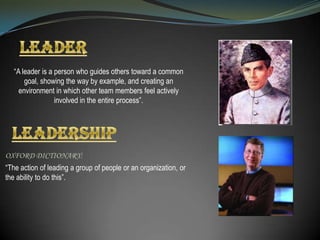
“A leader is a person who guides others toward a common
goal, showing the way by example, and creating an
environment in which other team members feel actively
involved in the entire process”.

OXFORD DICTIONARY:
“The action of leading a group of people or an organization, or
the ability to do this”.
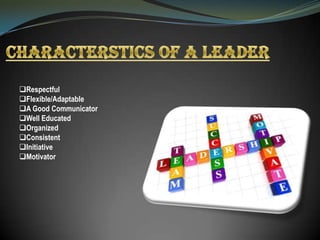
Respectful
Flexible/Adaptable
A Good Communicator
Well Educated
Organized
Consistent
Initiative
Motivator
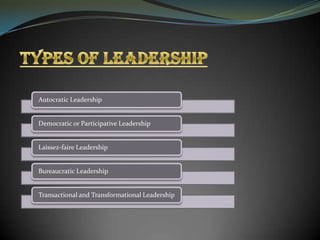
Autocratic Leadership

Democratic or Participative Leadership

Laissez-faire Leadership

Bureaucratic Leadership

Transactional and Transformational Leadership
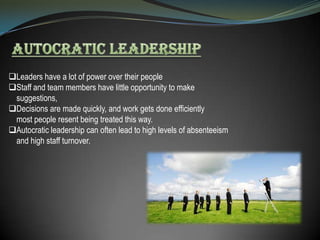
Leaders have a lot of power over their people
Staff and team members have little opportunity to make
suggestions,
Decisions are made quickly, and work gets done efficiently
most people resent being treated this way.
Autocratic leadership can often lead to high levels of absenteeism
and high staff turnover.
Team members in the decision-making process.
All group members participate freely.
Team members tend to have high job satisfaction and productive
Slow decision-making, but the result is often good.
Most suitable when working as a team is essential
Can often hinder situations where speed or efficiency is essential.
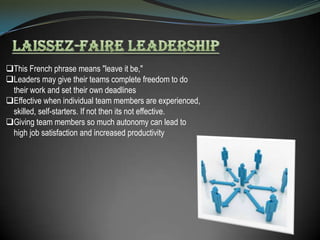
This French phrase means "leave it be,"
Leaders may give their teams complete freedom to do
their work and set their own deadlines
Effective when individual team members are experienced,
skilled, self-starters. If not then its not effective.
Giving team members so much autonomy can lead to
high job satisfaction and increased productivity
Everything must be done according to procedure or policy
This is a very appropriate style of work involving serious safety risk
or where large money are involved.
Staff need to understand certain standards or procedures
Staff lose their interest in their jobs
In transactional, Members agree to obey their leader when they
accept a job
The transformational leadership style depends on high levels of
communication from management to meet goals.
Clarifies everyone's roles and responsibilities
Team members can do little to improve their job satisfaction. It
can feel stifling, and it can lead to high staff turnover
Power is given to the leader to evaluate, correct and train
subordinates .
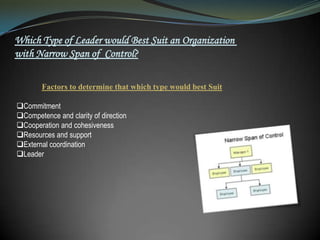
Which Type of Leader would Best Suit an Organization
with Narrow Span of Control?
Factors to determine that which type would best Suit
Commitment
Competence and clarity of direction
Cooperation and cohesiveness
Resources and support
External coordination
Leader
Leadership
Leadership

Leadership

  • 2.
  • 3.
    What is Leadership? Characteristicsof a good Leader Types of Leader i. Autocratic Leader ii. Democratic Leader iii. Laissez-Faire Leader iv. Transactional Leader Which type of Leader is best for organizational with narrow span of control? i. Factors for determining the best style ii. The right Leadership style
  • 4.
    “A leader isa person who guides others toward a common goal, showing the way by example, and creating an environment in which other team members feel actively involved in the entire process”. OXFORD DICTIONARY: “The action of leading a group of people or an organization, or the ability to do this”.
  • 5.
    Respectful Flexible/Adaptable A Good Communicator WellEducated Organized Consistent Initiative Motivator
  • 6.
    Autocratic Leadership Democratic orParticipative Leadership Laissez-faire Leadership Bureaucratic Leadership Transactional and Transformational Leadership
  • 7.
    Leaders have alot of power over their people Staff and team members have little opportunity to make suggestions, Decisions are made quickly, and work gets done efficiently most people resent being treated this way. Autocratic leadership can often lead to high levels of absenteeism and high staff turnover.
  • 8.
    Team members inthe decision-making process. All group members participate freely. Team members tend to have high job satisfaction and productive Slow decision-making, but the result is often good. Most suitable when working as a team is essential Can often hinder situations where speed or efficiency is essential.
  • 9.
    This French phrasemeans "leave it be," Leaders may give their teams complete freedom to do their work and set their own deadlines Effective when individual team members are experienced, skilled, self-starters. If not then its not effective. Giving team members so much autonomy can lead to high job satisfaction and increased productivity
  • 10.
    Everything must bedone according to procedure or policy This is a very appropriate style of work involving serious safety risk or where large money are involved. Staff need to understand certain standards or procedures Staff lose their interest in their jobs
  • 11.
    In transactional, Membersagree to obey their leader when they accept a job The transformational leadership style depends on high levels of communication from management to meet goals. Clarifies everyone's roles and responsibilities Team members can do little to improve their job satisfaction. It can feel stifling, and it can lead to high staff turnover Power is given to the leader to evaluate, correct and train subordinates .
  • 12.
    Which Type ofLeader would Best Suit an Organization with Narrow Span of Control? Factors to determine that which type would best Suit Commitment Competence and clarity of direction Cooperation and cohesiveness Resources and support External coordination Leader