


LEADERSHIP..
BHAGYA B.N
I M.COM
the guidance of
SUNDAR B.N
Asst. Prof . & Cource Co-Ordinator
Post Graduation Studies in Commerce
G.F.G.C.W. Holenarsipura
UNDER
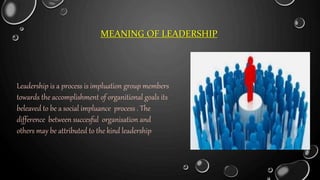
MEANING OF LEADERSHIP
Leadership is a process is impluation group members
towards the accomplishment of organitional goals its
beleaved to be a social impluance process . The
difference between succesful organisation and
others may be attributed to the kind leadership
DEFINATION OF LEADERSHIP
Alford and beatty defined leadership as “ The ability to
secure desirable action from a group of followers voluntarily
without the use ofcoerejon
 According to George terry “ leadership is the activity of
influencing people to strike willingly for mutual objectives .”
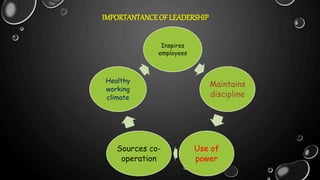
IMPORTANTANCEOF LEADERSHIP
Inspires
employees
Maintains
discipline
Use of
power
Sources co-
operation
Healthy
working
climate
 Inspires Employees : A good leader
encourages employees and creates a
strong urge in them for higher
performance .appropriate motivational
techniques are used to make them
perform efficiently.
 Maintains discipline : Leadership that is
present at all levels of an organisation
maintains discipline and order .when
subordinates observe rules,
regulations and procedures ,they are
supported by the leadership.
 Use of power : Leadership and power or
synonymous in any organization.
Leadership uses this power in the best
intrest of the enterprice.
 Secures co-operation: A leader influences
behaviou ofv subbortinates in such a
way that day readly agree to work for
the accoumplishement of
organisational goals.
 Healthy working climate : A leader provides a healthy
working climate so that group members can
work happily and willingly towards achieving
organisational objectives.
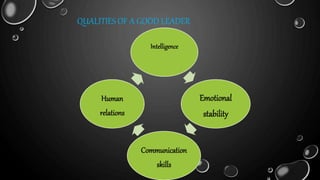
Intelligence
Emotional
stability
Communication
skills
Human
relations
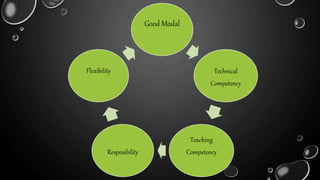
QUALITIES OF A GOOD LEADER
Good Modal
Technical
Competency
Teaching
Competency
Resposibility
Flexibility
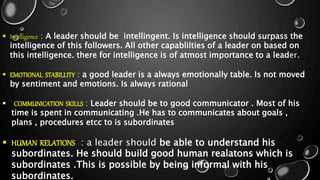
 Intelligence : A leader should be intellingent. Is intelligence should surpass the
intelligence of this followers. All other capablilties of a leader on based on
this intelligence. there for intelligence is of atmost importance to a leader.
 EMOTIONAL STABILLITY : a good leader is a always emotionally table. Is not moved
by sentiment and emotions. Is always rational
 COMMUNICATION SKILLS : Leader should be to good communicator . Most of his
time is spent in communicating .He has to communicates about goals ,
plans , procedures etcc to is subordinates
 HUMAN RELATIONS : a leader should be able to understand his
subordinates. He should build good human realatons which is
subordinates .This is possible by being informal with his
subordinates.
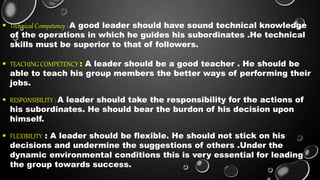
 Technical Competency : A good leader should have sound technical knowledge
of the operations in which he guides his subordinates .He technical
skills must be superior to that of followers.
 TEACHING COMPETENCY : A leader should be a good teacher . He should be
able to teach his group members the better ways of performing their
jobs.
 RESPONSIBILITY : A leader should take the responsibility for the actions of
his subordinates. He should bear the burdon of his decision upon
himself.
 FLEXIBILITY : A leader should be flexible. He should not stick on his
decisions and undermine the suggestions of others .Under the
dynamic environmental conditions this is very essential for leading
the group towards success.
REFFRENCE TOPIC: LEADERSHIP
RETRAIVED : https://www.chieflearningofficer.com/leadership
Leadership

Leadership

  • 1.
    LEADERSHIP.. BHAGYA B.N I M.COM theguidance of SUNDAR B.N Asst. Prof . & Cource Co-Ordinator Post Graduation Studies in Commerce G.F.G.C.W. Holenarsipura UNDER
  • 2.
    MEANING OF LEADERSHIP Leadershipis a process is impluation group members towards the accomplishment of organitional goals its beleaved to be a social impluance process . The difference between succesful organisation and others may be attributed to the kind leadership
  • 3.
    DEFINATION OF LEADERSHIP Alfordand beatty defined leadership as “ The ability to secure desirable action from a group of followers voluntarily without the use ofcoerejon  According to George terry “ leadership is the activity of influencing people to strike willingly for mutual objectives .”
  • 4.
  • 5.
     Inspires Employees: A good leader encourages employees and creates a strong urge in them for higher performance .appropriate motivational techniques are used to make them perform efficiently.  Maintains discipline : Leadership that is present at all levels of an organisation maintains discipline and order .when subordinates observe rules, regulations and procedures ,they are supported by the leadership.
  • 6.
     Use ofpower : Leadership and power or synonymous in any organization. Leadership uses this power in the best intrest of the enterprice.  Secures co-operation: A leader influences behaviou ofv subbortinates in such a way that day readly agree to work for the accoumplishement of organisational goals.
  • 7.
     Healthy workingclimate : A leader provides a healthy working climate so that group members can work happily and willingly towards achieving organisational objectives.
  • 8.
  • 9.
  • 10.
     Intelligence :A leader should be intellingent. Is intelligence should surpass the intelligence of this followers. All other capablilties of a leader on based on this intelligence. there for intelligence is of atmost importance to a leader.  EMOTIONAL STABILLITY : a good leader is a always emotionally table. Is not moved by sentiment and emotions. Is always rational  COMMUNICATION SKILLS : Leader should be to good communicator . Most of his time is spent in communicating .He has to communicates about goals , plans , procedures etcc to is subordinates  HUMAN RELATIONS : a leader should be able to understand his subordinates. He should build good human realatons which is subordinates .This is possible by being informal with his subordinates.
  • 11.
     Technical Competency: A good leader should have sound technical knowledge of the operations in which he guides his subordinates .He technical skills must be superior to that of followers.  TEACHING COMPETENCY : A leader should be a good teacher . He should be able to teach his group members the better ways of performing their jobs.  RESPONSIBILITY : A leader should take the responsibility for the actions of his subordinates. He should bear the burdon of his decision upon himself.  FLEXIBILITY : A leader should be flexible. He should not stick on his decisions and undermine the suggestions of others .Under the dynamic environmental conditions this is very essential for leading the group towards success.
  • 12.
    REFFRENCE TOPIC: LEADERSHIP RETRAIVED: https://www.chieflearningofficer.com/leadership