
ICT in Day to Day Life

RANJIT BANSHPAL
rrbanshpal@gmail.com

Note-Just send the topic and get ppt…………it’s free*
Introduction
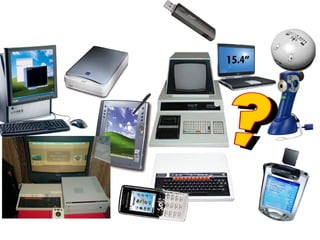
When the first computers made their entry into schools in the late 1970s,
we used to speak about computers in education. With computers came
printers, floppy disk drives, scanners and the first digital cameras. We began
to use the term IT or Information Technology, to describe computers and
these various peripheral devices. Then the internet arrived together with
computer networks, the World Wide Web, email and search engines. A new
term entered the language – ICT. The term ICT, short for Information and
Communication Technologies, embraces the many technologies that enable
us to receive information and communicate or exchange information with
others.
Defination:“ ICT itself is the set of activities that facilitate by electronic
means the processing, transmission, and display of information.”
1
Objectives of ICT in Education
• To improve 21st Century Critical Learning and
Innovation Skills of students.
• To improve 21st Century Information, Media,
and Technology Skills of students.
• To help to fight against world poverty.

2
• With ICT, the company can make the business easier to happen
with the client, supplier and the distributor.
• ICT provide right and updated information for taking right
decisions.
• ICT bring digital economy or economy network. It is one of the
economic development pillars to gain national competitive
advantage.
• The ICT has opened the door to access information worldwide for
the teachers and students.

3
Challenges of ICT IN

EDUCATION
WORK AND EMPLOYMENT
HOME AND DOMESTIC ACTIVITIES
PERSONAL AND CITIZEN ACTIVITIES
SHOPPING
SOCIAL NETWORK,COLLEGUE ,FRIENDS AND FAMILY EVENTS
ENCOUNTERS THROUGH MEDIA

4
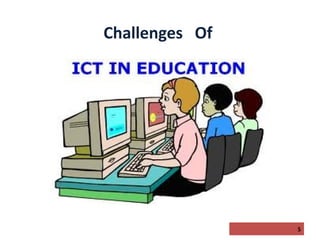
Challenges Of

5
In Education sector ICT is used by,
1)Teachers:- Use computers in research for preparing
teaching materials, participate in online forums and
online conferences as well as to assist their teaching.
2)Students:- Use computers as reference tool.
3)Researchers:- Use computers to collect and process data.
4)School Administrators:-Use computers for administrative
purposes to make sure that the entire operation runs
smoothly.

6
Computer are used in education sector as it offers:
•Enhanced learning.
•Interactive learning experience.
•Cognitive development.
•Problem based learning.

7
Uses of ICT in Education
•
•
•
•
•
•

Teaching.
Remedial Teaching.
Evaluation process.
Development of Virtual Laboratory.
Online Tutoring/ Training.
Developing Instructional Material.
8
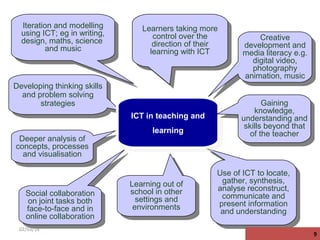
Iteration and modelling
using ICT; eg in writing,
design, maths, science
and music
and music

Learners taking more
control over the
control over the
direction of their
direction of their
learning with ICT
learning with ICT

Developing thinking skills
and problem solving
and problem solving
strategies
strategies

Deeper analysis of
Deeper analysis of
concepts, processes
concepts, processes
and visualisation
and visualisation

Social collaboration
on joint tasks both
on joint tasks both
face-to-face and in
face-to-face and in
online collaboration
02/03/14

ICT in teaching and
ICT in teaching and
learning
learning

Learning out of
Learning out of
school in other
school in other
settings and
settings and
environments
environments

Creative
Creative
development and
development and
media literacy e.g.
media literacy e.g.
digital video,
digital video,
photography
photography
animation, music
animation, music
Gaining
Gaining
knowledge,
knowledge,
understanding and
understanding and
skills beyond that
skills beyond that
of the teacher
of the teacher

Use of ICT to locate,
gather, synthesis,
gather, synthesis,
analyse reconstruct,
communicate and
communicate and
present information
present information
and understanding
and understanding
11

9
ICT FOR WORK AND EMPLOYMENT IN

BANKING
INDUSTRY
COMMERCE

10
ICT FOR WORK AND EMPLOYMENT

BANKING

The computers, networking and internet are the backbone of the
banking system. It functions to control the entire banking system
that also includes `Electronic banking Services'(e-banking).
In banking:
1) Customers can carry out online transactions (24 Hrs X 7 days).
2) Businessmen can save their time, access company accounts for
loan applications, business transactions and update on their cash
flow at any time.
3) Bank administrators can monitor entire banking activities.
11
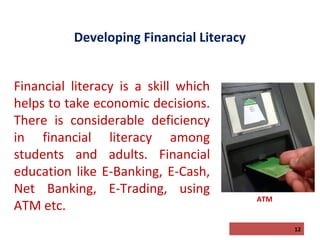
Developing Financial Literacy
Financial literacy is a skill which
helps to take economic decisions.
There is considerable deficiency
in financial literacy among
students and adults. Financial
education like E-Banking, E-Cash,
Net Banking, E-Trading, using
ATM etc.

ATM

12
INDUSTRY
Computers are used to facilitate production planning and control
systems, to support `supply chain management' and to help in
product design in the industrial sector.
1)Workers- Use machine to carry out routine task. In some
productions, robots are used to take over jobs that are dangerous.
2) Researchers– Use computers to analyze and collect research data
for development.
3) Administrators- Use computers to oversee the entire operations in
the plant or factory.

13
COMMERCE
E-commerce helps in boosting the economy. It makes buying and
selling activities easier, more efficient and faster. For this application,
computers, internet and shared software are needed.
In Commerce:
1) Customers- Use computers to be connected online with suppliers
to purchase products.
2) Suppliers- Use computers to keep track of their transactions.
3) Employees- Use computers and telephones to communicate with
their customers for any enquiries.

14
HOME AND DOMESTIC ACTIVITIES
•ICT has a great impact for our daily life, we can read our local news paper.
•Connect ourselves to our family, relatives, or colleagues while we are
abroad by using the electronic mail, messenger, call conference, or video
conference.
•Carry out electronic transactions through Debit / Credit cards, net banking,
trading of shares and Book Air / Rail tickets
•Purchase books / office equipments through commercial web sites
•Impart education through interactive web sites
•Demonstrate major surgical operations
•Watch TV programs, Getting information etc.

15
PERSONAL AND CITIZEN ACTIVITIES
 To improve quality of human life.
 Trading will be easier using ICT.
 Help in promoting culture ,tourism and local
products.
 ICT work as bridge between the Government and
the citizen by using e-governance.

16
SHOPPING
Online shopping involves E-commerce. Electronic commerce draws
on such technologies as electronic funds transfer, supply chain
management, Online transaction processing, EDI(Electronic Data
Interchange) , Inventory management system and automated data
collection systems.
Electronic commerce is generally considered to be the sales aspect
of e-business.

17
ICT AND SOCIAL NETWORK, COLLEGUE, FRIENDS AND
FAMILIES EVENTS
FASTER COMMUNICATION SPEED

With the Internet, news or messages are sent via e-mail to friends, business
partners or to anyone efficiently because of the capability of bandwidth,
broadband and connection speed on the Internet, information travel fast and at an
instant. It saves time and is inexpensive.

EFFECTIVE SHARING OF INFORMATION

•With the use of ICT, information, news, opinion, mailing lists, forums etc. can be
shared by people all around the world.
•Example of popular discussion groups on the Internet are: Facebook, Orkut,
Google Groups, Yahoo! Groups etc.

PAPERLESS ENVIRONMENT

This term means information can be stored and retrieved through the digital
medium instead of paper.
18
Encounters through media
• ICT have been extensively covered across media and there
deal of advertising for consumer products.

is a great

•Advertising campaigns for multimedia related products and services are
one source of exposure.
•The newspapers have been picking up on stories that involve the Internet
and other technologies for a few years, and these appear scattered
throughout the paper, in business, news and technology sections. People
can pick up on individual news items or just become aware of general
developments through scanning the paper.
•Media make people aware of innovations and help them know of certain
products and system.

19
Some Negative Effects Of ICT
Social Problems
Health Problem

20
ICT AND SOCIAL PROBLEMS
 Today ,people choose online communication
rather than real time conversations.
 They become more individualistic and introvert.
 Social networking sites can cause adverse effect
on young mind.

21
ICT AND HEALTH PROBLEMS
A computer may harm users if they use it for long
hours frequently.
Computer users also exposed to bad posture,
eyestrain, physical and mental stress.

22
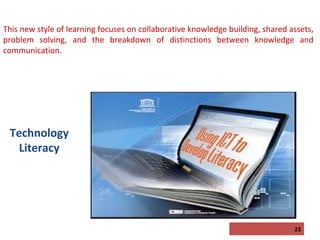
This new style of learning focuses on collaborative knowledge building, shared assets,
problem solving, and the breakdown of distinctions between knowledge and
communication.

Technology
Literacy

23
24
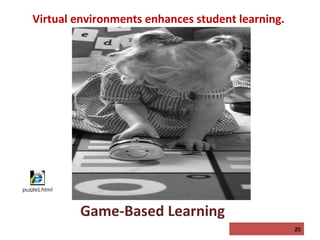
Virtual environments enhances student learning.

puzzle1.html

Game-Based Learning
25
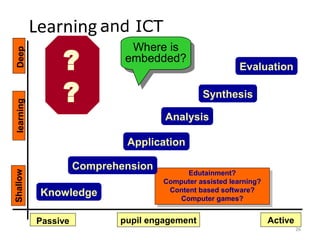
learning

Deep

Learning and ICT

?
?

Where is
Where is
embedded?
embedded?

Evaluation
Synthesis

Analysis

Shallow

Application
Comprehension
Knowledge
Passive

Edutainment?
Edutainment?
Computer assisted learning?
Content based software?
Computer games?
Computer games?

pupil engagement

Active
26
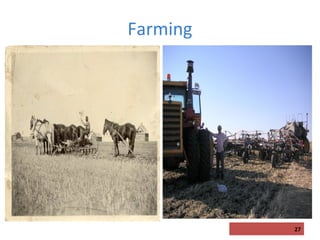
Farming

27
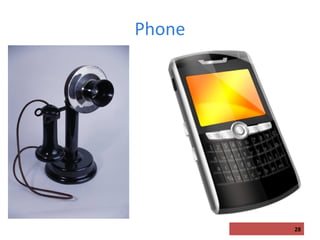
Phone

28
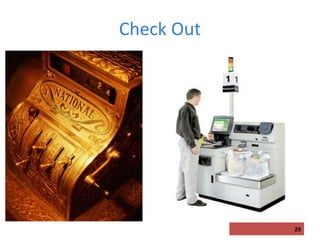
Check Out

29
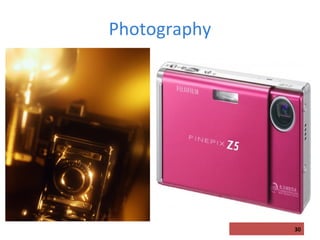
Photography

30
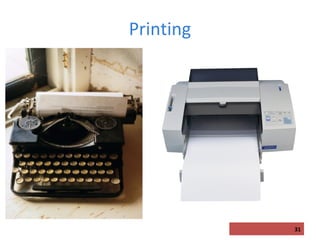
Printing

31
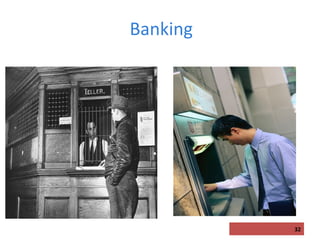
Banking

32
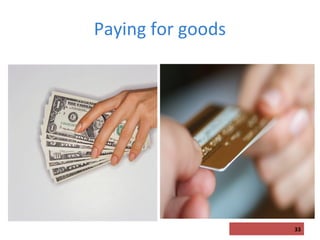
Paying for goods

33
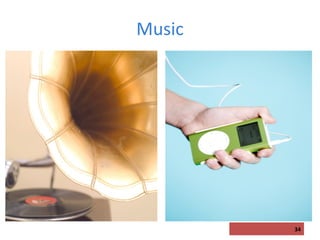
Music

34
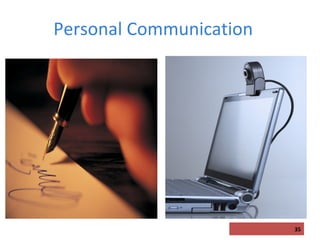
Personal Communication

35
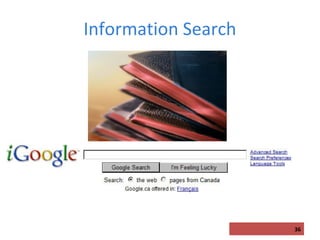
Information Search

36
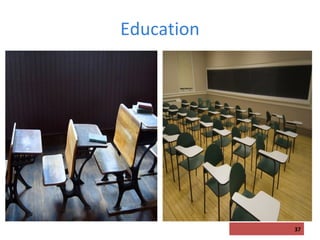
Education

37
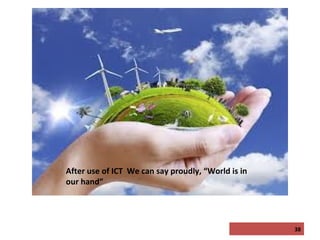
After use of ICT We can say proudly, “World is in
our hand”

38
THANK U

LCT in day2 day life

  • 1.
    ICT in Dayto Day Life RANJIT BANSHPAL rrbanshpal@gmail.com Note-Just send the topic and get ppt…………it’s free*
  • 3.
    Introduction When the firstcomputers made their entry into schools in the late 1970s, we used to speak about computers in education. With computers came printers, floppy disk drives, scanners and the first digital cameras. We began to use the term IT or Information Technology, to describe computers and these various peripheral devices. Then the internet arrived together with computer networks, the World Wide Web, email and search engines. A new term entered the language – ICT. The term ICT, short for Information and Communication Technologies, embraces the many technologies that enable us to receive information and communicate or exchange information with others. Defination:“ ICT itself is the set of activities that facilitate by electronic means the processing, transmission, and display of information.” 1
  • 4.
    Objectives of ICTin Education • To improve 21st Century Critical Learning and Innovation Skills of students. • To improve 21st Century Information, Media, and Technology Skills of students. • To help to fight against world poverty. 2
  • 5.
    • With ICT,the company can make the business easier to happen with the client, supplier and the distributor. • ICT provide right and updated information for taking right decisions. • ICT bring digital economy or economy network. It is one of the economic development pillars to gain national competitive advantage. • The ICT has opened the door to access information worldwide for the teachers and students. 3
  • 6.
    Challenges of ICTIN EDUCATION WORK AND EMPLOYMENT HOME AND DOMESTIC ACTIVITIES PERSONAL AND CITIZEN ACTIVITIES SHOPPING SOCIAL NETWORK,COLLEGUE ,FRIENDS AND FAMILY EVENTS ENCOUNTERS THROUGH MEDIA 4
  • 7.
  • 8.
    In Education sectorICT is used by, 1)Teachers:- Use computers in research for preparing teaching materials, participate in online forums and online conferences as well as to assist their teaching. 2)Students:- Use computers as reference tool. 3)Researchers:- Use computers to collect and process data. 4)School Administrators:-Use computers for administrative purposes to make sure that the entire operation runs smoothly. 6
  • 9.
    Computer are usedin education sector as it offers: •Enhanced learning. •Interactive learning experience. •Cognitive development. •Problem based learning. 7
  • 10.
    Uses of ICTin Education • • • • • • Teaching. Remedial Teaching. Evaluation process. Development of Virtual Laboratory. Online Tutoring/ Training. Developing Instructional Material. 8
  • 11.
    Iteration and modelling Iterationand modelling using ICT; eg in writing, using ICT; eg in writing, design, maths, science design, maths, science and music and music Learners taking more Learners taking more control over the control over the direction of their direction of their learning with ICT learning with ICT Developing thinking skills Developing thinking skills and problem solving and problem solving strategies strategies Deeper analysis of Deeper analysis of concepts, processes concepts, processes and visualisation and visualisation Social collaboration Social collaboration on joint tasks both on joint tasks both face-to-face and in face-to-face and in online collaboration online collaboration 02/03/14 ICT in teaching and ICT in teaching and learning learning Learning out of Learning out of school in other school in other settings and settings and environments environments Creative Creative development and development and media literacy e.g. media literacy e.g. digital video, digital video, photography photography animation, music animation, music Gaining Gaining knowledge, knowledge, understanding and understanding and skills beyond that skills beyond that of the teacher of the teacher Use of ICT to locate, Use of ICT to locate, gather, synthesis, gather, synthesis, analyse reconstruct, analyse reconstruct, communicate and communicate and present information present information and understanding and understanding 11 9
  • 12.
    ICT FOR WORKAND EMPLOYMENT IN BANKING INDUSTRY COMMERCE 10
  • 13.
    ICT FOR WORKAND EMPLOYMENT BANKING The computers, networking and internet are the backbone of the banking system. It functions to control the entire banking system that also includes `Electronic banking Services'(e-banking). In banking: 1) Customers can carry out online transactions (24 Hrs X 7 days). 2) Businessmen can save their time, access company accounts for loan applications, business transactions and update on their cash flow at any time. 3) Bank administrators can monitor entire banking activities. 11
  • 14.
    Developing Financial Literacy Financialliteracy is a skill which helps to take economic decisions. There is considerable deficiency in financial literacy among students and adults. Financial education like E-Banking, E-Cash, Net Banking, E-Trading, using ATM etc. ATM 12
  • 15.
    INDUSTRY Computers are usedto facilitate production planning and control systems, to support `supply chain management' and to help in product design in the industrial sector. 1)Workers- Use machine to carry out routine task. In some productions, robots are used to take over jobs that are dangerous. 2) Researchers– Use computers to analyze and collect research data for development. 3) Administrators- Use computers to oversee the entire operations in the plant or factory. 13
  • 16.
    COMMERCE E-commerce helps inboosting the economy. It makes buying and selling activities easier, more efficient and faster. For this application, computers, internet and shared software are needed. In Commerce: 1) Customers- Use computers to be connected online with suppliers to purchase products. 2) Suppliers- Use computers to keep track of their transactions. 3) Employees- Use computers and telephones to communicate with their customers for any enquiries. 14
  • 17.
    HOME AND DOMESTICACTIVITIES •ICT has a great impact for our daily life, we can read our local news paper. •Connect ourselves to our family, relatives, or colleagues while we are abroad by using the electronic mail, messenger, call conference, or video conference. •Carry out electronic transactions through Debit / Credit cards, net banking, trading of shares and Book Air / Rail tickets •Purchase books / office equipments through commercial web sites •Impart education through interactive web sites •Demonstrate major surgical operations •Watch TV programs, Getting information etc. 15
  • 18.
    PERSONAL AND CITIZENACTIVITIES  To improve quality of human life.  Trading will be easier using ICT.  Help in promoting culture ,tourism and local products.  ICT work as bridge between the Government and the citizen by using e-governance. 16
  • 19.
    SHOPPING Online shopping involvesE-commerce. Electronic commerce draws on such technologies as electronic funds transfer, supply chain management, Online transaction processing, EDI(Electronic Data Interchange) , Inventory management system and automated data collection systems. Electronic commerce is generally considered to be the sales aspect of e-business. 17
  • 20.
    ICT AND SOCIALNETWORK, COLLEGUE, FRIENDS AND FAMILIES EVENTS FASTER COMMUNICATION SPEED With the Internet, news or messages are sent via e-mail to friends, business partners or to anyone efficiently because of the capability of bandwidth, broadband and connection speed on the Internet, information travel fast and at an instant. It saves time and is inexpensive. EFFECTIVE SHARING OF INFORMATION •With the use of ICT, information, news, opinion, mailing lists, forums etc. can be shared by people all around the world. •Example of popular discussion groups on the Internet are: Facebook, Orkut, Google Groups, Yahoo! Groups etc. PAPERLESS ENVIRONMENT This term means information can be stored and retrieved through the digital medium instead of paper. 18
  • 21.
    Encounters through media •ICT have been extensively covered across media and there deal of advertising for consumer products. is a great •Advertising campaigns for multimedia related products and services are one source of exposure. •The newspapers have been picking up on stories that involve the Internet and other technologies for a few years, and these appear scattered throughout the paper, in business, news and technology sections. People can pick up on individual news items or just become aware of general developments through scanning the paper. •Media make people aware of innovations and help them know of certain products and system. 19
  • 22.
    Some Negative EffectsOf ICT Social Problems Health Problem 20
  • 23.
    ICT AND SOCIALPROBLEMS  Today ,people choose online communication rather than real time conversations.  They become more individualistic and introvert.  Social networking sites can cause adverse effect on young mind. 21
  • 24.
    ICT AND HEALTHPROBLEMS A computer may harm users if they use it for long hours frequently. Computer users also exposed to bad posture, eyestrain, physical and mental stress. 22
  • 25.
    This new styleof learning focuses on collaborative knowledge building, shared assets, problem solving, and the breakdown of distinctions between knowledge and communication. Technology Literacy 23
  • 26.
  • 27.
    Virtual environments enhancesstudent learning. puzzle1.html Game-Based Learning 25
  • 28.
    learning Deep Learning and ICT ? ? Whereis Where is embedded? embedded? Evaluation Synthesis Analysis Shallow Application Comprehension Knowledge Passive Edutainment? Edutainment? Computer assisted learning? Computer assisted learning? Content based software? Content based software? Computer games? Computer games? pupil engagement Active 26
  • 29.
  • 30.
  • 31.
  • 32.
  • 33.
  • 34.
  • 35.
  • 36.
  • 37.
  • 38.
  • 39.
  • 40.
    After use ofICT We can say proudly, “World is in our hand” 38
  • 41.