PassivHaus - the solution for low energy building? 
Colin Powell BA(Hons) DipArch Msc RIBA 
gcp : architecture : energy : sustainable design
Content 
• 
PassivHaus primer – a brief outline 
• 
(why) Do clients want PassivHaus 
• 
The problems for PassivHaus design – myths and reality 
• 
Knowledge based design – don’t be frightened by numbers 
• 
Challenges for the designer 
• 
Engaging the user – achieving performance in use 
gcp : architecture : energy : sustainable design
gcp 
architecture : energy : sustainable design 
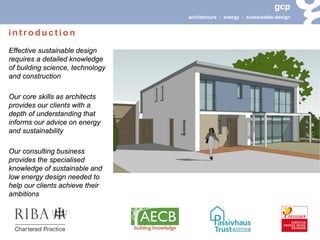
Effective sustainable design requires a detailed knowledge of building science, technology and construction 
Our core skills as architects provides our clients with a depth of understanding that informs our advice on energy and sustainability 
Our consulting business provides the specialised knowledge of sustainable and low energy design needed to help our clients achieve their ambitions 
introduction
gcp 
architecture : energy : sustainable design 
PassivHaus is a design standard for producing buildings with very low energy demand 
Developed in Germany in 1991, now being used around the world as a tried and tested standard 
Not only applicable to housing, it can be used for large and small buildings and refurbishment 
quick outline
gcp 
architecture : energy : sustainable design 
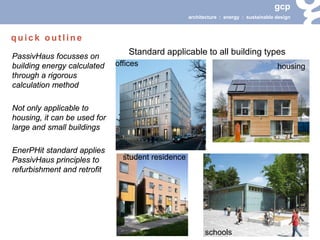
Standard applicable to all building types 
PassivHaus focusses on building energy calculated through a rigorous calculation method 
Not only applicable to housing, it can be used for large and small buildings 
EnerPHit standard applies PassivHaus principles to refurbishment and retrofit 
offices 
schools 
housing 
student residence 
quick outline
gcp 
architecture : energy : sustainable design 
• 
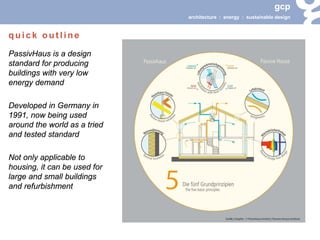
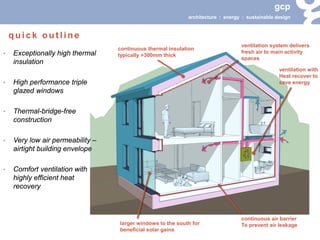
Exceptionally high thermal insulation 
• 
High performance triple glazed windows 
• 
Thermal-bridge-free construction 
• 
Very low air permeability – airtight building envelope 
• 
Comfort ventilation with highly efficient heat recovery 
continuous thermal insulation 
typically >300mm thick 
larger windows to the south for 
beneficial solar gains 
continuous air barrier 
To prevent air leakage 
ventilation system delivers fresh air to main activity spaces 
ventilation with 
Heat recover to save energy 
quick outline
gcp 
architecture : energy : sustainable design 
Govt. Agenda for Carbon Reduction – Climate Change Act 
35% Reduction in CO2 by 2020 
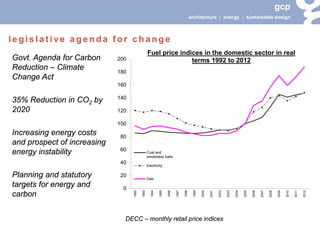
Increasing energy costs and prospect of increasing energy instability 
Planning and statutory targets for energy and carbon 
legislative agenda for change 
DECC – monthly retail price indices 
0 
20 
40 
60 
80 
100 
120 
140 
160 
180 
200 
1992 
1993 
1994 
1995 
1996 
1997 
1998 
1999 
2000 
2001 
2002 
2003 
2004 
2005 
2006 
2007 
2008 
2009 
2010 
2011 
2012 
Fuel price indices in the domestic sector in real terms 1992 to 2012 
Coal and 
smokeless fuels 
Electricity 
Gas
gcp 
architecture : energy : sustainable design 
Clients want reliable solutions that deliver real benefits 
Suspicion of complex renewable technologies that may not deliver reduced energy 
Resistance to sustainability measures that are counter-intuitive 
Need for solutions that are simple and robust 
We are increasingly finding that sustainability is an important driver to occupiers and investors; 
• 
Occupier concern over energy use and running cost 
• 
New taxation (e.g CRC) 
• 
Sustainable buildings give occupiers tangible costs savings (£5.2m saved in past 4 years) 
• 
Holds long term property values with investors 
• 
Now a contractual requirement for our whole supply chain 
(Sarah Cary – Sustainable Development - British Land) 
real-world issues 
In our previous offices, energy costs were over £23,000 per annum and rising fast. Energy costs in the new office are projected to be a credit of £2,000 per annum and rising in line with energy costs, representing a £25,000 per annum saving on the old office. 
(John Walkerdine - Interserve )
gcp 
architecture : energy : sustainable design 
Stable internal temperatures without cold surfaces or draughts 
Reduced risk of overheating 
Controlled ventilation can reduce the risks of respiratory disease 
Thermal performance and air- tightness through rigorous quality control at design and construction stage 
Image courtesy of International PassivHaus Association 
Its not just about money 
“We think each person lifted out of fuel poverty will save the health service about £250 a year. Data suggests there are 20% more deaths in Oldham in winter than in summer because of extra respiratory illnesses and heart problems [linked to cold homes]. If you get a cold winter and people cannot heat their homes, you get more people suffering and turning up in A&E” 
(Guardian Nov.13 – ‘Actively cutting energy bills in Oldham – Welcome to the Passivhauses’)
gcp 
architecture : energy : sustainable design 
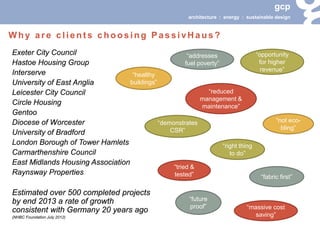
Exeter City Council 
Hastoe Housing Group 
Interserve 
University of East Anglia 
Leicester City Council 
Circle Housing 
Gentoo 
Diocese of Worcester 
University of Bradford 
London Borough of Tower Hamlets 
Carmarthenshire Council 
East Midlands Housing Association 
Raynsway Properties 
Estimated over 500 completed projects by end 2013 a rate of growth consistent with Germany 20 years ago 
(NHBC Foundation July 2012) 
Why are clients choosing PassivHaus? 
“healthy buildings” 
“addresses fuel poverty” 
“reduced management & maintenance” 
“future proof” 
“not eco- bling” 
“demonstrates CSR” 
“fabric first” 
“massive cost saving” 
“tried & tested” 
“opportunity for higher revenue” 
“right thing to do”
gcp 
architecture : energy : sustainable design 
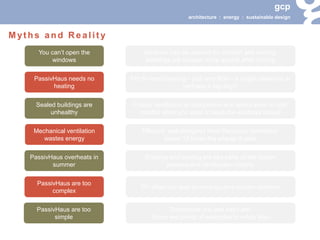
Myths and Reality 
You can’t open the windows 
PassivHaus needs no heating 
Sealed buildings are unhealthy 
Mechanical ventilation wastes energy 
PassivHaus overheats in summer 
PassivHaus are too complex 
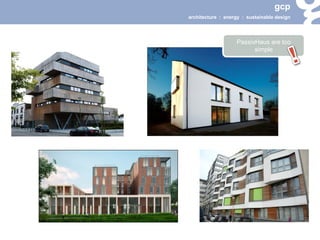
PassivHaus are too simple 
Windows can be opened for comfort and cooling, buildings will recover more quickly after closing 
PH do need heating – just very little – a single towel-rail or perhaps a big dog?! 
Proper ventilation is designed-in and works even in cold months when you want to keep the windows closed 
Efficient, well-designed Heat Recovery Ventilation saves 10 times the energy it uses 
Shading and cooling are key parts of the design process and certification criteria 
PH often use less technology and simpler systems 
Sometimes you just can’t win! (there are plenty of examples to refute this)
gcp 
architecture : energy : sustainable design 
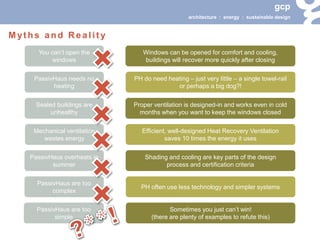
Myths and Reality 
You can’t open the windows 
PassivHaus needs no heating 
Sealed buildings are unhealthy 
Mechanical ventilation wastes energy 
PassivHaus overheats in summer 
PassivHaus are too complex 
PassivHaus are too simple 
Windows can be opened for comfort and cooling, buildings will recover more quickly after closing 
PH do need heating – just very little – a single towel-rail or perhaps a big dog?! 
Proper ventilation is designed-in and works even in cold months when you want to keep the windows closed 
Efficient, well-designed Heat Recovery Ventilation saves 10 times the energy it uses 
Shading and cooling are key parts of the design process and certification criteria 
PH often use less technology and simpler systems 
Sometimes you just can’t win! (there are plenty of examples to refute this)
gcp 
architecture : energy : sustainable design 
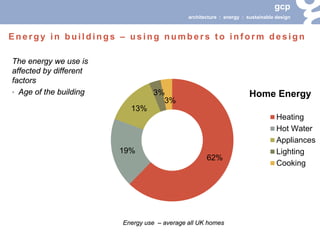
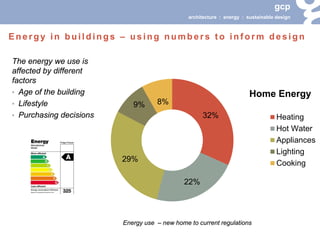
The energy we use is affected by different factors 
• 
Age of the building 
Energy in buildings – using numbers to inform design 
62% 
19% 
13% 
3% 
3% 
Home Energy 
Heating 
Hot Water 
Appliances 
Lighting 
Cooking 
Energy use – average all UK homes
gcp 
architecture : energy : sustainable design 
The energy we use is affected by different factors 
• 
Age of the building 
• 
Lifestyle 
• 
Purchasing decisions 
Energy in buildings 
32% 
22% 
29% 
9% 
8% 
Home Energy 
Heating 
Hot Water 
Appliances 
Lighting 
Cooking 
Energy use – new home to current regulations 
– using numbers to inform design
gcp 
architecture : energy : sustainable design 
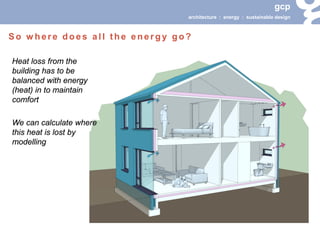
Heat loss from the building has to be balanced with energy (heat) in to maintain comfort 
We can calculate where this heat is lost by modelling 
So where does all the energy go?
gcp 
architecture : energy : sustainable design 
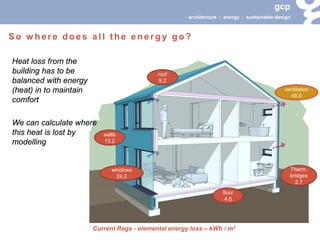
Heat loss from the building has to be balanced with energy (heat) in to maintain comfort 
We can calculate where this heat is lost by modelling 
So where does all the energy go? 
walls 
13.2 
roof 
9.2 
floor 
4.0 
windows 
24.2 
ventilation 
48.0 
Current Regs - elemental energy loss – kWh / m2 
Therm. 
bridges 
2.7
gcp 
architecture : energy : sustainable design 
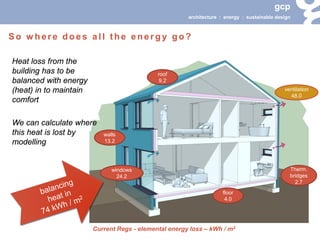
Heat loss from the building has to be balanced with energy (heat) in to maintain comfort 
We can calculate where this heat is lost by modelling 
So where does all the energy go? 
walls 
13.2 
roof 
9.2 
floor 
4.0 
windows 
24.2 
ventilation 
48.0 
Current Regs - elemental energy loss – kWh / m2 
Therm. 
bridges 
2.7
gcp 
architecture : energy : sustainable design 
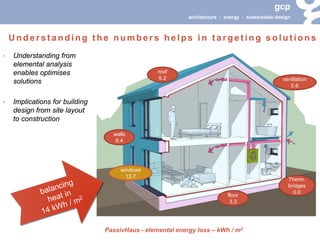
• 
Understanding from elemental analysis enables optimises solutions 
• 
Implications for building design from site layout to construction 
Understanding the numbers helps in targeting solutions 
walls 
8.4 
roof 
5.2 
floor 
3.3 
windows 
13.7 
ventilation 
5.6 
Therm. 
bridges 
0.0 
PassivHaus - elemental energy loss – kWh / m2
gcp 
architecture : energy : sustainable design 
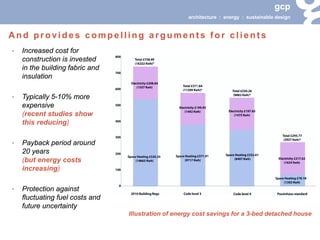
• 
Increased cost for construction is invested in the building fabric and insulation 
• 
Typically 5-10% more expensive (recent studies show this reducing) 
• 
Payback period around 20 years (but energy costs increasing) 
• 
Protection against fluctuating fuel costs and future uncertainty 
Illustration of energy cost savings for a 3-bed detached house 
And provides compelling arguments for clients
gcp 
architecture : energy : sustainable design 
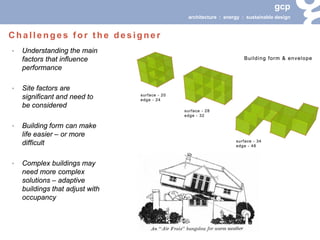
• 
Understanding the main factors that influence performance 
• 
Site factors are significant and need to be considered 
• 
Building form can make life easier – or more difficult 
• 
Complex buildings may need more complex solutions – adaptive buildings that adjust with occupancy 
Challenges for the designer
gcp 
architecture : energy : sustainable design 
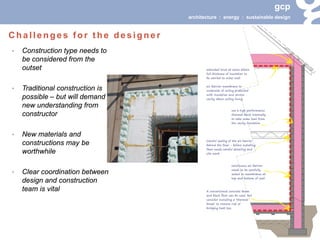
• 
Construction type needs to be considered from the outset 
• 
Traditional construction is possible – but will demand new understanding from constructor 
• 
New materials and constructions may be worthwhile 
• 
Clear coordination between design and construction team is vital 
Challenges for the designer
gcp 
architecture : energy : sustainable design 
• 
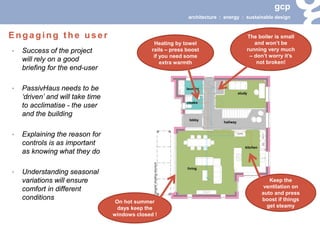
Success of the project will rely on a good briefing for the end-user 
• 
PassivHaus needs to be ‘driven’ and will take time to acclimatise - the user and the building 
• 
Explaining the reason for controls is as important as knowing what they do 
• 
Understanding seasonal variations will ensure comfort in different conditions 
Engaging the user 
On hot summer days keep the windows closed ! 
Heating by towel rails – press boost if you need some extra warmth 
Keep the ventilation on auto and press boost if things get steamy 
The boiler is small and won’t be running very much – don’t worry it’s not broken!
gcp 
architecture : energy : sustainable design 
PassivHaus are too simple
thank you 
gcp : architecture : energy : sustainable design 
www.gcparch.co.uk 
colin.powell@gcparch.co.uk

GCP, PassivHaus - the solution for low energy building? Low Carbon Business Breakfast, The Guild, Coworking Bath, 23 Sept 2014

  • 1.
    PassivHaus - thesolution for low energy building? Colin Powell BA(Hons) DipArch Msc RIBA gcp : architecture : energy : sustainable design
  • 2.
    Content • PassivHausprimer – a brief outline • (why) Do clients want PassivHaus • The problems for PassivHaus design – myths and reality • Knowledge based design – don’t be frightened by numbers • Challenges for the designer • Engaging the user – achieving performance in use gcp : architecture : energy : sustainable design
  • 3.
    gcp architecture :energy : sustainable design Effective sustainable design requires a detailed knowledge of building science, technology and construction Our core skills as architects provides our clients with a depth of understanding that informs our advice on energy and sustainability Our consulting business provides the specialised knowledge of sustainable and low energy design needed to help our clients achieve their ambitions introduction
  • 4.
    gcp architecture :energy : sustainable design PassivHaus is a design standard for producing buildings with very low energy demand Developed in Germany in 1991, now being used around the world as a tried and tested standard Not only applicable to housing, it can be used for large and small buildings and refurbishment quick outline
  • 5.
    gcp architecture :energy : sustainable design Standard applicable to all building types PassivHaus focusses on building energy calculated through a rigorous calculation method Not only applicable to housing, it can be used for large and small buildings EnerPHit standard applies PassivHaus principles to refurbishment and retrofit offices schools housing student residence quick outline
  • 6.
    gcp architecture :energy : sustainable design • Exceptionally high thermal insulation • High performance triple glazed windows • Thermal-bridge-free construction • Very low air permeability – airtight building envelope • Comfort ventilation with highly efficient heat recovery continuous thermal insulation typically >300mm thick larger windows to the south for beneficial solar gains continuous air barrier To prevent air leakage ventilation system delivers fresh air to main activity spaces ventilation with Heat recover to save energy quick outline
  • 7.
    gcp architecture :energy : sustainable design Govt. Agenda for Carbon Reduction – Climate Change Act 35% Reduction in CO2 by 2020 Increasing energy costs and prospect of increasing energy instability Planning and statutory targets for energy and carbon legislative agenda for change DECC – monthly retail price indices 0 20 40 60 80 100 120 140 160 180 200 1992 1993 1994 1995 1996 1997 1998 1999 2000 2001 2002 2003 2004 2005 2006 2007 2008 2009 2010 2011 2012 Fuel price indices in the domestic sector in real terms 1992 to 2012 Coal and smokeless fuels Electricity Gas
  • 8.
    gcp architecture :energy : sustainable design Clients want reliable solutions that deliver real benefits Suspicion of complex renewable technologies that may not deliver reduced energy Resistance to sustainability measures that are counter-intuitive Need for solutions that are simple and robust We are increasingly finding that sustainability is an important driver to occupiers and investors; • Occupier concern over energy use and running cost • New taxation (e.g CRC) • Sustainable buildings give occupiers tangible costs savings (£5.2m saved in past 4 years) • Holds long term property values with investors • Now a contractual requirement for our whole supply chain (Sarah Cary – Sustainable Development - British Land) real-world issues In our previous offices, energy costs were over £23,000 per annum and rising fast. Energy costs in the new office are projected to be a credit of £2,000 per annum and rising in line with energy costs, representing a £25,000 per annum saving on the old office. (John Walkerdine - Interserve )
  • 9.
    gcp architecture :energy : sustainable design Stable internal temperatures without cold surfaces or draughts Reduced risk of overheating Controlled ventilation can reduce the risks of respiratory disease Thermal performance and air- tightness through rigorous quality control at design and construction stage Image courtesy of International PassivHaus Association Its not just about money “We think each person lifted out of fuel poverty will save the health service about £250 a year. Data suggests there are 20% more deaths in Oldham in winter than in summer because of extra respiratory illnesses and heart problems [linked to cold homes]. If you get a cold winter and people cannot heat their homes, you get more people suffering and turning up in A&E” (Guardian Nov.13 – ‘Actively cutting energy bills in Oldham – Welcome to the Passivhauses’)
  • 10.
    gcp architecture :energy : sustainable design Exeter City Council Hastoe Housing Group Interserve University of East Anglia Leicester City Council Circle Housing Gentoo Diocese of Worcester University of Bradford London Borough of Tower Hamlets Carmarthenshire Council East Midlands Housing Association Raynsway Properties Estimated over 500 completed projects by end 2013 a rate of growth consistent with Germany 20 years ago (NHBC Foundation July 2012) Why are clients choosing PassivHaus? “healthy buildings” “addresses fuel poverty” “reduced management & maintenance” “future proof” “not eco- bling” “demonstrates CSR” “fabric first” “massive cost saving” “tried & tested” “opportunity for higher revenue” “right thing to do”
  • 11.
    gcp architecture :energy : sustainable design Myths and Reality You can’t open the windows PassivHaus needs no heating Sealed buildings are unhealthy Mechanical ventilation wastes energy PassivHaus overheats in summer PassivHaus are too complex PassivHaus are too simple Windows can be opened for comfort and cooling, buildings will recover more quickly after closing PH do need heating – just very little – a single towel-rail or perhaps a big dog?! Proper ventilation is designed-in and works even in cold months when you want to keep the windows closed Efficient, well-designed Heat Recovery Ventilation saves 10 times the energy it uses Shading and cooling are key parts of the design process and certification criteria PH often use less technology and simpler systems Sometimes you just can’t win! (there are plenty of examples to refute this)
  • 12.
    gcp architecture :energy : sustainable design Myths and Reality You can’t open the windows PassivHaus needs no heating Sealed buildings are unhealthy Mechanical ventilation wastes energy PassivHaus overheats in summer PassivHaus are too complex PassivHaus are too simple Windows can be opened for comfort and cooling, buildings will recover more quickly after closing PH do need heating – just very little – a single towel-rail or perhaps a big dog?! Proper ventilation is designed-in and works even in cold months when you want to keep the windows closed Efficient, well-designed Heat Recovery Ventilation saves 10 times the energy it uses Shading and cooling are key parts of the design process and certification criteria PH often use less technology and simpler systems Sometimes you just can’t win! (there are plenty of examples to refute this)
  • 13.
    gcp architecture :energy : sustainable design The energy we use is affected by different factors • Age of the building Energy in buildings – using numbers to inform design 62% 19% 13% 3% 3% Home Energy Heating Hot Water Appliances Lighting Cooking Energy use – average all UK homes
  • 14.
    gcp architecture :energy : sustainable design The energy we use is affected by different factors • Age of the building • Lifestyle • Purchasing decisions Energy in buildings 32% 22% 29% 9% 8% Home Energy Heating Hot Water Appliances Lighting Cooking Energy use – new home to current regulations – using numbers to inform design
  • 15.
    gcp architecture :energy : sustainable design Heat loss from the building has to be balanced with energy (heat) in to maintain comfort We can calculate where this heat is lost by modelling So where does all the energy go?
  • 16.
    gcp architecture :energy : sustainable design Heat loss from the building has to be balanced with energy (heat) in to maintain comfort We can calculate where this heat is lost by modelling So where does all the energy go? walls 13.2 roof 9.2 floor 4.0 windows 24.2 ventilation 48.0 Current Regs - elemental energy loss – kWh / m2 Therm. bridges 2.7
  • 17.
    gcp architecture :energy : sustainable design Heat loss from the building has to be balanced with energy (heat) in to maintain comfort We can calculate where this heat is lost by modelling So where does all the energy go? walls 13.2 roof 9.2 floor 4.0 windows 24.2 ventilation 48.0 Current Regs - elemental energy loss – kWh / m2 Therm. bridges 2.7
  • 18.
    gcp architecture :energy : sustainable design • Understanding from elemental analysis enables optimises solutions • Implications for building design from site layout to construction Understanding the numbers helps in targeting solutions walls 8.4 roof 5.2 floor 3.3 windows 13.7 ventilation 5.6 Therm. bridges 0.0 PassivHaus - elemental energy loss – kWh / m2
  • 19.
    gcp architecture :energy : sustainable design • Increased cost for construction is invested in the building fabric and insulation • Typically 5-10% more expensive (recent studies show this reducing) • Payback period around 20 years (but energy costs increasing) • Protection against fluctuating fuel costs and future uncertainty Illustration of energy cost savings for a 3-bed detached house And provides compelling arguments for clients
  • 20.
    gcp architecture :energy : sustainable design • Understanding the main factors that influence performance • Site factors are significant and need to be considered • Building form can make life easier – or more difficult • Complex buildings may need more complex solutions – adaptive buildings that adjust with occupancy Challenges for the designer
  • 21.
    gcp architecture :energy : sustainable design • Construction type needs to be considered from the outset • Traditional construction is possible – but will demand new understanding from constructor • New materials and constructions may be worthwhile • Clear coordination between design and construction team is vital Challenges for the designer
  • 22.
    gcp architecture :energy : sustainable design • Success of the project will rely on a good briefing for the end-user • PassivHaus needs to be ‘driven’ and will take time to acclimatise - the user and the building • Explaining the reason for controls is as important as knowing what they do • Understanding seasonal variations will ensure comfort in different conditions Engaging the user On hot summer days keep the windows closed ! Heating by towel rails – press boost if you need some extra warmth Keep the ventilation on auto and press boost if things get steamy The boiler is small and won’t be running very much – don’t worry it’s not broken!
  • 23.
    gcp architecture :energy : sustainable design PassivHaus are too simple
  • 24.
    thank you gcp: architecture : energy : sustainable design www.gcparch.co.uk colin.powell@gcparch.co.uk