Understand the history of IDEA and the reasons for the federal
government’s call for national intervention into special
educationIdentify and describe the six principles of IDEA.
Review objectives with participants
Understand the effects of personal cultural biases.Discuss
confidentiality, privacy and current issues.Identify resources for
teachers, parents and students.
Review objectives with participants
So who exactly is served in special education?
Exceptional Children
Physical or learning abilities of these children are either above
or below the norm and require a specialized program to meet
their needsDisability/Impairment
Reduced function or loss of a particular body part or organ
A child with a physical disability is not handicapped unless it
impairs educational, personal, social, vocational issues
Handicap
A problem a person with a disability or impairment encounters
interacting with the environmentAt-Risk
A child that is not currently identified as having a disability, are
considered to have a greater than usual chance of developing a
disability.
Also, refers to students who are experiencing learning problems
in the regular classroom
People First Language simply means that we should ALWAYS
put the person first in our descriptions.IDEA supports People
First Language. The term handicapped is replaced with
disability.Examples:
Children with disabilities
Students in special education
Students with learning differences, and
Students with autism.
This is an important concept because there is an expectation
that we do not categorize students by their disability.
MustUseStudentInstead ofCategory
A child evaluated as having. . .
A specific learning disability (LD)
An emotional disturbance (ED)
Intellectual Disability(ID)
A speech or language impairment (SI)
A visual impairment including blindness (VI)
A hearing impairment including deafness (AI)
An orthopedic impairment (OI)
These are the official labeling categories used for a student with
a disability and included next to the category is the acronym
used for each of the disability categories.
traumatic brain injury (TBI)
Autism (AI)
other health impairment (OHI)
multiple disability (MI)
deaf-blindness (DB)
non-categorical early childhood (NCEC)
may used for children ages 3 through 5
These are the official labeling categories used for a student with
a disability and included next to the category is the acronym
used for each of the disability categories. In Texas Students are
labeled by the time they have completed their fifth year;
however in other states in the country they are labeled
developmentally delayed but not given a specific disability
category until nine years of age.
NCEC: suspected of meeting eligibility criteria for:
autism
emotional disturbance
learning disability
Intellectual Disability
Use of the NCEC code is a local district decision
NCEC students must be suspected of meeting the following
criteria in order to be considered for this label. Use of the
NCEC code is a local district decision and you need to check
your district policies to see what the district does for this
population of students.
A Brief History Lesson
Responsibility of the familyResponsibility of institutions
Deaf students
Blind students
Students with Intellectual Disability
Goal: To protect students from society
*
Initially students either stayed home with families that did the
educating or students were institutionalized by families based
on doctor’s recommendations. There was a deep fear that these
students should not be a part of the general public at large.
Responsibility of private schools
Students with Intellectual Disabilities
Teachers compensated financiallyResponsibility of public
schools
Segregated day classes for students with
physical and sensory impairments Goal: To provide
temporary interim placements
*
There began to be a slow movement toward getting students into
some private and segregated public schools but it was very far
and few between and most parents either kept the children at
home or continued to institutionalize their children.Just a note
to the students this was not the parents fault, they were
following their medical doctors advice and did not know to
question the doctors opinion.
The Constitution
10th Amendment
14th AmendmentPublic education is responsibility of
statesPublic education addressed in state constitutionsExclusion
of students with disabilities from compulsory education
(1893-1958)Goal: To protect the larger student population from
students with disabilities
*
The United States Constitution is silent on Education, it is each
state’s decision as to how they run public education. This is
why there can be so much difference in state curriculums for
families who do a great deal of moving, Students with
disabilities still excluded from compulsory education.
Brown v. Board of Education (1954)
Segregation denied equal opportunity under the 14th
AmendmentCivil Rights Act of 1964
Outlawed discrimination by raceElementary and Secondary
Education Act of 1965
Title VI added grants to provide educational programs for
students with disabilities
*
Brown v. Board of Education: Landmark decision stopping the
segregation of African American students from Anglo schools.
This would become a foundation case for special education at a
later date since they used this idea of discrimination of any
person based on race to also state that you should not base
discrimination on disability.Civil Rights Act of 1964 that
continued to outlaw the act of discrimination based on race
continued to break down barriers.Elementary and Secondary
Education Act provided grants but it still was not a requirement
to provide compulsory education to students with disabilities.
PARC v. Pennsylvania (1971)
Class action lawsuit on behalf of
students with intellectual disabilities
Provided all students with intellectual disabilities with free
appropriate public education
*
Landmark case filed by parents of students with mental
retardation set the ball in motion for more groups to follow.
This state litigation began to move us to a more national
platform. There were many other cases going on but these were
some of the most important ones.
Mills v. Board of Education of
District of Columbia
Class action lawsuit on behalf of students with a variety of
disabilities
Mandated a publicly supported education
Required development of due process safeguards
*
First time that parent safeguards were put in place, again this
came from the parents suing the district in a class action
lawsuit.
Focus is on accessibility for studentsProvides auxiliary aides
for students with impaired sensory, manual or speaking skills
such as the following:
Readers for students who are blind
People to assist students with physical disabilities in moving
from place to place
ADHD students
Dyslexia students
Section 504 of the Rehabilitation Act of 1973
Purpose: to prohibit disability-based discrimination by any
agency receiving federal funds
Failed to include criminal or civil remedies for
noncomplianceEducation Amendments of 1974
Extended civil rights protections to persons with disabilities
Addressed least restrictive environment and due process
Believed to be unenforceable
*
Section 504: Stated that if an agency such as a school district
received federal funds, they could not discriminate against a
person with a disability but did not provide any federal dollars
to support the mandate.
Education Amendments of 1974: This law was not enforceable
but did address LRE and Due Process which became part of the
federal law.
IDEA – The Individuals with Disabilities Education Act
Mandates that eligible children with disabilities have available
to them special education and related services designed to
address their unique educational needs.
The IDEA, and most especially the provision of special
education, has its roots in the past.
Present day IDEA was preceded by several laws, beginning in
1965 as stated in previous slides.
*
The first IDEA provision was in place with P.L. 94-142 which
included the basic provisions of what still exists today with
added on parts.
Essential features of a free, appropriate public education:
An IEP developed cooperatively by the local educational agency
and parents
Services provided in accordance with the IEP in the least
restrictive environment appropriate to the child’s needs
Services reasonably calculated to confer educational benefit
An annual review of progress on established goals and
objectives
“ ...special education and related services that - (a) are provided
at public expense, under public supervision and direction, and
without charge. (Authority: 20 U.S.C. 1401 (8))
Essential features of a free, appropriate public education:
Instruction that is specifically designed to meet the unique
needs of a student with a disability
Instruction that is based upon an adequate and appropriate
evaluation of a child’s needs and abilities
Related services, as required, to assist a child with a disability
to benefit from special education
“ ...special education and related services that - (a) are provided
at public expense, under public supervision and direction, and
without charge. (Authority: 20 U.S.C. 1401 (8))
Education of All Handicapped Children Act (P.L. 94.142)
Provided federal funding to support a
Free Appropriate Public Education (FAPE) for all students
with disabilities, ages 5-21
Zero Reject
Required an Individualized Education Program (IEP) for each
student
Mandated placement in the least restrictive environment (LRE)
*
These founding six principles that were the hallmark of PL 94-
142 are still the basic principles that are founded in IDEA
which has been authorized four times with the fifth re-
authorization occurring in Congress now. The law has changed
and been enhanced; however, these basic six principles are still
valid and pertinent and are basic principles that have never
changed.
Education of All Handicapped Children Act (P.L. 94.142)
Provided for nondiscriminatory testing, evaluation, and
placement procedures
Included provisions for procedural due process, including
parental involvement
Goal: To provide access to schools
*
These founding six principles that were the hallmark of PL 94-
142 are still the basic principles that are founded in IDEA
which has been authorized four times with the fifth re-
authorization occurring in Congress now. The law has changed
and been enhanced; however, these basic six principles are still
valid and pertinent and are basic principles that have never
changed. Handouts 0, Page 10-15 has detailed information and
legal information regarding these six principles, please find
these handouts for an activity following slide 34-35 regarding
these six principles.
Related Services and Assistive Technology
Recreation
Rehabilitative services
School Health services
Social Work services
Speech Therapy [Instruction in Texas]
Transportation
Assistive Technology
These are some examples of related services and rehabilitative
services offered to students. In Texas, Speech Language
Pathology is an instructional arrangement not a related service
in most other states it is considered a related service. On the
Services Pages for students Speech will be coded as
instructional time for a student out of their school day.
Services provided
Board of Education of Hendrick
Hudson Central School District v. Rowley (1982)
Districts not obligated to provide perfect educational equity
Districts not required to provide services in a manner that
unduly diminishes the education of students without disabilities
*
This was an important landmark case in the sense that students
do not need to have the Lexus model of education everyone
deserves to get the Ford or Cheverlot but not everything that the
student or parent thinks they need to be successful. It is only to
provide a level playing field for the students.
Services provided
Irving Independent School District v. Tatro (1984)
Catheterization required as related service
*
Important case in a suburban Dallas Texas district where the
district did not feel that it should have to pay for a nurse to
catheterize a student and that the student should be on home
bound services. The parents took this case all the way to the
Supreme Court and the court found for the parents stating in
order to provide a Free Appropriate Public Education you must
provide access to the school and the school needed to pay for
the nurse and catheterization services. This is a landmark case
that is used by parents all the time to fight districts to pay for
these services especially since it is a Supreme Court decision.
Some Important Points About Related Services and Assistive
Technology
An assistive technology assessment and a related service
assessment must be considered for each disabled child if
requested by anyone.
A related service must be based on educational need
How do you determine educational need?
Assessment by qualified district personnel
Determination of educational need
Yes, if a parent, child, teacher, administrator or anyone that
works with a disabled child feels that a child needs assistive
technology or a related service such as counseling, occupational
therapy, physical therapy etc an assessment must be done by a
licensed person in that area for example a licensed Occupational
Therapist would do the assessment if the child needed adaptive
materials. A parent can get an independent evaluation however
the district only needs to consider this information. It can
accept the independent evaluation but all districts will have
their staff do an evaluation of the student.The district can also
review an outside evaluation but not take that evaluation into
consideration.Related Services and Assistive Technology must
be based on an educational need not a medical need
Example
Assessment report is presented at an ARD (Annual Review and
Dismissal) meeting
Johnny’s parents feel that he would be a better student with a
laptop computer.
An assessment determines that Johnny is passing courses with
B’s and some A’s using note-taking guides in class including:
graphic organizers
outlines from the teacher
notes from a peer, and
modified tests
How do you determine Educational Need?
Does Johnny need a laptop computer based on the
assessment? Yes or No
The answer is no, if he can do the work without an laptop and
get a “B” it is a nice item to have but not something needed to
level the playing field. This is not an educational need.
Public Law 99-457 extended provisions to preschool children by
Congress in 1986
Each state was required to serve all preschool children with
disabilities age 3-5 fully--or lose all federal funds for preschool
children
Incentive grant program--Children Birth to Two years old who
needed early intervention services
This was the added age group of 3 to 5 year olds and also
incentive programs for Children Birth to Two which includes
Auditory Impairments, Visual Impairments and some severe
multiply impaired students.
Educational planning for a child with a disability should be
done on an individual basis.
Parents should participate in the development of their child’s
IEP.
Decisions about a child’s eligibility and education should be
based on accurate and objective information.
Individuals with Disabilities Education Act (IDEA) of 1990
This was the next re-authorization of IDEA with some added
stipulations to the law. The six basic principles established in
PL 94-142 still remained in the law.
A child with a disability should be provided access to the
general education curriculum.
A child with a disability should be educated in general
education to the maximum extent appropriate with necessary
supports and services.
Parents and educators should have a means of resolving
differences about eligibility, the IEP, educational placement, or
provision of FAPE.
Individuals with Disabilities Education Act (IDEA) of 1990
This was the next re-authorization of IDEA with some added
stipulations to the law. The six basic principles established in
PL 94-142 still remained in the law.
An employer with 15 or more employees may not refuse to hire
or promote a person with a disability if they are qualified to
perform the jobPublic accommodations must provide access to
disabled individualsTelecommunications for the deafPublic
transit systems must provide accessible vehicles.
All students have access to district and state testing programs
(State Assessment, SDAA, LDAA)
All students have access to the general education curriculum
(TEKS)
Regular education teachers are included in the ARD meeting
Parents are partners in all decisions
Goal: Access to the Curriculum
All students will have access to District and State Curriculum
and Assessments was a new stipulation in the 1997 law. The six
basic principles of IDEA still remained in this law.
Re-affirmed commitment to early childhood intervention
Each state required to develop a comprehensive interagency
program for early intervention services including
Medical
Educational assessment
Physical, Occupational Therapy
Speech Therapy
Parent counseling and training
IDEA 1997
Re-Authorization of Individuals with Disabilities Act of 1997
This focus on Early Childhood Intervention was much more
prominent in the IDEA Re-Authorization.
States must ensure that FAPE is available to all children with
disabilities residing in the state between the ages of 3 and 21,
including children with disabilities who have been suspended or
expelled from school
34 CFR Section 612(a)(1)
IDEA 1997
Re-Authorization of Individuals with Disabilities Act of 1997
This new definition included students who were suspended or
expelled from school as part of the definition of FAPE.
The term “special education” means specifically designed
instruction, at no cost to parents to meet the unique needs of the
child with a disability, including—
(A) instruction conducted in the classroom, in the home, in
hospitals and institutions, and in other settings; and
(B) instruction in physical education
34 CFR Section 602(25)
IDEA 1997
Re-Authorization of Individuals with Disabilities Act of 1997
This slide shows that students can be in a wide variety of
settings where they can be served.
The ultimate goal is that all children will be proficient in all
subject matter by the year 2014
(A) instruction is provided by highly qualified teachers
(B) use of instructional practices based on research
(C) corrective actions put in place if not followed; and,
(D) instruction in physical education
Goal: Equity for All Students
NCLB 2001
Re-Authorization of the Elementary and Secondary Education
Act
NCLB 2001IDEA 2004Academic content and achievement
standardsSpecial Education (IEPs)
Annual assessments
Participation in all state and district wide assessmentsQualified
general education teachersQualified special education
teachersAccountability
Access to general curriculum
The law retained major components and principles of IDEA, key
changes included:
(A) benchmarks and short-term objectives required only in
IEP’s for students who take alternative assessment
(B) response to instruction may be used as a method to identify
students with learning disabilities
(C) highly qualified special education teachers defined; and,
(D) students may be removed from school to an interim
placement for up to 45 school days whether or not misconduct
was related to the child’s disability.
Goal: Equity for All Students
IDEA 2004
Re-Authorization of Individuals with Disabilities Act of 2004
STAAR- The Next Generation
A new testing journey begins with the launch of the State of
Texas Assessments of Academic Readiness or STAAR in the
2011-2012 school year. The standardized testing program
includes tests for students in grades
3-12.
STAAR Modified
State developed content modified in format and design
STAAR ALT
State developed assessment tasks linked to TEKS
Texas Public Schools Mission [TEC 4.001]
The mission of public education in this state is to ensure that
all Texas children have access to a quality education that
enables them to achieve their potential and fully participate now
and in the future in the social, economic, and educational
opportunities of our state and nation.
Ask the students to discuss what they think is the most
important word our our Texas School Mission for students with
disabilities? I would say it is that we ensure that all students in
Texas will have access to a quality education
Special Education
Access to schools curriculum classrooms
Child-centered based on individual strengths and areas of need
Collaboration among professionals parents agencies
These are the three areas that we provide children support in
with special education services.
The selective placement of special education students in one or
more “regular” education classes based on projected
“successfulness”
Opportunities are “earned”
Students must “keep up” in the regular classroom
Special education classes are separate and supportive
This was the original model of special education where students
had to earn their way into general education. Not our current
model.
The commitment to educate each child, to the maximum extent
appropriate in the school and/or classroom he or she would
otherwise attend, if not disabled.
Bringing the support services to the child
Allowing the child to benefit from the class
Favoring newer forms of educational service delivery
The issue of inclusion is a “full school” issue / not just an issue
between the general ed. teacher and the special ed. teacher.
Must continually reassess and restructure inclusive programs
IEP teams must carefully choose modifications and
accommodations / choose only modifications that child MUST
have in order to be success/ Examine personnel issues, etc.
(vertical teaming is a must)
“Co-teaching is not a way to support a weak teacher.”
Paras are Tools to facilitate inclusion
Least Restrictive Environment (LRE)
The term “inclusion” is not referenced in federal statute (ie:
Law)
Children with disabilities must be educated with children
who are not disabled to the maximum extent appropriate
Removal from regular education only when nature and severity
of disability precludes education in regular classes, even with
use of supplementary aids and services
(Authority: U.S.C. 1412 (a) (5) )
You always start with the general education classroom and than
move to more restrictive placements depending on the student’s
needs.
Continuum of Services Provided
“Each public agency shall ensure that a continuum of
alternative placements is available to meet the needs of
children with disabilities for special education and related
services.” (Authority:20 U.S.C. 1412 (a) (5))
LRE: Least Restrictive Environment meaning the place where
the student fits into the program best.
Texas Design
Regular Classroom with Supports
Co-Teaching
Content Mastery
Resource
Self-Contained
Day Schools
Residential Placement
Homebound/Hospital
Federal Design
Regular Classroom
Resource Room
Separate Classroom
Separate School
Residential Facility
Homebound/Hospital
These are different continuums for where a student could be
placed with the ARD committee always starting at the general
education classroom first.
THE CHILD-CENTERED EDUCATION PROCESS
Referral Initiated
Explanation of Procedural Safeguards
Consent for Assessment
Comprehensive Assessment Completed
Notice of ARD
ARD / IEP Meeting
Consent for Initial Placement
Initiation of Services
Annual ARD / IEP Review
Reevaluation Decisions
This is the child centered process from beginning to end. The
instructor has these master teacher handouts that will need to be
laminated and cut out. You give each table group a copy of
each of the steps and see if they can put them into a set order
than you provide them with the answers. This is a good way to
see if they can place these in the correct order and to start the
discussion of the whole child centered process in Texas.
Close the research to practice gapIncrease availability and
intensity of early intervention and prevention servicesHelp
students transition from school to adult lifeImprove the special
education general education partnership
As elementary students work through the reading process, they
must learn about multiple meaning words. Multiple meaning
words are those words with one spelling but connotation varies
depending on the usage.
Examples of multiple meanings words are bat, ring, page, level,
and vanity.
What multiple meaning words can you think of? Did
“inclusion” come to mind?
Inclusion has become one of those multiple meaning words. It
is a challenge for schools that wish to implement inclusive
settings because schools must first define inclusion as it best
fits their students and local campus’ needs. Schools must also
determine the roles of the regular education teacher and the
special education teacher. Schools have several models of
inclusion from which to choose.
Model 1
Model 2
Model 3
Model 1: All students with disabilities are in regular education
classes all day, however it is possible that they may receive
support in the regular classroom.
Model 2: All students with disabilities are in regular education
but only on a part-time basis. They are “pulled out” to
specialized instruction when an IEP warrants the individualized
assistance to maintain progress and it is determined that the
regular classroom can not meet the need.
Model 3: If a separate special school is determined appropriate
then a separate school could be part of the inclusion plan.
(Sack, 1997)
The No child Left Behind Act (NCLB) of 2001 reauthorized and
amended federal education programs established under the
Elementary and Secondary Education Act (ESEA) of 1985. The
major focus of NCLB is to provide all children a fair, equal, and
significant opportunity to obtain a quality education.
The Individual with Disabilities Education Act (IDEA) created a
federal right to special education for eligible students with
disabilities. This right compels school districts to provide a
free appropriate public education (FAPE) to all students with
disabilities. The law states: the education should be to the
maximum extent appropriate … with children who are not
disabled, and that special classes, separate schooling, or other
removal of children with disabilities from the regular
educational environment occurs only when the nature or
severity of the disability is such that education in regular
classes with the use of supplementary aids and services cannot
be achieved satisfactorily. (IDEA, 20, U.S.C. 1412, (5)(B)
After school districts determine which model of Inclusion best
fits the local campus needs, the challenge is set to apply the
requirements from NCLB and IDEA. One way to provide
services to students with disabilities in regular educations
settings is through the use of Co-Teaching and In-Class Support
Facilitation.
Definition- A formal year–long or semester-long commitment
between a general education teacher and a special education
teacher to jointly plan, deliver, and asses instruction for all
students in the general education class . These teachers must
engage in intentional planning time each week.
(Alief ISD)
Definition- A special education staff member (teacher,
paraprofessional, SLP, interventionist, etc.) who provides a
variety of supports, either to students and/or to the general
education teacher on a regularly schedule basis.
(Alief ISD)
Through effective co-teach and support facilitation models
special education student’s time in the general education
curriculum increases. It also decreases a school’s reliance on
special education placement to solve learning and behavior
problems.
Principal Leadership
Little and Theker, 2009
The idea of co-teaching and support facilitation must consider
not only academic successes but also embrace a sociology of
acceptance of all children into the school community as active,
fully participating members.
(Tash, 1993)
It is important that all students are: Presumed
competentWelcomed as valued members in general education
and extra curricular activitiesLearn side by side their non-
disabled peersHave instruction based on general
curriculumExperience reciprocal social relationships
(Tash, 2012)
As early as 1989, during the decade which emphasized
“Inclusion” as the new buzz word, Stainbeck, Stainbeck and
Forest agreed that “some parents feel that if an integrated
society is desired (regular/special ed.) , it is essential that the
mainstream be adaptive and sensitive to the unique needs of all
students and that positive peer relationships and friendships be
fostered for all students so they will feel welcome and secure.
Teachers that are proficient in differentiated instruction are
necessary for the student with special needs in a regular
classroom setting but they must also be aware of the
social/emotional needs of their students as well.
Collaborative
Teaming
Coaching
Consultant
ACADEMIC MODELS
Support Facilitation teacher monitors progress and supports
teacher in planning for progress.Support Facilitation teacher
monitors IEP and ensures that the teaching strategies provide a
pathway for IEP success.Support Facilitation teacher monitors
social/emotional progress within the school community.
Coaching is often the role of a department chair or an
administrator. Sometimes districts may provide mentors that
can assist in coaching for teachers. They can observe the
delivery of a lesson, planning session, or view a video of the
regular education teacher and special education teacher and
offer a critique with suggestions for best practices.
One Teach - One Observe – the teacher that is observing is
gathering data to be used in planning quality instruction
Examples of one teacher observing looks like:
Which students initiate conversations in cooperative groups
Which students begin/do not begin work promptly?
Is student A inattentive behavior less, about the same, or
greater
than that of other students in the class?
One Teach - One Drift.
Examples of one teach and one drifts looks like:
One teacher delivers instruction and the other teacher provides
unobtrusive assistance to students.
One teacher is primarily responsible for delivering instruction
while the other teacher watches
It is a way for a new co-teacher to observe a new environment
and become familiar with the classroom routines
Parallel Teaching
Examples of Parallel Teaching
The class is split into two groups and each student can share
their ending to a story.
Two groups of students in a science class are performing a lab
that needs close supervision.
Two groups of students are each constructing opposing sides to
a debate and are supported by one of the teachers. They are
learning the same strategies of debate but are researching
different views.
Station Teaching
Examples of Station Teacher looks like:
During language arts class, one station address comprehension,
one station focuses on editing and one station is an activity for
the skill being taught
During social studies, class rotates to different stations. They
will explore the geography, economy and culture of a region or
country.
During math, the students rotate through stations of review, use
of manipulatives, non verbal representations of a math problem
and a quiz station.
Alternative Teaching
Examples of Alternative Teaching looks like:
One teacher focuses on planned lesson for the math unit and the
other teacher is reteaching a math skill to a small group.
One teacher is continuing with a review of material for an
upcoming assessment and the other teacher is enriching the
learning of the students that have mastered the content and do
not need the review.
Team Teaching
Examples of Team Teaching looks like:
Both teachers are delivering instruction in a conversation like
manner. There is equal interaction between them.
In science, one teacher is performing the lab and the other
teacher is “talking through” the lab.
(Friend and Cook, 2004)
Yell and Drasgow (1999). A legal Analysis of Inclusion.
Preventing School Failure, 43, no 3 118-23 Spring 1999.
Little, Mary E., Theker, Lisa (2009). Coteaching: Two Are
Better Than One. Principal Leadership (Middle Scholl Edition),
9, n0. 8 42-6 April 2009.
Individuals with Disabilities Education Act, 20 U.S.C. 140-1485
(1990)
No child Left Behind Act (NCLB) of 2001
Stainback, S.,Stainback,W., and Forest, M. (Eds.) (1989).
Educating all Students in the Mainstream of Regular Education.
Baltimore: Paul H. Brooks Publishing Co.
The Association for Persons with Severe Handicaps (TASH),
1993
TASH.org (2012)
Gately, S. (2005). Two Are Better than One. Developing
Exemplary Teachers, May 2005
Friend and Cook (2004). Co-Teaching: Principles, Practices and
Pragmatics. New Mexico Public Education Department,
Quarterly Special Education Meeting, Albuquerque NM., April
29, 2004
READING STRATEGIES
FOR
ADVANCED PRIMARY READERS
Texas Reading Initiative Task Force for the
Education of Primary Gifted Children
Edited by
Bertie Kingore
COPYRIGHT NOTICE: Copyright © TEA staff, 2004 . The
Materials are
copyrighted © and trademarked ™ as the property of the Texas
Education Agency and
may not be reproduced without the express written permission
of the Texas Education
Agency, except under the following conditions:
1) Texas public school districts, charter schools, and Education
Service Centers may
reproduce and use copies of the Materials and Related Materials
for the districts’
and schools’ educational use without obtaining permission from
the Texas
Education Agency;
2) Residents of the state of Texas may reproduce and use copies
of the Materials
and Related Materials for individual personal use only without
obtaining written
permission of the Texas Education Agency;
3) Any portion reproduced must be reproduced in its entirety
and remain unedited,
unaltered and unchanged in any way;
4) No monetary charge can be made for the reproduced
materials or any document
containing them; however, a reasonable charge to cover only the
cost of
reproduction and distribution may be charged.
Private entities or persons located in Texas that are not Texas
public school districts or
Texas charter schools or any entity, whether public or private,
educational or non-
educational, located outside the state of Texas MUST obtain
written approval from the
Texas Education Agency and will be required to enter into a
license agreement that may
involve the payment of a licensing fee or a royalty fee.
A C K N O W L E D G E M E N T S
The Texas Primary Reading Initiative Task Force for the
Education of Primary Children
wishes to express its gratitude to:
• Evelyn Levsky Hiatt, Senior Director, Advanced Academic
Services, Texas Education Agency and
• Ann Wi n k, Director of Elementary Gifted Education,
Advanced Academic Services, Te x a s
Education A g e n c y
for their vision of excellence and dedication to young advanced
and gifted children.
A RT AND GRAPHIC DESIGN
J e ffery Kingore
Art and graphic design copyright 2002 by Jeffery Kingore
Reprinted in this text with permission
E D I TO R I A L A S S I S TA N T S
Nicole Drane
Matthew Kingore
The websites referenced in this text do not necessarily reflect
the positions and philosophies of the Texas Education A g e n c
y.
These text materials are copyrighted by and the property of the
State of Texas and may not be reproduced
without the written permission of the Texas Education Agency,
except under the following conditions:
1 . Any portion reproduced will be used exclusively for
educational purposes;
2 . Any portion reproduced will be reproduced in its entirety
and not altered in any form; and
3 . No monetary charge will be made for the reproduction of
the documents or materials contained
within them, except for a reasonable charge covering the cost to
reproduce and distribute them.
Texas Reading Initiative Task Force
for the Education of Primary Gifted Children
2 0 0 0 - 2 0 0 2
MEM B E R S
D r. Bertie Kingore, Chair
Consultant, Professional Associates Publishing, A u s t i n
D r. Amanda Batson
Texas Association for Gifted and Talented, A u s t i n
D r. Shirley V. Dickson
Director of Statewide Curriculum Initiatives, Texas Education A
g e n c y, A u s t i n
Krys Goree
Program Director of Texas Beginning Educator Support System
(TXBESS) and Gifted
Education Consultant, Baylor University, Wa c o
Susan Spates
Coordinator of Gifted and Talented, Pasadena ISD, Pasadena
Ann Tr u l l
D i r e c t o r, Elementary and Gifted Education, Paris ISD,
Paris
Ann Wi n k
Director of Elementary Gifted Education, Division of Advanced
Academic Services,
Texas Education A g e n c y, A u s t i n
D r. Keith Yo s t
Program Director Humanities, CREST, Tomball ISD, To m b a l
l
Laura Yo u n g
Talented and Gifted Facilitator, Killeen ISD, Killeen
i
While the Texas Student Success Initiative was created to
ensure that all Te x a s
children are able to read on or above grade level by the end of
third grade, many
Texas primary-aged children already read at advanced levels.
These children
should also have the right to progress academically.
The Texas Reading Initiative Task Force for the Education of
Primary Gifted Children
has prepared this publication to assist the classroom teacher in
identifying children
who may be advanced learners and in preparing reading
activities appropriate to
their learning level. Following the Texas tradition of supporting
reading instruction
based on scientific research, this work is based on empirical
evidence surrounding
these children’s specific learning needs.
Reading Strategies for Advanced Primary Readers, produced by
the Texas Reading
Initiative Task Force for the Education of Primary Gifted
Children, expands teacher
knowledge about the characteristics and needs of advanced and
gifted readers. In
addition, it explains how to differentiate reading instruction for
these children and
provides the classroom teacher with helpful strategies and ideas.
In essence, this publication defines yet another dimension of the
Texas Student
Success Initiative and expands its goal of providing all Texas
children with the tools
they need to have successful academic careers.
Melanie Pritchett
Assistant Commissioner
O ffice of Statewide Initiatives
Texas Education A g e n c y
i i
The Texas Student Success Initiative is committed to assuring
that every child
reads at least on grade level by the third grade. It is also
committed to assuring
that all children continually improve their reading ability and
skills. That means stu-
dents must be challenged to read progressively more
sophisticated material that is
commensurate with their abilities.
F r e q u e n t l y, people say that advanced readers "learn to
read by themselves." It is
true that many young gifted students come to our schools
already able to read
material of varying complexity. But this does not mean that the
students will sustain
their interest in reading or savor the pleasures of reading to
discover new ideas, far
o ff places, and interesting people. Teachers play a critical role
in encouraging
young readers to improve their reading skills. It is hoped that
this publication will
provide a background and activities to assist teachers in
providing an appropriate
learning environment for even our most gifted readers.
This document reflects the dedication of many Texas educators
that all students,
even those who already read at or above grade level, must be
instructed on how
they might better use their considerable skills. It was developed
over the course of
a year through long meetings, many rewrites, and intense
discussion about how
teachers might best engage advanced readers so they not only
maintain but also
expand their repertoire of skills and competencies. The Texas
Education A g e n c y
thanks the committed volunteers of the Texas Reading Initiative
Task Force for the
Education of Primary Gifted Children for their assistance.
We hope that readers of this publication will provide feedback
about how they
used this document and how it might be improved. Anyone may
contact us at
< g t e d @ t e a . s t a t e . t x . u s > .
Evelyn Hiatt
Senior Director
Advanced Academic Services
i i i
INTR O D UCT I O N
Customizing language arts instruction to match the
individual differences and readiness levels of all children is a
demanding task facing primary teachers. The adjustment
demands more than flexibility in methods and materials; it
requires a belief that each child has the right to progress as
rapidly as he or she is capable. Advanced and gifted readers
have the ability to read beyond grade level. Thus, they risk
receiving less instructional attention when concerned teach-
ers struggle to meet the needs of children performing below
grade level. While it is critical that all children receive the
support necessary to read at least at grade level, students
who have achieved this goal must be challenged to continue
developing advanced proficiencies.
One factor that discourages the continued reading
development of advanced readers is the use of less diff i c u l t
books. Chall and Conard (1991) continue to research the
match of text difficulty to reader readiness. They found that
the reading texts for advanced readers “...provided little or no
challenge, since they were matched to students’ grade place-
ments, not their reading levels.” Chall, who also researched
text difficulty in 1967 and 1983, noted that “This practice of
using grade-level reading textbooks for those who read two or
more grades above the norm has changed little through the
years, although it has been repeatedly questioned” (111).
GAS
For decades, educators assumed that primary-aged children who
read early
or at advanced levels had been pushed by a well-intending
adult. The accompanying
conventional wisdom has been that these students plateau and
read at grade level
by third or fourth grade.
Reading Strategies for Advanced Primary Readers 1
Indeed, recent studies document that advanced readers who are
limited to a
grade-level reading program do regress on standardized tests
and in their pace of
progress (CAG, 1999; Reis, 2001). At the same time, other
studies substantiate that
when advanced readers are taught with resources and instruction
commensurate
with their needs and abilities, regression does not take place. By
eliminating work on
skills already mastered and progressing through the language
arts curriculum at an
accelerated pace, students generally continued to extend their
reading proficiency
( G e n t r y, 1999; Kulik & Kulik, 1996). The evidence from
these research studies
demonstrates that to continue optimum learning, advanced
readers need to be chal-
lenged through instruction at their highest readiness level and
most appropriate
pace. Teachers need support and strategies to manage this
challenge within the
diversity of a classroom that also includes a wide range of
children who experience
d i fficulty in learning to read.
The reading strategies presented in this publication are designed
to provide
teachers with alternatives and replacement tasks to use in
differentiating lessons
for students who are assessed as developed on the Texas
Primary Reading
Inventory (TPRI) or other appropriate reading tests. After
teacher modeling and
demonstrations, advanced students can use many of these
strategies individually
or in small groups as teachers provide direct instruction to other
groups of students.
The strategies and examples in this book have been assembled
from teaching
experiences based upon research and responses to the nature and
needs of gifted
learners. All of the strategies relate to the Task Force’s Position
Statement that follows.
Texas Reading Initiative Task Force for the
Education of Primary Gifted Children
POSITION STAT E M E N T
The goal of the Texas Reading Initiative is for all children to
read on or above
grade level by the end of the third grade. Although this goal is
critical, it is
minimal relative to students who read well. The Texas Reading
Initiative
does not intend for advanced readers to stagnate or regress.
Rather, the
objective is that all students, including advanced readers,
receive instruction
and materials commensurate with their abilities. Advanced
readers must
progress at their appropriate rate, which is typically more than
one grade
level per year. The result of ignoring gifted readers is
educationally and emo-
tionally unjust to these children.
I n t r o d u c t i o n 2
The Task Force also developed the following eleven Reading
Recommendations
for Advanced Learners. As each strategy is discussed
throughout this publication, the
applicable Reading Recommendations are listed.
Texas Reading Initiative Task Force for the
Education of Primary Gifted Children
Reading Recommendations
for Advanced Learners
1 . Use preinstruction assessment to accurately determine
students'
instructional and independent levels of reading.
2 . Use a variety of assessments beyond standardized
achievement tests
to document students' progress and guide instruction.
3 . Use strategies geared to gifted students' instructional
needs including
curriculum compacting, advanced content, appropriate pacing,
and
above grade-level materials.
4 . Focus on far greater depth and complexity.
5 . Incorporate into reading programs rich, inviting tasks
requiring spatial
as well as analytical and abstract thinking.
6 . Encourage students to develop more complex, high-level
comprehen-
sion and reach advanced interpretations.
7 . Encourage and support advanced levels of vocabulary and
word study.
8 . Promote students' research using technology to generate
original i n v e s-
tigations and advanced products.
9 . Provide frequent opportunities for students to explore
authentic text and
a variety of genres.
1 0 . Allow students to pursue individual interests through
reading.
11 . Provide examples of superior work in order to challenge
students to
ever-increasing levels of excellence.
This publication briefly discusses the characteristics and needs
of advanced and
gifted readers and then addresses differentiation strategies for
reading instruction. T h e
strategies include authentic assessment and documentation,
curriculum compacting,
tiered assignments, flexible grouping, high-level thinking and
inquiry, visual tools for
individuals or groups, and vocabulary and word play. Each
strategy includes a brief
explanation, connections for advanced and gifted learners,
discussion of research, and
Reading Strategies for Advanced Primary Readers 3
multiple applications appropriate to primary advanced readers.
Printed-text and internet
resources are listed at the end of each section. This publication
concludes with an
Appendix addressing assessment as a guide to reading
instruction.
R e f e r e n c e s
CAG (California Association for the Gifted). (1999).
Academic advocacy for the forgotten readers--
Gifted and advanced learners. C o m m u n i c a t o r, 30 (1): 1,
33-35.
Chall, J. & Conard, W. (1991). Should textbooks challenge
students? The case for easier or
harder textbooks . New York: Teachers College Press.
G e n t r y, M. (1999). Promoting student achievement and
exemplary classroom practices through
cluster grouping: A research-based alternative to heterogeneous
elementary classrooms.
Storrs, CT: The National Research Center on the Gifted and Ta l
e n t e d .
Jackson, N. & Roller, C. (1993). Reading with young children .
Storrs, CT: The National Research
Center on the Gifted and Ta l e n t e d .
Kulik, J. & Kulik, C. (1996). Ability grouping and gifted
students. In Colangelo, N. & Davis, G.,
Eds. Handbook of gifted education , 2nd ed. Needham Heights,
MA: Allyn & Bacon.
Reis, S. (2001). What can we do with talented readers?
Teaching for High Potential, III (1): 1-2.
I n t r o d u c t i o n 4
U NDE RSTAN D I N G
AD VANCED AN D
G IFTED READERS
A myriad of characteristics are associated with
advanced potential. The brief list shared in this section is spe-
cific to behaviors demonstrated in language arts instruction
rather than inclusive of all areas of the curriculum. It is not
expected that a gifted reader would demonstrate all or even
most of the listed behaviors. Hence, the behaviors are worded
as to what advanced and gifted readers m a y demonstrate in
order to provide teachers with some specific ideas regarding
what giftedness looks and sounds like as children learn
t o g e t h e r.
The list is organized into seven categories characteristic
of advanced and gifted students (Kingore, 2001). All children
may demonstrate some of the characteristics in these cate-
gories some of the time. For example, all children can and
should engage in analytical thinking. However, advanced and
gifted students stand out in these categories as their responses
are noticed as beyond expectations, more complex, accelerated,
and higher-level than the behaviors of age-mates.
Using these seven categories, a distinction between
advanced and gifted students becomes clearer. While
advanced students may excel in one or more categories,
gifted students typically excel in three or more categories.
Advanced readers may
only demonstrate advanced levels in reading (Jackson et al,
1993), whereas gifted
readers may also use their advanced reading ability to accelerate
learning in other
academic areas.
Reading Strategies for Advanced Primary Readers 5
However bright students may be, they are less likely to
demonstrate
advanced or gifted performance if learning experiences are
limited to the regular,
grade-level reading curriculum. Duke (2000) found
informational texts almost nonex-
istent in first grade classrooms, yet gifted readers demonstrate a
voracious appetite
for nonfiction. Other studies admonish that instruction in most
regular classes
includes few, if any, provisions for advanced or gifted learners
(Ross, 1993;
Westberg et al, 1993).
S t u d e n t s ’ behaviors can be perceived as positive or
negative depending upon
the situation and the observer (Kingore, 2001). Richert (1997;
1982) noted that
behaviors interpreted as negative tend to screen gifted students
out of consideration
for gifted programs. Slocumb and Payne (2000) stress that
teachers must consider
both positive and negative behaviors if students from poverty
are to be recognized
for their gifted potentials. Thus, both the positive and negative
manifestations of gift-
edness are included in this overview. To accent the relationship
between both points
of view, the negative behaviors are correlated to the positive
gifted characteristic
that may be associated.
Categories of Characteristics
of Advanced and Gifted Readers
POSITIVE CHARACTERISTICS
Advanced Language
• Reads one to five years or more above grade level
• Is articulate; has advanced oral skills and a strong vocabulary
• Uses language ability to display leadership qualities
• Reads differently for different purposes or materials
Analytical Thinking
• Demonstrates complex and abstract thinking when responding
to text
• Works an advanced problem to its conclusion
• Connects ideas across a range of circumstances and materials
• Enjoys logic problems, complex puzzles, and word games
Understanding Advanced and Gifted Readers 6
Meaning Motivation
• Makes philosophical statements that exceed expectations for
age
• Prefers to work independently
• Concentrates/reads for long periods of time on a topic of
personal interest
• Asks penetrating, intellectual questions
P e r s p e c t i v e
• Is creative or inventive in approaches to problems
• Oral interpretations and written responses represent multiple
points of view
• Draws pictures from unexpected angles and dimensions
• Infers possibilities missed by peers: It could also mean that...
Sense of Humor
• Understands humor and puns missed by age peers in a story
• Uses figurative language for humorous eff e c t
• Has a more sophisticated sense of humor and understands
adults’ j o k e s
• Enjoys books with multiple layers of humor
S e n s i t i v i t y
• Wants to discuss character motivation with a depth that
exceeds the interest
of peers
• Expresses concern for human needs in the story, community,
and world
• Verbally or nonverbally demonstrates concern for the feelings
and motivations
of characters, peers, or adults
• Seeks resolution for anything perceived as injustice
Accelerated Learning
• Seeks and enjoys advanced-level challenges
• Requires minimum repetition for mastery of language arts
skills
• Displays musical, artistic, numerical, mechanical, or
intellectual abilities beyond
expectations for age
• Wants to read and develop a depth and complexity of
information about a
topic beyond the interests or attention span of most classmates
• Accesses data with ease using an unexpected variety of
technological tools
and printed resources
Adapted from the K O I (Kingore, 2001)
Reading Strategies for Advanced Primary Readers 7
N E G ATIVE CHARACTERISTICS
• Is self-critical; impatient with failures • • •
• Appears bored with routine curriculum • • •
• Makes jokes or puns at inappropriate times • •
• Refuses to do rote homework • • •
• Shows erratic behavior; easily upset; overreacts • • •
• Does messy work • • •
• Is demanding of teachers’ and other adults’ t i m e • • • •
• Dominates other children • • • •
• Seems intolerant of others • • • •
• Is reluctant to move to another topic • •
Adapted from Richert (1997, 1982) and Kingore (2001).
Expectations to Ponder
Advanced and gifted readers are children first and need to be
valued for who
they are, not what they are. Consider the following points as
you plan appropriate
learning experiences to match the readiness level of advanced
readers.
• The younger the child, the more inconsistent the test
behaviors (Jackson &
R o l l e r, 1993; Roedell et al., 1980).
• Children may have gifted heads and hearts, but their hands
are more age-bound.
Gifted primary children may have poor coordination and may
not enjoy lengthy
written tasks (Kingore, 2001).
• Many gifted children are asynchronous--the levels of their
cognitive, social, and
physical development vary. Skills in some academic areas may
be significantly
above age expectations while other areas may match regular
curriculum expec-
tations (Silverman, 1993).
Understanding Advanced and Gifted Readers 8
• Children can be advanced in reading and not in other
academic areas. All preco-
cious readers are not necessarily gifted. All gifted children are
not necessarily
advanced in reading (Jackson & Roller, 1993).
• The most sophisticated and enthusiastic precocious
readers are those children who
have driven their parents and teachers to keep up with them
(Jackson & Roller, 1993).
• Reading materials for advanced and gifted readers need to
be sufficiently challenging
and engaging yet appropriate in content. Materials should match
both their linguistic
and social/emotional development (Polette, 2000; Jackson &
Roller, 1993).
• Many talented students become underachievers in later
grades if their learning
environments are unchallenging (Reis et al, 1995).
• Recognizing that some students have gifted potentials
does not make them more
important or more valuable. Having gifted potential means that
students learn dif -
f e r e n t l y than others--not that they are better than others
(Kingore, 2001).
Gifted Readers Like...
A classic study by Dole and Adams (1983), surveyed gifted
students to elicit
their perceptions of the most important attributes of good
reading materials. A s u m-
mary of those findings is included here.
• Sophisticated beginning-to-read books
• Nuanced language
• Multidimensional characters
• Visually inventive picture books
• Playful thinking
• Unusual connections; finding patterns and parallels within
and among books
• Abstractions and analogies
• A blend of fantasy and non-fiction
• Extraordinary quantities of information about a favorite
topic
• Books about gifted children
Use this information as a guide to prepare questions for
surveying gifted stu-
dents in your class or even all of the gifted students in your
school. What do they most
like or dislike about reading? What do they most want in books
and stories? What
makes them pick up a book and want to read it? We can better
customize reading
instruction to challenge advanced readiness levels and motivate
gifted learners when
we understand how to more closely match their preferences and
interest.
Reading Strategies for Advanced Primary Readers 9
R e f e r e n c e s
Dole, J. & Adams, P. (1983). Reading curriculum for gifted
readers: A
s u r v e y. Gifted Child Quarterly, 27.
Duke, N. (2000). 3.6 minutes per day: The scarcity of
international texts in
first grade. Reading Research Quarterly, 35, 2 0 2 - 2 2 4 .
Kingore, B. (2001). The Kingore observational inventory (KOI),
2nd ed.
Austin: Professional Associates Publishing.
Jackson, N. & Roller, C. (1993). Reading with young children.
Storrs, CT: The National Research
Center on the Gifted and Ta l e n t e d .
Polette, N. (2000). Gifted books, gifted readers. Englewood,
CO: Libraries Unlimited, Inc.
Reis, S., Hebert, T., Diaz, E., Maxfield, L., & Ratley, M.
(1995). Case studies of talented students
who achieve and underachieve in an urban high school. Storrs,
CT: National Research
Center on the Gifted and Ta l e n t e d .
Richert, E., Alvino, J., & McDonnel, R. (1982). National report
on identification: Assessment and
recommendations for comprehensive identification of gifted and
talented youth. Wa s h i n g t o n ,
DC: U.S. Department of Education, Educational Information
Resource Center.
Richert, E. (1997). Rampant problems and promising practices
in identification. In N. Colangelo &
G. Davis, Eds. Handbook of gifted education. Boston: Allyn &
Bacon.
Roedell, W., Jackson, N., & Robinson, H. (1980). Gifted young
children. New York: Te a c h e r s
College Press.
Ross, P. (1993). National excellence: The case for developing A
m e r i c a ’s talent. Washington, DC:
U.S. Department of Education, Office of Educational Research
and Improvement.
Silverman, L. (1993). Counseling the gifted and talented.
Denver: Love Publishing Company.
Slocumb, P. & Payne, R. (2000). Removing the mask:
Giftedness in poverty. Highlands, TX: RFT
P u b l i s h i n g .
Westberg, K., Archambault, F., Jr., Dobyuns, S., & Salvin, T.
(1993). The classroom practices
observation study. Journal for the Education of the Gifted, 1 6 (
2 ), 120-146.
Additional Resources
Collins, N. and Alex, N. (1995). Gifted readers and reading
instruction. ERIC Digest, EDO-CS-95-04.
Halstead, J. (1994). Some of my best friends are books. Dayton,
OH: Ohio Psychology Press.
Kingore, B. (2001). Gifted kids, gifted characters, & great
books. Gifted Child To d a y, 24 (1), 3 0 - 3 2 .
Polette, N. (2001). Non fiction in the primary grades. Marion,
IL: Pieces of Learning.
1 0 Understanding Advanced and Gifted Readers
We b o g r a p h y
Hoagies Gifted Educations. <www. h o a g i e s g i f t e d . o r g
>
National Association for Gifted Children (NAGC). <www. n a g
c . o r g >
N R C / G T online resources. National Research Center on the
Gifted and Ta l e n t e d .
< w w w. g i f t e d . u c o n n . e d u / n r c o n l i n . h t m l >
Texas Association for the Gifted and Talented (TAGT). <www.
t x g i f t e d . o r g >
Texas Education Agency (TEA). <www. t e a . s t a t e . t x . u s
>
Reading Strategies for Advanced Primary Readers 11
1 2 Understanding Advanced and Gifted Readers
A U T H E N T I C
A S S E S S M E N T:
D O C U M E N TAT I O N
OF LEARNING
Strategy Introduction
Assessment drives instruction as it documents that
learning has occurred and guides which instructional objec-
tives to pursue. To be authentic, assessment must be ongoing,
occur in natural learning situations, and involve real learning
tasks. Those tasks should require students to generate
responses rather than choose among descriptors, as in a
forced choice response.
It is important to use a balance of data from authentic
assessments and standardized tools. A combination of tests
and assessments ensures a more accurate consideration of
the multiple facets of children’s talents.
For the gifted primary reader, comprehension should
be assessed authentically. A test in which students list the
name of the main character and bubble-in the main idea lim-
its the gifted student’s opportunities to demonstrate more
advanced interpretations. Oral summaries via tape recorders,
creation of a hyper-studio stack for use by other students,
reading/writing logs, and other creative, open-ended options
provide broader opportunities to demonstrate comprehension
depth and complexity.
TEXAS
Reading Strategies for Advanced Primary Readers 1 3
Assessment tasks provide tangible evidence of students’
understanding and
growth before instruction begins (preassessment), as instruction
progresses (forma-
tive assessment), and at the end of a segment of instruction
(summative assessment)
( Tomlinson, 2002). Many teachers need a larger repertoire of
authentic assessment
procedures to implement with their students, so a variety of
options are discussed in
this section.
Reading Recommendations for Advanced Learners
Authentic assessment is applicable to the following reading
recommendations that are listed on page
three: 1, 2, 4, 6, 10, and 11 .
Texas State Plan for the Education of Gifted/Talented Students
Several statements in the Texas State Plan (2000) support
incorporating authentic assessment for
documentation of the learning achievements of gifted students.
• School districts assure an array of learning opportunities
that are commensurate with the abilities
of gifted/talented students... (2.1A; 3.1A; 19 TAC §89.3)
• Program options enable gifted/talented students to work
together as a group, work with other
students, and work independently... (2.2A; 19 TAC §89.3(1))
• School districts shall ensure that student assessment and
services comply with accountability
standards...(2.6A; 10 TAC §89.5)
• Opportunities are provided for students to pursue areas of
interest in selected disciplines through
guided and independent research. (3.1.1R)
• A continuum of learning experiences is provided that
leads to the development of advanced-level
products and/or performances. (3.2A; 19 TAC §89.3(2))
• Student progress/performance in programs for the gifted is
periodically assessed, and this
information is communicated to parents or guardians. (3.6R)
Overview of Research
Authentic assessment applications are required to provide
curriculum and
instruction appropriate for advanced and gifted learners.
Researchers document the
f o l l o w i n g .
• Early assessment of a child’s reading and writing skills
may facilitate the develop-
ment of appropriate curriculum for both precocious and slow-to-
develop readers
(Jackson & Roller, 1993).
• Gifted learners should experience consistent opportunities
to demonstrate previous
mastery before a particular unit of work is taught (Wi n e b r e n
n e r, 2001).
1 4 Authentic A s s e s s m e n t
• Gifted readers may be able to read at a higher level than
they can comprehend
(Assouline, 1997). However, assessment may document that
they also compre-
hend at a higher level than adults assume.
• A curriculum to develop high potentials assesses both
concrete and abstract
products. Concrete products (skills and the range of things
students produce) are
vehicles through which abstract products are developed and
applied. A b s t r a c t
products are the more enduring and transferable outcomes of
learning, including
frameworks of knowledge, ideas, problem-solving strategies,
attitudes, values,
and self-efficacy (Tomlinson et al, 2002).
• E ffective curriculum helps learners monitor their work to
ensure competent
approaches to problem solving. It involves students in setting
goals for their
learning and assessing their progress toward those goals
(Tomlinson et al, 2002).
A p p l i c a t i o n s
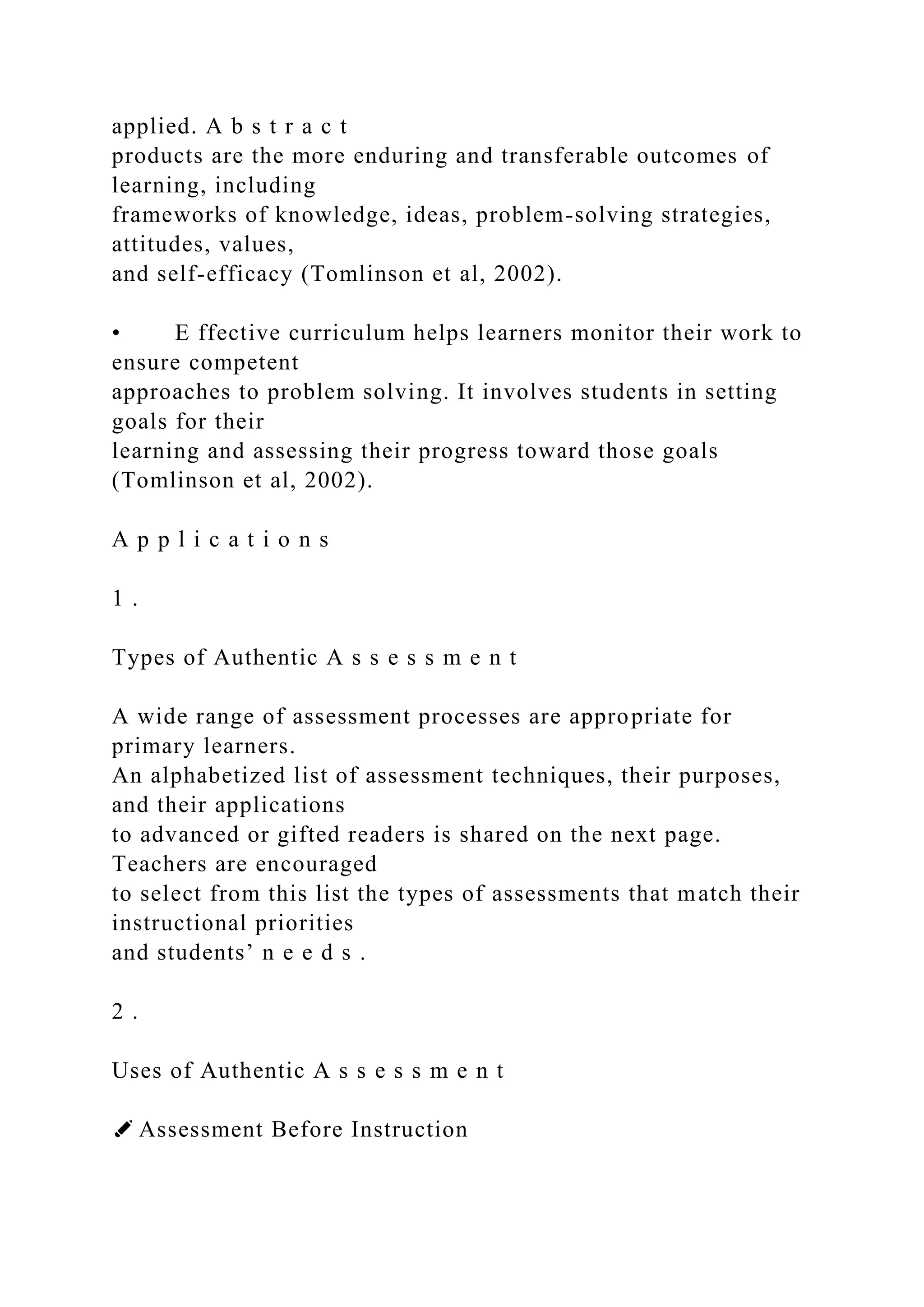
1 .
Types of Authentic A s s e s s m e n t
A wide range of assessment processes are appropriate for
primary learners.
An alphabetized list of assessment techniques, their purposes,
and their applications
to advanced or gifted readers is shared on the next page.
Teachers are encouraged
to select from this list the types of assessments that match their
instructional priorities
and students’ n e e d s .
2 .
Uses of Authentic A s s e s s m e n t
✐ Assessment Before Instruction
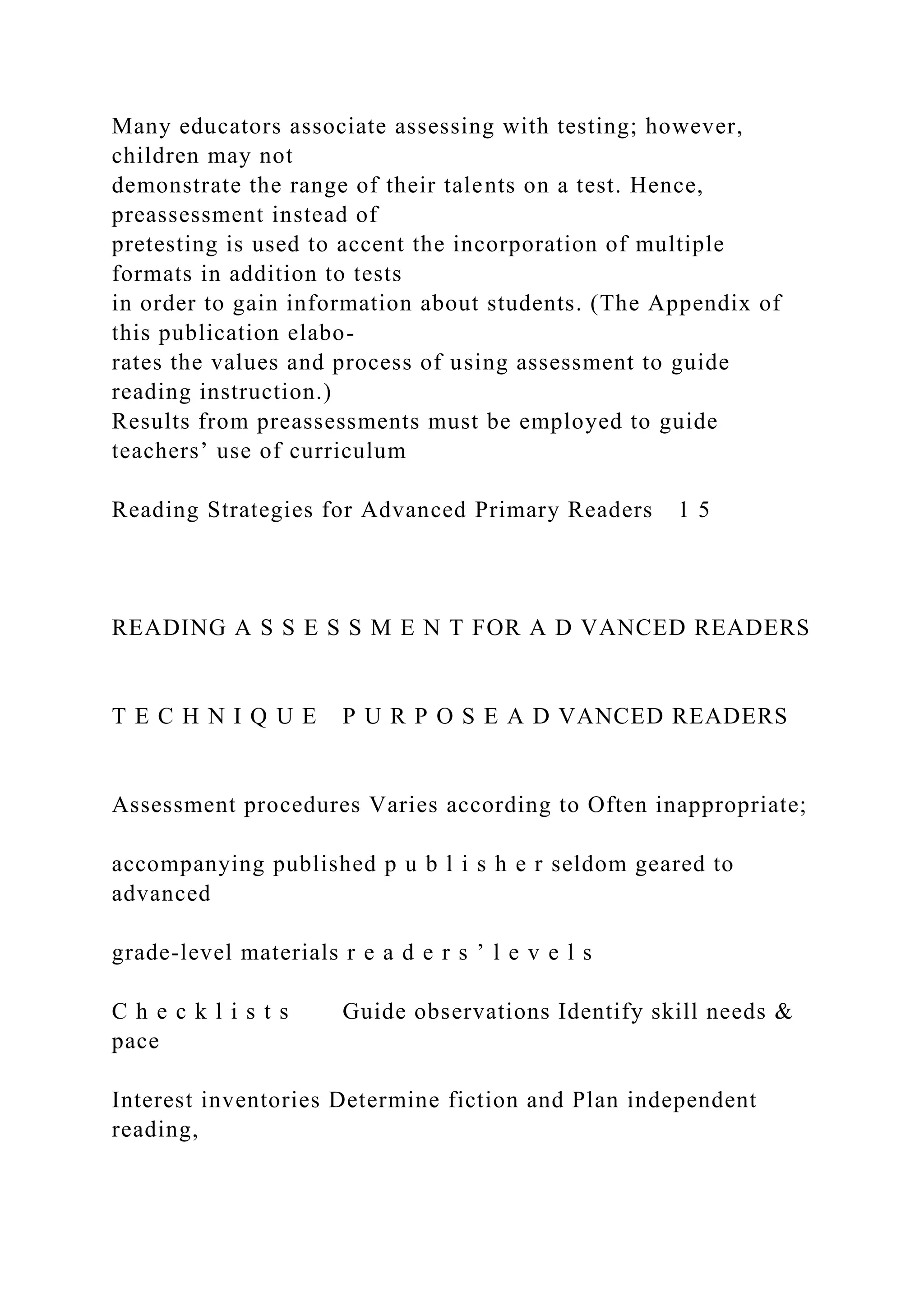
Many educators associate assessing with testing; however,
children may not
demonstrate the range of their talents on a test. Hence,
preassessment instead of
pretesting is used to accent the incorporation of multiple
formats in addition to tests
in order to gain information about students. (The Appendix of
this publication elabo-
rates the values and process of using assessment to guide
reading instruction.)
Results from preassessments must be employed to guide
teachers’ use of curriculum
Reading Strategies for Advanced Primary Readers 1 5
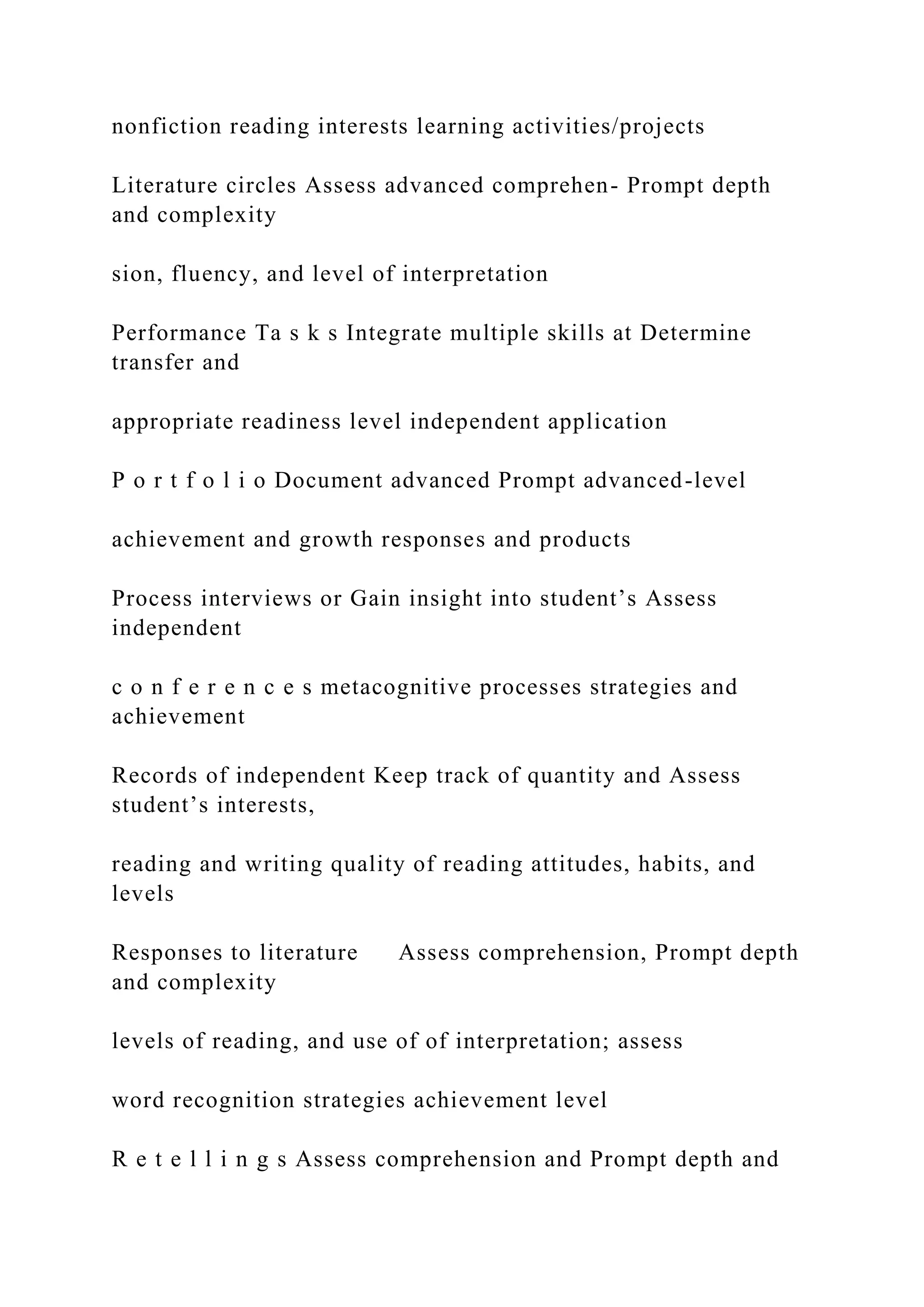
READING A S S E S S M E N T FOR A D VANCED READERS
T E C H N I Q U E P U R P O S E A D VANCED READERS
Assessment procedures Varies according to Often inappropriate;
accompanying published p u b l i s h e r seldom geared to
advanced
grade-level materials r e a d e r s ’ l e v e l s
C h e c k l i s t s Guide observations Identify skill needs &
pace
Interest inventories Determine fiction and Plan independent
reading,
nonfiction reading interests learning activities/projects
Literature circles Assess advanced comprehen- Prompt depth
and complexity
sion, fluency, and level of interpretation
Performance Ta s k s Integrate multiple skills at Determine
transfer and
appropriate readiness level independent application
P o r t f o l i o Document advanced Prompt advanced-level
achievement and growth responses and products
Process interviews or Gain insight into student’s Assess
independent
c o n f e r e n c e s metacognitive processes strategies and
achievement
Records of independent Keep track of quantity and Assess
student’s interests,
reading and writing quality of reading attitudes, habits, and
levels
Responses to literature Assess comprehension, Prompt depth
and complexity
levels of reading, and use of of interpretation; assess
word recognition strategies achievement level
R e t e l l i n g s Assess comprehension and Prompt depth and
complexity
i n t e r p r e t a t i o n s of interpretation
Running records Assess fluency and transfer of Identify skill
needs
decoding strategies
Student self-evaluations Increase student responsibility
Enhance motivation for
for learning; elicit student’s excellence rather than only
p e r c e p t i o n s focusing on a grade
Teacher-selected reading Assess comprehension, word Compare
growth over time;
s a m p l e s recognition strategies, fluency, insure that beyond
grade-
and readiness level level growth continues
1 6 Authentic A s s e s s m e n t
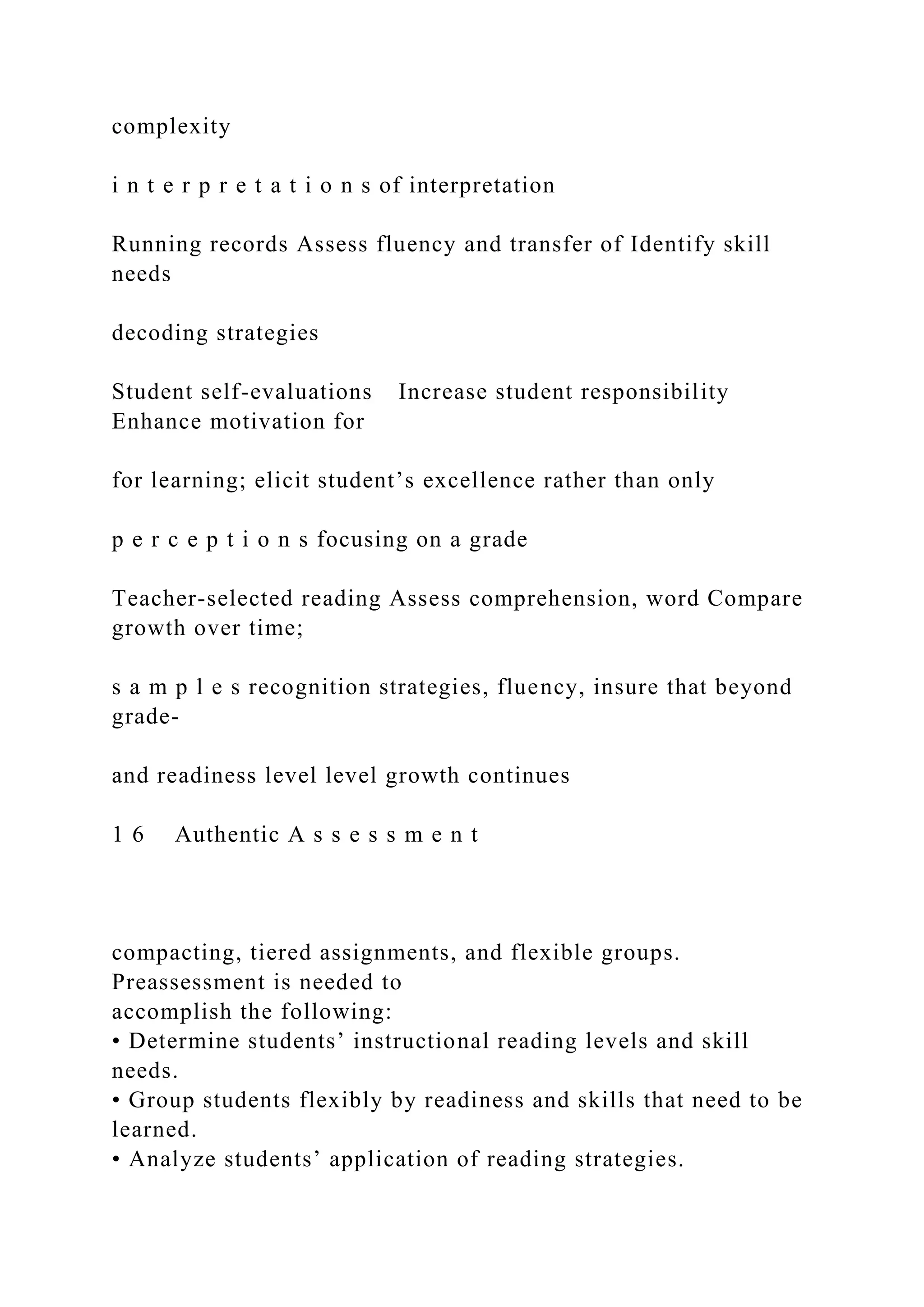
compacting, tiered assignments, and flexible groups.
Preassessment is needed to
accomplish the following:
• Determine students’ instructional reading levels and skill
needs.
• Group students flexibly by readiness and skills that need to be
learned.
• Analyze students’ application of reading strategies.
• Provide information for selecting and pacing appropriate
instructional materials.
TYPES OF ASSESSMENT THAT CAN BE USED AS
PREASSESSMENTS
❑ C h e c k l i s t s ❑ Records of independent reading
❑ Interest inventories ❑ Running records
❑ O b s e r v a t i o n s ❑ S t u d e n t s ’ s e l f - e v a l u a t i o
n s
❑ Performance tasks ❑ Teachers’-selected reading samples
❑ Process interviews ❑ Writing samples
✐ Formative and Summative A s s e s s m e n t s
Formative assessments should occur throughout a unit of study
to guide a
t e a c h e r’s instructional decision-making. Checklists,
participation in literature circles,
observations, process interviews, retellings, and running records
are some exam-
ples that are effective for the feedback a teacher needs to
determine the pacing of
reading instruction.
Summative assessments document students’ levels of
achievement following
instruction and guide the flexible regrouping of students for
reteaching or advancing
to the next instructional segment. Performance tasks, products
from students’
responses to literature, retellings, and students’ self-evaluations
are effective exam-
ples of summative assessments in reading.
✐ S t u d e n t s ’ S e l f - a s s e s s m e n t s
Students increase their responsibility for their own learning by
assessing
their work before it is graded or shared with others. One focus
of self-assessment
with primary-aged children is the use of metacognitive
responses (developed later
in this section). A second focus is the use of rubrics.
Rubrics are guidelines to quality. They provide a clearer view
of the merits
and demerits of students’ work than grades alone can
communicate. Rubrics show
Reading Strategies for Advanced Primary Readers 1 7
students how they are responsible for the grades they earn
rather than to continue
to view grades as something someone gives them (Kingore,
2002). Pictorial rubrics
are effective for children with limited reading and writing
development. To use the
example on the next page, a student or teacher fills in the kind
of product or task
at the top of the rubric. In the blanks at the bottom of the form,
teachers fill in their
preferred evaluation scale, such as less than expected,
appropriate work, very well
done, and outstanding work. After modeling and successful
experiences with multi-
ple rubrics, some gifted learners may be able to develop their
own rubrics and other
methods to assess their independent study projects (Wi n e b r e
n n e r, 2001).
The criteria on a rubric should inform students what attributes
to include in a
product to demonstrate their understanding of the information
they acquire. Criteria
must accent content rather than just focus on appearance and
how to complete the
product. With advanced and gifted learners the emphasis should
include depth and
c o m p l e x i t y.
Complexity Too simple or Simple informa- Information shows
not appropriate tion; limited critical thinking;
critical thinking compares a n d
c o n t r a s t s
Beyond expected
level; analyzes
from multiple
points of view
Content Needs more Needs to add Covers topic well; Precise;
in-depth;
depth information or depth or develops informa- supports
content
more accurate elaboration tion beyond facts
information and details
Adapted from: Rubrics and More! (Kingore, 2002)
✐ Determining Interests
Teachers use ongoing assessment of students’ interests and
learning profiles
for the purpose of matching instructional tasks to students’
needs (Tomlinson, 1999).
Interest inventories, interviews, and conferences provide
insights into students’
interests and passions, thus guiding opportunities for teacher-
suggested and stu-
d e n t s ’ self-selected reading materials. Advanced and gifted
readers need time to
pursue their interests through reading. They require access to
fiction materials and
informational texts several grade levels above the class average
to continue their
reading development.
1 8 Authentic A s s e s s m e n t
1 . Complete and detailed
2 . Content and information
I wro I wrote a I wrote some. I wrote
l i t t l e . I learned. i n t e r e s t i n g
information.
I tried to
learn more.
3 . O r g a n i z a t i o n
4 . Neat and attractive
Reprinted with permission: Kingore, B. (2002). Rubrics and
More!
Austin: Professional Associates Publishing.
Reading Strategies for Advanced Primary Readers 1 9
My goal is
What I will do to achieve my goal
When I want to reach my goal
On the back, write what you accomplish.
✐ Goal Setting
As active participants in their learning, students are encouraged
to review
their work, assess its strengths, and then set goals for growth
and development.
Most primary students need modeling and assistance to learn
how to set realistic,
appropriate goals and plan specific steps to accomplish their
goals. Goal setting is
particularly useful to increase independence when advanced and
gifted students
work on replacement tasks and independent or guided studies.
The contract exam-
ples in Curriculum Compacting serve as effective next steps
after goal setting.
3 .
Student-Managed Portfolios
Farr (1998) describes a portfolio as evidence of the student's
progress
as a thinker and language user. Kingore (1999) describes a
portfolio as
a systematic collection of student work selected largely by that
student
to provide information about the student’s attitudes, motivation,
levels of
achievements, and growth over time.
Portfolios offer a concrete record of the development of
students’ talents and
achievements during a year or more. In classrooms where all
students develop
portfolios, the portfolio process enables each student to be
noticed for the level of
products he or she produces. In this manner, portfolios increase
inclusion instead
of exclusion by providing multiple opportunities for children
from every population
to demonstrate talents and gifted potential. Portfolio assessment
allows schools to
honor the diversity of students and discover the strengths of
each learner.
2 0 Authentic A s s e s s m e n t
*Examples of Portfolio Products
PRODUCT EXPLANATION PURPOSE
A r t
Audio tapes
C o m p u t e r
p r o d u c t s
D i c t a t i o n s
Graphs or
c h a r t s
P h o t o g r a p h s
R e a d i n g
l e v e l
R e s e a r c h
Video tape
Written
p r o d u c t s
Art pieces should include the child’s natural,
creative explorations and interpretations
(rather than crafts).
The child tapes story retellings, explanations of
advanced concepts, philosophical viewpoints,
musical creations, problem solutions, and ideas.
Document computer skills through applications
of more sophisticated software, word processing
products, and programs created by the child.
Write the child's dictated explanation of a prod-
uct or process. Prompt these dictations with
statements such as: “Tell me about your work,”
or "Tell me how you did that."
Some children produce graphs or charts to rep-
resent relationships, formulate problems, illus-
trate math solutions, and demonstrate the
results of independent investigations.
Photograph the child’s math patterns, creative
projects, dioramas, sculptures, constructions,
experiments, models, or organizational systems.
Duplicate one or two examples of text the child
reads independently. Include the child’s reflec-
tion of the book to demonstrate analysis skills.
Date the product.
Gifted students usually have information and
expertise beyond the age-level expectations in
one or more areas. Share examples of the
independent studies pursued by the child.
Video tapes are wonderful ways to document
performing arts, the child’s learning process,
and oversized products. Limit tape entries to
three to five minutes to encourage the child to
plan the presentation.
Provide examples of original works written by
the child including stories, reports, scientific
observations, poems, or reflections.
Art reflects developmental levels, interests,
graphic talents, abstract thinking, and cre-
a t i v i t y.
Audio tapes verify vocabulary, fluency, cre-
a t i v i t y, high-order thinking, and concept
d e p t h .
Computer-generated products indicate com-
puter literacy, analysis, content-related acade-
mic skills, and applied concepts.
Dictations increase adults’ understanding of
the why and how of what children do. It may
indicate advanced vocabulary, high-level
thinking, fluency, and content depth.
Graphs or charts demonstrate specific skills
or concepts applied in the task, high-level
thinking, data recording strategies, and orga-
nizational skills.
Photographs represent three-dimensional
products. They provide a record when no
paper product is feasible.
Text samples help document reading level
and the child’s sophistication when interpret-
ing advanced-level material.
Research products reveal specific interests,
synthesis, content depth, and complexity of
the learner’s thinking.
A video presents a significant visual record
and integration of skills and behaviors. When
recording group interactions, a video can
demonstrate interpersonal and leadership
s k i l l s .
Written products may demonstrate advanced
language, thinking, organization, meaning
construction, concept depth, and complexity.
Adapted from: Kingore, B. (2000). Parent assessment of
giftedness: Using portfolios. Tempo, XX (2), 6 - 8
Reading Strategies for Advanced Primary Readers 2 1
Primary-aged children c a n learn to be responsible for
organizing and manag-
ing a portfolio of their work that documents agreed-upon
criteria. Children learn to file
their selected work in the back of their portfolio so it
approximates a chronological
order and clarifies growth over time. Increasing emphasis on
students’ s e l f - r e f l e c t i o n s
and making judgments about their products is one of the values
of portfolios for all
children.
Values of Portfolios for Advanced and Gifted Children
• Products can be assessed for a level of depth and
complexity appropriate for
advanced-level products.
• Products can demonstrate all areas of giftedness.
• The portfolio can be shared with parents or other
professionals to document the
growth and achievements of gifted students.
• Portfolios provide examples of superior work for gifted
students to share among
themselves as models to challenge ever-increasing levels of
excellence.
H o w e v e r, portfolios will not document advanced and gifted
potentials if they
are limited to a collection of grade-level tasks. Only to the
degree that portfolios
include children’s highest levels of performance on a wide array
of challenging tasks
can the portfolio process substantiate giftedness. With young
children, portfolios
must include more than just paper and pencil products to
document their range of
giftedness. Examples of products for a portfolio with an
explanation and purpose for
each are included in this section.
4 .
M e t a c o g n i t i o n
As children read in school, they need to be guided in their
development of
metacognitive or self-monitoring strategies so that these
important skills become an
internalized part of their regular reading behavior (Cecil, 1995).
Metacognition is
referred to as thinking about thinking. It invites children to
bring their thinking to a
conscious level and provides a window that increases adults’
understanding of stu-
d e n t s ’ behaviors. A parent reported that her second-grade
daughter did not want to
participate in a discussion about a book she had immensely
enjoyed, because “I
have already discussed it with myself.” Since gifted readers are
so consciously
involved in introspection, teachers should continually analyze
students’ b e h a v i o r s
and talk with them to make sense of what is occurring in
learning situations.
(Abilock, 1999)
2 2 Authentic A s s e s s m e n t
Teachers can prompt metacognitive responses with young
children through
one or more reflective questions, such as the following.
Children can respond orally
to these metacognitive questions or write brief responses to
explain their thinking.
The last four questions approach a more complex interpretation
particularly appro-
priate for advanced and gifted students.
M E TACOGNITIVE QUESTIONS
• Tell me about your work.
• What did you think was easy to do and hard to do?
• What changes would you want to make?
• What is the most important thing you learned from this?
• What do you do when you are reading and you find a word you
do not know?
• When might it be a good idea to reread something?
• Why do you think that is so?
• How did the author cause you to infer/conclude that?
• What evidence can you use to support that?
• If you did not know, what would you do to get the most
information?
✐ T h i n k - a l o u d s
Think-aloud is a metacognitive strategy that teachers initially
model with stu-
dents and then encourage students to practice in small groups.
In this approach,
teachers verbally share with students the cognitive processes or
thinking that they
go through as they read. Consider the following partial think-
aloud a teacher models
for learning to infer main ideas.
As I read through this paragraph I can immediately tell that the
topic of
it is space travel because it mentions outer space, rockets, and
planets.
Even though mention is made of early pioneers, I can see that
this is
only a point of comparison. I notice that all of the points
compared show
me how early pioneer travel and space travel have been similar
( C o o p e r, 1993, 459).
Think-alouds must be done within the context of a specific text
to avoid the
activity becoming nothing more than modeling of an isolated
skill (Roehler & Duff y,
1991). Teachers can use think-alouds to model high-level
comprehension processes
with advanced primary students.
Reading Strategies for Advanced Primary Readers 2 3
✐ Reading Logs
Reading logs (or journals) are reading records and responses
that children
complete individually. The logs include lists of completed
books and interesting
books to read, interpretations and reactions to the materials
read, and questions to
pursue through other readings or discussions. Students should
write entries several
times a week. If the logs are completed less often, they may be
viewed by students
as less important and, therefore, deserving of limited eff o r t .
✐ Product Captions
Metacognition intensifies the
assessment value of portfolios for young
children. Children select a product for
their portfolio and staple on a caption (a
brief statement that reflects their thinking
about their work). The caption can be a
sentence children write on a blank paper
NAME D ATE
I wanted to put this in my portfolio because:
❏ I am proud of my work.
❏ I took time and thought hard.
Reprinted with permission: Kingore, B. (1999). A s s e s s m e n
t, 2nd ed. Austin: Professional Associates Publishing.
2 4 Authentic A s s e s s m e n t
or a simple duplicated form children complete. In the example
form on the previous
page, children write their name, date, check a criterion
statement, and/or write a
response. Some young children like to draw a face to show how
they feel about their
w o r k .
Captions for portfolio products can also list learning standards
that advanced
and gifted students check to substantiate the learning objectives
applied in their
replacement tasks and independent or guided studies. An
example of this metacog-
nitive device follows. Captions with standards encourage
students to be responsible
for their own learning, think about what they are learning, and
consider what they still
want to learn. The captions crystallize the harmony of the
concrete product and the
p r o d u c t ’s abstract quality of more enduring learning, such
as frameworks of knowl-
edge, strategies, attitudes, and self-efficacy (Tomlinson et al,
2002). As adults review
products, these captions document a student’s learning so
redundant activities can
be avoided.
NAME D ATE
This work shows that I can
I feel
Demonstrated objectives/skills:
❑ Cause and effect ❑ S u m m a r y
❑ Points of view ❑ Understanding feelings
❑ Sequential order
of characters
Adapted from: Kingore, B. (1999). A s s e s s m e n t, 2nd ed.
Austin: Professional Associates Publishing.
Reading Strategies for Advanced Primary Readers 2 5
R e f e r e n c e s
Abilock, D. (1999). Librarians and gifted readers. Knowledge
Quest,
2 7, 30-35.
Assouline, S. G. (1997). Assessment of gifted children. In N.
Colangelo
& G. Davis, Eds. Handbook of gifted education ( 8 9 - 1 0 8 ) .
Boston: Allyn & Bacon.
Cecil, N. (1995). The art of inquiry: Questioning strategies for
K-6 classrooms . Winnipeg, MB,
Canada: Peguin Publishers.
Center for the Improvement of Early Reading Achievement
(CIERA). (2001). Put reading first: The
research building blocks for teaching children to read. Jessup,
MD: National Institute for
Literacy at ED Pubs.
C o o p e r, J. (1993). Literacy: Helping children construct
meaning, 2nd ed. Boston: Houghton Miff l i n .
F a r r, R. & Tone, B. (1998). Portfolio and performance
assessment: Helping students evaluate their
progress as readers and writers, 2nd ed. Fort Worth: Harcourt
Brace College Publishers.
Jackson, N. & Roller, C. (1993). Reading with young children.
Storrs, CT: The National Research
Center on the Gifted and Ta l e n t e d .
Kingore, B. (2002). Rubrics and more! Austin: Professional
Associates Publishing.
( 1 9 9 9 ) . Assessment: Time-saving procedures for busy
teachers. Austin: Professional
Associates Publishing.
National Reading Panel (NRP). (2000). Teaching children to
read: An evidence-based
assessment of the scientific research literature on reading and
its implications for
reading instruction . Jessup, MD: National Institute for Literacy
at ED Publishers.
R o e h l e r, L. & Duff y, G. (1991). Te a c h e r’s instructional
actions. In R. Barr, M. Kamil, P. Mosenthal,
& P. Pearson (Eds.), Handbook of reading research, 2, 861-883.
New York: Longman.
Tomlinson, C., Kaplan, S., Renzulli, J., Purcell, J., Leppien, J.,
& Burns, D. (2002). The parallel
curriculum: A design to develop high potential and challenge
high-ability learners.
Thousand Oaks, CA: Corwin Press.
Tomlinson, C. (1999). The differentiated classroom:
Responding to the needs of all learners.
Alexandria, VA: Association for Supervision and Curriculum
Development.
Wi n e b r e n n e r, S. (2001). Teaching gifted kids in the
regular classroom, 2nd ed. Minneapolis:
Free Spirit Publishing.
2 6 Authentic A s s e s s m e n t
Additional Resources
Coil, C. & Merritt, D. (2001). Solving the assessment puzzle
piece by piece. Marion, IL: Pieces
of Learning
Popham, J. (1993). Educational testing in America: What’s right
and what’s wrong? A criterion refer-
enced perspective. Educational Measurement: Issues and
Practice, 12(1), 11 - 1 4 .
We b o g r a p h y
Assessment resources and tools. Center for Research on
Learning at the
University of Kansas. <www. 4 t e a c h e r s . o r g / p r o f d /
a s s e s s m e n t . s h t m l >
Assessment and technology in early childhood. National Center
for Research on Evaluation,
Standards, and Student Testing (CRESST). <www. c s e . u c l a
. e d u / c r e s s t / f i l e s / e l b s e r v e . p p t >
Authentic assessment resource links. Bowling Green State
University.
< w w w. b g s u . e d u / o r g a n i z a t i o n s / c t l / a a . h t
m l >
Authentic assessment resources. University of Northern Iowa.
<www. u n i . e d u / p r o f d e v / a s s e s s . h t m l >
Full text internet library of assessment and evaluation.
Educational Resource Information
Center (ERIC). <www. e r i c a e . n e t / f t l i b . h t m >
Texas reading initiative: Early reading assessments. Texas
Education Agency (TEA).
< w w w. t e a . s t a t e . t x . u s / r e a d i n g / i n t e r e s t / e
a r r e a a s s . h t m l >
Reading Strategies for Advanced Primary Readers 2 7
2 8 Authentic A s s e s s m e n t
C UR R I C ULU M
COM PACT I N G
Strategy Introduction
Curriculum compacting is an instructional strategy
designed to adapt the regular curriculum by eliminating work
that has been mastered and streamlining content to a pace
commensurate with gifted students’ readiness. A d v a n c e d
students familiar with a topic can demonstrate mastery on an
assessment before the content is introduced in class. T h e s e
students require engagement in replacement material
instead of redundant work in what they already know.
Compacting is appropriate for gifted learners because it pro-
vides an educational option that challenges learners and
a ffords students who demonstrate high levels of achievement
the time to pursue differentiated activities.
There are several basic principles to consider when
c o m p a c t i n g .
• Teachers must be very knowledgeable of the objectives
and content of a topic in order to accurately assess what
information is new or redundant for each student.
• Pre-instruction assessment is required to determine areas
of mastery.
• Grades must be based on the curriculum compacted (what
the student has mas-
tered), rather than the replacement material.
• Students must have vested interest in the replacement
task, and the replacement
tasks should involve advanced and accelerated content rather
than enrichment
o n l y.
Reading Strategies for Advanced Primary Readers 2 9
Curriculum compacting is a significant differentiation strategy
for advanced or
gifted learners who typically require less repetition. These
students learn skills and
concepts more rapidly in their areas of giftedness and therefore
need to proceed at
a faster pace.
Reading Recommendations for Advanced Learners
Curriculum compacting is applicable to the following reading
recommendations that are listed on
page three: 1, 2, 3, 4, 5, 6, 7, 8, 9, and 10.
The Texas State Plan for the Education of Gifted/Talented
Students
Several statements in the Texas State Plan (2000) support
curriculum compacting for gifted students.
• Services for gifted/talented students are comprehensive,
structured, sequenced, and appropriately
challenging, including options in the four (4) core academic
areas... (2.1.1E)
• Flexible grouping patterns and independent investigations
are employed in the four (4) core
academic areas. (2.2R; 3.3R)
• Flexible pacing is employed, allowing students to learn at
the pace and level appropriate for
their abilities and skills. (2.4.1R)
• District administrators, counselors, and teachers actively
facilitating accelerated options. (2.4E)
• Opportunities are provided to accelerate in areas of
student strengths. (3.3A; 19 §89.3(3))
• Scheduling modifications are implemented in order to
meet the needs of individual students.
(3 . 3 E )
Overview of Research
Researchers document the need for curriculum compacting as a
strategy to
d i fferentiate instruction for advanced and gifted students.
• Gifted and talented elementary school students will have
mastered from 35 to
50 percent of the curriculum to be offered in the five basic
subject areas before
they begin the school year (Ross, 1993).
• As much as 50 percent of the current grade-level
curriculum could be eliminated
for advanced and gifted students without lowering achievement
test results
(Reis et al., 1992).
• By grade five, 78 to 88 percent of students can pass
pretests on basal compre-
hension skills before the material is presented with an accuracy
of 92 percent
for average students and 93 percent for above-average students
(Taylor & Frye,
1 9 8 8 ) .
3 0 Curriculum Compacting
• With minimal training, teachers can effectively identify
and eliminate already-
mastered material (Reis et al., 1992).
• Teachers in successful reading programs organize flexible
and purposeful groups
based upon children’s instructional needs and adjust
instructional practices
according to how well and how quickly the children progress
(Texas Reading
Initiative, 1997).
• The majority of regular classroom teachers in all regions
of the country make few,
if any, provisions for advanced or gifted learners (Archambault,
1993; Ross, 1 9 9 3 ;
Westberg et al., 1993).
A p p l i c a t i o n s
1 .
Curriculum Compacting
Steps in Compacting the Curriculum
1 . Identify relevant learning objectives.
2 . Incorporate preassessment using formal and/or informal
procedures to identify
students who demonstrate mastery of some or all of the
objectives.
3 . Implement appropriate instruction through the following.
a . Eliminate practice and instruction in areas in which
students have mastered
learning objectives.
b . Streamline instruction in the areas in which students
have demonstrated
achievement of some of the learning objectives.
c . Customize instruction for students who have not mastered
all of the objectives
but who are capable of mastering the objectives at a more
accelerated pace
than classmates.
4 . Incorporate acceleration or replacement tasks for students
who have demon-
strated mastery of the learning objectives.
5 . Provide time for students to participate in identified
acceleration or replacement
task options.
6 . Maintain records to document the compacting process and
the results for involved
s t u d e n t s .
Reading Strategies for Advanced Primary Readers 3 1
2 .
A Curriculum Compacting Form
The concept of compacting was originated by Joseph Renzulli
and Linda Smith
(Renzulli & Smith, 1978). The Curriculum Compacting form
located in this section is
an adaptation that incorporates Carol To m l i n s o n ’s (1999)
suggestions to include what
the student already knows, which objectives the student has not
mastered, and a plan
for the student’s meaningful and challenging use of time. A
completed example of this
form follows. For additional forms and elaboration, see Reis,
Burns, and Renzulli
(1992) or Winebrenner (2001).
L i n n e a Mr. Samuels
September 15
Linnea’s independent reading skills and comprehension level is
Standardized reading test
three-years above grade placement. Records of independent
reading
Running records
Her spelling is at grade level. High-frequency words
Word stems
Word processing on computer
• She will read independently when the class works on
skills that she has mastered. The librarian will help her
access materials about her interest in ocean animals.
• She will use the computer to write a book about ocean
life.
• She will join an advanced group working with the teacher
on word stems and researching words of personal
i n t e r e s t .
Kingore, B., Ed. (2002). Reading Strategies for Advanced
Primary Readers. Austin: Texas Education Agency.
3 2 Curriculum Compacting
Reading Strategies for Advanced Primary Readers 3 3
3 .
Process Recommendations
Educators new to the process might consider the following
recommendations
(Reis et al., 1992; Siegle, 1999; Wi n e b r e n n e r, 2001).
• Begin slowly to perfect the process. Implement
compacting with one or two
responsible students or a small group.
• Focus on curriculum that is most appropriate for
compacting. The writing
process, for example, should not be compacted.
• Select content with which teachers and students feel
comfortable.
• Try a variety of methods to determine the students’
mastery of the material. A n
oral preassessment in the form of a conversation with a student
may be as
e ffective as a written pretest. Document the conversation with
dated notes and
e x a m p l e s .
• When needed, request help from available sources, such as
fellow teachers,
parents, and community members.
• Develop simple forms, such as a compacting form and
learning contracts, so
that students can maintain records instead of relying on the
teacher’s paper
m a n a g e m e n t .
4 .
Learning Contracts
Learning contracts support the curriculum compacting process
by docu-
menting the customized learning plan and process. They provide
an opportunity for
students to work independently with some freedom while
maintaining the teacher’s
objectives. Contracts communicate what is expected and
encourage students to be
more responsible for their learning. Include working conditions
(Wi n e b r e n n e r, 2001)
to increase the likelihood that a student’s behaviors are
appropriate for the learning
environment and the requirements of the learning tasks. The
Learning Contract form
and Reading Contract form located in this section are included
as examples to
model possibilities.
3 4 Curriculum Compacting
Reading Strategies for Advanced Primary Readers 3 5
Learning Contract
S U B J E C T AREAS INVOLVED
STUDENT’S SIGNATURE
D ATE
TEACHER’S SIGNATURE
D ATE
WORKING CONDITIONS
•
•
•
•
C R I T E R I A FOR THE PRODUCT
D ATE OF PROJECT COMPLETION
I will use at least these resources.
•
•
•
My finished product will be
I will present my product to
Kingore, B., Ed. (2002). Reading Strategies for Advanced
Primary Readers. Austin: Texas Education Agency.
3 6 Curriculum Compacting
I will read .
by .
This book has chapters or pages.
This is my pace for reading.
This is the activity I decided to do.
This is how I will work.
❑ I did not finish. ❑ I kept my pace. ❑ I finished early!
I am on .
STUDENT’S SIGNATURE
DATE
TEACHER’S SIGNATURE
DATE
Sunday Monday Tuesday Wednesday Thursday Friday Saturday
Kingore, B., Ed. (2002). Reading Strategies for Advanced
Primary Readers. Austin: Texas Education Agency.
Reading Strategies for Advanced Primary Readers 3 7
R e f e r e n c e s
Archambault, F., Jr., (1993). Classroom practices used with
gifted third
and fourth grade students. Journal for the Education for the
Gifted, 16(2), 1 0 3 - 11 9 .
Reis, S., Burns, D., & Renzulli, J. (1992). Curriculum
compacting: The
complete guide to modifying the regular curriculum for
high-ability students . Mansfield Center, CT: Creative Learning
P r e s s .
Reis, S., Westburg, K., Kulikowich, J., Calliard, F., Herbert, T.,
Purcell, J., Rogers, J., Smith, J.,
& Plucker, J. (1992). An analysis of the impact of curriculum
compacting on classroom
p r a c t i c e s . Technical Report. Storrs, CT: The National
Research Center on the Gifted and
Ta l e n t e d .
Renzulli, J. & Smith, L. (1978). The compactor. Mansfield
Center, CT: Creative Learning Press.
Ross, P. (1993). National excellence: A case for developing A
m e r i c a ’s talent. Washington, DC:
US Department of Education.
Siegle, D. (Fall, 1999). Curriculum compacting: A necessity for
academic advancement. N a t i o n a l
Research Center/GT Newsletter . University of Connecticut.
Ta y l o r, B. & Frye, B. (1988). Pretesting: Minimize time
spent of skill work for intermediate readers.
The Reading Te a c h e r, 42(2), 100-3.
Texas Education A g e n c y, Division of Advanced Academic
Services. (2000). Texas state plan for
the education of gifted/talented students . Austin: Texas
Education A g e n c y.
Texas Education A g e n c y, Texas Reading Initiative. (1997).
Beginning reading instruction:
Components and features of a research-based reading program.
Austin: Texas Education
A g e n c y.
Westberg, K., Archambault, F., Dobyns, S., & Salvin, T. (1993).
The classroom practices study:
Observational findings. Storrs, CT: The National Research
Center on the Gifted and
Ta l e n t e d .
Wi n e b r e n n e r, S. (2001). Teaching gifted kids in the
regular classroom , 2nd ed. Minneapolis: Free
Spirit Publishing.
Additional Resources
D o o l e y, C. (April, 1993). The challenge: Meeting the needs
of gifted readers. The Reading
Te a c h e r, 46, n7, 546-51.
3 8 Curriculum Compacting
Starko, AJ. (1986). It's about time: Inservice strategies for
curriculum compacting. Mansfield
C e n t e r, CN : Creative Learning Press, Inc.
Thomlinson, CA. (1999) The differentiated classroom:
Responding to the needs of all learners .
A l e x a n d r i a , VA: Association for Supervision and
Curriculum Development.
Whitlock, M.S. (1993). The classroom practices observational
study. Journal for the Education of
the Gifted, 16, 120-46.
We b o g r a p h y
National excellence: The case for developing A m e r i c a ’s
talent--An online
copy of the report. US Department of Education.
< w w w. e d . g o v / p u b s / D e v Ta l e n t >
Curriculum compacting: A systematic procedure for modifying
the curriculum for above average
ability students. National Research Center on the Gifted and
Talented (NRC/GT).
< w w w. s p . u c o n n . e d u / ~ n r c g t / s e m / s e m a r t 0
8 . h t m l >
Curriculum compacting. Metagifted Education Resource
Organization.
< w w w. m e t a g i f t e d . o r g / t o p i c s / g i f t e d / c u r r
i c u l u m / c o m p a c t i n g >
Curriculum compacting study. National Research Center on the
Gifted and Talented (Javits
Center). <www. e d . g o v / o ff i c e s / O E R I / A t - R i s k /
j a v s 2 . h t m l >
Curriculum compacting. US Department of Education.
< w w w. e d . g o v / p u b s / To o l s f o r S c h o o l s / c u r c
. h t m l >
D i fferentiation: Compacting curriculum. Technology
Leadership Institute at the University of
North Texas. <www. t l i . u n t . e d u / l i b r a r y / c f b / d i
ff e r e n t i a t e / r e s o u r c e . h t m l >
G / T curriculum compacting. Educational Resources
Information Center (ERIC).
< w w w. e r i c e c . o r g / f a q / g t - c o m p . h t m l >
Reading Strategies for Advanced Primary Readers 3 9
4 0 Curriculum Compacting
T I E R E D
AS S IGNMENT S
Strategy Introduction
Tiered activities provide a way for all students to work
within the same unit or content area yet still be challenged at
the different levels they are individually capable of working.
Tomlinson (1999) poses the analogy of a ladder to explain
tiered assignments. The top rung represents students with
very high skill and complexity of understanding. The bottom
rung represents students with fewer skills. As teachers think
about students’ readiness and decide where that lesson
should be placed on the ladder, it becomes clear who needs
another version of the lesson.
Tiered assignments incorporate appropriately challenging
tasks that vary in the content level of information, the thinking
processes required, and the complexity of products students
must create. These diverse assignments provide for varying
learner differences by modifying learning conditions, providing
leveled activities, motivating students, and promoting success.
They allow students to focus on the essential skills at diff e r e
n t
levels of complexity and abstractness. Such activities engage
students beyond what they find easy or comfortable, providing
genuine challenge and helping them progress.
When differentiating instruction with tiered activities, the
teacher uses varied
levels of activities to ensure that students explore ideas at a
level that builds upon
what they already know and to facilitate their continued
progression. The use of tiered
Reading Strategies for Advanced Primary Readers 4 1
assignments blends assessment and instruction. The teacher
assesses what the
child knows and prescribes learning experiences that address
the subject material at
the student's readiness level.
Reading Recommendations for Advanced Learners
Tiered activities are applicable to the following reading
recommendations that are listed on page
three: 1, 3, 4, 5, 6, 7, 8, 9, and 10.
The Texas State Plan for the Education of Gifted/Talented
Students
Several statements in the Texas State Plan (2000) support tiered
assignments for gifted students.
• School districts assure an array of learning opportunities
that are commensurate with the abilities
of gifted/talented students... (2.1A; 3.1A; 19 TAC §89.3)
• Services for gifted/talented students are comprehensive,
structured, sequenced, and appro-
priately challenging... (2.1.1E)
• Curriculum for gifted/talented students provides options
in intellectual, creative, or artistic
areas; leadership; and specific fields. (3.1E)
• A continuum of learning experiences is provided that
leads to the development of advanced-
level products and/or performances. (3.2A; 19 TAC §89.3(2))
• Students at all grade levels are involved in experiences
that result in the development of
sophisticated products and/or performances that are targeted to
an audience outside the
classroom. (3.2R)
• Students who have been served in a gifted program for
one or more years will develop sophis-
ticated products and/or performances assessed by external
evaluators who are knowledgeable
in the field that is the focus of the product. (3.2E)
Overview of Research
The need for tiered assignments to differentiate instruction is
clearly substan-
tiated by the following.
• Observational studies indicate that activities that are
geared to the entire class
seldom help struggling learners or challenge above-grade-level
students to
increase their thinking and expand their knowledge (Westberg et
al, 1993).
• National reports document that most teachers incorporate
almost no variations in
their learning experiences despite the fact that students exhibit
very diff e r e n t
readiness levels (Ross, 1993).
• There is ample evidence that students are more successful
in school and find it
more satisfying if they are taught in ways that are responsive to
their readiness
4 2 Tiered A s s i g n m e n t s
levels (Vy g o t s k y, 1986), interests (Csikszentmihalyi, 1997),
and learning profiles
(Sternberg et al., 1998).
• Tomlinson (1999) advocates that teachers use tiered
activities so all students can
focus on the same essential understandings and skills at
different levels of com-
p l e x i t y, abstractness, and open-endedness. Tiered
assignments are relevant to
advanced learners in mixed-ability classrooms when these tasks
keep the activity’s
objective the same but provide routes of access at varying
degrees of depth and
c o m p l e x i t y. Thus, the teacher maximizes the likelihood
that each student comes
away with pivotal skills and key understandings at an
appropriate challenge level.
A p p l i c a t i o n s
Steps in Developing a Tiered A c t i v i t y
1 . Select the concept, skill, or generalization to be
addressed.
2 . Determine students’ readiness and/or interests.
3 . Create an activity that challenges most students, is
interesting, and promotes
understanding of key concepts.
4 . Vary the activity appropriately for students with fewer
skills.
5 . Create additional activities that require high levels of
thinking, are interesting,
and use advanced resources and technology. Determine the
complexity of each
activity to document those that will challenge above-grade-level
students and
gifted learners.
6 . Ensure that each student is assigned a variation of the
activity that corresponds to
that student’s readiness level.
The complexity of tiered activities is determined by the specific
needs of the
learners in a class. The levels of the activities begin at the
readiness levels of the
students and continue to stretch the students slightly beyond
their comfort zones to
promote continual development. In classes with below grade-
level learners, the
lowest tier would respond to that level. In classes in which all
students are at or
above grade level, the lowest tier would respond to grade-level
or even above
grade-level readiness. All tiers require teacher modeling and
support.
There is no absolute number of levels of tiered activities.
Sometimes two are
s u fficient; at other times, three to five or more work better to
match the wide range
of learners. The following lesson examples are tiered in process
and product
according to readiness.
Reading Strategies for Advanced Primary Readers 4 3
1 .
Nursery Rhymes and Traditional Literature
Every student in the class listens to nursery rhymes to develop
phonemic
awareness. They also read familiar rhymes together and identify
rhyming words. By
identifying the problems in a rhyme and examining how
different characters resolve
them, students gain a greater understanding of character traits
and problem solving.
I• The teacher writes on the board and discusses four words
from different nursery rhymes. Students are given a happy-face
sticker to place on the tip of one finger.
They listen as the teacher recites well known rhymes and raise
their sticker when
they hear a word that rhymes with one on the board.
Tier I
• The teacher and students read together another familiar
rhyme. They identify the
rhyming words, and students name and list additional words that
rhyme.
• The teacher presents a list of nursery rhyme characters. To
g e t h e r, the group
brainstorms and lists a problem experienced by each. Then, they
add a star
beside the name of each character if the problem was solved.
• During independent work time, students create a web with
a problem in the center,
listing the characters who experienced this problem in the
connecting circles.
I I Tier II • Students are given a happy-face sticker to place
on the tip of one finger. T h e y listen as the teacher recites a
well known nursery rhyme. The teacher and stu-
dents then read the same rhyme together. They stop at the end
of each line, and
students raise their sticker as they think of another word that
rhymes with the
last word. The teacher and students list the rhyming words and
then discuss
what they observe about the spelling patterns and differences
among the
rhyming words.
Little Boy Blue
P e t e r, Peter, Pumpkin-Eater Little Miss Muffet
Little Bo Peep
Three Blind Mice
Lost
something
• After discussing d e t e r m i n a t i o n as a trait of the
Itsy Bitsy Spider, the group analyzes
the spider’s problem and how the spider used that trait to solve
the problem.
Students then work in pairs to decide a trait of another nursery
rhyme character
and how that character used that trait to solve the problem.
4 4 Tiered A s s i g n m e n t s
• Following the teachers’ model, the students write
analogies comparing two
diverse characters.
is like because .
is like when .
Humpty Dumpty is like Jack and Jill because they all fell down.
The cow who jumped over the moon is like Mirette on that high
wire because they
both did something very hard to do.
• During independent work time, students demonstrate their
understanding of a
character by writing and illustrating what they think happens
next in a nursery
rhyme of their choice.
As a culminating activity for both tiers, gather in a large group
to read and
recite favorite rhymes and discuss what each group learned. To
g e t h e r, construct a
graph to determine which rhymes are the favorites of the
children in the class.
2
4
6
8
10
12
Which nursery rhyme is your favorite?
2 .
Novel Study
Another example of a lesson using tiered activities involves
comparison/
contrast and cause/effect within a novel or between novels. Tier
I analyzes
c a u s e / e ffect situations and compares information within
one novel. Tiers II, III, and
IV analyze cause/effect and compare/ contrast between two
novels. Every student
in the class reads Chocolate Fever. However, Tier II also reads
The Chocolate
To u c h, and Tiers III and IV also read Charlie and the
Chocolate Factory. All stu-
dents are involved in analyzing text. The tasks vary in the kinds
of interpretations
and sophistication of products they require.
Reading Strategies for Advanced Primary Readers 4 5
ITier I Chocolate Fever by Robert Smith
• The teacher presents a list of five causes in the story. Students
review the story
to determine the effect of each. The teacher records the eff e c t
s .
CAUSE: W h y ? E F F E C T: What happened?
1 . H e n r y ’s parents let him eat as He eats chocolate with
every
much chocolate as he wants. m e a l .
2 .
3 .
• Select two of the cause/effect situations to compare.
Discuss which is funnier and
which is more important to the story.
• Students work with the teacher and use a Venn diagram
(see Visual Tools, page
74) to compare and contrast the main character at the beginning
and at the end of
the book. Then, brainstorm and list together the events that
caused the character
to change.
I ITier II Chocolate Fever The Chocolate To u c h & by
Robert Smith by Patrick Catling
• Students create a story map (see Visual Tools, page 76)
for each novel.
• Students use the information on their story maps to
compare and contrast the two
stories on a Venn diagram (page 74).
• Discuss what might happen if Henry and John became
friends. Based upon the
c h a r a c t e r s ’ development and the information in both
books, list and illustrate the
varied and unusual effects that might occur.
I I ITier III Chocolate Fever & Charlie and the Chocolate
Factory
by Robert Smith by Roald Dahl
• Based upon an analysis of the character, discuss the possible
effects if Henry
found himself in Willy Wo n k a ’s factory.
4 6 Tiered A s s i g n m e n t s
• Students forecast a list of the many varied and unusual
effects that might occur if
Willy Wonka and Sugar Cane were to become partners. Next,
students work in
small groups using specific information from both stories to
create a visual product
that illustrates the results.
• Each student writes a letter to Roald Dahl or Robert Smith
explaining the simi-
larities and differences of the other author’s work.
IVTier IV Chocolate Fever & Charlie and the Chocolate Factory
by Robert K. Smith by Roald Dahl
• Based upon an analysis of both books, students debate
whether or not either
book will be valued as a classic by future generations. Students
develop criteria
to evaluate the relevancy of the theme for future youths, the
appropriateness of
the characterizations in a global society, and the significance of
the issues posed
in each book. Each debater represents a specific book character
or someone w i t h
a relationship to the book, such as the author, publisher,
librarian, literary critic, o r
r e a d e r.
R e f e r e n c e s
Catling, P. (1979). The chocolate touch. New York: Morrow.
Csikszentmihalyi, M. (1997). Creative flow and the psychology
of
discovery and invention. New York: Harper Collins.
Dahl, R. (1964). Charlie and the chocolate factory. New York:
Knopf.
M c C u l l y, E. (1992). Mirette on the High Wi r e . New York:
Putnam.
Ross, P. (1993). National excellence: A case for developing A
m e r i c a ’s
t a l e n t . Washington, DC: US Department of Education.
Smith, R. (1978). Chocolate fever. New York: Dell.
Sternberg, R., To r ff, & Grigorenko. (1998). Teaching
triarchically improves student achievement.
Journal of Educational Psychology, 90. 3 7 4 - 3 8 4 .
Tomlinson, C. (1999). The differentiated classroom:
Responding to the needs of all learners.
Alexandria, VA: Association for Supervision and Curriculum
Development.
Vy g o t s k y, L. (1986). Thought and language. Cambridge:
MIT P r e s s .
Westberg, K., Archambault, F., Dobyns, S., & Salvin, T. (1993).
The classroom practices study:
Observational findings. Storrs, CT: The National Research
Center on the Gifted and Ta l e n t e d .
Reading Strategies for Advanced Primary Readers 4 7
Additional Resources
ASCD. (1994). Vi d e o : Challenging gifted learners in the
regular classroom. Alexandria, VA :
Association for Supervision and Curriculum Development.
S m u t n y, J., Wa l k e r, S., & Meckstroth, E. (1997).
Teaching young gifted children in the regular
c l a s s r o o m. Minneapolis: Free Spirit Pub.
Tomlinson, C. (1995). How to differentiate instruction in
mixed-ability classrooms . A l e x a n d r i a ,
VA: Association for Supervision and Curriculum Development.
We b o g r a p h y
Tiered curriculum project. US Department of Education.
< w w w. d o e . s t a t e . i n . u s / g t / t i e r e d _ c u r r i c u
l u m / w e l c o m e . h t m l >
4 8 Tiered A s s i g n m e n t s
F LEX I B L E
GRO UP I N G
Strategy Introduction
Grouping within the classroom is essential in order to
provide the optimal learning environment for all students.
Flexible grouping is the practice of short-term grouping and
regrouping students in response to the instructional objec-
tives and students’ needs. It contrasts with more stagnant
grouping procedures in which students are placed in the
same group or given whole-group instruction for all or most
of the school year. Flexible groups are fluid. In any week, a
child may work independently, be in one group for a specific
purpose, and then participate in other groups to accomplish
d i fferent objectives. In a differentiated classroom that uses
flexible grouping practices, whole-class instruction can also
be used for introductory information and group-building
e x p e r i e n c e s .
Flexible grouping seeks to avoid the stigma of labeling
children by their ability levels, and it recognizes that no single
group placement matches all of a child’s needs. With flexible
grouping, students are assigned to groups in varied ways
and for varied purposes. Students can be grouped by skill,
readiness, ability, interest, learning style, or for socialization.
Grouping can take place within a classroom, among grade-level
classrooms, across
grade levels, throughout an entire school, or even between
schools.
Reading Strategies for Advanced Primary Readers 4 9
Reading Recommendations for Advanced Learners
Flexible grouping is applicable to the following reading
recommendations that are listed on page
three: 1, 4, 5, 6, 8, and 10.
The Texas State Plan for the Education of Gifted/Talented
Students
Multiple statements in the Texas State Plan (2000) support
flexible grouping for gifted students.
• Services for gifted/talented students are comprehensive,
structured, sequenced, and appro-
priately challenging... (2.1.1E)
• Program options enable gifted/talented students to work
together as a group, work with other
students, and work independently... (2.2A; 19 TAC §89.3(1))
• Flexible grouping patterns and independent investigations
are employed... (2.2R; 3.3R)
• Flexible pacing is employed, allowing students to learn at
the pace and level appropriate for
their abilities and skills. (2.4.1R)
• Opportunities are provided for students to pursue areas of
interest in selected disciplines
through guided and independent research. (3.1.1R)
Overview of Research
The case for flexible grouping of students is strongly supported
in educational
literature with multiple studies detailing its positive eff e c t s .
• The Texas Reading Initiative (1997) noted that teachers in
successful reading
programs organize flexible and purposeful groups based upon
children’s instruc-
tional needs and adjust instructional practices according to how
well and how
quickly the children progress.
• The National Reading Panel (2000) reports that reading
skill instruction is most
e ffective when teaching children in small groups.
• Kulik (1992) detailed the advantages of ability grouping,
and found that the
greatest effects were realized when the curriculum was adjusted
to the aptitude
levels of the groups.
• Schuler (1997) surveyed 69 school districts in 29 states
using cluster grouping. She
concluded that gifted students benefit from this program
approach and noted that
cluster grouping may have a positive effect on the achievement
of all students.
• Gentry (1999) documented the positive effects of cluster
grouping and reported
that flexible grouping provided numerous benefits to all
students and teachers.
• Rogers (1998) reported the beneficial effects of ability
and cluster grouping,
pointing out that acceleration opportunities must be used in
tandem with these
grouping strategies for a substantial achievement effect. She
accented that no
5 0 Flexible Grouping
well-controlled research supports that whole group and mixed-
ability grouping
has any achievement effect with highly able or gifted students.
• Loveless (1998) stated that within-class and cross-grade
ability grouping are
both supported by research.
A p p l i c a t i o n s
1 .
Cluster Groups
Flexible grouping practices are positively impacted by cluster
grouping. Cluster
grouping is a program model in which at least five advanced or
gifted students in a
grade level are placed in one classroom with an otherwise
heterogeneous student
mix. This placement responds to the fact that gifted students
benefit from learning
together and need to work with intellectual peers who have
similar areas of strength
(Kulik, 1992; Rogers, 1998). This cluster is assigned a teacher
who has special
training in teaching advanced and gifted children to ensure that
the learning needs
of these students are met within the heterogeneous class.
Cluster grouping encourages a variety of flexible grouping
arrangements. In
response to different instructional objectives, students work
independently, in small
groups, in mixed-ability groups, or with the entire class. Since
several advanced stu-
dents are clustered together full-time in one room, a teacher can
flexibly place them
in a homogeneous group part of the day for more effective
compacting and diff e r e n-
tiation. Cluster grouping allows advanced readers to learn
together on a daily basis
(because the research supports that they learn better in
homogeneous groups) while
students of all other ability levels are grouped heterogeneously
(as research indicates
is best for them) (Winebrenner & Devlin 2001).
2 .
Examples of Flexible Grouping
Teachers in one grade level or across grade levels can utilize
these flexible-
grouping examples. The assistance of a librarian or special
populations teacher such
as a gifted specialist can be invaluable in helping make this
strategy successful.
Reading Strategies for Advanced Primary Readers 5 1
✐ Skill Groups
Skill groups are short-term placements based upon a diagnosed
instructional
need in grade-level skills or for acceleration in advanced-level
skills. Instruction may
be in word analysis, comprehension, increasing reading fluency,
or adding depth to a
composition. Students are regrouped as they master the skill.
Gifted and talented stu-
dents may exit the group before other students.
✐ Independent or Guided Studies
Using an interest inventory and an assessment of individual
student’s con-
tent readiness, the teacher groups students for independent or
guided studies.
Facilitated by a classroom teacher, librarian, special populations
teacher, gifted
specialist, or an adult specialist in that topic, students work
independently or in a
small group to research a topic of personal interest in greater
depth and complete
a project to share with an audience. Independent or guided
projects are an eff e c-
tive replacement task for students who pretest beyond the
planned curriculum.
Gifted students have the opportunity to develop the level of
products described in
the state goal for services for gifted students found in The
Texas State Plan for the
Education of Gifted and Talented Students ( 2 0 0 0 ) .
✐ Reading and/or Writing Wo r k s h o p s
Workshops provide an authentic purpose for the development of
reading and
writing skills. Students work together to read, write, edit,
and/or comment on each
o t h e r’s original work. Schedules are flexible and include
periods of time for students’
uninterrupted reading or writing, sharing, debriefing, and
conferencing with the
teacher and/or other students. Teachers continually assess
through observation and
model appropriate reading and writing behaviors as needed.
Student responsibilities
include reading and writing logs, goal setting, self-assessment,
and creating portfo-
lios of products that reflect their level of expertise.
✐ Literature Circles and Book Clubs
Literature circles and book clubs are informal, interest-based,
flexible groups.
Their purpose is to augment the regular reading program, build
upon students’ i n t e r-
ests, and encourage a love of reading. Multiple copies of several
books are made
available for students to select. The books represent different
levels of complexity
and appeal to diverse interests. A small group is formed by
students interested in
reading the same book. Other groups form to read different
books, books by the
5 2 Flexible Grouping
same author, or books around a common theme. The focus is
conversational as
groups discuss story elements, inferences and opinions. The
teacher facilitates the
process, prompts content comparisons, motivates sharing across
groups, and
authentically assesses students’ strengths and instructional
needs as well as possi-
bilities for future book selections.
These flexible groups change with each book students read.
Literature circles
and book clubs provide groups of advanced students
opportunities to read at their
appropriate pace and level. These groups also encourage
advanced readers to con-
struct more complex and abstract analyses with others who are
prepared to think at
that level.
R e f e r e n c e s
G e n t r y, M. (1999). Promoting student achievement and
exemplary
classroom practices through cluster grouping: A r e s e a r c h -
b a s e d
alternative to heterogeneous elementary classrooms . Storrs,
CT:
The National Research Center on the Gifted and Ta l e n t e d .
Kulik, J. (1992). Analysis of the research on ability grouping:
Historical
and contemporary perspectives . Storrs, CT: The National
Research Center on the Gifted and Talented.
Loveless, T. (1998). Tracking and ability grouping debate.
Washington, D.C.: The Thomas B.
Fordham Foundation.
Rogers, K. (1998). Using current research to make "good"
decisions about grouping. N A S S P
Bulletin, 82, 38-46.
S c h u l e r, P. (1997). Cluster grouping coast to coast. The
National Research Center on the
Gifted and Talented, Winter Newsletter.
Texas Education A g e n c y. (2000). Texas state plan for the
education of gifted/talented students
Austin: Texas Education A g e n c y.
Wi n e b r e n n e r, S. & Devlin, B. (2001). Cluster grouping of
gifted students: How to provide full-
time services on a part-time budget: update 2001. ERIC
Clearinghouse on Disabilities
and Gifted Education . ERIC EC Digest #E607.
Reading Strategies for Advanced Primary Readers 5 3
Additional Resources
Daniels, H. (1994). Literature circles: Voice and choice in the
student-centered classroom. Yo r k ,
MA: Stenhouse Publishers.
Johnson, R. & Johnson, D. (1989). What to say to parents of
gifted students about cooperative
learning. The Cooperative Link, 5, 2 .
Tomlinson, C. (1999). The differentiated classroom:
Responding to the needs of all learners.
Alexandria, VA: Association for Supervision and Curriculum
Development.
Wi n e b r e n n e r, S. (2001). Teaching gifted kids in the
regular classroom , 2nd ed. Minneapolis: Free
Spirit Publishing.
We b o g r a p h y
Ability grouping. National Association of School Psychologists.
< w w w. n a s p o n l i n e . o r g / i n f o r m a t i o n / p o s p a
p e r _ a g . h t m l >
Cluster grouping coast to coast. National Research Center on
the Gifted and Talented (NRC/GT).
< w w w. s p . u c o n n . e d u / ~ n r c g t / n e w s / w i n t e r
9 7 / w i n t r 9 7 4 . h t m l >
Cluster grouping of gifted students: How to provide full-time
service on a pert-time budget: Update
2001. Educational Resource Informations Center (ERIC).
< w w w. e r i c e c . o r g / d i g e s t s / e 6 0 7 . h t m l >
Grouping practices resources. Educational Resource Information
Center (ERIC).
< w w w. e r i c e c . o r g / f a q / g t - g r o u p . h t m l >
Total school cluster grouping: An investigation of achievement
and identification of elementary
school students. National Research Center on the Gifted and
Talented (NRC/GT).
< w w w. s p . u c o n n . e d u / ~ n r c g t / n e w s / s p r i n g
9 6 / s p r n g 9 6 4 . h t m l >
5 4 Flexible Grouping
H IGH - LEV E L
T H IN KIN G
AND IN QUI RY
All students need to be exposed to challenges and
thinking experiences that encourage them to process infor-
mation at high levels. Many activities shared here can be
used with the entire class. Some are best used with grouping
arrangements that allow advanced students to work together
and challenge each other while other students experience a
simpler level of success appropriate to their needs. This sec-
tion describes techniques that enable teachers to diff e r e n t i a
t e
lessons to promote greater depth, complexity, and abstract-
thinking opportunities for the gifted learners. These advanced
students can also use high-level thinking strategies to invent
their own variations for challenge.
Reading Recommendations for Advanced Learners
Inquiry and high-level thinking are applicable to the following
recommen-
dations that are listed on page three: 3, 4, 5, 6, 7, 8, 9, 10, and
11 .
Texas State Plan for the Education of Gifted/Talented Students
Several statements in the Texas State Plan (2000) support
incorporating
inquiry and high-level thinking experiences for gifted students.
• School districts assure an array of learning opportunities
that are commensurate with the abilities
of gifted/talented students... (2.1A; 3.1A; 19 TAC §89.3)
• Program options enable gifted/talented students to work
together as a group, work with other
students, and work independently... (2.2A; 19 TAC §89.3(1))
Reading Strategies for Advanced Primary Readers 5 5
Strategy Introduction
But I heard...
But I saw...
But you
said...
But I thought...
But in...
But what about...
But I read...
But when...
But tomorrow...
• School districts, when possible, shall provide out-of-
school options relevant to the student’s area
of strength. (2.3A; 19 TAC §89.3(3))
• Opportunities are provided for students to pursue areas of
interest in selected disciplines through
guided and independent research. (3.1.1R)
• A continuum of learning experiences is provided that
leads to the development of advanced-level
products and/or performances. (3.2A; 19 TAC §89.3(2))
Overview of Research
D i fferentiation through high-level thinking and inquiry is
supported by the
f o l l o w i n g .
• The use of inquiry and high-level thinking is a long-
standing instructional goal
(Bloom, 1956) and a frequently-used method of differentiation
(Tomlinson, 1995).
• If teachers pose simple questions, they get basic responses
from students. If
teachers ask questions that require high-level analysis, they are
more likely to
receive high-level responses (Westberg et al.,1993).
• The Classroom Practices Study substantiated that teachers
differentiate very little
in question types and levels between the average and gifted
students. In regards
to wait time (the length of elapsed silent time after a question),
this study noted
that more wait time was provided to average-ability students
than to gifted students.
This practice risks encouraging advanced students to respond
more glibly rather
than develop depth and complexity in their responses (Westberg
et al.,1993).
• A common objective for gifted students is to increase
their critical and productive
thinking capacity (Gallagher & Gallagher, 1994).
• Attention to high levels of thinking help ensure that
activities for advanced students
are not just busy work and time fillers (Davis & Rimm, 1989).
A p p l i c a t i o n s
1 .
A Thinking Skills Checklist
Lessons can be differentiated through high-level thinking skills
that promote
greater depth, complexity, and abstract thinking opportunities
for gifted learners. A
5 6 High-Level Thinking and Inquiry
list of critical and creative problem-solving skills from The
National Research Center
for Gifted and Talented (Kaplan and Cannon, 2000) is adapted
and organized here
as an alphabetized checklist.
THINKING SKILLS
❑ C a t e g o r i z e ❑ Identify ambiguity
❑ C l a s s i f y ❑ Identify characteristics
❑ Determine cause and eff e c t ❑ Identify the pattern
❑ Determine relevancy ❑ Judge with criteria
❑ Determine strength of argument ❑ Make analogies
❑ D i fferentiate real and fantasy ❑ Rank, prioritize, and
sequence
❑ Discriminate similarities and ❑ See relationships
d i ff e r e n c e s ❑ S u m m a r i z e
❑ Formulate questions ❑ Think deductively
❑ H y p o t h e s i z e ❑ Think inductively
Use these thinking skills to enhance a lesson by:
• Checking the skills that most apply to the materials being
used and the readiness
of the students in the class.
• Modeling those skills in activities and discussions with a
group of advanced
learners.
• Providing that group a copy of a shorter version of the
most applicable thinking
skills that have been successfully demonstrated and
experienced.
• Encouraging students who demonstrate competency in this
process to use the
checklist independently to incorporate their own variations and
develop more
challenging lessons and products.
Examples of incorporating some of these thinking skills into a
reading lesson
are provided using two popular children’s books. In these first
and third grade
examples, teachers select a small number of thinking skills that
apply to the content
and then guide the discussion and tasks with a small group of
advanced students
who have already read and comprehended the stories. Later,
teachers instruct some
students to independently apply the same thinking skills to
another book as the
teacher works directly with other students.
Reading Strategies for Advanced Primary Readers 5 7
✐ Where the Wild Things A r e THINKING SKILLS
by Maurice Sendak
❑ Discriminate similarities and diff e r e n c e s
❑ D i fferentiate real and fantasy
❑ Determine relevancy
Group discussion and learning tasks
• Complete a Venn Diagram that compares how Max is
different before and after
visiting the wild things.
• Fold a paper in half. On one side, draw things in the story
that could be real. On
the other side, draw things in the story that could only be
fantasy.
• Discuss the value of imagination for children and for
adults.
✐ The Mysteries of Harris Burdick THINKING SKILLS
by Chris Van A l l s b u r g
❑ Identify characteristics
❑ Identify the pattern
❑ Determine cause and eff e c t
❑ Judge with criteria
Group discussion and learning tasks
• What attributes do all of the pictures have in common?
• Illustrate or explain one pattern you identify in this book.
• Identify several cause and effect relationships inferred in
this book.
• As a group, brainstorm and list criteria for judging a piece
of literature as a classic.
Then, individually, write an editorial declaring whether or not
this book will be val-
ued as a classic by future generations.
2 .
B l o o m ’s Taxonomy of Educational Objectives
B l o o m ’s Taxonomy is probably the most familiar way to
examine thinking. T h i s
taxonomy includes six levels from the beginning level
(knowledge) to the highest
level (evaluation). Each student needs to experience the full
range of Bloom's
5 8 High-Level Thinking and Inquiry
Ta x o n o m y. However, it is appropriate for advanced-level
students and imperative
for gifted students to spend the majority of their time
experiencing the analysis,
synthesis, and evaluation levels.
Judging concepts and ideas by established criteria
Arranging and rearranging information and ideas to
create new elements or an original product
Interpreting whole/part relationships; interrelating
knowledge and concepts
Illustrating, constructing, or applying a principal to solve
a wide range of problems
Demonstrating an understanding of the concept or
p r i n c i p a l
Recalling facts, giving definitions, and providing
d e s c r i p t i o n s
The literary elements of setting and character effectively
demonstrate an
application of Bloom's Taxonomy to a story. Notice in the
examples how the
Taxonomy can be used to develop both questions and learning
tasks.
S e t t i n g
K N O W L E D G E Where does the story take place?
C O M P R E H E N S I O N What words are used to describe
the setting?
A P P L I C AT I O N Illustrate the setting as it is described in
the
s t o r y.
A N A LY S I S Discuss three ways that the setting is like or
d i fferent from where you live.
S Y N T H E S I S Create a different setting for this story and
predict how the story would change.
E VA L U AT I O N Establish criteria to evaluate whether the
orig-
inal or the new setting is more compatible for
the characters.
Reading Strategies for Advanced Primary Readers 5 9
C h a r a c t e r
K N O W L E D G E Who is the main character?
C O M P R E H E N S I O N Write two or three sentences
describing the
c h a r a c t e r.
A P P L I C AT I O N Demonstrate how the character uses i n
the story.
A N A LY S I S List three traits, and explain how the main
character exhibits these traits in the story.
S Y N T H E S I S Hypothesize what happens to the character
after the story ends. Explain your prediction by
relating it to the characters’ traits and actions
in the original story.
E VA L U AT I O N Evaluate the main characters, and provide
evidence of who were the cleverest, funniest,
bravest, and most or least likeable characters
in the story.
3 .
I n q u i r y
Inquiry is used in this section to model four types of questions
applicable to
primary children: quantity questions, compare/contrast
questions, feelings/opinions/
personification questions, and what-if/how-come questions.
✐ Quantity Questions
Quantity questions are basically l i s t i n g questions (Johnson,
1992). Te a c h e r s
tend to ask reproductive quantity questions more than other
types (Westberg et
al.,1993). Reproductive questions refer to those questions that
only require students
to review the story or passage and then to reproduce the
materials from it. Care
must be taken with advanced and gifted readers to ensure that
questions engage
their productive thinking. Productive thinking questions require
learners to interpret
the material in their reading to produce more creative responses.
The challenge is
to move from reproductive questions to productive questions.
Primary teachers like
to refer to these as skinny and fat questions.
6 0 High-Level Thinking and Inquiry
Reproductive/Skinny Questions Productive/Fat Questions
R e s p o n s e s
Simple thinking High-level thinking
One or two word answers More elaborated answers
Right-and-wrong-answer responses Open-ended, multiple
possibilities
Key words and phrases
List . Create .
Name . Analyze .
How many ? What are different ways ?
E x a m p l e s
What is three plus two? What are all the ways to make five?
List all the parts of a clock. What are all the ways besides
clocks
to tell time?
Brainstorming is a technique to encourage quantity questions. It
provides the
opportunity to share as many ideas and details as a particular
group can list. One
pneumonic device for establishing the brainstorming process is
BUILD.
B uild on each other's ideas.
U se the far-out.
I nvent, invent, invent many answers.
L ist anything and everything.
D o stretch your ideas.
Remember that during brainstorming, answers are not judged,
and all ideas are
accepted. Many times, the most original ideas come after the
group gets silly or just
as ideas seem to be exhausted.
✐ Compare and Contrast Questions
Compare and contrast questions analyze how two items are alike
and/or dif-
ferent. Venn diagrams (see Visual Tools) help students visualize
and organize the
similarities and differences between items. Challenge advanced
students to complete
Venn diagrams individually or in pairs rather than only in whole
class discussions.
Compare and contrast questions are ideal for advanced students
when the
questions progress from the concrete to the abstract and
gradually evolve to more
Reading Strategies for Advanced Primary Readers 6 1
d i fficult and complex categories requiring forced associations
and analogies. Forced
associations and analogies are linking-thinking comparisons
involving items that do
not seem to belong together.
• How is a button like a zipper or a sand dollar?
• How is the rain forest like spring or winter or a house?
• How is thinking like a tree or an umbrella?
• How is a pencil like you or your community or an eagle?
These forced associations can be content rich when students
must analyze common
attributes of the compared items to complete the task.
✐ Feelings, Opinions, and Personification Questions
Feelings, opinions, and personification questions are
characterized as view-
point or personal-involvement questions that encourage students
to make connections
to the content being studied. These questions prompt multiple
points of view and invite
personal responses. The following guidelines enable teachers to
implement feeling,
opinions, and personification questions while promoting a risk-
free thinking environ-
ment for children.
• Allow time to really listen to students' opinions.
• Discuss w h y certain ideas are expressed.
• Encourage children to elaborate and build upon initial
statements.
• Help students learn that it is okay for them to have
different opinions and
preferences.
EXAMPLES FOR EACH TYPE OF QUESTION
? ?
• FEELINGS: If you were a bridge over the river in our
story, what would make you
feel happy? What would make you feel tired? What might make
you feel worried?
• FEELINGS/OPINIONS: How do you think it would it feel
to be this character?
• OPINIONS: Which five words do you think are the most
important words in the
world? Why do you think so?
• OPINION: In your opinion, what is the most important
story we have read this year.
What makes you think that?
• P E R S O N I F I C ATION: If you were something that
lives in the ocean, what would you
be? Why would you choose that?
• P E R S O N I F I C ATION: If you were one of the
characters in this story, which one would
you be? Why do you prefer that character?
Help students develop their own questions such as:
• How would it feel to be a ?
• What do you think would have done in the same situation?
6 2 High-Level Thinking and Inquiry
• How would this look if you were a ?
• If you were this book we are reading, what would you
want to ask the author?
What might you ask a librarian?
• What might a pencil want to ask a marker? What might a
book about animals ask
an animal at the zoo?
• How do you feel about ? How might you feel about it if
you had lived
150 years ago?
✐ What-If and How-Come Questions
These questions help students learn to think beyond facts and
details.
Teachers frequently rely on who, what, when, where, why, and
sometimes h o w
questions to prompt students’ retelling of the main points of a
story. Enhance those
simple questions with more productive thinking challenges that
encourage high-
level responses.
• What are all the ways ?
• What if ?
• Why shouldn’t the character ?
• Who cannot ?
• How would ?
• Who will ?
• How is d i fferent from ?
• What might happen next if ?
• When would ?
• Where might ?
4 .
Question Cubes
Question cubes are a technique to connect thinking skills and
inquiry. Using
the cube pattern in this section, teachers list on each of the cube
surfaces diff e r e n t
thinking skills, verbs that correspond to Bloom’s levels of
thinking, or prompts based
upon the four types of inquiry questions. A cube is then gently
tossed. The prompt that
ends up on the top of the cube determines the question or
learning task for students
to complete.
Teachers can make cubes in different colors corresponding to
the degree of
d i fficulty or complexity of the thinking required by the
prompts. Colored cubes allow
the teacher to group students for tasks appropriate to their level.
For example, on
Reading Strategies for Advanced Primary Readers 6 3
one cube the d e s c r i b e question could ask
students to describe the setting using words
or pictures. Another cube directs other stu-
dents to describe the setting using at least
three sentences with two or more adjectives
in each sentence.
Question Cube A c t i v i t i e s
• Students work in groups. When it is their
turn, each group tosses a cube that is
pre-made by the teacher. Each group
then has two or three minutes to prepare
and share with the class what they think is
the best response to the prompt on the
top of the cube.
• Each group of students is given a diff e r e n t
colored cube appropriate to their readi-
ness level. Each group works together to
pose one question about the topic or story
for each side of the cube. Later, groups exchange questions and
answer each
o t h e r’s questions.
• Individuals are given different-colored cubes according to
their readiness. Each
student then responds to the prompts on the cube using the
specific content of a
s t o r y.
• Individuals or pairs of students are provided a blank copy
of the cube pattern. On
each surface of the cube, they create and write a question to ask
others about
the topic or story.
Tab
Describe.
Compare.
Describe
your feelings
about it.
Name the
parts.
Tell the good
and bad.
Act it out.
5 .
Independent High-Level Thinking and Inquiry A c t i v i t i e s
Many advanced and gifted students would benefit from
opportunities to use
the thinking-skills checklist, Bloom’s Ta x o n o m y, and the
four types of inquiry ques-
tions in small, advanced groups or independently. After
analyzing student readiness
and the demands of the learning task, teachers select and
provide students with a
list of three or more appropriate thinking prompts that have
been modeled with the
children. These students then use those prompts to incorporate
their own variations
and develop more challenging lessons and products.
6 4 High-Level Thinking and Inquiry
Question
Cube
Kingore, B., Ed. (2002). Reading Strategies for Advanced
Primary Readers. Austin: Texas Education A g e n c y.
Reading Strategies for Advanced Primary Readers 6 5
✐ Independent and Guided Studies.
Students use the prompts to plan and organize research projects.
Independent and guided studies are richer and result in more
sophisticated products
when children incorporate high-level thinking prompts and
questions. Specific ques-
tions also guide them toward authentic texts and genres which
best serve as
r e s o u r c e s .
✐ Research Question Models
Children post their research questions in the classroom, hall, or
library as
models for other students. Students can compare ideas for
unanswered questions
they might incorporate into their projects.
✐ Discussion Questions
Students develop questions to pose to other advanced classmates
during
small group discussions of the current topic of study. Many
students ponder a topic’s
depth of possibilities more seriously when they are preparing
questions that others
will be challenged to answer.
✐ I n t e r v i e w s
Advanced and gifted learners compose questions with which to
interview others
who have expertise in the student’s topic of interest.
Interviewing “experts” (both
adults and other students) extends students’ learning depth and
provides new infor-
mation to ponder. High-level thinking enables students to avoid
interview questions
that are typically answered with only a word or two and instead
focus on questions
that provoke more insight and information. (Children can tape
record their interviews
to avoid handwriting limitations.)
R e f e r e n c e s
Bloom, B. (1956). Taxonomy of educational objectives: The
classification of
educational goals. Handbook I: Cognitive domain. NY:
Longmans.
Davis, G. & Rimm, S. (1989). Education of the gifted and
talented.
Englewood Cliffs, New Jersey: Prentice Hall.
6 6 High-Level Thinking and Inquiry
G a l l a g h e r, J. & Gallagher, S. (1994). Teaching the gifted
child, 4th ed. Needham Heights, MA.:
Allyn & Bacon.
Johnson, N. (1992). Thinking is the key. Beavercreek, OH:
Creative Learning Consultants, Inc.
Kaplan, S. & Cannon, M. (2000). Curriculum starter cards:
Developing differentiated lessons for
gifted students. Austin: Texas Association for the Gifted and Ta
l e n t e d .
Sendak, M. (1963). Where the wild things are. New York:
Harper & Row.
Tomlinson, C. (1995). How to differentiate instruction in
mixed-ability classrooms. A l e x a n d r i a ,
Virginia: A S C D .
Van Allsburg, C. (1984). The mysteries of Harris Burdick.
Boston: Houghton Miff l i n .
Westberg, K., Archambault, F., Dobyns, S., & Salvin, T. (1993).
The classroom practices study:
Observational findings. Storrs, CT: The National Research
Center on the Gifted and
Ta l e n t e d .
Additional Resources
B e y e r, B. (1987). Practical strategies for the teaching of
thinking. Boston: Allyn & Bacon.
Cecil, N. (1995). The art of inquiry: Questioning strategies for
K-6 classrooms. Winnipeg, MB,
Canada: Peguis Publishers.
Costa, A. (1985). Developing minds: A resource book for
teaching thinking. Alexandria, Vi r g i n i a :
A S C D .
Halsted, J. (1994). Some of my best friends are books: Guiding
gifted readers from pre-school to
high school. Dayton, OH: Ohio Psychology Press.
H e a l y, J. (1992). How to have intelligent and creative
conversations with your kids. New Yo r k :
D o u b l e d a y.
Johnson, N. (1990). Questioning makes the difference.
Beavercreek, OH: Creative Learning
Consultants, Inc.
Kingore, B. (1999). Teaching without nonsense: Activities to
encourage high-level responses.
Austin, TX: Professional Associates Publishing.
Petreshene, S. (1985). Mind joggers! 5- to 15-minute activities
that make kids think. West Nyack,
N Y: The Center for Applied Research in Education, Inc.
Stanish, B. (1981). Hippogriff feathers encounters with creative
thinking. Carthage, IL: Good
Apple, Inc.
Reading Strategies for Advanced Primary Readers 6 7
We b o g r a p h y
Asking good questions. Teachers Involvement in Professional
Support at the
University of Texas. <www. e d b . u t e x a s . e d u / p b l / t i
p s / q u e s t i o n . h t m l >
Book list--Critical thinking. Eau Claire Area School District
(ECASD) Curriculum & Instruction.
< w w w. e c a s d . k 1 2 . w i . u s / d e p a r t m e n t s / c i / c
r i t i c a l _ t h i n k i n g / c r i t i c a l t h i n k i n g b i b . h t
m >
Combining brain power and the internet. WebQuest at San
Diego State University.
< h t t p : / / w e b q u e s t . s d s u . e d u / w e b q u e s t . h t
m l >
How to use thinking skills to differentiate curricula for gifted
and highly creative students.
OCLC.
<http://libsnap.dom.edu/Reserves/EDU571Johnson_How. h t m
>
6 8 High-Level Thinking and Inquiry
<http://libsnap.dom.edu/Reserves/EDU571Johnson_How
V IS UA L TO OL S
F O R I N DI V IDU A L S
O R GRO UPS
Strategy Introduction
Visual tools are symbols graphically linked by
mental associations to create a pattern of infor
-
mation and a form of knowledge about an idea.
These linear or nonlinear forms are constructed
by individual or collaborative thinkers on paper,
board, or computer screen (Clarke, 1991).
Educators typically associate visual tools with graphic
organizers. However, the concept of visual tools extends
beyond just graphically organizing data and enables learners
to generate, analyze, synthesize, and evaluate information
(Hyerle, 2000, 1996). These dynamic and constructive tools
take multiple forms, such as brainstorming webs, thinking-
process maps, semantic maps, concept maps, story maps,
charts, time lines, graphs, Venn diagrams and outlines, helping
students predict, explore, and expand concepts.
Reading Recommendations for Advanced Learners
Visual tools are applicable to the following recommendations on
page three: 1, 4, 5, 6, 7, 8, 9, and 10.
The Texas State Plan for the Education of Gifted/Talented
Students
Several statements in the Texas State Plan (2000) support the
use of visual tools for gifted students.
• School districts assure an array of learning opportunities
that are commensurate with the
abilities of gifted/talented students... (2.1A; 3.1A)
Reading Strategies for Advanced Primary Readers 6 9
• Curriculum for gifted/talented students provides options
in intellectual, creative, or artistic
areas... (3.1E)
• Students at all grade levels are involved...in the
development of sophisticated products and/or
performances that are targeted to an audience outside the
classroom. (3.2R)
Overview of Research
Researchers document the benefits of using visual tools to
foster active
l e a r n i n g .
• Visual tools are especially relevant for advanced or gifted
learners who char-
acteristically think in relationships, prefer to organize
information in unique
ways, and often have a depth of understanding beyond that of
their age-mates
(Kingore, 2001).
• Graphic tools enable gifted visual-spatial learners to
synthesize and demon-
strate their intuitive grasp of complex systems (Silverman,
2002).
• Young children high in spatial intelligence thrive on
exploring abstract concepts a n d
problem solving by expressing themselves visually or
graphically (Gardner, 1993).
• Reading comprehension is enhanced through the use of
graphic and semantic
organizers where readers make graphic representation of the
written material
( N R P, 2000).
A p p l i c a t i o n s
1 .
Values of Visual To o l s
Visual tools are an appropriate strategy for differentiation, not
from the appli-
cation of the blank structures themselves but from the
perspective of the complex
content and productive thinking processes that a gifted student
applies to complete
the structures. As a differentiation strategy, visual tools:
• Emphasize advanced, abstract, or complex material rather
than the simple
acquisition of knowledge.
• Provide an effective assessment device for preinstruction,
formative, and sum-
mative evaluation.
7 0 Visual To o l s
• Can be used independently by individuals or small groups
while the teacher is
directing instruction with others once students experience
modeling and successful
applications with a specific tool.
• Are particularly applicable for young learners with limited
writing skills (whose
hands tire before their heads) because extensive analysis and
synthesis can be
expressed in pictures, symbols, or a few words.
• Can be used repeatedly during the school year with
different books or topics of
s t u d y.
• Require a minimum of preparation time.
• Prompt many educators to engage gifted students in
constructing their own visual
tools. More advanced levels of learning are demonstrated when
children produce
original graphics and visualizations to convey their ideas and
relationships.
2 .
Reading Connections
Visual tools have a myriad of applications in a reading program.
Visual tools
are effective when:
• Mapping a book or story.
• Predicting and summarizing. The Gardener Sarah Stewart
• Developing individual text interpretations.
Lydia Grace has to live with
• Analyzing cause and effect relationships. her grouchy
uncle. Her family is
• Webbing character traits and actions. out of money.
• Developing vocabulary connections and She takes a train
to the
city. It is scary. It is ugly.
e x t e n s i o n s .
• Analyzing story structure and text patterns. Uncle Jim
She begins to plant
flowers and help everyone.
• Organizing and categorizing.
• Synthesizing sequences.
a big city
• Synthesizing main ideas and themes. a bakery
1935 She makes the roof a• Comparing and contrasting
characters,
secret garden. It makes Uncle
books, or themes. Jim happy.
• Contrasting fact and fantasy.
Lydia Grace’s papa gets a job.
She gets to go home. She made
When using visual tools with a small
Uncle Jim love her because she
was so loving.
group of advanced students in a reading pro-
gram, discussion emerges as an integral,
continual feature of the learning process. Students discuss their
ideas, explain their
rationales, clarify uncertainties, and enhance their
understanding through interaction
with other advanced students and/or by thoughtful questions
posed by the teacher.
Reading Strategies for Advanced Primary Readers 7 1
Lydia Grace
3 .
Assessment and Evaluation Connections
To ensure appropriately-challenging learning experiences and
products for
advanced learners, consider the following suggestions when
these students are
using visual tools independently or with direct teacher
instruction.
1. As students use visual tools, challenge them to
demonstrate the depth of their
information about a topic rather than allow them to simply list
facts.
2. Require an oral or written reflection from each student
elaborating and explaining
the components on the graphic.
3 . Use products generated from learning experiences with
visual tools to include
in portfolios as documentations of the student’s mastery of
specific learning
objectives or skills.
4. Enhance analysis and discussion by providing a completed
version of a visual
tool with errors on it. In small groups or as individuals, students
correct and
explain the errors.
5 . Develop rubrics to establish a standard that students and
teachers can use to
evaluate the content and value of completed visual tools.
Include levels of profi-
ciency for each criterion, and share the completed rubric with
students before
they begin the learning task to clearly communicate
expectations. The attributes
that follow are suggestions for criteria to incorporate in a rubric
for visual tools
(Kingore, 1999). To increase the depth of responses rather than
foster a fill-in-
the-blank attitude, implement these attributes as students
construct visual tools.
Attributes of Effective Graphic Products
• Content relationships are evident.
• Ideas are clearly developed and organized.
• High-level thinking is apparent.
• Integrated skills are accurately applied.
• The response exceeds typical or simple information.
• The response includes an appropriate degree of elaboration to
clearly inform.
• In-depth content is incorporated.
• Complex ideas and concepts are evident.
7 2 Visual To o l s
4 .
Visually Challenging Books
Some books themselves are visual tools to ignite thinking.
Visually challenging
books rely on the reader’s sophisticated visual intelligence to be
understood or
enjoyed. David Macaulay’s Black and White intermingles four
independent but
related stories on each page that require the primary reader to
recognize the trans-
formation as the stories evolve into one another. David W i e s
n e r’s Sector 7 is a
wordless book that demands the reader’s interpretation to
develop a plot with com-
plex character emotions. Wi e s n e r’s T h e Three Pigs
incorporates visual references
to animation and several literary sources to weave a story on
multiple levels of fan-
t a s y. Many primary-aged readers do not enjoy these works
because “they don’t get
it”. Gifted spatial readers find these books intriguing and
delight in analyzing the
visual analogies incorporated within the pages.
5 .
Examples of Graphics
✐ Venn Diagrams
A Venn Diagram compares how things are different and how
they are similar.
On the classic Venn with two overlapping ovals such as the one
below, information
is organized by listing in the ovals the attributes of each item;
the attributes common
to both items are listed in the overlapping area.
N i g h t D a y
12 hours or less t i m e 12 hours or more
c o o l e r temperature changes w a r m e r
d a r k rotation of earth l i g h t
moon and stars objects in space s u n
sometimes scary r e a s s u r i n g
D I F F E R E N T S I M I L A R D I F F E R E N T
Reading Strategies for Advanced Primary Readers 7 3
7 4 Visual To o l s
Vary the process for completing a Venn diagram. In most
primary classes,
the teacher completes the Venn using ideas and suggestions
from the students.
After modeling, however, have small groups of students
complete Venn diagrams
by themselves. A pair or small group of advanced readers
working together can
focus on text structure as they read or analyze more complex
concepts and how
they are related. Make the diagram large enough to
accommodate young children’s
h a n d w r i t i n g .
Varying the form of the Venn increases visual appeal and
enables it to be
used frequently without becoming mundane. Several variations
are suggested as
possibilities (Kingore, 1999).
• Vertical Ve n n
Use the Venn vertically instead of horizontally to provide a
wider area to encourage
more legible handwriting from young hands.
• Three-dimensional Ve n n
Large, three-dimensional Venn diagrams are effective when a
small group works
t o g e t h e r. Use concrete items to manipulate or provide large
index cards for chil-
dren to write on and categorize.
• Yarn Ve n n
Use thick yarn to form large, overlapping circles on carpet or
felt boards. T h e
yarn adheres to the carpet or felt surfaces and allows the
comparison of large
manipulatives.
• Hula Ve n n
Two hula hoops can overlap on the floor to form large
manipulative areas for
categorizing and comparing concrete items.
✐ Story Map
A story map categorizes the key elements of a story. One
example is shared
on page 71. A story map has several applications with young
readers.
• The teacher models completing the map as children in a
group suggest content
to include.
• Enlarge the blank tool to poster-size and laminate it so it
can be repeatedly used.
• Have a flexible group of advanced and gifted students
complete a story map
t o g e t h e r. Encourage them to show depth and complexity in
their interpretation of
the story.
Reading Strategies for Advanced Primary Readers 7 5
Story Map
BOOK
AUTHOR
Characters
P r o b l e m
1. Event
2. Event
3. Event
S o l u t i o n
S e t t i n g
Kingore, B., Ed. (2002). Reading Strategies for Advanced
Primary Readers. Austin: Texas Education A g e n c y.
7 6 Visual To o l s
• Ask individual advanced and gifted students to each
complete a story map. T h e n ,
group those students to compare and contrast their different
interpretations.
• Challenge gifted students to incorporate symbols on their
maps to represent the
literary elements and the events. Invite them to explain their
symbols.
✐ Concept Map
A concept or semantic map enables students to visually
represent the rela-
tionships within a topic, story, or concept. The conceptual
pattern shared here
begins with a central idea or category and is then surrounded by
related or sup-
porting information. Both a more simple and an expanded form
are provided for
s t u d e n t s ’ responses. Teachers might begin with simpler
forms to model the
process. The simple forms may also prove more appropriate for
some young
learners. However, many advanced readers should work with
expanded forms to
encourage them to embellish their ideas and then move toward
creating their own
visual tools.
The examples provided here were completed by first grade
students--one
identified as a regular learner and one identified as a gifted
learner in reading.
Notice that both children were successful, but the gifted learner
demonstrates depth
of information and relationships. She also approaches the more
abstract idea of
ethics involved in the topic.
Reading Strategies for Advanced Primary Readers 7 7
7 8 Visual To o l s
Kingore, B., Ed. (2002). Reading Strategies for Advanced
Primary Readers. Austin: Texas Education A g e n c y.
Reading Strategies for Advanced Primary Readers 7 9
Kingore, B., Ed. (2002). Reading Strategies for Advanced
Primary Readers. Austin: Texas Education A g e n c y.
8 0 Visual To o l s
R e f e r e n c e s
Clarke, J. (1991). Patterns of thinking. Needham Heights, MA:
Allyn &
B a c o n .
G a r d n e r, H. (1993). Multiple intelligences: The theory in
practice. New Yo r k :
Basic Books.
Hyerle, D. (2000). A field guide to using visual tools.
Alexandria, VA: A S C D .
(1996). Visual tools for constructing knowledge. Alexandria,
VA: ASCD.
Kingore, B. (2001). The Kingore observation inventory, 2nd ed.
Austin: Professional A s s o c i a t e s
P u b l i s h i n g .
(1999). Integrating thinking: Practical strategies & activities to
encourage high-level
r e s p o n s e s. Austin: Professional Associates Publishing.
M a c a u l a y, D. (1990). Black and white. Boston: Houghton
Miff l i n .
National Reading Panel (NRP). (2000). Teaching children to
read: An evidence-based assessment
of the scientific research literature on reading and its
implications for reading instruction.
Jessup, MD: National institute for Literacy at ED Pubs.
Silverman, L. (2002). Effective techniques for teaching highly
gifted visual-spatial learners.
< w w w. g i f t e d d e v e l o p m e n t . c o m > .
Stewart, S. (1997). The gardener. New York: Farrar Straus
Giroux.
We i s n e r, D. (1999). Sector 7. New York: Clarion Books.
We i s n e r, D. (2001). The three pigs. New York: Clarion
Books.
Additional Resources
B r o m l e y, K. & Irwin-DeVitis, L. (1995). Visual strategies
for active learning. New York: Scholastic
Professional Books.
Texas Education A g e n c y. (2000). Promoting vocabulary
development. Texas Reading Initiative.
Austin: T E A Publishing Division.
S o f t w a r e
I n s p i r a t i o n. (2002). Inspiration Software, Inc.
Resources for Strategic Thinking. (2001). New York:
Macmillan/McGraw-Hill.
Reading Strategies for Advanced Primary Readers 8 1
We b o g r a p h y
Graphic organizers. ESD 105 Reading Cadre.
< w w w. e s d 1 0 5 . w e d n e t . e d u / R e a d i n g C a d r e
/ B e f o r e O r g a n i z e r s . h t m l >
Visual learning and graphic organizers suggested reading.
Strategic Transitions.
< w w w. s t r a t e g i c t r a n s i t i o n s . c o m / s u g g e s t
e d r e a d i n g . h t m >
Visual thinking tools. Encyclopedia of Educational Te c h n o l
o g y.
< h t t p : / / c o e . s d s u . e d u / e e t / A r t i c l e s / Vi s T h
i n k To o l s / s t a r t . h t m >
Visual tools for constructing knowledge. Association for
Supervision and Curriculum
Development. <www. a s c d . o r g / r e a d i n g r o o m / b o o
k s / h y e r l e 9 6 b o o k . h t m l >
8 2 Visual To o l s
V O C A B U L A RY
AND WORD PLAY
Strategy Introduction
Vocabulary is important because readers must know
what most of the words mean before they can understand
what they are reading. In order to help advanced and gifted
readers understand more sophisticated information and con-
cepts, these students need to expand their repertories of
facilely read and understood words.
Advanced and gifted children learn at a much faster
pace than their age-level peers. As a result, vocabulary
study must be differentiated for these students. Following
appropriate preassessments to determine a student's
instructional level, the teacher plans developmentally appro-
priate vocabulary activities to challenge the gifted learner.
These readers should be provided multiple avenues to
demonstrate their vocabulary comprehension through verbal
explanations, written responses, graphics and illustrations,
and other open-ended products. Instructional strategies for
both indirect learning and direct teaching of vocabulary are
presented in this section in order for teachers to guide stu-
d e n t s ’ enlargement of their reading vocabularies and expand
their reading proficiency.
Reading Recommendations for Advanced Learners
Vocabulary and word play are applicable to the following
reading recommendations on page
three: 3, 4, 6, 7, 9
Reading Strategies for Advanced Primary Readers 8 3
Texas State Plan for the Education of Gifted/Talented Students
Several statements in the Texas State Plan (2000) support
incorporating vocabulary development
and word play for gifted students.
• School districts assure an array of learning opportunities
that are commensurate with the
abilities of gifted/talented students... (2.1A; 3.1A; 19 TAC
§89.3)
• Services for gifted/talented students are comprehensive,
structured, sequenced, and appro-
priately challenging, including options in the four (4) core
academic areas... (2.1.1E)
• Program options enable gifted/talented students to work
together as a group, work with other
students, and work independently... (2.2A; 19 TAC §89.3(1))
• Opportunities are provided for students to pursue areas of
interest in selected disciplines
through guided and independent research. (3.1.1R)
• Opportunities are provided to accelerate in areas of
student strengths. (3.3A; 19 TAC §89.3(4))
Overview of Research
The research on vocabulary instruction reveals several factors
to guide
vocabulary development for advanced and gifted readers.
• Intense and effective vocabulary study must be a daily
component of an eff e c t i v e
literacy program (Adams, 1990; Clay, 1993).
• A c h i l d ’s mastery of oral language is one of the most
critical factors in a child’s
success in reading. Wide-ranging knowledge of the world and
the ability to
express that knowledge through language becomes critical in
advanced reading
development (Jackson & Roller, 1993).
• Although most vocabulary is learned indirectly, some
vocabulary must be taught
d i r e c t l y. Students learn vocabulary directly when they are
explicitly taught
words and word-learning strategies. Direct vocabulary
instruction aids reading
comprehension (CIERA, 2001).
• Indirect learning of vocabulary is encouraged in two
ways: first, by reading aloud
to students and discussing the selection together, and secondly,
by inviting stu-
dents to read extensively on their own (CIERA, 2001).
• One element of curricula depth and complexity is a strong
underpinning in the
language of the discipline (Kaplan & Cannon, 2000).
• The difficulty level of vocabulary is much greater in the
reading texts of the past.
Current texts use simple vocabulary that provides little or no
challenge for
advanced readers (Chall & Conard, 1991).
• Gifted children need to encounter and use increasingly
difficult vocabulary and
concepts (Clark, 2002).
8 4 Vocabulary and Word Play
• Verbal talent develops as a result of challenge, which is
an encounter with
something beyond one’s capability (Thompson, (2001).
A p p l i c a t i o n s
1 .
Word Analysis Chart
A word analysis chart is a graphic organizer adapted from the
linguistic study of
semantic features analysis (Pittelman,1991). Its purpose is to
encourage students to
analyze and compare the significant characteristics of several
words. It also serves
as an effective vehicle to revisit word analysis skills and check
for understanding.
After modeling and successful learning experiences working
with the graphic in small
groups of advanced learners, some gifted readers are able to
complete the analysis
chart independently.
• Allow students to place a question mark in any box for
which they are uncertain.
• Discuss the similarities, differences, and question marks
recorded on completed
graphics.
• Challenge students to expand the graphic with different
characteristics by which
to compare words.
• Encourage individuals or pairs of readers to select
interesting words to analyze
from the book they are reading.
momentum noun ? 3 o ?
remorseful adjective sorry 3 e ful
muttered verb mumbled 2 none ed
astounded verb amazed 3 none ed
i n c r e d u l o u s adjective disbelieving 4 u ous
Part of
speech Synonym
Number of
syllables
Long
vowels Suffix
Mouse and the Motorcycle Beverly Cleary
Reprinted with permission: Kingore, B. (2002). Just What I
Need. Austin: Professional Associates Publishing.
Reading Strategies for Advanced Primary Readers 8 5
8 6 Vocabulary and Word Play
2 .
Word S o r t s
Word sorts is an activity where students group words by
categories. A l t h o u g h
all students should do word sorts, advanced and gifted students
should complete
more advanced examples, such as the following.
• P r e f i x / S u ff i x
Students sort a variety of words by affixes (prefixes and
suffixes), such as p r e -
dictable, preempt, and p r e f a c e. In addition, students use the
affixes to create and
define new words, such as pre-eat (when you have to have a
snack before dinner).
• H o m o p h o n e s
Students sort words by homophones, such as bear/bare,
sea/see/sí, a n d t h e r e /
t h e i r / t h e y ’ r e. Invite them to write and illustrate
sentences using homophone pairs
or trios.
• P a l i n d r o m e s
Students identify palindromes and words that are not
palindromes. Palindromes
are words or phrases spelled the same forward and backward,
such as d a d ,
m o m, and Madam, I’m A d a m . Encourage children to consult
books and web sites
to develop a collection of palindromes.
• E u p h e m i s m s
As a fun comprehension task, students sort euphemisms into
matched pairs.
Euphemisms are more gentle ways of saying things, such as
They let him go
instead of He was fired.
3 .
Vocabulary Notebooks
Word study notebooks are usually organized around
orthographic features,
such as simple spelling patterns. Advanced and gifted students
should study more
advanced orthographic features, such as word stems. Students
may use their
notebooks to record word sorts, interesting new words to add to
their vocabulary,
and origins of words. In addition, they use vocabulary
notebooks to record and
question the connotative and denotative meaning of words
encountered in the current
text they are reading. For example, a student might write:
“Innuendo” has negative
c o n n o t a t i o n s.
Reading Strategies for Advanced Primary Readers 8 7
4 .
Study of Word Stems
Although learning words in context is an important practice,
gifted students
also need more academic vocabulary study targeted toward the
Latin-based lan-
guage that pervades professional life (Thompson (2001). About
60% of all English
words have Greek and Latin stems (CIERA, 2001). Thus,
learning word stems is
more powerful than learning one word at a time. When children
learn b i o, they have
learned a meaningful connection to b i o g r a p h e r, b i o l o g
i s t, b i o f e e d b a c k, b i o s p h e r e
and dozens of other words that involve life or living organisms.
Many gifted readers
could begin to study applicable word stems in first or second
grade.
Whereas thousands of English words are actually two or three
stems in a row,
learning stems means that gifted learners can automatically
spell thousands of
words. Consider, for example, how perfectly these words break
into stems: b i • c y c l e,
t h e r m o • m e t e r, geo•graphy, a n d auto•graph.
Furthermore, when spelling by stems,
each stem has meaning, so spelling makes more sense to gifted
minds.
The study of word stems could be completed in centers, in pairs,
or indepen-
dently in vocabulary notebooks. Visual students enjoy
organizing their studies of
word stems on Word Tr e e s .
5 .
Word Tr e e s
migratory Word Trees can be used with young advanced
and gifted readers to stimulate vocabulary develop-
migrating migration ment. Using an overhead pen and a
laminated poster
migrant board of a tree with branches, students write a base
emigre
immigration word at the bottom of the tree. Next, they
brainstorm
emigrate immigrate and research as many words as possible that
contain
the base word. After completing the word tree, students
emigrant immigrant
can illustrate some words and/or create a story using
many of the words from the word tree.
migrate
8 8 Vocabulary and Word Play
6 .
M i c r o p o e m s
Thompson (2001) wants to excite gifted readers with the
micropoetry of
words. Ordinary dictionary definitions are only the surface of
words. Interpreting the
stems that compose the word enables the reader to see that some
of humanity’s
best insights are captured in the words we use.
An example is the word r e s p e c t , which is an ordinary word
that most
elementary students could define, but when we look at the stems
in the
word, we see r e and s p e c t. Suddenly, we realize the
micropoetry of the
word; at the moment that we come to respect someone, we find
our-
selves l o o k i n g at him or her a g a i n, in a new way
(Thompson, 2001, 9).
7 .
Word Map
A word map is ideal for
gifted readers to organize their commotion
in-depth study of words. Wo r d
1. a noun maps help these students define 2. a tumultuous
activity
and refine their understanding of 3. a disturbance
the multiple applications of a
word. Word maps can be com-
fuss, turmoil, disorder
pleted individually, but it is an
e ffective activity to work on in
pairs to encourage extensive
precision, harmony,
conversations about the word. order
Commotion is to a
soccer game as peace
is to a library.
The squirrel caused a terrible commotion
when he got into the school cafeteria.
Reading Strategies for Advanced Primary Readers 8 9
Word
Map
THE WORD
WHAT IS IT?
SYNONYMS
ANTONYMS
ANALOGY
WRITE A GREAT SENTENCE!
Reprinted with permission: Kingore, B. (2002). Just What I
Need. Austin: Professional Associates Publishing.
9 0 Vocabulary and Word Play
8 .
Figurative Language
Concise figurative language is the ideal playground for the
impressive array
of vocabulary and syntax strategies exhibited by young gifted
readers (Abilock,
1999). Poetry and books rich in figurative language challenge
gifted readers to elicit
definitions from context and by analogy to other root words.
Figurative language also
sharpens advanced learners’ ability to deduce meaning from
word order.
Young children need time to explore relationships when
developing figurative
language skills. Providing analogy formats and a list of words,
ask students to
develop a relationship between two of the words, and explain
their thinking.
Consider the following list of words as a beginning example.
words, sign, cloud, pencil, bolt, toe, TV, potato, barn, bird,
carrot, tree, house,
c a r, chalk, book, doll, truck, rock, fish, love, joy, kindness,
smile, bottle, light
is to as is to . is like because .
A bird is to a birdhouse as a car is to a garage. A doll is like a
fish because they both need
A bolt is to a TV as words are to a book. someone to take care
of and love them.
Love is to hate as a smile is to a frown. A carrot is like a book
because they both
help you grow in healthy ways.
9 .
M a t e r i a l s
Certain classroom resources support vocabulary study and
facilitate
advanced and gifted students working with the teacher or with
less teacher direction
in small groups or independently.
• Pocket charts and sentence strips
• Wide variety of texts and nonfiction books above grade
level
• Individual magnetic boards, write on/wipe off boards, and
chalk boards for letter,
word, and vocabulary work
• A set of four to eight thesauruses so several children or
small groups can simul-
taneously engage in vocabulary studies
• Dictionaries and glossaries appropriate for young children
yet with suff i c i e n t l y
rich word power to engage gifted readers. (Some beginning
dictionaries are too
simple to allow gifted children to encounter and use
increasingly difficult vocabulary.)
Reading Strategies for Advanced Primary Readers 9 1
R e f e r e n c e s
Abilock, D. (1999). Librarians and gifted readers. Knowledge
Quest, 27,
3 0 - 3 5 .
Adams, M.J. (1990). Beginning to read: Thinking and learning
about print .
Cambridge,MA: MIT P r e s s .
Center for the Improvement of Early Reading Achievement
(CIERA).
(2001). Put reading first: The research building blocks for
teaching children to read.
Jessup, MD: National Institute for Literacy at ED Pubs.
Chall, J. & Conard, W. (1991). Should textbooks challenge
students? The case for easier or
harder textbooks. New York: Teachers College Press.
Clark, B. (2002). Growing up gifted, 6th ed. Upper Saddle
River, NJ: Prentice Hall.
C l a y, M.M. (1993). An observation of early literacy
achievement . Auckland: Heinemann.
C l e a r y, B. (1965). The mouse and the motorcycle. New
York: Dell Publ.
Jackson, N.E. & Roller, C. (1993). Reading with young
children. Storrs, CT: The National
Research Center on the Gifted and Ta l e n t e d .
Kaplan, S. & Cannon, M. (2000). Curriculum starter cards:
Developing differentiated lessons for
gifted students. Austin: Texas Association for the Gifted and Ta
l e n t e d .
National Reading Panel (NRP). (2000). Teaching children to
read: An evidence-based
assessment of the scientific research literature on reading and
its implications for reading
i n s t r u c t i o n. Jessup, MD: National Institute for Literacy at
ED Pubs.
Pittelman, S., Heimlich, J., Berglund, R. & French, M. (1991)
Semantic feature analysis . Newark,
D E : International Reading A s s o c i a t i o n .
Texas Education A g e n c y. (2000). Promoting vocabulary
development: Components of effective
vocabulary instruction. Austin: T E A Publishing Division.
Thompson, M. (2001). The Verbal Option: How can we
challenge gifted students with classical
literature, enriched vocabulary, and the study of grammar?
Understanding Our Gifted, 14,
7 - 1 0 .
Additional Resources
B e a r, D., Invernizzi, M., Templeton, S., & Johnston, F.
(1996). Work their way. Upper Saddle River,
NJ: Merrill.
Ganske, K. (2000). Word journeys: Assessment-guided phonics,
spelling, and vocabulary
i n s t r u c t i o n . New York: Guilford Press.
Vy g o t s k y, L.S. (1962). Thought and language. Cambridge,
MA: MIT P r e s s .
9 2 Vocabulary and Word Play
We b o l o g y
Grammar hotline. Grammar Lady. <www. g r a m m a r l a d y. c
o m / h o t l i n e . h t m l >
Pun of the Day, funny joke of the day, free archive of funny one
liners, and
funny people. Pun of the Day. <www. p u n o f t h e d a y. c o m
>
Vocabulary drill for kids. CANITech. <www. e d u 4 k i d s . c
o m / l a n g >
Vo c a b u l a r y, free word puzzles, and activities. Vocabulary
University. <www. v o c a b u l a r y. c o m >
The wordplay website. Fun-with-Words. <www. f u n - w i t h -
w o r d s . c o m >
Reading Strategies for Advanced Primary Readers 9 3
9 4 Vocabulary and Word Play
R E F L E C T I O N S
Be not afraid of going slowly;
be afraid only of standing still.
- - A n o n y m o u s
The collection of strategies and activities in this publi-
cation is a work in progress. Teachers are encouraged to use
these ideas to prompt additional applications to diff e r e n t i a
t e
reading instruction for advanced readers. When you find an
e ffective differentiation strategy or activity, share it with two
or
three other teachers. Let’s network successes.
Expand your understanding of advanced and gifted
readers. Challenge yourself to continue consulting articles,
books, and web sites to remain current in the research and
best practices for instructing highly-able learners. S e v e r a l
web sites at the end of this section provide valuable updates
that are more current than some publications.
Discuss differentiation issues with your colleagues.
Support staff development opportunities that enable your
faculty to become more confident in adapting curriculum and
instruction to be responsive to all students’ n e e d s - - i n c l u
d i n g
advanced and gifted learners.
Help parents understand the use of diff e r e n t i a t i o n
strategies for their gifted child. Parents need information. Your
insights are invalu-
able to them and ensure them of your concern for their child’s
optimum learning and
development. Consider placing a few brief articles about gifted
children and their
learning needs in a folder that you can share with parents
seeking information.
Well-informed parents are in a much better position to support
your instructional
plan for their child.
Reading Strategies for Advanced Primary Readers 9 5
Providing an Appropriately Challenging
Reading Instruction
• All children need a teacher’s instruction and interaction.
Without teacher
feedback and guidance, reading is less effective (National
Reading Panel,
2 0 0 0 ) .
• To grow in reading proficiency, children require small-group
instruction at
their ability/readiness level (National Reading Panel, 2000).
• Children continue to learn and grow toward their potentials
when encouraged
to stretch through tasks that are just a little too hard for them.
• Exempt gifted children from work they already know, and
guide their continued
progress with alternatives that promote high levels of
complexity.
• Prompt more advanced reading and research investigations by
supplying
complex, in-depth information through multiple texts,
supplementary materials,
and technology.
• Use inquiry that requires children to incorporate high-level
thinking at a
greater level of complexity.
• Encourage students’ development of expertise by inviting their
in-depth pursuit
of topics of personal interest.
• Motivate children to establish personal goals and criteria for
success in their
w o r k .
• Guide students to develop responsibility and independence by
means of self-
assessing and maintaining records of their own progress rather
than only
comparing their work with less-advanced peers.
A parting thought...
Only when students work at appropriate challenge levels do
they
develop the essential habits of persistence, curiosity, and
willingness
to take intellectual risks. To ask less of advanced learners is to
predict
less productive and engaged adult lives (Tomlinson, 2001, 5).
9 6 R e f l e c t i o n s
R e f e r e n c e s
National Reading Panel (NRP). (2000). Teaching children to
read: An evi -
dence-based assessment of the scientific research literature on
reading and its implications for reading instruction. Jessup,
MD:
National institute for Literacy at ED Pubs.
Tomlinson, C. (2001). Differentiated instruction in the regular
classroom: What does it mean?
How does it look? Understanding Our Gifted, 14, 3 - 6 .
We b o g r a p h y
American Library Association. <www. a l a . o r g >
ERIC Reading, English, and Communication. Education
Resource
Information Center (ERIC). <www. i n d i a n a . e d u / ~ e r i c
_ r e c >
International Reading Association--Gifted Division. <www. r e
a d i n g . o r g >
Internet Public Library--Youth Division. <www. i p l . o r g / y
o u t h >
L I B S N A P. <http://libsnap.dom.edu>
National Association for Gifted Children (NAGC). <www. n a g
c . o r g >
National Institute for Literacy. <www. n i f l . g o v >
National Research Center on the Gifted and Talented
(NRC/GT). <www. g i f t e d . u c o n n . e d u / n r c g t . h t m
l >
Texas Association for the Gifted and Talented (TAGT). <www.
t x g i f t e d . o r g >
Texas Education Agency (TEA). <www. t e a . s t a t e . t x . u s
>
US Department of Education. <www. e d . g o v >
Reading Strategies for Advanced Primary Readers 9 7
<http://libsnap.dom.edu>
9 8 R e f l e c t i o n s
A P PE N D I X
G u i d i n g
R e a d i n g
I n s t r u c t i o n
T h r o u g h
A s s e s s m e n t
D r. Shirley V. Dickson
Reading instruction for advanced learners
balances students’ strengths and needs,
breadth and depth of content, and pace of
instruction. To avoid haphazard instruction for
advanced learners, assessment before, during,
and following instruction is critical. A s s e s s m e n t
provides students an opportunity to demonstrate
what they know and guides teachers’ d e c i s i o n s
regarding what to teach, what to review, and the
most appropriate pace of instruction.
Overview of Research
Preassessing student knowledge guides
appropriate instructional decisions for advanced
Reading Strategies for Advanced Primary Readers
learners (Assouline, 1997). Information from the
preassessment prevents teachers from teaching
gifted students what they already know and from
assuming students have all prerequisite skills
( Wi n e b r e n n e r, 2001). For example, a student
may read above grade level but lack knowledge
of some letter-sound correspondences such as
/au/. The teacher may temporarily group this
student with others learning /au/ as a word
analysis strategy. Students who complete the
pretest successfully require no more work in that
area.
In addition to being administered at the
beginning of the school year, preassessments
should be administered throughout instruction.
They must include an analysis of strategies and
skill levels in word recognition, fluency, and com-
prehension. Preassessments can take the form of
checklists, oral reading fluency measures, criterion-
referenced measures, and diagnostic activities.
To illustrate the use of pretests, imagine
an advanced reader in grade one. The student
reads at a grade-seven level. However, the stu-
dent does not understand the vocabulary or fully
comprehend the text. When reading grade-four
text, the student understands the vocabulary
and recalls and summarizes but does not infer.
Based on this information from the pretests, the
teacher may decide to use grade four reading
materials (e.g., literature, expository text) for
instruction and include instruction in vocabulary
development and/or comprehension strategies
(Assouline, 1997).
Just as preassessment guides instruc-
tion, so too does progress monitoring or ongoing
assessment. Ongoing assessment measures a
s t u d e n t ’s incremental progress. Information
9 9
from ongoing assessment helps teachers to
determine the pace of instruction for advanced
learners and maintain instruction in appropriate
content (Smutny, 2000). For example, advanced
learners usually require less practice in new
knowledge than typical learners. T h r o u g h
progress monitoring, the teacher can judge
when the advanced learner no longer needs to
be part of an instructional group based on need-
ed skills or no longer requires practice in a skill
such as summarizing or drawing conclusions.
Ongoing assessments include portfolios, class
assignments, observations, informal interviews,
and checklists.
F i n a l l y, assessments at the end of a unit
of study provide an opportunity for learners to
demonstrate what they have learned.
A d d i t i o n a l l y, unit assessments may reveal a
need of the advanced learner for greater diff e r-
entiation of instruction, higher level work, and/or
more comprehensive planning for future instruc-
tion (Howley, Howley, & Pendarvis, 1986). T h e
assessment needs to allow for the differences of
the advanced learners in understanding,
achievement, and creativity (Smutny, 2000). If
the advanced learner scores at the top of the
scale on the measure, the teacher gains little
information about the learning of the advanced
l e a r n e r, especially if the student also scored at
the top of the scale on the pretest (Va n Ta s s e l -
Baska, 1992).
A p p l i c a t i o n s
Teachers of advanced learners need
multiple approaches to assessment before, dur-
ing, and following instruction. A s s e s s m e n t s
should cover a broad range of skills within the
following areas:
• Phonemic awareness and phonics,
• F l u e n c y,
• C o m p r e h e n s i o n ,
• Vo c a b u l a r y, and
• S p e l l i n g .
Teachers may find appropriate, ready-
made, sample assessments in advanced-level
classroom basals. Informal reading inventories
that extend through high-school levels may be
the most appropriate for use with primary gifted
students. Ganske (2000) and Johns (1997) are
two sources of reading assessments. Te a c h e r s
of advanced primary readers can develop
assessments based on their classroom reading
curriculum. If teachers develop their own
assessments, they should have a specialist in
gifted education, another teacher with training in
gifted education, or a reading specialist with a
background in gifted education critique the
measure before administering it to primary gifted
s t u d e n t s .
1 .
Phonemic Awareness and Phonics
The National Reading Panel (2000)
concluded that phonemic awareness and phon-
ics instruction produce significant benefits for
primary students. However, they cautioned that
phonics teaching is a means to an end. Children
appropriately applying phonics skills in the
reading process do not require the same level
and intensity of phonics instruction provided to
most children. “In light of this, teachers need to
be flexible in their phonics instruction in order to
adapt it to individual students’ needs” (NRP,
2000, 11 ) .
1 0 0 A p p e n d i x
2 .
F l u e n c y
Fluent readers read orally with speed,
a c c u r a c y, and appropriate expression. Oral
reading fluency is sensitive to student growth
and correlates strongly with reading comprehen-
sion (NRP, 2000). Directions for creating and
administering oral reading fluency measures are
in the First, Second, and Third Grade Te a c h e r
Reading Academy notebooks. Monitoring stu-
dent progress in fluency is useful in evaluating
instructional needs and setting instructional
goals (CIERA, 2001).
Advanced readers as well as those
experiencing reading difficulties require guid-
ance from teachers (NRP, 2000). Independent
silent reading is not effective when used as the
only type of reading instruction to develop fluen-
cy (NRP, 2000). Hence, able readers need time
with the teacher in guided oral reading proce-
dures at their instructional level.
3 .
C o m p r e h e n s i o n
H a r r i s ’ and Hodges’ (1995) definition of
comprehension as “instructional thinking during
which meaning is constructed” fits advanced
readers who engage in active, problem-solving,
thinking processes as they construct meaning
from text. With advanced primary students,
assessment of comprehension should include
critical reading skills such as analysis, synthesis,
integration, application, and extension of ideas.
Gifted students can demonstrate comprehension
through oral summaries, small group discussions,
tape recordings, written responses, and other
open-ended options.
Teachers need to assess comprehension
c a r e f u l l y. Advanced learners with well-developed
verbal and memory skills can hide a lack of under-
standing with a barrage of words relating closely to
the questions asked (Barbe & Milone, 1985).
Teachers should maintain a checklist of comprehen-
sion skills and be sure to teach those skills/strategies
that students lack (Barbe & Milone, 1985).
4 .
Vocabulary A s s e s s m e n t
Vocabulary is critically important in
comprehension. The larger the reader’s vocab-
u l a r y, the easier it is to comprehend text (NRP,
2000). Teachers can orally assess students
understanding of words prior to reading new
material. The teacher should pre-read the mate-
rial, select words key to understanding the con-
tent or story (Texas Education A g e n c y, 2000),
and check students’ understanding of the
words. Teachers should elicit student-provided
meanings that go beyond using the word “thing”
or that merely state the class the word belongs
to, e.g., a desk is a piece of furniture (Ganske,
2000). The teacher can monitor the student’s
vocabulary knowledge by analyzing a student’s
written work for appropriate usage of new
vocabulary words. These readers should be
provided multiple avenues to demonstrate their
vocabulary comprehension, such as verbal
explanations, writing, drawing, and other open-
ended strategies.
5 .
Spelling A s s e s s m e n t s
A developmental spelling measure can
be used to determine students’ spelling strengths
and instructional needs. Asample developmental
Reading Strategies for Advanced Primary Readers 1 0 1
spelling screening and inventory assessment
can be found in Ganske (2000). The measure
includes an inventory to identify a student’s
spelling stage and a longer spelling assessment
with words representative of various spelling fea-
tures or patterns within that stage. Teachers can
also assess spelling strengths and instructional
needs by analyzing students’ w r i t i n g .
R e f e r e n c e s
Assouline, S. (1997). Assessment of
gifted children. In N.
Colangelo & G. Davis, Eds.
Handbook of gifted education
(89-108). Boston: Allyn & Bacon.
Barbe, W., & Milone, M. (1985). Reading and
writing. In R. H. Swassing, Ed. Te a c h i n g
gifted children and adolescents.
Columbus, OH: Bell & Howell.
Center for the Improvement of Early Reading
Achievement (CIERA). (2001). P u t
reading first: The research building
blocks for teaching children to read.
Jessup, MD: National Institute for
Literacy at ED Pubs.
Ganske, K. (2000). Word journeys:
Assessment-guided phonics, spelling,
and vocabulary instruction. New Yo r k :
Guilford Press.
H o w l e y, A., Howley, C., & Pendarvis, E. (1986).
Teaching gifted children: Principles and
s t r a t e g i e s . Boston: Little, Brown &
C o m p a n y.
Johns, J., & Lenski, S. (1997) Improving
reading: A handbook of strategies.
Dubuque, IA: Kendal/Hunt.
National Reading Panel (NRP). (2000).
Teaching children to read: An evidence-
based assessment of the scientific
research literature on reading and its
implications for reading instruction.
Jessup, MD: National institute for
Literacy at ED Pubs.
S m u t n y, J. (2000). Teaching young gifted chil-
dren in the regular classroom. E R I C
D i g e s t , E595 EDO-ED-00-4 T h e
Council for Exceptional Children.
Texas Education A g e n c y. (2000). P r o m o t i n g
vocabulary development: Components
of effective vocabulary instruction.
Austin: T E A Publishing Division.
Tindal, G. & Marston, D. (1990). C l a s s r o o m -
based assessment: Evaluating
instructional outcomes. Columbus, OH:
M e r r i l l .
Van Tassel-Baska, J. (1992). Planning effective
curriculum for gifted learners. D e n v e r :
Love Publishing Co.
Wi n e b r e n n e r, S. (2001). Teaching gifted kids in
the regular classroom, 2nd ed.
Minneapolis: Free Spirit Publishing.
Additional Resources
Feldhusen, J. & Va n Tassel-Baska, J. (1989).
Social studies and language arts for the
gifted. In J. F. Feldhusen, J. Va n
Tassel-Baska, & K. Seeley, K., Eds.
Excellence in educating the gifted.
Denver: Love Publishing Co.
Fuchs, L., Fuchs, D., Hamlett, C., Walz, L. &
Germann, G. (1993). Formative
evaluation of academic progress: How
much growth can we expect? S c h o o l
Psychology Review, 22, 27-48.
Tangel, D., & Blachman, B. (1992). Effect of
phonemic awareness instruction on
kindergarten children’s invented
spelling. Journal of Reading Behavior,
2 4 , 2 3 3 - 2 6 1 .
1 0 2 A p p e n d i x
IN DE X
A
Authentic assessment, 13-27
Applications, 15-25
Research, 14-15
Visual tools connections, 72
B
B l o o m ’s Ta x o n o m y, 58-60
C
Caption strips, 20, 24, 25
Cluster groups, 51
Compare and contrast questions, 61-62
Concept map, 77-80
Forms, 78-80
Curriculum compacting, 29-39
Applications, 31-37
Form, 32-33
Learning contracts, 34-37
Process recommendations, 34
Research, 30
Steps, 31
D
Discussion questions, 66
F
Feelings, opinions, and personification, 62-63
Figurative language, 91
Flexible grouping, 49-54
Applications, 51-53
Examples, 51-53
Research, 50
Formative and summative assessments, 17
Reading Strategies for Advanced Primary Readers
G
Gifted readers, 5-11
Characteristics, 6-8
Negatively perceived, 8
Positive, 6-7
Reading preferences, 9
Goal setting, 20
H
High-level thinking and inquiry, 55-68
Applications, 56-66
B l o o m ’s Ta x o n o m y, 58-60
Research, 56
Thinking skills checklist, 57
I
Independent high-level thinking, 64, 66
Independent or guided studies, 52, 66
I n q u i r y, 60-63
Interviews, 66
L
Learning contracts, 34-37
Forms, 35-37
Literature circles and book clubs, 52-53
M
Metacognition, 22-25
Metacognitive questions, 23
Product captions, 24-25
Reading logs, 24
Think-alouds, 23
Micropoems, 89
P
P o r t f o l i o s
Product examples, 21-25
Student managed, 20-22
Values, 22
Position statement, 2
Preassessment, 15, 17
1 0 3
Q
Quantity questions, 60-61
Question cubes, 63-65
Form, 65
R
Reading assessment for advanced readers, 16
Reading recommendations for advanced
learners, 3
Reading and/or writing workshops, 52
References, 4, 10, 26, 38, 47, 53, 66, 81, 92, 97
Reflections, 95-96
Research question models, 66
Resources, 10, 27, 38, 48, 54, 67, 81, 92
Rubric criteria, 18
Primary picture rubric, 19
S
Skill groups, 52
Self-assessment, 17-19
Story map, 75-77
Form, 76
T
Tiered assignments, 41-48
Applications, 43
Example lessons, 44-47
Research, 42
Steps, 43
Thinking skills, 57
U
Understanding advanced and gifted readers, 5-11
V
Venn diagrams, 73-75
Form, 74
Visual tools, 69-82
Applications, 70-80
Assessment and evaluation connections, 72
Forms, 73-80
Reading connections, 71
Research, 70
Values, 70-71
Visually challenging books, 73
Vo c a b u l a r y, 83-93
Applications, 85-91
Materials, 91
Research, 84-85
Vocabulary notebooks, 87
W
We b o g r a p h y, 11, 27, 39, 48, 54, 68, 82, 93, 97
What-if and how-come questions, 63
Word analysis chart, 85-86
Form, 86
Word map, 89-90
Form, 90
Word play, 83-93
Applications, 85-91
Materials, 91
Research, 84-85
Word sorts, 87
Word stem studies, 88
Word trees, 88
1 0 4 I n d e x

Understand the history of IDEA and the reasons f.docx

  • 1.
    Understand the historyof IDEA and the reasons for the federal government’s call for national intervention into special educationIdentify and describe the six principles of IDEA. Review objectives with participants Understand the effects of personal cultural biases.Discuss confidentiality, privacy and current issues.Identify resources for teachers, parents and students. Review objectives with participants So who exactly is served in special education? Exceptional Children Physical or learning abilities of these children are either above or below the norm and require a specialized program to meet
  • 2.
    their needsDisability/Impairment Reduced functionor loss of a particular body part or organ A child with a physical disability is not handicapped unless it impairs educational, personal, social, vocational issues Handicap A problem a person with a disability or impairment encounters interacting with the environmentAt-Risk A child that is not currently identified as having a disability, are considered to have a greater than usual chance of developing a disability. Also, refers to students who are experiencing learning problems in the regular classroom People First Language simply means that we should ALWAYS put the person first in our descriptions.IDEA supports People First Language. The term handicapped is replaced with disability.Examples: Children with disabilities Students in special education Students with learning differences, and Students with autism. This is an important concept because there is an expectation that we do not categorize students by their disability. MustUseStudentInstead ofCategory
  • 3.
    A child evaluatedas having. . . A specific learning disability (LD) An emotional disturbance (ED) Intellectual Disability(ID) A speech or language impairment (SI) A visual impairment including blindness (VI) A hearing impairment including deafness (AI) An orthopedic impairment (OI) These are the official labeling categories used for a student with a disability and included next to the category is the acronym used for each of the disability categories. traumatic brain injury (TBI) Autism (AI) other health impairment (OHI) multiple disability (MI) deaf-blindness (DB) non-categorical early childhood (NCEC) may used for children ages 3 through 5 These are the official labeling categories used for a student with a disability and included next to the category is the acronym used for each of the disability categories. In Texas Students are labeled by the time they have completed their fifth year; however in other states in the country they are labeled developmentally delayed but not given a specific disability category until nine years of age.
  • 4.
    NCEC: suspected ofmeeting eligibility criteria for: autism emotional disturbance learning disability Intellectual Disability Use of the NCEC code is a local district decision NCEC students must be suspected of meeting the following criteria in order to be considered for this label. Use of the NCEC code is a local district decision and you need to check your district policies to see what the district does for this population of students. A Brief History Lesson Responsibility of the familyResponsibility of institutions Deaf students Blind students Students with Intellectual Disability Goal: To protect students from society * Initially students either stayed home with families that did the educating or students were institutionalized by families based on doctor’s recommendations. There was a deep fear that these students should not be a part of the general public at large. Responsibility of private schools
  • 5.
    Students with IntellectualDisabilities Teachers compensated financiallyResponsibility of public schools Segregated day classes for students with physical and sensory impairments Goal: To provide temporary interim placements * There began to be a slow movement toward getting students into some private and segregated public schools but it was very far and few between and most parents either kept the children at home or continued to institutionalize their children.Just a note to the students this was not the parents fault, they were following their medical doctors advice and did not know to question the doctors opinion. The Constitution 10th Amendment 14th AmendmentPublic education is responsibility of statesPublic education addressed in state constitutionsExclusion of students with disabilities from compulsory education (1893-1958)Goal: To protect the larger student population from students with disabilities * The United States Constitution is silent on Education, it is each state’s decision as to how they run public education. This is why there can be so much difference in state curriculums for families who do a great deal of moving, Students with disabilities still excluded from compulsory education.
  • 6.
    Brown v. Boardof Education (1954) Segregation denied equal opportunity under the 14th AmendmentCivil Rights Act of 1964 Outlawed discrimination by raceElementary and Secondary Education Act of 1965 Title VI added grants to provide educational programs for students with disabilities * Brown v. Board of Education: Landmark decision stopping the segregation of African American students from Anglo schools. This would become a foundation case for special education at a later date since they used this idea of discrimination of any person based on race to also state that you should not base discrimination on disability.Civil Rights Act of 1964 that continued to outlaw the act of discrimination based on race continued to break down barriers.Elementary and Secondary Education Act provided grants but it still was not a requirement to provide compulsory education to students with disabilities. PARC v. Pennsylvania (1971) Class action lawsuit on behalf of students with intellectual disabilities Provided all students with intellectual disabilities with free appropriate public education * Landmark case filed by parents of students with mental retardation set the ball in motion for more groups to follow. This state litigation began to move us to a more national platform. There were many other cases going on but these were
  • 7.
    some of themost important ones. Mills v. Board of Education of District of Columbia Class action lawsuit on behalf of students with a variety of disabilities Mandated a publicly supported education Required development of due process safeguards * First time that parent safeguards were put in place, again this came from the parents suing the district in a class action lawsuit. Focus is on accessibility for studentsProvides auxiliary aides for students with impaired sensory, manual or speaking skills such as the following: Readers for students who are blind People to assist students with physical disabilities in moving from place to place ADHD students Dyslexia students Section 504 of the Rehabilitation Act of 1973 Purpose: to prohibit disability-based discrimination by any agency receiving federal funds Failed to include criminal or civil remedies for noncomplianceEducation Amendments of 1974 Extended civil rights protections to persons with disabilities Addressed least restrictive environment and due process Believed to be unenforceable *
  • 8.
    Section 504: Statedthat if an agency such as a school district received federal funds, they could not discriminate against a person with a disability but did not provide any federal dollars to support the mandate. Education Amendments of 1974: This law was not enforceable but did address LRE and Due Process which became part of the federal law. IDEA – The Individuals with Disabilities Education Act Mandates that eligible children with disabilities have available to them special education and related services designed to address their unique educational needs. The IDEA, and most especially the provision of special education, has its roots in the past. Present day IDEA was preceded by several laws, beginning in 1965 as stated in previous slides. * The first IDEA provision was in place with P.L. 94-142 which included the basic provisions of what still exists today with added on parts. Essential features of a free, appropriate public education: An IEP developed cooperatively by the local educational agency and parents Services provided in accordance with the IEP in the least restrictive environment appropriate to the child’s needs Services reasonably calculated to confer educational benefit An annual review of progress on established goals and objectives
  • 9.
    “ ...special educationand related services that - (a) are provided at public expense, under public supervision and direction, and without charge. (Authority: 20 U.S.C. 1401 (8)) Essential features of a free, appropriate public education: Instruction that is specifically designed to meet the unique needs of a student with a disability Instruction that is based upon an adequate and appropriate evaluation of a child’s needs and abilities Related services, as required, to assist a child with a disability to benefit from special education “ ...special education and related services that - (a) are provided at public expense, under public supervision and direction, and without charge. (Authority: 20 U.S.C. 1401 (8)) Education of All Handicapped Children Act (P.L. 94.142) Provided federal funding to support a Free Appropriate Public Education (FAPE) for all students with disabilities, ages 5-21 Zero Reject Required an Individualized Education Program (IEP) for each student Mandated placement in the least restrictive environment (LRE) * These founding six principles that were the hallmark of PL 94- 142 are still the basic principles that are founded in IDEA which has been authorized four times with the fifth re- authorization occurring in Congress now. The law has changed and been enhanced; however, these basic six principles are still valid and pertinent and are basic principles that have never
  • 10.
    changed. Education of AllHandicapped Children Act (P.L. 94.142) Provided for nondiscriminatory testing, evaluation, and placement procedures Included provisions for procedural due process, including parental involvement Goal: To provide access to schools * These founding six principles that were the hallmark of PL 94- 142 are still the basic principles that are founded in IDEA which has been authorized four times with the fifth re- authorization occurring in Congress now. The law has changed and been enhanced; however, these basic six principles are still valid and pertinent and are basic principles that have never changed. Handouts 0, Page 10-15 has detailed information and legal information regarding these six principles, please find these handouts for an activity following slide 34-35 regarding these six principles. Related Services and Assistive Technology Recreation Rehabilitative services School Health services Social Work services Speech Therapy [Instruction in Texas] Transportation Assistive Technology These are some examples of related services and rehabilitative
  • 11.
    services offered tostudents. In Texas, Speech Language Pathology is an instructional arrangement not a related service in most other states it is considered a related service. On the Services Pages for students Speech will be coded as instructional time for a student out of their school day. Services provided Board of Education of Hendrick Hudson Central School District v. Rowley (1982) Districts not obligated to provide perfect educational equity Districts not required to provide services in a manner that unduly diminishes the education of students without disabilities * This was an important landmark case in the sense that students do not need to have the Lexus model of education everyone deserves to get the Ford or Cheverlot but not everything that the student or parent thinks they need to be successful. It is only to provide a level playing field for the students. Services provided Irving Independent School District v. Tatro (1984) Catheterization required as related service * Important case in a suburban Dallas Texas district where the district did not feel that it should have to pay for a nurse to catheterize a student and that the student should be on home bound services. The parents took this case all the way to the Supreme Court and the court found for the parents stating in order to provide a Free Appropriate Public Education you must provide access to the school and the school needed to pay for
  • 12.
    the nurse andcatheterization services. This is a landmark case that is used by parents all the time to fight districts to pay for these services especially since it is a Supreme Court decision. Some Important Points About Related Services and Assistive Technology An assistive technology assessment and a related service assessment must be considered for each disabled child if requested by anyone. A related service must be based on educational need How do you determine educational need? Assessment by qualified district personnel Determination of educational need Yes, if a parent, child, teacher, administrator or anyone that works with a disabled child feels that a child needs assistive technology or a related service such as counseling, occupational therapy, physical therapy etc an assessment must be done by a licensed person in that area for example a licensed Occupational Therapist would do the assessment if the child needed adaptive materials. A parent can get an independent evaluation however the district only needs to consider this information. It can accept the independent evaluation but all districts will have their staff do an evaluation of the student.The district can also review an outside evaluation but not take that evaluation into consideration.Related Services and Assistive Technology must be based on an educational need not a medical need Example Assessment report is presented at an ARD (Annual Review and Dismissal) meeting Johnny’s parents feel that he would be a better student with a
  • 13.
    laptop computer. An assessmentdetermines that Johnny is passing courses with B’s and some A’s using note-taking guides in class including: graphic organizers outlines from the teacher notes from a peer, and modified tests How do you determine Educational Need? Does Johnny need a laptop computer based on the assessment? Yes or No The answer is no, if he can do the work without an laptop and get a “B” it is a nice item to have but not something needed to level the playing field. This is not an educational need. Public Law 99-457 extended provisions to preschool children by Congress in 1986 Each state was required to serve all preschool children with disabilities age 3-5 fully--or lose all federal funds for preschool children Incentive grant program--Children Birth to Two years old who needed early intervention services This was the added age group of 3 to 5 year olds and also
  • 14.
    incentive programs forChildren Birth to Two which includes Auditory Impairments, Visual Impairments and some severe multiply impaired students. Educational planning for a child with a disability should be done on an individual basis. Parents should participate in the development of their child’s IEP. Decisions about a child’s eligibility and education should be based on accurate and objective information. Individuals with Disabilities Education Act (IDEA) of 1990 This was the next re-authorization of IDEA with some added stipulations to the law. The six basic principles established in PL 94-142 still remained in the law. A child with a disability should be provided access to the general education curriculum. A child with a disability should be educated in general education to the maximum extent appropriate with necessary supports and services. Parents and educators should have a means of resolving differences about eligibility, the IEP, educational placement, or provision of FAPE. Individuals with Disabilities Education Act (IDEA) of 1990 This was the next re-authorization of IDEA with some added stipulations to the law. The six basic principles established in PL 94-142 still remained in the law.
  • 15.
    An employer with15 or more employees may not refuse to hire or promote a person with a disability if they are qualified to perform the jobPublic accommodations must provide access to disabled individualsTelecommunications for the deafPublic transit systems must provide accessible vehicles. All students have access to district and state testing programs (State Assessment, SDAA, LDAA) All students have access to the general education curriculum (TEKS) Regular education teachers are included in the ARD meeting Parents are partners in all decisions Goal: Access to the Curriculum All students will have access to District and State Curriculum and Assessments was a new stipulation in the 1997 law. The six basic principles of IDEA still remained in this law. Re-affirmed commitment to early childhood intervention Each state required to develop a comprehensive interagency program for early intervention services including Medical Educational assessment Physical, Occupational Therapy Speech Therapy Parent counseling and training IDEA 1997 Re-Authorization of Individuals with Disabilities Act of 1997
  • 16.
    This focus onEarly Childhood Intervention was much more prominent in the IDEA Re-Authorization. States must ensure that FAPE is available to all children with disabilities residing in the state between the ages of 3 and 21, including children with disabilities who have been suspended or expelled from school 34 CFR Section 612(a)(1) IDEA 1997 Re-Authorization of Individuals with Disabilities Act of 1997 This new definition included students who were suspended or expelled from school as part of the definition of FAPE. The term “special education” means specifically designed instruction, at no cost to parents to meet the unique needs of the child with a disability, including— (A) instruction conducted in the classroom, in the home, in hospitals and institutions, and in other settings; and (B) instruction in physical education 34 CFR Section 602(25) IDEA 1997 Re-Authorization of Individuals with Disabilities Act of 1997
  • 17.
    This slide showsthat students can be in a wide variety of settings where they can be served. The ultimate goal is that all children will be proficient in all subject matter by the year 2014 (A) instruction is provided by highly qualified teachers (B) use of instructional practices based on research (C) corrective actions put in place if not followed; and, (D) instruction in physical education Goal: Equity for All Students NCLB 2001 Re-Authorization of the Elementary and Secondary Education Act NCLB 2001IDEA 2004Academic content and achievement standardsSpecial Education (IEPs) Annual assessments Participation in all state and district wide assessmentsQualified general education teachersQualified special education teachersAccountability Access to general curriculum
  • 18.
    The law retainedmajor components and principles of IDEA, key changes included: (A) benchmarks and short-term objectives required only in IEP’s for students who take alternative assessment (B) response to instruction may be used as a method to identify students with learning disabilities (C) highly qualified special education teachers defined; and, (D) students may be removed from school to an interim placement for up to 45 school days whether or not misconduct was related to the child’s disability. Goal: Equity for All Students IDEA 2004 Re-Authorization of Individuals with Disabilities Act of 2004
  • 19.
    STAAR- The NextGeneration A new testing journey begins with the launch of the State of Texas Assessments of Academic Readiness or STAAR in the 2011-2012 school year. The standardized testing program includes tests for students in grades 3-12. STAAR Modified State developed content modified in format and design STAAR ALT State developed assessment tasks linked to TEKS Texas Public Schools Mission [TEC 4.001] The mission of public education in this state is to ensure that all Texas children have access to a quality education that enables them to achieve their potential and fully participate now and in the future in the social, economic, and educational opportunities of our state and nation. Ask the students to discuss what they think is the most important word our our Texas School Mission for students with disabilities? I would say it is that we ensure that all students in Texas will have access to a quality education
  • 20.
    Special Education Access toschools curriculum classrooms Child-centered based on individual strengths and areas of need Collaboration among professionals parents agencies These are the three areas that we provide children support in with special education services. The selective placement of special education students in one or more “regular” education classes based on projected “successfulness” Opportunities are “earned” Students must “keep up” in the regular classroom Special education classes are separate and supportive This was the original model of special education where students had to earn their way into general education. Not our current model. The commitment to educate each child, to the maximum extent
  • 21.
    appropriate in theschool and/or classroom he or she would otherwise attend, if not disabled. Bringing the support services to the child Allowing the child to benefit from the class Favoring newer forms of educational service delivery The issue of inclusion is a “full school” issue / not just an issue between the general ed. teacher and the special ed. teacher. Must continually reassess and restructure inclusive programs IEP teams must carefully choose modifications and accommodations / choose only modifications that child MUST have in order to be success/ Examine personnel issues, etc. (vertical teaming is a must) “Co-teaching is not a way to support a weak teacher.” Paras are Tools to facilitate inclusion Least Restrictive Environment (LRE) The term “inclusion” is not referenced in federal statute (ie: Law) Children with disabilities must be educated with children who are not disabled to the maximum extent appropriate Removal from regular education only when nature and severity of disability precludes education in regular classes, even with use of supplementary aids and services (Authority: U.S.C. 1412 (a) (5) ) You always start with the general education classroom and than move to more restrictive placements depending on the student’s needs. Continuum of Services Provided “Each public agency shall ensure that a continuum of
  • 22.
    alternative placements isavailable to meet the needs of children with disabilities for special education and related services.” (Authority:20 U.S.C. 1412 (a) (5)) LRE: Least Restrictive Environment meaning the place where the student fits into the program best. Texas Design Regular Classroom with Supports Co-Teaching Content Mastery Resource Self-Contained Day Schools Residential Placement Homebound/Hospital Federal Design Regular Classroom Resource Room Separate Classroom Separate School Residential Facility Homebound/Hospital These are different continuums for where a student could be placed with the ARD committee always starting at the general education classroom first. THE CHILD-CENTERED EDUCATION PROCESS
  • 23.
    Referral Initiated Explanation ofProcedural Safeguards Consent for Assessment Comprehensive Assessment Completed Notice of ARD ARD / IEP Meeting Consent for Initial Placement Initiation of Services Annual ARD / IEP Review Reevaluation Decisions This is the child centered process from beginning to end. The instructor has these master teacher handouts that will need to be laminated and cut out. You give each table group a copy of each of the steps and see if they can put them into a set order than you provide them with the answers. This is a good way to see if they can place these in the correct order and to start the discussion of the whole child centered process in Texas. Close the research to practice gapIncrease availability and intensity of early intervention and prevention servicesHelp students transition from school to adult lifeImprove the special education general education partnership
  • 24.
    As elementary studentswork through the reading process, they must learn about multiple meaning words. Multiple meaning words are those words with one spelling but connotation varies depending on the usage. Examples of multiple meanings words are bat, ring, page, level, and vanity. What multiple meaning words can you think of? Did “inclusion” come to mind? Inclusion has become one of those multiple meaning words. It is a challenge for schools that wish to implement inclusive settings because schools must first define inclusion as it best fits their students and local campus’ needs. Schools must also determine the roles of the regular education teacher and the special education teacher. Schools have several models of inclusion from which to choose. Model 1 Model 2 Model 3
  • 25.
    Model 1: Allstudents with disabilities are in regular education classes all day, however it is possible that they may receive support in the regular classroom. Model 2: All students with disabilities are in regular education but only on a part-time basis. They are “pulled out” to specialized instruction when an IEP warrants the individualized assistance to maintain progress and it is determined that the regular classroom can not meet the need. Model 3: If a separate special school is determined appropriate then a separate school could be part of the inclusion plan. (Sack, 1997) The No child Left Behind Act (NCLB) of 2001 reauthorized and amended federal education programs established under the Elementary and Secondary Education Act (ESEA) of 1985. The major focus of NCLB is to provide all children a fair, equal, and significant opportunity to obtain a quality education. The Individual with Disabilities Education Act (IDEA) created a federal right to special education for eligible students with disabilities. This right compels school districts to provide a free appropriate public education (FAPE) to all students with disabilities. The law states: the education should be to the
  • 26.
    maximum extent appropriate… with children who are not disabled, and that special classes, separate schooling, or other removal of children with disabilities from the regular educational environment occurs only when the nature or severity of the disability is such that education in regular classes with the use of supplementary aids and services cannot be achieved satisfactorily. (IDEA, 20, U.S.C. 1412, (5)(B) After school districts determine which model of Inclusion best fits the local campus needs, the challenge is set to apply the requirements from NCLB and IDEA. One way to provide services to students with disabilities in regular educations settings is through the use of Co-Teaching and In-Class Support Facilitation. Definition- A formal year–long or semester-long commitment between a general education teacher and a special education teacher to jointly plan, deliver, and asses instruction for all students in the general education class . These teachers must engage in intentional planning time each week. (Alief ISD) Definition- A special education staff member (teacher, paraprofessional, SLP, interventionist, etc.) who provides a variety of supports, either to students and/or to the general education teacher on a regularly schedule basis. (Alief ISD) Through effective co-teach and support facilitation models
  • 27.
    special education student’stime in the general education curriculum increases. It also decreases a school’s reliance on special education placement to solve learning and behavior problems. Principal Leadership Little and Theker, 2009 The idea of co-teaching and support facilitation must consider not only academic successes but also embrace a sociology of acceptance of all children into the school community as active, fully participating members. (Tash, 1993) It is important that all students are: Presumed competentWelcomed as valued members in general education and extra curricular activitiesLearn side by side their non- disabled peersHave instruction based on general curriculumExperience reciprocal social relationships (Tash, 2012) As early as 1989, during the decade which emphasized “Inclusion” as the new buzz word, Stainbeck, Stainbeck and Forest agreed that “some parents feel that if an integrated society is desired (regular/special ed.) , it is essential that the mainstream be adaptive and sensitive to the unique needs of all students and that positive peer relationships and friendships be fostered for all students so they will feel welcome and secure. Teachers that are proficient in differentiated instruction are necessary for the student with special needs in a regular classroom setting but they must also be aware of the social/emotional needs of their students as well.
  • 28.
    Collaborative Teaming Coaching Consultant ACADEMIC MODELS Support Facilitationteacher monitors progress and supports teacher in planning for progress.Support Facilitation teacher monitors IEP and ensures that the teaching strategies provide a pathway for IEP success.Support Facilitation teacher monitors social/emotional progress within the school community. Coaching is often the role of a department chair or an administrator. Sometimes districts may provide mentors that can assist in coaching for teachers. They can observe the delivery of a lesson, planning session, or view a video of the regular education teacher and special education teacher and offer a critique with suggestions for best practices. One Teach - One Observe – the teacher that is observing is gathering data to be used in planning quality instruction Examples of one teacher observing looks like: Which students initiate conversations in cooperative groups Which students begin/do not begin work promptly? Is student A inattentive behavior less, about the same, or greater
  • 29.
    than that ofother students in the class? One Teach - One Drift. Examples of one teach and one drifts looks like: One teacher delivers instruction and the other teacher provides unobtrusive assistance to students. One teacher is primarily responsible for delivering instruction while the other teacher watches It is a way for a new co-teacher to observe a new environment and become familiar with the classroom routines Parallel Teaching Examples of Parallel Teaching The class is split into two groups and each student can share their ending to a story. Two groups of students in a science class are performing a lab that needs close supervision. Two groups of students are each constructing opposing sides to a debate and are supported by one of the teachers. They are learning the same strategies of debate but are researching different views. Station Teaching Examples of Station Teacher looks like: During language arts class, one station address comprehension, one station focuses on editing and one station is an activity for the skill being taught During social studies, class rotates to different stations. They will explore the geography, economy and culture of a region or country. During math, the students rotate through stations of review, use of manipulatives, non verbal representations of a math problem and a quiz station. Alternative Teaching Examples of Alternative Teaching looks like: One teacher focuses on planned lesson for the math unit and the
  • 30.
    other teacher isreteaching a math skill to a small group. One teacher is continuing with a review of material for an upcoming assessment and the other teacher is enriching the learning of the students that have mastered the content and do not need the review. Team Teaching Examples of Team Teaching looks like: Both teachers are delivering instruction in a conversation like manner. There is equal interaction between them. In science, one teacher is performing the lab and the other teacher is “talking through” the lab. (Friend and Cook, 2004) Yell and Drasgow (1999). A legal Analysis of Inclusion. Preventing School Failure, 43, no 3 118-23 Spring 1999. Little, Mary E., Theker, Lisa (2009). Coteaching: Two Are Better Than One. Principal Leadership (Middle Scholl Edition), 9, n0. 8 42-6 April 2009. Individuals with Disabilities Education Act, 20 U.S.C. 140-1485 (1990) No child Left Behind Act (NCLB) of 2001 Stainback, S.,Stainback,W., and Forest, M. (Eds.) (1989). Educating all Students in the Mainstream of Regular Education. Baltimore: Paul H. Brooks Publishing Co. The Association for Persons with Severe Handicaps (TASH), 1993 TASH.org (2012) Gately, S. (2005). Two Are Better than One. Developing Exemplary Teachers, May 2005 Friend and Cook (2004). Co-Teaching: Principles, Practices and Pragmatics. New Mexico Public Education Department, Quarterly Special Education Meeting, Albuquerque NM., April 29, 2004
  • 31.
    READING STRATEGIES FOR ADVANCED PRIMARYREADERS Texas Reading Initiative Task Force for the Education of Primary Gifted Children Edited by Bertie Kingore COPYRIGHT NOTICE: Copyright © TEA staff, 2004 . The Materials are copyrighted © and trademarked ™ as the property of the Texas Education Agency and may not be reproduced without the express written permission of the Texas Education Agency, except under the following conditions: 1) Texas public school districts, charter schools, and Education Service Centers may reproduce and use copies of the Materials and Related Materials for the districts’
  • 32.
    and schools’ educationaluse without obtaining permission from the Texas Education Agency; 2) Residents of the state of Texas may reproduce and use copies of the Materials and Related Materials for individual personal use only without obtaining written permission of the Texas Education Agency; 3) Any portion reproduced must be reproduced in its entirety and remain unedited, unaltered and unchanged in any way; 4) No monetary charge can be made for the reproduced materials or any document containing them; however, a reasonable charge to cover only the cost of reproduction and distribution may be charged. Private entities or persons located in Texas that are not Texas public school districts or Texas charter schools or any entity, whether public or private, educational or non- educational, located outside the state of Texas MUST obtain written approval from the Texas Education Agency and will be required to enter into a license agreement that may involve the payment of a licensing fee or a royalty fee. A C K N O W L E D G E M E N T S The Texas Primary Reading Initiative Task Force for the
  • 33.
    Education of PrimaryChildren wishes to express its gratitude to: • Evelyn Levsky Hiatt, Senior Director, Advanced Academic Services, Texas Education Agency and • Ann Wi n k, Director of Elementary Gifted Education, Advanced Academic Services, Te x a s Education A g e n c y for their vision of excellence and dedication to young advanced and gifted children. A RT AND GRAPHIC DESIGN J e ffery Kingore Art and graphic design copyright 2002 by Jeffery Kingore Reprinted in this text with permission E D I TO R I A L A S S I S TA N T S Nicole Drane Matthew Kingore The websites referenced in this text do not necessarily reflect the positions and philosophies of the Texas Education A g e n c y. These text materials are copyrighted by and the property of the State of Texas and may not be reproduced
  • 34.
    without the writtenpermission of the Texas Education Agency, except under the following conditions: 1 . Any portion reproduced will be used exclusively for educational purposes; 2 . Any portion reproduced will be reproduced in its entirety and not altered in any form; and 3 . No monetary charge will be made for the reproduction of the documents or materials contained within them, except for a reasonable charge covering the cost to reproduce and distribute them. Texas Reading Initiative Task Force for the Education of Primary Gifted Children 2 0 0 0 - 2 0 0 2 MEM B E R S D r. Bertie Kingore, Chair Consultant, Professional Associates Publishing, A u s t i n D r. Amanda Batson Texas Association for Gifted and Talented, A u s t i n D r. Shirley V. Dickson Director of Statewide Curriculum Initiatives, Texas Education A g e n c y, A u s t i n Krys Goree
  • 35.
    Program Director ofTexas Beginning Educator Support System (TXBESS) and Gifted Education Consultant, Baylor University, Wa c o Susan Spates Coordinator of Gifted and Talented, Pasadena ISD, Pasadena Ann Tr u l l D i r e c t o r, Elementary and Gifted Education, Paris ISD, Paris Ann Wi n k Director of Elementary Gifted Education, Division of Advanced Academic Services, Texas Education A g e n c y, A u s t i n D r. Keith Yo s t Program Director Humanities, CREST, Tomball ISD, To m b a l l Laura Yo u n g Talented and Gifted Facilitator, Killeen ISD, Killeen i While the Texas Student Success Initiative was created to ensure that all Te x a s children are able to read on or above grade level by the end of third grade, many Texas primary-aged children already read at advanced levels.
  • 36.
    These children should alsohave the right to progress academically. The Texas Reading Initiative Task Force for the Education of Primary Gifted Children has prepared this publication to assist the classroom teacher in identifying children who may be advanced learners and in preparing reading activities appropriate to their learning level. Following the Texas tradition of supporting reading instruction based on scientific research, this work is based on empirical evidence surrounding these children’s specific learning needs. Reading Strategies for Advanced Primary Readers, produced by the Texas Reading Initiative Task Force for the Education of Primary Gifted Children, expands teacher knowledge about the characteristics and needs of advanced and gifted readers. In addition, it explains how to differentiate reading instruction for these children and provides the classroom teacher with helpful strategies and ideas. In essence, this publication defines yet another dimension of the Texas Student Success Initiative and expands its goal of providing all Texas children with the tools they need to have successful academic careers. Melanie Pritchett Assistant Commissioner O ffice of Statewide Initiatives Texas Education A g e n c y
  • 37.
    i i The TexasStudent Success Initiative is committed to assuring that every child reads at least on grade level by the third grade. It is also committed to assuring that all children continually improve their reading ability and skills. That means stu- dents must be challenged to read progressively more sophisticated material that is commensurate with their abilities. F r e q u e n t l y, people say that advanced readers "learn to read by themselves." It is true that many young gifted students come to our schools already able to read material of varying complexity. But this does not mean that the students will sustain their interest in reading or savor the pleasures of reading to discover new ideas, far o ff places, and interesting people. Teachers play a critical role in encouraging young readers to improve their reading skills. It is hoped that this publication will provide a background and activities to assist teachers in providing an appropriate learning environment for even our most gifted readers. This document reflects the dedication of many Texas educators that all students, even those who already read at or above grade level, must be instructed on how
  • 38.
    they might betteruse their considerable skills. It was developed over the course of a year through long meetings, many rewrites, and intense discussion about how teachers might best engage advanced readers so they not only maintain but also expand their repertoire of skills and competencies. The Texas Education A g e n c y thanks the committed volunteers of the Texas Reading Initiative Task Force for the Education of Primary Gifted Children for their assistance. We hope that readers of this publication will provide feedback about how they used this document and how it might be improved. Anyone may contact us at < g t e d @ t e a . s t a t e . t x . u s > . Evelyn Hiatt Senior Director Advanced Academic Services i i i INTR O D UCT I O N Customizing language arts instruction to match the
  • 39.
    individual differences andreadiness levels of all children is a demanding task facing primary teachers. The adjustment demands more than flexibility in methods and materials; it requires a belief that each child has the right to progress as rapidly as he or she is capable. Advanced and gifted readers have the ability to read beyond grade level. Thus, they risk receiving less instructional attention when concerned teach- ers struggle to meet the needs of children performing below grade level. While it is critical that all children receive the support necessary to read at least at grade level, students who have achieved this goal must be challenged to continue developing advanced proficiencies. One factor that discourages the continued reading development of advanced readers is the use of less diff i c u l t books. Chall and Conard (1991) continue to research the match of text difficulty to reader readiness. They found that the reading texts for advanced readers “...provided little or no challenge, since they were matched to students’ grade place- ments, not their reading levels.” Chall, who also researched text difficulty in 1967 and 1983, noted that “This practice of using grade-level reading textbooks for those who read two or more grades above the norm has changed little through the years, although it has been repeatedly questioned” (111). GAS For decades, educators assumed that primary-aged children who read early or at advanced levels had been pushed by a well-intending adult. The accompanying conventional wisdom has been that these students plateau and read at grade level by third or fourth grade. Reading Strategies for Advanced Primary Readers 1
  • 40.
    Indeed, recent studiesdocument that advanced readers who are limited to a grade-level reading program do regress on standardized tests and in their pace of progress (CAG, 1999; Reis, 2001). At the same time, other studies substantiate that when advanced readers are taught with resources and instruction commensurate with their needs and abilities, regression does not take place. By eliminating work on skills already mastered and progressing through the language arts curriculum at an accelerated pace, students generally continued to extend their reading proficiency ( G e n t r y, 1999; Kulik & Kulik, 1996). The evidence from these research studies demonstrates that to continue optimum learning, advanced readers need to be chal- lenged through instruction at their highest readiness level and most appropriate pace. Teachers need support and strategies to manage this challenge within the diversity of a classroom that also includes a wide range of children who experience d i fficulty in learning to read. The reading strategies presented in this publication are designed to provide teachers with alternatives and replacement tasks to use in differentiating lessons for students who are assessed as developed on the Texas Primary Reading Inventory (TPRI) or other appropriate reading tests. After
  • 41.
    teacher modeling and demonstrations,advanced students can use many of these strategies individually or in small groups as teachers provide direct instruction to other groups of students. The strategies and examples in this book have been assembled from teaching experiences based upon research and responses to the nature and needs of gifted learners. All of the strategies relate to the Task Force’s Position Statement that follows. Texas Reading Initiative Task Force for the Education of Primary Gifted Children POSITION STAT E M E N T The goal of the Texas Reading Initiative is for all children to read on or above grade level by the end of the third grade. Although this goal is critical, it is minimal relative to students who read well. The Texas Reading Initiative does not intend for advanced readers to stagnate or regress. Rather, the objective is that all students, including advanced readers, receive instruction and materials commensurate with their abilities. Advanced readers must
  • 42.
    progress at theirappropriate rate, which is typically more than one grade level per year. The result of ignoring gifted readers is educationally and emo- tionally unjust to these children. I n t r o d u c t i o n 2 The Task Force also developed the following eleven Reading Recommendations for Advanced Learners. As each strategy is discussed throughout this publication, the applicable Reading Recommendations are listed. Texas Reading Initiative Task Force for the Education of Primary Gifted Children Reading Recommendations for Advanced Learners 1 . Use preinstruction assessment to accurately determine students' instructional and independent levels of reading. 2 . Use a variety of assessments beyond standardized achievement tests to document students' progress and guide instruction. 3 . Use strategies geared to gifted students' instructional needs including curriculum compacting, advanced content, appropriate pacing,
  • 43.
    and above grade-level materials. 4. Focus on far greater depth and complexity. 5 . Incorporate into reading programs rich, inviting tasks requiring spatial as well as analytical and abstract thinking. 6 . Encourage students to develop more complex, high-level comprehen- sion and reach advanced interpretations. 7 . Encourage and support advanced levels of vocabulary and word study. 8 . Promote students' research using technology to generate original i n v e s- tigations and advanced products. 9 . Provide frequent opportunities for students to explore authentic text and a variety of genres. 1 0 . Allow students to pursue individual interests through reading. 11 . Provide examples of superior work in order to challenge students to ever-increasing levels of excellence. This publication briefly discusses the characteristics and needs of advanced and gifted readers and then addresses differentiation strategies for reading instruction. T h e strategies include authentic assessment and documentation, curriculum compacting, tiered assignments, flexible grouping, high-level thinking and
  • 44.
    inquiry, visual toolsfor individuals or groups, and vocabulary and word play. Each strategy includes a brief explanation, connections for advanced and gifted learners, discussion of research, and Reading Strategies for Advanced Primary Readers 3 multiple applications appropriate to primary advanced readers. Printed-text and internet resources are listed at the end of each section. This publication concludes with an Appendix addressing assessment as a guide to reading instruction. R e f e r e n c e s CAG (California Association for the Gifted). (1999). Academic advocacy for the forgotten readers-- Gifted and advanced learners. C o m m u n i c a t o r, 30 (1): 1, 33-35. Chall, J. & Conard, W. (1991). Should textbooks challenge students? The case for easier or harder textbooks . New York: Teachers College Press. G e n t r y, M. (1999). Promoting student achievement and exemplary classroom practices through cluster grouping: A research-based alternative to heterogeneous elementary classrooms.
  • 45.
    Storrs, CT: TheNational Research Center on the Gifted and Ta l e n t e d . Jackson, N. & Roller, C. (1993). Reading with young children . Storrs, CT: The National Research Center on the Gifted and Ta l e n t e d . Kulik, J. & Kulik, C. (1996). Ability grouping and gifted students. In Colangelo, N. & Davis, G., Eds. Handbook of gifted education , 2nd ed. Needham Heights, MA: Allyn & Bacon. Reis, S. (2001). What can we do with talented readers? Teaching for High Potential, III (1): 1-2. I n t r o d u c t i o n 4 U NDE RSTAN D I N G AD VANCED AN D G IFTED READERS A myriad of characteristics are associated with advanced potential. The brief list shared in this section is spe- cific to behaviors demonstrated in language arts instruction rather than inclusive of all areas of the curriculum. It is not expected that a gifted reader would demonstrate all or even most of the listed behaviors. Hence, the behaviors are worded as to what advanced and gifted readers m a y demonstrate in order to provide teachers with some specific ideas regarding what giftedness looks and sounds like as children learn
  • 46.
    t o ge t h e r. The list is organized into seven categories characteristic of advanced and gifted students (Kingore, 2001). All children may demonstrate some of the characteristics in these cate- gories some of the time. For example, all children can and should engage in analytical thinking. However, advanced and gifted students stand out in these categories as their responses are noticed as beyond expectations, more complex, accelerated, and higher-level than the behaviors of age-mates. Using these seven categories, a distinction between advanced and gifted students becomes clearer. While advanced students may excel in one or more categories, gifted students typically excel in three or more categories. Advanced readers may only demonstrate advanced levels in reading (Jackson et al, 1993), whereas gifted readers may also use their advanced reading ability to accelerate learning in other academic areas. Reading Strategies for Advanced Primary Readers 5 However bright students may be, they are less likely to demonstrate advanced or gifted performance if learning experiences are limited to the regular, grade-level reading curriculum. Duke (2000) found informational texts almost nonex- istent in first grade classrooms, yet gifted readers demonstrate a voracious appetite for nonfiction. Other studies admonish that instruction in most regular classes
  • 47.
    includes few, ifany, provisions for advanced or gifted learners (Ross, 1993; Westberg et al, 1993). S t u d e n t s ’ behaviors can be perceived as positive or negative depending upon the situation and the observer (Kingore, 2001). Richert (1997; 1982) noted that behaviors interpreted as negative tend to screen gifted students out of consideration for gifted programs. Slocumb and Payne (2000) stress that teachers must consider both positive and negative behaviors if students from poverty are to be recognized for their gifted potentials. Thus, both the positive and negative manifestations of gift- edness are included in this overview. To accent the relationship between both points of view, the negative behaviors are correlated to the positive gifted characteristic that may be associated. Categories of Characteristics of Advanced and Gifted Readers POSITIVE CHARACTERISTICS Advanced Language • Reads one to five years or more above grade level • Is articulate; has advanced oral skills and a strong vocabulary • Uses language ability to display leadership qualities • Reads differently for different purposes or materials Analytical Thinking
  • 48.
    • Demonstrates complexand abstract thinking when responding to text • Works an advanced problem to its conclusion • Connects ideas across a range of circumstances and materials • Enjoys logic problems, complex puzzles, and word games Understanding Advanced and Gifted Readers 6 Meaning Motivation • Makes philosophical statements that exceed expectations for age • Prefers to work independently • Concentrates/reads for long periods of time on a topic of personal interest • Asks penetrating, intellectual questions P e r s p e c t i v e • Is creative or inventive in approaches to problems • Oral interpretations and written responses represent multiple points of view • Draws pictures from unexpected angles and dimensions • Infers possibilities missed by peers: It could also mean that... Sense of Humor • Understands humor and puns missed by age peers in a story • Uses figurative language for humorous eff e c t • Has a more sophisticated sense of humor and understands adults’ j o k e s • Enjoys books with multiple layers of humor
  • 49.
    S e ns i t i v i t y • Wants to discuss character motivation with a depth that exceeds the interest of peers • Expresses concern for human needs in the story, community, and world • Verbally or nonverbally demonstrates concern for the feelings and motivations of characters, peers, or adults • Seeks resolution for anything perceived as injustice Accelerated Learning • Seeks and enjoys advanced-level challenges • Requires minimum repetition for mastery of language arts skills • Displays musical, artistic, numerical, mechanical, or intellectual abilities beyond expectations for age • Wants to read and develop a depth and complexity of information about a topic beyond the interests or attention span of most classmates • Accesses data with ease using an unexpected variety of technological tools and printed resources Adapted from the K O I (Kingore, 2001) Reading Strategies for Advanced Primary Readers 7
  • 50.
    N E GATIVE CHARACTERISTICS • Is self-critical; impatient with failures • • • • Appears bored with routine curriculum • • • • Makes jokes or puns at inappropriate times • • • Refuses to do rote homework • • • • Shows erratic behavior; easily upset; overreacts • • • • Does messy work • • • • Is demanding of teachers’ and other adults’ t i m e • • • • • Dominates other children • • • • • Seems intolerant of others • • • • • Is reluctant to move to another topic • • Adapted from Richert (1997, 1982) and Kingore (2001). Expectations to Ponder Advanced and gifted readers are children first and need to be valued for who they are, not what they are. Consider the following points as you plan appropriate learning experiences to match the readiness level of advanced readers. • The younger the child, the more inconsistent the test behaviors (Jackson & R o l l e r, 1993; Roedell et al., 1980). • Children may have gifted heads and hearts, but their hands are more age-bound. Gifted primary children may have poor coordination and may not enjoy lengthy written tasks (Kingore, 2001).
  • 51.
    • Many giftedchildren are asynchronous--the levels of their cognitive, social, and physical development vary. Skills in some academic areas may be significantly above age expectations while other areas may match regular curriculum expec- tations (Silverman, 1993). Understanding Advanced and Gifted Readers 8 • Children can be advanced in reading and not in other academic areas. All preco- cious readers are not necessarily gifted. All gifted children are not necessarily advanced in reading (Jackson & Roller, 1993). • The most sophisticated and enthusiastic precocious readers are those children who have driven their parents and teachers to keep up with them (Jackson & Roller, 1993). • Reading materials for advanced and gifted readers need to be sufficiently challenging and engaging yet appropriate in content. Materials should match both their linguistic and social/emotional development (Polette, 2000; Jackson & Roller, 1993). • Many talented students become underachievers in later grades if their learning environments are unchallenging (Reis et al, 1995). • Recognizing that some students have gifted potentials does not make them more
  • 52.
    important or morevaluable. Having gifted potential means that students learn dif - f e r e n t l y than others--not that they are better than others (Kingore, 2001). Gifted Readers Like... A classic study by Dole and Adams (1983), surveyed gifted students to elicit their perceptions of the most important attributes of good reading materials. A s u m- mary of those findings is included here. • Sophisticated beginning-to-read books • Nuanced language • Multidimensional characters • Visually inventive picture books • Playful thinking • Unusual connections; finding patterns and parallels within and among books • Abstractions and analogies • A blend of fantasy and non-fiction • Extraordinary quantities of information about a favorite topic • Books about gifted children Use this information as a guide to prepare questions for surveying gifted stu- dents in your class or even all of the gifted students in your school. What do they most like or dislike about reading? What do they most want in books and stories? What makes them pick up a book and want to read it? We can better customize reading instruction to challenge advanced readiness levels and motivate gifted learners when
  • 53.
    we understand howto more closely match their preferences and interest. Reading Strategies for Advanced Primary Readers 9 R e f e r e n c e s Dole, J. & Adams, P. (1983). Reading curriculum for gifted readers: A s u r v e y. Gifted Child Quarterly, 27. Duke, N. (2000). 3.6 minutes per day: The scarcity of international texts in first grade. Reading Research Quarterly, 35, 2 0 2 - 2 2 4 . Kingore, B. (2001). The Kingore observational inventory (KOI), 2nd ed. Austin: Professional Associates Publishing. Jackson, N. & Roller, C. (1993). Reading with young children. Storrs, CT: The National Research Center on the Gifted and Ta l e n t e d . Polette, N. (2000). Gifted books, gifted readers. Englewood, CO: Libraries Unlimited, Inc. Reis, S., Hebert, T., Diaz, E., Maxfield, L., & Ratley, M. (1995). Case studies of talented students who achieve and underachieve in an urban high school. Storrs,
  • 54.
    CT: National Research Centeron the Gifted and Ta l e n t e d . Richert, E., Alvino, J., & McDonnel, R. (1982). National report on identification: Assessment and recommendations for comprehensive identification of gifted and talented youth. Wa s h i n g t o n , DC: U.S. Department of Education, Educational Information Resource Center. Richert, E. (1997). Rampant problems and promising practices in identification. In N. Colangelo & G. Davis, Eds. Handbook of gifted education. Boston: Allyn & Bacon. Roedell, W., Jackson, N., & Robinson, H. (1980). Gifted young children. New York: Te a c h e r s College Press. Ross, P. (1993). National excellence: The case for developing A m e r i c a ’s talent. Washington, DC: U.S. Department of Education, Office of Educational Research and Improvement. Silverman, L. (1993). Counseling the gifted and talented. Denver: Love Publishing Company. Slocumb, P. & Payne, R. (2000). Removing the mask: Giftedness in poverty. Highlands, TX: RFT
  • 55.
    P u bl i s h i n g . Westberg, K., Archambault, F., Jr., Dobyuns, S., & Salvin, T. (1993). The classroom practices observation study. Journal for the Education of the Gifted, 1 6 ( 2 ), 120-146. Additional Resources Collins, N. and Alex, N. (1995). Gifted readers and reading instruction. ERIC Digest, EDO-CS-95-04. Halstead, J. (1994). Some of my best friends are books. Dayton, OH: Ohio Psychology Press. Kingore, B. (2001). Gifted kids, gifted characters, & great books. Gifted Child To d a y, 24 (1), 3 0 - 3 2 . Polette, N. (2001). Non fiction in the primary grades. Marion, IL: Pieces of Learning. 1 0 Understanding Advanced and Gifted Readers We b o g r a p h y Hoagies Gifted Educations. <www. h o a g i e s g i f t e d . o r g > National Association for Gifted Children (NAGC). <www. n a g c . o r g > N R C / G T online resources. National Research Center on the Gifted and Ta l e n t e d .
  • 56.
    < w ww. g i f t e d . u c o n n . e d u / n r c o n l i n . h t m l > Texas Association for the Gifted and Talented (TAGT). <www. t x g i f t e d . o r g > Texas Education Agency (TEA). <www. t e a . s t a t e . t x . u s > Reading Strategies for Advanced Primary Readers 11 1 2 Understanding Advanced and Gifted Readers A U T H E N T I C A S S E S S M E N T: D O C U M E N TAT I O N OF LEARNING Strategy Introduction Assessment drives instruction as it documents that learning has occurred and guides which instructional objec- tives to pursue. To be authentic, assessment must be ongoing, occur in natural learning situations, and involve real learning tasks. Those tasks should require students to generate responses rather than choose among descriptors, as in a forced choice response. It is important to use a balance of data from authentic assessments and standardized tools. A combination of tests and assessments ensures a more accurate consideration of
  • 57.
    the multiple facetsof children’s talents. For the gifted primary reader, comprehension should be assessed authentically. A test in which students list the name of the main character and bubble-in the main idea lim- its the gifted student’s opportunities to demonstrate more advanced interpretations. Oral summaries via tape recorders, creation of a hyper-studio stack for use by other students, reading/writing logs, and other creative, open-ended options provide broader opportunities to demonstrate comprehension depth and complexity. TEXAS Reading Strategies for Advanced Primary Readers 1 3 Assessment tasks provide tangible evidence of students’ understanding and growth before instruction begins (preassessment), as instruction progresses (forma- tive assessment), and at the end of a segment of instruction (summative assessment) ( Tomlinson, 2002). Many teachers need a larger repertoire of authentic assessment procedures to implement with their students, so a variety of options are discussed in this section. Reading Recommendations for Advanced Learners Authentic assessment is applicable to the following reading recommendations that are listed on page three: 1, 2, 4, 6, 10, and 11 .
  • 58.
    Texas State Planfor the Education of Gifted/Talented Students Several statements in the Texas State Plan (2000) support incorporating authentic assessment for documentation of the learning achievements of gifted students. • School districts assure an array of learning opportunities that are commensurate with the abilities of gifted/talented students... (2.1A; 3.1A; 19 TAC §89.3) • Program options enable gifted/talented students to work together as a group, work with other students, and work independently... (2.2A; 19 TAC §89.3(1)) • School districts shall ensure that student assessment and services comply with accountability standards...(2.6A; 10 TAC §89.5) • Opportunities are provided for students to pursue areas of interest in selected disciplines through guided and independent research. (3.1.1R) • A continuum of learning experiences is provided that leads to the development of advanced-level products and/or performances. (3.2A; 19 TAC §89.3(2)) • Student progress/performance in programs for the gifted is periodically assessed, and this
  • 59.
    information is communicatedto parents or guardians. (3.6R) Overview of Research Authentic assessment applications are required to provide curriculum and instruction appropriate for advanced and gifted learners. Researchers document the f o l l o w i n g . • Early assessment of a child’s reading and writing skills may facilitate the develop- ment of appropriate curriculum for both precocious and slow-to- develop readers (Jackson & Roller, 1993). • Gifted learners should experience consistent opportunities to demonstrate previous mastery before a particular unit of work is taught (Wi n e b r e n n e r, 2001). 1 4 Authentic A s s e s s m e n t • Gifted readers may be able to read at a higher level than they can comprehend (Assouline, 1997). However, assessment may document that they also compre- hend at a higher level than adults assume. • A curriculum to develop high potentials assesses both concrete and abstract products. Concrete products (skills and the range of things students produce) are vehicles through which abstract products are developed and
  • 60.
    applied. A bs t r a c t products are the more enduring and transferable outcomes of learning, including frameworks of knowledge, ideas, problem-solving strategies, attitudes, values, and self-efficacy (Tomlinson et al, 2002). • E ffective curriculum helps learners monitor their work to ensure competent approaches to problem solving. It involves students in setting goals for their learning and assessing their progress toward those goals (Tomlinson et al, 2002). A p p l i c a t i o n s 1 . Types of Authentic A s s e s s m e n t A wide range of assessment processes are appropriate for primary learners. An alphabetized list of assessment techniques, their purposes, and their applications to advanced or gifted readers is shared on the next page. Teachers are encouraged to select from this list the types of assessments that match their instructional priorities and students’ n e e d s . 2 . Uses of Authentic A s s e s s m e n t ✐ Assessment Before Instruction
  • 61.
    Many educators associateassessing with testing; however, children may not demonstrate the range of their talents on a test. Hence, preassessment instead of pretesting is used to accent the incorporation of multiple formats in addition to tests in order to gain information about students. (The Appendix of this publication elabo- rates the values and process of using assessment to guide reading instruction.) Results from preassessments must be employed to guide teachers’ use of curriculum Reading Strategies for Advanced Primary Readers 1 5 READING A S S E S S M E N T FOR A D VANCED READERS T E C H N I Q U E P U R P O S E A D VANCED READERS Assessment procedures Varies according to Often inappropriate; accompanying published p u b l i s h e r seldom geared to advanced grade-level materials r e a d e r s ’ l e v e l s C h e c k l i s t s Guide observations Identify skill needs & pace Interest inventories Determine fiction and Plan independent reading,
  • 62.
    nonfiction reading interestslearning activities/projects Literature circles Assess advanced comprehen- Prompt depth and complexity sion, fluency, and level of interpretation Performance Ta s k s Integrate multiple skills at Determine transfer and appropriate readiness level independent application P o r t f o l i o Document advanced Prompt advanced-level achievement and growth responses and products Process interviews or Gain insight into student’s Assess independent c o n f e r e n c e s metacognitive processes strategies and achievement Records of independent Keep track of quantity and Assess student’s interests, reading and writing quality of reading attitudes, habits, and levels Responses to literature Assess comprehension, Prompt depth and complexity levels of reading, and use of of interpretation; assess word recognition strategies achievement level R e t e l l i n g s Assess comprehension and Prompt depth and
  • 63.
    complexity i n te r p r e t a t i o n s of interpretation Running records Assess fluency and transfer of Identify skill needs decoding strategies Student self-evaluations Increase student responsibility Enhance motivation for for learning; elicit student’s excellence rather than only p e r c e p t i o n s focusing on a grade Teacher-selected reading Assess comprehension, word Compare growth over time; s a m p l e s recognition strategies, fluency, insure that beyond grade- and readiness level level growth continues 1 6 Authentic A s s e s s m e n t compacting, tiered assignments, and flexible groups. Preassessment is needed to accomplish the following: • Determine students’ instructional reading levels and skill needs. • Group students flexibly by readiness and skills that need to be learned. • Analyze students’ application of reading strategies.
  • 64.
    • Provide informationfor selecting and pacing appropriate instructional materials. TYPES OF ASSESSMENT THAT CAN BE USED AS PREASSESSMENTS ❑ C h e c k l i s t s ❑ Records of independent reading ❑ Interest inventories ❑ Running records ❑ O b s e r v a t i o n s ❑ S t u d e n t s ’ s e l f - e v a l u a t i o n s ❑ Performance tasks ❑ Teachers’-selected reading samples ❑ Process interviews ❑ Writing samples ✐ Formative and Summative A s s e s s m e n t s Formative assessments should occur throughout a unit of study to guide a t e a c h e r’s instructional decision-making. Checklists, participation in literature circles, observations, process interviews, retellings, and running records are some exam- ples that are effective for the feedback a teacher needs to determine the pacing of reading instruction. Summative assessments document students’ levels of achievement following instruction and guide the flexible regrouping of students for reteaching or advancing to the next instructional segment. Performance tasks, products from students’ responses to literature, retellings, and students’ self-evaluations are effective exam- ples of summative assessments in reading.
  • 65.
    ✐ S tu d e n t s ’ S e l f - a s s e s s m e n t s Students increase their responsibility for their own learning by assessing their work before it is graded or shared with others. One focus of self-assessment with primary-aged children is the use of metacognitive responses (developed later in this section). A second focus is the use of rubrics. Rubrics are guidelines to quality. They provide a clearer view of the merits and demerits of students’ work than grades alone can communicate. Rubrics show Reading Strategies for Advanced Primary Readers 1 7 students how they are responsible for the grades they earn rather than to continue to view grades as something someone gives them (Kingore, 2002). Pictorial rubrics are effective for children with limited reading and writing development. To use the example on the next page, a student or teacher fills in the kind of product or task at the top of the rubric. In the blanks at the bottom of the form, teachers fill in their preferred evaluation scale, such as less than expected, appropriate work, very well done, and outstanding work. After modeling and successful experiences with multi- ple rubrics, some gifted learners may be able to develop their own rubrics and other methods to assess their independent study projects (Wi n e b r e
  • 66.
    n n er, 2001). The criteria on a rubric should inform students what attributes to include in a product to demonstrate their understanding of the information they acquire. Criteria must accent content rather than just focus on appearance and how to complete the product. With advanced and gifted learners the emphasis should include depth and c o m p l e x i t y. Complexity Too simple or Simple informa- Information shows not appropriate tion; limited critical thinking; critical thinking compares a n d c o n t r a s t s Beyond expected level; analyzes from multiple points of view Content Needs more Needs to add Covers topic well; Precise; in-depth; depth information or depth or develops informa- supports content more accurate elaboration tion beyond facts information and details
  • 67.
    Adapted from: Rubricsand More! (Kingore, 2002) ✐ Determining Interests Teachers use ongoing assessment of students’ interests and learning profiles for the purpose of matching instructional tasks to students’ needs (Tomlinson, 1999). Interest inventories, interviews, and conferences provide insights into students’ interests and passions, thus guiding opportunities for teacher- suggested and stu- d e n t s ’ self-selected reading materials. Advanced and gifted readers need time to pursue their interests through reading. They require access to fiction materials and informational texts several grade levels above the class average to continue their reading development. 1 8 Authentic A s s e s s m e n t 1 . Complete and detailed 2 . Content and information I wro I wrote a I wrote some. I wrote l i t t l e . I learned. i n t e r e s t i n g information. I tried to learn more.
  • 68.
    3 . Or g a n i z a t i o n 4 . Neat and attractive Reprinted with permission: Kingore, B. (2002). Rubrics and More! Austin: Professional Associates Publishing. Reading Strategies for Advanced Primary Readers 1 9 My goal is What I will do to achieve my goal When I want to reach my goal On the back, write what you accomplish. ✐ Goal Setting As active participants in their learning, students are encouraged to review their work, assess its strengths, and then set goals for growth and development. Most primary students need modeling and assistance to learn how to set realistic, appropriate goals and plan specific steps to accomplish their goals. Goal setting is particularly useful to increase independence when advanced and gifted students work on replacement tasks and independent or guided studies. The contract exam- ples in Curriculum Compacting serve as effective next steps after goal setting.
  • 69.
    3 . Student-Managed Portfolios Farr(1998) describes a portfolio as evidence of the student's progress as a thinker and language user. Kingore (1999) describes a portfolio as a systematic collection of student work selected largely by that student to provide information about the student’s attitudes, motivation, levels of achievements, and growth over time. Portfolios offer a concrete record of the development of students’ talents and achievements during a year or more. In classrooms where all students develop portfolios, the portfolio process enables each student to be noticed for the level of products he or she produces. In this manner, portfolios increase inclusion instead of exclusion by providing multiple opportunities for children from every population to demonstrate talents and gifted potential. Portfolio assessment allows schools to honor the diversity of students and discover the strengths of each learner. 2 0 Authentic A s s e s s m e n t *Examples of Portfolio Products
  • 70.
    PRODUCT EXPLANATION PURPOSE Ar t Audio tapes C o m p u t e r p r o d u c t s D i c t a t i o n s Graphs or c h a r t s P h o t o g r a p h s R e a d i n g l e v e l R e s e a r c h Video tape Written p r o d u c t s Art pieces should include the child’s natural, creative explorations and interpretations (rather than crafts). The child tapes story retellings, explanations of advanced concepts, philosophical viewpoints, musical creations, problem solutions, and ideas. Document computer skills through applications of more sophisticated software, word processing
  • 71.
    products, and programscreated by the child. Write the child's dictated explanation of a prod- uct or process. Prompt these dictations with statements such as: “Tell me about your work,” or "Tell me how you did that." Some children produce graphs or charts to rep- resent relationships, formulate problems, illus- trate math solutions, and demonstrate the results of independent investigations. Photograph the child’s math patterns, creative projects, dioramas, sculptures, constructions, experiments, models, or organizational systems. Duplicate one or two examples of text the child reads independently. Include the child’s reflec- tion of the book to demonstrate analysis skills. Date the product. Gifted students usually have information and expertise beyond the age-level expectations in one or more areas. Share examples of the independent studies pursued by the child. Video tapes are wonderful ways to document performing arts, the child’s learning process, and oversized products. Limit tape entries to three to five minutes to encourage the child to plan the presentation. Provide examples of original works written by the child including stories, reports, scientific observations, poems, or reflections.
  • 72.
    Art reflects developmentallevels, interests, graphic talents, abstract thinking, and cre- a t i v i t y. Audio tapes verify vocabulary, fluency, cre- a t i v i t y, high-order thinking, and concept d e p t h . Computer-generated products indicate com- puter literacy, analysis, content-related acade- mic skills, and applied concepts. Dictations increase adults’ understanding of the why and how of what children do. It may indicate advanced vocabulary, high-level thinking, fluency, and content depth. Graphs or charts demonstrate specific skills or concepts applied in the task, high-level thinking, data recording strategies, and orga- nizational skills. Photographs represent three-dimensional products. They provide a record when no paper product is feasible. Text samples help document reading level and the child’s sophistication when interpret- ing advanced-level material. Research products reveal specific interests, synthesis, content depth, and complexity of the learner’s thinking. A video presents a significant visual record and integration of skills and behaviors. When
  • 73.
    recording group interactions,a video can demonstrate interpersonal and leadership s k i l l s . Written products may demonstrate advanced language, thinking, organization, meaning construction, concept depth, and complexity. Adapted from: Kingore, B. (2000). Parent assessment of giftedness: Using portfolios. Tempo, XX (2), 6 - 8 Reading Strategies for Advanced Primary Readers 2 1 Primary-aged children c a n learn to be responsible for organizing and manag- ing a portfolio of their work that documents agreed-upon criteria. Children learn to file their selected work in the back of their portfolio so it approximates a chronological order and clarifies growth over time. Increasing emphasis on students’ s e l f - r e f l e c t i o n s and making judgments about their products is one of the values of portfolios for all children. Values of Portfolios for Advanced and Gifted Children • Products can be assessed for a level of depth and complexity appropriate for advanced-level products. • Products can demonstrate all areas of giftedness. • The portfolio can be shared with parents or other professionals to document the
  • 74.
    growth and achievementsof gifted students. • Portfolios provide examples of superior work for gifted students to share among themselves as models to challenge ever-increasing levels of excellence. H o w e v e r, portfolios will not document advanced and gifted potentials if they are limited to a collection of grade-level tasks. Only to the degree that portfolios include children’s highest levels of performance on a wide array of challenging tasks can the portfolio process substantiate giftedness. With young children, portfolios must include more than just paper and pencil products to document their range of giftedness. Examples of products for a portfolio with an explanation and purpose for each are included in this section. 4 . M e t a c o g n i t i o n As children read in school, they need to be guided in their development of metacognitive or self-monitoring strategies so that these important skills become an internalized part of their regular reading behavior (Cecil, 1995). Metacognition is referred to as thinking about thinking. It invites children to bring their thinking to a conscious level and provides a window that increases adults’ understanding of stu- d e n t s ’ behaviors. A parent reported that her second-grade
  • 75.
    daughter did notwant to participate in a discussion about a book she had immensely enjoyed, because “I have already discussed it with myself.” Since gifted readers are so consciously involved in introspection, teachers should continually analyze students’ b e h a v i o r s and talk with them to make sense of what is occurring in learning situations. (Abilock, 1999) 2 2 Authentic A s s e s s m e n t Teachers can prompt metacognitive responses with young children through one or more reflective questions, such as the following. Children can respond orally to these metacognitive questions or write brief responses to explain their thinking. The last four questions approach a more complex interpretation particularly appro- priate for advanced and gifted students. M E TACOGNITIVE QUESTIONS • Tell me about your work. • What did you think was easy to do and hard to do? • What changes would you want to make? • What is the most important thing you learned from this? • What do you do when you are reading and you find a word you do not know? • When might it be a good idea to reread something? • Why do you think that is so? • How did the author cause you to infer/conclude that?
  • 76.
    • What evidencecan you use to support that? • If you did not know, what would you do to get the most information? ✐ T h i n k - a l o u d s Think-aloud is a metacognitive strategy that teachers initially model with stu- dents and then encourage students to practice in small groups. In this approach, teachers verbally share with students the cognitive processes or thinking that they go through as they read. Consider the following partial think- aloud a teacher models for learning to infer main ideas. As I read through this paragraph I can immediately tell that the topic of it is space travel because it mentions outer space, rockets, and planets. Even though mention is made of early pioneers, I can see that this is only a point of comparison. I notice that all of the points compared show me how early pioneer travel and space travel have been similar ( C o o p e r, 1993, 459). Think-alouds must be done within the context of a specific text to avoid the activity becoming nothing more than modeling of an isolated skill (Roehler & Duff y, 1991). Teachers can use think-alouds to model high-level comprehension processes with advanced primary students. Reading Strategies for Advanced Primary Readers 2 3
  • 77.
    ✐ Reading Logs Readinglogs (or journals) are reading records and responses that children complete individually. The logs include lists of completed books and interesting books to read, interpretations and reactions to the materials read, and questions to pursue through other readings or discussions. Students should write entries several times a week. If the logs are completed less often, they may be viewed by students as less important and, therefore, deserving of limited eff o r t . ✐ Product Captions Metacognition intensifies the assessment value of portfolios for young children. Children select a product for their portfolio and staple on a caption (a brief statement that reflects their thinking about their work). The caption can be a sentence children write on a blank paper NAME D ATE I wanted to put this in my portfolio because: ❏ I am proud of my work. ❏ I took time and thought hard. Reprinted with permission: Kingore, B. (1999). A s s e s s m e n t, 2nd ed. Austin: Professional Associates Publishing.
  • 78.
    2 4 AuthenticA s s e s s m e n t or a simple duplicated form children complete. In the example form on the previous page, children write their name, date, check a criterion statement, and/or write a response. Some young children like to draw a face to show how they feel about their w o r k . Captions for portfolio products can also list learning standards that advanced and gifted students check to substantiate the learning objectives applied in their replacement tasks and independent or guided studies. An example of this metacog- nitive device follows. Captions with standards encourage students to be responsible for their own learning, think about what they are learning, and consider what they still want to learn. The captions crystallize the harmony of the concrete product and the p r o d u c t ’s abstract quality of more enduring learning, such as frameworks of knowl- edge, strategies, attitudes, and self-efficacy (Tomlinson et al, 2002). As adults review products, these captions document a student’s learning so redundant activities can be avoided. NAME D ATE This work shows that I can
  • 79.
    I feel Demonstrated objectives/skills: ❑Cause and effect ❑ S u m m a r y ❑ Points of view ❑ Understanding feelings ❑ Sequential order of characters Adapted from: Kingore, B. (1999). A s s e s s m e n t, 2nd ed. Austin: Professional Associates Publishing. Reading Strategies for Advanced Primary Readers 2 5 R e f e r e n c e s Abilock, D. (1999). Librarians and gifted readers. Knowledge Quest, 2 7, 30-35. Assouline, S. G. (1997). Assessment of gifted children. In N. Colangelo & G. Davis, Eds. Handbook of gifted education ( 8 9 - 1 0 8 ) . Boston: Allyn & Bacon. Cecil, N. (1995). The art of inquiry: Questioning strategies for K-6 classrooms . Winnipeg, MB, Canada: Peguin Publishers.
  • 80.
    Center for theImprovement of Early Reading Achievement (CIERA). (2001). Put reading first: The research building blocks for teaching children to read. Jessup, MD: National Institute for Literacy at ED Pubs. C o o p e r, J. (1993). Literacy: Helping children construct meaning, 2nd ed. Boston: Houghton Miff l i n . F a r r, R. & Tone, B. (1998). Portfolio and performance assessment: Helping students evaluate their progress as readers and writers, 2nd ed. Fort Worth: Harcourt Brace College Publishers. Jackson, N. & Roller, C. (1993). Reading with young children. Storrs, CT: The National Research Center on the Gifted and Ta l e n t e d . Kingore, B. (2002). Rubrics and more! Austin: Professional Associates Publishing. ( 1 9 9 9 ) . Assessment: Time-saving procedures for busy teachers. Austin: Professional Associates Publishing. National Reading Panel (NRP). (2000). Teaching children to read: An evidence-based assessment of the scientific research literature on reading and its implications for
  • 81.
    reading instruction .Jessup, MD: National Institute for Literacy at ED Publishers. R o e h l e r, L. & Duff y, G. (1991). Te a c h e r’s instructional actions. In R. Barr, M. Kamil, P. Mosenthal, & P. Pearson (Eds.), Handbook of reading research, 2, 861-883. New York: Longman. Tomlinson, C., Kaplan, S., Renzulli, J., Purcell, J., Leppien, J., & Burns, D. (2002). The parallel curriculum: A design to develop high potential and challenge high-ability learners. Thousand Oaks, CA: Corwin Press. Tomlinson, C. (1999). The differentiated classroom: Responding to the needs of all learners. Alexandria, VA: Association for Supervision and Curriculum Development. Wi n e b r e n n e r, S. (2001). Teaching gifted kids in the regular classroom, 2nd ed. Minneapolis: Free Spirit Publishing. 2 6 Authentic A s s e s s m e n t Additional Resources Coil, C. & Merritt, D. (2001). Solving the assessment puzzle
  • 82.
    piece by piece.Marion, IL: Pieces of Learning Popham, J. (1993). Educational testing in America: What’s right and what’s wrong? A criterion refer- enced perspective. Educational Measurement: Issues and Practice, 12(1), 11 - 1 4 . We b o g r a p h y Assessment resources and tools. Center for Research on Learning at the University of Kansas. <www. 4 t e a c h e r s . o r g / p r o f d / a s s e s s m e n t . s h t m l > Assessment and technology in early childhood. National Center for Research on Evaluation, Standards, and Student Testing (CRESST). <www. c s e . u c l a . e d u / c r e s s t / f i l e s / e l b s e r v e . p p t > Authentic assessment resource links. Bowling Green State University. < w w w. b g s u . e d u / o r g a n i z a t i o n s / c t l / a a . h t m l > Authentic assessment resources. University of Northern Iowa. <www. u n i . e d u / p r o f d e v / a s s e s s . h t m l > Full text internet library of assessment and evaluation. Educational Resource Information
  • 83.
    Center (ERIC). <www.e r i c a e . n e t / f t l i b . h t m > Texas reading initiative: Early reading assessments. Texas Education Agency (TEA). < w w w. t e a . s t a t e . t x . u s / r e a d i n g / i n t e r e s t / e a r r e a a s s . h t m l > Reading Strategies for Advanced Primary Readers 2 7 2 8 Authentic A s s e s s m e n t C UR R I C ULU M COM PACT I N G Strategy Introduction Curriculum compacting is an instructional strategy designed to adapt the regular curriculum by eliminating work that has been mastered and streamlining content to a pace commensurate with gifted students’ readiness. A d v a n c e d students familiar with a topic can demonstrate mastery on an assessment before the content is introduced in class. T h e s e students require engagement in replacement material instead of redundant work in what they already know. Compacting is appropriate for gifted learners because it pro- vides an educational option that challenges learners and a ffords students who demonstrate high levels of achievement the time to pursue differentiated activities. There are several basic principles to consider when c o m p a c t i n g .
  • 84.
    • Teachers mustbe very knowledgeable of the objectives and content of a topic in order to accurately assess what information is new or redundant for each student. • Pre-instruction assessment is required to determine areas of mastery. • Grades must be based on the curriculum compacted (what the student has mas- tered), rather than the replacement material. • Students must have vested interest in the replacement task, and the replacement tasks should involve advanced and accelerated content rather than enrichment o n l y. Reading Strategies for Advanced Primary Readers 2 9 Curriculum compacting is a significant differentiation strategy for advanced or gifted learners who typically require less repetition. These students learn skills and concepts more rapidly in their areas of giftedness and therefore need to proceed at a faster pace. Reading Recommendations for Advanced Learners Curriculum compacting is applicable to the following reading recommendations that are listed on page three: 1, 2, 3, 4, 5, 6, 7, 8, 9, and 10.
  • 85.
    The Texas StatePlan for the Education of Gifted/Talented Students Several statements in the Texas State Plan (2000) support curriculum compacting for gifted students. • Services for gifted/talented students are comprehensive, structured, sequenced, and appropriately challenging, including options in the four (4) core academic areas... (2.1.1E) • Flexible grouping patterns and independent investigations are employed in the four (4) core academic areas. (2.2R; 3.3R) • Flexible pacing is employed, allowing students to learn at the pace and level appropriate for their abilities and skills. (2.4.1R) • District administrators, counselors, and teachers actively facilitating accelerated options. (2.4E) • Opportunities are provided to accelerate in areas of student strengths. (3.3A; 19 §89.3(3)) • Scheduling modifications are implemented in order to meet the needs of individual students. (3 . 3 E ) Overview of Research
  • 86.
    Researchers document theneed for curriculum compacting as a strategy to d i fferentiate instruction for advanced and gifted students. • Gifted and talented elementary school students will have mastered from 35 to 50 percent of the curriculum to be offered in the five basic subject areas before they begin the school year (Ross, 1993). • As much as 50 percent of the current grade-level curriculum could be eliminated for advanced and gifted students without lowering achievement test results (Reis et al., 1992). • By grade five, 78 to 88 percent of students can pass pretests on basal compre- hension skills before the material is presented with an accuracy of 92 percent for average students and 93 percent for above-average students (Taylor & Frye, 1 9 8 8 ) . 3 0 Curriculum Compacting • With minimal training, teachers can effectively identify and eliminate already- mastered material (Reis et al., 1992). • Teachers in successful reading programs organize flexible and purposeful groups based upon children’s instructional needs and adjust instructional practices
  • 87.
    according to howwell and how quickly the children progress (Texas Reading Initiative, 1997). • The majority of regular classroom teachers in all regions of the country make few, if any, provisions for advanced or gifted learners (Archambault, 1993; Ross, 1 9 9 3 ; Westberg et al., 1993). A p p l i c a t i o n s 1 . Curriculum Compacting Steps in Compacting the Curriculum 1 . Identify relevant learning objectives. 2 . Incorporate preassessment using formal and/or informal procedures to identify students who demonstrate mastery of some or all of the objectives. 3 . Implement appropriate instruction through the following. a . Eliminate practice and instruction in areas in which students have mastered learning objectives. b . Streamline instruction in the areas in which students have demonstrated achievement of some of the learning objectives. c . Customize instruction for students who have not mastered all of the objectives but who are capable of mastering the objectives at a more
  • 88.
    accelerated pace than classmates. 4. Incorporate acceleration or replacement tasks for students who have demon- strated mastery of the learning objectives. 5 . Provide time for students to participate in identified acceleration or replacement task options. 6 . Maintain records to document the compacting process and the results for involved s t u d e n t s . Reading Strategies for Advanced Primary Readers 3 1 2 . A Curriculum Compacting Form The concept of compacting was originated by Joseph Renzulli and Linda Smith (Renzulli & Smith, 1978). The Curriculum Compacting form located in this section is an adaptation that incorporates Carol To m l i n s o n ’s (1999) suggestions to include what the student already knows, which objectives the student has not mastered, and a plan for the student’s meaningful and challenging use of time. A completed example of this form follows. For additional forms and elaboration, see Reis, Burns, and Renzulli (1992) or Winebrenner (2001).
  • 89.
    L i nn e a Mr. Samuels September 15 Linnea’s independent reading skills and comprehension level is Standardized reading test three-years above grade placement. Records of independent reading Running records Her spelling is at grade level. High-frequency words Word stems Word processing on computer • She will read independently when the class works on skills that she has mastered. The librarian will help her access materials about her interest in ocean animals. • She will use the computer to write a book about ocean life. • She will join an advanced group working with the teacher on word stems and researching words of personal i n t e r e s t . Kingore, B., Ed. (2002). Reading Strategies for Advanced Primary Readers. Austin: Texas Education Agency. 3 2 Curriculum Compacting Reading Strategies for Advanced Primary Readers 3 3
  • 90.
    3 . Process Recommendations Educatorsnew to the process might consider the following recommendations (Reis et al., 1992; Siegle, 1999; Wi n e b r e n n e r, 2001). • Begin slowly to perfect the process. Implement compacting with one or two responsible students or a small group. • Focus on curriculum that is most appropriate for compacting. The writing process, for example, should not be compacted. • Select content with which teachers and students feel comfortable. • Try a variety of methods to determine the students’ mastery of the material. A n oral preassessment in the form of a conversation with a student may be as e ffective as a written pretest. Document the conversation with dated notes and e x a m p l e s . • When needed, request help from available sources, such as fellow teachers, parents, and community members. • Develop simple forms, such as a compacting form and learning contracts, so that students can maintain records instead of relying on the teacher’s paper
  • 91.
    m a na g e m e n t . 4 . Learning Contracts Learning contracts support the curriculum compacting process by docu- menting the customized learning plan and process. They provide an opportunity for students to work independently with some freedom while maintaining the teacher’s objectives. Contracts communicate what is expected and encourage students to be more responsible for their learning. Include working conditions (Wi n e b r e n n e r, 2001) to increase the likelihood that a student’s behaviors are appropriate for the learning environment and the requirements of the learning tasks. The Learning Contract form and Reading Contract form located in this section are included as examples to model possibilities. 3 4 Curriculum Compacting Reading Strategies for Advanced Primary Readers 3 5 Learning Contract S U B J E C T AREAS INVOLVED
  • 92.
    STUDENT’S SIGNATURE D ATE TEACHER’SSIGNATURE D ATE WORKING CONDITIONS • • • • C R I T E R I A FOR THE PRODUCT D ATE OF PROJECT COMPLETION I will use at least these resources. • • • My finished product will be I will present my product to Kingore, B., Ed. (2002). Reading Strategies for Advanced Primary Readers. Austin: Texas Education Agency.
  • 93.
    3 6 CurriculumCompacting I will read . by . This book has chapters or pages. This is my pace for reading. This is the activity I decided to do. This is how I will work. ❑ I did not finish. ❑ I kept my pace. ❑ I finished early! I am on . STUDENT’S SIGNATURE DATE TEACHER’S SIGNATURE DATE Sunday Monday Tuesday Wednesday Thursday Friday Saturday Kingore, B., Ed. (2002). Reading Strategies for Advanced Primary Readers. Austin: Texas Education Agency.
  • 94.
    Reading Strategies forAdvanced Primary Readers 3 7 R e f e r e n c e s Archambault, F., Jr., (1993). Classroom practices used with gifted third and fourth grade students. Journal for the Education for the Gifted, 16(2), 1 0 3 - 11 9 . Reis, S., Burns, D., & Renzulli, J. (1992). Curriculum compacting: The complete guide to modifying the regular curriculum for high-ability students . Mansfield Center, CT: Creative Learning P r e s s . Reis, S., Westburg, K., Kulikowich, J., Calliard, F., Herbert, T., Purcell, J., Rogers, J., Smith, J., & Plucker, J. (1992). An analysis of the impact of curriculum compacting on classroom p r a c t i c e s . Technical Report. Storrs, CT: The National Research Center on the Gifted and Ta l e n t e d .
  • 95.
    Renzulli, J. &Smith, L. (1978). The compactor. Mansfield Center, CT: Creative Learning Press. Ross, P. (1993). National excellence: A case for developing A m e r i c a ’s talent. Washington, DC: US Department of Education. Siegle, D. (Fall, 1999). Curriculum compacting: A necessity for academic advancement. N a t i o n a l Research Center/GT Newsletter . University of Connecticut. Ta y l o r, B. & Frye, B. (1988). Pretesting: Minimize time spent of skill work for intermediate readers. The Reading Te a c h e r, 42(2), 100-3. Texas Education A g e n c y, Division of Advanced Academic Services. (2000). Texas state plan for the education of gifted/talented students . Austin: Texas Education A g e n c y. Texas Education A g e n c y, Texas Reading Initiative. (1997). Beginning reading instruction: Components and features of a research-based reading program. Austin: Texas Education A g e n c y. Westberg, K., Archambault, F., Dobyns, S., & Salvin, T. (1993). The classroom practices study:
  • 96.
    Observational findings. Storrs,CT: The National Research Center on the Gifted and Ta l e n t e d . Wi n e b r e n n e r, S. (2001). Teaching gifted kids in the regular classroom , 2nd ed. Minneapolis: Free Spirit Publishing. Additional Resources D o o l e y, C. (April, 1993). The challenge: Meeting the needs of gifted readers. The Reading Te a c h e r, 46, n7, 546-51. 3 8 Curriculum Compacting Starko, AJ. (1986). It's about time: Inservice strategies for curriculum compacting. Mansfield C e n t e r, CN : Creative Learning Press, Inc. Thomlinson, CA. (1999) The differentiated classroom: Responding to the needs of all learners . A l e x a n d r i a , VA: Association for Supervision and Curriculum Development. Whitlock, M.S. (1993). The classroom practices observational study. Journal for the Education of the Gifted, 16, 120-46.
  • 97.
    We b og r a p h y National excellence: The case for developing A m e r i c a ’s talent--An online copy of the report. US Department of Education. < w w w. e d . g o v / p u b s / D e v Ta l e n t > Curriculum compacting: A systematic procedure for modifying the curriculum for above average ability students. National Research Center on the Gifted and Talented (NRC/GT). < w w w. s p . u c o n n . e d u / ~ n r c g t / s e m / s e m a r t 0 8 . h t m l > Curriculum compacting. Metagifted Education Resource Organization. < w w w. m e t a g i f t e d . o r g / t o p i c s / g i f t e d / c u r r i c u l u m / c o m p a c t i n g > Curriculum compacting study. National Research Center on the Gifted and Talented (Javits Center). <www. e d . g o v / o ff i c e s / O E R I / A t - R i s k / j a v s 2 . h t m l > Curriculum compacting. US Department of Education. < w w w. e d . g o v / p u b s / To o l s f o r S c h o o l s / c u r c . h t m l >
  • 98.
    D i fferentiation:Compacting curriculum. Technology Leadership Institute at the University of North Texas. <www. t l i . u n t . e d u / l i b r a r y / c f b / d i ff e r e n t i a t e / r e s o u r c e . h t m l > G / T curriculum compacting. Educational Resources Information Center (ERIC). < w w w. e r i c e c . o r g / f a q / g t - c o m p . h t m l > Reading Strategies for Advanced Primary Readers 3 9 4 0 Curriculum Compacting T I E R E D AS S IGNMENT S Strategy Introduction Tiered activities provide a way for all students to work within the same unit or content area yet still be challenged at the different levels they are individually capable of working. Tomlinson (1999) poses the analogy of a ladder to explain tiered assignments. The top rung represents students with very high skill and complexity of understanding. The bottom rung represents students with fewer skills. As teachers think about students’ readiness and decide where that lesson should be placed on the ladder, it becomes clear who needs another version of the lesson. Tiered assignments incorporate appropriately challenging
  • 99.
    tasks that varyin the content level of information, the thinking processes required, and the complexity of products students must create. These diverse assignments provide for varying learner differences by modifying learning conditions, providing leveled activities, motivating students, and promoting success. They allow students to focus on the essential skills at diff e r e n t levels of complexity and abstractness. Such activities engage students beyond what they find easy or comfortable, providing genuine challenge and helping them progress. When differentiating instruction with tiered activities, the teacher uses varied levels of activities to ensure that students explore ideas at a level that builds upon what they already know and to facilitate their continued progression. The use of tiered Reading Strategies for Advanced Primary Readers 4 1 assignments blends assessment and instruction. The teacher assesses what the child knows and prescribes learning experiences that address the subject material at the student's readiness level. Reading Recommendations for Advanced Learners Tiered activities are applicable to the following reading recommendations that are listed on page three: 1, 3, 4, 5, 6, 7, 8, 9, and 10. The Texas State Plan for the Education of Gifted/Talented
  • 100.
    Students Several statements inthe Texas State Plan (2000) support tiered assignments for gifted students. • School districts assure an array of learning opportunities that are commensurate with the abilities of gifted/talented students... (2.1A; 3.1A; 19 TAC §89.3) • Services for gifted/talented students are comprehensive, structured, sequenced, and appro- priately challenging... (2.1.1E) • Curriculum for gifted/talented students provides options in intellectual, creative, or artistic areas; leadership; and specific fields. (3.1E) • A continuum of learning experiences is provided that leads to the development of advanced- level products and/or performances. (3.2A; 19 TAC §89.3(2)) • Students at all grade levels are involved in experiences that result in the development of sophisticated products and/or performances that are targeted to an audience outside the classroom. (3.2R) • Students who have been served in a gifted program for one or more years will develop sophis-
  • 101.
    ticated products and/orperformances assessed by external evaluators who are knowledgeable in the field that is the focus of the product. (3.2E) Overview of Research The need for tiered assignments to differentiate instruction is clearly substan- tiated by the following. • Observational studies indicate that activities that are geared to the entire class seldom help struggling learners or challenge above-grade-level students to increase their thinking and expand their knowledge (Westberg et al, 1993). • National reports document that most teachers incorporate almost no variations in their learning experiences despite the fact that students exhibit very diff e r e n t readiness levels (Ross, 1993). • There is ample evidence that students are more successful in school and find it more satisfying if they are taught in ways that are responsive to their readiness 4 2 Tiered A s s i g n m e n t s levels (Vy g o t s k y, 1986), interests (Csikszentmihalyi, 1997), and learning profiles (Sternberg et al., 1998).
  • 102.
    • Tomlinson (1999)advocates that teachers use tiered activities so all students can focus on the same essential understandings and skills at different levels of com- p l e x i t y, abstractness, and open-endedness. Tiered assignments are relevant to advanced learners in mixed-ability classrooms when these tasks keep the activity’s objective the same but provide routes of access at varying degrees of depth and c o m p l e x i t y. Thus, the teacher maximizes the likelihood that each student comes away with pivotal skills and key understandings at an appropriate challenge level. A p p l i c a t i o n s Steps in Developing a Tiered A c t i v i t y 1 . Select the concept, skill, or generalization to be addressed. 2 . Determine students’ readiness and/or interests. 3 . Create an activity that challenges most students, is interesting, and promotes understanding of key concepts. 4 . Vary the activity appropriately for students with fewer skills. 5 . Create additional activities that require high levels of thinking, are interesting, and use advanced resources and technology. Determine the complexity of each activity to document those that will challenge above-grade-level students and gifted learners.
  • 103.
    6 . Ensurethat each student is assigned a variation of the activity that corresponds to that student’s readiness level. The complexity of tiered activities is determined by the specific needs of the learners in a class. The levels of the activities begin at the readiness levels of the students and continue to stretch the students slightly beyond their comfort zones to promote continual development. In classes with below grade- level learners, the lowest tier would respond to that level. In classes in which all students are at or above grade level, the lowest tier would respond to grade-level or even above grade-level readiness. All tiers require teacher modeling and support. There is no absolute number of levels of tiered activities. Sometimes two are s u fficient; at other times, three to five or more work better to match the wide range of learners. The following lesson examples are tiered in process and product according to readiness. Reading Strategies for Advanced Primary Readers 4 3 1 . Nursery Rhymes and Traditional Literature
  • 104.
    Every student inthe class listens to nursery rhymes to develop phonemic awareness. They also read familiar rhymes together and identify rhyming words. By identifying the problems in a rhyme and examining how different characters resolve them, students gain a greater understanding of character traits and problem solving. I• The teacher writes on the board and discusses four words from different nursery rhymes. Students are given a happy-face sticker to place on the tip of one finger. They listen as the teacher recites well known rhymes and raise their sticker when they hear a word that rhymes with one on the board. Tier I • The teacher and students read together another familiar rhyme. They identify the rhyming words, and students name and list additional words that rhyme. • The teacher presents a list of nursery rhyme characters. To g e t h e r, the group brainstorms and lists a problem experienced by each. Then, they add a star beside the name of each character if the problem was solved. • During independent work time, students create a web with a problem in the center, listing the characters who experienced this problem in the connecting circles. I I Tier II • Students are given a happy-face sticker to place on the tip of one finger. T h e y listen as the teacher recites a
  • 105.
    well known nurseryrhyme. The teacher and stu- dents then read the same rhyme together. They stop at the end of each line, and students raise their sticker as they think of another word that rhymes with the last word. The teacher and students list the rhyming words and then discuss what they observe about the spelling patterns and differences among the rhyming words. Little Boy Blue P e t e r, Peter, Pumpkin-Eater Little Miss Muffet Little Bo Peep Three Blind Mice Lost something • After discussing d e t e r m i n a t i o n as a trait of the Itsy Bitsy Spider, the group analyzes the spider’s problem and how the spider used that trait to solve the problem. Students then work in pairs to decide a trait of another nursery rhyme character and how that character used that trait to solve the problem. 4 4 Tiered A s s i g n m e n t s • Following the teachers’ model, the students write analogies comparing two
  • 106.
    diverse characters. is likebecause . is like when . Humpty Dumpty is like Jack and Jill because they all fell down. The cow who jumped over the moon is like Mirette on that high wire because they both did something very hard to do. • During independent work time, students demonstrate their understanding of a character by writing and illustrating what they think happens next in a nursery rhyme of their choice. As a culminating activity for both tiers, gather in a large group to read and recite favorite rhymes and discuss what each group learned. To g e t h e r, construct a graph to determine which rhymes are the favorites of the children in the class. 2 4 6 8 10
  • 107.
    12 Which nursery rhymeis your favorite? 2 . Novel Study Another example of a lesson using tiered activities involves comparison/ contrast and cause/effect within a novel or between novels. Tier I analyzes c a u s e / e ffect situations and compares information within one novel. Tiers II, III, and IV analyze cause/effect and compare/ contrast between two novels. Every student in the class reads Chocolate Fever. However, Tier II also reads The Chocolate To u c h, and Tiers III and IV also read Charlie and the Chocolate Factory. All stu- dents are involved in analyzing text. The tasks vary in the kinds of interpretations and sophistication of products they require. Reading Strategies for Advanced Primary Readers 4 5 ITier I Chocolate Fever by Robert Smith • The teacher presents a list of five causes in the story. Students review the story to determine the effect of each. The teacher records the eff e c t s . CAUSE: W h y ? E F F E C T: What happened?
  • 108.
    1 . He n r y ’s parents let him eat as He eats chocolate with every much chocolate as he wants. m e a l . 2 . 3 . • Select two of the cause/effect situations to compare. Discuss which is funnier and which is more important to the story. • Students work with the teacher and use a Venn diagram (see Visual Tools, page 74) to compare and contrast the main character at the beginning and at the end of the book. Then, brainstorm and list together the events that caused the character to change. I ITier II Chocolate Fever The Chocolate To u c h & by Robert Smith by Patrick Catling • Students create a story map (see Visual Tools, page 76) for each novel. • Students use the information on their story maps to compare and contrast the two stories on a Venn diagram (page 74). • Discuss what might happen if Henry and John became friends. Based upon the c h a r a c t e r s ’ development and the information in both books, list and illustrate the varied and unusual effects that might occur.
  • 109.
    I I ITierIII Chocolate Fever & Charlie and the Chocolate Factory by Robert Smith by Roald Dahl • Based upon an analysis of the character, discuss the possible effects if Henry found himself in Willy Wo n k a ’s factory. 4 6 Tiered A s s i g n m e n t s • Students forecast a list of the many varied and unusual effects that might occur if Willy Wonka and Sugar Cane were to become partners. Next, students work in small groups using specific information from both stories to create a visual product that illustrates the results. • Each student writes a letter to Roald Dahl or Robert Smith explaining the simi- larities and differences of the other author’s work. IVTier IV Chocolate Fever & Charlie and the Chocolate Factory by Robert K. Smith by Roald Dahl • Based upon an analysis of both books, students debate whether or not either book will be valued as a classic by future generations. Students develop criteria to evaluate the relevancy of the theme for future youths, the appropriateness of the characterizations in a global society, and the significance of the issues posed
  • 110.
    in each book.Each debater represents a specific book character or someone w i t h a relationship to the book, such as the author, publisher, librarian, literary critic, o r r e a d e r. R e f e r e n c e s Catling, P. (1979). The chocolate touch. New York: Morrow. Csikszentmihalyi, M. (1997). Creative flow and the psychology of discovery and invention. New York: Harper Collins. Dahl, R. (1964). Charlie and the chocolate factory. New York: Knopf. M c C u l l y, E. (1992). Mirette on the High Wi r e . New York: Putnam. Ross, P. (1993). National excellence: A case for developing A m e r i c a ’s t a l e n t . Washington, DC: US Department of Education. Smith, R. (1978). Chocolate fever. New York: Dell. Sternberg, R., To r ff, & Grigorenko. (1998). Teaching triarchically improves student achievement. Journal of Educational Psychology, 90. 3 7 4 - 3 8 4 . Tomlinson, C. (1999). The differentiated classroom: Responding to the needs of all learners.
  • 111.
    Alexandria, VA: Associationfor Supervision and Curriculum Development. Vy g o t s k y, L. (1986). Thought and language. Cambridge: MIT P r e s s . Westberg, K., Archambault, F., Dobyns, S., & Salvin, T. (1993). The classroom practices study: Observational findings. Storrs, CT: The National Research Center on the Gifted and Ta l e n t e d . Reading Strategies for Advanced Primary Readers 4 7 Additional Resources ASCD. (1994). Vi d e o : Challenging gifted learners in the regular classroom. Alexandria, VA : Association for Supervision and Curriculum Development. S m u t n y, J., Wa l k e r, S., & Meckstroth, E. (1997). Teaching young gifted children in the regular c l a s s r o o m. Minneapolis: Free Spirit Pub. Tomlinson, C. (1995). How to differentiate instruction in mixed-ability classrooms . A l e x a n d r i a , VA: Association for Supervision and Curriculum Development. We b o g r a p h y Tiered curriculum project. US Department of Education.
  • 112.
    < w ww. d o e . s t a t e . i n . u s / g t / t i e r e d _ c u r r i c u l u m / w e l c o m e . h t m l > 4 8 Tiered A s s i g n m e n t s F LEX I B L E GRO UP I N G Strategy Introduction Grouping within the classroom is essential in order to provide the optimal learning environment for all students. Flexible grouping is the practice of short-term grouping and regrouping students in response to the instructional objec- tives and students’ needs. It contrasts with more stagnant grouping procedures in which students are placed in the same group or given whole-group instruction for all or most of the school year. Flexible groups are fluid. In any week, a child may work independently, be in one group for a specific purpose, and then participate in other groups to accomplish d i fferent objectives. In a differentiated classroom that uses flexible grouping practices, whole-class instruction can also be used for introductory information and group-building e x p e r i e n c e s . Flexible grouping seeks to avoid the stigma of labeling children by their ability levels, and it recognizes that no single group placement matches all of a child’s needs. With flexible grouping, students are assigned to groups in varied ways and for varied purposes. Students can be grouped by skill, readiness, ability, interest, learning style, or for socialization. Grouping can take place within a classroom, among grade-level classrooms, across
  • 113.
    grade levels, throughoutan entire school, or even between schools. Reading Strategies for Advanced Primary Readers 4 9 Reading Recommendations for Advanced Learners Flexible grouping is applicable to the following reading recommendations that are listed on page three: 1, 4, 5, 6, 8, and 10. The Texas State Plan for the Education of Gifted/Talented Students Multiple statements in the Texas State Plan (2000) support flexible grouping for gifted students. • Services for gifted/talented students are comprehensive, structured, sequenced, and appro- priately challenging... (2.1.1E) • Program options enable gifted/talented students to work together as a group, work with other students, and work independently... (2.2A; 19 TAC §89.3(1)) • Flexible grouping patterns and independent investigations are employed... (2.2R; 3.3R) • Flexible pacing is employed, allowing students to learn at the pace and level appropriate for
  • 114.
    their abilities andskills. (2.4.1R) • Opportunities are provided for students to pursue areas of interest in selected disciplines through guided and independent research. (3.1.1R) Overview of Research The case for flexible grouping of students is strongly supported in educational literature with multiple studies detailing its positive eff e c t s . • The Texas Reading Initiative (1997) noted that teachers in successful reading programs organize flexible and purposeful groups based upon children’s instruc- tional needs and adjust instructional practices according to how well and how quickly the children progress. • The National Reading Panel (2000) reports that reading skill instruction is most e ffective when teaching children in small groups. • Kulik (1992) detailed the advantages of ability grouping, and found that the greatest effects were realized when the curriculum was adjusted to the aptitude levels of the groups. • Schuler (1997) surveyed 69 school districts in 29 states using cluster grouping. She concluded that gifted students benefit from this program approach and noted that cluster grouping may have a positive effect on the achievement
  • 115.
    of all students. •Gentry (1999) documented the positive effects of cluster grouping and reported that flexible grouping provided numerous benefits to all students and teachers. • Rogers (1998) reported the beneficial effects of ability and cluster grouping, pointing out that acceleration opportunities must be used in tandem with these grouping strategies for a substantial achievement effect. She accented that no 5 0 Flexible Grouping well-controlled research supports that whole group and mixed- ability grouping has any achievement effect with highly able or gifted students. • Loveless (1998) stated that within-class and cross-grade ability grouping are both supported by research. A p p l i c a t i o n s 1 . Cluster Groups Flexible grouping practices are positively impacted by cluster grouping. Cluster grouping is a program model in which at least five advanced or gifted students in a
  • 116.
    grade level areplaced in one classroom with an otherwise heterogeneous student mix. This placement responds to the fact that gifted students benefit from learning together and need to work with intellectual peers who have similar areas of strength (Kulik, 1992; Rogers, 1998). This cluster is assigned a teacher who has special training in teaching advanced and gifted children to ensure that the learning needs of these students are met within the heterogeneous class. Cluster grouping encourages a variety of flexible grouping arrangements. In response to different instructional objectives, students work independently, in small groups, in mixed-ability groups, or with the entire class. Since several advanced stu- dents are clustered together full-time in one room, a teacher can flexibly place them in a homogeneous group part of the day for more effective compacting and diff e r e n- tiation. Cluster grouping allows advanced readers to learn together on a daily basis (because the research supports that they learn better in homogeneous groups) while students of all other ability levels are grouped heterogeneously (as research indicates is best for them) (Winebrenner & Devlin 2001). 2 . Examples of Flexible Grouping Teachers in one grade level or across grade levels can utilize these flexible-
  • 117.
    grouping examples. Theassistance of a librarian or special populations teacher such as a gifted specialist can be invaluable in helping make this strategy successful. Reading Strategies for Advanced Primary Readers 5 1 ✐ Skill Groups Skill groups are short-term placements based upon a diagnosed instructional need in grade-level skills or for acceleration in advanced-level skills. Instruction may be in word analysis, comprehension, increasing reading fluency, or adding depth to a composition. Students are regrouped as they master the skill. Gifted and talented stu- dents may exit the group before other students. ✐ Independent or Guided Studies Using an interest inventory and an assessment of individual student’s con- tent readiness, the teacher groups students for independent or guided studies. Facilitated by a classroom teacher, librarian, special populations teacher, gifted specialist, or an adult specialist in that topic, students work independently or in a small group to research a topic of personal interest in greater depth and complete a project to share with an audience. Independent or guided projects are an eff e c- tive replacement task for students who pretest beyond the
  • 118.
    planned curriculum. Gifted studentshave the opportunity to develop the level of products described in the state goal for services for gifted students found in The Texas State Plan for the Education of Gifted and Talented Students ( 2 0 0 0 ) . ✐ Reading and/or Writing Wo r k s h o p s Workshops provide an authentic purpose for the development of reading and writing skills. Students work together to read, write, edit, and/or comment on each o t h e r’s original work. Schedules are flexible and include periods of time for students’ uninterrupted reading or writing, sharing, debriefing, and conferencing with the teacher and/or other students. Teachers continually assess through observation and model appropriate reading and writing behaviors as needed. Student responsibilities include reading and writing logs, goal setting, self-assessment, and creating portfo- lios of products that reflect their level of expertise. ✐ Literature Circles and Book Clubs Literature circles and book clubs are informal, interest-based, flexible groups. Their purpose is to augment the regular reading program, build upon students’ i n t e r- ests, and encourage a love of reading. Multiple copies of several books are made available for students to select. The books represent different levels of complexity and appeal to diverse interests. A small group is formed by
  • 119.
    students interested in readingthe same book. Other groups form to read different books, books by the 5 2 Flexible Grouping same author, or books around a common theme. The focus is conversational as groups discuss story elements, inferences and opinions. The teacher facilitates the process, prompts content comparisons, motivates sharing across groups, and authentically assesses students’ strengths and instructional needs as well as possi- bilities for future book selections. These flexible groups change with each book students read. Literature circles and book clubs provide groups of advanced students opportunities to read at their appropriate pace and level. These groups also encourage advanced readers to con- struct more complex and abstract analyses with others who are prepared to think at that level. R e f e r e n c e s G e n t r y, M. (1999). Promoting student achievement and exemplary classroom practices through cluster grouping: A r e s e a r c h - b a s e d
  • 120.
    alternative to heterogeneouselementary classrooms . Storrs, CT: The National Research Center on the Gifted and Ta l e n t e d . Kulik, J. (1992). Analysis of the research on ability grouping: Historical and contemporary perspectives . Storrs, CT: The National Research Center on the Gifted and Talented. Loveless, T. (1998). Tracking and ability grouping debate. Washington, D.C.: The Thomas B. Fordham Foundation. Rogers, K. (1998). Using current research to make "good" decisions about grouping. N A S S P Bulletin, 82, 38-46. S c h u l e r, P. (1997). Cluster grouping coast to coast. The National Research Center on the Gifted and Talented, Winter Newsletter. Texas Education A g e n c y. (2000). Texas state plan for the education of gifted/talented students Austin: Texas Education A g e n c y. Wi n e b r e n n e r, S. & Devlin, B. (2001). Cluster grouping of gifted students: How to provide full-
  • 121.
    time services ona part-time budget: update 2001. ERIC Clearinghouse on Disabilities and Gifted Education . ERIC EC Digest #E607. Reading Strategies for Advanced Primary Readers 5 3 Additional Resources Daniels, H. (1994). Literature circles: Voice and choice in the student-centered classroom. Yo r k , MA: Stenhouse Publishers. Johnson, R. & Johnson, D. (1989). What to say to parents of gifted students about cooperative learning. The Cooperative Link, 5, 2 . Tomlinson, C. (1999). The differentiated classroom: Responding to the needs of all learners. Alexandria, VA: Association for Supervision and Curriculum Development. Wi n e b r e n n e r, S. (2001). Teaching gifted kids in the regular classroom , 2nd ed. Minneapolis: Free Spirit Publishing. We b o g r a p h y Ability grouping. National Association of School Psychologists.
  • 122.
    < w ww. n a s p o n l i n e . o r g / i n f o r m a t i o n / p o s p a p e r _ a g . h t m l > Cluster grouping coast to coast. National Research Center on the Gifted and Talented (NRC/GT). < w w w. s p . u c o n n . e d u / ~ n r c g t / n e w s / w i n t e r 9 7 / w i n t r 9 7 4 . h t m l > Cluster grouping of gifted students: How to provide full-time service on a pert-time budget: Update 2001. Educational Resource Informations Center (ERIC). < w w w. e r i c e c . o r g / d i g e s t s / e 6 0 7 . h t m l > Grouping practices resources. Educational Resource Information Center (ERIC). < w w w. e r i c e c . o r g / f a q / g t - g r o u p . h t m l > Total school cluster grouping: An investigation of achievement and identification of elementary school students. National Research Center on the Gifted and Talented (NRC/GT). < w w w. s p . u c o n n . e d u / ~ n r c g t / n e w s / s p r i n g 9 6 / s p r n g 9 6 4 . h t m l > 5 4 Flexible Grouping H IGH - LEV E L
  • 123.
    T H INKIN G AND IN QUI RY All students need to be exposed to challenges and thinking experiences that encourage them to process infor- mation at high levels. Many activities shared here can be used with the entire class. Some are best used with grouping arrangements that allow advanced students to work together and challenge each other while other students experience a simpler level of success appropriate to their needs. This sec- tion describes techniques that enable teachers to diff e r e n t i a t e lessons to promote greater depth, complexity, and abstract- thinking opportunities for the gifted learners. These advanced students can also use high-level thinking strategies to invent their own variations for challenge. Reading Recommendations for Advanced Learners Inquiry and high-level thinking are applicable to the following recommen- dations that are listed on page three: 3, 4, 5, 6, 7, 8, 9, 10, and 11 . Texas State Plan for the Education of Gifted/Talented Students Several statements in the Texas State Plan (2000) support incorporating inquiry and high-level thinking experiences for gifted students. • School districts assure an array of learning opportunities that are commensurate with the abilities
  • 124.
    of gifted/talented students...(2.1A; 3.1A; 19 TAC §89.3) • Program options enable gifted/talented students to work together as a group, work with other students, and work independently... (2.2A; 19 TAC §89.3(1)) Reading Strategies for Advanced Primary Readers 5 5 Strategy Introduction But I heard... But I saw... But you said... But I thought... But in... But what about... But I read... But when... But tomorrow... • School districts, when possible, shall provide out-of- school options relevant to the student’s area of strength. (2.3A; 19 TAC §89.3(3))
  • 125.
    • Opportunities areprovided for students to pursue areas of interest in selected disciplines through guided and independent research. (3.1.1R) • A continuum of learning experiences is provided that leads to the development of advanced-level products and/or performances. (3.2A; 19 TAC §89.3(2)) Overview of Research D i fferentiation through high-level thinking and inquiry is supported by the f o l l o w i n g . • The use of inquiry and high-level thinking is a long- standing instructional goal (Bloom, 1956) and a frequently-used method of differentiation (Tomlinson, 1995). • If teachers pose simple questions, they get basic responses from students. If teachers ask questions that require high-level analysis, they are more likely to receive high-level responses (Westberg et al.,1993). • The Classroom Practices Study substantiated that teachers differentiate very little in question types and levels between the average and gifted students. In regards to wait time (the length of elapsed silent time after a question), this study noted that more wait time was provided to average-ability students than to gifted students.
  • 126.
    This practice risksencouraging advanced students to respond more glibly rather than develop depth and complexity in their responses (Westberg et al.,1993). • A common objective for gifted students is to increase their critical and productive thinking capacity (Gallagher & Gallagher, 1994). • Attention to high levels of thinking help ensure that activities for advanced students are not just busy work and time fillers (Davis & Rimm, 1989). A p p l i c a t i o n s 1 . A Thinking Skills Checklist Lessons can be differentiated through high-level thinking skills that promote greater depth, complexity, and abstract thinking opportunities for gifted learners. A 5 6 High-Level Thinking and Inquiry list of critical and creative problem-solving skills from The National Research Center for Gifted and Talented (Kaplan and Cannon, 2000) is adapted and organized here as an alphabetized checklist. THINKING SKILLS
  • 127.
    ❑ C at e g o r i z e ❑ Identify ambiguity ❑ C l a s s i f y ❑ Identify characteristics ❑ Determine cause and eff e c t ❑ Identify the pattern ❑ Determine relevancy ❑ Judge with criteria ❑ Determine strength of argument ❑ Make analogies ❑ D i fferentiate real and fantasy ❑ Rank, prioritize, and sequence ❑ Discriminate similarities and ❑ See relationships d i ff e r e n c e s ❑ S u m m a r i z e ❑ Formulate questions ❑ Think deductively ❑ H y p o t h e s i z e ❑ Think inductively Use these thinking skills to enhance a lesson by: • Checking the skills that most apply to the materials being used and the readiness of the students in the class. • Modeling those skills in activities and discussions with a group of advanced learners. • Providing that group a copy of a shorter version of the most applicable thinking skills that have been successfully demonstrated and experienced. • Encouraging students who demonstrate competency in this
  • 128.
    process to usethe checklist independently to incorporate their own variations and develop more challenging lessons and products. Examples of incorporating some of these thinking skills into a reading lesson are provided using two popular children’s books. In these first and third grade examples, teachers select a small number of thinking skills that apply to the content and then guide the discussion and tasks with a small group of advanced students who have already read and comprehended the stories. Later, teachers instruct some students to independently apply the same thinking skills to another book as the teacher works directly with other students. Reading Strategies for Advanced Primary Readers 5 7 ✐ Where the Wild Things A r e THINKING SKILLS by Maurice Sendak ❑ Discriminate similarities and diff e r e n c e s ❑ D i fferentiate real and fantasy ❑ Determine relevancy Group discussion and learning tasks • Complete a Venn Diagram that compares how Max is different before and after visiting the wild things.
  • 129.
    • Fold apaper in half. On one side, draw things in the story that could be real. On the other side, draw things in the story that could only be fantasy. • Discuss the value of imagination for children and for adults. ✐ The Mysteries of Harris Burdick THINKING SKILLS by Chris Van A l l s b u r g ❑ Identify characteristics ❑ Identify the pattern ❑ Determine cause and eff e c t ❑ Judge with criteria Group discussion and learning tasks • What attributes do all of the pictures have in common? • Illustrate or explain one pattern you identify in this book. • Identify several cause and effect relationships inferred in this book. • As a group, brainstorm and list criteria for judging a piece of literature as a classic. Then, individually, write an editorial declaring whether or not this book will be val- ued as a classic by future generations. 2 . B l o o m ’s Taxonomy of Educational Objectives B l o o m ’s Taxonomy is probably the most familiar way to examine thinking. T h i s taxonomy includes six levels from the beginning level (knowledge) to the highest
  • 130.
    level (evaluation). Eachstudent needs to experience the full range of Bloom's 5 8 High-Level Thinking and Inquiry Ta x o n o m y. However, it is appropriate for advanced-level students and imperative for gifted students to spend the majority of their time experiencing the analysis, synthesis, and evaluation levels. Judging concepts and ideas by established criteria Arranging and rearranging information and ideas to create new elements or an original product Interpreting whole/part relationships; interrelating knowledge and concepts Illustrating, constructing, or applying a principal to solve a wide range of problems Demonstrating an understanding of the concept or p r i n c i p a l Recalling facts, giving definitions, and providing d e s c r i p t i o n s The literary elements of setting and character effectively demonstrate an application of Bloom's Taxonomy to a story. Notice in the examples how the Taxonomy can be used to develop both questions and learning tasks.
  • 131.
    S e tt i n g K N O W L E D G E Where does the story take place? C O M P R E H E N S I O N What words are used to describe the setting? A P P L I C AT I O N Illustrate the setting as it is described in the s t o r y. A N A LY S I S Discuss three ways that the setting is like or d i fferent from where you live. S Y N T H E S I S Create a different setting for this story and predict how the story would change. E VA L U AT I O N Establish criteria to evaluate whether the orig- inal or the new setting is more compatible for the characters. Reading Strategies for Advanced Primary Readers 5 9 C h a r a c t e r K N O W L E D G E Who is the main character? C O M P R E H E N S I O N Write two or three sentences describing the c h a r a c t e r. A P P L I C AT I O N Demonstrate how the character uses i n the story.
  • 132.
    A N ALY S I S List three traits, and explain how the main character exhibits these traits in the story. S Y N T H E S I S Hypothesize what happens to the character after the story ends. Explain your prediction by relating it to the characters’ traits and actions in the original story. E VA L U AT I O N Evaluate the main characters, and provide evidence of who were the cleverest, funniest, bravest, and most or least likeable characters in the story. 3 . I n q u i r y Inquiry is used in this section to model four types of questions applicable to primary children: quantity questions, compare/contrast questions, feelings/opinions/ personification questions, and what-if/how-come questions. ✐ Quantity Questions Quantity questions are basically l i s t i n g questions (Johnson, 1992). Te a c h e r s tend to ask reproductive quantity questions more than other types (Westberg et al.,1993). Reproductive questions refer to those questions that only require students to review the story or passage and then to reproduce the materials from it. Care must be taken with advanced and gifted readers to ensure that questions engage
  • 133.
    their productive thinking.Productive thinking questions require learners to interpret the material in their reading to produce more creative responses. The challenge is to move from reproductive questions to productive questions. Primary teachers like to refer to these as skinny and fat questions. 6 0 High-Level Thinking and Inquiry Reproductive/Skinny Questions Productive/Fat Questions R e s p o n s e s Simple thinking High-level thinking One or two word answers More elaborated answers Right-and-wrong-answer responses Open-ended, multiple possibilities Key words and phrases List . Create . Name . Analyze . How many ? What are different ways ? E x a m p l e s What is three plus two? What are all the ways to make five? List all the parts of a clock. What are all the ways besides clocks to tell time? Brainstorming is a technique to encourage quantity questions. It
  • 134.
    provides the opportunity toshare as many ideas and details as a particular group can list. One pneumonic device for establishing the brainstorming process is BUILD. B uild on each other's ideas. U se the far-out. I nvent, invent, invent many answers. L ist anything and everything. D o stretch your ideas. Remember that during brainstorming, answers are not judged, and all ideas are accepted. Many times, the most original ideas come after the group gets silly or just as ideas seem to be exhausted. ✐ Compare and Contrast Questions Compare and contrast questions analyze how two items are alike and/or dif- ferent. Venn diagrams (see Visual Tools) help students visualize and organize the similarities and differences between items. Challenge advanced students to complete Venn diagrams individually or in pairs rather than only in whole class discussions. Compare and contrast questions are ideal for advanced students when the questions progress from the concrete to the abstract and gradually evolve to more Reading Strategies for Advanced Primary Readers 6 1
  • 135.
    d i fficultand complex categories requiring forced associations and analogies. Forced associations and analogies are linking-thinking comparisons involving items that do not seem to belong together. • How is a button like a zipper or a sand dollar? • How is the rain forest like spring or winter or a house? • How is thinking like a tree or an umbrella? • How is a pencil like you or your community or an eagle? These forced associations can be content rich when students must analyze common attributes of the compared items to complete the task. ✐ Feelings, Opinions, and Personification Questions Feelings, opinions, and personification questions are characterized as view- point or personal-involvement questions that encourage students to make connections to the content being studied. These questions prompt multiple points of view and invite personal responses. The following guidelines enable teachers to implement feeling, opinions, and personification questions while promoting a risk- free thinking environ- ment for children. • Allow time to really listen to students' opinions. • Discuss w h y certain ideas are expressed. • Encourage children to elaborate and build upon initial statements. • Help students learn that it is okay for them to have
  • 136.
    different opinions and preferences. EXAMPLESFOR EACH TYPE OF QUESTION ? ? • FEELINGS: If you were a bridge over the river in our story, what would make you feel happy? What would make you feel tired? What might make you feel worried? • FEELINGS/OPINIONS: How do you think it would it feel to be this character? • OPINIONS: Which five words do you think are the most important words in the world? Why do you think so? • OPINION: In your opinion, what is the most important story we have read this year. What makes you think that? • P E R S O N I F I C ATION: If you were something that lives in the ocean, what would you be? Why would you choose that? • P E R S O N I F I C ATION: If you were one of the characters in this story, which one would you be? Why do you prefer that character? Help students develop their own questions such as: • How would it feel to be a ? • What do you think would have done in the same situation?
  • 137.
    6 2 High-LevelThinking and Inquiry • How would this look if you were a ? • If you were this book we are reading, what would you want to ask the author? What might you ask a librarian? • What might a pencil want to ask a marker? What might a book about animals ask an animal at the zoo? • How do you feel about ? How might you feel about it if you had lived 150 years ago? ✐ What-If and How-Come Questions These questions help students learn to think beyond facts and details. Teachers frequently rely on who, what, when, where, why, and sometimes h o w questions to prompt students’ retelling of the main points of a story. Enhance those simple questions with more productive thinking challenges that encourage high- level responses. • What are all the ways ? • What if ? • Why shouldn’t the character ? • Who cannot ? • How would ? • Who will ?
  • 138.
    • How isd i fferent from ? • What might happen next if ? • When would ? • Where might ? 4 . Question Cubes Question cubes are a technique to connect thinking skills and inquiry. Using the cube pattern in this section, teachers list on each of the cube surfaces diff e r e n t thinking skills, verbs that correspond to Bloom’s levels of thinking, or prompts based upon the four types of inquiry questions. A cube is then gently tossed. The prompt that ends up on the top of the cube determines the question or learning task for students to complete. Teachers can make cubes in different colors corresponding to the degree of d i fficulty or complexity of the thinking required by the prompts. Colored cubes allow the teacher to group students for tasks appropriate to their level. For example, on Reading Strategies for Advanced Primary Readers 6 3 one cube the d e s c r i b e question could ask students to describe the setting using words or pictures. Another cube directs other stu- dents to describe the setting using at least
  • 139.
    three sentences withtwo or more adjectives in each sentence. Question Cube A c t i v i t i e s • Students work in groups. When it is their turn, each group tosses a cube that is pre-made by the teacher. Each group then has two or three minutes to prepare and share with the class what they think is the best response to the prompt on the top of the cube. • Each group of students is given a diff e r e n t colored cube appropriate to their readi- ness level. Each group works together to pose one question about the topic or story for each side of the cube. Later, groups exchange questions and answer each o t h e r’s questions. • Individuals are given different-colored cubes according to their readiness. Each student then responds to the prompts on the cube using the specific content of a s t o r y. • Individuals or pairs of students are provided a blank copy of the cube pattern. On each surface of the cube, they create and write a question to ask others about the topic or story. Tab Describe.
  • 140.
    Compare. Describe your feelings about it. Namethe parts. Tell the good and bad. Act it out. 5 . Independent High-Level Thinking and Inquiry A c t i v i t i e s Many advanced and gifted students would benefit from opportunities to use the thinking-skills checklist, Bloom’s Ta x o n o m y, and the four types of inquiry ques- tions in small, advanced groups or independently. After analyzing student readiness and the demands of the learning task, teachers select and provide students with a list of three or more appropriate thinking prompts that have been modeled with the children. These students then use those prompts to incorporate their own variations and develop more challenging lessons and products. 6 4 High-Level Thinking and Inquiry
  • 141.
    Question Cube Kingore, B., Ed.(2002). Reading Strategies for Advanced Primary Readers. Austin: Texas Education A g e n c y. Reading Strategies for Advanced Primary Readers 6 5 ✐ Independent and Guided Studies. Students use the prompts to plan and organize research projects. Independent and guided studies are richer and result in more sophisticated products when children incorporate high-level thinking prompts and questions. Specific ques- tions also guide them toward authentic texts and genres which best serve as r e s o u r c e s . ✐ Research Question Models Children post their research questions in the classroom, hall, or library as models for other students. Students can compare ideas for unanswered questions they might incorporate into their projects. ✐ Discussion Questions Students develop questions to pose to other advanced classmates during small group discussions of the current topic of study. Many students ponder a topic’s
  • 142.
    depth of possibilitiesmore seriously when they are preparing questions that others will be challenged to answer. ✐ I n t e r v i e w s Advanced and gifted learners compose questions with which to interview others who have expertise in the student’s topic of interest. Interviewing “experts” (both adults and other students) extends students’ learning depth and provides new infor- mation to ponder. High-level thinking enables students to avoid interview questions that are typically answered with only a word or two and instead focus on questions that provoke more insight and information. (Children can tape record their interviews to avoid handwriting limitations.) R e f e r e n c e s Bloom, B. (1956). Taxonomy of educational objectives: The classification of educational goals. Handbook I: Cognitive domain. NY: Longmans. Davis, G. & Rimm, S. (1989). Education of the gifted and talented. Englewood Cliffs, New Jersey: Prentice Hall. 6 6 High-Level Thinking and Inquiry
  • 143.
    G a ll a g h e r, J. & Gallagher, S. (1994). Teaching the gifted child, 4th ed. Needham Heights, MA.: Allyn & Bacon. Johnson, N. (1992). Thinking is the key. Beavercreek, OH: Creative Learning Consultants, Inc. Kaplan, S. & Cannon, M. (2000). Curriculum starter cards: Developing differentiated lessons for gifted students. Austin: Texas Association for the Gifted and Ta l e n t e d . Sendak, M. (1963). Where the wild things are. New York: Harper & Row. Tomlinson, C. (1995). How to differentiate instruction in mixed-ability classrooms. A l e x a n d r i a , Virginia: A S C D . Van Allsburg, C. (1984). The mysteries of Harris Burdick. Boston: Houghton Miff l i n . Westberg, K., Archambault, F., Dobyns, S., & Salvin, T. (1993). The classroom practices study: Observational findings. Storrs, CT: The National Research Center on the Gifted and Ta l e n t e d . Additional Resources
  • 144.
    B e ye r, B. (1987). Practical strategies for the teaching of thinking. Boston: Allyn & Bacon. Cecil, N. (1995). The art of inquiry: Questioning strategies for K-6 classrooms. Winnipeg, MB, Canada: Peguis Publishers. Costa, A. (1985). Developing minds: A resource book for teaching thinking. Alexandria, Vi r g i n i a : A S C D . Halsted, J. (1994). Some of my best friends are books: Guiding gifted readers from pre-school to high school. Dayton, OH: Ohio Psychology Press. H e a l y, J. (1992). How to have intelligent and creative conversations with your kids. New Yo r k : D o u b l e d a y. Johnson, N. (1990). Questioning makes the difference. Beavercreek, OH: Creative Learning Consultants, Inc. Kingore, B. (1999). Teaching without nonsense: Activities to encourage high-level responses. Austin, TX: Professional Associates Publishing. Petreshene, S. (1985). Mind joggers! 5- to 15-minute activities that make kids think. West Nyack,
  • 145.
    N Y: TheCenter for Applied Research in Education, Inc. Stanish, B. (1981). Hippogriff feathers encounters with creative thinking. Carthage, IL: Good Apple, Inc. Reading Strategies for Advanced Primary Readers 6 7 We b o g r a p h y Asking good questions. Teachers Involvement in Professional Support at the University of Texas. <www. e d b . u t e x a s . e d u / p b l / t i p s / q u e s t i o n . h t m l > Book list--Critical thinking. Eau Claire Area School District (ECASD) Curriculum & Instruction. < w w w. e c a s d . k 1 2 . w i . u s / d e p a r t m e n t s / c i / c r i t i c a l _ t h i n k i n g / c r i t i c a l t h i n k i n g b i b . h t m > Combining brain power and the internet. WebQuest at San Diego State University. < h t t p : / / w e b q u e s t . s d s u . e d u / w e b q u e s t . h t m l > How to use thinking skills to differentiate curricula for gifted and highly creative students. OCLC.
  • 146.
    <http://libsnap.dom.edu/Reserves/EDU571Johnson_How. h tm > 6 8 High-Level Thinking and Inquiry <http://libsnap.dom.edu/Reserves/EDU571Johnson_How V IS UA L TO OL S F O R I N DI V IDU A L S O R GRO UPS Strategy Introduction Visual tools are symbols graphically linked by mental associations to create a pattern of infor - mation and a form of knowledge about an idea. These linear or nonlinear forms are constructed by individual or collaborative thinkers on paper, board, or computer screen (Clarke, 1991). Educators typically associate visual tools with graphic organizers. However, the concept of visual tools extends beyond just graphically organizing data and enables learners to generate, analyze, synthesize, and evaluate information (Hyerle, 2000, 1996). These dynamic and constructive tools take multiple forms, such as brainstorming webs, thinking- process maps, semantic maps, concept maps, story maps, charts, time lines, graphs, Venn diagrams and outlines, helping
  • 147.
    students predict, explore,and expand concepts. Reading Recommendations for Advanced Learners Visual tools are applicable to the following recommendations on page three: 1, 4, 5, 6, 7, 8, 9, and 10. The Texas State Plan for the Education of Gifted/Talented Students Several statements in the Texas State Plan (2000) support the use of visual tools for gifted students. • School districts assure an array of learning opportunities that are commensurate with the abilities of gifted/talented students... (2.1A; 3.1A) Reading Strategies for Advanced Primary Readers 6 9 • Curriculum for gifted/talented students provides options in intellectual, creative, or artistic areas... (3.1E) • Students at all grade levels are involved...in the development of sophisticated products and/or performances that are targeted to an audience outside the classroom. (3.2R) Overview of Research Researchers document the benefits of using visual tools to
  • 148.
    foster active l ea r n i n g . • Visual tools are especially relevant for advanced or gifted learners who char- acteristically think in relationships, prefer to organize information in unique ways, and often have a depth of understanding beyond that of their age-mates (Kingore, 2001). • Graphic tools enable gifted visual-spatial learners to synthesize and demon- strate their intuitive grasp of complex systems (Silverman, 2002). • Young children high in spatial intelligence thrive on exploring abstract concepts a n d problem solving by expressing themselves visually or graphically (Gardner, 1993). • Reading comprehension is enhanced through the use of graphic and semantic organizers where readers make graphic representation of the written material ( N R P, 2000). A p p l i c a t i o n s 1 . Values of Visual To o l s Visual tools are an appropriate strategy for differentiation, not from the appli- cation of the blank structures themselves but from the
  • 149.
    perspective of thecomplex content and productive thinking processes that a gifted student applies to complete the structures. As a differentiation strategy, visual tools: • Emphasize advanced, abstract, or complex material rather than the simple acquisition of knowledge. • Provide an effective assessment device for preinstruction, formative, and sum- mative evaluation. 7 0 Visual To o l s • Can be used independently by individuals or small groups while the teacher is directing instruction with others once students experience modeling and successful applications with a specific tool. • Are particularly applicable for young learners with limited writing skills (whose hands tire before their heads) because extensive analysis and synthesis can be expressed in pictures, symbols, or a few words. • Can be used repeatedly during the school year with different books or topics of s t u d y. • Require a minimum of preparation time. • Prompt many educators to engage gifted students in constructing their own visual
  • 150.
    tools. More advancedlevels of learning are demonstrated when children produce original graphics and visualizations to convey their ideas and relationships. 2 . Reading Connections Visual tools have a myriad of applications in a reading program. Visual tools are effective when: • Mapping a book or story. • Predicting and summarizing. The Gardener Sarah Stewart • Developing individual text interpretations. Lydia Grace has to live with • Analyzing cause and effect relationships. her grouchy uncle. Her family is • Webbing character traits and actions. out of money. • Developing vocabulary connections and She takes a train to the city. It is scary. It is ugly. e x t e n s i o n s . • Analyzing story structure and text patterns. Uncle Jim She begins to plant flowers and help everyone. • Organizing and categorizing. • Synthesizing sequences. a big city
  • 151.
    • Synthesizing mainideas and themes. a bakery 1935 She makes the roof a• Comparing and contrasting characters, secret garden. It makes Uncle books, or themes. Jim happy. • Contrasting fact and fantasy. Lydia Grace’s papa gets a job. She gets to go home. She made When using visual tools with a small Uncle Jim love her because she was so loving. group of advanced students in a reading pro- gram, discussion emerges as an integral, continual feature of the learning process. Students discuss their ideas, explain their rationales, clarify uncertainties, and enhance their understanding through interaction with other advanced students and/or by thoughtful questions posed by the teacher. Reading Strategies for Advanced Primary Readers 7 1 Lydia Grace 3 . Assessment and Evaluation Connections
  • 152.
    To ensure appropriately-challenginglearning experiences and products for advanced learners, consider the following suggestions when these students are using visual tools independently or with direct teacher instruction. 1. As students use visual tools, challenge them to demonstrate the depth of their information about a topic rather than allow them to simply list facts. 2. Require an oral or written reflection from each student elaborating and explaining the components on the graphic. 3 . Use products generated from learning experiences with visual tools to include in portfolios as documentations of the student’s mastery of specific learning objectives or skills. 4. Enhance analysis and discussion by providing a completed version of a visual tool with errors on it. In small groups or as individuals, students correct and explain the errors. 5 . Develop rubrics to establish a standard that students and teachers can use to evaluate the content and value of completed visual tools. Include levels of profi- ciency for each criterion, and share the completed rubric with students before they begin the learning task to clearly communicate
  • 153.
    expectations. The attributes thatfollow are suggestions for criteria to incorporate in a rubric for visual tools (Kingore, 1999). To increase the depth of responses rather than foster a fill-in- the-blank attitude, implement these attributes as students construct visual tools. Attributes of Effective Graphic Products • Content relationships are evident. • Ideas are clearly developed and organized. • High-level thinking is apparent. • Integrated skills are accurately applied. • The response exceeds typical or simple information. • The response includes an appropriate degree of elaboration to clearly inform. • In-depth content is incorporated. • Complex ideas and concepts are evident. 7 2 Visual To o l s 4 . Visually Challenging Books Some books themselves are visual tools to ignite thinking. Visually challenging books rely on the reader’s sophisticated visual intelligence to be understood or enjoyed. David Macaulay’s Black and White intermingles four independent but related stories on each page that require the primary reader to
  • 154.
    recognize the trans- formationas the stories evolve into one another. David W i e s n e r’s Sector 7 is a wordless book that demands the reader’s interpretation to develop a plot with com- plex character emotions. Wi e s n e r’s T h e Three Pigs incorporates visual references to animation and several literary sources to weave a story on multiple levels of fan- t a s y. Many primary-aged readers do not enjoy these works because “they don’t get it”. Gifted spatial readers find these books intriguing and delight in analyzing the visual analogies incorporated within the pages. 5 . Examples of Graphics ✐ Venn Diagrams A Venn Diagram compares how things are different and how they are similar. On the classic Venn with two overlapping ovals such as the one below, information is organized by listing in the ovals the attributes of each item; the attributes common to both items are listed in the overlapping area. N i g h t D a y 12 hours or less t i m e 12 hours or more c o o l e r temperature changes w a r m e r d a r k rotation of earth l i g h t moon and stars objects in space s u n
  • 155.
    sometimes scary re a s s u r i n g D I F F E R E N T S I M I L A R D I F F E R E N T Reading Strategies for Advanced Primary Readers 7 3 7 4 Visual To o l s Vary the process for completing a Venn diagram. In most primary classes, the teacher completes the Venn using ideas and suggestions from the students. After modeling, however, have small groups of students complete Venn diagrams by themselves. A pair or small group of advanced readers working together can focus on text structure as they read or analyze more complex concepts and how they are related. Make the diagram large enough to accommodate young children’s h a n d w r i t i n g . Varying the form of the Venn increases visual appeal and enables it to be used frequently without becoming mundane. Several variations are suggested as possibilities (Kingore, 1999). • Vertical Ve n n Use the Venn vertically instead of horizontally to provide a wider area to encourage
  • 156.
    more legible handwritingfrom young hands. • Three-dimensional Ve n n Large, three-dimensional Venn diagrams are effective when a small group works t o g e t h e r. Use concrete items to manipulate or provide large index cards for chil- dren to write on and categorize. • Yarn Ve n n Use thick yarn to form large, overlapping circles on carpet or felt boards. T h e yarn adheres to the carpet or felt surfaces and allows the comparison of large manipulatives. • Hula Ve n n Two hula hoops can overlap on the floor to form large manipulative areas for categorizing and comparing concrete items. ✐ Story Map A story map categorizes the key elements of a story. One example is shared on page 71. A story map has several applications with young readers. • The teacher models completing the map as children in a group suggest content to include. • Enlarge the blank tool to poster-size and laminate it so it can be repeatedly used. • Have a flexible group of advanced and gifted students complete a story map
  • 157.
    t o ge t h e r. Encourage them to show depth and complexity in their interpretation of the story. Reading Strategies for Advanced Primary Readers 7 5 Story Map BOOK AUTHOR Characters P r o b l e m 1. Event 2. Event 3. Event S o l u t i o n S e t t i n g Kingore, B., Ed. (2002). Reading Strategies for Advanced Primary Readers. Austin: Texas Education A g e n c y. 7 6 Visual To o l s
  • 158.
    • Ask individualadvanced and gifted students to each complete a story map. T h e n , group those students to compare and contrast their different interpretations. • Challenge gifted students to incorporate symbols on their maps to represent the literary elements and the events. Invite them to explain their symbols. ✐ Concept Map A concept or semantic map enables students to visually represent the rela- tionships within a topic, story, or concept. The conceptual pattern shared here begins with a central idea or category and is then surrounded by related or sup- porting information. Both a more simple and an expanded form are provided for s t u d e n t s ’ responses. Teachers might begin with simpler forms to model the process. The simple forms may also prove more appropriate for some young learners. However, many advanced readers should work with expanded forms to encourage them to embellish their ideas and then move toward creating their own visual tools. The examples provided here were completed by first grade students--one identified as a regular learner and one identified as a gifted learner in reading. Notice that both children were successful, but the gifted learner demonstrates depth
  • 159.
    of information andrelationships. She also approaches the more abstract idea of ethics involved in the topic. Reading Strategies for Advanced Primary Readers 7 7 7 8 Visual To o l s Kingore, B., Ed. (2002). Reading Strategies for Advanced Primary Readers. Austin: Texas Education A g e n c y. Reading Strategies for Advanced Primary Readers 7 9 Kingore, B., Ed. (2002). Reading Strategies for Advanced Primary Readers. Austin: Texas Education A g e n c y. 8 0 Visual To o l s R e f e r e n c e s Clarke, J. (1991). Patterns of thinking. Needham Heights, MA: Allyn & B a c o n . G a r d n e r, H. (1993). Multiple intelligences: The theory in
  • 160.
    practice. New Yor k : Basic Books. Hyerle, D. (2000). A field guide to using visual tools. Alexandria, VA: A S C D . (1996). Visual tools for constructing knowledge. Alexandria, VA: ASCD. Kingore, B. (2001). The Kingore observation inventory, 2nd ed. Austin: Professional A s s o c i a t e s P u b l i s h i n g . (1999). Integrating thinking: Practical strategies & activities to encourage high-level r e s p o n s e s. Austin: Professional Associates Publishing. M a c a u l a y, D. (1990). Black and white. Boston: Houghton Miff l i n . National Reading Panel (NRP). (2000). Teaching children to read: An evidence-based assessment of the scientific research literature on reading and its implications for reading instruction. Jessup, MD: National institute for Literacy at ED Pubs. Silverman, L. (2002). Effective techniques for teaching highly gifted visual-spatial learners. < w w w. g i f t e d d e v e l o p m e n t . c o m > .
  • 161.
    Stewart, S. (1997).The gardener. New York: Farrar Straus Giroux. We i s n e r, D. (1999). Sector 7. New York: Clarion Books. We i s n e r, D. (2001). The three pigs. New York: Clarion Books. Additional Resources B r o m l e y, K. & Irwin-DeVitis, L. (1995). Visual strategies for active learning. New York: Scholastic Professional Books. Texas Education A g e n c y. (2000). Promoting vocabulary development. Texas Reading Initiative. Austin: T E A Publishing Division. S o f t w a r e I n s p i r a t i o n. (2002). Inspiration Software, Inc. Resources for Strategic Thinking. (2001). New York: Macmillan/McGraw-Hill. Reading Strategies for Advanced Primary Readers 8 1 We b o g r a p h y Graphic organizers. ESD 105 Reading Cadre.
  • 162.
    < w ww. e s d 1 0 5 . w e d n e t . e d u / R e a d i n g C a d r e / B e f o r e O r g a n i z e r s . h t m l > Visual learning and graphic organizers suggested reading. Strategic Transitions. < w w w. s t r a t e g i c t r a n s i t i o n s . c o m / s u g g e s t e d r e a d i n g . h t m > Visual thinking tools. Encyclopedia of Educational Te c h n o l o g y. < h t t p : / / c o e . s d s u . e d u / e e t / A r t i c l e s / Vi s T h i n k To o l s / s t a r t . h t m > Visual tools for constructing knowledge. Association for Supervision and Curriculum Development. <www. a s c d . o r g / r e a d i n g r o o m / b o o k s / h y e r l e 9 6 b o o k . h t m l > 8 2 Visual To o l s V O C A B U L A RY AND WORD PLAY Strategy Introduction Vocabulary is important because readers must know what most of the words mean before they can understand what they are reading. In order to help advanced and gifted readers understand more sophisticated information and con- cepts, these students need to expand their repertories of
  • 163.
    facilely read andunderstood words. Advanced and gifted children learn at a much faster pace than their age-level peers. As a result, vocabulary study must be differentiated for these students. Following appropriate preassessments to determine a student's instructional level, the teacher plans developmentally appro- priate vocabulary activities to challenge the gifted learner. These readers should be provided multiple avenues to demonstrate their vocabulary comprehension through verbal explanations, written responses, graphics and illustrations, and other open-ended products. Instructional strategies for both indirect learning and direct teaching of vocabulary are presented in this section in order for teachers to guide stu- d e n t s ’ enlargement of their reading vocabularies and expand their reading proficiency. Reading Recommendations for Advanced Learners Vocabulary and word play are applicable to the following reading recommendations on page three: 3, 4, 6, 7, 9 Reading Strategies for Advanced Primary Readers 8 3 Texas State Plan for the Education of Gifted/Talented Students Several statements in the Texas State Plan (2000) support incorporating vocabulary development and word play for gifted students. • School districts assure an array of learning opportunities
  • 164.
    that are commensuratewith the abilities of gifted/talented students... (2.1A; 3.1A; 19 TAC §89.3) • Services for gifted/talented students are comprehensive, structured, sequenced, and appro- priately challenging, including options in the four (4) core academic areas... (2.1.1E) • Program options enable gifted/talented students to work together as a group, work with other students, and work independently... (2.2A; 19 TAC §89.3(1)) • Opportunities are provided for students to pursue areas of interest in selected disciplines through guided and independent research. (3.1.1R) • Opportunities are provided to accelerate in areas of student strengths. (3.3A; 19 TAC §89.3(4)) Overview of Research The research on vocabulary instruction reveals several factors to guide vocabulary development for advanced and gifted readers. • Intense and effective vocabulary study must be a daily component of an eff e c t i v e literacy program (Adams, 1990; Clay, 1993). • A c h i l d ’s mastery of oral language is one of the most critical factors in a child’s
  • 165.
    success in reading.Wide-ranging knowledge of the world and the ability to express that knowledge through language becomes critical in advanced reading development (Jackson & Roller, 1993). • Although most vocabulary is learned indirectly, some vocabulary must be taught d i r e c t l y. Students learn vocabulary directly when they are explicitly taught words and word-learning strategies. Direct vocabulary instruction aids reading comprehension (CIERA, 2001). • Indirect learning of vocabulary is encouraged in two ways: first, by reading aloud to students and discussing the selection together, and secondly, by inviting stu- dents to read extensively on their own (CIERA, 2001). • One element of curricula depth and complexity is a strong underpinning in the language of the discipline (Kaplan & Cannon, 2000). • The difficulty level of vocabulary is much greater in the reading texts of the past. Current texts use simple vocabulary that provides little or no challenge for advanced readers (Chall & Conard, 1991). • Gifted children need to encounter and use increasingly difficult vocabulary and concepts (Clark, 2002). 8 4 Vocabulary and Word Play
  • 166.
    • Verbal talentdevelops as a result of challenge, which is an encounter with something beyond one’s capability (Thompson, (2001). A p p l i c a t i o n s 1 . Word Analysis Chart A word analysis chart is a graphic organizer adapted from the linguistic study of semantic features analysis (Pittelman,1991). Its purpose is to encourage students to analyze and compare the significant characteristics of several words. It also serves as an effective vehicle to revisit word analysis skills and check for understanding. After modeling and successful learning experiences working with the graphic in small groups of advanced learners, some gifted readers are able to complete the analysis chart independently. • Allow students to place a question mark in any box for which they are uncertain. • Discuss the similarities, differences, and question marks recorded on completed graphics. • Challenge students to expand the graphic with different characteristics by which to compare words. • Encourage individuals or pairs of readers to select
  • 167.
    interesting words toanalyze from the book they are reading. momentum noun ? 3 o ? remorseful adjective sorry 3 e ful muttered verb mumbled 2 none ed astounded verb amazed 3 none ed i n c r e d u l o u s adjective disbelieving 4 u ous Part of speech Synonym Number of syllables Long vowels Suffix Mouse and the Motorcycle Beverly Cleary Reprinted with permission: Kingore, B. (2002). Just What I Need. Austin: Professional Associates Publishing. Reading Strategies for Advanced Primary Readers 8 5 8 6 Vocabulary and Word Play
  • 168.
    2 . Word So r t s Word sorts is an activity where students group words by categories. A l t h o u g h all students should do word sorts, advanced and gifted students should complete more advanced examples, such as the following. • P r e f i x / S u ff i x Students sort a variety of words by affixes (prefixes and suffixes), such as p r e - dictable, preempt, and p r e f a c e. In addition, students use the affixes to create and define new words, such as pre-eat (when you have to have a snack before dinner). • H o m o p h o n e s Students sort words by homophones, such as bear/bare, sea/see/sí, a n d t h e r e / t h e i r / t h e y ’ r e. Invite them to write and illustrate sentences using homophone pairs or trios. • P a l i n d r o m e s Students identify palindromes and words that are not palindromes. Palindromes are words or phrases spelled the same forward and backward, such as d a d , m o m, and Madam, I’m A d a m . Encourage children to consult books and web sites to develop a collection of palindromes. • E u p h e m i s m s As a fun comprehension task, students sort euphemisms into
  • 169.
    matched pairs. Euphemisms aremore gentle ways of saying things, such as They let him go instead of He was fired. 3 . Vocabulary Notebooks Word study notebooks are usually organized around orthographic features, such as simple spelling patterns. Advanced and gifted students should study more advanced orthographic features, such as word stems. Students may use their notebooks to record word sorts, interesting new words to add to their vocabulary, and origins of words. In addition, they use vocabulary notebooks to record and question the connotative and denotative meaning of words encountered in the current text they are reading. For example, a student might write: “Innuendo” has negative c o n n o t a t i o n s. Reading Strategies for Advanced Primary Readers 8 7 4 . Study of Word Stems Although learning words in context is an important practice, gifted students also need more academic vocabulary study targeted toward the
  • 170.
    Latin-based lan- guage thatpervades professional life (Thompson (2001). About 60% of all English words have Greek and Latin stems (CIERA, 2001). Thus, learning word stems is more powerful than learning one word at a time. When children learn b i o, they have learned a meaningful connection to b i o g r a p h e r, b i o l o g i s t, b i o f e e d b a c k, b i o s p h e r e and dozens of other words that involve life or living organisms. Many gifted readers could begin to study applicable word stems in first or second grade. Whereas thousands of English words are actually two or three stems in a row, learning stems means that gifted learners can automatically spell thousands of words. Consider, for example, how perfectly these words break into stems: b i • c y c l e, t h e r m o • m e t e r, geo•graphy, a n d auto•graph. Furthermore, when spelling by stems, each stem has meaning, so spelling makes more sense to gifted minds. The study of word stems could be completed in centers, in pairs, or indepen- dently in vocabulary notebooks. Visual students enjoy organizing their studies of word stems on Word Tr e e s . 5 . Word Tr e e s migratory Word Trees can be used with young advanced
  • 171.
    and gifted readersto stimulate vocabulary develop- migrating migration ment. Using an overhead pen and a laminated poster migrant board of a tree with branches, students write a base emigre immigration word at the bottom of the tree. Next, they brainstorm emigrate immigrate and research as many words as possible that contain the base word. After completing the word tree, students emigrant immigrant can illustrate some words and/or create a story using many of the words from the word tree. migrate 8 8 Vocabulary and Word Play 6 . M i c r o p o e m s Thompson (2001) wants to excite gifted readers with the micropoetry of words. Ordinary dictionary definitions are only the surface of words. Interpreting the stems that compose the word enables the reader to see that some of humanity’s best insights are captured in the words we use.
  • 172.
    An example isthe word r e s p e c t , which is an ordinary word that most elementary students could define, but when we look at the stems in the word, we see r e and s p e c t. Suddenly, we realize the micropoetry of the word; at the moment that we come to respect someone, we find our- selves l o o k i n g at him or her a g a i n, in a new way (Thompson, 2001, 9). 7 . Word Map A word map is ideal for gifted readers to organize their commotion in-depth study of words. Wo r d 1. a noun maps help these students define 2. a tumultuous activity and refine their understanding of 3. a disturbance the multiple applications of a word. Word maps can be com- fuss, turmoil, disorder pleted individually, but it is an e ffective activity to work on in pairs to encourage extensive precision, harmony, conversations about the word. order Commotion is to a
  • 173.
    soccer game aspeace is to a library. The squirrel caused a terrible commotion when he got into the school cafeteria. Reading Strategies for Advanced Primary Readers 8 9 Word Map THE WORD WHAT IS IT? SYNONYMS ANTONYMS ANALOGY WRITE A GREAT SENTENCE! Reprinted with permission: Kingore, B. (2002). Just What I Need. Austin: Professional Associates Publishing. 9 0 Vocabulary and Word Play 8 . Figurative Language
  • 174.
    Concise figurative languageis the ideal playground for the impressive array of vocabulary and syntax strategies exhibited by young gifted readers (Abilock, 1999). Poetry and books rich in figurative language challenge gifted readers to elicit definitions from context and by analogy to other root words. Figurative language also sharpens advanced learners’ ability to deduce meaning from word order. Young children need time to explore relationships when developing figurative language skills. Providing analogy formats and a list of words, ask students to develop a relationship between two of the words, and explain their thinking. Consider the following list of words as a beginning example. words, sign, cloud, pencil, bolt, toe, TV, potato, barn, bird, carrot, tree, house, c a r, chalk, book, doll, truck, rock, fish, love, joy, kindness, smile, bottle, light is to as is to . is like because . A bird is to a birdhouse as a car is to a garage. A doll is like a fish because they both need A bolt is to a TV as words are to a book. someone to take care of and love them. Love is to hate as a smile is to a frown. A carrot is like a book because they both
  • 175.
    help you growin healthy ways. 9 . M a t e r i a l s Certain classroom resources support vocabulary study and facilitate advanced and gifted students working with the teacher or with less teacher direction in small groups or independently. • Pocket charts and sentence strips • Wide variety of texts and nonfiction books above grade level • Individual magnetic boards, write on/wipe off boards, and chalk boards for letter, word, and vocabulary work • A set of four to eight thesauruses so several children or small groups can simul- taneously engage in vocabulary studies • Dictionaries and glossaries appropriate for young children yet with suff i c i e n t l y rich word power to engage gifted readers. (Some beginning dictionaries are too simple to allow gifted children to encounter and use increasingly difficult vocabulary.) Reading Strategies for Advanced Primary Readers 9 1 R e f e r e n c e s
  • 176.
    Abilock, D. (1999).Librarians and gifted readers. Knowledge Quest, 27, 3 0 - 3 5 . Adams, M.J. (1990). Beginning to read: Thinking and learning about print . Cambridge,MA: MIT P r e s s . Center for the Improvement of Early Reading Achievement (CIERA). (2001). Put reading first: The research building blocks for teaching children to read. Jessup, MD: National Institute for Literacy at ED Pubs. Chall, J. & Conard, W. (1991). Should textbooks challenge students? The case for easier or harder textbooks. New York: Teachers College Press. Clark, B. (2002). Growing up gifted, 6th ed. Upper Saddle River, NJ: Prentice Hall. C l a y, M.M. (1993). An observation of early literacy achievement . Auckland: Heinemann. C l e a r y, B. (1965). The mouse and the motorcycle. New York: Dell Publ. Jackson, N.E. & Roller, C. (1993). Reading with young children. Storrs, CT: The National Research Center on the Gifted and Ta l e n t e d .
  • 177.
    Kaplan, S. &Cannon, M. (2000). Curriculum starter cards: Developing differentiated lessons for gifted students. Austin: Texas Association for the Gifted and Ta l e n t e d . National Reading Panel (NRP). (2000). Teaching children to read: An evidence-based assessment of the scientific research literature on reading and its implications for reading i n s t r u c t i o n. Jessup, MD: National Institute for Literacy at ED Pubs. Pittelman, S., Heimlich, J., Berglund, R. & French, M. (1991) Semantic feature analysis . Newark, D E : International Reading A s s o c i a t i o n . Texas Education A g e n c y. (2000). Promoting vocabulary development: Components of effective vocabulary instruction. Austin: T E A Publishing Division. Thompson, M. (2001). The Verbal Option: How can we challenge gifted students with classical literature, enriched vocabulary, and the study of grammar? Understanding Our Gifted, 14, 7 - 1 0 . Additional Resources B e a r, D., Invernizzi, M., Templeton, S., & Johnston, F.
  • 178.
    (1996). Work theirway. Upper Saddle River, NJ: Merrill. Ganske, K. (2000). Word journeys: Assessment-guided phonics, spelling, and vocabulary i n s t r u c t i o n . New York: Guilford Press. Vy g o t s k y, L.S. (1962). Thought and language. Cambridge, MA: MIT P r e s s . 9 2 Vocabulary and Word Play We b o l o g y Grammar hotline. Grammar Lady. <www. g r a m m a r l a d y. c o m / h o t l i n e . h t m l > Pun of the Day, funny joke of the day, free archive of funny one liners, and funny people. Pun of the Day. <www. p u n o f t h e d a y. c o m > Vocabulary drill for kids. CANITech. <www. e d u 4 k i d s . c o m / l a n g > Vo c a b u l a r y, free word puzzles, and activities. Vocabulary University. <www. v o c a b u l a r y. c o m > The wordplay website. Fun-with-Words. <www. f u n - w i t h -
  • 179.
    w o rd s . c o m > Reading Strategies for Advanced Primary Readers 9 3 9 4 Vocabulary and Word Play R E F L E C T I O N S Be not afraid of going slowly; be afraid only of standing still. - - A n o n y m o u s The collection of strategies and activities in this publi- cation is a work in progress. Teachers are encouraged to use these ideas to prompt additional applications to diff e r e n t i a t e reading instruction for advanced readers. When you find an e ffective differentiation strategy or activity, share it with two or three other teachers. Let’s network successes. Expand your understanding of advanced and gifted readers. Challenge yourself to continue consulting articles, books, and web sites to remain current in the research and best practices for instructing highly-able learners. S e v e r a l web sites at the end of this section provide valuable updates that are more current than some publications. Discuss differentiation issues with your colleagues. Support staff development opportunities that enable your faculty to become more confident in adapting curriculum and
  • 180.
    instruction to beresponsive to all students’ n e e d s - - i n c l u d i n g advanced and gifted learners. Help parents understand the use of diff e r e n t i a t i o n strategies for their gifted child. Parents need information. Your insights are invalu- able to them and ensure them of your concern for their child’s optimum learning and development. Consider placing a few brief articles about gifted children and their learning needs in a folder that you can share with parents seeking information. Well-informed parents are in a much better position to support your instructional plan for their child. Reading Strategies for Advanced Primary Readers 9 5 Providing an Appropriately Challenging Reading Instruction • All children need a teacher’s instruction and interaction. Without teacher feedback and guidance, reading is less effective (National Reading Panel, 2 0 0 0 ) . • To grow in reading proficiency, children require small-group instruction at their ability/readiness level (National Reading Panel, 2000). • Children continue to learn and grow toward their potentials when encouraged
  • 181.
    to stretch throughtasks that are just a little too hard for them. • Exempt gifted children from work they already know, and guide their continued progress with alternatives that promote high levels of complexity. • Prompt more advanced reading and research investigations by supplying complex, in-depth information through multiple texts, supplementary materials, and technology. • Use inquiry that requires children to incorporate high-level thinking at a greater level of complexity. • Encourage students’ development of expertise by inviting their in-depth pursuit of topics of personal interest. • Motivate children to establish personal goals and criteria for success in their w o r k . • Guide students to develop responsibility and independence by means of self- assessing and maintaining records of their own progress rather than only comparing their work with less-advanced peers. A parting thought... Only when students work at appropriate challenge levels do they develop the essential habits of persistence, curiosity, and
  • 182.
    willingness to take intellectualrisks. To ask less of advanced learners is to predict less productive and engaged adult lives (Tomlinson, 2001, 5). 9 6 R e f l e c t i o n s R e f e r e n c e s National Reading Panel (NRP). (2000). Teaching children to read: An evi - dence-based assessment of the scientific research literature on reading and its implications for reading instruction. Jessup, MD: National institute for Literacy at ED Pubs. Tomlinson, C. (2001). Differentiated instruction in the regular classroom: What does it mean? How does it look? Understanding Our Gifted, 14, 3 - 6 . We b o g r a p h y American Library Association. <www. a l a . o r g > ERIC Reading, English, and Communication. Education Resource
  • 183.
    Information Center (ERIC).<www. i n d i a n a . e d u / ~ e r i c _ r e c > International Reading Association--Gifted Division. <www. r e a d i n g . o r g > Internet Public Library--Youth Division. <www. i p l . o r g / y o u t h > L I B S N A P. <http://libsnap.dom.edu> National Association for Gifted Children (NAGC). <www. n a g c . o r g > National Institute for Literacy. <www. n i f l . g o v > National Research Center on the Gifted and Talented (NRC/GT). <www. g i f t e d . u c o n n . e d u / n r c g t . h t m l > Texas Association for the Gifted and Talented (TAGT). <www. t x g i f t e d . o r g > Texas Education Agency (TEA). <www. t e a . s t a t e . t x . u s > US Department of Education. <www. e d . g o v > Reading Strategies for Advanced Primary Readers 9 7 <http://libsnap.dom.edu> 9 8 R e f l e c t i o n s
  • 184.
    A P PEN D I X G u i d i n g R e a d i n g I n s t r u c t i o n T h r o u g h A s s e s s m e n t D r. Shirley V. Dickson Reading instruction for advanced learners balances students’ strengths and needs, breadth and depth of content, and pace of instruction. To avoid haphazard instruction for advanced learners, assessment before, during, and following instruction is critical. A s s e s s m e n t provides students an opportunity to demonstrate what they know and guides teachers’ d e c i s i o n s regarding what to teach, what to review, and the most appropriate pace of instruction. Overview of Research
  • 185.
    Preassessing student knowledgeguides appropriate instructional decisions for advanced Reading Strategies for Advanced Primary Readers learners (Assouline, 1997). Information from the preassessment prevents teachers from teaching gifted students what they already know and from assuming students have all prerequisite skills ( Wi n e b r e n n e r, 2001). For example, a student may read above grade level but lack knowledge of some letter-sound correspondences such as /au/. The teacher may temporarily group this student with others learning /au/ as a word analysis strategy. Students who complete the pretest successfully require no more work in that area. In addition to being administered at the beginning of the school year, preassessments should be administered throughout instruction.
  • 186.
    They must includean analysis of strategies and skill levels in word recognition, fluency, and com- prehension. Preassessments can take the form of checklists, oral reading fluency measures, criterion- referenced measures, and diagnostic activities. To illustrate the use of pretests, imagine an advanced reader in grade one. The student reads at a grade-seven level. However, the stu- dent does not understand the vocabulary or fully comprehend the text. When reading grade-four text, the student understands the vocabulary and recalls and summarizes but does not infer. Based on this information from the pretests, the teacher may decide to use grade four reading materials (e.g., literature, expository text) for instruction and include instruction in vocabulary development and/or comprehension strategies (Assouline, 1997).
  • 187.
    Just as preassessmentguides instruc- tion, so too does progress monitoring or ongoing assessment. Ongoing assessment measures a s t u d e n t ’s incremental progress. Information 9 9 from ongoing assessment helps teachers to determine the pace of instruction for advanced learners and maintain instruction in appropriate content (Smutny, 2000). For example, advanced learners usually require less practice in new knowledge than typical learners. T h r o u g h progress monitoring, the teacher can judge when the advanced learner no longer needs to be part of an instructional group based on need- ed skills or no longer requires practice in a skill such as summarizing or drawing conclusions. Ongoing assessments include portfolios, class
  • 188.
    assignments, observations, informalinterviews, and checklists. F i n a l l y, assessments at the end of a unit of study provide an opportunity for learners to demonstrate what they have learned. A d d i t i o n a l l y, unit assessments may reveal a need of the advanced learner for greater diff e r- entiation of instruction, higher level work, and/or more comprehensive planning for future instruc- tion (Howley, Howley, & Pendarvis, 1986). T h e assessment needs to allow for the differences of the advanced learners in understanding, achievement, and creativity (Smutny, 2000). If the advanced learner scores at the top of the scale on the measure, the teacher gains little information about the learning of the advanced l e a r n e r, especially if the student also scored at the top of the scale on the pretest (Va n Ta s s e l -
  • 189.
    Baska, 1992). A pp l i c a t i o n s Teachers of advanced learners need multiple approaches to assessment before, dur- ing, and following instruction. A s s e s s m e n t s should cover a broad range of skills within the following areas: • Phonemic awareness and phonics, • F l u e n c y, • C o m p r e h e n s i o n , • Vo c a b u l a r y, and • S p e l l i n g . Teachers may find appropriate, ready- made, sample assessments in advanced-level classroom basals. Informal reading inventories that extend through high-school levels may be the most appropriate for use with primary gifted students. Ganske (2000) and Johns (1997) are two sources of reading assessments. Te a c h e r s of advanced primary readers can develop
  • 190.
    assessments based ontheir classroom reading curriculum. If teachers develop their own assessments, they should have a specialist in gifted education, another teacher with training in gifted education, or a reading specialist with a background in gifted education critique the measure before administering it to primary gifted s t u d e n t s . 1 . Phonemic Awareness and Phonics The National Reading Panel (2000) concluded that phonemic awareness and phon- ics instruction produce significant benefits for primary students. However, they cautioned that phonics teaching is a means to an end. Children appropriately applying phonics skills in the reading process do not require the same level and intensity of phonics instruction provided to
  • 191.
    most children. “Inlight of this, teachers need to be flexible in their phonics instruction in order to adapt it to individual students’ needs” (NRP, 2000, 11 ) . 1 0 0 A p p e n d i x 2 . F l u e n c y Fluent readers read orally with speed, a c c u r a c y, and appropriate expression. Oral reading fluency is sensitive to student growth and correlates strongly with reading comprehen- sion (NRP, 2000). Directions for creating and administering oral reading fluency measures are in the First, Second, and Third Grade Te a c h e r Reading Academy notebooks. Monitoring stu- dent progress in fluency is useful in evaluating instructional needs and setting instructional
  • 192.
    goals (CIERA, 2001). Advancedreaders as well as those experiencing reading difficulties require guid- ance from teachers (NRP, 2000). Independent silent reading is not effective when used as the only type of reading instruction to develop fluen- cy (NRP, 2000). Hence, able readers need time with the teacher in guided oral reading proce- dures at their instructional level. 3 . C o m p r e h e n s i o n H a r r i s ’ and Hodges’ (1995) definition of comprehension as “instructional thinking during which meaning is constructed” fits advanced readers who engage in active, problem-solving, thinking processes as they construct meaning from text. With advanced primary students, assessment of comprehension should include
  • 193.
    critical reading skillssuch as analysis, synthesis, integration, application, and extension of ideas. Gifted students can demonstrate comprehension through oral summaries, small group discussions, tape recordings, written responses, and other open-ended options. Teachers need to assess comprehension c a r e f u l l y. Advanced learners with well-developed verbal and memory skills can hide a lack of under- standing with a barrage of words relating closely to the questions asked (Barbe & Milone, 1985). Teachers should maintain a checklist of comprehen- sion skills and be sure to teach those skills/strategies that students lack (Barbe & Milone, 1985). 4 . Vocabulary A s s e s s m e n t Vocabulary is critically important in comprehension. The larger the reader’s vocab-
  • 194.
    u l ar y, the easier it is to comprehend text (NRP, 2000). Teachers can orally assess students understanding of words prior to reading new material. The teacher should pre-read the mate- rial, select words key to understanding the con- tent or story (Texas Education A g e n c y, 2000), and check students’ understanding of the words. Teachers should elicit student-provided meanings that go beyond using the word “thing” or that merely state the class the word belongs to, e.g., a desk is a piece of furniture (Ganske, 2000). The teacher can monitor the student’s vocabulary knowledge by analyzing a student’s written work for appropriate usage of new vocabulary words. These readers should be provided multiple avenues to demonstrate their vocabulary comprehension, such as verbal explanations, writing, drawing, and other open-
  • 195.
    ended strategies. 5 . SpellingA s s e s s m e n t s A developmental spelling measure can be used to determine students’ spelling strengths and instructional needs. Asample developmental Reading Strategies for Advanced Primary Readers 1 0 1 spelling screening and inventory assessment can be found in Ganske (2000). The measure includes an inventory to identify a student’s spelling stage and a longer spelling assessment with words representative of various spelling fea- tures or patterns within that stage. Teachers can also assess spelling strengths and instructional needs by analyzing students’ w r i t i n g . R e f e r e n c e s Assouline, S. (1997). Assessment of
  • 196.
    gifted children. InN. Colangelo & G. Davis, Eds. Handbook of gifted education (89-108). Boston: Allyn & Bacon. Barbe, W., & Milone, M. (1985). Reading and writing. In R. H. Swassing, Ed. Te a c h i n g gifted children and adolescents. Columbus, OH: Bell & Howell. Center for the Improvement of Early Reading Achievement (CIERA). (2001). P u t reading first: The research building blocks for teaching children to read. Jessup, MD: National Institute for Literacy at ED Pubs. Ganske, K. (2000). Word journeys: Assessment-guided phonics, spelling, and vocabulary instruction. New Yo r k : Guilford Press.
  • 197.
    H o wl e y, A., Howley, C., & Pendarvis, E. (1986). Teaching gifted children: Principles and s t r a t e g i e s . Boston: Little, Brown & C o m p a n y. Johns, J., & Lenski, S. (1997) Improving reading: A handbook of strategies. Dubuque, IA: Kendal/Hunt. National Reading Panel (NRP). (2000). Teaching children to read: An evidence- based assessment of the scientific research literature on reading and its implications for reading instruction. Jessup, MD: National institute for Literacy at ED Pubs. S m u t n y, J. (2000). Teaching young gifted chil- dren in the regular classroom. E R I C D i g e s t , E595 EDO-ED-00-4 T h e Council for Exceptional Children.
  • 198.
    Texas Education Ag e n c y. (2000). P r o m o t i n g vocabulary development: Components of effective vocabulary instruction. Austin: T E A Publishing Division. Tindal, G. & Marston, D. (1990). C l a s s r o o m - based assessment: Evaluating instructional outcomes. Columbus, OH: M e r r i l l . Van Tassel-Baska, J. (1992). Planning effective curriculum for gifted learners. D e n v e r : Love Publishing Co. Wi n e b r e n n e r, S. (2001). Teaching gifted kids in the regular classroom, 2nd ed. Minneapolis: Free Spirit Publishing. Additional Resources Feldhusen, J. & Va n Tassel-Baska, J. (1989). Social studies and language arts for the gifted. In J. F. Feldhusen, J. Va n
  • 199.
    Tassel-Baska, & K.Seeley, K., Eds. Excellence in educating the gifted. Denver: Love Publishing Co. Fuchs, L., Fuchs, D., Hamlett, C., Walz, L. & Germann, G. (1993). Formative evaluation of academic progress: How much growth can we expect? S c h o o l Psychology Review, 22, 27-48. Tangel, D., & Blachman, B. (1992). Effect of phonemic awareness instruction on kindergarten children’s invented spelling. Journal of Reading Behavior, 2 4 , 2 3 3 - 2 6 1 . 1 0 2 A p p e n d i x IN DE X A Authentic assessment, 13-27
  • 200.
    Applications, 15-25 Research, 14-15 Visualtools connections, 72 B B l o o m ’s Ta x o n o m y, 58-60 C Caption strips, 20, 24, 25 Cluster groups, 51 Compare and contrast questions, 61-62 Concept map, 77-80 Forms, 78-80 Curriculum compacting, 29-39 Applications, 31-37
  • 201.
    Form, 32-33 Learning contracts,34-37 Process recommendations, 34 Research, 30 Steps, 31 D Discussion questions, 66 F Feelings, opinions, and personification, 62-63 Figurative language, 91 Flexible grouping, 49-54 Applications, 51-53 Examples, 51-53 Research, 50
  • 202.
    Formative and summativeassessments, 17 Reading Strategies for Advanced Primary Readers G Gifted readers, 5-11 Characteristics, 6-8 Negatively perceived, 8 Positive, 6-7 Reading preferences, 9 Goal setting, 20 H High-level thinking and inquiry, 55-68 Applications, 56-66 B l o o m ’s Ta x o n o m y, 58-60
  • 203.
    Research, 56 Thinking skillschecklist, 57 I Independent high-level thinking, 64, 66 Independent or guided studies, 52, 66 I n q u i r y, 60-63 Interviews, 66 L Learning contracts, 34-37 Forms, 35-37 Literature circles and book clubs, 52-53 M Metacognition, 22-25 Metacognitive questions, 23
  • 204.
    Product captions, 24-25 Readinglogs, 24 Think-alouds, 23 Micropoems, 89 P P o r t f o l i o s Product examples, 21-25 Student managed, 20-22 Values, 22 Position statement, 2 Preassessment, 15, 17 1 0 3
  • 205.
    Q Quantity questions, 60-61 Questioncubes, 63-65 Form, 65 R Reading assessment for advanced readers, 16 Reading recommendations for advanced learners, 3 Reading and/or writing workshops, 52 References, 4, 10, 26, 38, 47, 53, 66, 81, 92, 97 Reflections, 95-96 Research question models, 66 Resources, 10, 27, 38, 48, 54, 67, 81, 92
  • 206.
    Rubric criteria, 18 Primarypicture rubric, 19 S Skill groups, 52 Self-assessment, 17-19 Story map, 75-77 Form, 76 T Tiered assignments, 41-48 Applications, 43 Example lessons, 44-47 Research, 42 Steps, 43 Thinking skills, 57
  • 207.
    U Understanding advanced andgifted readers, 5-11 V Venn diagrams, 73-75 Form, 74 Visual tools, 69-82 Applications, 70-80 Assessment and evaluation connections, 72 Forms, 73-80 Reading connections, 71 Research, 70 Values, 70-71 Visually challenging books, 73
  • 208.
    Vo c ab u l a r y, 83-93 Applications, 85-91 Materials, 91 Research, 84-85 Vocabulary notebooks, 87 W We b o g r a p h y, 11, 27, 39, 48, 54, 68, 82, 93, 97 What-if and how-come questions, 63 Word analysis chart, 85-86 Form, 86 Word map, 89-90 Form, 90
  • 209.
    Word play, 83-93 Applications,85-91 Materials, 91 Research, 84-85 Word sorts, 87 Word stem studies, 88 Word trees, 88 1 0 4 I n d e x