Ethics in the
Government
Service
ETHICS
 THE MORAL
PRINCIPLES WHICH
DETERMINE THE
RIGHTNESS OR
WRONGNESS OF
PARTICULAR ACTS OR
ACTIVITIES.
ETHICS
is the distinction we make
between Right and Wrong,
Good and Evil in relation to
actions, intentions or character.
ETHICS
IS DECIDING
WHAT IS
RIGHT AND
DOING IT
ETHICS is equated with:
Good Governance: It requires us to
decide what is good.
Public Service Ethics: Requires us
to give quality service to the
public.
Standards, Rules, Morals - ETHICS
is the “science of human duty”.
ETHICS OF GOVERNANCE
Good Governance is characterized with:
Accountability
Transparency
Participation
Non-Discrimination
Responsiveness
Poverty Alleviation
ETHICS OF GOVERNANCE
Participation
Rule of Law
Transparency
Responsiveness
Consensus Orientation
Equity
Effectiveness and Efficiency
Accountability
ETHICAL BASES
RULES
RESULTS
RELATIONSHIPS
TRADITION
RULES AS AN ETHICAL BASIS
WE BELIEVE IN THEM AS
COMING BY DIVINE
REVELATION.
 WITH AUTHORITY OR OF
OUR COMMUNITY.
RESULTS AS AN ETHICAL BASIS
THE UTILITARIAN PRINCIPLE FOCUSES OUR
ATTENTION ON RESULTS OR THE
CONSEQUENCES OF OUR ACTIONS. IT HAS
BEEN EXPRESSED TRADITIONALLY AS
“SEEKING THE GREATEST GOOD FOR THE
GREATEST NUMBER”
RELATIONSHIPS AS AN ETHICAL
BASIS
CONFUCIUS’ “GOLDEN RULE” OF
CARING: “DO NOT DO TO OTHERS
WHAT YOU WOULD NOT HAVE THEM
DO TO YOU”.
JESUS CHRIST’S EXPRESSION OF LOVE:
“IN EVERYTHING, DO TO OTHERS AS
YOU WOULD HAVE THEM DO TO
YOU”.
TRADITION AS AN ETHICAL BASIS
TRADITIONAL ETHICS – THE ETHICS
OF EARLIER GENERATIONS THAT IS
BASED ON TRADITION. IT IS RIGHT
TO ACT IN CERTAIN WAY BECAUSE
THAT IS WHAT IT HAS ALWAYS BEEN
DONE.
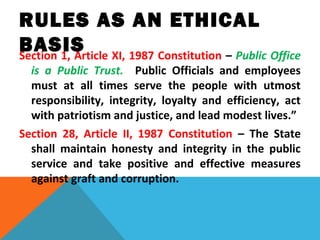
RULES AS AN ETHICAL
BASISSection 1, Article XI, 1987 Constitution – Public Office
is a Public Trust. Public Officials and employees
must at all times serve the people with utmost
responsibility, integrity, loyalty and efficiency, act
with patriotism and justice, and lead modest lives.”
Section 28, Article II, 1987 Constitution – The State
shall maintain honesty and integrity in the public
service and take positive and effective measures
against graft and corruption.
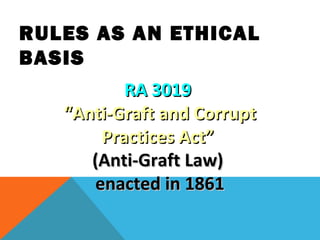
RA 3019RA 3019
““Anti-Graft and CorruptAnti-Graft and Corrupt
Practices Act”Practices Act”
(Anti-Graft Law)(Anti-Graft Law)
enacted in 1861enacted in 1861
RULES AS AN ETHICAL
BASIS
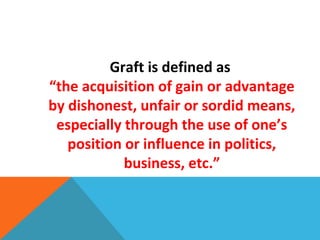
Graft is defined as
“the acquisition of gain or advantage
by dishonest, unfair or sordid means,
especially through the use of one’s
position or influence in politics,
business, etc.”
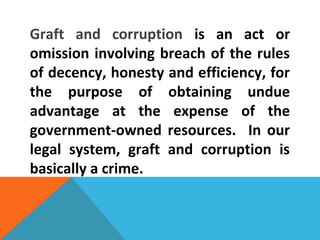
Graft and corruption is an act or
omission involving breach of the rules
of decency, honesty and efficiency, for
the purpose of obtaining undue
advantage at the expense of the
government-owned resources. In our
legal system, graft and corruption is
basically a crime.
Corruption is “an act done with an
intent to give some advantage
inconsistent with official duty and the
rights of others. It includes bribery, but
it is more comprehensive, because an
act may be corruptly done through the
advantage to be delivered from it be not
offered by another.”
Corruption is the perversion or
destruction of integrity of fidelity in
discharging public duties and
responsibilities by bribery or favor. It
entails the use of public power for
private advantage in ways which
transgresses some formal rule of law.
RA 6713RA 6713
““Code of Conduct and EthicalCode of Conduct and Ethical
Standards for Public Officials andStandards for Public Officials and
Employees”Employees”
signed into law bysigned into law by
then President Corazon C. Aquinothen President Corazon C. Aquino
on February 20, 1989on February 20, 1989
RULES AS AN ETHICAL
BASIS
RA 6713
Rule X. Grounds For Administrative
Disciplinary Action
Directly or indirectly
having financial and
material interest in any
transaction requiring
the approval of his
office.
RA 6713
Owning, controlling,
managing or accepting
employment as officer,
employee, consultant,
counsel, broker, agent,
trustee, or nominee in any
private enterprise regulated,
supervised or licensed by his
office, unless expressly
allowed by law.
RA 6713
Engaging in the private
practice of his profession
unless authorized by the
Constitution, law or
regulation, provided that
such practice will not
conflict or tend to conflict
with his officials functions.
RA 6713
Recommending any
person to any position
in a private enterprise
which has a regular or
pending official
transaction with his
office.
RA 6713
Soliciting or accepting, directly
or indirectly, any gift, gratuity,
favor, entertainment, loan or
anything of monetary value
which in the course of his
official duties or in connection
with any operation being
regulated by, or any
transaction which may be
affected by the function of his
office.
RA 6713
Unfair discrimination in
rendering public service
due to party affiliation.
RA 6713
Disloyalty to the Republic of
the Philippines and to the
Filipino people.
Failure to act promptly on
letters and requests within
15 working days from
receipt, except as
otherwise provided in
these Rules.
RA 6713
Failure to attend to anyone
who wants to avail himself of
the services of the office or to
act promptly and
expeditiously on public
personal transactions.
Failure to file sworn
statements of assets,
liabilities and networth, and
disclosure of business
interests and financial
connections.
RA 9485RA 9485
““Anti-Red Tape Act of 2007”Anti-Red Tape Act of 2007”
signed into law bysigned into law by
Pres. Gloria Macapagal-ArroyoPres. Gloria Macapagal-Arroyo
on June 02, 2007on June 02, 2007
RULES AS AN ETHICAL
BASIS
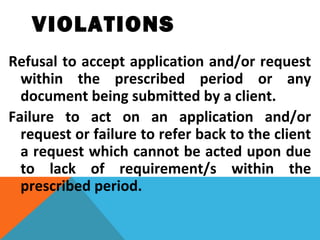
VIOLATIONS
Refusal to accept application and/or request
within the prescribed period or any
document being submitted by a client.
Failure to act on an application and/or
request or failure to refer back to the client
a request which cannot be acted upon due
to lack of requirement/s within the
prescribed period.
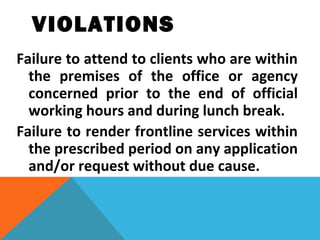
VIOLATIONS
Failure to attend to clients who are within
the premises of the office or agency
concerned prior to the end of official
working hours and during lunch break.
Failure to render frontline services within
the prescribed period on any application
and/or request without due cause.
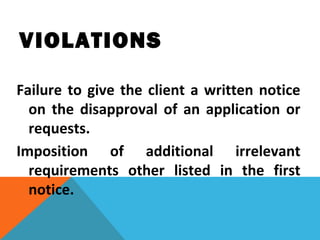
VIOLATIONS
Failure to give the client a written notice
on the disapproval of an application or
requests.
Imposition of additional irrelevant
requirements other listed in the first
notice.
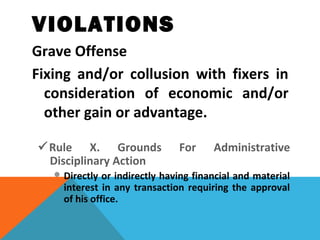
VIOLATIONS
Grave Offense
Fixing and/or collusion with fixers in
consideration of economic and/or
other gain or advantage.
Rule X. Grounds For Administrative
Disciplinary Action
 Directly or indirectly having financial and material
interest in any transaction requiring the approval
of his office.
RED TAPE
Inaction/No Action
Slow Action
Inappropriate/Wrong
Action
Inadequate/Insufficient
Action
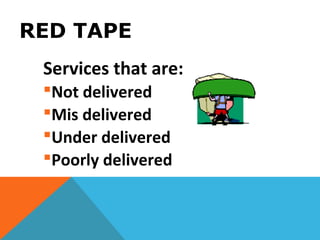
RED TAPE
Services that are:
Not delivered
Mis delivered
Under delivered
Poorly delivered
UNLAWFUL ACTS
RA 3019
Graft and Corruption
Malversation
RA 6713
Pecuniary interest
Conflict of interest
Nepotism
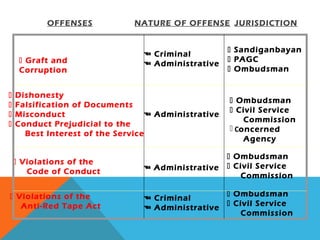
 Graft and
Corruption
 Dishonesty
 Falsification of Documents
 Misconduct
 Conduct Prejudicial to the
Best Interest of the Service
 Violations of the
Code of Conduct
 Criminal
 Administrative
 Administrative
 Administrative
 Sandiganbayan
 PAGC
 Ombudsman
 Ombudsman
 Civil Service
Commission
 Concerned
Agency
 Ombudsman
 Civil Service
Commission
 Violations of the
Anti-Red Tape Act
 Criminal
 Administrative
 Ombudsman
 Civil Service
Commission
NATURE OF OFFENSEOFFENSES JURISDICTION
Not all things that are
Legal are Moral !
UNETHICAL BEHAVIOR isUNETHICAL BEHAVIOR is
not necessarily illegal butnot necessarily illegal but
nevertheless is contrary tonevertheless is contrary to
what is RIGHT and doingwhat is RIGHT and doing
WHAT IS NOT RIGHTWHAT IS NOT RIGHT
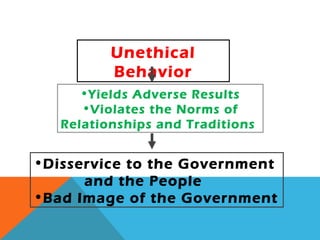
•Disservice to the Government
and the People
•Bad Image of the Government
Unethical
Behavior
•Yields Adverse Results
•Violates the Norms of
Relationships and Traditions
DIBAWAL,
PERO DIDAPAT!
DI BAWAL, PERO DI
DAPAT
PADRINO SYSTEM
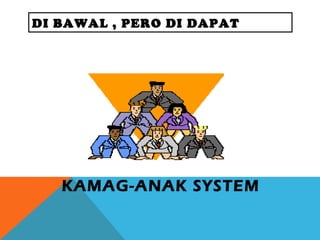
DI BAWAL , PERO DI DAPAT
KAMAG-ANAK SYSTEM
DI BAWAL, PERO DI
DAPAT
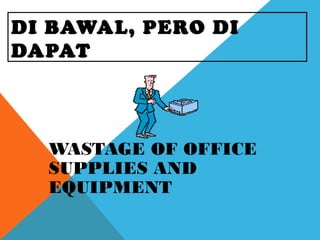
WASTAGE OF OFFICE
SUPPLIES AND
EQUIPMENT
DI BAWAL, PERO DI
DAPAT
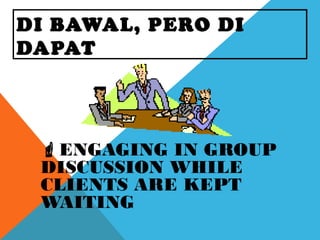
ENGAGING IN GROUP
DISCUSSION WHILE
CLIENTS ARE KEPT
WAITING
DI BAWAL, PERO DI
DAPAT
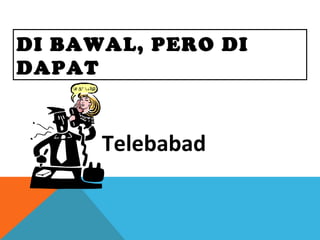
Telebabad
DI BAWAL , PERO DI
DAPAT
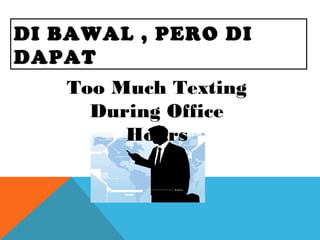
Too Much Texting
During Office
Hours
DI BAWAL, PERO DI
DAPAT
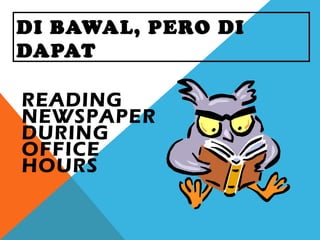
READING
NEWSPAPER
DURING
OFFICE
HOURS
DI BAWAL, PERO DI
DAPAT
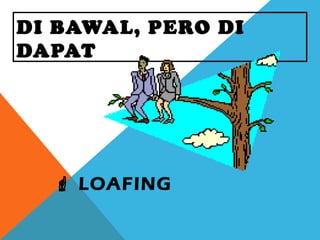
 LOAFING
DI BAWAL, PERO DI
DAPAT
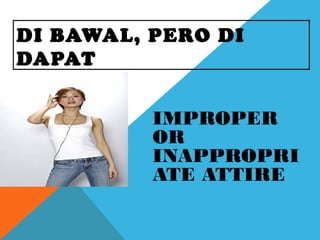
IMPROPER
OR
INAPPROPRI
ATE ATTIRE
DI BAWAL, PERO DI
DAPAT
CLOCK-
WATCHIN
G
DI BAWAL, PERO DI
DAPAT
EXTENDED
BREAK
DI BAWAL, PERO DI
DAPAT
GOING OUT
OF THE
OFFICE
WITHOUT
PERMISSION
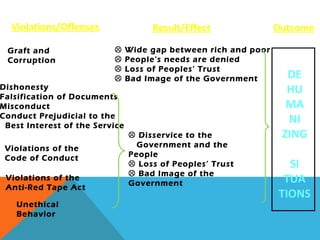
Graft and
Corruption
Dishonesty
Falsification of Documents
Misconduct
Conduct Prejudicial to the
Best Interest of the Service
Violations of the
Code of Conduct
Violations of the
Anti-Red Tape Act
 Wide gap between rich and poor
 People’s needs are denied
 Loss of Peoples’ Trust
 Bad Image of the Government
 Disservice to the
Government and the
People
 Loss of Peoples’ Trust
 Bad Image of the
Government
Violations/Offenses Result/Effect
DE
HU
MA
NI
ZING
SI
TUA
TIONS
Outcome
Unethical
Behavior
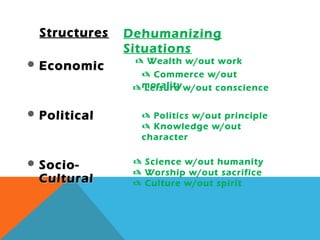
Dehumanizing
Situations
StructuresStructures
 EconomicEconomic
 PoliticalPolitical
 Socio-Socio-
CulturalCultural
 Commerce w/out
morality
 Politics w/out principle
 Knowledge w/out
character
 Worship w/out sacrifice
 Culture w/out spirit
 Wealth w/out work
 Leisure w/out conscience
 Science w/out humanity
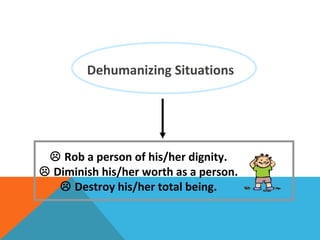
Dehumanizing Situations
 Rob a person of his/her dignity.
 Diminish his/her worth as a person.
 Destroy his/her total being.
It’s the CHOICES that
make us who we are. And
we can always choose to
do what’s right.
- Peter Parker
“Spiderman 3”
Every officials of the government, even
the most modest, has a job to perform
and is as much in duty bound to perform
that job well as those occupying higher
positions. In our effort to give the people
the best government that there is, we
have to have everybody do his job,
including the Clerk, the policeman –
everybody in the service. Everyone of
them should do his best because a
government cannot be a government of
higher officials only.
Pres. Manuel L. Quezon

LAW

  • 1.
  • 2.
    ETHICS  THE MORAL PRINCIPLESWHICH DETERMINE THE RIGHTNESS OR WRONGNESS OF PARTICULAR ACTS OR ACTIVITIES.
  • 3.
    ETHICS is the distinctionwe make between Right and Wrong, Good and Evil in relation to actions, intentions or character.
  • 4.
  • 5.
    ETHICS is equatedwith: Good Governance: It requires us to decide what is good. Public Service Ethics: Requires us to give quality service to the public. Standards, Rules, Morals - ETHICS is the “science of human duty”.
  • 6.
    ETHICS OF GOVERNANCE GoodGovernance is characterized with: Accountability Transparency Participation Non-Discrimination Responsiveness Poverty Alleviation
  • 7.
    ETHICS OF GOVERNANCE Participation Ruleof Law Transparency Responsiveness Consensus Orientation Equity Effectiveness and Efficiency Accountability
  • 8.
  • 9.
    RULES AS ANETHICAL BASIS WE BELIEVE IN THEM AS COMING BY DIVINE REVELATION.  WITH AUTHORITY OR OF OUR COMMUNITY.
  • 10.
    RESULTS AS ANETHICAL BASIS THE UTILITARIAN PRINCIPLE FOCUSES OUR ATTENTION ON RESULTS OR THE CONSEQUENCES OF OUR ACTIONS. IT HAS BEEN EXPRESSED TRADITIONALLY AS “SEEKING THE GREATEST GOOD FOR THE GREATEST NUMBER”
  • 11.
    RELATIONSHIPS AS ANETHICAL BASIS CONFUCIUS’ “GOLDEN RULE” OF CARING: “DO NOT DO TO OTHERS WHAT YOU WOULD NOT HAVE THEM DO TO YOU”. JESUS CHRIST’S EXPRESSION OF LOVE: “IN EVERYTHING, DO TO OTHERS AS YOU WOULD HAVE THEM DO TO YOU”.
  • 12.
    TRADITION AS ANETHICAL BASIS TRADITIONAL ETHICS – THE ETHICS OF EARLIER GENERATIONS THAT IS BASED ON TRADITION. IT IS RIGHT TO ACT IN CERTAIN WAY BECAUSE THAT IS WHAT IT HAS ALWAYS BEEN DONE.
  • 13.
    RULES AS ANETHICAL BASISSection 1, Article XI, 1987 Constitution – Public Office is a Public Trust. Public Officials and employees must at all times serve the people with utmost responsibility, integrity, loyalty and efficiency, act with patriotism and justice, and lead modest lives.” Section 28, Article II, 1987 Constitution – The State shall maintain honesty and integrity in the public service and take positive and effective measures against graft and corruption.
  • 14.
    RA 3019RA 3019 ““Anti-Graftand CorruptAnti-Graft and Corrupt Practices Act”Practices Act” (Anti-Graft Law)(Anti-Graft Law) enacted in 1861enacted in 1861 RULES AS AN ETHICAL BASIS
  • 15.
    Graft is definedas “the acquisition of gain or advantage by dishonest, unfair or sordid means, especially through the use of one’s position or influence in politics, business, etc.”
  • 16.
    Graft and corruptionis an act or omission involving breach of the rules of decency, honesty and efficiency, for the purpose of obtaining undue advantage at the expense of the government-owned resources. In our legal system, graft and corruption is basically a crime.
  • 17.
    Corruption is “anact done with an intent to give some advantage inconsistent with official duty and the rights of others. It includes bribery, but it is more comprehensive, because an act may be corruptly done through the advantage to be delivered from it be not offered by another.”
  • 18.
    Corruption is theperversion or destruction of integrity of fidelity in discharging public duties and responsibilities by bribery or favor. It entails the use of public power for private advantage in ways which transgresses some formal rule of law.
  • 19.
    RA 6713RA 6713 ““Codeof Conduct and EthicalCode of Conduct and Ethical Standards for Public Officials andStandards for Public Officials and Employees”Employees” signed into law bysigned into law by then President Corazon C. Aquinothen President Corazon C. Aquino on February 20, 1989on February 20, 1989 RULES AS AN ETHICAL BASIS
  • 20.
    RA 6713 Rule X.Grounds For Administrative Disciplinary Action Directly or indirectly having financial and material interest in any transaction requiring the approval of his office.
  • 21.
    RA 6713 Owning, controlling, managingor accepting employment as officer, employee, consultant, counsel, broker, agent, trustee, or nominee in any private enterprise regulated, supervised or licensed by his office, unless expressly allowed by law.
  • 22.
    RA 6713 Engaging inthe private practice of his profession unless authorized by the Constitution, law or regulation, provided that such practice will not conflict or tend to conflict with his officials functions.
  • 23.
    RA 6713 Recommending any personto any position in a private enterprise which has a regular or pending official transaction with his office.
  • 24.
    RA 6713 Soliciting oraccepting, directly or indirectly, any gift, gratuity, favor, entertainment, loan or anything of monetary value which in the course of his official duties or in connection with any operation being regulated by, or any transaction which may be affected by the function of his office.
  • 25.
    RA 6713 Unfair discriminationin rendering public service due to party affiliation.
  • 26.
    RA 6713 Disloyalty tothe Republic of the Philippines and to the Filipino people. Failure to act promptly on letters and requests within 15 working days from receipt, except as otherwise provided in these Rules.
  • 27.
    RA 6713 Failure toattend to anyone who wants to avail himself of the services of the office or to act promptly and expeditiously on public personal transactions. Failure to file sworn statements of assets, liabilities and networth, and disclosure of business interests and financial connections.
  • 28.
    RA 9485RA 9485 ““Anti-RedTape Act of 2007”Anti-Red Tape Act of 2007” signed into law bysigned into law by Pres. Gloria Macapagal-ArroyoPres. Gloria Macapagal-Arroyo on June 02, 2007on June 02, 2007 RULES AS AN ETHICAL BASIS
  • 29.
    VIOLATIONS Refusal to acceptapplication and/or request within the prescribed period or any document being submitted by a client. Failure to act on an application and/or request or failure to refer back to the client a request which cannot be acted upon due to lack of requirement/s within the prescribed period.
  • 30.
    VIOLATIONS Failure to attendto clients who are within the premises of the office or agency concerned prior to the end of official working hours and during lunch break. Failure to render frontline services within the prescribed period on any application and/or request without due cause.
  • 31.
    VIOLATIONS Failure to givethe client a written notice on the disapproval of an application or requests. Imposition of additional irrelevant requirements other listed in the first notice.
  • 32.
    VIOLATIONS Grave Offense Fixing and/orcollusion with fixers in consideration of economic and/or other gain or advantage. Rule X. Grounds For Administrative Disciplinary Action  Directly or indirectly having financial and material interest in any transaction requiring the approval of his office.
  • 33.
    RED TAPE Inaction/No Action SlowAction Inappropriate/Wrong Action Inadequate/Insufficient Action
  • 34.
    RED TAPE Services thatare: Not delivered Mis delivered Under delivered Poorly delivered
  • 35.
    UNLAWFUL ACTS RA 3019 Graftand Corruption Malversation RA 6713 Pecuniary interest Conflict of interest Nepotism
  • 36.
     Graft and Corruption Dishonesty  Falsification of Documents  Misconduct  Conduct Prejudicial to the Best Interest of the Service  Violations of the Code of Conduct  Criminal  Administrative  Administrative  Administrative  Sandiganbayan  PAGC  Ombudsman  Ombudsman  Civil Service Commission  Concerned Agency  Ombudsman  Civil Service Commission  Violations of the Anti-Red Tape Act  Criminal  Administrative  Ombudsman  Civil Service Commission NATURE OF OFFENSEOFFENSES JURISDICTION
  • 37.
    Not all thingsthat are Legal are Moral ! UNETHICAL BEHAVIOR isUNETHICAL BEHAVIOR is not necessarily illegal butnot necessarily illegal but nevertheless is contrary tonevertheless is contrary to what is RIGHT and doingwhat is RIGHT and doing WHAT IS NOT RIGHTWHAT IS NOT RIGHT
  • 38.
    •Disservice to theGovernment and the People •Bad Image of the Government Unethical Behavior •Yields Adverse Results •Violates the Norms of Relationships and Traditions
  • 39.
  • 40.
    DI BAWAL, PERODI DAPAT PADRINO SYSTEM
  • 41.
    DI BAWAL ,PERO DI DAPAT KAMAG-ANAK SYSTEM
  • 42.
    DI BAWAL, PERODI DAPAT WASTAGE OF OFFICE SUPPLIES AND EQUIPMENT
  • 43.
    DI BAWAL, PERODI DAPAT ENGAGING IN GROUP DISCUSSION WHILE CLIENTS ARE KEPT WAITING
  • 44.
    DI BAWAL, PERODI DAPAT Telebabad
  • 45.
    DI BAWAL ,PERO DI DAPAT Too Much Texting During Office Hours
  • 46.
    DI BAWAL, PERODI DAPAT READING NEWSPAPER DURING OFFICE HOURS
  • 47.
    DI BAWAL, PERODI DAPAT  LOAFING
  • 48.
    DI BAWAL, PERODI DAPAT IMPROPER OR INAPPROPRI ATE ATTIRE
  • 49.
    DI BAWAL, PERODI DAPAT CLOCK- WATCHIN G
  • 50.
    DI BAWAL, PERODI DAPAT EXTENDED BREAK
  • 51.
    DI BAWAL, PERODI DAPAT GOING OUT OF THE OFFICE WITHOUT PERMISSION
  • 52.
    Graft and Corruption Dishonesty Falsification ofDocuments Misconduct Conduct Prejudicial to the Best Interest of the Service Violations of the Code of Conduct Violations of the Anti-Red Tape Act  Wide gap between rich and poor  People’s needs are denied  Loss of Peoples’ Trust  Bad Image of the Government  Disservice to the Government and the People  Loss of Peoples’ Trust  Bad Image of the Government Violations/Offenses Result/Effect DE HU MA NI ZING SI TUA TIONS Outcome Unethical Behavior
  • 53.
    Dehumanizing Situations StructuresStructures  EconomicEconomic  PoliticalPolitical Socio-Socio- CulturalCultural  Commerce w/out morality  Politics w/out principle  Knowledge w/out character  Worship w/out sacrifice  Culture w/out spirit  Wealth w/out work  Leisure w/out conscience  Science w/out humanity
  • 54.
    Dehumanizing Situations  Roba person of his/her dignity.  Diminish his/her worth as a person.  Destroy his/her total being.
  • 55.
    It’s the CHOICESthat make us who we are. And we can always choose to do what’s right. - Peter Parker “Spiderman 3”
  • 56.
    Every officials ofthe government, even the most modest, has a job to perform and is as much in duty bound to perform that job well as those occupying higher positions. In our effort to give the people the best government that there is, we have to have everybody do his job, including the Clerk, the policeman – everybody in the service. Everyone of them should do his best because a government cannot be a government of higher officials only. Pres. Manuel L. Quezon