Module_4_Updated_Presentation CORRUPTION AND GRAFT IN THE PHILIPPINES.pdf
1.
MODULE 4 –PROFESSIONAL
CODE OF CONDUCT AND
CHARACTER DEVELOPMENT
For Government Employees
and Guards
PRAETORIAN SECURITY TRAINING AND ASSESSMENT CENTER, INC.
3D JGS Complex, 4th Ave. Bagong Lipunan ng Crame, Quezon City,
Quezon City, Philippines
1
2/17/2025
Training Module Disclaimer& Copyright Infringement
Notice Disclaimer:
This training module is for educational purposes only. The information provided
is intended to enhance security personnel's knowledge and skills but does not
substitute for official regulations, laws, or company policies.
Copyright Infringement Notice:
All materials, including text, images, and presentation content, are copyrighted
and owned by the author. Unauthorized reproduction, distribution, or
modification of this material without written permission is strictly prohibited and
may result in legal action.
5.
HOUSE RULES FORTRAINING
Guidelines for Participants:
1.Punctuality – Arrive on time and be prepared for each session.
2.Respect – Maintain professionalism when interacting with trainers and fellow
trainees.
3.Participation – Engage in discussions, activities, and role-playing exercises.
4.Mobile Phones – Keep devices on silent mode; use only when necessary.
5.Confidentiality – Do not share training materials without permission.
6.Dress Code – Follow the prescribed uniform or business attire.
7.Cleanliness – Maintain a clean and organized training environment.
8.Compliance – Follow all safety protocols and emergency procedures.
LEGAL MATTERS
❑RA 6713:Code of Conduct and Ethical Standards
❑Anti-Graft and Corrupt Practices Act
❑Disciplinary actions and legal consequences
16
2/17/2025
17.
ENABLING LEARNING OBJECTIVES
❑Understandprofessional ethics and responsibilities
❑Identify legal implications of misconduct
❑Develop self-discipline and ethical decision-making
17
2/17/2025
18.
APPLICATION AND OBJECTIVES
❑Applyethical principles in daily duties
❑Promote professionalism and integrity
❑Enhance security service effectiveness
18
2/17/2025
19.
OVERVIEW OF RA6713
& ANTI-GRAFT LAWS
❑Code of Conduct for Public Officials
❑Anti-Graft measures and penalties
19
2/17/2025
Definitions of KeyTerms:
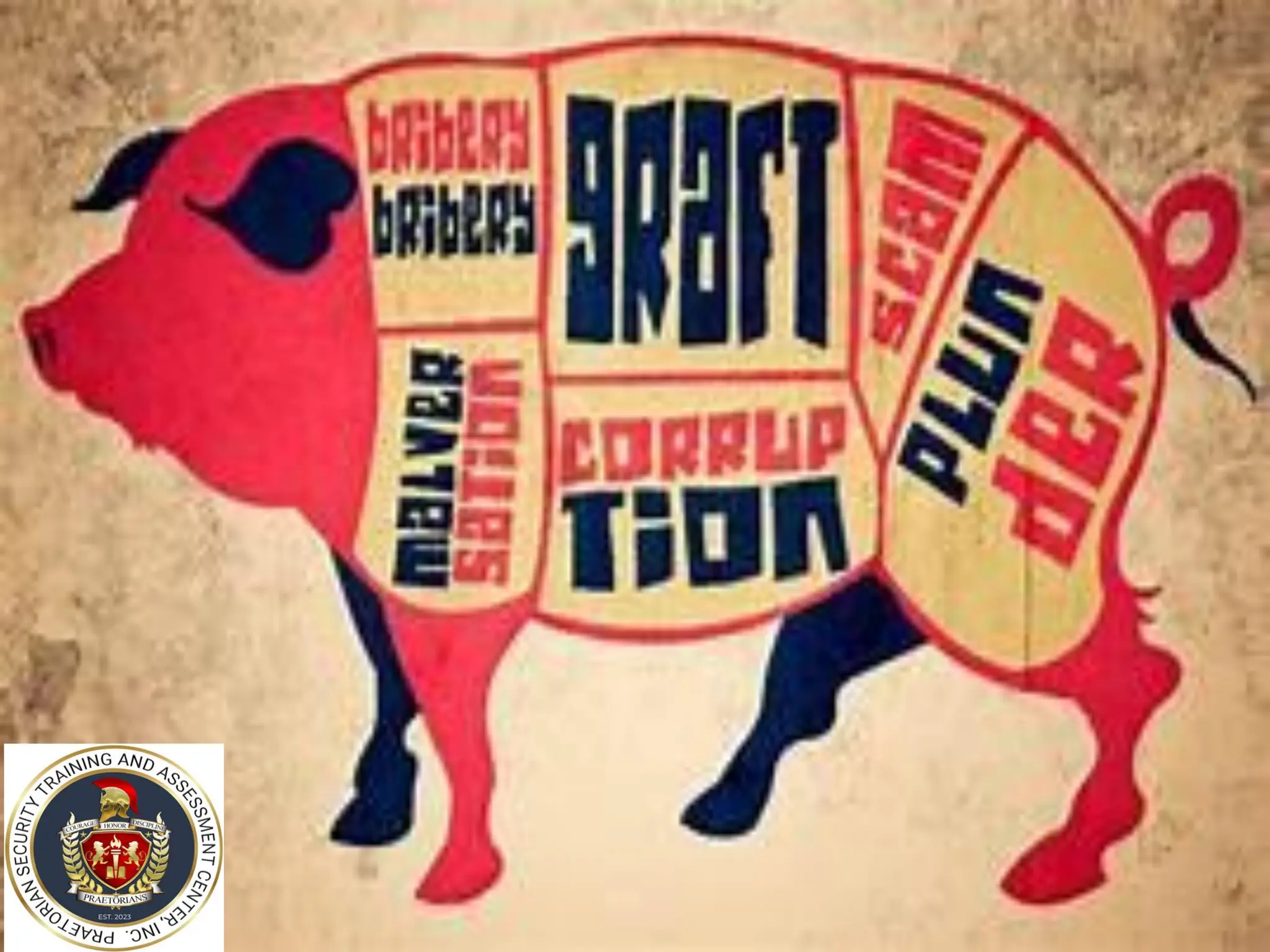
1. Graft – Refers to the illegal use of public office or position for personal gain, particularly
through bribery, kickbacks, embezzlement, or misappropriation of government funds. It involves
the abuse of power to secure improper financial gain for oneself or others.
2. Corruption – A broader term encompassing acts where officials or employees abuse their
authority to gain personal benefits, such as accepting bribes or engaging in illicit transactions.
This includes manipulation or alteration of official documents for personal profit.
3. Bribery – Offering or receiving any undue financial advantage or favors in exchange for
favorable decisions, contracts, or actions from a public official.
4. Conflict of Interest – Situations where a government official or employee’s personal
interests interfere with their public duties, resulting in biased decisions or actions.
Relevant Laws:
1. Republic Act No. 3019 (Anti-Graft and Corrupt Practices Act) – This law defines illegal acts
that constitute graft and corruption, providing penalties for government officials and employees
involved in such activities.
o Key Provisions:
Section 3 lists prohibited acts such as soliciting or accepting gifts, engaging in conflict of
interest, and abusing public office for personal gain.
Penalties: Violators can face imprisonment of 6 to 15 years, disqualification from public
office, and forfeiture of any ill-gotten wealth.
24
2/17/2025
25.
2. Republic ActNo. 6713 (Code of Conduct and Ethical Standards for Public Officials and
Employees) – This law establishes ethical standards for public officials and employees to follow,
aiming to ensure that they perform their duties with transparency and accountability.
o Key Provisions:
Public officials must not engage in unethical conduct or conflict of interest situations.
Establishes the responsibility to uphold public trust and avoid any act of corruption.
3. Republic Act No. 7080 (Plunder Law) – This law specifically targets large-scale corruption,
particularly cases where the public official embezzles or illegally accumulates wealth over a
period, generally exceeding P50 million.
o Penalties: If convicted, the accused may face life imprisonment and forfeiture of assets
derived from the illicit activity.
4. Anti-Red Tape Act (Republic Act No. 9485) – Aimed at improving government services and
reducing opportunities for corruption, especially in transactions with the public.
5. The Revised Penal Code (Articles 210 to 211) – Covers bribery and corruption of public
officers, including the acceptance of gifts or illegal financial gains.
25
2/17/2025
Penalties for GovernmentOfficials and Employees:
1. Imprisonment – Graft and corruption violations can lead to imprisonment ranging from 6
years to life, depending on the severity of the offense.
2. Fines – In some cases, violators can be required to pay fines in addition to serving jail
time.
3. Disqualification from Holding Public Office – Offenders are permanently banned from
holding any government position, whether elected or appointed.
4. Forfeiture of Ill-Gotten Wealth – Assets or properties acquired through illegal means may
be seized by the government.
5. Civil Liabilities – The government may demand the return of misappropriated funds or
assets.
29
2/17/2025
30.
30
2/17/2025
For Security GuardsInvolved in Corruption:
Security guards, though not government employees, may still face charges under certain
circumstances if they are involved in corruption or graft-like activities that involve
government contracts or transactions.
1. Bribery and Corruption in Government Contracts – If a security guard accepts a
bribe in exchange for facilitating a government contract (such as securing a
government building), they may be charged under RA 3019 (Anti-Graft Act).
2. Private Sector Corruption – Security guards working for private security agencies
who engage in corrupt activities (e.g., taking bribes) may face criminal charges under the
Revised Penal Code, such as Article 210 (Corruption of Public Officials), depending on
the involvement in public dealings.
31.
31
2/17/2025
In general, graftand corruption laws in the Philippines aim to maintain the integrity of
public service, holding both government officials and private individuals accountable
for actions that hinder public welfare.
1. Professional Conduct
Definition:
The adherence to ethical standards, laws, and regulations governing a profession. It
includes responsibilities, accountability, and expected behavior in professional settings.
Example:
A licensed security guard must follow the Republic Act No. 11917 (The Private Security
Agency Law), ensuring ethical behavior while on duty, such as avoiding bribery or the
misuse of confidential information.
Application:
If a security guard accepts a bribe to allow unauthorized access to a restricted area,
they can be held legally accountable under the Revised Penal Code (Article 210 -
Direct Bribery).
32.
32
2/17/2025
2. Character Development
Definition:
Theprocess of building personal and professional integrity by following ethical guidelines,
honesty, discipline, and legal responsibilities.
Example:
A security officer who finds a wallet left in a public place should report it instead of taking it.
Keeping lost property without reporting it could be considered theft (Article 308, Revised
Penal Code).
Application:
A government employee found guilty of falsifying official reports (e.g., falsifying security logs
or tampering with evidence) may face administrative and criminal charges under the Anti-
Graft and Corrupt Practices Act (RA 3019).
33.
33
2/17/2025
3. Security Ethics
Definition:
Moralprinciples governing the conduct of security professionals, ensuring the protection
of people, property, and information with integrity.
Example:
A security guard must respect privacy laws, meaning they cannot leak CCTV footage
of individuals without proper authorization.
Application:
Illegally disclosing surveillance data without consent can result in charges under the
Data Privacy Act of 2012 (RA 10173) and possible dismissal from duty.
34.
34
2/17/2025
4. Due Process
Definition:
Alegal principle ensuring fair treatment in judicial or administrative proceedings,
protecting individuals from arbitrary actions.
Example:
If a security officer is accused of misconduct, they must be given a chance to defend
themselves before termination.
Application:
If an employer fires a security guard without investigation or a chance to explain their
side, the employer may face a labor complaint for violating due process under the
Labor Code of the Philippines.
35.
35
2/17/2025
5. Graft andCorruption
Definition:
Illegal acts where public officials or employees misuse their position for personal gain,
such as accepting bribes, misusing government funds, or influencing decisions unethically.
Example:
A government security officer awarding a contract to a private security agency in
exchange for a kickback (commission) is an act of graft.
Application:
The security officer can be prosecuted under Republic Act No. 3019 (Anti-Graft and
Corrupt Practices Act) and face imprisonment of 6 to 15 years plus a lifetime ban from
holding public office.
36.
36
2/17/2025
6. Bribery
Definition:
The actof offering, giving, receiving, or soliciting something of value to influence an
official action.
Example:
A security guard who accepts money from a vendor in exchange for allowing illegal
vending inside a government facility.
Application:
Under Article 210 (Direct Bribery) and Article 211 (Indirect Bribery) of the Revised
Penal Code, the guard can be fined or imprisoned depending on the severity of the
act.
37.
37
2/17/2025
7. Conflict ofInterest
Definition:
A situation where an individual's personal interests interfere with their duty to act
impartially and in the best interest of their employer or the public.
Example:
A security officer owning shares in a private security agency and influencing the selection
process for security contracts in a government agency.
Application:
Under RA 6713 (Code of Conduct for Public Officials), individuals involved in such
conflicts can face suspension, termination, or legal consequences.
38.
38
2/17/2025
8. Misconduct
Definition:
Improper, unlawful,or unethical behavior by a professional in violation of laws,
company policies, or ethical standards.
Example:
A security guard found sleeping on duty or abusing authority by harassing individuals
within their assigned post.
Application:
• Mild misconduct (e.g., tardiness) may result in suspension or warnings.
• Serious misconduct (e.g., physical assault) could lead to termination and possible
criminal charges under the Revised Penal Code.
39.
39
2/17/2025
9. Negligence
Definition:
Failure toexercise the proper level of care expected in a professional setting, resulting
in harm or damage.
Example:
A security guard fails to check incoming vehicles, allowing unauthorized persons to
enter a restricted area, leading to a security breach.
Application:
If negligence results in property loss or injury, the guard and employer may face
liabilities under the Civil Code of the Philippines (Article 2176 - Quasi-Delict Liability).
(Extra-Contractual Obligations due to Fault or Negligence):
Article 2176 (Quasi-Delict) – Filipino Version“ Sinumang gumagawa ng isang bawal na
gawa o kapabayaan na nagdudulot ng pinsala sa ibang tao, na hindi lumalabag sa
isang kasunduan, ay may pananagutan sa mga nasabing pinsala alinsunod sa mga
prinsipyo ng batas.”
40.
40
2/17/2025
10. Whistleblower Protection
Definition:
Legalprotection for employees who report illegal or unethical activities within an
organization.
Example:
A security officer exposes corruption within their agency and is threatened with
dismissal.
Application:
Under the Whistleblower Protection Act and related laws, retaliation against
whistleblowers is punishable, and the complainant is protected from unjust dismissal or
harassment.
41.
41
2/17/2025
Conclusion
Understanding these legalterminologies helps security
professionals, government employees, and private
workers uphold ethical standards and avoid legal
consequences.
By adhering to laws like the Anti-Graft and Corrupt
Practices Act, Revised Penal Code, and Labor Code,
individuals can maintain professionalism, integrity, and
security ethics in their duties
42.
42
2/17/2025
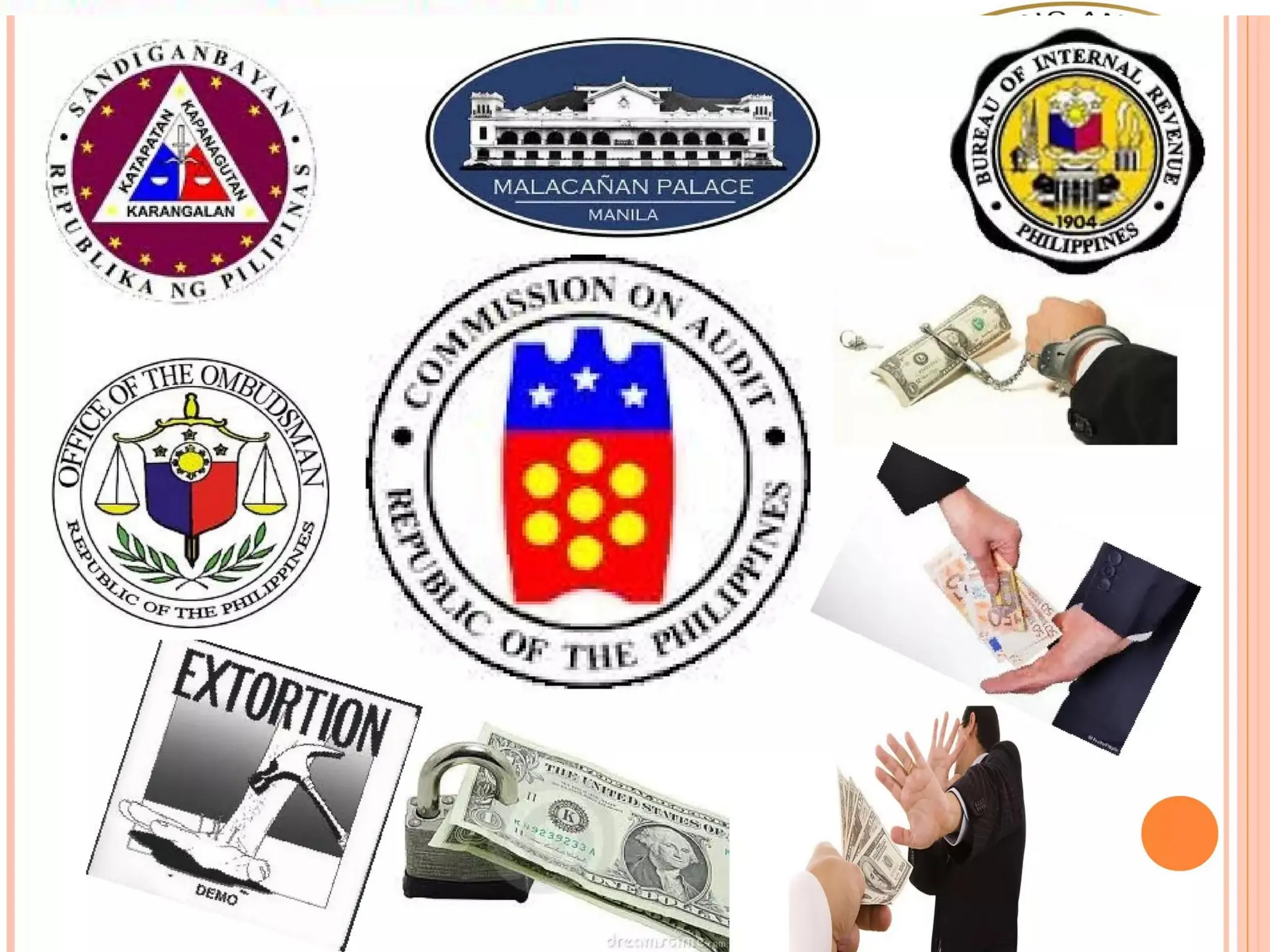
In the Philippines,various government agencies are
responsible for investigating, prosecuting, and
adjudicating cases related to graft and corruption,
including those involving public officials and private
individuals like security guards when implicated in
corruption-related offenses.
Here’s a breakdown of these agencies:
43.
CAUSES OF CORRUPTION
Corruptionoccurs due to various
factors, including systemic weaknesses,
lack of oversight, and personal greed.
Here are the main causes of corruption:
43
2/17/2025
44.
CAUSES OF CORRUPTION
1.Weak Government Institutions
• Lack of strict enforcement of laws
and policies
• Inefficient government processes
that encourage bribery
• Absence of transparency in
transactions
44
2/17/2025
45.
CAUSES OF CORRUPTION
2.Poor Law Enforcement & Judicial
System
• Slow and biased judicial processes
• Weak penalties that do not deter
corruption
• Influence of money and power in
court decisions
45
2/17/2025
46.
CAUSES OF CORRUPTION
3.Lack of Transparency and
Accountability
• Officials not being held responsible
for their actions
• Hidden government transactions
• Lack of independent auditing and
monitoring agencies
46
2/17/2025
47.
CAUSES OF CORRUPTION
4.Greed and Personal Gain
• Officials prioritizing personal wealth
over public service
• Businesses bribing officials to get
unfair advantages
• Politicians using public funds for
personal enrichment
47
2/17/2025
48.
CAUSES OF CORRUPTION
5.Low Salaries in Public Sector
• Government employees accepting
bribes due to low income
• High temptation to engage in
corrupt activities to sustain their needs
• Weak employee benefits that make
officials prone to bribery
48
2/17/2025
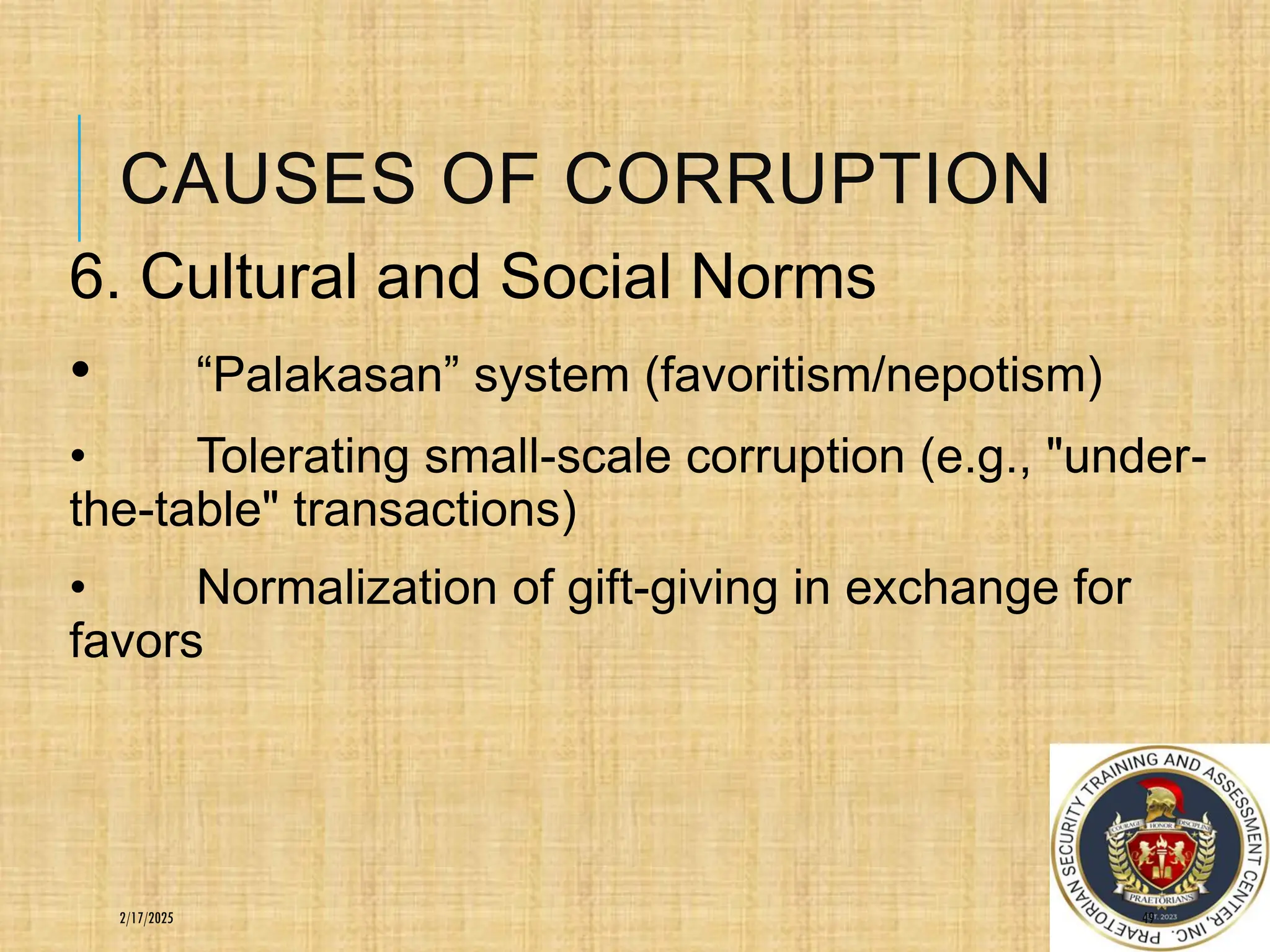
49.
CAUSES OF CORRUPTION
6.Cultural and Social Norms
• “Palakasan” system (favoritism/nepotism)
• Tolerating small-scale corruption (e.g., "under-
the-table" transactions)
• Normalization of gift-giving in exchange for
favors
49
2/17/2025
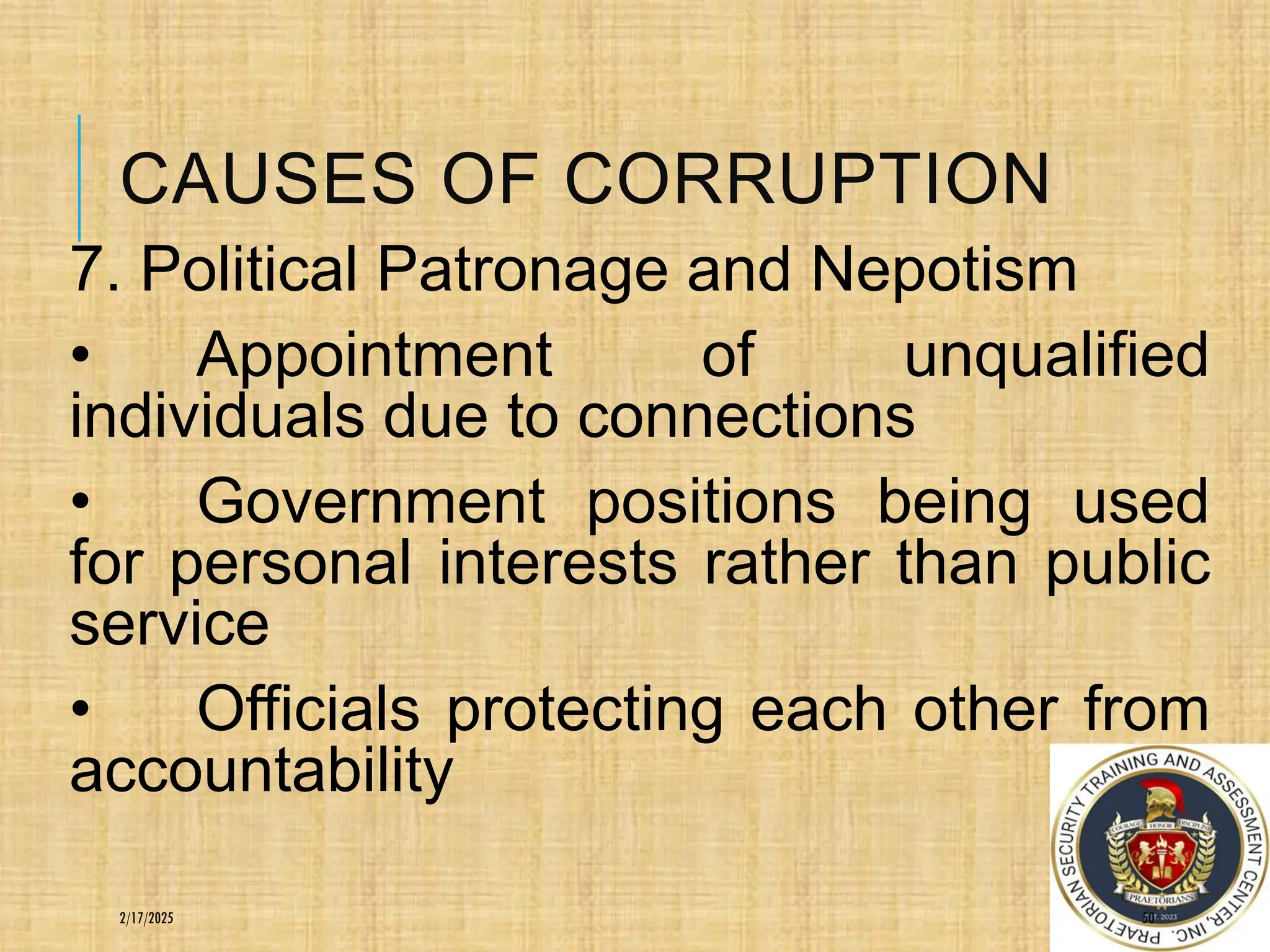
50.
CAUSES OF CORRUPTION
7.Political Patronage and Nepotism
• Appointment of unqualified
individuals due to connections
• Government positions being used
for personal interests rather than public
service
• Officials protecting each other from
accountability
50
2/17/2025
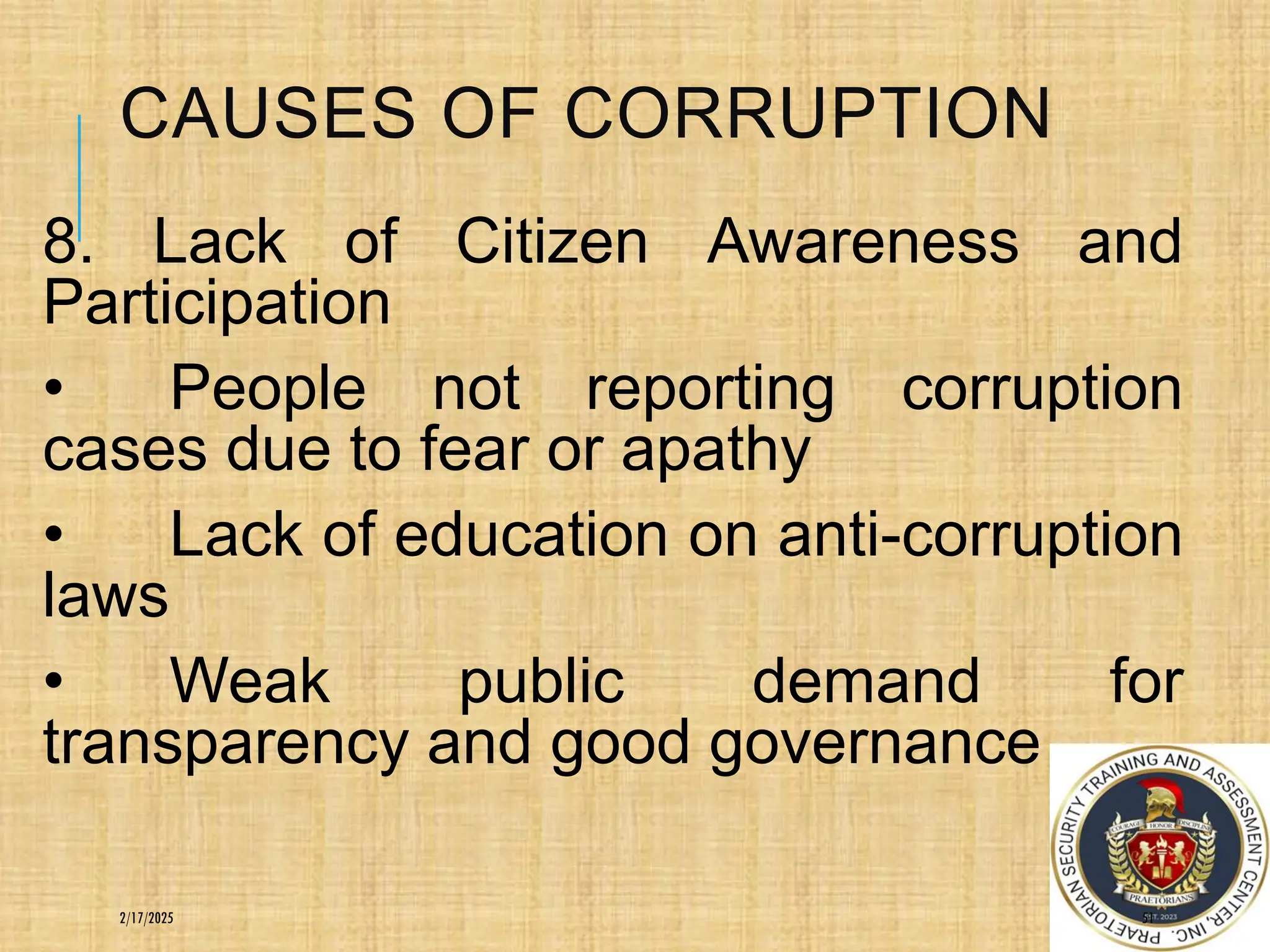
51.
CAUSES OF CORRUPTION
8.Lack of Citizen Awareness and
Participation
• People not reporting corruption
cases due to fear or apathy
• Lack of education on anti-corruption
laws
• Weak public demand for
transparency and good governance
51
2/17/2025
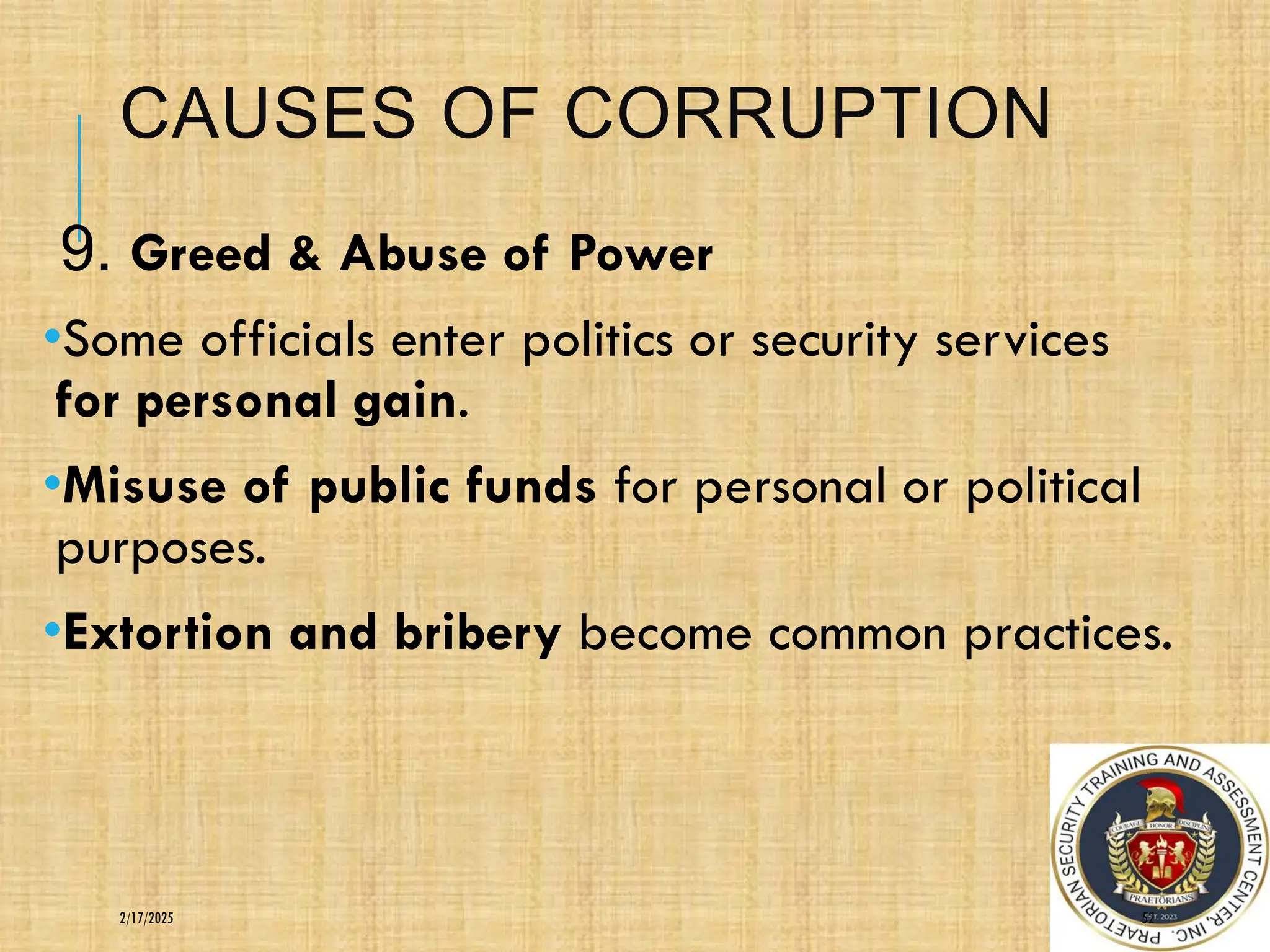
52.
CAUSES OF CORRUPTION
9.Greed & Abuse of Power
•Some officials enter politics or security services
for personal gain.
•Misuse of public funds for personal or political
purposes.
•Extortion and bribery become common practices.
52
2/17/2025
53.
CAUSES OF CORRUPTION
10.Culture of "Pakikisama" & "Utang na
Loob"
• Favoritism due to personal connections or
political favors.
• Officials protect wrongdoers because of
debt of gratitude.
• Bribery and kickbacks are seen as
“normal” in business deals.
53
2/17/2025
54.
CAUSES OF CORRUPTION
11.WeakAnti-Corruption Institutions
• Agencies like the Office of the
Ombudsman, Sandiganbayan, and COA lack
resources and independence.
• Limited budget and manpower prevent full
investigations.
• Some anti-corruption officers are
themselves corrupt or influenced by higher
powers.
54
2/17/2025
55.
CAUSES OF CORRUPTION
12.Inefficient Bureaucracy & Red Tape
• Complex procedures force citizens to pay
bribes for faster service.
• Officials deliberately create delays to
extract money from people.
• Corrupt officers take advantage of long
approval processes.
55
2/17/2025
56.
CAUSES OF CORRUPTION
13.Influence of Big Business & Oligarchy
• Large corporations offer kickbacks and
bribes to secure contracts.
• Business owners influence government
policies for personal benefit.
• Some security agencies and private firms
use bribery to get government contracts.
56
2/17/2025
57.
CAUSES OF CORRUPTION
14.Lack of Public Awareness & Civic
Engagement
• Citizens are afraid to report corruption
due to retaliation.
• Lack of whistleblower protection laws
discourages people from exposing
corruption.
• Many Filipinos feel helpless or
indifferent towards corruption cases.
.
57
2/17/2025
58.
CAUSES OF CORRUPTION
PossibleSolutions to Combat Corruption:
Strengthening anti-corruption laws (RA 3019, RA 6713, RA 7080)
Increasing salaries of government employees and security
personnel
Implementing strict transparency measures in all government
transactions
Establishing whistleblower protection and reward programs
Encouraging citizen participation in anti-corruption efforts
Enhancing digital governance to reduce human intervention in
transactions
.
.
58
2/17/2025
59.
59
2/17/2025
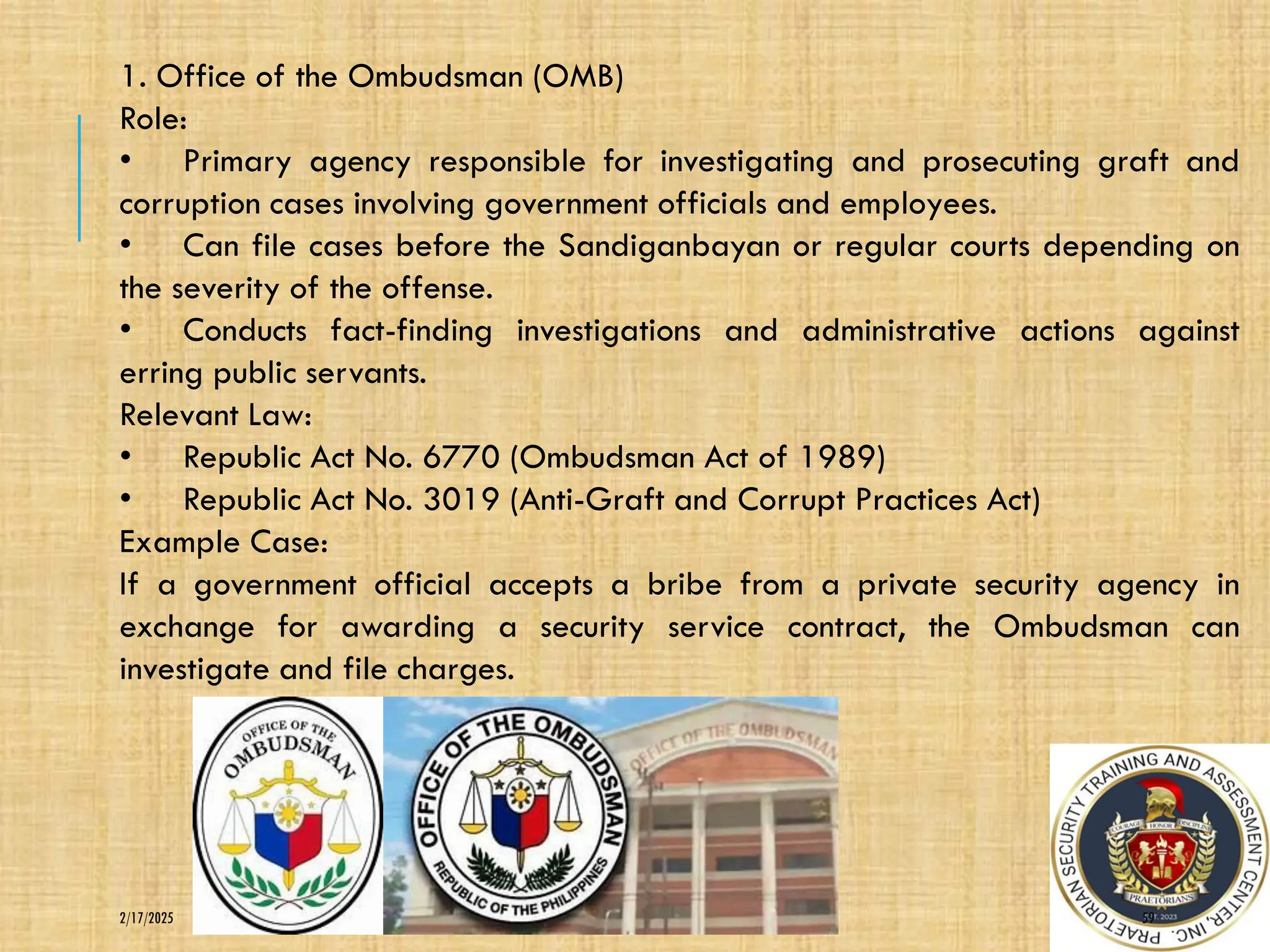
1. Office ofthe Ombudsman (OMB)
Role:
• Primary agency responsible for investigating and prosecuting graft and
corruption cases involving government officials and employees.
• Can file cases before the Sandiganbayan or regular courts depending on
the severity of the offense.
• Conducts fact-finding investigations and administrative actions against
erring public servants.
Relevant Law:
• Republic Act No. 6770 (Ombudsman Act of 1989)
• Republic Act No. 3019 (Anti-Graft and Corrupt Practices Act)
Example Case:
If a government official accepts a bribe from a private security agency in
exchange for awarding a security service contract, the Ombudsman can
investigate and file charges.
60.
60
2/17/2025
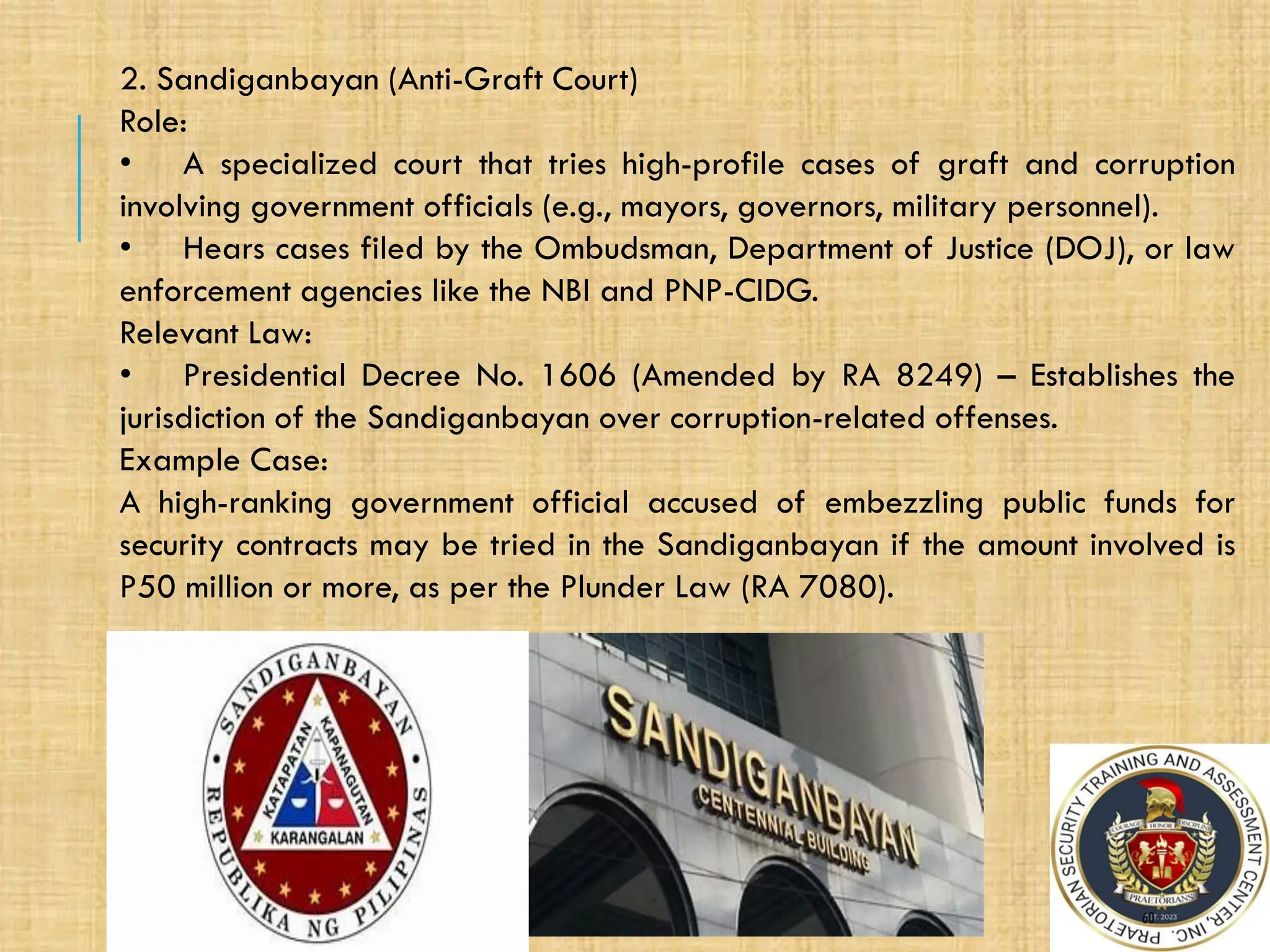
2. Sandiganbayan (Anti-GraftCourt)
Role:
• A specialized court that tries high-profile cases of graft and corruption
involving government officials (e.g., mayors, governors, military personnel).
• Hears cases filed by the Ombudsman, Department of Justice (DOJ), or law
enforcement agencies like the NBI and PNP-CIDG.
Relevant Law:
• Presidential Decree No. 1606 (Amended by RA 8249) – Establishes the
jurisdiction of the Sandiganbayan over corruption-related offenses.
Example Case:
A high-ranking government official accused of embezzling public funds for
security contracts may be tried in the Sandiganbayan if the amount involved is
P50 million or more, as per the Plunder Law (RA 7080).
61.
61
2/17/2025
3. Commission onAudit (COA)
Role:
• Ensures proper use of government funds and prevents financial
irregularities.
• Conducts audits of government agencies and reports financial anomalies
to the Ombudsman or Sandiganbayan for legal action.
Relevant Law:
• 1987 Philippine Constitution (Article IX-D: Commission on Audit)
• Presidential Decree No. 1445 (Government Auditing Code of the
Philippines)
Example Case:
If a government agency overpays a security contractor for services not
rendered, COA can flag the transaction and recommend charges for those
involved in anomalous deals.
62.
62
2/17/2025
4. Department ofJustice (DOJ) & National Prosecution Service (NPS)
Role:
• Investigates and prosecutes graft and corruption cases involving both public
and private individuals in regular courts.
• Works with NBI, PNP-CIDG, and AMLC to gather evidence and build cases.
Relevant Law:
• Administrative Code of 1987 (Executive Order No. 292)
Example Case:
If a security guard is involved in a bribery scheme with a local government
official to allow illegal activities in a government facility, the DOJ can prosecute
the case under RA 3019 (Anti-Graft Law).
63.
63
2/17/2025
5. National Bureauof Investigation (NBI)
Role:
• Conducts criminal investigations on high-level corruption cases and
financial fraud involving public officials and private entities.
• Can file complaints before the Ombudsman, DOJ, or Sandiganbayan.
Relevant Law:
• Republic Act No. 157 (NBI Charter, as amended by RA 10867)
Example Case:
If an NBI investigation uncovers that a private security agency colluded with
local officials to rig bidding processes, the case may be forwarded to the
Ombudsman for prosecution.
64.
64
2/17/2025
6. Philippine NationalPolice - Criminal Investigation and Detection Group
(PNP-CIDG)
Role:
• Investigates graft, corruption, and bribery cases related to local
government units (LGUs) and security-related corruption cases.
• Works with the DOJ, Ombudsman, and NBI to file charges.
Relevant Law:
• Republic Act No. 6975 (DILG Act of 1990) – Organizes the PNP and its
investigative units.
Example Case:
If a security guard working in a government office is caught accepting bribes
to allow smuggling of restricted goods, PNP-CIDG can investigate and refer
the case to the DOJ for prosecution.
65.
65
2/17/2025
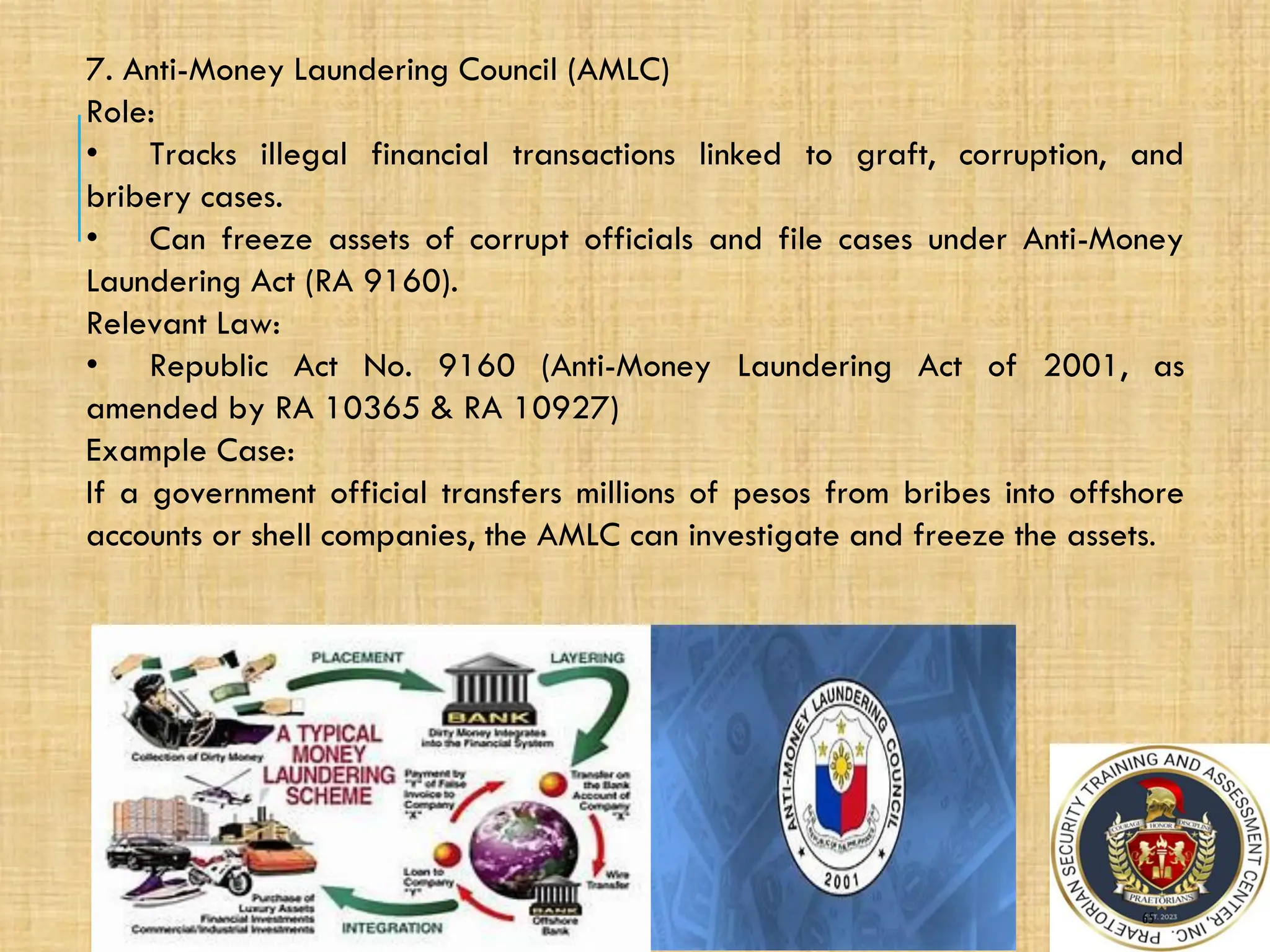
7. Anti-Money LaunderingCouncil (AMLC)
Role:
• Tracks illegal financial transactions linked to graft, corruption, and
bribery cases.
• Can freeze assets of corrupt officials and file cases under Anti-Money
Laundering Act (RA 9160).
Relevant Law:
• Republic Act No. 9160 (Anti-Money Laundering Act of 2001, as
amended by RA 10365 & RA 10927)
Example Case:
If a government official transfers millions of pesos from bribes into offshore
accounts or shell companies, the AMLC can investigate and freeze the assets.
66.
66
2/17/2025
Special Cases InvolvingSecurity Guards & Private Sectors
Private individuals, including security guards and security agency
owners, can be held liable if involved in corruption-related cases.
Here’s how:
1. Bribery (Revised Penal Code, Articles 210-211)
o If a security guard accepts money to let unauthorized persons
enter a government facility, they can face criminal charges.
2. Plunder (RA 7080)
o If a private security agency colludes with government officials
to overprice security contracts beyond P50 million, it qualifies as
plunder.
3. Anti-Graft and Corrupt Practices Act (RA 3019)
o If a private company bribes a government official for
exclusive contracts, both parties can face graft charges.
67.
67
2/17/2025
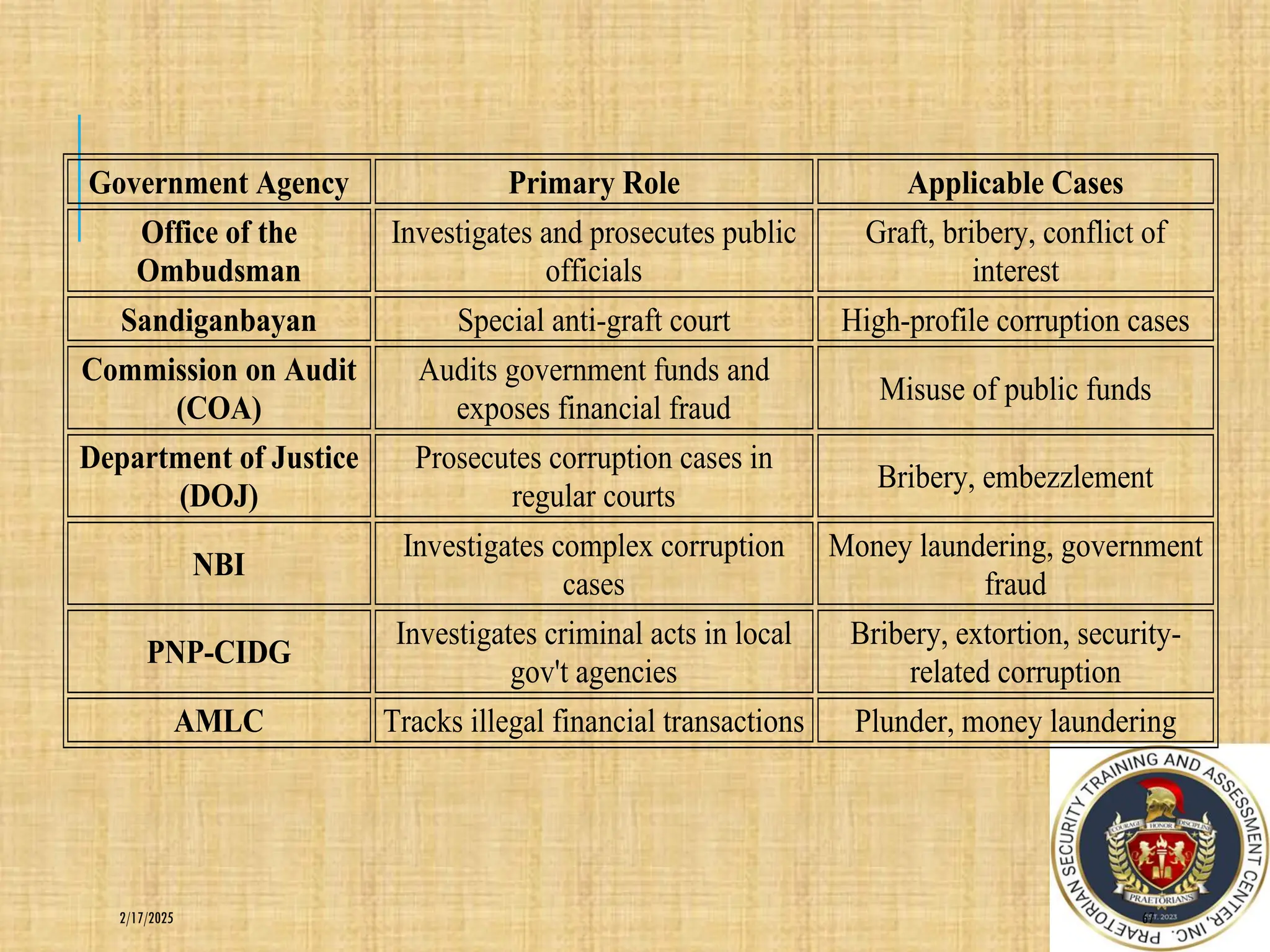
Government Agency PrimaryRole Applicable Cases
Office of the
Ombudsman
Investigates and prosecutes public
officials
Graft, bribery, conflict of
interest
Sandiganbayan Special anti-graft court High-profile corruption cases
Commission on Audit
(COA)
Audits government funds and
exposes financial fraud
Misuse of public funds
Department of Justice
(DOJ)
Prosecutes corruption cases in
regular courts
Bribery, embezzlement
NBI
Investigates complex corruption
cases
Money laundering, government
fraud
PNP-CIDG
Investigates criminal acts in local
gov't agencies
Bribery, extortion, security-
related corruption
AMLC Tracks illegal financial transactions Plunder, money laundering
68.
SANCTIONS & PENALTIES
Legalconsequences of misconduct
Below are the most relevant laws
and their corresponding penalties
68
2/17/2025
69.
LAWS AND PENALTIESON GRAFT
AND CORRUPTION IN THE
PHILIPPINES
The Philippines has several laws aimed
at preventing and punishing graft and
corruption involving government
officials, private individuals, and security
personnel.
69
2/17/2025
70.
LAWS AND PENALTIESON GRAFT
AND CORRUPTION IN THE
PHILIPPINES
1. Republic Act No. 3019 – Anti-Graft and Corrupt Practices Act
What It Covers:
This law penalizes corrupt acts of public officials, including:
Receiving bribes (direct or indirect)
Misuse of public funds
Giving undue advantage to private individuals or companies
Entering into contracts grossly disadvantageous to the government
Penalties:
• Imprisonment of 6 years and 1 month to 15 years
• Perpetual disqualification from public office
• Forfeiture of ill-gotten wealth in favor of the government
70
2/17/2025
71.
LAWS AND PENALTIESON GRAFT
AND CORRUPTION IN THE
PHILIPPINES
2. Republic Act No. 6713 – Code of Conduct and Ethical Standards for Public
Officials and Employees
What It Covers:
• Sets ethical standards for public officials
• Requires full disclosure of assets and liabilities (SALN)
• Prohibits conflicts of interest and gifts from private individuals
Penalties:
• Suspension or dismissal from service
• Fines and administrative sanctions
• Imprisonment of up to 5 years for serious violations
71
2/17/2025
72.
LAWS AND PENALTIESON GRAFT
AND CORRUPTION IN THE
PHILIPPINES
The Philippines has several laws aimed
at preventing and punishing graft and
corruption involving government
officials, private individuals, and security
personnel.
72
2/17/2025
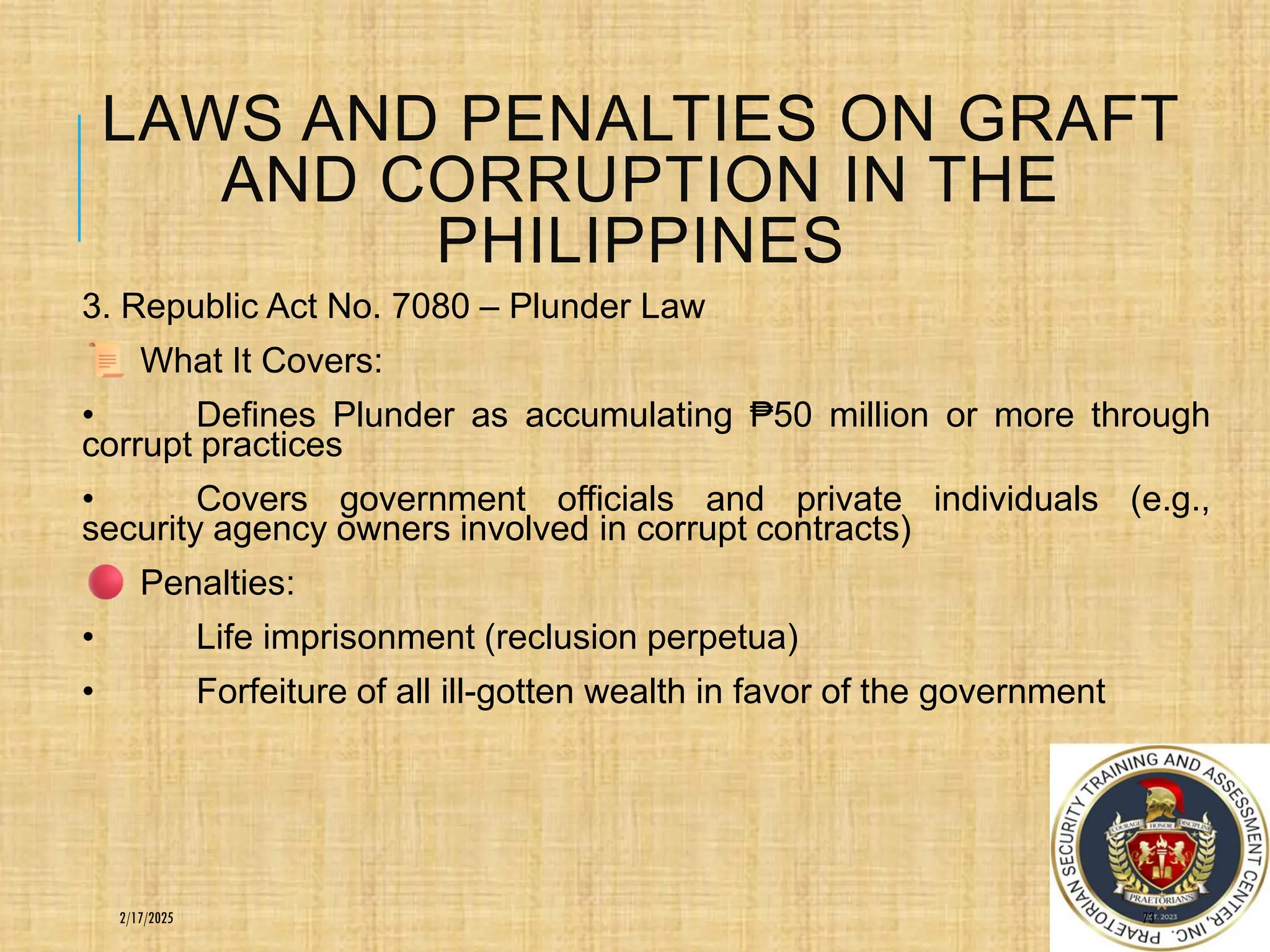
73.
LAWS AND PENALTIESON GRAFT
AND CORRUPTION IN THE
PHILIPPINES
3. Republic Act No. 7080 – Plunder Law
What It Covers:
• Defines Plunder as accumulating ₱50 million or more through
corrupt practices
• Covers government officials and private individuals (e.g.,
security agency owners involved in corrupt contracts)
Penalties:
• Life imprisonment (reclusion perpetua)
• Forfeiture of all ill-gotten wealth in favor of the government
73
2/17/2025
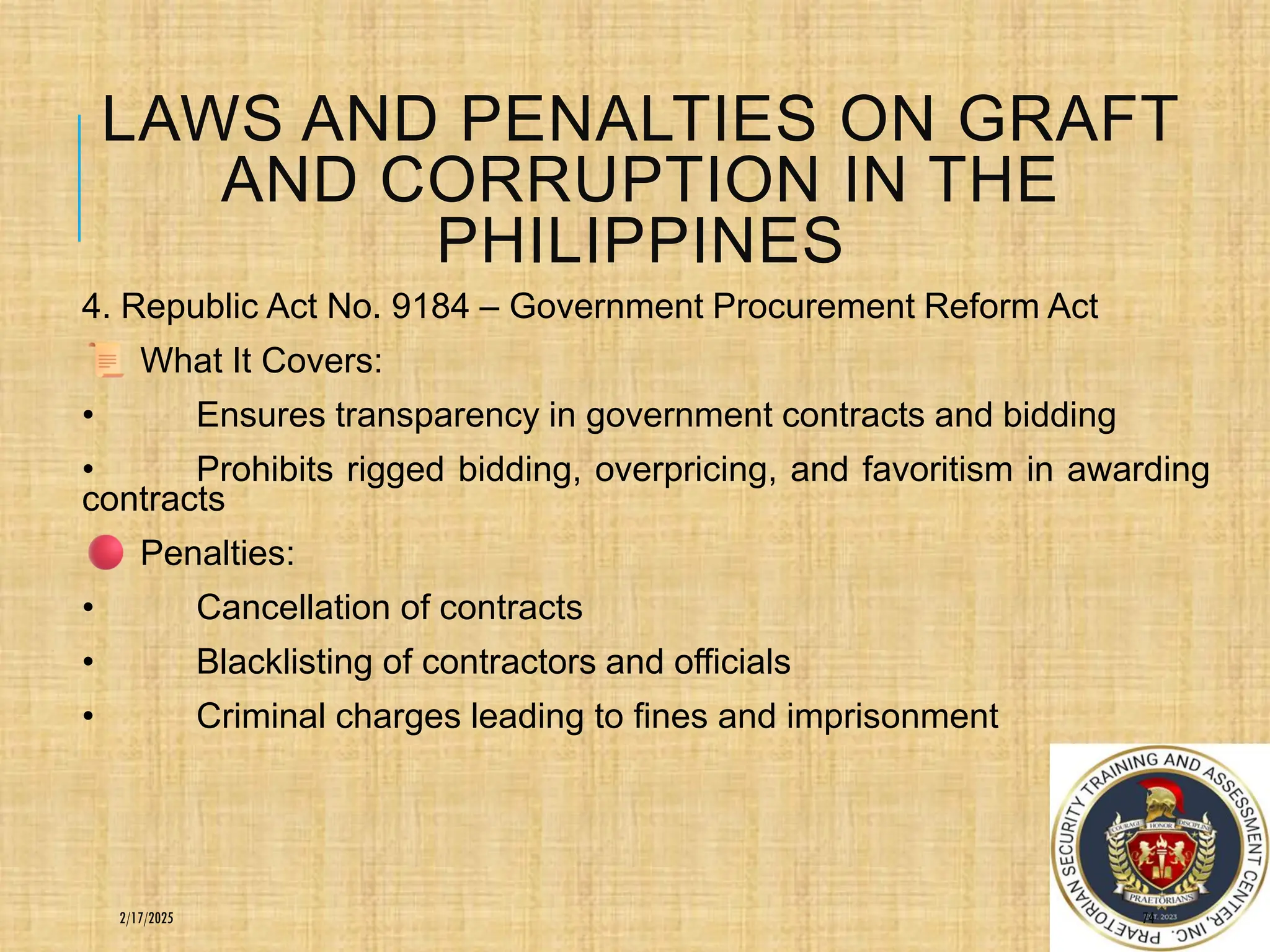
74.
LAWS AND PENALTIESON GRAFT
AND CORRUPTION IN THE
PHILIPPINES
4. Republic Act No. 9184 – Government Procurement Reform Act
What It Covers:
• Ensures transparency in government contracts and bidding
• Prohibits rigged bidding, overpricing, and favoritism in awarding
contracts
Penalties:
• Cancellation of contracts
• Blacklisting of contractors and officials
• Criminal charges leading to fines and imprisonment
74
2/17/2025
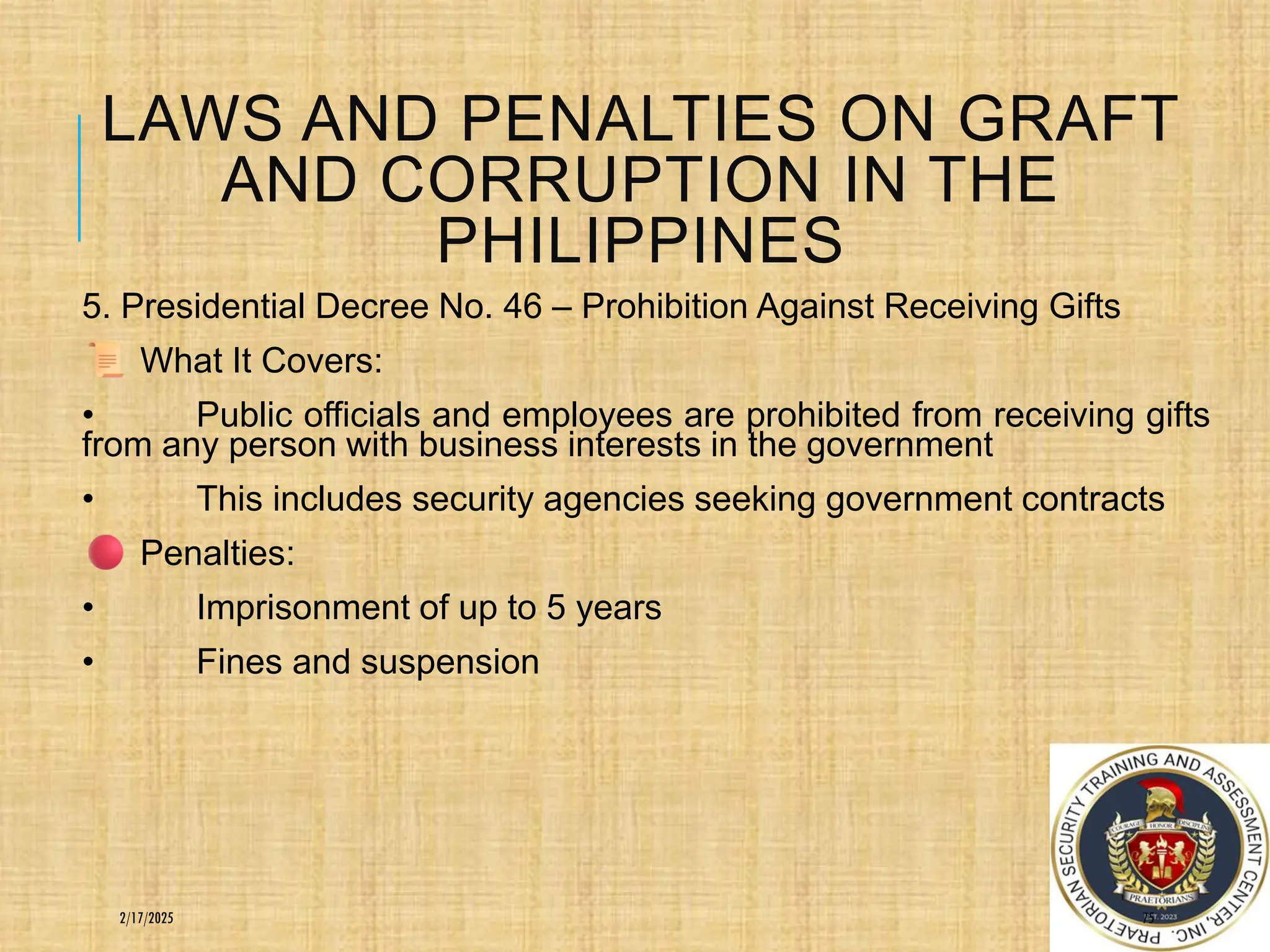
75.
LAWS AND PENALTIESON GRAFT
AND CORRUPTION IN THE
PHILIPPINES
5. Presidential Decree No. 46 – Prohibition Against Receiving Gifts
What It Covers:
• Public officials and employees are prohibited from receiving gifts
from any person with business interests in the government
• This includes security agencies seeking government contracts
Penalties:
• Imprisonment of up to 5 years
• Fines and suspension
75
2/17/2025
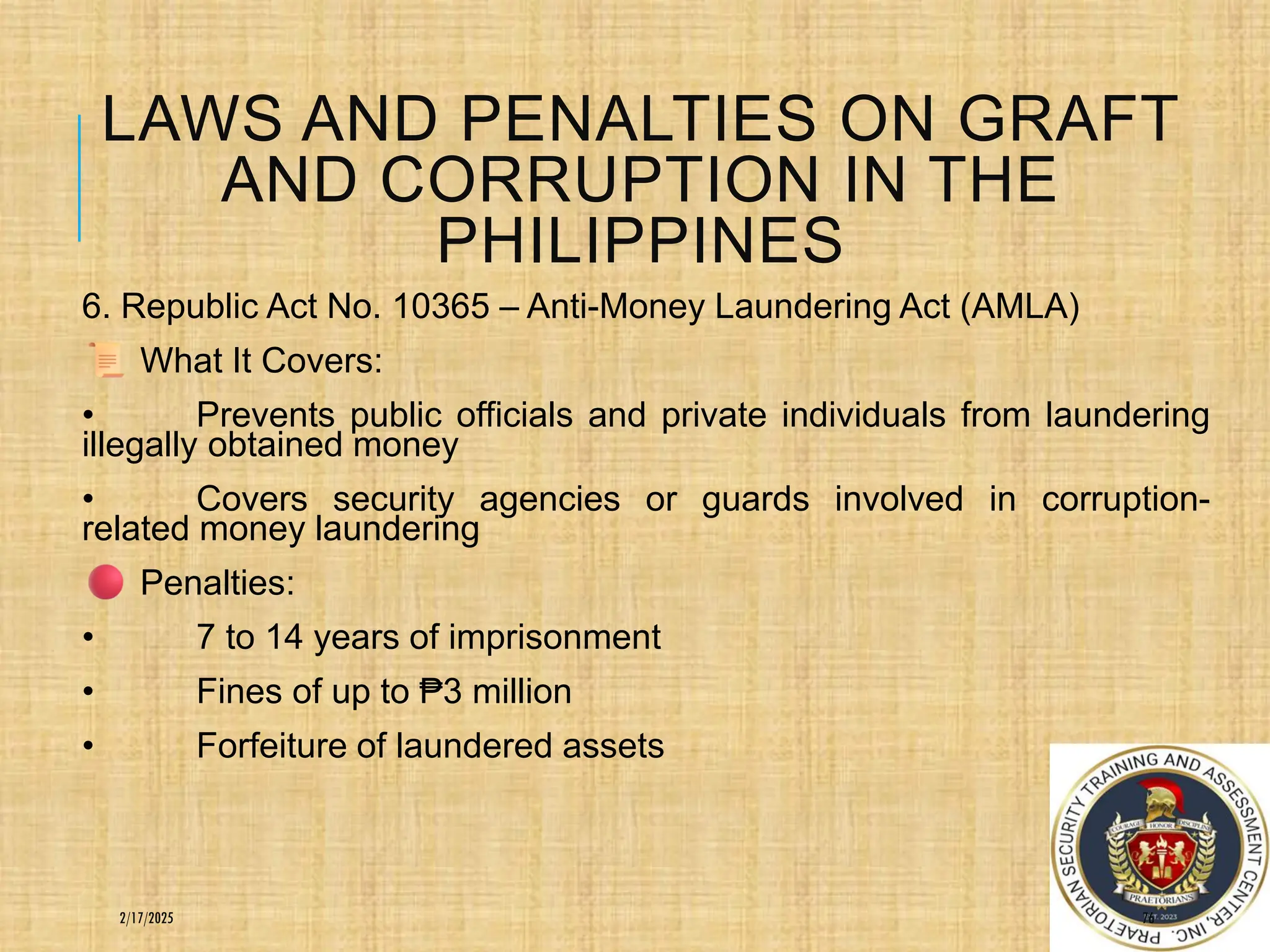
76.
LAWS AND PENALTIESON GRAFT
AND CORRUPTION IN THE
PHILIPPINES
6. Republic Act No. 10365 – Anti-Money Laundering Act (AMLA)
What It Covers:
• Prevents public officials and private individuals from laundering
illegally obtained money
• Covers security agencies or guards involved in corruption-
related money laundering
Penalties:
• 7 to 14 years of imprisonment
• Fines of up to ₱3 million
• Forfeiture of laundered assets
76
2/17/2025
77.
LAWS AND PENALTIESON GRAFT
AND CORRUPTION IN THE
PHILIPPINES
7. Republic Act No. 7080 – Anti-Bribery and Corrupt
Practices Law
What It Covers:
• Bribery of public officials to influence decisions
• Extortion by government employees (e.g., security
guards demanding bribes for protection services)
Penalties:
• Imprisonment of 6 to 12 years
• Dismissal from government service
• Forfeiture of benefits
77
2/17/2025
78.
LAWS AND PENALTIESON GRAFT
AND CORRUPTION IN THE
PHILIPPINES
Specific Cases: Corruption in the Security Industry
Security agencies and guards involved in corruption can be charged under:
RA 3019 (Anti-Graft and Corrupt Practices Act) if they conspire with government
officials for contracts
RA 6713 (Code of Conduct for Public Officials) if they offer bribes for licensing
RA 7080 (Plunder Law) if they accumulate over ₱50 million through corruption
Conclusion: How to Combat Corruption?
Report corrupt activities to the Office of the Ombudsman, Sandiganbayan, or
PNP-CIDG
File administrative cases for unethical conduct
Use whistleblower protection laws to expose corruption
78
2/17/2025
79.
79
2/17/2025
SUMMARY
Corruption cases inthe public and private sector are
handled by multiple government agencies, each with its
own jurisdiction.
Security guards, private security agencies, and public
officials can be prosecuted under anti-corruption laws
if found guilty of misconduct, bribery, or fraudulent
dealings.