Version 1.2
Chip Gettinger
VP Global Solutions Consulting, SDL
@cgettinger
Future-proof Your Content:
Beyond Traditional Publishing
Across all industries,
disruptive technologies
are introducing new
players and evolving
consumer expectations
Image placeholder
Click on image icon
Browse to image you want
to add to slide
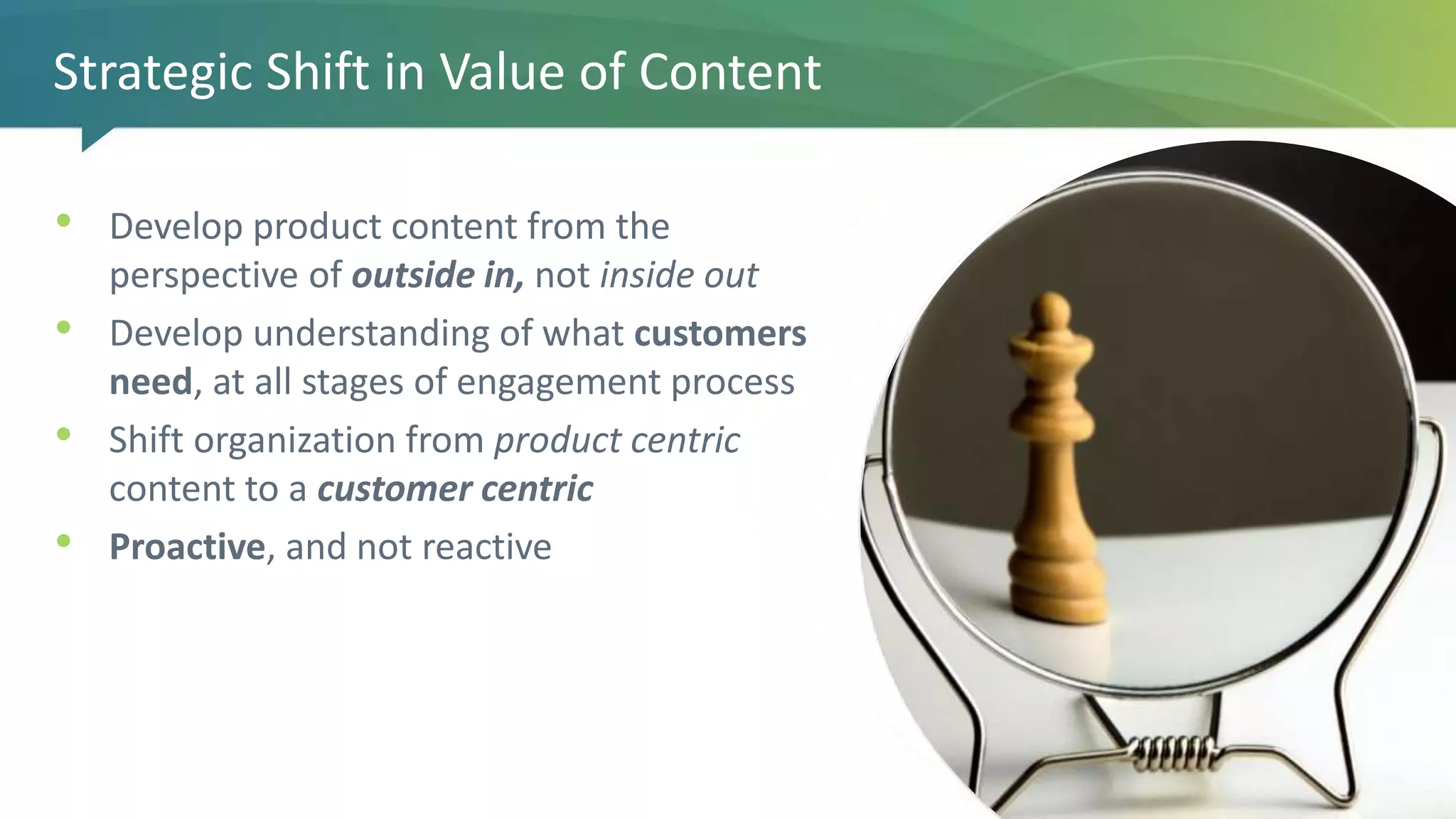
Strategic Shift in Value of Content
• Develop product content from the
perspective of outside in, not inside out
• Develop understanding of what customers
need, at all stages of engagement process
• Shift organization from product centric
content to a customer centric
• Proactive, and not reactive
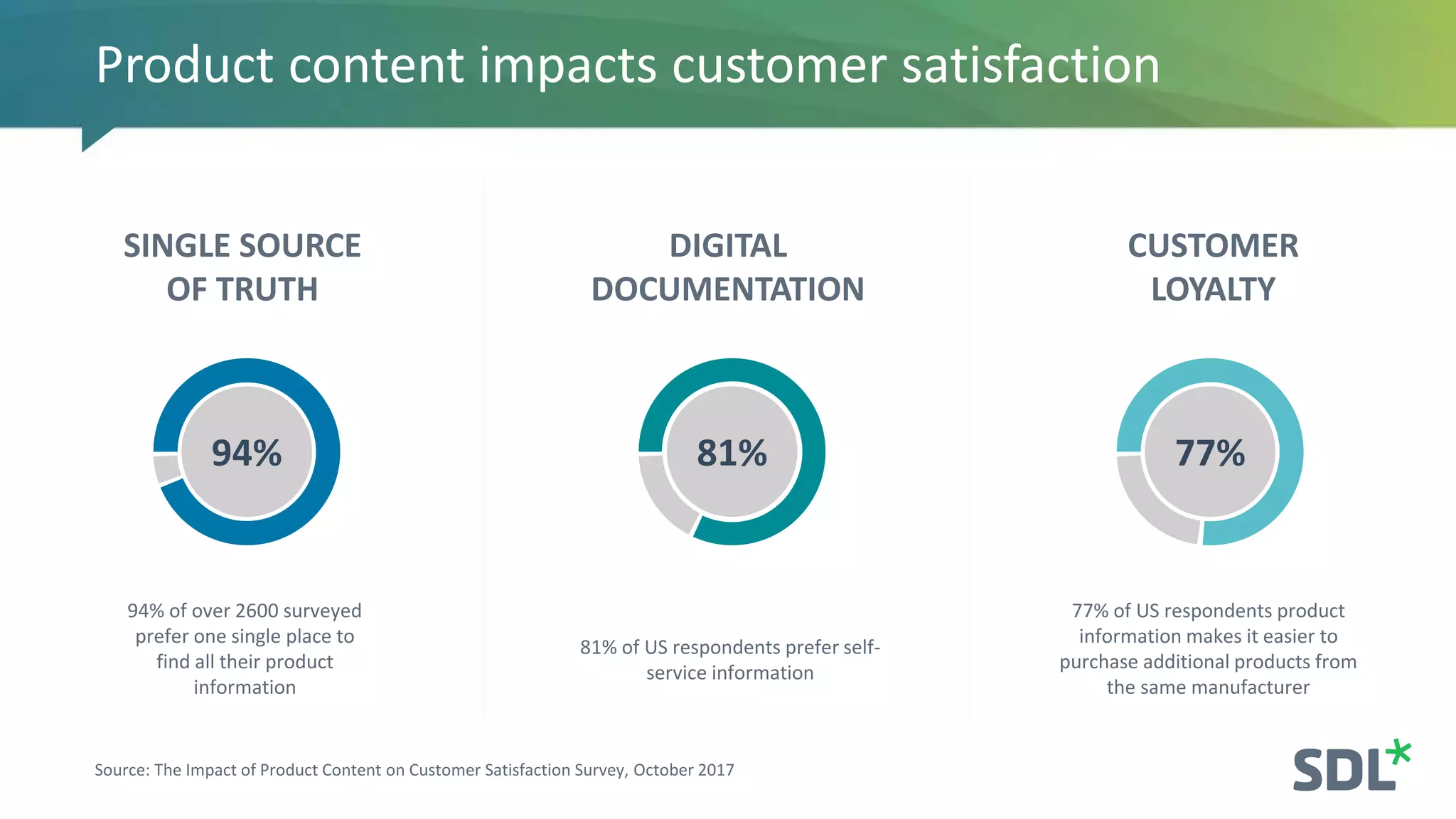
SINGLE SOURCE
OF TRUTH
DIGITAL
DOCUMENTATION
CUSTOMER
LOYALTY
94% of over 2600 surveyed
prefer one single place to
find all their product
information
81% of US respondents prefer self-
service information
94% 81%
77% of US respondents product
information makes it easier to
purchase additional products from
the same manufacturer
77%
Source: The Impact of Product Content on Customer Satisfaction Survey, October 2017
Product content impacts customer satisfaction
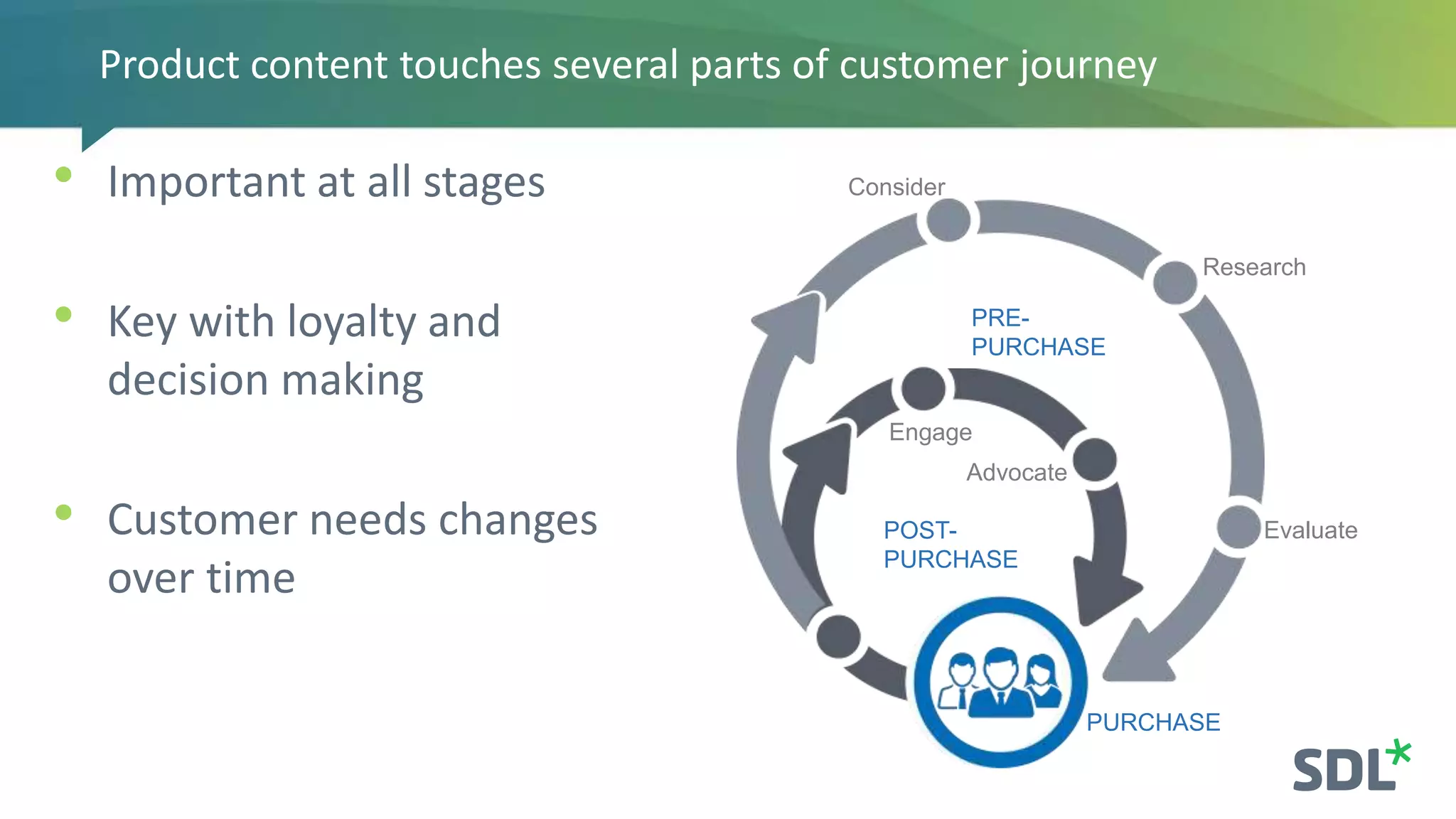
Product content touches several parts of customer journey
• Important at all stages
• Key with loyalty and
decision making
• Customer needs changes
over time
PRE-
PURCHASE
Consider
Research
Evaluate
PURCHASE
POST-
PURCHASE
Engage
Advocate
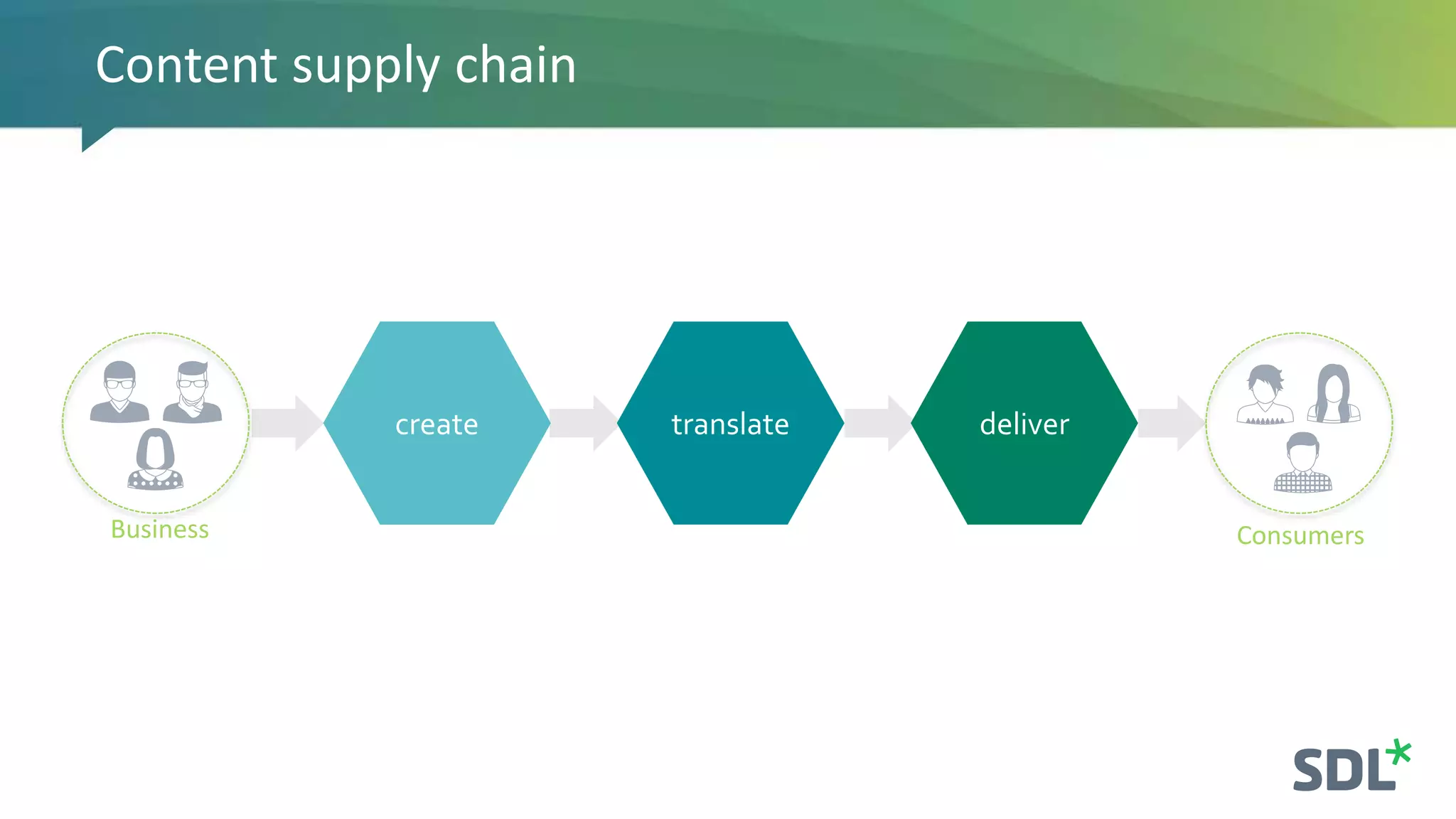
Content supply chain
ConsumersBusiness
create translate deliver
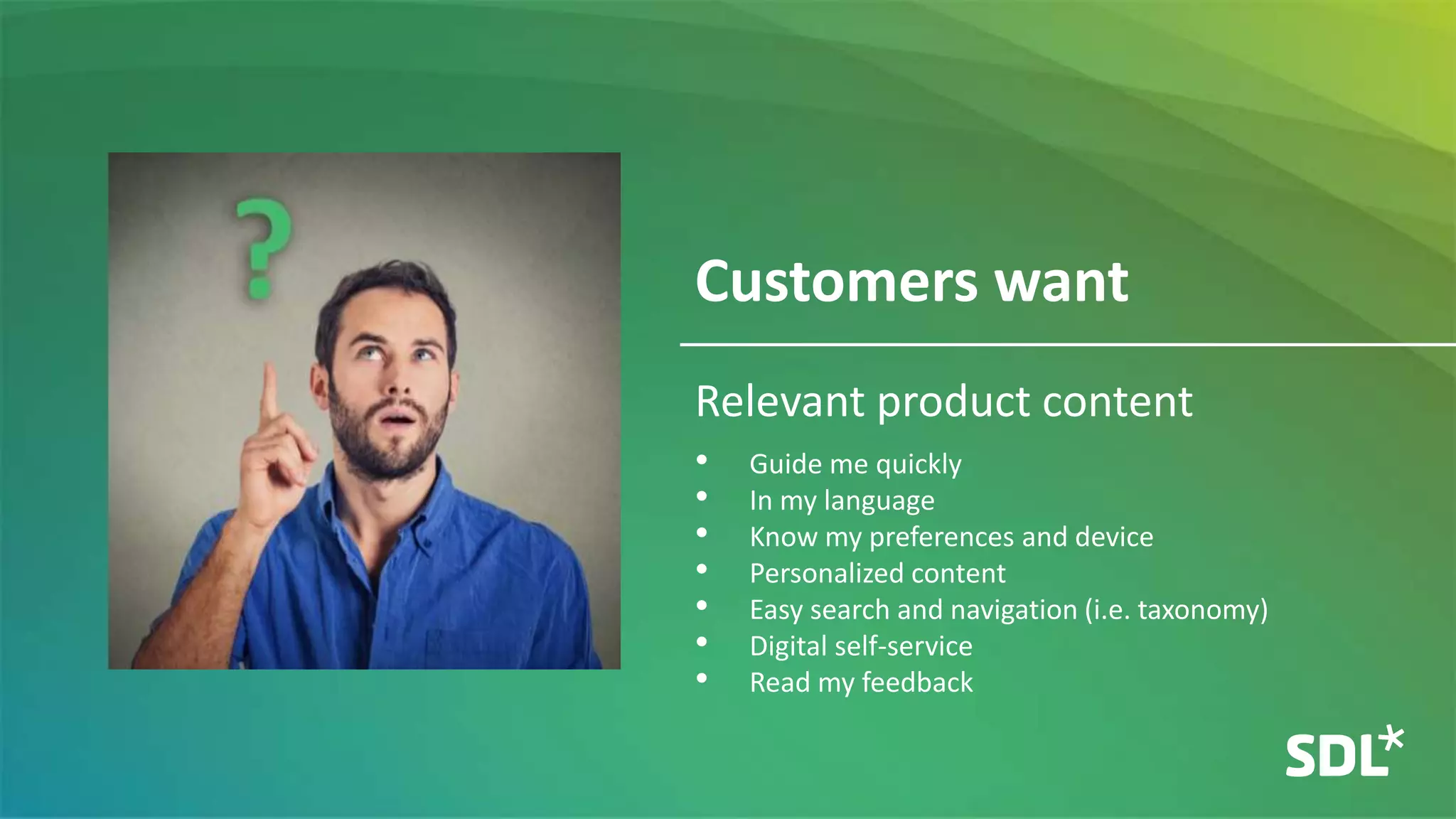
Customers want
Relevant product content
• Guide me quickly
• In my language
• Know my preferences and device
• Personalized content
• Easy search and navigation (i.e. taxonomy)
• Digital self-service
• Read my feedback
INTERNAL
CHALLENGES
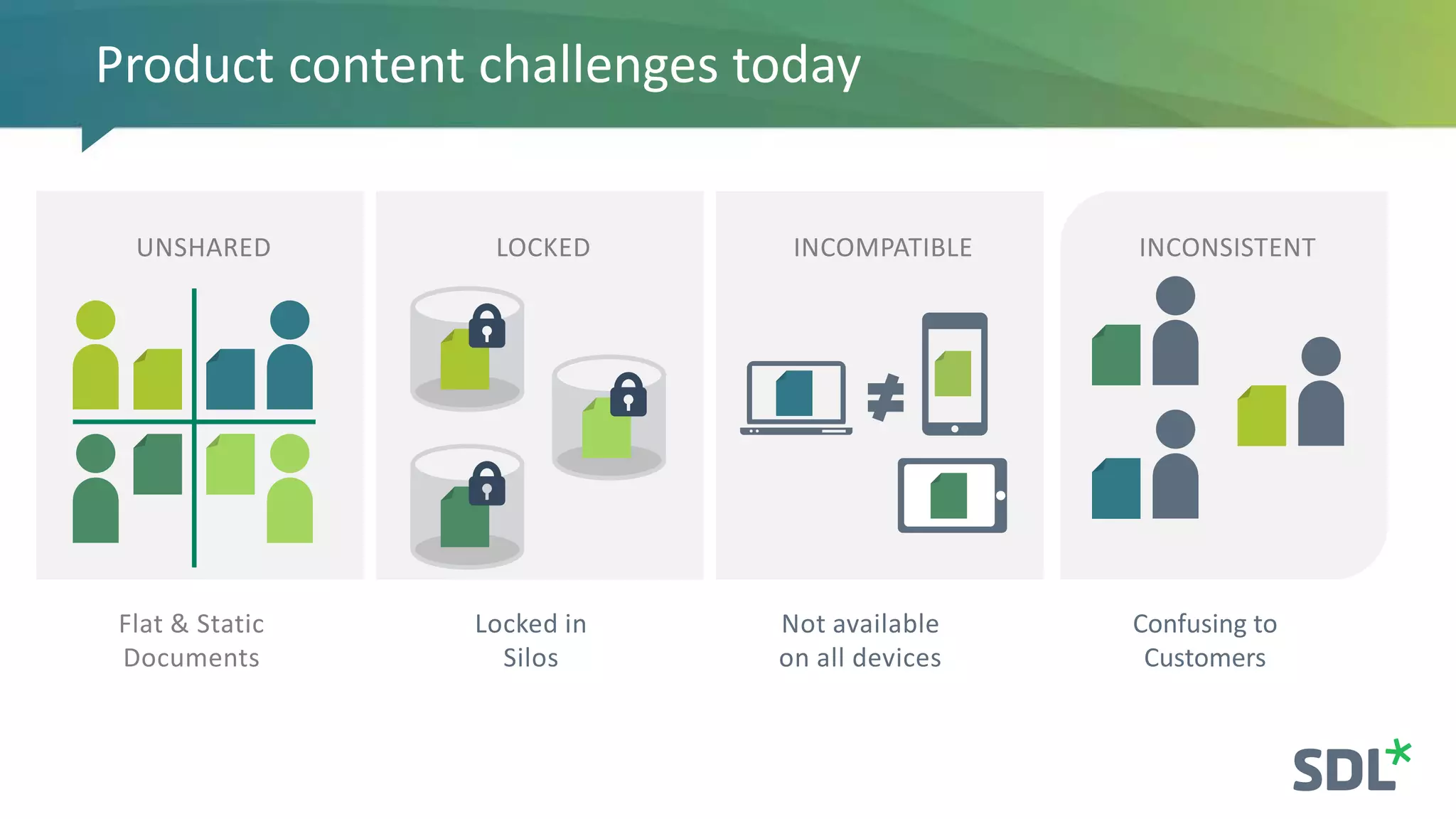
Locked in
Silos
LOCKED
Product content challenges today
Flat & Static
Documents
UNSHARED
Not available
on all devices
INCOMPATIBLE
Confusing to
Customers
INCONSISTENT
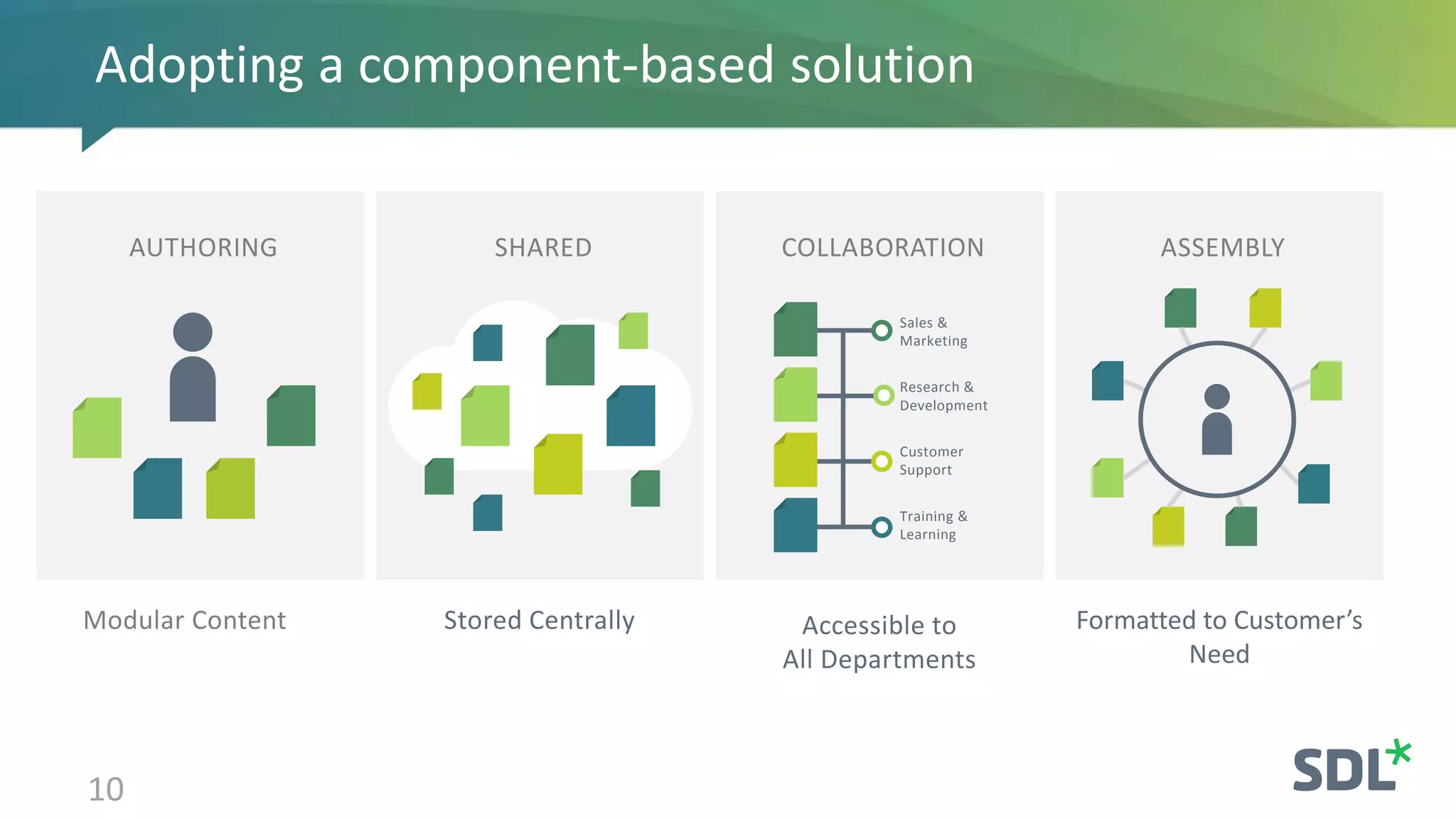
Adopting a component-based solution
10
Modular Content
AUTHORING
Stored Centrally
SHARED COLLABORATION
Accessible to
All Departments
Sales &
Marketing
Research &
Development
Customer
Support
Training &
Learning
ASSEMBLY
Formatted to Customer’s
Need
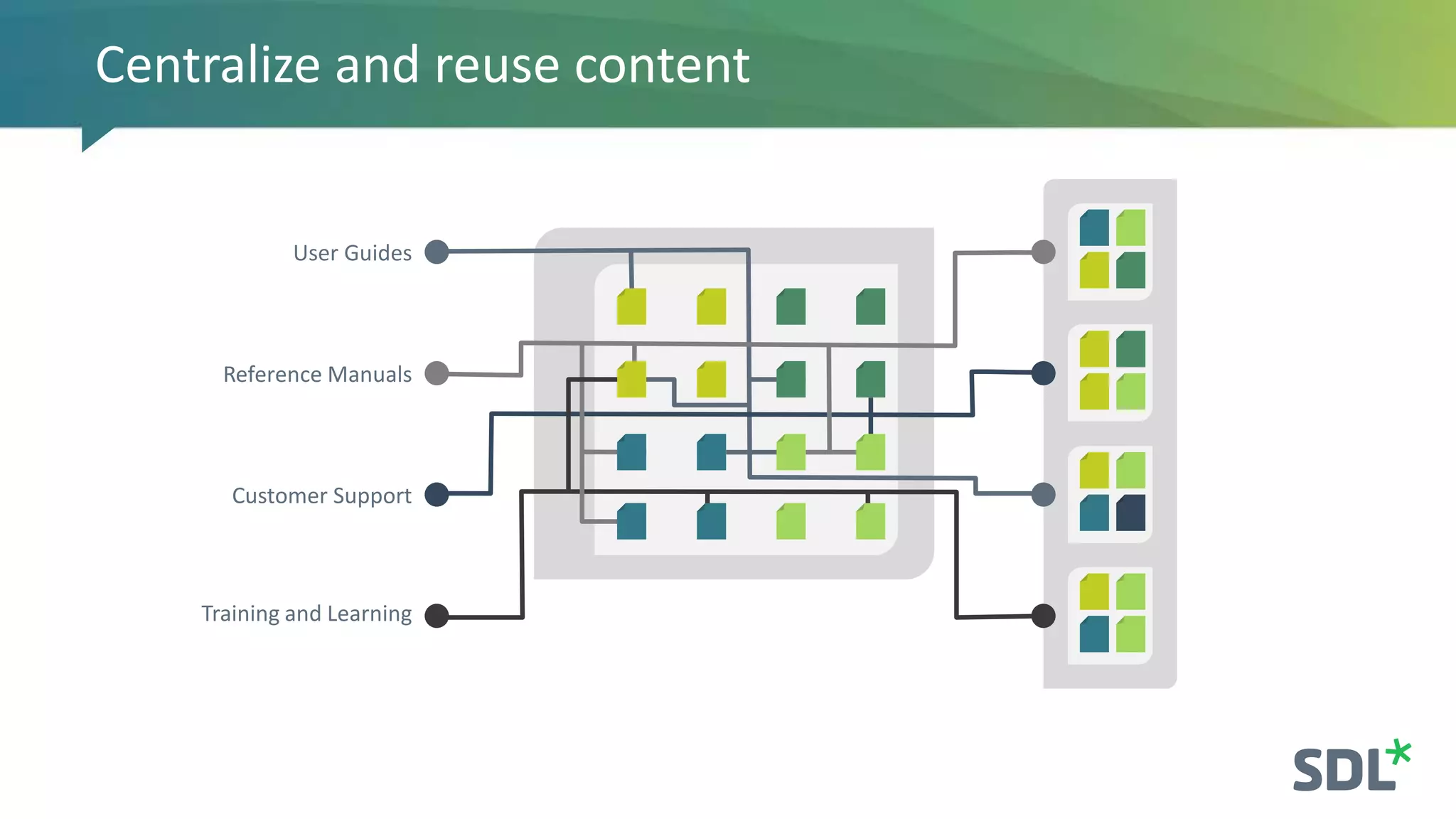
Centralize and reuse content
User Guides
Reference Manuals
Customer Support
Training and Learning
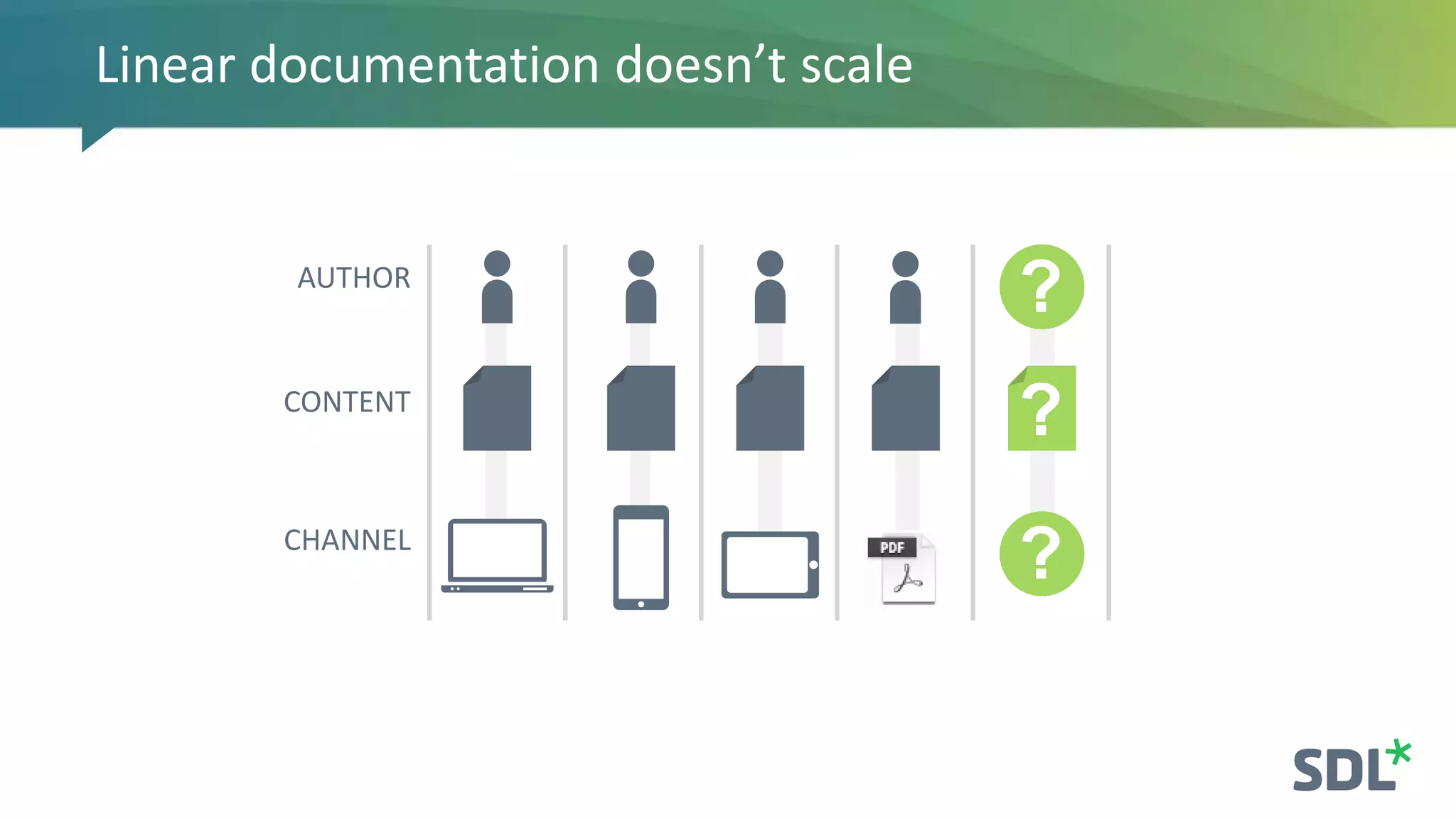
Linear documentation doesn’t scale
AUTHOR
CONTENT
CHANNEL
?
?
?
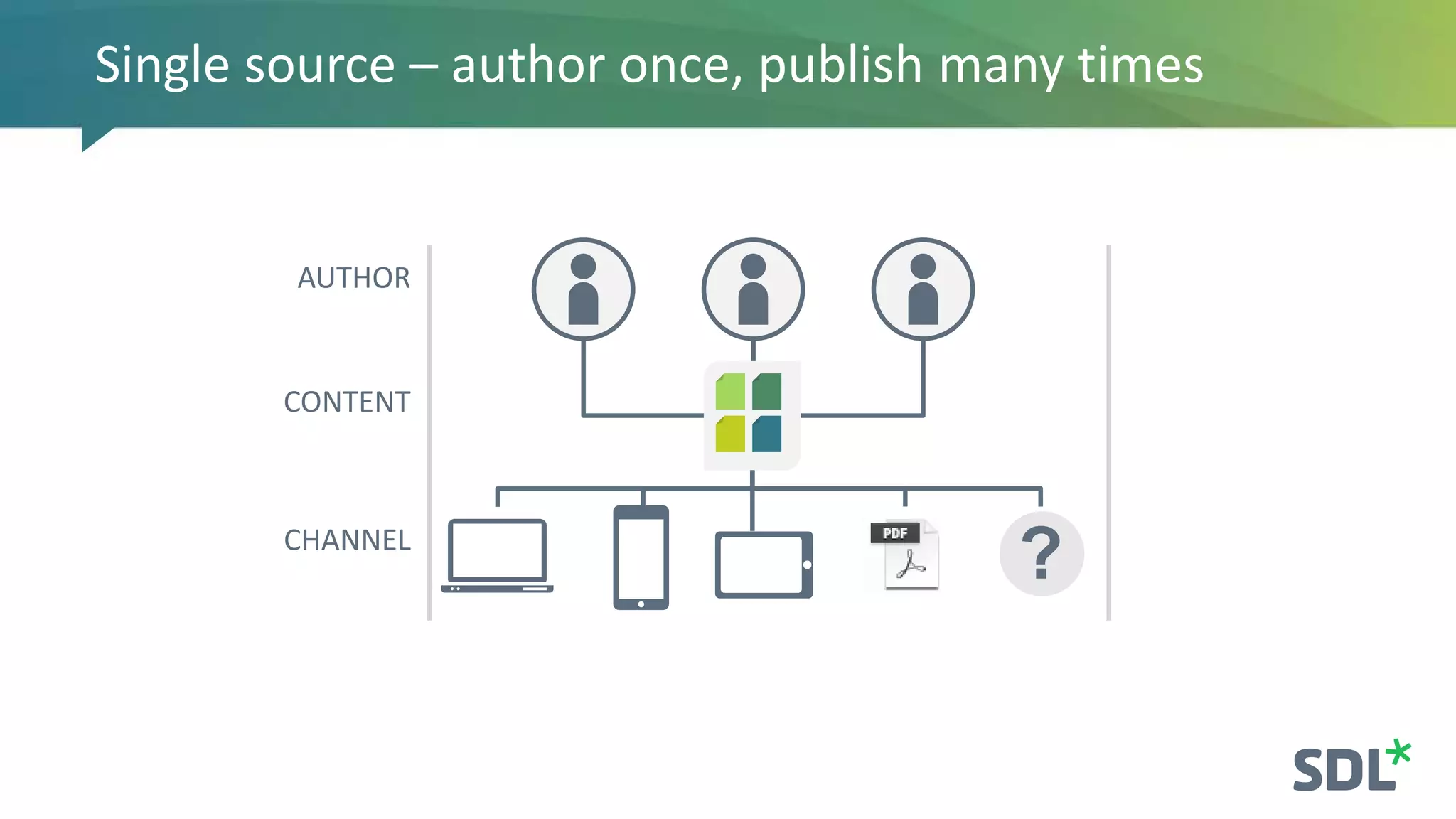
Single source – author once, publish many times
AUTHOR
CONTENT
CHANNEL
?
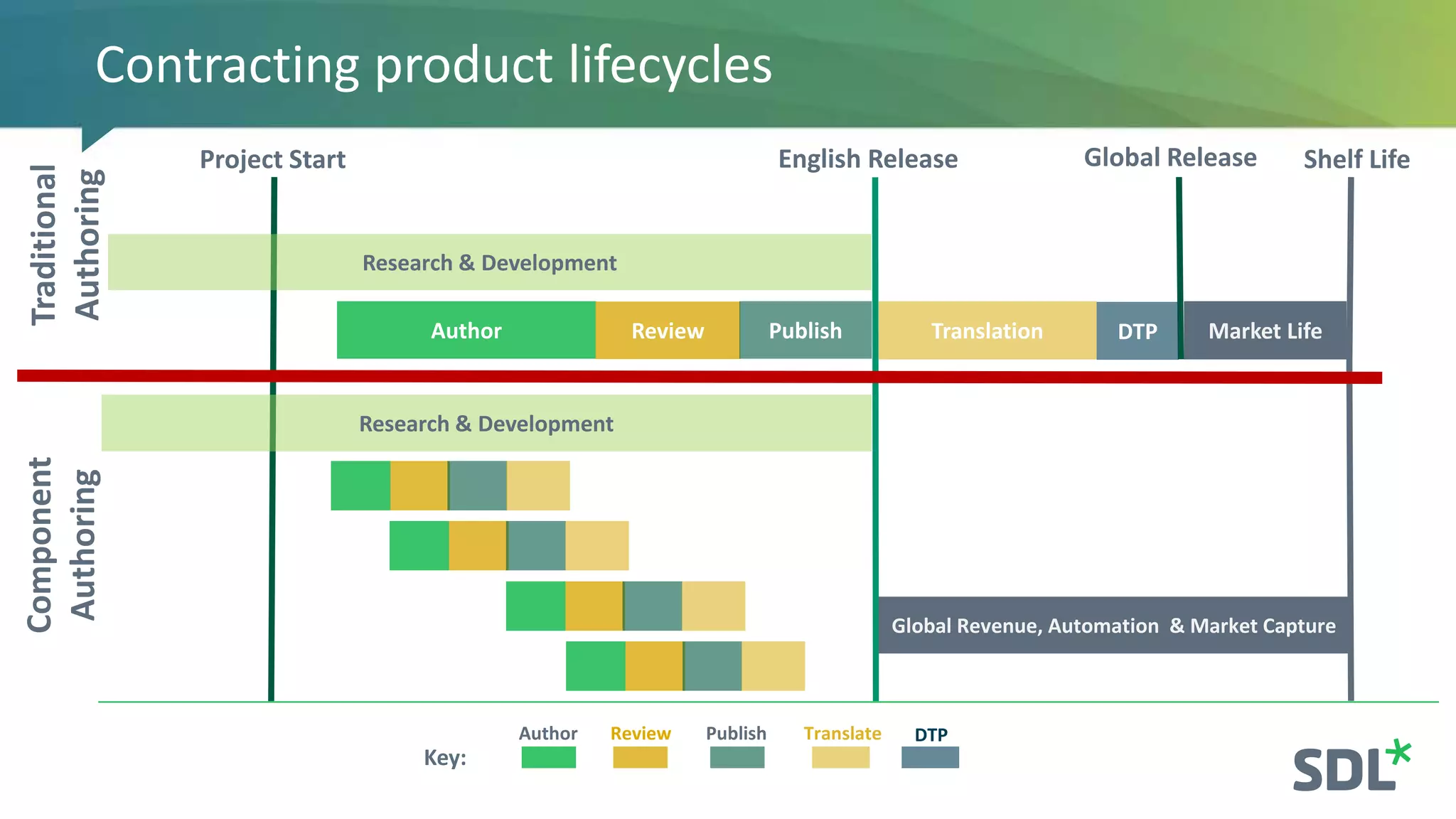
Contracting product lifecycles
Research & Development
Market Life
Project Start Global ReleaseEnglish Release Shelf Life
Traditional
Authoring
Research & Development
Global Revenue, Automation & Market Capture
Component
Authoring
TranslationAuthor Review Publish
Author Review Publish Translate
Key:
DTP
DTP
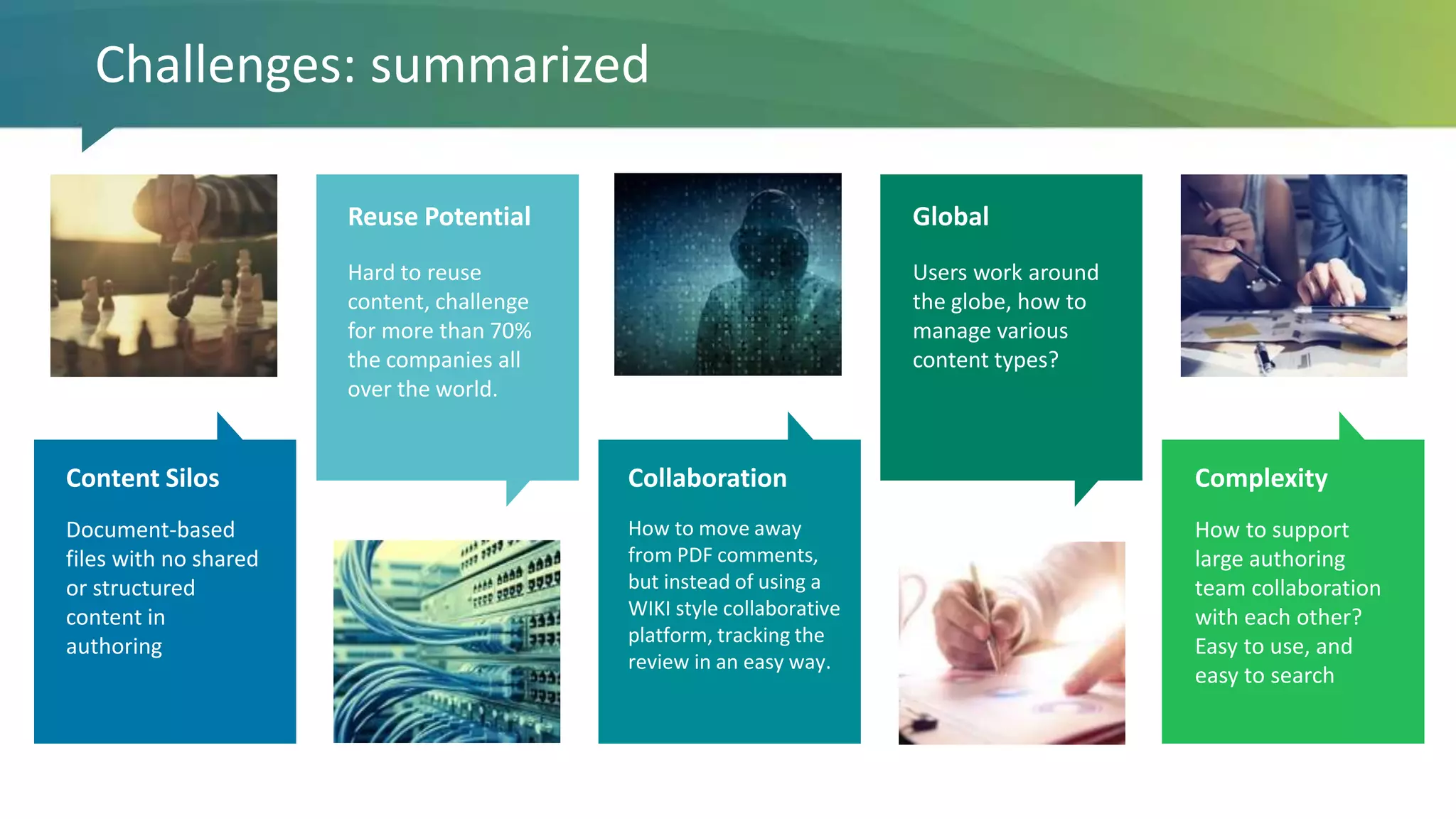
Reuse Potential
Hard to reuse
content, challenge
for more than 70%
the companies all
over the world.
Global
Users work around
the globe, how to
manage various
content types?
Content Silos
Document-based
files with no shared
or structured
content in
authoring
Collaboration
How to move away
from PDF comments,
but instead of using a
WIKI style collaborative
platform, tracking the
review in an easy way.
Complexity
How to support
large authoring
team collaboration
with each other?
Easy to use, and
easy to search
Challenges: summarized
INTELLIGENT
CONTENT:
MORE FINDABILITY
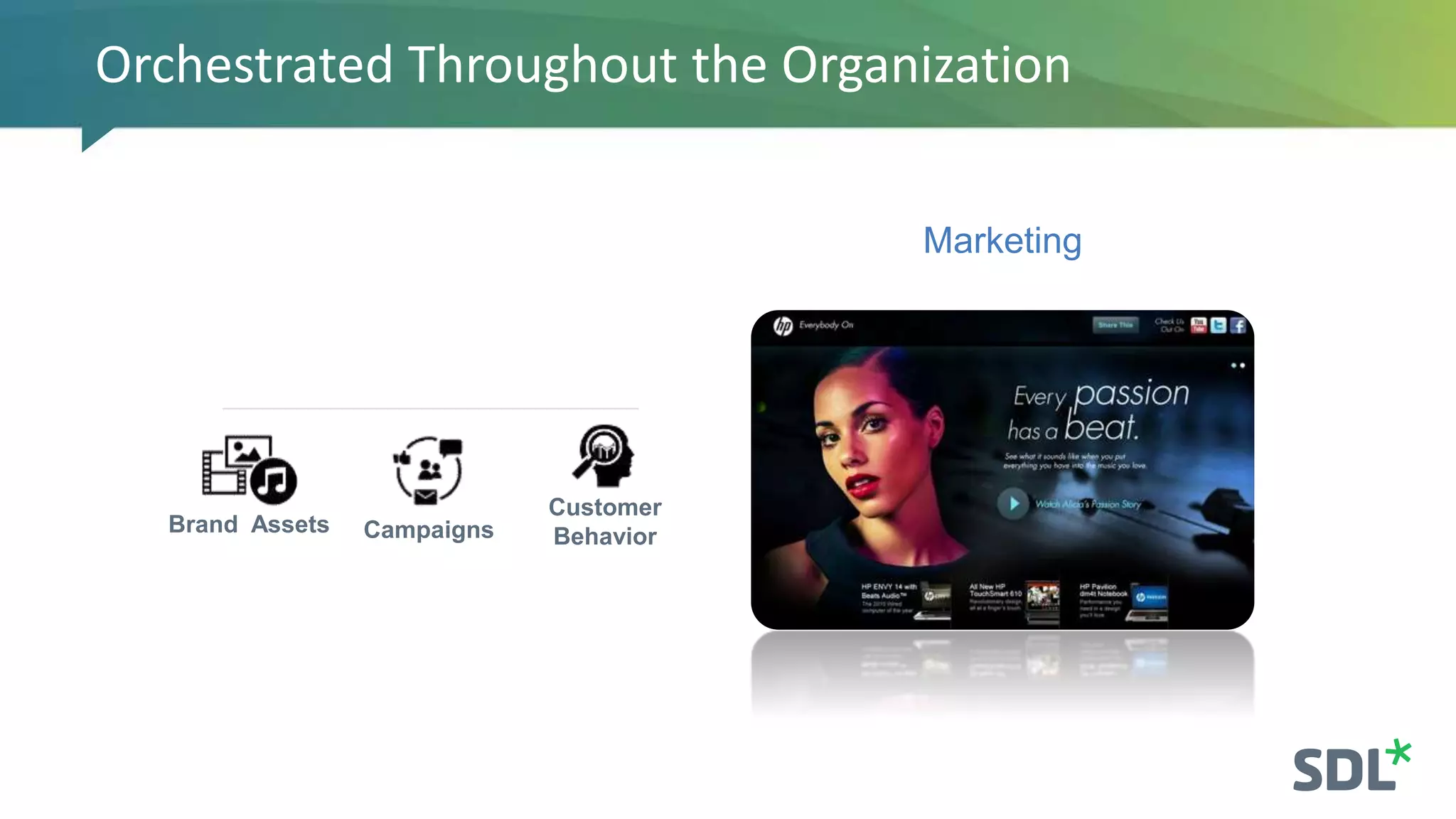
Marketing
Customer
BehaviorBrand Assets Campaigns
Orchestrated Throughout the Organization
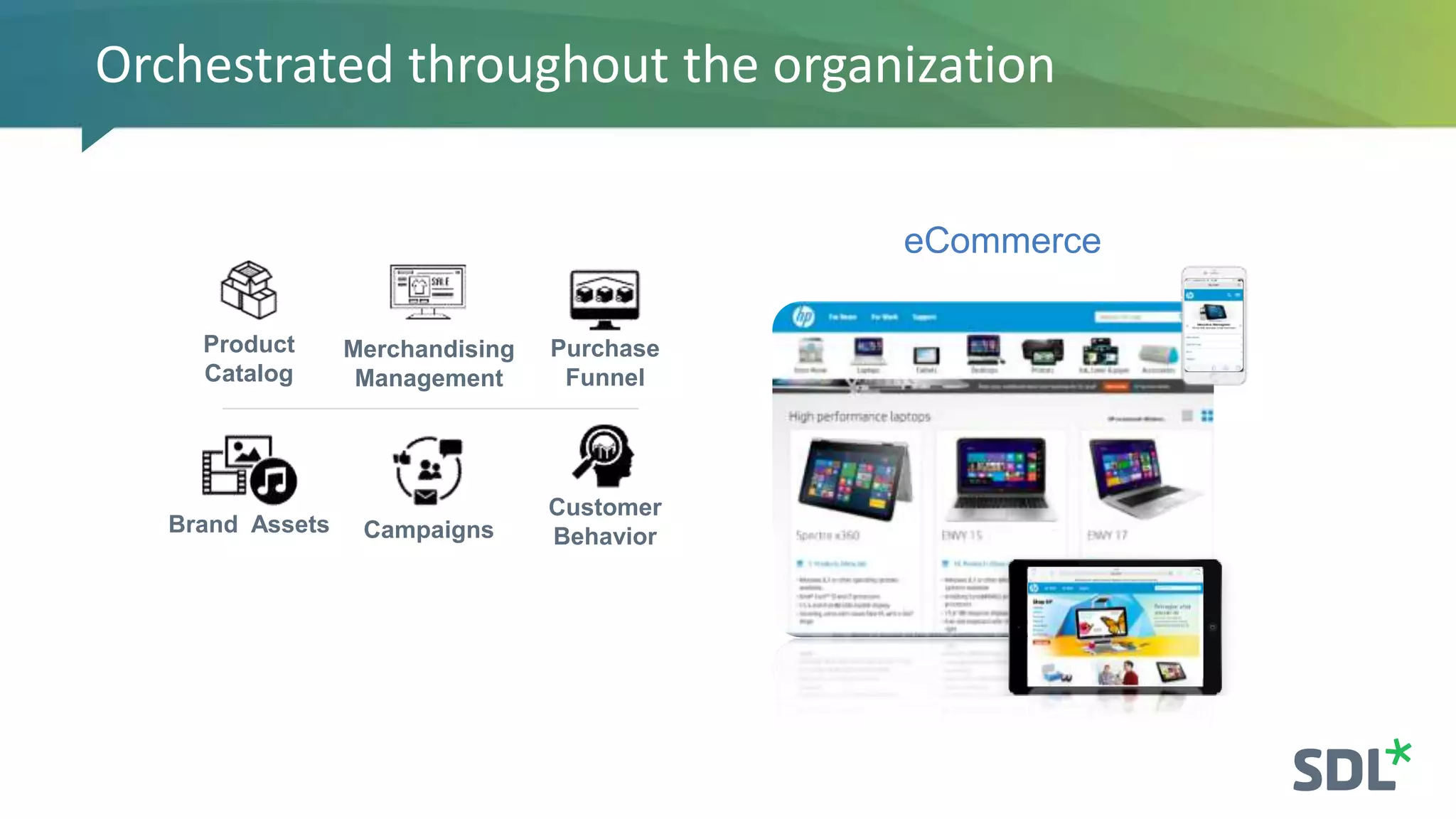
eCommerce
Customer
BehaviorBrand Assets Campaigns
Product
Catalog
Purchase
Funnel
Merchandising
Management
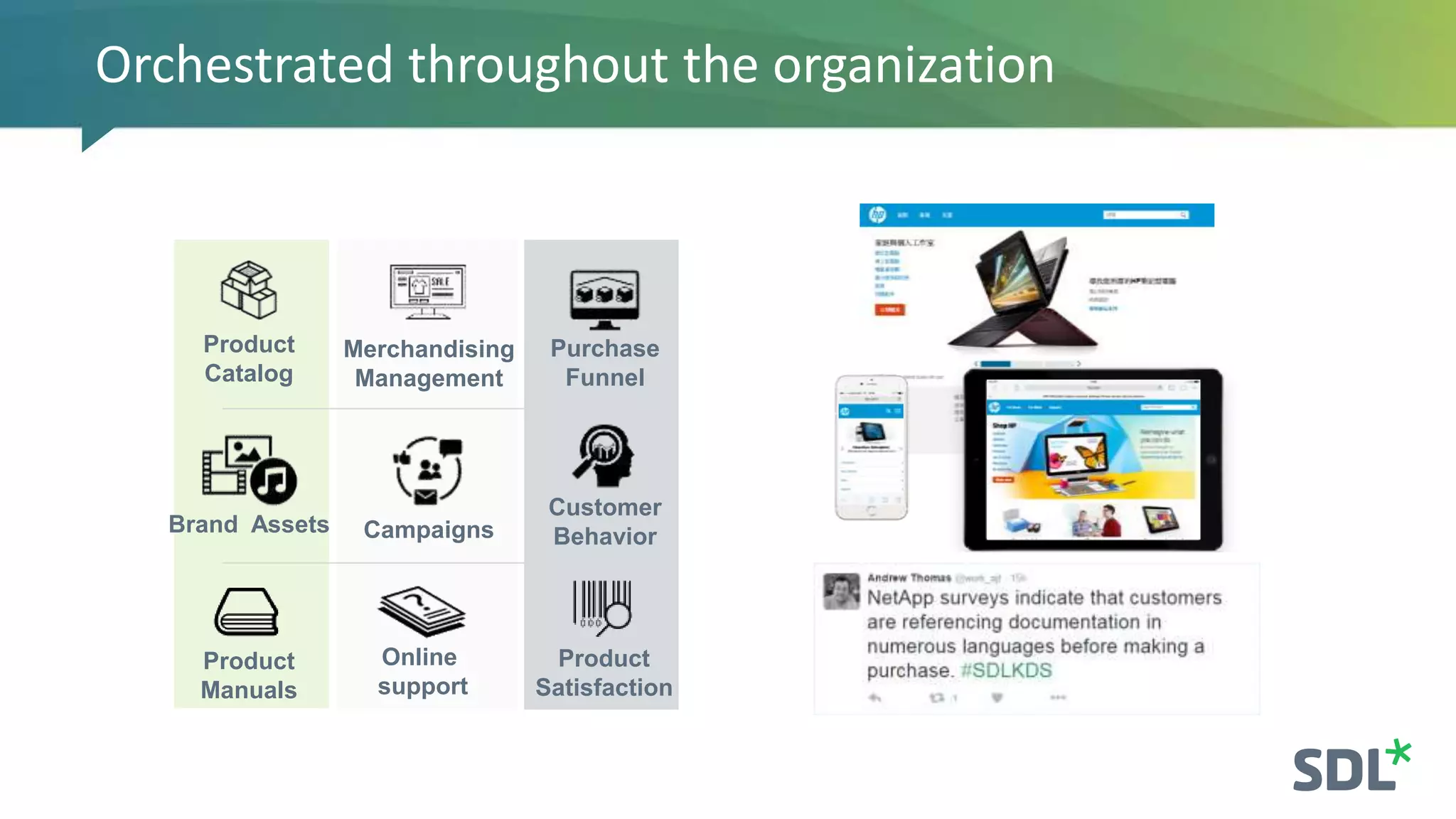
Orchestrated throughout the organization
Product
Manuals
Product
Satisfaction
Online
support
Product
Catalog
Purchase
Funnel
Merchandising
Management
Customer
BehaviorBrand Assets Campaigns
Orchestrated throughout the organization
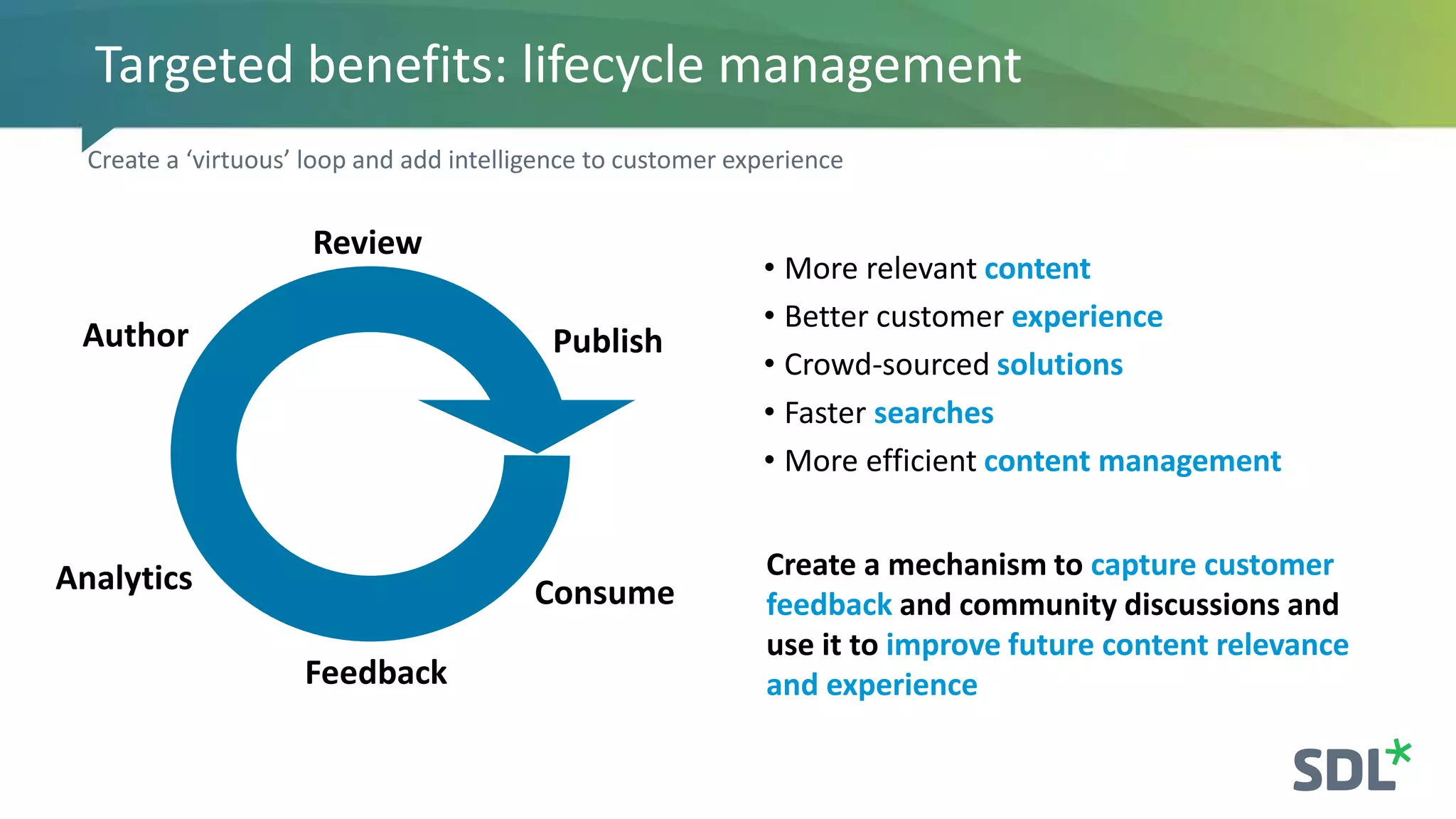
Targeted benefits: lifecycle management
Create a ‘virtuous’ loop and add intelligence to customer experience
Author
Review
Publish
Consume
Feedback
Analytics
• More relevant content
• Better customer experience
• Crowd-sourced solutions
• Faster searches
• More efficient content management
Create a mechanism to capture customer
feedback and community discussions and
use it to improve future content relevance
and experience
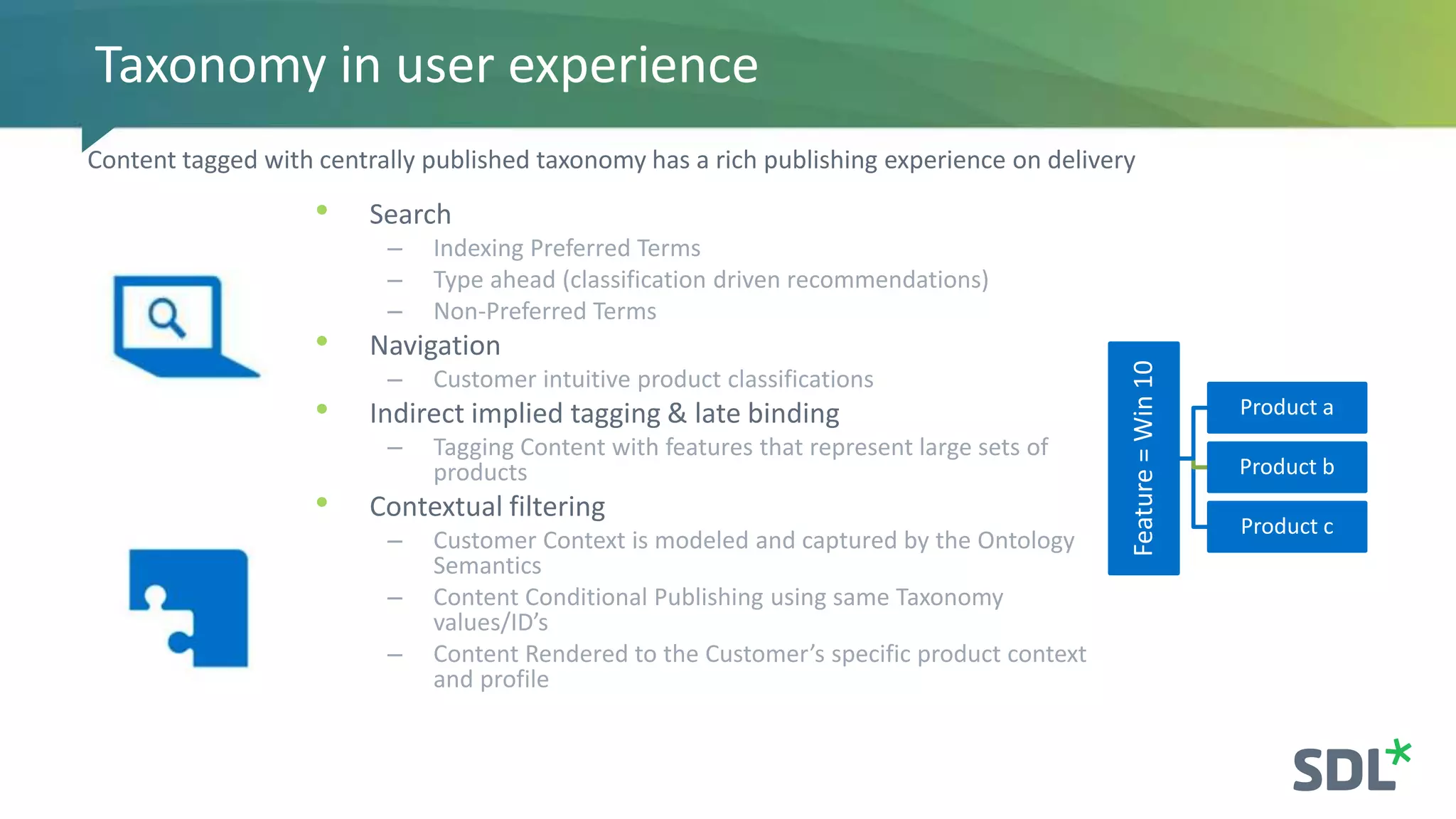
Taxonomy in user experience
Content tagged with centrally published taxonomy has a rich publishing experience on delivery
• Search
– Indexing Preferred Terms
– Type ahead (classification driven recommendations)
– Non-Preferred Terms
• Navigation
– Customer intuitive product classifications
• Indirect implied tagging & late binding
– Tagging Content with features that represent large sets of
products
• Contextual filtering
– Customer Context is modeled and captured by the Ontology
Semantics
– Content Conditional Publishing using same Taxonomy
values/ID’s
– Content Rendered to the Customer’s specific product context
and profile
Feature=Win10
Product a
Product b
Product c
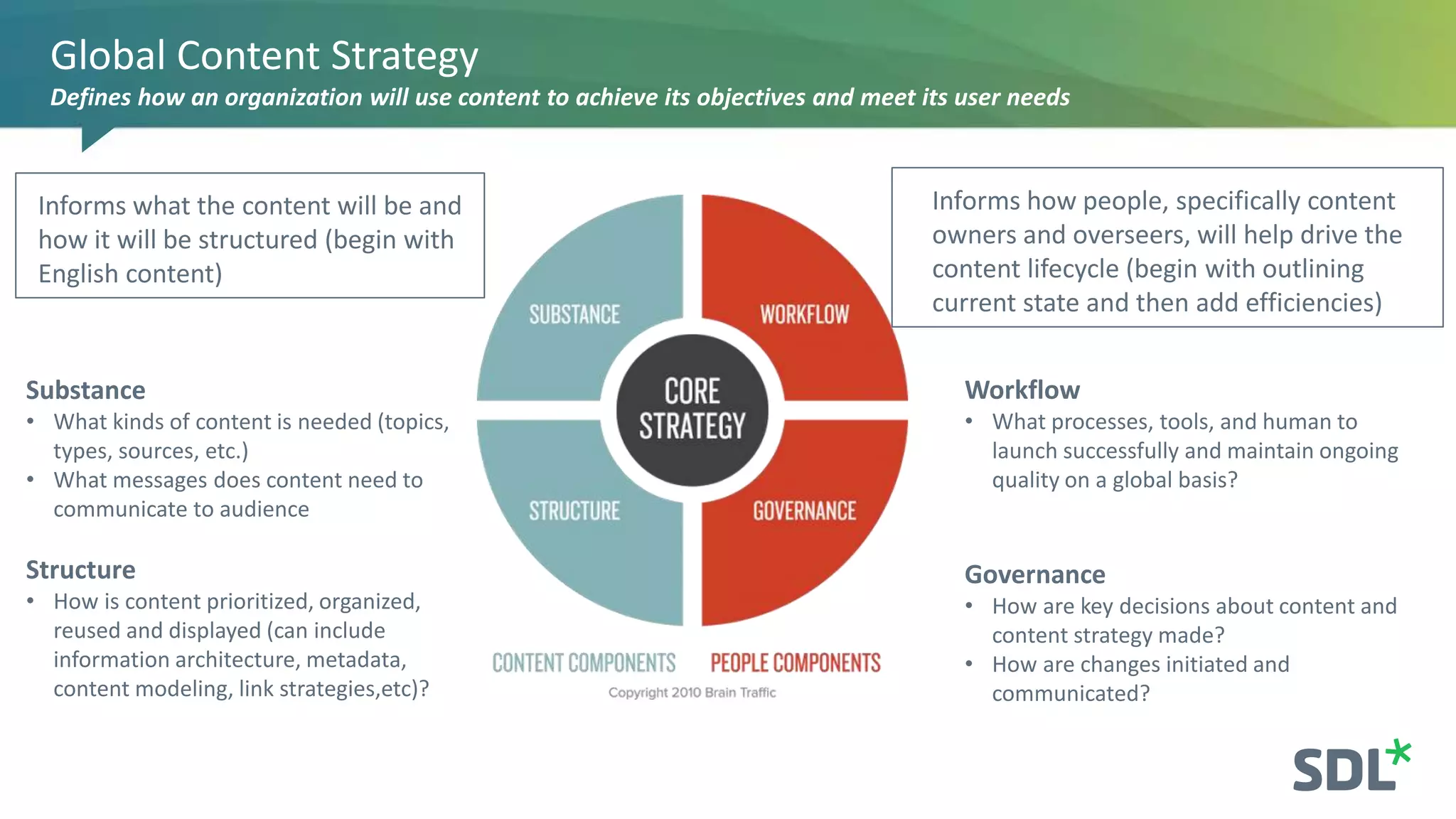
Global Content Strategy
Defines how an organization will use content to achieve its objectives and meet its user needs
Substance
• What kinds of content is needed (topics,
types, sources, etc.)
• What messages does content need to
communicate to audience
Structure
• How is content prioritized, organized,
reused and displayed (can include
information architecture, metadata,
content modeling, link strategies,etc)?
Workflow
• What processes, tools, and human to
launch successfully and maintain ongoing
quality on a global basis?
Governance
• How are key decisions about content and
content strategy made?
• How are changes initiated and
communicated?
Informs how people, specifically content
owners and overseers, will help drive the
content lifecycle (begin with outlining
current state and then add efficiencies)
Informs what the content will be and
how it will be structured (begin with
English content)
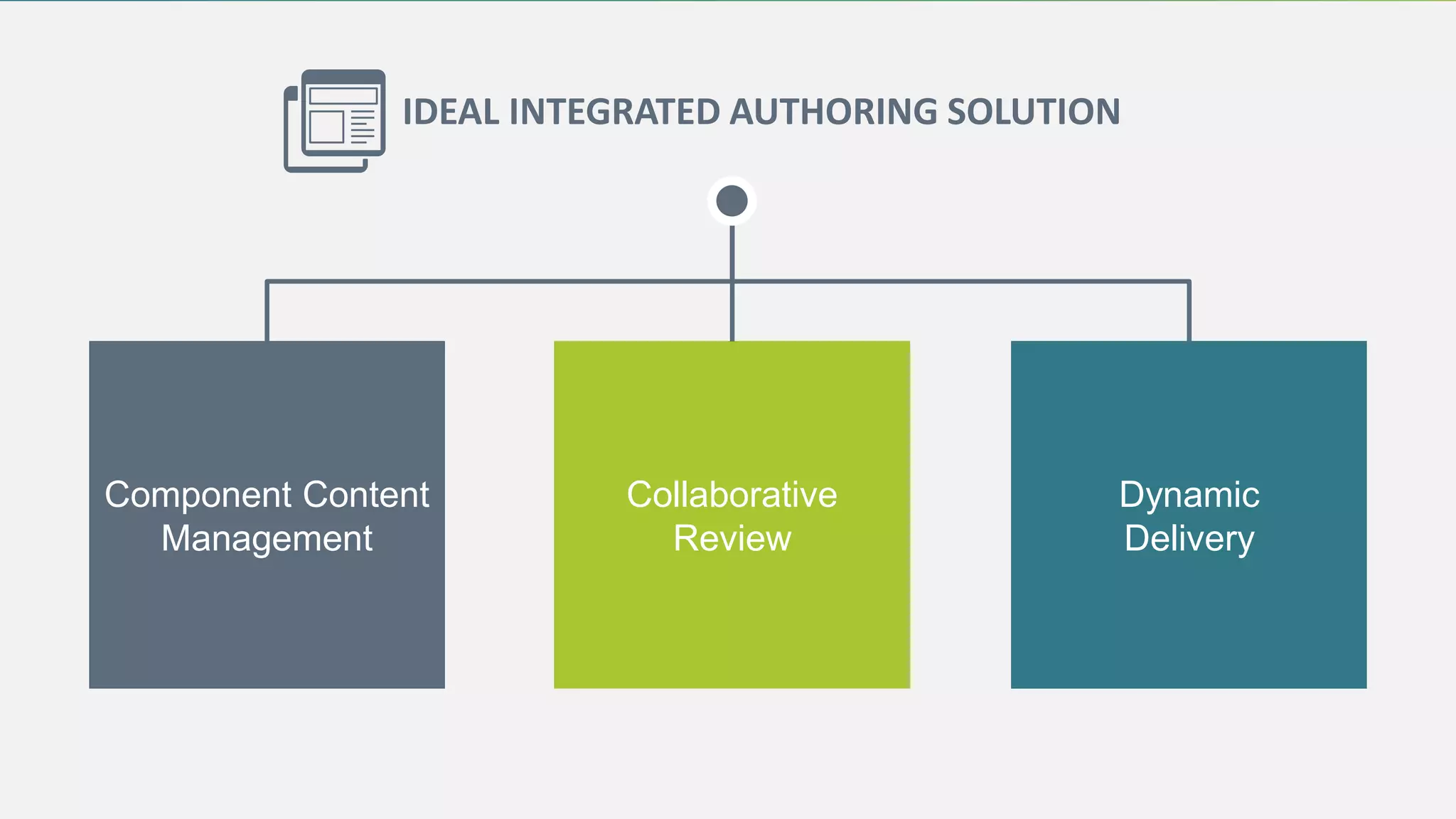
Component Content
Management
Collaborative
Review
Dynamic
Delivery
IDEAL INTEGRATED AUTHORING SOLUTION
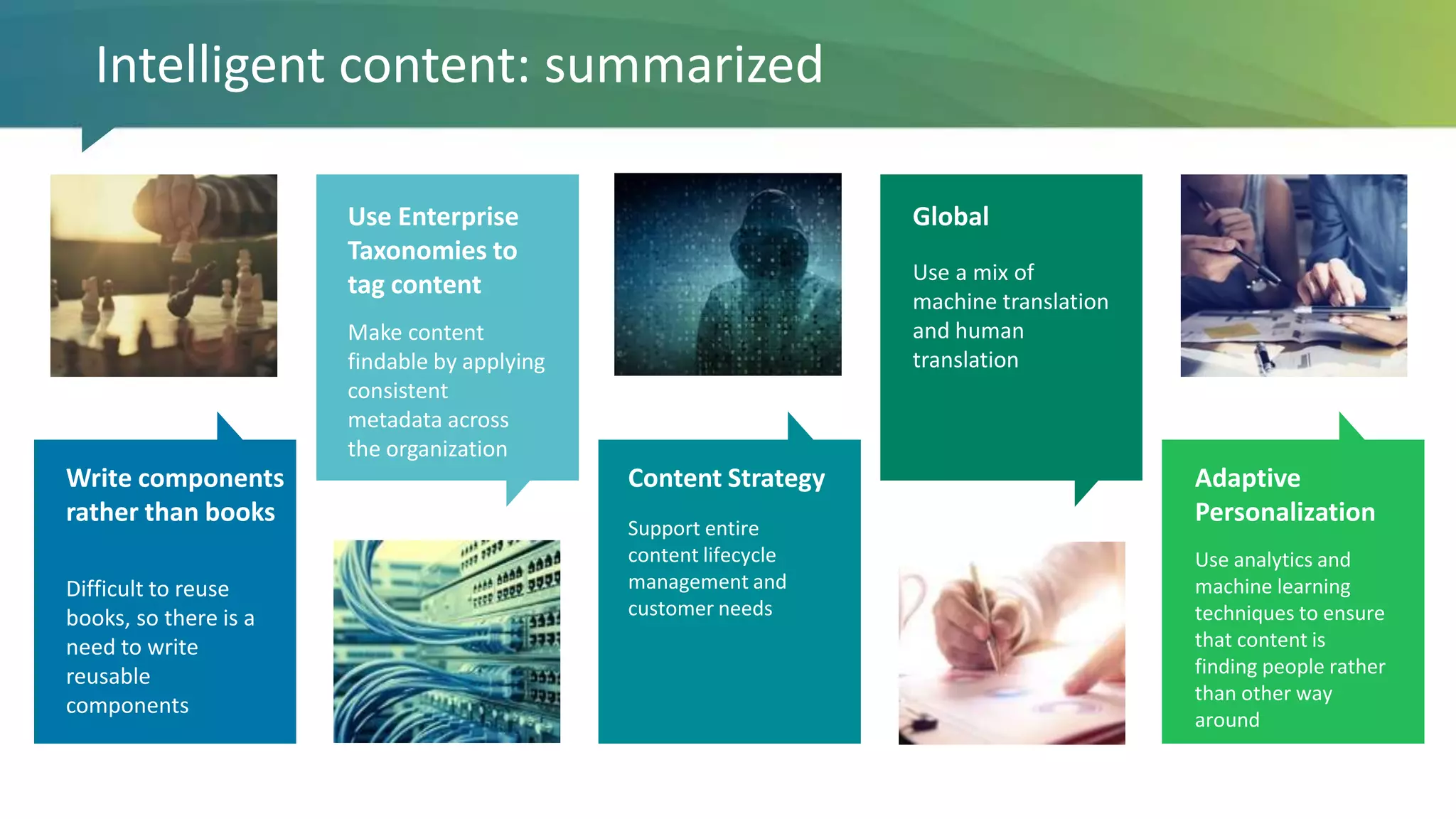
Use Enterprise
Taxonomies to
tag content
Make content
findable by applying
consistent
metadata across
the organization
Global
Use a mix of
machine translation
and human
translation
Write components
rather than books
Difficult to reuse
books, so there is a
need to write
reusable
components
Content Strategy
Support entire
content lifecycle
management and
customer needs
Adaptive
Personalization
Use analytics and
machine learning
techniques to ensure
that content is
finding people rather
than other way
around
Intelligent content: summarized
RESULTS FROM
CUSTOMER CASE
STUDIES
The ACI experience
The beginning
• Feature/functionality content
• Multiple authoring tools
• 78,000 pages of content (growing)
• 0% reuse
Moved to topic authoring and collaborative
review with SDL Knowledge Center in 2013
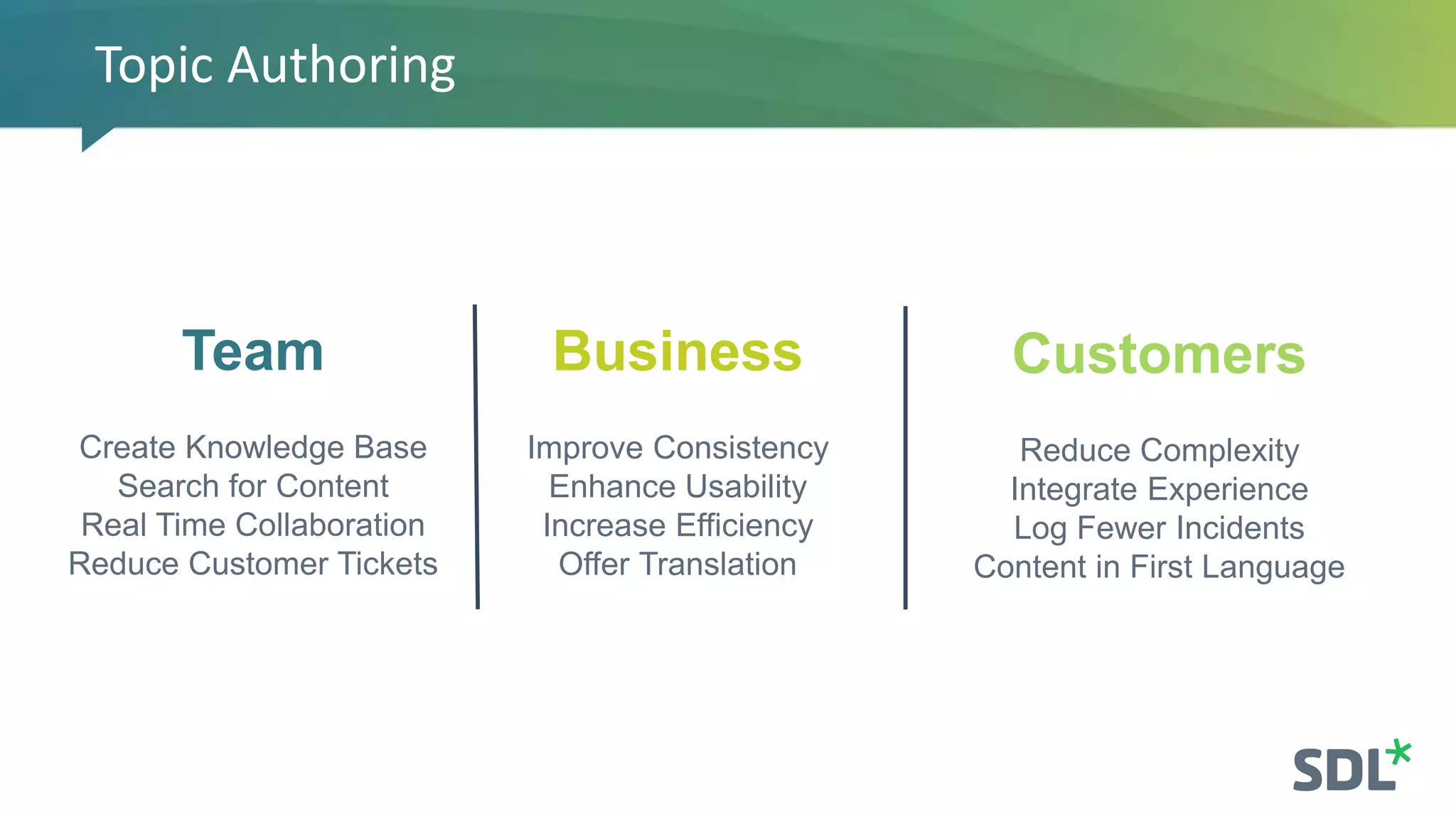
Topic Authoring
Team
Create Knowledge Base
Search for Content
Real Time Collaboration
Reduce Customer Tickets
Business
Improve Consistency
Enhance Usability
Increase Efficiency
Offer Translation
Customers
Reduce Complexity
Integrate Experience
Log Fewer Incidents
Content in First Language
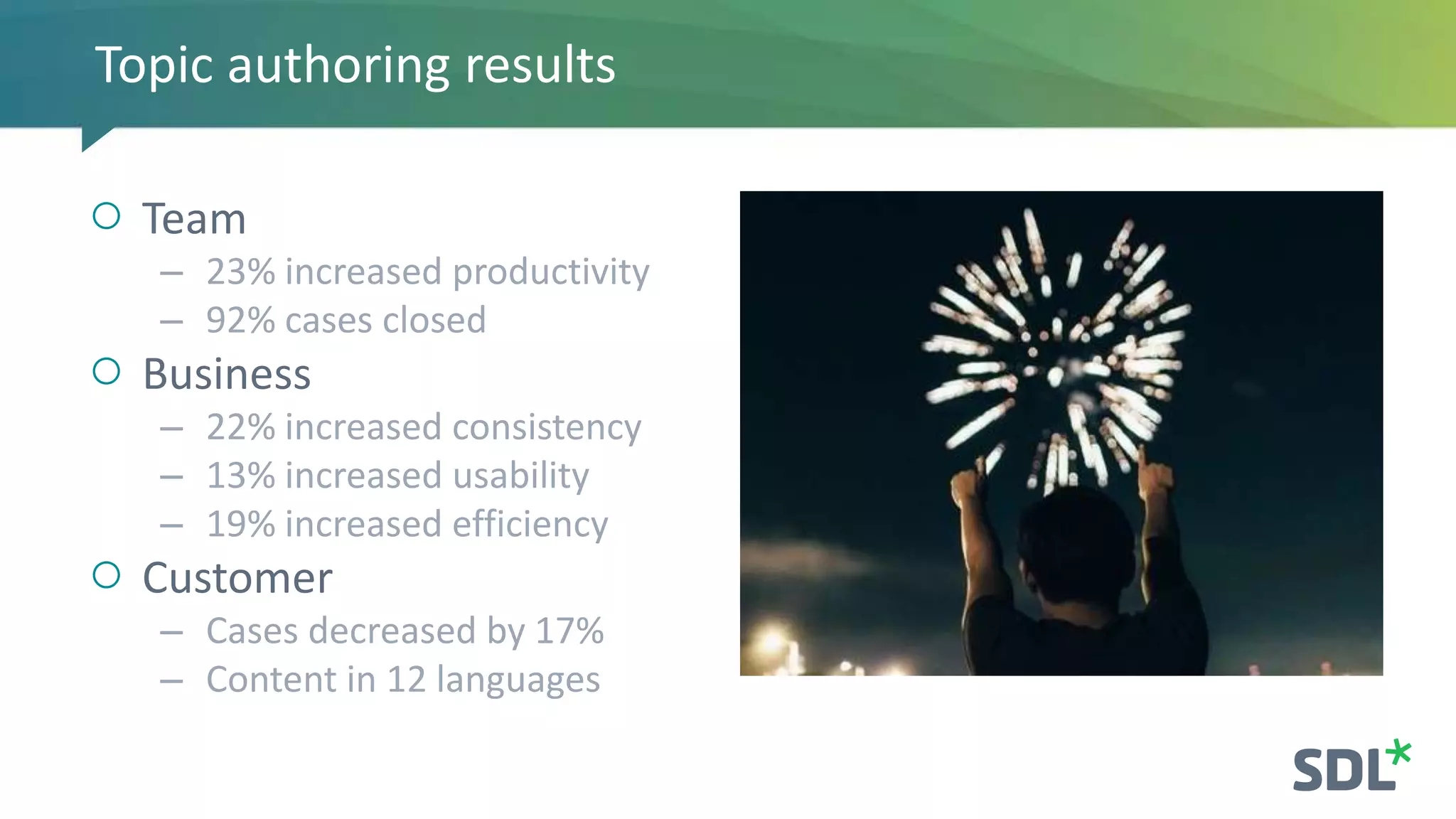
○ Team
– 23% increased productivity
– 92% cases closed
○ Business
– 22% increased consistency
– 13% increased usability
– 19% increased efficiency
○ Customer
– Cases decreased by 17%
– Content in 12 languages
Topic authoring results
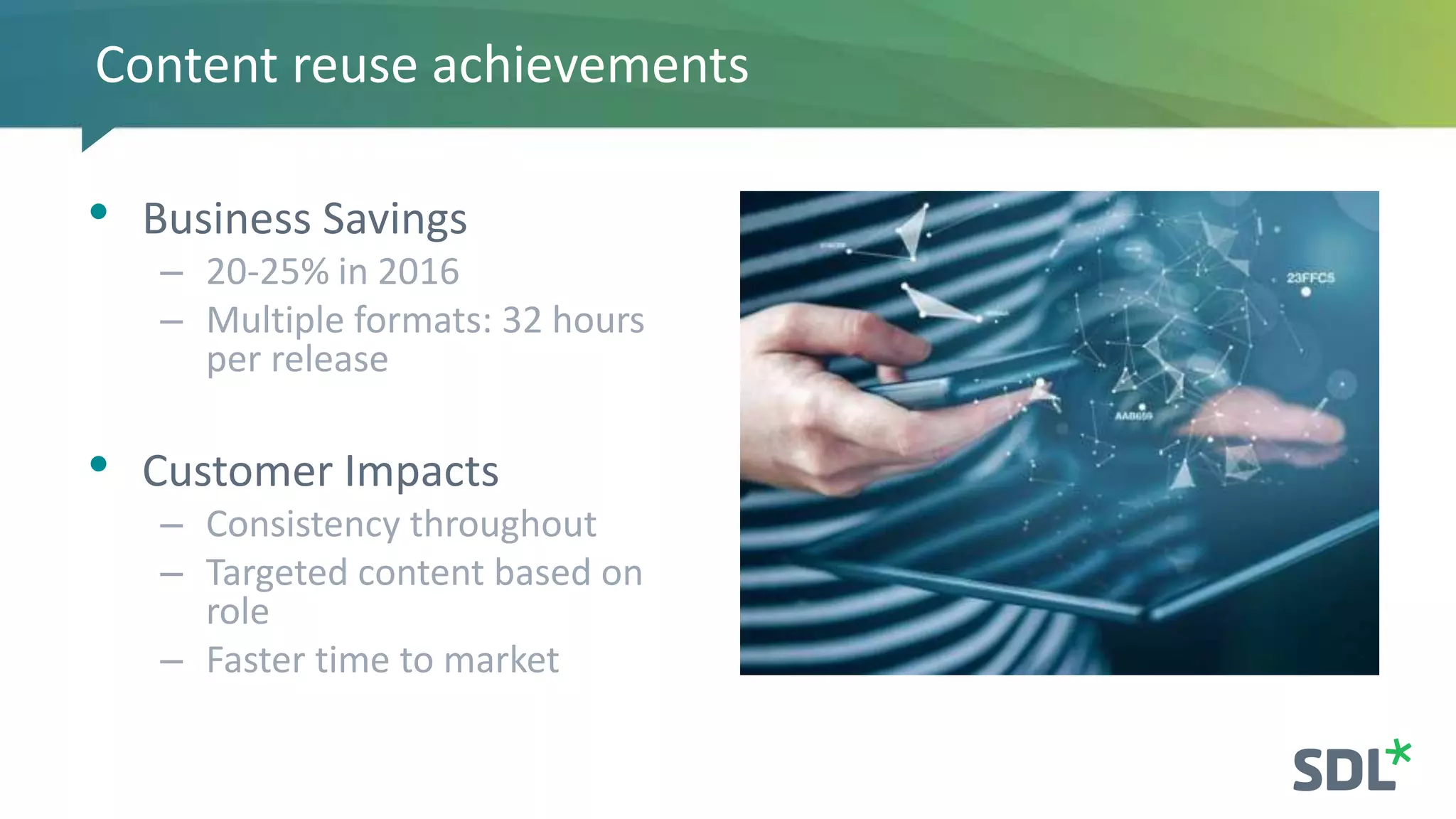
• Business Savings
– 20-25% in 2016
– Multiple formats: 32 hours
per release
• Customer Impacts
– Consistency throughout
– Targeted content based on
role
– Faster time to market
Content reuse achievements
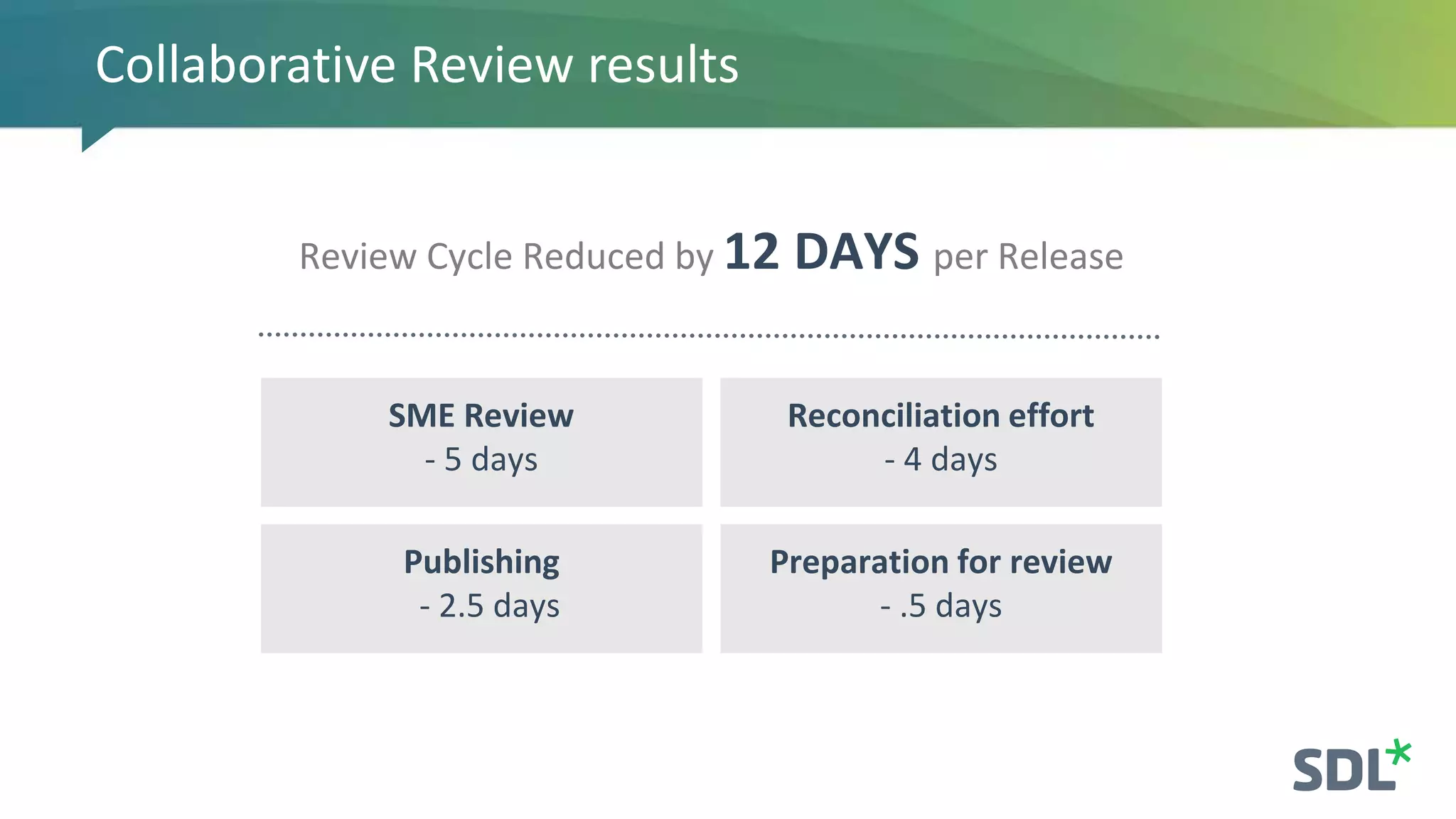
Collaborative Review results
Review Cycle Reduced by 12 DAYS per Release
Reconciliation effort
- 4 days
Publishing
- 2.5 days
Preparation for review
- .5 days
SME Review
- 5 days
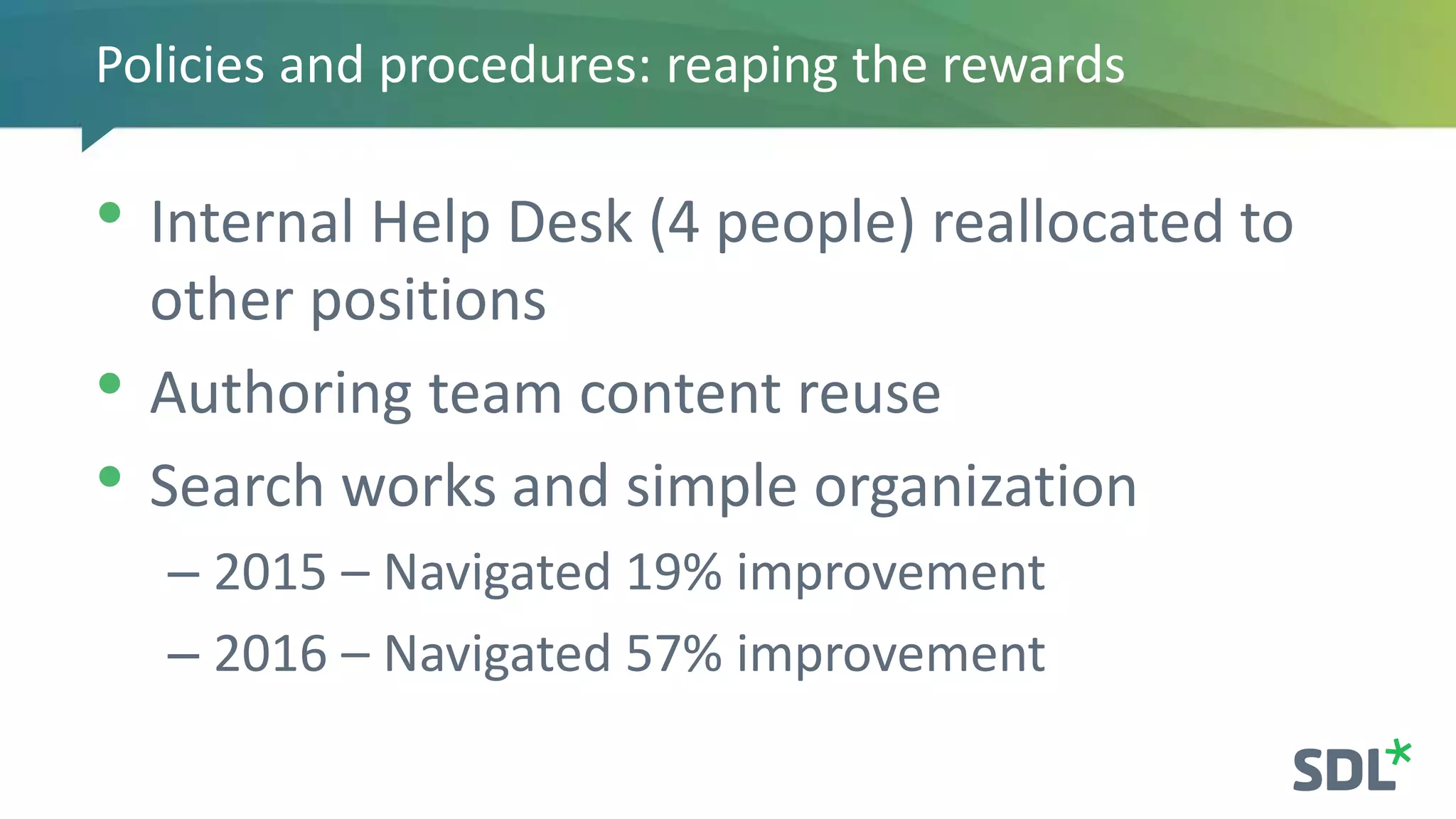
Policies and procedures: reaping the rewards
• Internal Help Desk (4 people) reallocated to
other positions
• Authoring team content reuse
• Search works and simple organization
– 2015 – Navigated 19% improvement
– 2016 – Navigated 57% improvement
ANSWERS
&
QUESTIONS
Copyright © 2008-2017 SDL plc. All rights reserved. All company names, brand names,
trademarks, service marks, images and logos are the property of their respective owners.
This presentation and its content are SDL confidential unless otherwise specified, and may
not be copied, used or distributed except as authorised by SDL.
Software and Services for Human Understanding

LavaCon 2017 - Future-proof Your Content: Beyond Traditional Publishing for Scalability

  • 1.
    Version 1.2 Chip Gettinger VPGlobal Solutions Consulting, SDL @cgettinger Future-proof Your Content: Beyond Traditional Publishing
  • 2.
    Across all industries, disruptivetechnologies are introducing new players and evolving consumer expectations
  • 3.
    Image placeholder Click onimage icon Browse to image you want to add to slide Strategic Shift in Value of Content • Develop product content from the perspective of outside in, not inside out • Develop understanding of what customers need, at all stages of engagement process • Shift organization from product centric content to a customer centric • Proactive, and not reactive
  • 4.
    SINGLE SOURCE OF TRUTH DIGITAL DOCUMENTATION CUSTOMER LOYALTY 94%of over 2600 surveyed prefer one single place to find all their product information 81% of US respondents prefer self- service information 94% 81% 77% of US respondents product information makes it easier to purchase additional products from the same manufacturer 77% Source: The Impact of Product Content on Customer Satisfaction Survey, October 2017 Product content impacts customer satisfaction
  • 5.
    Product content touchesseveral parts of customer journey • Important at all stages • Key with loyalty and decision making • Customer needs changes over time PRE- PURCHASE Consider Research Evaluate PURCHASE POST- PURCHASE Engage Advocate
  • 6.
  • 7.
    Customers want Relevant productcontent • Guide me quickly • In my language • Know my preferences and device • Personalized content • Easy search and navigation (i.e. taxonomy) • Digital self-service • Read my feedback
  • 8.
  • 9.
    Locked in Silos LOCKED Product contentchallenges today Flat & Static Documents UNSHARED Not available on all devices INCOMPATIBLE Confusing to Customers INCONSISTENT
  • 10.
    Adopting a component-basedsolution 10 Modular Content AUTHORING Stored Centrally SHARED COLLABORATION Accessible to All Departments Sales & Marketing Research & Development Customer Support Training & Learning ASSEMBLY Formatted to Customer’s Need
  • 11.
    Centralize and reusecontent User Guides Reference Manuals Customer Support Training and Learning
  • 12.
    Linear documentation doesn’tscale AUTHOR CONTENT CHANNEL ? ? ?
  • 13.
    Single source –author once, publish many times AUTHOR CONTENT CHANNEL ?
  • 14.
    Contracting product lifecycles Research& Development Market Life Project Start Global ReleaseEnglish Release Shelf Life Traditional Authoring Research & Development Global Revenue, Automation & Market Capture Component Authoring TranslationAuthor Review Publish Author Review Publish Translate Key: DTP DTP
  • 15.
    Reuse Potential Hard toreuse content, challenge for more than 70% the companies all over the world. Global Users work around the globe, how to manage various content types? Content Silos Document-based files with no shared or structured content in authoring Collaboration How to move away from PDF comments, but instead of using a WIKI style collaborative platform, tracking the review in an easy way. Complexity How to support large authoring team collaboration with each other? Easy to use, and easy to search Challenges: summarized
  • 16.
  • 17.
  • 18.
  • 19.
  • 20.
    Targeted benefits: lifecyclemanagement Create a ‘virtuous’ loop and add intelligence to customer experience Author Review Publish Consume Feedback Analytics • More relevant content • Better customer experience • Crowd-sourced solutions • Faster searches • More efficient content management Create a mechanism to capture customer feedback and community discussions and use it to improve future content relevance and experience
  • 21.
    Taxonomy in userexperience Content tagged with centrally published taxonomy has a rich publishing experience on delivery • Search – Indexing Preferred Terms – Type ahead (classification driven recommendations) – Non-Preferred Terms • Navigation – Customer intuitive product classifications • Indirect implied tagging & late binding – Tagging Content with features that represent large sets of products • Contextual filtering – Customer Context is modeled and captured by the Ontology Semantics – Content Conditional Publishing using same Taxonomy values/ID’s – Content Rendered to the Customer’s specific product context and profile Feature=Win10 Product a Product b Product c
  • 22.
    Global Content Strategy Defineshow an organization will use content to achieve its objectives and meet its user needs Substance • What kinds of content is needed (topics, types, sources, etc.) • What messages does content need to communicate to audience Structure • How is content prioritized, organized, reused and displayed (can include information architecture, metadata, content modeling, link strategies,etc)? Workflow • What processes, tools, and human to launch successfully and maintain ongoing quality on a global basis? Governance • How are key decisions about content and content strategy made? • How are changes initiated and communicated? Informs how people, specifically content owners and overseers, will help drive the content lifecycle (begin with outlining current state and then add efficiencies) Informs what the content will be and how it will be structured (begin with English content)
  • 23.
  • 24.
    Use Enterprise Taxonomies to tagcontent Make content findable by applying consistent metadata across the organization Global Use a mix of machine translation and human translation Write components rather than books Difficult to reuse books, so there is a need to write reusable components Content Strategy Support entire content lifecycle management and customer needs Adaptive Personalization Use analytics and machine learning techniques to ensure that content is finding people rather than other way around Intelligent content: summarized
  • 25.
  • 26.
    The ACI experience Thebeginning • Feature/functionality content • Multiple authoring tools • 78,000 pages of content (growing) • 0% reuse Moved to topic authoring and collaborative review with SDL Knowledge Center in 2013
  • 27.
    Topic Authoring Team Create KnowledgeBase Search for Content Real Time Collaboration Reduce Customer Tickets Business Improve Consistency Enhance Usability Increase Efficiency Offer Translation Customers Reduce Complexity Integrate Experience Log Fewer Incidents Content in First Language
  • 28.
    ○ Team – 23%increased productivity – 92% cases closed ○ Business – 22% increased consistency – 13% increased usability – 19% increased efficiency ○ Customer – Cases decreased by 17% – Content in 12 languages Topic authoring results
  • 29.
    • Business Savings –20-25% in 2016 – Multiple formats: 32 hours per release • Customer Impacts – Consistency throughout – Targeted content based on role – Faster time to market Content reuse achievements
  • 30.
    Collaborative Review results ReviewCycle Reduced by 12 DAYS per Release Reconciliation effort - 4 days Publishing - 2.5 days Preparation for review - .5 days SME Review - 5 days
  • 31.
    Policies and procedures:reaping the rewards • Internal Help Desk (4 people) reallocated to other positions • Authoring team content reuse • Search works and simple organization – 2015 – Navigated 19% improvement – 2016 – Navigated 57% improvement
  • 32.
  • 33.
    Copyright © 2008-2017SDL plc. All rights reserved. All company names, brand names, trademarks, service marks, images and logos are the property of their respective owners. This presentation and its content are SDL confidential unless otherwise specified, and may not be copied, used or distributed except as authorised by SDL. Software and Services for Human Understanding