Content Strategy  for Print and Web Sites SEA 2009
Overview Content is the cornerstone Content trends Content planning Content review Content management 1 2 3 4 5 Content distribution Content research Summary 6 7 8
“ Writing is like driving sheep down a road. If there are any gates on either side, readers will exit.” C.S. Lewis
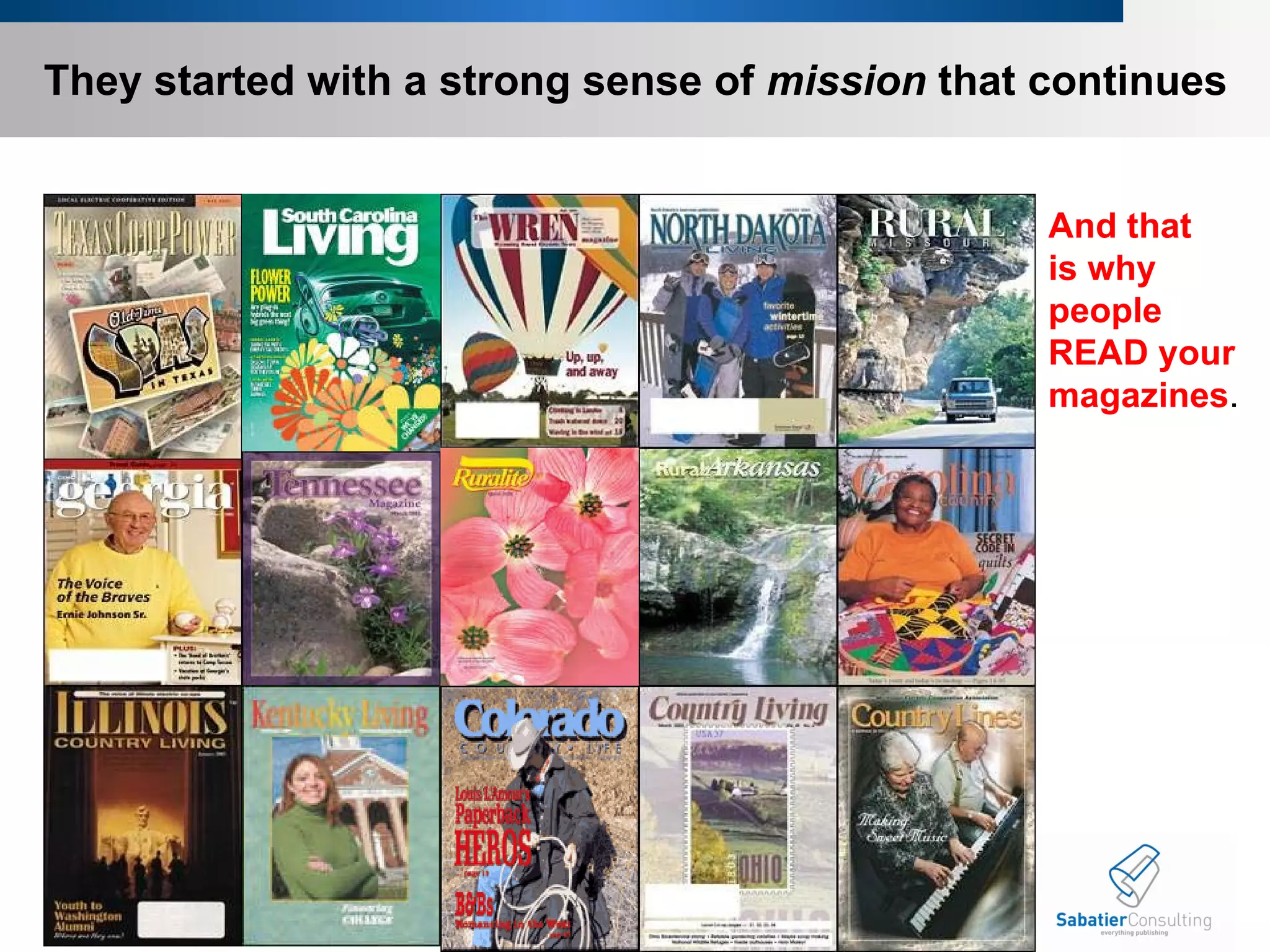
They started with a strong sense of  mission  that continues And that is why people READ your magazines .
Content is the Cornerstone Expanded definition: text, graphics, audio, video, data or any combination of these More attention to the “needs” of your audience The voice/lens through which you present content is  very  important
Content is the Cornerstone Publishers add value to content through delivery and packaging, connecting print, online and other media, and by “curating” and “rating” of content Curating: careful selection and presentation of content from all sources to best meet audience needs Rating: audience input on value of content, etc.
Content is the Cornerstone User generated content embraced by many publishers and will become more mainstream
Content is the Cornerstone The business impact of content planning is that it engages all stakeholders and ensures alignment, investment, and accountability around content creation and maintenance.  
Content Trends
Content Trends   Content Creation   Expansion of multimedia content: marrying traditional print content with video, audio and graphics online   Implication:   Requires additional/different skills than those possessed by “traditional journalists.”  
Content Trends   Content Creation Widespread adoption of user generated content (forums, blogs, online communities)   Implication:    Requires a certain loss of control by editors accustomed to being gatekeepers.
Content Trends   Content Creation Shift to constantly updated content from traditional defined publication cycle   Implication:   Places heavier demands on staff and requires change in mindset.  
Content Trends   Content Creation Use of third-party content to supplement content generated in-house.   Implication:    Requires establishing criteria and quality standards for third-party content.
Content Trends   Content Creation Pooling of print and online resources under a “chief content officer”   Implication:    Requires separating "high-value activities" from "commodity-style activities" in order to reduce redundancies and focus on producing content.
Content Trends   Content Management Trend towards bringing print and online content production together Implication:   Changing organizational structure and/or creating effective collaboration matrix.  
Content Trends   Content Management Trend away from vertical editing hierarchy towards empowering frontline content creators Implication:   Creating clear guidelines for content creators to follow, rather than requiring multiple layers of editing review.      
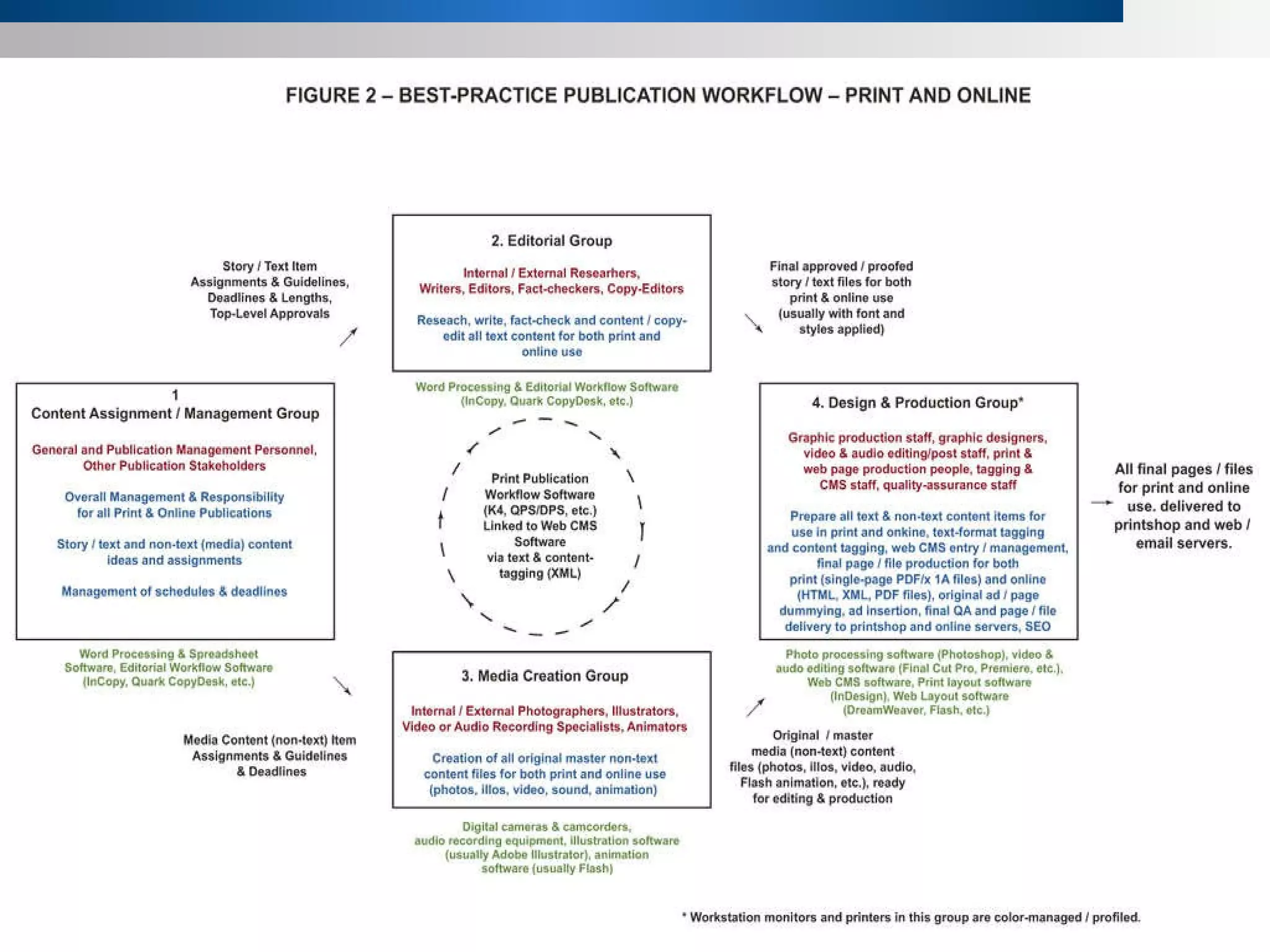
Content Trends   Content Production Highly automated single-path design and layout delivering  both print and online product  Implication: Once a story is written and the visual elements  (photos, illustrations, media clips) are assembled, a  single design and layout process creates final (or near-final) page files for both print and web delivery.      
Content Trends Content Production Blogging platforms replacing standard production  methods on websites  Implication: Writers and editors can create, collaborate, edit and post online stories, photos and videos quickly and easily anytime/anywhere without any technical or design assistance, using pre-designed blog templates. They can be held as internal until approved, then quickly switched to the public side.      
Content Trends Content Production Content easily searchable Implication: Requires meta data and tagging      
Content Trends Content Distribution  Use of multiple channels for maximum delivery of content: print, web, e-mail, RSS feeds, Twitter feeds etc content aggregators, databases Implication:    Requires development of clear content strategy to match appropriate content to delivery venue. Requires sophisticated content management tools, including tagging, metadata.  Requires careful control of licensing arrangements to maintain control of content while maximizing distribution.      
Content Planning
Content Planning Content planning-  plans for the creation, publication, and governance of useful, usable content. [It’s deciding what you are going to include and what you are going to leave out.] Key themes and messages Topics Content purpose (bridge audience needs) Content gap analysis
Content Planning First step is to create a clear and current definition of the primary audience segments Example: Denomination Publication Segment 1 – Pastors Segment 2 – Paid staff, church leaders Segment 3 – Educators Segment 4 – Lay person
Content Planning Important to note that the audience in print and online most likely do not overlap 100% What are the differences between print and online audience?
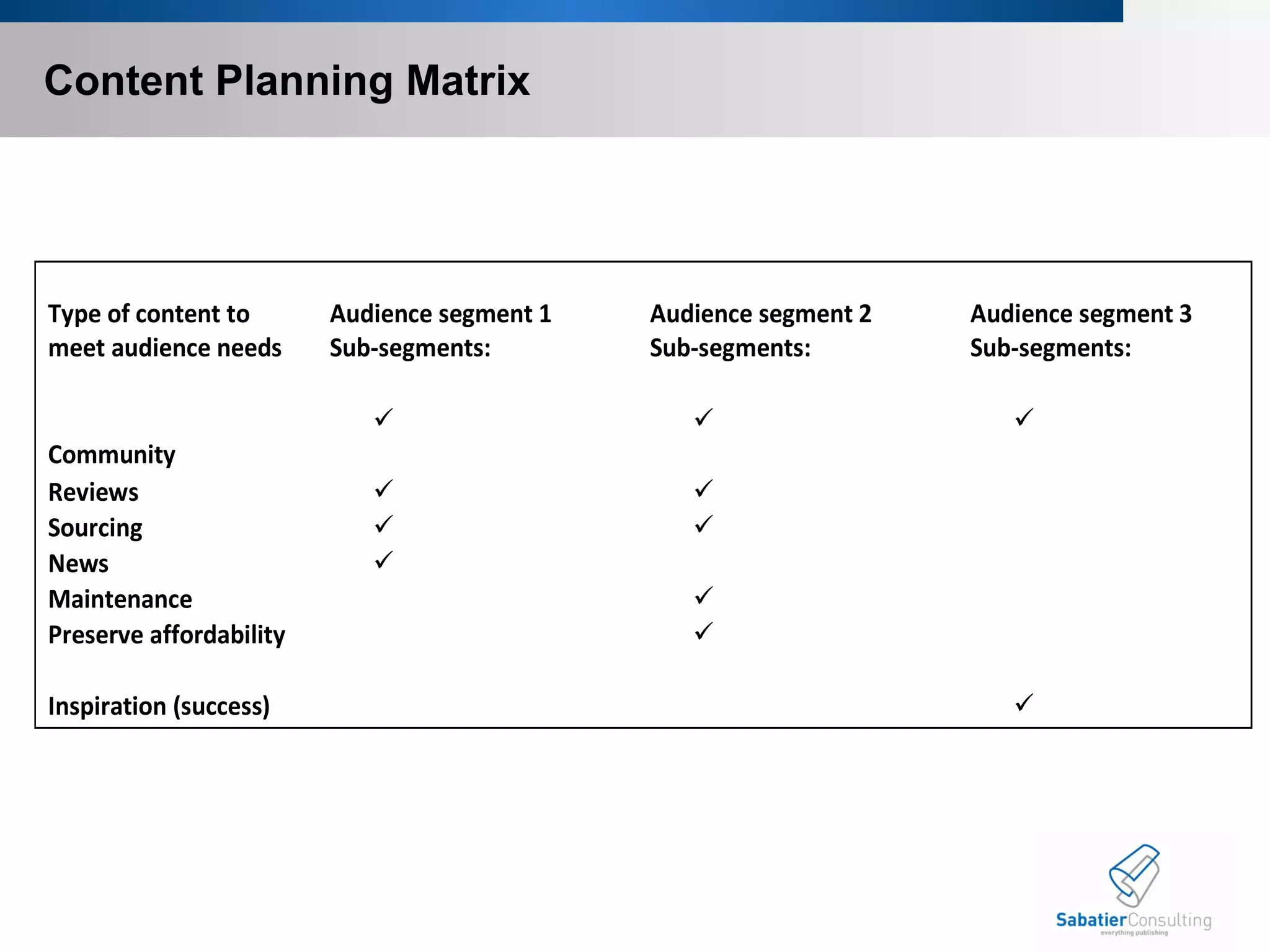
Content Planning Next step is to document the anticipated audience needs for each segment (reader wants) Examples: Inspiration (success) News Community How to information/education Sourcing Product/reviews
Content Planning Brands that thrive (versus survive) meet the  needs  of the audience We don’t publish (in any format) for a demographic; we meet the  needs  of one or more demographics Recognizing this core principal is key to creating and sustaining audiences that are  engaged  and  profitable  for publishers
Content Planning Matrix
Content Planning–Signature Content What is signature content? (example: The Week) Signature content either appears in no other publication or the writer is distinctive/prominent, etc. and thus, the content stands out within the issue The importance of signature content Differentiates your publication from all others with readers and advertisers
Content Planning-Print Cover What is your current cover strategy ? There is as much pressure to get a readers to pick up the issue and read it if they receive it at home as there is on the newsstand or in your place of distribution.
Content Planning-Tagline A tagline can “frame” the publication for first-time readers and reinforce brand/and purpose for regular/frequent readers Tagline is stronger when it speaks to emotions versus a description
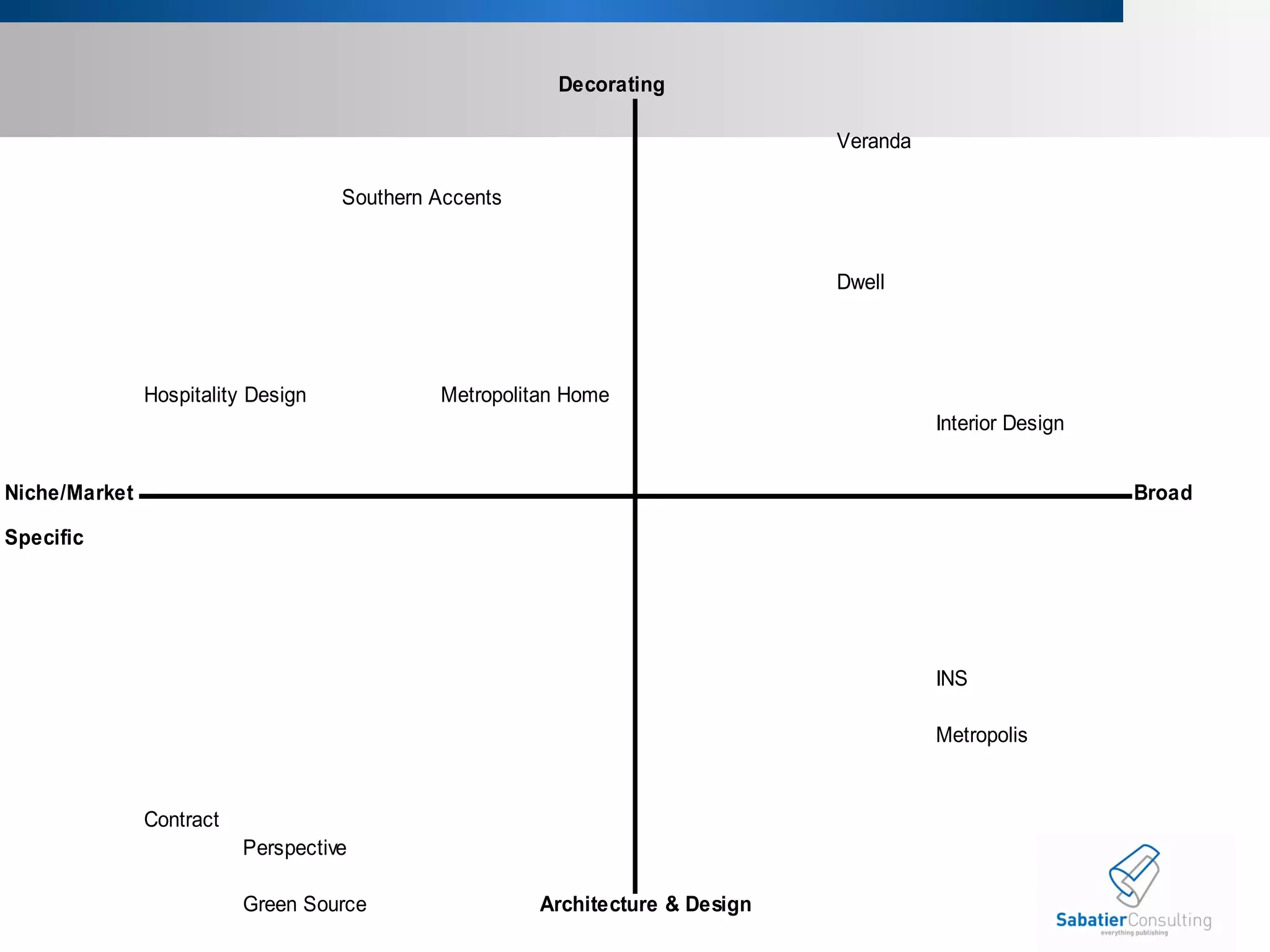
Content Competitive Review What other publications/websites serve your audience? What type of content do they offer? Where does it come from?
 
Content Management
Content Management Content  management  defines the technologies needed to create, capture, store, deliver and preserve your content.  Creation and assignment Publishing infrastructure Workflow
Content Management  Creation and assignment-where can content come from? In-house staff Freelance contributors User generated Licensing Aggregated Links Partnerships
Content Management  Partnership ideas for content generation: Academic institutions Non-profits Aligned member organizations  Advertisers Retailers Other publishers
Content Management  Another view of sourcing content  (Don Nicholas, Mequoda) Original Recycled original articles periodicals forum threads newsletters blog posts books podcasts webinars customers white papers
Content Management  When possible, you want to buy or secure non-exclusive rights to all content Try not to agree to where the content will be used
 
Content Distribution
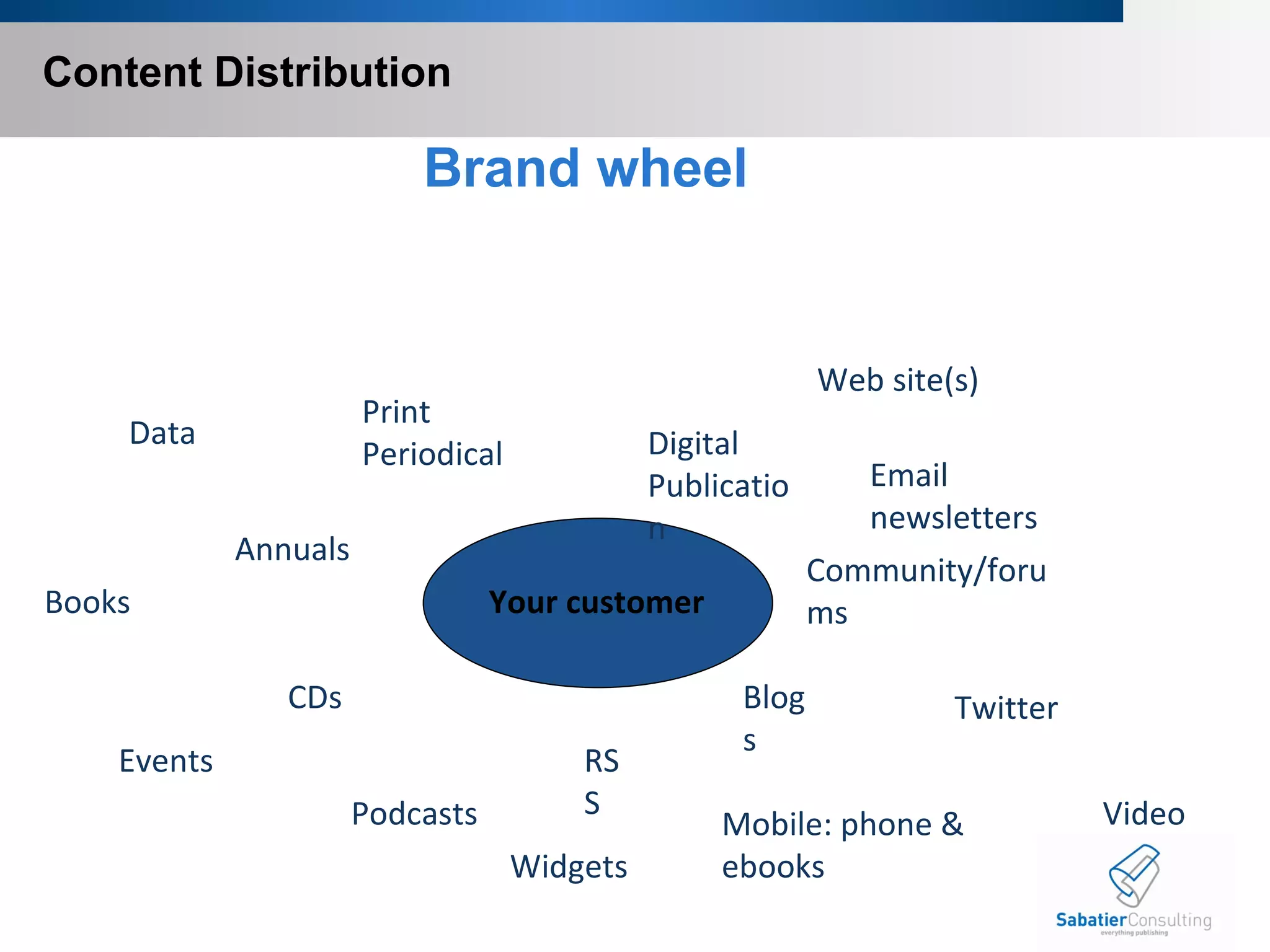
Content Distribution Content distribution  defines how and where content will be made available to users.  Timing for distribution Where – print publication, digital publication, newsletters, webinars, email, podcasts, blog posts, forum threads, video, audio,  mobile, events
Content Distribution Brand wheel Blogs Video Mobile: phone & ebooks RSS Podcasts Community/forums Events Print Periodical Data Web site(s) Widgets Digital Publication Twitter Your customer Books Annuals  Email newsletters CDs
Content Research Stay close to your audience by measuring their needs, attitudes, opinions, and feedback (not demographic research) Conduct research print/online/events  Holistic view…not just one channel Track analytics Engagement, conversion, retention  Google analytics, Compete.com, Clickability.com
? Questions? ? ?
Wrap-Up Planning enables you to leverage resources and serve your audience and mission more efficiently Affirm what’s working Take calculated risks Measure through research
Thank you. Sabatier Consulting LLC 607 Greenwich Street Falls Church, VA 22046 703.536.2635 www.SabatierConsulting.com

Content Strategy Final (2)

  • 1.
    Content Strategy for Print and Web Sites SEA 2009
  • 2.
    Overview Content isthe cornerstone Content trends Content planning Content review Content management 1 2 3 4 5 Content distribution Content research Summary 6 7 8
  • 3.
    “ Writing islike driving sheep down a road. If there are any gates on either side, readers will exit.” C.S. Lewis
  • 4.
    They started witha strong sense of mission that continues And that is why people READ your magazines .
  • 5.
    Content is theCornerstone Expanded definition: text, graphics, audio, video, data or any combination of these More attention to the “needs” of your audience The voice/lens through which you present content is very important
  • 6.
    Content is theCornerstone Publishers add value to content through delivery and packaging, connecting print, online and other media, and by “curating” and “rating” of content Curating: careful selection and presentation of content from all sources to best meet audience needs Rating: audience input on value of content, etc.
  • 7.
    Content is theCornerstone User generated content embraced by many publishers and will become more mainstream
  • 8.
    Content is theCornerstone The business impact of content planning is that it engages all stakeholders and ensures alignment, investment, and accountability around content creation and maintenance.  
  • 9.
  • 10.
    Content Trends  Content Creation   Expansion of multimedia content: marrying traditional print content with video, audio and graphics online   Implication:   Requires additional/different skills than those possessed by “traditional journalists.”  
  • 11.
    Content Trends  Content Creation Widespread adoption of user generated content (forums, blogs, online communities)   Implication:   Requires a certain loss of control by editors accustomed to being gatekeepers.
  • 12.
    Content Trends  Content Creation Shift to constantly updated content from traditional defined publication cycle   Implication:   Places heavier demands on staff and requires change in mindset.  
  • 13.
    Content Trends  Content Creation Use of third-party content to supplement content generated in-house.   Implication:   Requires establishing criteria and quality standards for third-party content.
  • 14.
    Content Trends  Content Creation Pooling of print and online resources under a “chief content officer”   Implication:   Requires separating "high-value activities" from "commodity-style activities" in order to reduce redundancies and focus on producing content.
  • 15.
    Content Trends  Content Management Trend towards bringing print and online content production together Implication:   Changing organizational structure and/or creating effective collaboration matrix.  
  • 16.
    Content Trends  Content Management Trend away from vertical editing hierarchy towards empowering frontline content creators Implication:   Creating clear guidelines for content creators to follow, rather than requiring multiple layers of editing review.      
  • 17.
    Content Trends  Content Production Highly automated single-path design and layout delivering both print and online product Implication: Once a story is written and the visual elements (photos, illustrations, media clips) are assembled, a single design and layout process creates final (or near-final) page files for both print and web delivery.      
  • 18.
    Content Trends ContentProduction Blogging platforms replacing standard production methods on websites Implication: Writers and editors can create, collaborate, edit and post online stories, photos and videos quickly and easily anytime/anywhere without any technical or design assistance, using pre-designed blog templates. They can be held as internal until approved, then quickly switched to the public side.      
  • 19.
    Content Trends ContentProduction Content easily searchable Implication: Requires meta data and tagging      
  • 20.
    Content Trends ContentDistribution Use of multiple channels for maximum delivery of content: print, web, e-mail, RSS feeds, Twitter feeds etc content aggregators, databases Implication:   Requires development of clear content strategy to match appropriate content to delivery venue. Requires sophisticated content management tools, including tagging, metadata.  Requires careful control of licensing arrangements to maintain control of content while maximizing distribution.      
  • 21.
  • 22.
    Content Planning Contentplanning- plans for the creation, publication, and governance of useful, usable content. [It’s deciding what you are going to include and what you are going to leave out.] Key themes and messages Topics Content purpose (bridge audience needs) Content gap analysis
  • 23.
    Content Planning Firststep is to create a clear and current definition of the primary audience segments Example: Denomination Publication Segment 1 – Pastors Segment 2 – Paid staff, church leaders Segment 3 – Educators Segment 4 – Lay person
  • 24.
    Content Planning Importantto note that the audience in print and online most likely do not overlap 100% What are the differences between print and online audience?
  • 25.
    Content Planning Nextstep is to document the anticipated audience needs for each segment (reader wants) Examples: Inspiration (success) News Community How to information/education Sourcing Product/reviews
  • 26.
    Content Planning Brandsthat thrive (versus survive) meet the needs of the audience We don’t publish (in any format) for a demographic; we meet the needs of one or more demographics Recognizing this core principal is key to creating and sustaining audiences that are engaged and profitable for publishers
  • 27.
  • 28.
    Content Planning–Signature ContentWhat is signature content? (example: The Week) Signature content either appears in no other publication or the writer is distinctive/prominent, etc. and thus, the content stands out within the issue The importance of signature content Differentiates your publication from all others with readers and advertisers
  • 29.
    Content Planning-Print CoverWhat is your current cover strategy ? There is as much pressure to get a readers to pick up the issue and read it if they receive it at home as there is on the newsstand or in your place of distribution.
  • 30.
    Content Planning-Tagline Atagline can “frame” the publication for first-time readers and reinforce brand/and purpose for regular/frequent readers Tagline is stronger when it speaks to emotions versus a description
  • 31.
    Content Competitive ReviewWhat other publications/websites serve your audience? What type of content do they offer? Where does it come from?
  • 32.
  • 33.
  • 34.
    Content Management Content management defines the technologies needed to create, capture, store, deliver and preserve your content. Creation and assignment Publishing infrastructure Workflow
  • 35.
    Content Management Creation and assignment-where can content come from? In-house staff Freelance contributors User generated Licensing Aggregated Links Partnerships
  • 36.
    Content Management Partnership ideas for content generation: Academic institutions Non-profits Aligned member organizations Advertisers Retailers Other publishers
  • 37.
    Content Management Another view of sourcing content (Don Nicholas, Mequoda) Original Recycled original articles periodicals forum threads newsletters blog posts books podcasts webinars customers white papers
  • 38.
    Content Management When possible, you want to buy or secure non-exclusive rights to all content Try not to agree to where the content will be used
  • 39.
  • 40.
  • 41.
    Content Distribution Contentdistribution defines how and where content will be made available to users. Timing for distribution Where – print publication, digital publication, newsletters, webinars, email, podcasts, blog posts, forum threads, video, audio, mobile, events
  • 42.
    Content Distribution Brandwheel Blogs Video Mobile: phone & ebooks RSS Podcasts Community/forums Events Print Periodical Data Web site(s) Widgets Digital Publication Twitter Your customer Books Annuals Email newsletters CDs
  • 43.
    Content Research Stayclose to your audience by measuring their needs, attitudes, opinions, and feedback (not demographic research) Conduct research print/online/events Holistic view…not just one channel Track analytics Engagement, conversion, retention Google analytics, Compete.com, Clickability.com
  • 44.
  • 45.
    Wrap-Up Planning enablesyou to leverage resources and serve your audience and mission more efficiently Affirm what’s working Take calculated risks Measure through research
  • 46.
    Thank you. SabatierConsulting LLC 607 Greenwich Street Falls Church, VA 22046 703.536.2635 www.SabatierConsulting.com