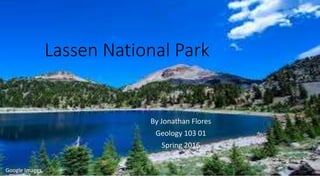
Lassen National Park
By Jonathan Flores
Geology 103 01
Spring 2016
Google Images
Lassen National Park During the Pliocene
• In the Cenozoic Era, between 3 and 4
million years ago, uplifting and westward
tilting of the Sierra Nevada along with
extensive volcanism generated huge lahars
(volcanic-derived mud flows).
• During the Pliocene Epoch these volcanic-
derived mud flows called lahars streamed
down several major mountains that
included nearby but now extinct Mount
Yana and Mount Maidu to become the
Tuscan Formation.
• Basaltic and later andesitic to dacitic flows
of lava covered increasingly larger areas of
this formation to eventually form the lava
plateau that the park sits on.
• http://www.newworldencyclopedia.org/entry/Lassen_Volcanic_N
ational_Park
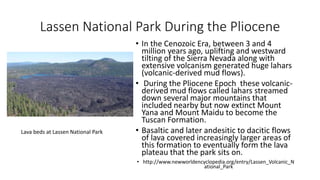
Lava beds at Lassen National Park
The Lassen National Park During the
Pleistocene
• During the Pleistocene about 600,000 years
ago, contemporary with the formation of
nearby Mount Shasta, a series of large
eruptions formed a huge volcano, Mount
Tehama.
• At its base, it measured 18 km (11 miles) by
24 km (15 miles) wide and it stood more than
3,353 m (11,000 feet) tall. Its total volume
must have been well in excess of 400 cubic
kilometers, a rough calculation yields a
volume of 425 cu km, comfortably larger than
either present-day Mount Shasta or Mount
Hood.
https://volcanocafe.wordpress.com/2013/10/14/mount-tehama-
brokeoff-mountain-and-the-lassen-volcanic-national-park/
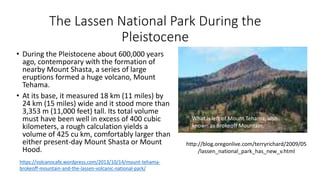
What is left of Mount Tehama, also
known as Brokeoff Mountain.
http://blog.oregonlive.com/terryrichard/2009/05
/lassen_national_park_has_new_v.html
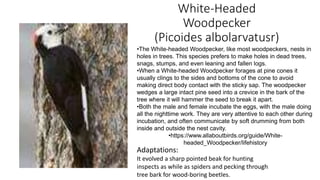
White-Headed
Woodpecker
(Picoides albolarvatusr)
Adaptations:
It evolved a sharp pointed beak for hunting
inspects as while as spiders and pecking through
tree bark for wood-boring beetles.
•The White-headed Woodpecker, like most woodpeckers, nests in
holes in trees. This species prefers to make holes in dead trees,
snags, stumps, and even leaning and fallen logs.
•When a White-headed Woodpecker forages at pine cones it
usually clings to the sides and bottoms of the cone to avoid
making direct body contact with the sticky sap. The woodpecker
wedges a large intact pine seed into a crevice in the bark of the
tree where it will hammer the seed to break it apart.
•Both the male and female incubate the eggs, with the male doing
all the nighttime work. They are very attentive to each other during
incubation, and often communicate by soft drumming from both
inside and outside the nest cavity.
•https://www.allaboutbirds.org/guide/White-
headed_Woodpecker/lifehistory
The evolution of the White-Headed
Woodpecker
• Like most birds the White-Headed Woodpecker
evolved from a group of dinosaurs called theropods
in the Mesozoic Era.
• Their bodies got smaller as their arms turned into
wings and they developed feathers becoming the
most abundant and diverse group of bird like
creatures during the Mesozoic, Enantiornithes.
• Eventually becoming like most birds you see today.
• The evolutionary history of this group is not well
documented, however the earliest known modern
picids were piculet-like forms of the Late Oligocene
about 25 million years ago.
• By that time they were already in America and
Europe.
• Wiki White-Headed Woodpecker
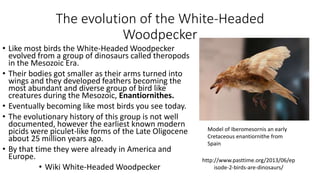
Model of Iberomesornis an early
Cretaceous enantiornithe from
Spain
http://www.pasttime.org/2013/06/ep
isode-2-birds-are-dinosaurs/
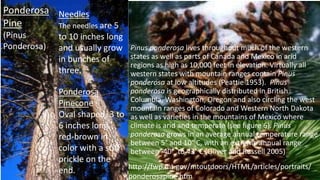
Ponderosa
Pinecone
Oval shaped, 3 to
6 inches long,
red-brown in
color with a stiff
prickle on the
end. http://fwp.mt.gov/mtoutdoors/HTML/articles/portraits/
ponderosapine.htm
Needles
The needles are 5
to 10 inches long
and usually grow
in bunches of
three.
Pinus ponderosa lives throughout much of the western
states as well as parts of Canada and Mexico in arid
regions as high as 10,000 feet in elevation. Virtually all
western states with mountain ranges contain Pinus
ponderosa at low altitudes (Peattie 1953). Pinus
ponderosa is geographically distributed in British
Columbia, Washington, Oregon and also circling the west
mountain ranges of Colorado and Western North Dakota
as well as varieties in the mountains of Mexico where
climate is arid and temperate (see figure 6). Pinus
ponderosa grows in an average annual temperature range
between 5° and 10° C, with an extreme annual range
between -40° to 43° C (Oliver and Russell 2005)
Ponderosa
Pine
(Pinus
Ponderosa)
Ponderosa Pine Geneology
• Like most modern land trees, Ponderosa Pines evolved from the Gymnosperms that
left the need for water behind with the evolution of pollen and seed fertilization.
Which were then replaced by Angiosperms in the Triassic that found a faster
reproduction and growth rate using animal pollination.
• The oldest remains of Pinus ponderosa in the Western United States are 600,000-year-
old fossils found in west central Nevada (Bettancourt 1990).
• The exact origins of Pinus ponderosa are unknown. However, the genetic diversity of
the species suggest evidence that Pinus ponderosa survived the northern glaciation of
the Pleistocene epoch, including areas of the Sierra Nevada (Alt 2000, Frankis 1998).
• Pinus ponderosa evolution was greatly influenced by the glacial period known as the
Wisconsin Ice Age (50,000-14,000 B.P.). While this majestic tree grows on lower
mountain slopes today, during glacial periods cold temperatures pushed Pinus
ponderosa out of the Rockies and to the south to Arizona, Mexico and beyond
(Brittingham 2005). Although the species was absent from most of North America
during this Ice Age epoch, Pinus ponderosa distribution later emerged and continued
to appear along central Arizona, as well as California (Frankis 1998).
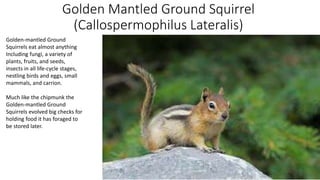
Golden Mantled Ground Squirrel
(Callospermophilus Lateralis)
Golden-mantled Ground
Squirrels eat almost anything
Including fungi, a variety of
plants, fruits, and seeds,
insects in all life-cycle stages,
nestling birds and eggs, small
mammals, and carrion.
Much like the chipmunk the
Golden-mantled Ground
Squirrels evolved big checks for
holding food it has foraged to
be stored later.
Evolution of the Golden Mantled Ground Squirrel
• Modern squirrels belong to the
Sciurinae subfamily that make sup
half of the Sciuridae of the Rodentia
family.
• Fossil records of tree squirrels date
back to the Eocene Epoch of North
America 41.7 to 33.7 million years
ago, as well as the Miocene Epoch of
Eurasia and Africa that occurred 23.8
to 5.3 million years ago.
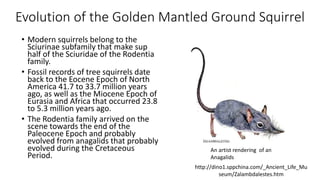
• The Rodentia family arrived on the
scene towards the end of the
Paleocene Epoch and probably
evolved from anagalids that probably
evolved during the Cretaceous
Period.
An artist rendering of an
Anagalids
http://dino1.sppchina.com/_Ancient_Life_Mu
seum/Zalambdalestes.htm
Brokeoff Mountain and Glacial Erosion
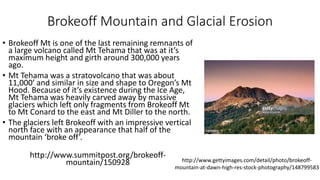
• Brokeoff Mt is one of the last remaining remnants of
a large volcano called Mt Tehama that was at it’s
maximum height and girth around 300,000 years
ago.
• Mt Tehama was a stratovolcano that was about
11,000’ and similar in size and shape to Oregon’s Mt
Hood. Because of it’s existence during the Ice Age,
Mt Tehama was heavily carved away by massive
glaciers which left only fragments from Brokeoff Mt
to Mt Conard to the east and Mt Diller to the north.
• The glaciers left Brokeoff with an impressive vertical
north face with an appearance that half of the
mountain ‘broke off’.
http://www.summitpost.org/brokeoff-
mountain/150928 http://www.gettyimages.com/detail/photo/brokeoff-
mountain-at-dawn-high-res-stock-photography/148799583
Diamond Point and the principle of cross-
cutting relationships.
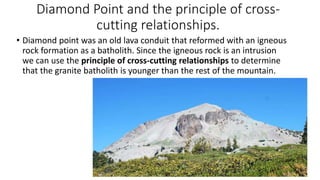
• Diamond point was an old lava conduit that reformed with an igneous
rock formation as a batholith. Since the igneous rock is an intrusion
we can use the principle of cross-cutting relationships to determine
that the granite batholith is younger than the rest of the mountain.
Disconformity
at Chaos Crags
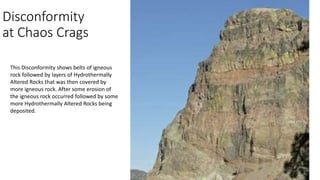
This Disconformity shows belts of igneous
rock followed by layers of Hydrothermally
Altered Rocks that was then covered by
more igneous rock. After some erosion of
the igneous rock occurred followed by some
more Hydrothermally Altered Rocks being
deposited.
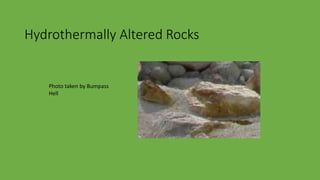
Hydrothermally Altered Rocks
Photo taken by Bumpass
Hell
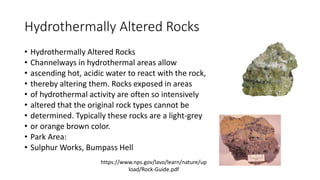
Hydrothermally Altered Rocks
• Hydrothermally Altered Rocks
• Channelways in hydrothermal areas allow
• ascending hot, acidic water to react with the rock,
• thereby altering them. Rocks exposed in areas
• of hydrothermal activity are often so intensively
• altered that the original rock types cannot be
• determined. Typically these rocks are a light-grey
• or orange brown color.
• Park Area:
• Sulphur Works, Bumpass Hell
https://www.nps.gov/lavo/learn/nature/up
load/Rock-Guide.pdf
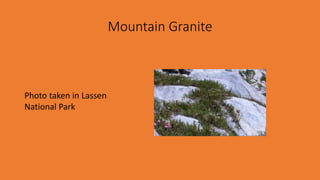
Mountain Granite
Photo taken in Lassen
National Park
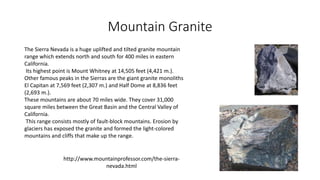
Mountain Granite
The Sierra Nevada is a huge uplifted and tilted granite mountain
range which extends north and south for 400 miles in eastern
California.
Its highest point is Mount Whitney at 14,505 feet (4,421 m.).
Other famous peaks in the Sierras are the giant granite monoliths
El Capitan at 7,569 feet (2,307 m.) and Half Dome at 8,836 feet
(2,693 m.).
These mountains are about 70 miles wide. They cover 31,000
square miles between the Great Basin and the Central Valley of
California.
This range consists mostly of fault-block mountains. Erosion by
glaciers has exposed the granite and formed the light-colored
mountains and cliffs that make up the range.
http://www.mountainprofessor.com/the-sierra-
nevada.html
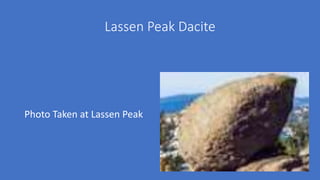
Lassen Peak Dacite
Photo Taken at Lassen Peak
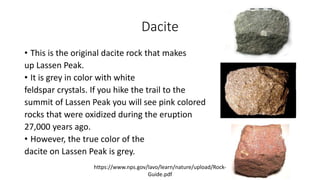
Dacite
• This is the original dacite rock that makes
up Lassen Peak.
• It is grey in color with white
feldspar crystals. If you hike the trail to the
summit of Lassen Peak you will see pink colored
rocks that were oxidized during the eruption
27,000 years ago.
• However, the true color of the
dacite on Lassen Peak is grey.
https://www.nps.gov/lavo/learn/nature/upload/Rock-
Guide.pdf
Bibliography
• Suess, B. (2010) Brokeoff Mountain. Retrieved from
http://www.summitpost.org/brokeoff-mountain/150928 on June, 2 2016
• National Parks Service. (2014) Lassen Rock Guide. Retrieved from
https://www.nps.gov/lavo/learn/nature/upload/Rock-Guide.pdf on June, 2
2016
• Carl. (2013) Mount Tehama, Brokeoff Mountain and the Lassen Volcanic National
Park. Retrieved from https://volcanocafe.wordpress.com/2013/10/14/mount-
tehama-brokeoff- mountain-and-the-lassen-volcanic-national-park/ on June, 3 2016
• New World Encyclopedia. (2014) Lassen Volcanic National Park. Retrieved from
http://www.newworldencyclopedia.org/entry/Lassen_Volcanic_National_P
ark on June, 8 2016
• Mountain Professor. (2016) The Sierra Nevada. Retrieved from
http://www.mountainprofessor.com/the-sierra-nevada.html on June, 12 2016
• Musser, G. (2016) Encyclopedia Britannica, Squirrel. Retrieved from
http://www.britannica.com/animal/squirrel on June, 13 2016
Bibliography Continued
• Cornell University. (2015) White-headed Woodpecker. Retrieved from
https://www.allaboutbirds.org/guide/White headed_Woodpecker/lifehistory on June, 6 2016
• Richard, T. (2009) Lassen National Park has new visitor center. Retrieved from
http://blog.oregonlive.com/terryrichard/2009/05/lassen_national_park_has_new_v.html
• History of Lassen National Park found at
https://en.wikipedia.org/wiki/Geology_of_the_Lassen_volcanic_area#Geologic_his
• tory_of_the_region on June, 5 2016
• Evolution of birds found at https://en.wikipedia.org/wiki/Evolution_of_birds on June, 10 2016
• Choi, C. (2014 Ancient Squirrel-Like Creatures Push Back Mammal Evolution. Retrieved from
http://www.livescience.com/47774-ancient-squirrels-push-back-mammal-evolution.html on June,
14 2016
• Picture of Brokeoff Mountain North side found at
http://www.gettyimages.com/detail/photo/brokeoff-mountain-at-dawn-high-res- stock-
photography/148799583 on June, 11 2016

Lassen national park

  • 1.
    Lassen National Park ByJonathan Flores Geology 103 01 Spring 2016 Google Images
  • 2.
    Lassen National ParkDuring the Pliocene • In the Cenozoic Era, between 3 and 4 million years ago, uplifting and westward tilting of the Sierra Nevada along with extensive volcanism generated huge lahars (volcanic-derived mud flows). • During the Pliocene Epoch these volcanic- derived mud flows called lahars streamed down several major mountains that included nearby but now extinct Mount Yana and Mount Maidu to become the Tuscan Formation. • Basaltic and later andesitic to dacitic flows of lava covered increasingly larger areas of this formation to eventually form the lava plateau that the park sits on. • http://www.newworldencyclopedia.org/entry/Lassen_Volcanic_N ational_Park Lava beds at Lassen National Park
  • 3.
    The Lassen NationalPark During the Pleistocene • During the Pleistocene about 600,000 years ago, contemporary with the formation of nearby Mount Shasta, a series of large eruptions formed a huge volcano, Mount Tehama. • At its base, it measured 18 km (11 miles) by 24 km (15 miles) wide and it stood more than 3,353 m (11,000 feet) tall. Its total volume must have been well in excess of 400 cubic kilometers, a rough calculation yields a volume of 425 cu km, comfortably larger than either present-day Mount Shasta or Mount Hood. https://volcanocafe.wordpress.com/2013/10/14/mount-tehama- brokeoff-mountain-and-the-lassen-volcanic-national-park/ What is left of Mount Tehama, also known as Brokeoff Mountain. http://blog.oregonlive.com/terryrichard/2009/05 /lassen_national_park_has_new_v.html
  • 4.
    White-Headed Woodpecker (Picoides albolarvatusr) Adaptations: It evolveda sharp pointed beak for hunting inspects as while as spiders and pecking through tree bark for wood-boring beetles. •The White-headed Woodpecker, like most woodpeckers, nests in holes in trees. This species prefers to make holes in dead trees, snags, stumps, and even leaning and fallen logs. •When a White-headed Woodpecker forages at pine cones it usually clings to the sides and bottoms of the cone to avoid making direct body contact with the sticky sap. The woodpecker wedges a large intact pine seed into a crevice in the bark of the tree where it will hammer the seed to break it apart. •Both the male and female incubate the eggs, with the male doing all the nighttime work. They are very attentive to each other during incubation, and often communicate by soft drumming from both inside and outside the nest cavity. •https://www.allaboutbirds.org/guide/White- headed_Woodpecker/lifehistory
  • 5.
    The evolution ofthe White-Headed Woodpecker • Like most birds the White-Headed Woodpecker evolved from a group of dinosaurs called theropods in the Mesozoic Era. • Their bodies got smaller as their arms turned into wings and they developed feathers becoming the most abundant and diverse group of bird like creatures during the Mesozoic, Enantiornithes. • Eventually becoming like most birds you see today. • The evolutionary history of this group is not well documented, however the earliest known modern picids were piculet-like forms of the Late Oligocene about 25 million years ago. • By that time they were already in America and Europe. • Wiki White-Headed Woodpecker Model of Iberomesornis an early Cretaceous enantiornithe from Spain http://www.pasttime.org/2013/06/ep isode-2-birds-are-dinosaurs/
  • 6.
    Ponderosa Pinecone Oval shaped, 3to 6 inches long, red-brown in color with a stiff prickle on the end. http://fwp.mt.gov/mtoutdoors/HTML/articles/portraits/ ponderosapine.htm Needles The needles are 5 to 10 inches long and usually grow in bunches of three. Pinus ponderosa lives throughout much of the western states as well as parts of Canada and Mexico in arid regions as high as 10,000 feet in elevation. Virtually all western states with mountain ranges contain Pinus ponderosa at low altitudes (Peattie 1953). Pinus ponderosa is geographically distributed in British Columbia, Washington, Oregon and also circling the west mountain ranges of Colorado and Western North Dakota as well as varieties in the mountains of Mexico where climate is arid and temperate (see figure 6). Pinus ponderosa grows in an average annual temperature range between 5° and 10° C, with an extreme annual range between -40° to 43° C (Oliver and Russell 2005) Ponderosa Pine (Pinus Ponderosa)
  • 7.
    Ponderosa Pine Geneology •Like most modern land trees, Ponderosa Pines evolved from the Gymnosperms that left the need for water behind with the evolution of pollen and seed fertilization. Which were then replaced by Angiosperms in the Triassic that found a faster reproduction and growth rate using animal pollination. • The oldest remains of Pinus ponderosa in the Western United States are 600,000-year- old fossils found in west central Nevada (Bettancourt 1990). • The exact origins of Pinus ponderosa are unknown. However, the genetic diversity of the species suggest evidence that Pinus ponderosa survived the northern glaciation of the Pleistocene epoch, including areas of the Sierra Nevada (Alt 2000, Frankis 1998). • Pinus ponderosa evolution was greatly influenced by the glacial period known as the Wisconsin Ice Age (50,000-14,000 B.P.). While this majestic tree grows on lower mountain slopes today, during glacial periods cold temperatures pushed Pinus ponderosa out of the Rockies and to the south to Arizona, Mexico and beyond (Brittingham 2005). Although the species was absent from most of North America during this Ice Age epoch, Pinus ponderosa distribution later emerged and continued to appear along central Arizona, as well as California (Frankis 1998).
  • 8.
    Golden Mantled GroundSquirrel (Callospermophilus Lateralis) Golden-mantled Ground Squirrels eat almost anything Including fungi, a variety of plants, fruits, and seeds, insects in all life-cycle stages, nestling birds and eggs, small mammals, and carrion. Much like the chipmunk the Golden-mantled Ground Squirrels evolved big checks for holding food it has foraged to be stored later.
  • 9.
    Evolution of theGolden Mantled Ground Squirrel • Modern squirrels belong to the Sciurinae subfamily that make sup half of the Sciuridae of the Rodentia family. • Fossil records of tree squirrels date back to the Eocene Epoch of North America 41.7 to 33.7 million years ago, as well as the Miocene Epoch of Eurasia and Africa that occurred 23.8 to 5.3 million years ago. • The Rodentia family arrived on the scene towards the end of the Paleocene Epoch and probably evolved from anagalids that probably evolved during the Cretaceous Period. An artist rendering of an Anagalids http://dino1.sppchina.com/_Ancient_Life_Mu seum/Zalambdalestes.htm
  • 10.
    Brokeoff Mountain andGlacial Erosion • Brokeoff Mt is one of the last remaining remnants of a large volcano called Mt Tehama that was at it’s maximum height and girth around 300,000 years ago. • Mt Tehama was a stratovolcano that was about 11,000’ and similar in size and shape to Oregon’s Mt Hood. Because of it’s existence during the Ice Age, Mt Tehama was heavily carved away by massive glaciers which left only fragments from Brokeoff Mt to Mt Conard to the east and Mt Diller to the north. • The glaciers left Brokeoff with an impressive vertical north face with an appearance that half of the mountain ‘broke off’. http://www.summitpost.org/brokeoff- mountain/150928 http://www.gettyimages.com/detail/photo/brokeoff- mountain-at-dawn-high-res-stock-photography/148799583
  • 11.
    Diamond Point andthe principle of cross- cutting relationships. • Diamond point was an old lava conduit that reformed with an igneous rock formation as a batholith. Since the igneous rock is an intrusion we can use the principle of cross-cutting relationships to determine that the granite batholith is younger than the rest of the mountain.
  • 12.
    Disconformity at Chaos Crags ThisDisconformity shows belts of igneous rock followed by layers of Hydrothermally Altered Rocks that was then covered by more igneous rock. After some erosion of the igneous rock occurred followed by some more Hydrothermally Altered Rocks being deposited.
  • 13.
  • 14.
    Hydrothermally Altered Rocks •Hydrothermally Altered Rocks • Channelways in hydrothermal areas allow • ascending hot, acidic water to react with the rock, • thereby altering them. Rocks exposed in areas • of hydrothermal activity are often so intensively • altered that the original rock types cannot be • determined. Typically these rocks are a light-grey • or orange brown color. • Park Area: • Sulphur Works, Bumpass Hell https://www.nps.gov/lavo/learn/nature/up load/Rock-Guide.pdf
  • 15.
    Mountain Granite Photo takenin Lassen National Park
  • 16.
    Mountain Granite The SierraNevada is a huge uplifted and tilted granite mountain range which extends north and south for 400 miles in eastern California. Its highest point is Mount Whitney at 14,505 feet (4,421 m.). Other famous peaks in the Sierras are the giant granite monoliths El Capitan at 7,569 feet (2,307 m.) and Half Dome at 8,836 feet (2,693 m.). These mountains are about 70 miles wide. They cover 31,000 square miles between the Great Basin and the Central Valley of California. This range consists mostly of fault-block mountains. Erosion by glaciers has exposed the granite and formed the light-colored mountains and cliffs that make up the range. http://www.mountainprofessor.com/the-sierra- nevada.html
  • 17.
    Lassen Peak Dacite PhotoTaken at Lassen Peak
  • 18.
    Dacite • This isthe original dacite rock that makes up Lassen Peak. • It is grey in color with white feldspar crystals. If you hike the trail to the summit of Lassen Peak you will see pink colored rocks that were oxidized during the eruption 27,000 years ago. • However, the true color of the dacite on Lassen Peak is grey. https://www.nps.gov/lavo/learn/nature/upload/Rock- Guide.pdf
  • 19.
    Bibliography • Suess, B.(2010) Brokeoff Mountain. Retrieved from http://www.summitpost.org/brokeoff-mountain/150928 on June, 2 2016 • National Parks Service. (2014) Lassen Rock Guide. Retrieved from https://www.nps.gov/lavo/learn/nature/upload/Rock-Guide.pdf on June, 2 2016 • Carl. (2013) Mount Tehama, Brokeoff Mountain and the Lassen Volcanic National Park. Retrieved from https://volcanocafe.wordpress.com/2013/10/14/mount- tehama-brokeoff- mountain-and-the-lassen-volcanic-national-park/ on June, 3 2016 • New World Encyclopedia. (2014) Lassen Volcanic National Park. Retrieved from http://www.newworldencyclopedia.org/entry/Lassen_Volcanic_National_P ark on June, 8 2016 • Mountain Professor. (2016) The Sierra Nevada. Retrieved from http://www.mountainprofessor.com/the-sierra-nevada.html on June, 12 2016 • Musser, G. (2016) Encyclopedia Britannica, Squirrel. Retrieved from http://www.britannica.com/animal/squirrel on June, 13 2016
  • 20.
    Bibliography Continued • CornellUniversity. (2015) White-headed Woodpecker. Retrieved from https://www.allaboutbirds.org/guide/White headed_Woodpecker/lifehistory on June, 6 2016 • Richard, T. (2009) Lassen National Park has new visitor center. Retrieved from http://blog.oregonlive.com/terryrichard/2009/05/lassen_national_park_has_new_v.html • History of Lassen National Park found at https://en.wikipedia.org/wiki/Geology_of_the_Lassen_volcanic_area#Geologic_his • tory_of_the_region on June, 5 2016 • Evolution of birds found at https://en.wikipedia.org/wiki/Evolution_of_birds on June, 10 2016 • Choi, C. (2014 Ancient Squirrel-Like Creatures Push Back Mammal Evolution. Retrieved from http://www.livescience.com/47774-ancient-squirrels-push-back-mammal-evolution.html on June, 14 2016 • Picture of Brokeoff Mountain North side found at http://www.gettyimages.com/detail/photo/brokeoff-mountain-at-dawn-high-res- stock- photography/148799583 on June, 11 2016