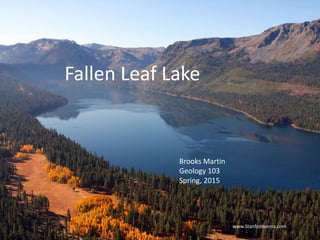
Fallen Leaf Lake
Brooks Martin
Geology 103
Spring, 2015
www.Stanfordsierra.com
www.steveandkim.us
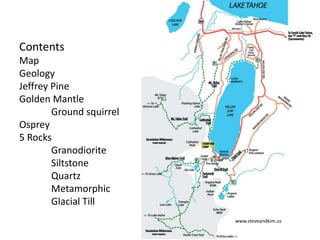
Contents
Map
Geology
Jeffrey Pine
Golden Mantle
Ground squirrel
Osprey
5 Rocks
Granodiorite
Siltstone
Quartz
Metamorphic
Glacial Till
Geology
Paleozoic: Carbonate platform of
passive continental margin.
Mesozoic: Emplacement of
granitic plutons at depth with
contact metamorphism.
Cenozoic: elevation of the plutons
with tilt, creating steep East face,
sloping west face, and eroding off
up to 10 kilometers of surface
material.
South west corner of the lake lies
along the West Tahoe Dollar Point
fault zone, where the western side
rose by several thousand feet
relative to the east. (Konigsmark, 2011)
geosphere.gsapubs.org
Aboutlaketahoe.com
--------Fault line-------
4 episodes of glaciation flowing
down Glen Alpine Creek route
from Desolation Wilderness.
Most Recent:
Tahoe: 150-74,000 BP
Tioga: 26-19,000 BP
Created:
U shaped valleys
Sharp peaks
Glacial striations
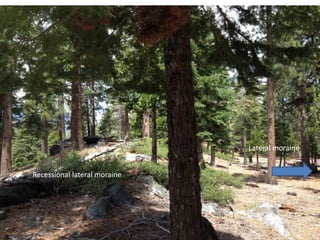
Lateral moraines
Terminal moraine
Recessional moraines
Laketahoequest.com
Laddish.net
Lateral moraine
Terminal moraine
Geosphere.gsapubs.org
Terminal moraine
Lateral moraine
Recessional moraines
Lateral moraine
Lidar: Light detection and
Ranging
Laser based technique for
visualizing ground structure
even through vegetation.
Multiple recessional moraines
are seen at the far end
Multiple lateral moraines are
seen on the sides.
Both of these are created as the
glacier recedes, then stops for a
period of time, depositing till.
(Valentine, 2014)
Recessional lateral moraine
Lateral moraine
En.wikipedia.com
Stephenkharper.com
Conifers.org
Jeffrey Pine
Pinus jeffreyi
Oregon to Baja
High Altitude
Long needles in 3
Inward barbs on cone
3 years to make seeds
Up to 130 feet tall
Vanilla odor:
n-heptane
Evolution: Gymnosperms, Angiosperms and pine
Carboniferous: Gymnosperms made the final jump to terrestrial
status by separating from the need for as much water: by pollen
fertilization, and by seed, which allowed wider dispersal. (Wiki Pinophyta)
Triassic: Gymnosperm dominance short lived, as angiosperms took
over because of adaptations like:
Animal Pollination Faster reproduction
Seed dispersal by animals (seed dropped in a pile of fertilizer)
Faster growth (tulane) Spread by Rhizomes
Better self fertilization by leaf breakdown (Berendse)
Soon, pines relegated to borderline ecological conditions
(cold, snow, dry or fire)
Became fire avoiders, fire tolerator, fire embracer, or fire refugee
strategy (Keeley, 2012)
Pines started in Mesozoic, spread across Laurasia.
Now pines are limited to the Boreal forests of the north, high
altitude, dry areas or fire prone areas.
Adaptations:
Thick waxy cuticle to prevent water loss
Stomata in row underneath needle, covered by surface cells
(sunken stomata) to limit water loss
Winter and snow: conical shape of tree, with down ward
bending branches to shed snow.
Hardening by changing biochemistry of leaves to prevent
freezing in winter.
Resin: helps fight fungus and insects
Dark color leaves for more light absorption.
(Wiki pine)
Osprey
Pandion halietus
Diurnal, fish eating Raptor
All continents except Antarctica
One species world wide
Nest re-used for years
Adaptations:
Talons rounded, not grooved.
Only Osprey and Owl can reverse
their outer toe so they have two in
front, two in back for grasping.
Backward scales on talon act to
help grasp fish.
Closable nostrils to keep out water
(Wiki Osprey)
theguardian.com
En.wikipedia.org
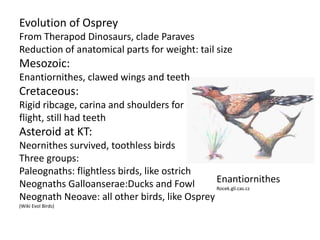
Enantiornithes
Rocek.gli.cas.cz
Evolution of Osprey
From Therapod Dinosaurs, clade Paraves
Reduction of anatomical parts for weight: tail size
Mesozoic:
Enantiornithes, clawed wings and teeth
Cretaceous:
Rigid ribcage, carina and shoulders for
flight, still had teeth
Asteroid at KT:
Neornithes survived, toothless birds
Three groups:
Paleognaths: flightless birds, like ostrich
Neognaths Galloanserae:Ducks and Fowl
Neognath Neoave: all other birds, like Osprey
(Wiki Evol Birds)
Summitpost/org
Chipmunk
Golden-Mantled Ground Squirrel
Callospermophilus lateralis
Ground squirrel, western North
America
Wide variety of ranges, rocky to
meadow to sage.
Chipmunk-like stripes not on face
Bigger than chipmunk
(8” vs 9-12”, 2 oz. vs. 4-14 oz)
Hibernator
Cheek pouches to carry food back
to den at high speed
Shallow burrows up to 30 m in length
Food: Seeds, nuts, berries insects and
underground fungi.
Prey of: Hawks, Jays, weasel, bobcat,
coyote.
(Wiki GMGS)
En.wikipedia.org
Evolution of Golden-Mantled Ground Squirrel
Rodentia:
Includes mice, rats, squirrels, prairie dog,
porcupine, beaver, guinea pig, hamster
and marmots but not rabbits.
Paleocene: in Laurasia
Spread all over except Antarctica, and was the
only placental mammal to reach Australia
Adaptations of rodents:
Front incisors keep growing, the softer dentine on the
back wears off, leaving the sharp front enamel
acting like a chisel.
Diastema: gap behind incisors, so can close off mouth
and throat to wood chips, etc.
Sciuridae: Squirrels, stand upright for long periods.
(Wiki Ground Squirrel)
Ecologyedu.com
(Wiki rodentia)
South West Corner
of Fallen Leaf Lake
Pale Blue:
Sandstone and siltstone
Green:
Metavolcanic
Pink
Echo lakes granodiorite
F West Tahoe Fault Zone
L Lateral Moraine
T Terminal Moraine
R Recessional moraines
(Loomis, 1983)
L
L
R
T
F
F
Nps.gov
Granodiorite
Granodiorite
Large, interlocking, visible crystals:
Igneous Intrusive rock
Dark crystals of amphibole or biotite.
Whitish crystals of Na Feldspar
Pinkish crystals of K feldspar.
Between Granite and Diorite in composition.
Specifically called Echo Lake granodiorite
(Loomis, 1983)
Granite: Intrusive, phaneretic ,
Felsic with composition like rhyolite
Quartz, muscovite, biotite and K feldspar.
Diorite: Intrusive, phaneretic,
Intermediate with composition
like andesite.
Amphibole, biotite, Na feldspar.
Granite
Geology.about.com
Diorite
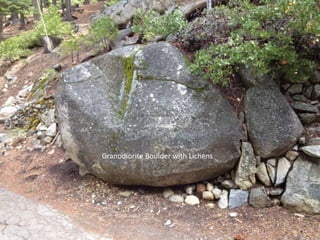
Granodiorite Boulder with Lichens
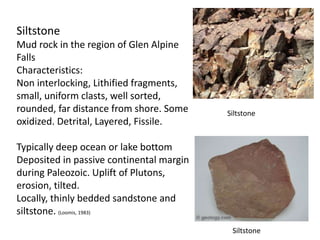
Siltstone
Siltstone
Mud rock in the region of Glen Alpine
Falls
Characteristics:
Non interlocking, Lithified fragments,
small, uniform clasts, well sorted,
rounded, far distance from shore. Some
oxidized. Detrital, Layered, Fissile.
Typically deep ocean or lake bottom
Deposited in passive continental margin
during Paleozoic. Uplift of Plutons,
erosion, tilted.
Locally, thinly bedded sandstone and
siltstone. (Loomis, 1983)
Siltstone
Siltstone Metamorphic rock just below and left of A
A
Scienceforkids.kidiepede.com
Quartz
Milky white, irregular surface, some
suggestion of crystal structure.
Found as part of Glacial till.
Non ferromagnesian silicate, SiO2
In a three dimensional network.
Deposited in hydrothermal regions
which penetrate cracks to
form veins, which then cool and
solidify.
Banded hornfels from
contact metamorphism
Banded hornfel
Characteristics:
Non- fissile.
Fine grained. no foliation.
Layers of light alternate with dark.
Parent rock: Mudrock
Metamorphic, low grade.
Layered sandstone and shale
metamorphosed by intruding
granite pluton.
Layers of dark biotite hornfel
alternating with
calcite silicate hornfel
with lighter color from limestone.
(Wiki Hornfels)
Allaboutgenstones.com
Yosemite.ca.us
Glacial Till
No sorting by particle size.
Angular clasts of varying sizes.
No stratification.
Deposited by glacier in a ridge,
in this case a lateral moraine.
References
Berendse, F. & Scheffer, M. (2009). The angiosperm radiation revisited, an ecological explanation for Darwin’s “abominable mystery”.
Ecological Letter 12(9): 865-872. Retrieved from ttp://www.ncbi.nlm.nih.gov/pmc/articles/PMC2777257/ on May 24, 2015
Fraley, J. (2013). Golden-mantled Ground Squirrel. Retrieved from
http://fwp.mt.gov/mtoutdoors/HTML/articles/portraits/gmgroundsquirrel.htm on May 23, 2015.
Keeley, J.E. (2012) Ecology and evolution of pine life histories. Retrieved from
http://www.werc.usgs.gov/ProductDetails.aspx?ID=4756 on May 23, 2015.
Konigsmark, T. (2011). Geologic Trips Sierra Nevada. Mendocino, CA:Geo Press.
Loomis, A.A. (1983). Geology of Fallen leaf lake 15’ quadrangle, El Dorado county, CA. Retrieved from
http://ngmdb.usgs.gov/Prodesc/proddesc_370.htm on May 24, 2015.
NHPTV. (2015). Golden-mantled Ground Squirrel. Retrieved from http://www.nhptv.org/natureworks/goldensquirrel.htm on May 23, 2015.
Pines. (2015). Pines, General characteristics, evolution and classification. Retrieved from http://science.jrank.org/pages/5241/Pines.html
on May 23, 2015.
Tulane. (no date). Lab 9, Gymnosperms and Angiosperms. Retrieved from
http://www.tulane.edu/~bfleury/diversity/labguide/gymangio.html on May 23, 2015.
References (continued)
Wiki Evolution. (2015). Evolution of Birds. Retrieved from http://en.wikipedia.org/wiki/Evolution_of_birds on May 23, 2015.
Wiki Ground Squirrel. (2015). Ground Squirrel. Retrieved from http://en.wikipedia.org/wiki/Ground_squirrel on May 25, 2015.
Wiki Hornfels. (2015). Hornfels. Retrieved from http://en.wikipedia.org/wiki/Hornfels on May 25, 2015.
Wiki Jeffrey. (2015). Jeffrey Pine. Retrieved from http://en.wikipedia.org/wiki/Jeffrey_pine on May 23, 2015.
Wiki Osprey. (2015). Osprey. Retrieved from http://en.wikipedia.org/wiki/Osprey on May 23, 2015.
Wiki Pinophyta. (2015). Pinophyta. Retrieved from http://en.wikipedia.org/wiki/Pinophyta on May 23, 2015.

Fallen leaf lake

  • 1.
    Fallen Leaf Lake BrooksMartin Geology 103 Spring, 2015 www.Stanfordsierra.com
  • 2.
    www.steveandkim.us Contents Map Geology Jeffrey Pine Golden Mantle Groundsquirrel Osprey 5 Rocks Granodiorite Siltstone Quartz Metamorphic Glacial Till
  • 3.
    Geology Paleozoic: Carbonate platformof passive continental margin. Mesozoic: Emplacement of granitic plutons at depth with contact metamorphism. Cenozoic: elevation of the plutons with tilt, creating steep East face, sloping west face, and eroding off up to 10 kilometers of surface material. South west corner of the lake lies along the West Tahoe Dollar Point fault zone, where the western side rose by several thousand feet relative to the east. (Konigsmark, 2011) geosphere.gsapubs.org Aboutlaketahoe.com --------Fault line-------
  • 4.
    4 episodes ofglaciation flowing down Glen Alpine Creek route from Desolation Wilderness. Most Recent: Tahoe: 150-74,000 BP Tioga: 26-19,000 BP Created: U shaped valleys Sharp peaks Glacial striations Lateral moraines Terminal moraine Recessional moraines Laketahoequest.com Laddish.net Lateral moraine Terminal moraine
  • 5.
    Geosphere.gsapubs.org Terminal moraine Lateral moraine Recessionalmoraines Lateral moraine Lidar: Light detection and Ranging Laser based technique for visualizing ground structure even through vegetation. Multiple recessional moraines are seen at the far end Multiple lateral moraines are seen on the sides. Both of these are created as the glacier recedes, then stops for a period of time, depositing till. (Valentine, 2014)
  • 6.
  • 7.
    En.wikipedia.com Stephenkharper.com Conifers.org Jeffrey Pine Pinus jeffreyi Oregonto Baja High Altitude Long needles in 3 Inward barbs on cone 3 years to make seeds Up to 130 feet tall Vanilla odor: n-heptane
  • 8.
    Evolution: Gymnosperms, Angiospermsand pine Carboniferous: Gymnosperms made the final jump to terrestrial status by separating from the need for as much water: by pollen fertilization, and by seed, which allowed wider dispersal. (Wiki Pinophyta) Triassic: Gymnosperm dominance short lived, as angiosperms took over because of adaptations like: Animal Pollination Faster reproduction Seed dispersal by animals (seed dropped in a pile of fertilizer) Faster growth (tulane) Spread by Rhizomes Better self fertilization by leaf breakdown (Berendse) Soon, pines relegated to borderline ecological conditions (cold, snow, dry or fire) Became fire avoiders, fire tolerator, fire embracer, or fire refugee strategy (Keeley, 2012)
  • 9.
    Pines started inMesozoic, spread across Laurasia. Now pines are limited to the Boreal forests of the north, high altitude, dry areas or fire prone areas. Adaptations: Thick waxy cuticle to prevent water loss Stomata in row underneath needle, covered by surface cells (sunken stomata) to limit water loss Winter and snow: conical shape of tree, with down ward bending branches to shed snow. Hardening by changing biochemistry of leaves to prevent freezing in winter. Resin: helps fight fungus and insects Dark color leaves for more light absorption. (Wiki pine)
  • 10.
    Osprey Pandion halietus Diurnal, fisheating Raptor All continents except Antarctica One species world wide Nest re-used for years Adaptations: Talons rounded, not grooved. Only Osprey and Owl can reverse their outer toe so they have two in front, two in back for grasping. Backward scales on talon act to help grasp fish. Closable nostrils to keep out water (Wiki Osprey) theguardian.com En.wikipedia.org
  • 11.
    Enantiornithes Rocek.gli.cas.cz Evolution of Osprey FromTherapod Dinosaurs, clade Paraves Reduction of anatomical parts for weight: tail size Mesozoic: Enantiornithes, clawed wings and teeth Cretaceous: Rigid ribcage, carina and shoulders for flight, still had teeth Asteroid at KT: Neornithes survived, toothless birds Three groups: Paleognaths: flightless birds, like ostrich Neognaths Galloanserae:Ducks and Fowl Neognath Neoave: all other birds, like Osprey (Wiki Evol Birds)
  • 12.
    Summitpost/org Chipmunk Golden-Mantled Ground Squirrel Callospermophiluslateralis Ground squirrel, western North America Wide variety of ranges, rocky to meadow to sage. Chipmunk-like stripes not on face Bigger than chipmunk (8” vs 9-12”, 2 oz. vs. 4-14 oz) Hibernator Cheek pouches to carry food back to den at high speed Shallow burrows up to 30 m in length Food: Seeds, nuts, berries insects and underground fungi. Prey of: Hawks, Jays, weasel, bobcat, coyote. (Wiki GMGS) En.wikipedia.org
  • 13.
    Evolution of Golden-MantledGround Squirrel Rodentia: Includes mice, rats, squirrels, prairie dog, porcupine, beaver, guinea pig, hamster and marmots but not rabbits. Paleocene: in Laurasia Spread all over except Antarctica, and was the only placental mammal to reach Australia Adaptations of rodents: Front incisors keep growing, the softer dentine on the back wears off, leaving the sharp front enamel acting like a chisel. Diastema: gap behind incisors, so can close off mouth and throat to wood chips, etc. Sciuridae: Squirrels, stand upright for long periods. (Wiki Ground Squirrel) Ecologyedu.com (Wiki rodentia)
  • 14.
    South West Corner ofFallen Leaf Lake Pale Blue: Sandstone and siltstone Green: Metavolcanic Pink Echo lakes granodiorite F West Tahoe Fault Zone L Lateral Moraine T Terminal Moraine R Recessional moraines (Loomis, 1983) L L R T F F
  • 15.
    Nps.gov Granodiorite Granodiorite Large, interlocking, visiblecrystals: Igneous Intrusive rock Dark crystals of amphibole or biotite. Whitish crystals of Na Feldspar Pinkish crystals of K feldspar. Between Granite and Diorite in composition. Specifically called Echo Lake granodiorite (Loomis, 1983) Granite: Intrusive, phaneretic , Felsic with composition like rhyolite Quartz, muscovite, biotite and K feldspar. Diorite: Intrusive, phaneretic, Intermediate with composition like andesite. Amphibole, biotite, Na feldspar. Granite Geology.about.com Diorite
  • 16.
  • 17.
    Siltstone Siltstone Mud rock inthe region of Glen Alpine Falls Characteristics: Non interlocking, Lithified fragments, small, uniform clasts, well sorted, rounded, far distance from shore. Some oxidized. Detrital, Layered, Fissile. Typically deep ocean or lake bottom Deposited in passive continental margin during Paleozoic. Uplift of Plutons, erosion, tilted. Locally, thinly bedded sandstone and siltstone. (Loomis, 1983) Siltstone
  • 18.
    Siltstone Metamorphic rockjust below and left of A A
  • 19.
    Scienceforkids.kidiepede.com Quartz Milky white, irregularsurface, some suggestion of crystal structure. Found as part of Glacial till. Non ferromagnesian silicate, SiO2 In a three dimensional network. Deposited in hydrothermal regions which penetrate cracks to form veins, which then cool and solidify.
  • 20.
    Banded hornfels from contactmetamorphism Banded hornfel Characteristics: Non- fissile. Fine grained. no foliation. Layers of light alternate with dark. Parent rock: Mudrock Metamorphic, low grade. Layered sandstone and shale metamorphosed by intruding granite pluton. Layers of dark biotite hornfel alternating with calcite silicate hornfel with lighter color from limestone. (Wiki Hornfels) Allaboutgenstones.com
  • 21.
    Yosemite.ca.us Glacial Till No sortingby particle size. Angular clasts of varying sizes. No stratification. Deposited by glacier in a ridge, in this case a lateral moraine.
  • 22.
    References Berendse, F. &Scheffer, M. (2009). The angiosperm radiation revisited, an ecological explanation for Darwin’s “abominable mystery”. Ecological Letter 12(9): 865-872. Retrieved from ttp://www.ncbi.nlm.nih.gov/pmc/articles/PMC2777257/ on May 24, 2015 Fraley, J. (2013). Golden-mantled Ground Squirrel. Retrieved from http://fwp.mt.gov/mtoutdoors/HTML/articles/portraits/gmgroundsquirrel.htm on May 23, 2015. Keeley, J.E. (2012) Ecology and evolution of pine life histories. Retrieved from http://www.werc.usgs.gov/ProductDetails.aspx?ID=4756 on May 23, 2015. Konigsmark, T. (2011). Geologic Trips Sierra Nevada. Mendocino, CA:Geo Press. Loomis, A.A. (1983). Geology of Fallen leaf lake 15’ quadrangle, El Dorado county, CA. Retrieved from http://ngmdb.usgs.gov/Prodesc/proddesc_370.htm on May 24, 2015. NHPTV. (2015). Golden-mantled Ground Squirrel. Retrieved from http://www.nhptv.org/natureworks/goldensquirrel.htm on May 23, 2015. Pines. (2015). Pines, General characteristics, evolution and classification. Retrieved from http://science.jrank.org/pages/5241/Pines.html on May 23, 2015. Tulane. (no date). Lab 9, Gymnosperms and Angiosperms. Retrieved from http://www.tulane.edu/~bfleury/diversity/labguide/gymangio.html on May 23, 2015.
  • 23.
    References (continued) Wiki Evolution.(2015). Evolution of Birds. Retrieved from http://en.wikipedia.org/wiki/Evolution_of_birds on May 23, 2015. Wiki Ground Squirrel. (2015). Ground Squirrel. Retrieved from http://en.wikipedia.org/wiki/Ground_squirrel on May 25, 2015. Wiki Hornfels. (2015). Hornfels. Retrieved from http://en.wikipedia.org/wiki/Hornfels on May 25, 2015. Wiki Jeffrey. (2015). Jeffrey Pine. Retrieved from http://en.wikipedia.org/wiki/Jeffrey_pine on May 23, 2015. Wiki Osprey. (2015). Osprey. Retrieved from http://en.wikipedia.org/wiki/Osprey on May 23, 2015. Wiki Pinophyta. (2015). Pinophyta. Retrieved from http://en.wikipedia.org/wiki/Pinophyta on May 23, 2015.