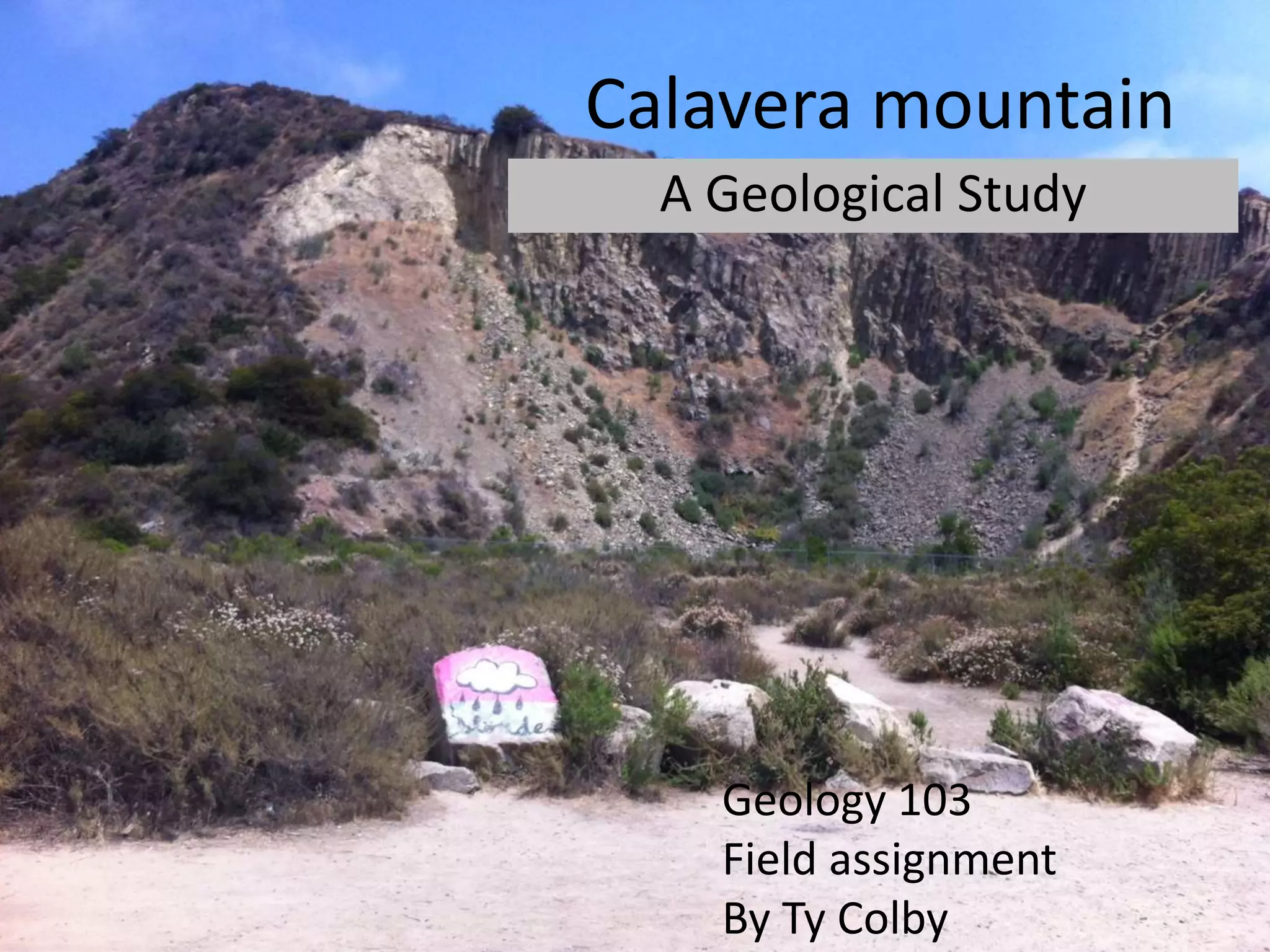
Calavera mountain
A Geological Study
Geology 103
Field assignment
By Ty Colby
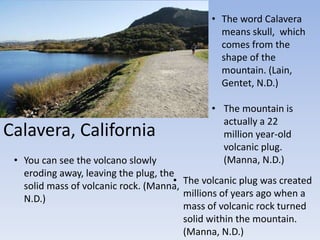
Calavera, California
• The word Calavera
means skull, which
comes from the
shape of the
mountain. (Lain,
Gentet, N.D.)
• The mountain is
actually a 22
million year-old
volcanic plug.
(Manna, N.D.)• You can see the volcano slowly
eroding away, leaving the plug, the
solid mass of volcanic rock. (Manna,
N.D.)
• The volcanic plug was created
millions of years ago when a
mass of volcanic rock turned
solid within the mountain.
(Manna, N.D.)
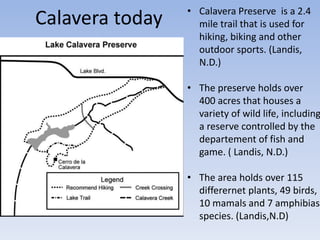
Calavera today • Calavera Preserve is a 2.4
mile trail that is used for
hiking, biking and other
outdoor sports. (Landis,
N.D.)
• The preserve holds over
400 acres that houses a
variety of wild life, including
a reserve controlled by the
departement of fish and
game. ( Landis, N.D.)
• The area holds over 115
differernet plants, 49 birds,
10 mamals and 7 amphibias
species. (Landis,N.D)
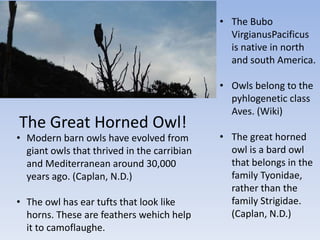
The Great Horned Owl!
• The Bubo
VirgianusPacificus
is native in north
and south America.
• Owls belong to the
pyhlogenetic class
Aves. (Wiki)
• The great horned
owl is a bard owl
that belongs in the
family Tyonidae,
rather than the
family Strigidae.
(Caplan, N.D.)
• Modern barn owls have evolved from
giant owls that thrived in the carribian
and Mediterranean around 30,000
years ago. (Caplan, N.D.)
• The owl has ear tufts that look like
horns. These are feathers wehich help
it to camoflaughe.
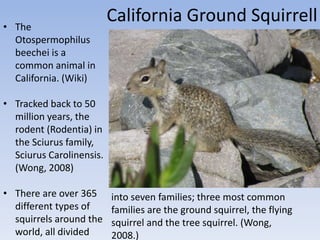
California Ground Squirrell• The
Otospermophilus
beechei is a
common animal in
California. (Wiki)
• Tracked back to 50
million years, the
rodent (Rodentia) in
the Sciurus family,
Sciurus Carolinensis.
(Wong, 2008)
• There are over 365
different types of
squirrels around the
world, all divided
into seven families; three most common
families are the ground squirrel, the flying
squirrel and the tree squirrel. (Wong,
2008.)
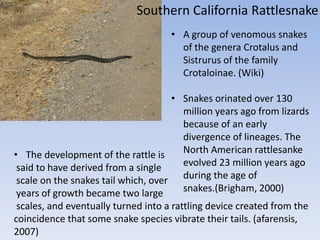
• A group of venomous snakes
of the genera Crotalus and
Sistrurus of the family
Crotaloinae. (Wiki)
• Snakes orinated over 130
million years ago from lizards
because of an early
divergence of lineages. The
North American rattlesanke
evolved 23 million years ago
during the age of
snakes.(Brigham, 2000)
Southern California Rattlesnake
• The development of the rattle is
said to have derived from a single
scale on the snakes tail which, over
years of growth became two large
scales, and eventually turned into a rattling device created from the
coincidence that some snake species vibrate their tails. (afarensis,
2007)
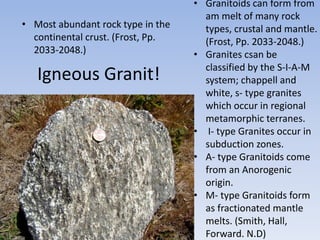
Igneous Granit!
• Most abundant rock type in the
continental crust. (Frost, Pp.
2033-2048.)
• Granitoids can form from
am melt of many rock
types, crustal and mantle.
(Frost, Pp. 2033-2048.)
• Granites csan be
classified by the S-I-A-M
system; chappell and
white, s- type granites
which occur in regional
metamorphic terranes.
• I- type Granites occur in
subduction zones.
• A- type Granitoids come
from an Anorogenic
origin.
• M- type Granitoids form
as fractionated mantle
melts. (Smith, Hall,
Forward. N.D)
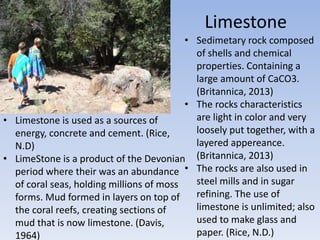
Limestone
• Sedimetary rock composed
of shells and chemical
properties. Containing a
large amount of CaCO3.
(Britannica, 2013)
• The rocks characteristics
are light in color and very
loosely put together, with a
layered appereance.
(Britannica, 2013)
• The rocks are also used in
steel mills and in sugar
refining. The use of
limestone is unlimited; also
used to make glass and
paper. (Rice, N.D.)
• Limestone is used as a sources of
energy, concrete and cement. (Rice,
N.D)
• LimeStone is a product of the Devonian
period where their was an abundance
of coral seas, holding millions of moss
forms. Mud formed in layers on top of
the coral reefs, creating sections of
mud that is now limestone. (Davis,
1964)
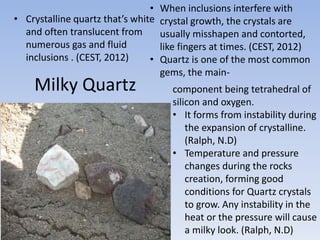
Milky Quartz
• Crystalline quartz that’s white
and often translucent from
numerous gas and fluid
inclusions . (CEST, 2012)
• When inclusions interfere with
crystal growth, the crystals are
usually misshapen and contorted,
like fingers at times. (CEST, 2012)
• Quartz is one of the most common
gems, the main-
component being tetrahedral of
silicon and oxygen.
• It forms from instability during
the expansion of crystalline.
(Ralph, N.D)
• Temperature and pressure
changes during the rocks
creation, forming good
conditions for Quartz crystals
to grow. Any instability in the
heat or the pressure will cause
a milky look. (Ralph, N.D)
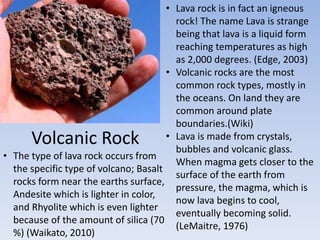
Volcanic Rock
• Lava rock is in fact an igneous
rock! The name Lava is strange
being that lava is a liquid form
reaching temperatures as high
as 2,000 degrees. (Edge, 2003)
• Volcanic rocks are the most
common rock types, mostly in
the oceans. On land they are
common around plate
boundaries.(Wiki)
• Lava is made from crystals,
bubbles and volcanic glass.
When magma gets closer to the
surface of the earth from
pressure, the magma, which is
now lava begins to cool,
eventually becoming solid.
(LeMaitre, 1976)
• The type of lava rock occurs from
the specific type of volcano; Basalt
rocks form near the earths surface,
Andesite which is lighter in color,
and Rhyolite which is even lighter
because of the amount of silica (70
%) (Waikato, 2010)
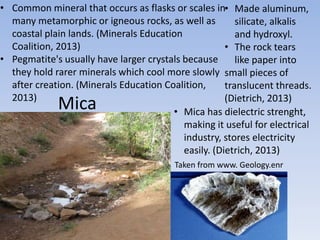
Mica
• Common mineral that occurs as flasks or scales in
many metamorphic or igneous rocks, as well as
coastal plain lands. (Minerals Education
Coalition, 2013)
• Pegmatite's usually have larger crystals because
they hold rarer minerals which cool more slowly
after creation. (Minerals Education Coalition,
2013)
Taken from www. Geology.enr
• Made aluminum,
silicate, alkalis
and hydroxyl.
• The rock tears
like paper into
small pieces of
translucent threads.
(Dietrich, 2013)
• Mica has dielectric strenght,
making it useful for electrical
industry, stores electricity
easily. (Dietrich, 2013)
• There are two forms of Mica; muscovite and phlogopite. They
are valued for their ability to tolerate high temperatures.
(Hale, 2010)
• Mica is also very shiny and somewhat smoky. It also absorbs
water easily, and is very reflective. (Hale, 2010)
References
• Background information: History of Rusty and Iris.
(n.d.). Retrieved
fromhttp://www.internationalowlcenter.org/ouro
wls/rustyandiris/backgroundinformation?gclid=Cjk
KEQjw_ZmdBRD1qNKXhomX_sEBEiQAc9XNUBWK
HfTgeB-7YiG
• Brigham, C. (2000). The biogeography of the
Mojave rattlesnake.
• Retrievedfromhttp://online.sfsu.edu/bholzman/co
urses/Fall00Projects/rsnake.htm
• Calavera nature preserve. Retrieved from
http://www.calaverahills.info/ch-preserve.htm
• Manna, S. (n.d.). The history of valley springs.
Retrieved from
http://westcalaverashistory.org/node/43
• Milky quartz. (n.d.). Retrieved from
http://www.mindat.org/min-6129.html
• Rice, J. History of the limestone quarry. (n.d.).
Retrieved from
http://www.portagequarry.com/history.htm
• S-I-A-M Classification. (n.d.). Retrieved from
http://www.nsm.buffalo.edu/courses/gly206/L08B_S
IAMClassy.pdf
• Smith, A., Hall, B., & Forward, K. (n.d.). Retrieved
from
http://www.ndsu.edu/pubweb/~sainieid/pet/project
s/Smith-Hall-Forward-Antarctic-cobbles.pdf
• The great horned owl. (n.d.). Retrieved from
http://en.wikipedia.org/wiki/Great_horned_owl
• Natural Lava Rock. (2003, January 1). What is
Lava Rock. Retrieved June 23, 2014, from
http://reddome.com/lava-rock.html
• LeMaitre, R. (1976, January 1). What is lava made
of? | Volcano World. What is lava made of? |
Volcano World. Retrieved June 23, 2014, from
http://volcano.oregonstate.edu/what-lava-made
• Dietrich, R. (2010, October 25). Origin and
occurrence. Encyclopedia Britannica Online.
Retrieved September 22, 2014, from
http://www.britannica.com/EBchecked/topic/379
747/mica/80071/Origin-and-occurrence
• History: Squirrel place. (n.d.). Retrieved from
http://www.squirrels.org/history.html
• Gems and minerals: Milky quartz. (n.d.).
Retrieved from
http://geology.answers.com/gems-and-
minerals/gems-and-minerals-milky-quartz
• Wong, K. (2008). Lord of the burrows: The
incredible edible ground squirrel. Retrieved from
http://baynature.org/articles/lord-of-the-
burrows/
• Lain, E. &Gentet, R. (n.d.). The case for the
Calaveras skull. Retrieved from
http://www.creationhistory.com/calaverasskull.s
html
• Darwin explains the rattlesnake’s rattle. (2007).
Retrieved from
http://afarensis99.wordpress.com/2007/04/30/d
arwin_explains_the_rattlesnak/
• What is natural selection? (n.d.). Retrieved
from
http://thegreathornedowlresource.weebly.co
m/evolution.html

Calavera mountain

  • 1.
    Calavera mountain A GeologicalStudy Geology 103 Field assignment By Ty Colby
  • 2.
    Calavera, California • Theword Calavera means skull, which comes from the shape of the mountain. (Lain, Gentet, N.D.) • The mountain is actually a 22 million year-old volcanic plug. (Manna, N.D.)• You can see the volcano slowly eroding away, leaving the plug, the solid mass of volcanic rock. (Manna, N.D.) • The volcanic plug was created millions of years ago when a mass of volcanic rock turned solid within the mountain. (Manna, N.D.)
  • 3.
    Calavera today •Calavera Preserve is a 2.4 mile trail that is used for hiking, biking and other outdoor sports. (Landis, N.D.) • The preserve holds over 400 acres that houses a variety of wild life, including a reserve controlled by the departement of fish and game. ( Landis, N.D.) • The area holds over 115 differernet plants, 49 birds, 10 mamals and 7 amphibias species. (Landis,N.D)
  • 4.
    The Great HornedOwl! • The Bubo VirgianusPacificus is native in north and south America. • Owls belong to the pyhlogenetic class Aves. (Wiki) • The great horned owl is a bard owl that belongs in the family Tyonidae, rather than the family Strigidae. (Caplan, N.D.) • Modern barn owls have evolved from giant owls that thrived in the carribian and Mediterranean around 30,000 years ago. (Caplan, N.D.) • The owl has ear tufts that look like horns. These are feathers wehich help it to camoflaughe.
  • 5.
    California Ground Squirrell•The Otospermophilus beechei is a common animal in California. (Wiki) • Tracked back to 50 million years, the rodent (Rodentia) in the Sciurus family, Sciurus Carolinensis. (Wong, 2008) • There are over 365 different types of squirrels around the world, all divided into seven families; three most common families are the ground squirrel, the flying squirrel and the tree squirrel. (Wong, 2008.)
  • 6.
    • A groupof venomous snakes of the genera Crotalus and Sistrurus of the family Crotaloinae. (Wiki) • Snakes orinated over 130 million years ago from lizards because of an early divergence of lineages. The North American rattlesanke evolved 23 million years ago during the age of snakes.(Brigham, 2000) Southern California Rattlesnake • The development of the rattle is said to have derived from a single scale on the snakes tail which, over years of growth became two large scales, and eventually turned into a rattling device created from the coincidence that some snake species vibrate their tails. (afarensis, 2007)
  • 7.
    Igneous Granit! • Mostabundant rock type in the continental crust. (Frost, Pp. 2033-2048.) • Granitoids can form from am melt of many rock types, crustal and mantle. (Frost, Pp. 2033-2048.) • Granites csan be classified by the S-I-A-M system; chappell and white, s- type granites which occur in regional metamorphic terranes. • I- type Granites occur in subduction zones. • A- type Granitoids come from an Anorogenic origin. • M- type Granitoids form as fractionated mantle melts. (Smith, Hall, Forward. N.D)
  • 8.
    Limestone • Sedimetary rockcomposed of shells and chemical properties. Containing a large amount of CaCO3. (Britannica, 2013) • The rocks characteristics are light in color and very loosely put together, with a layered appereance. (Britannica, 2013) • The rocks are also used in steel mills and in sugar refining. The use of limestone is unlimited; also used to make glass and paper. (Rice, N.D.) • Limestone is used as a sources of energy, concrete and cement. (Rice, N.D) • LimeStone is a product of the Devonian period where their was an abundance of coral seas, holding millions of moss forms. Mud formed in layers on top of the coral reefs, creating sections of mud that is now limestone. (Davis, 1964)
  • 9.
    Milky Quartz • Crystallinequartz that’s white and often translucent from numerous gas and fluid inclusions . (CEST, 2012) • When inclusions interfere with crystal growth, the crystals are usually misshapen and contorted, like fingers at times. (CEST, 2012) • Quartz is one of the most common gems, the main- component being tetrahedral of silicon and oxygen. • It forms from instability during the expansion of crystalline. (Ralph, N.D) • Temperature and pressure changes during the rocks creation, forming good conditions for Quartz crystals to grow. Any instability in the heat or the pressure will cause a milky look. (Ralph, N.D)
  • 10.
    Volcanic Rock • Lavarock is in fact an igneous rock! The name Lava is strange being that lava is a liquid form reaching temperatures as high as 2,000 degrees. (Edge, 2003) • Volcanic rocks are the most common rock types, mostly in the oceans. On land they are common around plate boundaries.(Wiki) • Lava is made from crystals, bubbles and volcanic glass. When magma gets closer to the surface of the earth from pressure, the magma, which is now lava begins to cool, eventually becoming solid. (LeMaitre, 1976) • The type of lava rock occurs from the specific type of volcano; Basalt rocks form near the earths surface, Andesite which is lighter in color, and Rhyolite which is even lighter because of the amount of silica (70 %) (Waikato, 2010)
  • 11.
    Mica • Common mineralthat occurs as flasks or scales in many metamorphic or igneous rocks, as well as coastal plain lands. (Minerals Education Coalition, 2013) • Pegmatite's usually have larger crystals because they hold rarer minerals which cool more slowly after creation. (Minerals Education Coalition, 2013) Taken from www. Geology.enr • Made aluminum, silicate, alkalis and hydroxyl. • The rock tears like paper into small pieces of translucent threads. (Dietrich, 2013) • Mica has dielectric strenght, making it useful for electrical industry, stores electricity easily. (Dietrich, 2013)
  • 12.
    • There aretwo forms of Mica; muscovite and phlogopite. They are valued for their ability to tolerate high temperatures. (Hale, 2010) • Mica is also very shiny and somewhat smoky. It also absorbs water easily, and is very reflective. (Hale, 2010)
  • 13.
    References • Background information:History of Rusty and Iris. (n.d.). Retrieved fromhttp://www.internationalowlcenter.org/ouro wls/rustyandiris/backgroundinformation?gclid=Cjk KEQjw_ZmdBRD1qNKXhomX_sEBEiQAc9XNUBWK HfTgeB-7YiG • Brigham, C. (2000). The biogeography of the Mojave rattlesnake. • Retrievedfromhttp://online.sfsu.edu/bholzman/co urses/Fall00Projects/rsnake.htm • Calavera nature preserve. Retrieved from http://www.calaverahills.info/ch-preserve.htm
  • 14.
    • Manna, S.(n.d.). The history of valley springs. Retrieved from http://westcalaverashistory.org/node/43 • Milky quartz. (n.d.). Retrieved from http://www.mindat.org/min-6129.html • Rice, J. History of the limestone quarry. (n.d.). Retrieved from http://www.portagequarry.com/history.htm • S-I-A-M Classification. (n.d.). Retrieved from http://www.nsm.buffalo.edu/courses/gly206/L08B_S IAMClassy.pdf • Smith, A., Hall, B., & Forward, K. (n.d.). Retrieved from http://www.ndsu.edu/pubweb/~sainieid/pet/project s/Smith-Hall-Forward-Antarctic-cobbles.pdf • The great horned owl. (n.d.). Retrieved from http://en.wikipedia.org/wiki/Great_horned_owl
  • 15.
    • Natural LavaRock. (2003, January 1). What is Lava Rock. Retrieved June 23, 2014, from http://reddome.com/lava-rock.html • LeMaitre, R. (1976, January 1). What is lava made of? | Volcano World. What is lava made of? | Volcano World. Retrieved June 23, 2014, from http://volcano.oregonstate.edu/what-lava-made • Dietrich, R. (2010, October 25). Origin and occurrence. Encyclopedia Britannica Online. Retrieved September 22, 2014, from http://www.britannica.com/EBchecked/topic/379 747/mica/80071/Origin-and-occurrence • History: Squirrel place. (n.d.). Retrieved from http://www.squirrels.org/history.html
  • 16.
    • Gems andminerals: Milky quartz. (n.d.). Retrieved from http://geology.answers.com/gems-and- minerals/gems-and-minerals-milky-quartz • Wong, K. (2008). Lord of the burrows: The incredible edible ground squirrel. Retrieved from http://baynature.org/articles/lord-of-the- burrows/ • Lain, E. &Gentet, R. (n.d.). The case for the Calaveras skull. Retrieved from http://www.creationhistory.com/calaverasskull.s html • Darwin explains the rattlesnake’s rattle. (2007). Retrieved from http://afarensis99.wordpress.com/2007/04/30/d arwin_explains_the_rattlesnak/
  • 17.
    • What isnatural selection? (n.d.). Retrieved from http://thegreathornedowlresource.weebly.co m/evolution.html