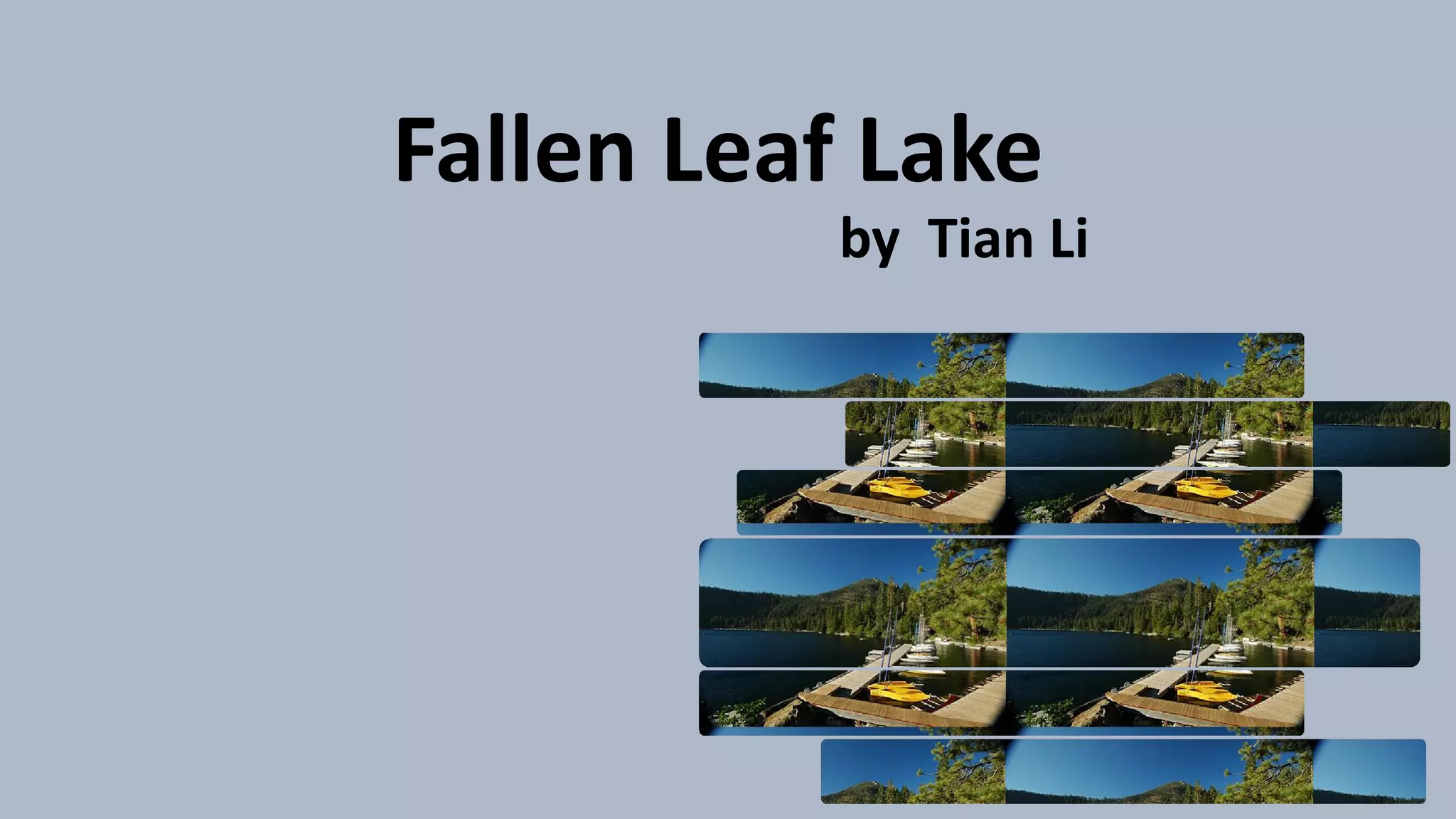
Fallen Leaf Lake
by Tian Li
Introduction
Fallen Leaf Lake is a mountain lake located in El
Dorado County, California, near the California-
Nevada state border, about one mile south west of
the much larger Lake Tahoe. It is approximately
aligned north-to-south and oval in shape, measuring
approximately 2.9 miles (4.6 km) on the long axis
and 0.9 miles (1.4 km) on the short axis. The lake
was created by at least two glaciers that traveled
northward down the Glen Alpine Valley. If the glacier
had continued instead of stopping, Fallen Leaf Lake
would be a bay of Lake Tahoe, similar to nearby
Emerald Bay. A terminal moraine is visible at the
north end of the lake on the northeast edge.
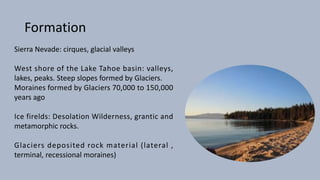
Formation
Sierra Nevade: cirques, glacial valleys
West shore of the Lake Tahoe basin: valleys,
lakes, peaks. Steep slopes formed by Glaciers.
Moraines formed by Glaciers 70,000 to 150,000
years ago
Ice firelds: Desolation Wilderness, grantic and
metamorphic rocks.
Glaciers deposited rock material (lateral ,
terminal, recessional moraines)
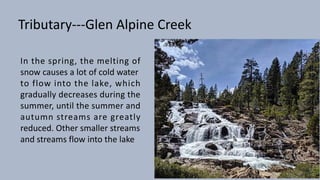
Tributary---Glen Alpine Creek
In the spring, the melting of
snow causes a lot of cold water
to flow into the lake, which
gradually decreases during the
summer, until the summer and
autumn streams are greatly
reduced. Other smaller streams
and streams flow into the lake
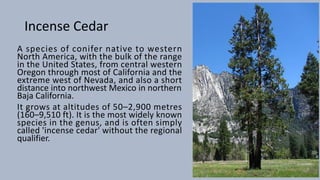
Incense Cedar
A species of conifer native to western
North America, with the bulk of the range
in the United States, from central western
Oregon through most of California and the
extreme west of Nevada, and also a short
distance into northwest Mexico in northern
Baja California.
It grows at altitudes of 50–2,900 metres
(160–9,510 ft). It is the most widely known
species in the genus, and is often simply
called 'incense cedar' without the regional
qualifier.
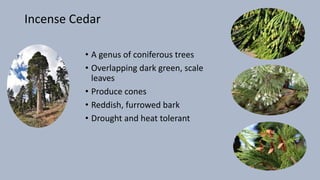
Incense Cedar
• A genus of coniferous trees
• Overlapping dark green, scale
leaves
• Produce cones
• Reddish, furrowed bark
• Drought and heat tolerant
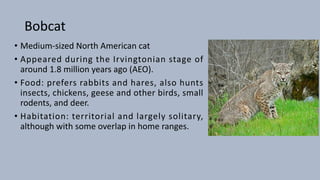
Bobcat
• Medium-sized North American cat
• Appeared during the Irvingtonian stage of
around 1.8 million years ago (AEO).
• Food: prefers rabbits and hares, also hunts
insects, chickens, geese and other birds, small
rodents, and deer.
• Habitation: territorial and largely solitary,
although with some overlap in home ranges.
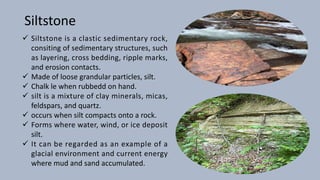
Siltstone
ü Siltstone is a clastic sedimentary rock,
consiting of sedimentary structures, such
as layering, cross bedding, ripple marks,
and erosion contacts.
ü Made of loose grandular particles, silt.
ü Chalk le when rubbedd on hand.
ü silt is a mixture of clay minerals, micas,
feldspars, and quartz.
ü occurs when silt compacts onto a rock.
ü Forms where water, wind, or ice deposit
silt.
ü It can be regarded as an example of a
glacial environment and current energy
where mud and sand accumulated.
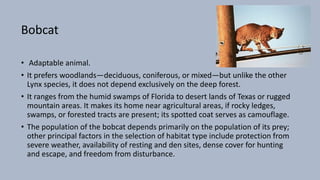
Bobcat
• Adaptable animal.
• It prefers woodlands—deciduous, coniferous, or mixed—but unlike the other
Lynx species, it does not depend exclusively on the deep forest.
• It ranges from the humid swamps of Florida to desert lands of Texas or rugged
mountain areas. It makes its home near agricultural areas, if rocky ledges,
swamps, or forested tracts are present; its spotted coat serves as camouflage.
• The population of the bobcat depends primarily on the population of its prey;
other principal factors in the selection of habitat type include protection from
severe weather, availability of resting and den sites, dense cover for hunting
and escape, and freedom from disturbance.
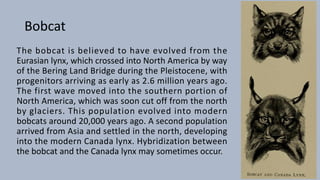
Bobcat
The bobcat is believed to have evolved from the
Eurasian lynx, which crossed into North America by way
of the Bering Land Bridge during the Pleistocene, with
progenitors arriving as early as 2.6 million years ago.
The first wave moved into the southern portion of
North America, which was soon cut off from the north
by glaciers. This population evolved into modern
bobcats around 20,000 years ago. A second population
arrived from Asia and settled in the north, developing
into the modern Canada lynx. Hybridization between
the bobcat and the Canada lynx may sometimes occur.
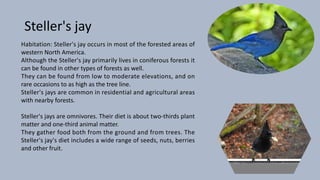
Steller's jay
Habitation: Steller's jay occurs in most of the forested areas of
western North America.
Although the Steller's jay primarily lives in coniferous forests it
can be found in other types of forests as well.
They can be found from low to moderate elevations, and on
rare occasions to as high as the tree line.
Steller's jays are common in residential and agricultural areas
with nearby forests.
Steller's jays are omnivores. Their diet is about two-thirds plant
matter and one-third animal matter.
They gather food both from the ground and from trees. The
Steller's jay's diet includes a wide range of seeds, nuts, berries
and other fruit.
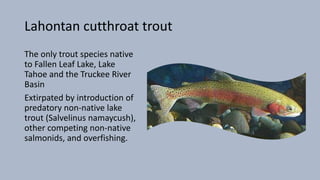
Lahontan cutthroat trout
The only trout species native
to Fallen Leaf Lake, Lake
Tahoe and the Truckee River
Basin
Extirpated by introduction of
predatory non-native lake
trout (Salvelinus namaycush),
other competing non-native
salmonids, and overfishing.
References
• Zielinski, William J; Kuceradate, Thomas E (1998). American Marten, Fisher,
Lynx, and Wolverine: Survey Methods for Their Detection. DIANE Publishing.
pp. 77–8. ISBN 978-0-7881-3628-3.
• Carron Meaney; Gary P. Beauvais (September 2004). "Species Assessment for
Canada lynx (Lynx Canadensis) in Wyoming" (PDF). United States Department
of the Interior, Bureau of Land Management. Retrieved 2007-06-25.
• Johnson, W.E.; Eizirik, E.; Pecon-Slattery, J.; Murphy, W.J.; Antunes, A.; Teeling,
E. & O'Brien, S.J. (2006). "The Late Miocene radiation of modern Felidae: A
genetic assessment". Science. 311 (5757): 73–77. Bibcode:2006Sci...311...73J.
doi:10.1126/science.1122277. PMID 16400146.
• Mills, L. Scott (November 2006). Conservation of Wildlife Populations:
Demography, Genetics, and Management. Blackwell Publishing. p. 48. ISBN
978-1-4051-2146-0.
References
• Kitchener, A. C.; Breitenmoser-Würsten, C.; Eizirik, E.; Gentry, A.;
Werdelin, L.; Wilting, A.; Yamaguchi, N.; Abramov, A. V.; Christiansen,
P.; Driscoll, C.; Duckworth, J. W.; Johnson, W.; Luo, S.-J.; Meijaard, E.;
O'Donoghue, P.; Sanderson, J.; Seymour, K.; Bruford, M.; Groves, C.;
Hoffmann, M.; Nowell, K.; Timmons, Z.; Tobe, S. (2017). "A revised
taxonomy of the Felidae: The final report of the Cat Classification Task
Force of the IUCN Cat Specialist Group" . Cat News (Special Issue 11).
• Folk, R.L., 1965, Petrology of sedimentary rocks PDF version. Austin:
Hemphill's Bookstore. 2nd ed. 1981, ISBN 0-914696-14-9
• "Calocedrus decurrens (Torr.) Florin". World Checklist of Selected
Plant Families (WCSP). Royal Botanic Gardens, Kew. Retrieved 6
January 2017 – via The Plant List.

Lab

  • 1.
  • 2.
    Introduction Fallen Leaf Lakeis a mountain lake located in El Dorado County, California, near the California- Nevada state border, about one mile south west of the much larger Lake Tahoe. It is approximately aligned north-to-south and oval in shape, measuring approximately 2.9 miles (4.6 km) on the long axis and 0.9 miles (1.4 km) on the short axis. The lake was created by at least two glaciers that traveled northward down the Glen Alpine Valley. If the glacier had continued instead of stopping, Fallen Leaf Lake would be a bay of Lake Tahoe, similar to nearby Emerald Bay. A terminal moraine is visible at the north end of the lake on the northeast edge.
  • 3.
    Formation Sierra Nevade: cirques,glacial valleys West shore of the Lake Tahoe basin: valleys, lakes, peaks. Steep slopes formed by Glaciers. Moraines formed by Glaciers 70,000 to 150,000 years ago Ice firelds: Desolation Wilderness, grantic and metamorphic rocks. Glaciers deposited rock material (lateral , terminal, recessional moraines)
  • 4.
    Tributary---Glen Alpine Creek Inthe spring, the melting of snow causes a lot of cold water to flow into the lake, which gradually decreases during the summer, until the summer and autumn streams are greatly reduced. Other smaller streams and streams flow into the lake
  • 5.
    Incense Cedar A speciesof conifer native to western North America, with the bulk of the range in the United States, from central western Oregon through most of California and the extreme west of Nevada, and also a short distance into northwest Mexico in northern Baja California. It grows at altitudes of 50–2,900 metres (160–9,510 ft). It is the most widely known species in the genus, and is often simply called 'incense cedar' without the regional qualifier.
  • 6.
    Incense Cedar • Agenus of coniferous trees • Overlapping dark green, scale leaves • Produce cones • Reddish, furrowed bark • Drought and heat tolerant
  • 7.
    Bobcat • Medium-sized NorthAmerican cat • Appeared during the Irvingtonian stage of around 1.8 million years ago (AEO). • Food: prefers rabbits and hares, also hunts insects, chickens, geese and other birds, small rodents, and deer. • Habitation: territorial and largely solitary, although with some overlap in home ranges.
  • 8.
    Siltstone ü Siltstone isa clastic sedimentary rock, consiting of sedimentary structures, such as layering, cross bedding, ripple marks, and erosion contacts. ü Made of loose grandular particles, silt. ü Chalk le when rubbedd on hand. ü silt is a mixture of clay minerals, micas, feldspars, and quartz. ü occurs when silt compacts onto a rock. ü Forms where water, wind, or ice deposit silt. ü It can be regarded as an example of a glacial environment and current energy where mud and sand accumulated.
  • 9.
    Bobcat • Adaptable animal. •It prefers woodlands—deciduous, coniferous, or mixed—but unlike the other Lynx species, it does not depend exclusively on the deep forest. • It ranges from the humid swamps of Florida to desert lands of Texas or rugged mountain areas. It makes its home near agricultural areas, if rocky ledges, swamps, or forested tracts are present; its spotted coat serves as camouflage. • The population of the bobcat depends primarily on the population of its prey; other principal factors in the selection of habitat type include protection from severe weather, availability of resting and den sites, dense cover for hunting and escape, and freedom from disturbance.
  • 10.
    Bobcat The bobcat isbelieved to have evolved from the Eurasian lynx, which crossed into North America by way of the Bering Land Bridge during the Pleistocene, with progenitors arriving as early as 2.6 million years ago. The first wave moved into the southern portion of North America, which was soon cut off from the north by glaciers. This population evolved into modern bobcats around 20,000 years ago. A second population arrived from Asia and settled in the north, developing into the modern Canada lynx. Hybridization between the bobcat and the Canada lynx may sometimes occur.
  • 11.
    Steller's jay Habitation: Steller'sjay occurs in most of the forested areas of western North America. Although the Steller's jay primarily lives in coniferous forests it can be found in other types of forests as well. They can be found from low to moderate elevations, and on rare occasions to as high as the tree line. Steller's jays are common in residential and agricultural areas with nearby forests. Steller's jays are omnivores. Their diet is about two-thirds plant matter and one-third animal matter. They gather food both from the ground and from trees. The Steller's jay's diet includes a wide range of seeds, nuts, berries and other fruit.
  • 12.
    Lahontan cutthroat trout Theonly trout species native to Fallen Leaf Lake, Lake Tahoe and the Truckee River Basin Extirpated by introduction of predatory non-native lake trout (Salvelinus namaycush), other competing non-native salmonids, and overfishing.
  • 13.
    References • Zielinski, WilliamJ; Kuceradate, Thomas E (1998). American Marten, Fisher, Lynx, and Wolverine: Survey Methods for Their Detection. DIANE Publishing. pp. 77–8. ISBN 978-0-7881-3628-3. • Carron Meaney; Gary P. Beauvais (September 2004). "Species Assessment for Canada lynx (Lynx Canadensis) in Wyoming" (PDF). United States Department of the Interior, Bureau of Land Management. Retrieved 2007-06-25. • Johnson, W.E.; Eizirik, E.; Pecon-Slattery, J.; Murphy, W.J.; Antunes, A.; Teeling, E. & O'Brien, S.J. (2006). "The Late Miocene radiation of modern Felidae: A genetic assessment". Science. 311 (5757): 73–77. Bibcode:2006Sci...311...73J. doi:10.1126/science.1122277. PMID 16400146. • Mills, L. Scott (November 2006). Conservation of Wildlife Populations: Demography, Genetics, and Management. Blackwell Publishing. p. 48. ISBN 978-1-4051-2146-0.
  • 14.
    References • Kitchener, A.C.; Breitenmoser-Würsten, C.; Eizirik, E.; Gentry, A.; Werdelin, L.; Wilting, A.; Yamaguchi, N.; Abramov, A. V.; Christiansen, P.; Driscoll, C.; Duckworth, J. W.; Johnson, W.; Luo, S.-J.; Meijaard, E.; O'Donoghue, P.; Sanderson, J.; Seymour, K.; Bruford, M.; Groves, C.; Hoffmann, M.; Nowell, K.; Timmons, Z.; Tobe, S. (2017). "A revised taxonomy of the Felidae: The final report of the Cat Classification Task Force of the IUCN Cat Specialist Group" . Cat News (Special Issue 11). • Folk, R.L., 1965, Petrology of sedimentary rocks PDF version. Austin: Hemphill's Bookstore. 2nd ed. 1981, ISBN 0-914696-14-9 • "Calocedrus decurrens (Torr.) Florin". World Checklist of Selected Plant Families (WCSP). Royal Botanic Gardens, Kew. Retrieved 6 January 2017 – via The Plant List.