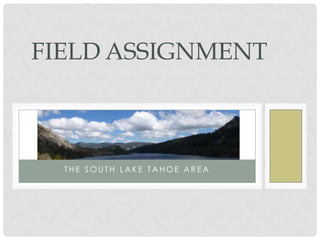
The South Lake Tahoe AreaFieldAssignment
Lake Tahoe: the beginningTaking this class over the summer really made me start to think differently about things I see all the time. For example, Lake Tahoe. Ive seen it numerous times, but it was not until this class that I wondered how did it get here?
The first thing I learned was that, unlike many of the surrounding Lakes, Lake Tahoe was NOT formed by glaciers
though the glaciers did have an effect, raising the water level by 800 ft(Antonucci 2011)
How was the lake formed?About 4 million years ago, a system of parallel faults caused an upward thrust, creating the surrounding mountains, and a downward fall of the valley bottom that formed the basin that would become Lake TahoeErupting volcanoes blocked the river channel which caused the water to become trappedIt became a “lava dammed lake”Around 15 thousand years ago an underwater earthquake triggered a massive underwater landslide that widened the lake by 3 miles and explains the “bulge ” on the west shoreWaves, tsunamis and damming by humans has created the Lake we see today(Antonucci 2011; Alt 1995)
The Lake TodayBecause Lake Tahoe is 2-3 million years old, it is among the 20 oldest lakes in the worldIts avg. depth is 1,027 feet, the max depth is 1,645, feet making it the 2nd largest lake in the U.S.The lake holds 39 trillion gallons of water, enough to completely cover the entire state of CA in a foot of waterThe water coming from rain and snowmelt runoff(Antonucci 2011)
The Ponderosa Pine(Pinus ponderosa)I came across this tree when I was out hiking behind my grandparents cabin in S. Lake Tahoe (off of North Upper Truckee). It was much larger than the other surrounding trees which is why it grabbed my attention Ponderosa Pines grow to 150-180 feet on averagePonderosas live to be extremely old, the oldest recorded was 1047 years old!(Fagan 2009)
How do you know it’s a Ponderosa?Needles-  4-7 Inches long and in groups of 2 or 3Cones- oval shaped and open with fine pricklesBark-  thick, bright orangey-brown, deeply grooved into jig-saw like flakesHabitat- dry mountain soils (like Lake Tahoe)Wernert (1982)
History of the PinePine trees have been around since the early Crestaceous period (130 million years ago)There are records of the Neanderthal man using pine trees for firePines come from a group of gymnosperms (naked seed plants) including four phyla, cycads, ginko, conifers (the pines), and gnetophytesConifers range from ground shrubs to redwoods, which are some of the largest trees in the worldPine trees can be found all over the world, each adapting to the environment in which it livesThe ponderosa lives in dry mountain areas so it has extremely large roots that help it get water and prevent it from blowing over(“Pines: evolution and classification”2011; Wernert 1982)
Snow Plant(Sarcodessanguinea)I found this when I was up hiking behind Sorensons off of hwy 89, the trail was still extremely wet from the melting snow and a bunch of these plants were popping up alongside the trailSnowplants usually bloom in May and June because they flourish as the snow begins to melt (not usually in the snow which is a common misconception from its name)The thing that first caught my attention was the bright red color of this flowerit is to attract the attention of carrion insects (like beetles) in the deep forest (a perfect of example of adapting to its environment)(Gauna 2010)
More about the Snow plantIt belongs to the Monotropaceae, or Indian-pipe family, a family closely related to the Ericaceae, or heath family
Because it is a non-photosynthetic plant it has been difficult to completely trace the lineage (though it is thought to stem from the  Orobanchaceaeor Cuscutaceae family)
The snow plant is related to shrubs like the  manzanita, madroño, laurel, and azalea (though not much resemblance )
The snowplant is a monotropoid, which are unusual parasites.

Field assignment

  • 1.
    The South LakeTahoe AreaFieldAssignment
  • 2.
    Lake Tahoe: thebeginningTaking this class over the summer really made me start to think differently about things I see all the time. For example, Lake Tahoe. Ive seen it numerous times, but it was not until this class that I wondered how did it get here?
  • 3.
    The first thingI learned was that, unlike many of the surrounding Lakes, Lake Tahoe was NOT formed by glaciers
  • 4.
    though the glaciersdid have an effect, raising the water level by 800 ft(Antonucci 2011)
  • 5.
    How was thelake formed?About 4 million years ago, a system of parallel faults caused an upward thrust, creating the surrounding mountains, and a downward fall of the valley bottom that formed the basin that would become Lake TahoeErupting volcanoes blocked the river channel which caused the water to become trappedIt became a “lava dammed lake”Around 15 thousand years ago an underwater earthquake triggered a massive underwater landslide that widened the lake by 3 miles and explains the “bulge ” on the west shoreWaves, tsunamis and damming by humans has created the Lake we see today(Antonucci 2011; Alt 1995)
  • 6.
    The Lake TodayBecauseLake Tahoe is 2-3 million years old, it is among the 20 oldest lakes in the worldIts avg. depth is 1,027 feet, the max depth is 1,645, feet making it the 2nd largest lake in the U.S.The lake holds 39 trillion gallons of water, enough to completely cover the entire state of CA in a foot of waterThe water coming from rain and snowmelt runoff(Antonucci 2011)
  • 7.
    The Ponderosa Pine(Pinusponderosa)I came across this tree when I was out hiking behind my grandparents cabin in S. Lake Tahoe (off of North Upper Truckee). It was much larger than the other surrounding trees which is why it grabbed my attention Ponderosa Pines grow to 150-180 feet on averagePonderosas live to be extremely old, the oldest recorded was 1047 years old!(Fagan 2009)
  • 8.
    How do youknow it’s a Ponderosa?Needles- 4-7 Inches long and in groups of 2 or 3Cones- oval shaped and open with fine pricklesBark- thick, bright orangey-brown, deeply grooved into jig-saw like flakesHabitat- dry mountain soils (like Lake Tahoe)Wernert (1982)
  • 9.
    History of thePinePine trees have been around since the early Crestaceous period (130 million years ago)There are records of the Neanderthal man using pine trees for firePines come from a group of gymnosperms (naked seed plants) including four phyla, cycads, ginko, conifers (the pines), and gnetophytesConifers range from ground shrubs to redwoods, which are some of the largest trees in the worldPine trees can be found all over the world, each adapting to the environment in which it livesThe ponderosa lives in dry mountain areas so it has extremely large roots that help it get water and prevent it from blowing over(“Pines: evolution and classification”2011; Wernert 1982)
  • 10.
    Snow Plant(Sarcodessanguinea)I foundthis when I was up hiking behind Sorensons off of hwy 89, the trail was still extremely wet from the melting snow and a bunch of these plants were popping up alongside the trailSnowplants usually bloom in May and June because they flourish as the snow begins to melt (not usually in the snow which is a common misconception from its name)The thing that first caught my attention was the bright red color of this flowerit is to attract the attention of carrion insects (like beetles) in the deep forest (a perfect of example of adapting to its environment)(Gauna 2010)
  • 11.
    More about theSnow plantIt belongs to the Monotropaceae, or Indian-pipe family, a family closely related to the Ericaceae, or heath family
  • 12.
    Because it isa non-photosynthetic plant it has been difficult to completely trace the lineage (though it is thought to stem from the  Orobanchaceaeor Cuscutaceae family)
  • 13.
    The snow plantis related to shrubs like the manzanita, madroño, laurel, and azalea (though not much resemblance )
  • 14.
    The snowplant isa monotropoid, which are unusual parasites.