Seminar Report
Presentation
on
PISTON LESSPUMP
Submitted by – Simranjeet Singh
B.Tech ME-57
1612240198
INTRODUCTION
Pump is a device which converts mechanical energy into hydraulic
energy.
Principle: A partial vacuum created when internal parts of pump
receives mechanical energy .
 NASA have developed a Low cost rocket fuel pump which has
Comparable performance to turbo pump at 80-90% lower cost.
 A turbo pump design requires a large engineering effort and is expensive
to mfg. and test.
This pump saves up to 90% of the mass of the tanks as compared to a
pressure fed system.
. By this pump the rocket does not have to carry heavy load and can travel
with very high speed.
Continued-
• APiston lesspump is atype of pump designed to move fluids without
any moving parts other than three chamber valves.
• Thispump provides increased design flexibility & increase
damageand fault tolerance.
• Absenceof piston leads to lessfriction losses & hence
improves efficiency of engineconsiderably.
WHYPISTONLESSPUMP??
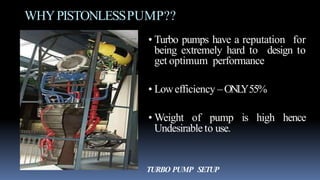
• Turbo pumps have a reputation for
being extremely hard to design to
get optimum performance
• Lowefficiency –ONLY55%
• Weight of pump is high hence
Undesirable to use.
TURBO PUMP SETUP
NECESSITY
• The turbo pumps used in rocket are very heavy, containing many rotating parts by
which there are more frictional losses which more consumption of fuel there by
decreasingthe efficiency of the engine .
• Since the rocket has to remain stable in the space, is difficult and require complex
methods for it. If this pump gets any fault then its reappearance requires long time.
So, there must be such a device which overcomes all the drawbacks of the turbo
pump.
• ThePistonless pump isthe solution for the problems faced by usingturbo pumps.
DIFFERENCE BETWEEN TURBO & PISTONLESS PUMP
TURB
O
PUMP
Piston
Less
PUMP
WORKING OF PISTONLESS
PUMP (Rocket engine)
It consists of main tank and Two pumping
chambers . The pump starts with both
chambers filled.
Each one being alternately refilled and
pressurized .
One chamber is pressurized, and fluid is
delivered to the rocket engine fromthat
chamber(Step 1).
 Once the level gets low in one
chamber, the other chamber is
pressurized;
 Flow is thereby established from
both
period
sides
until
during a short
full flow is
established
chamber.
from
Then
the other
the nearly
empty chamber is vented and
refilled.
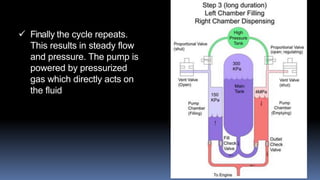
 Finally the cycle repeats.
This results in steady flow
and pressure. The pump is
powered by pressurized
gas which directly acts on
the fluid
Working model video of piston less pump
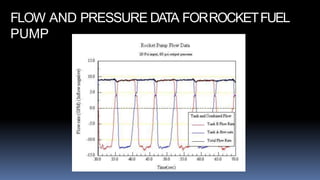
FLOW AND PRESSURE DATA FORROCKETFUEL
PUMP
DUAL PISTONLESS PUMP
 NASAhas designed, built and tested a
simple, light weight pump (dual piston
less pump) for use in liquid propelled
rocket where a reliable pump with
minimal moving parts is needed.
 This pump has the potential to
reduce the cost and increase the
reliability of rocket fuel pumps by a
factor of 20 to 100.
Safety and Reliability
This type of pump is not new in fact it has been used to pump groundwater out
of basements for over 100 years, where reliability is critical.The present design
operates much more quickly and works in space and in a zero gee environment,
but the key to reliability is the slow moving parts and wide operational
tolerances, which allow the pump to work regardless of contamination, leakage
or sensor failures. A complete analysis has shown that many of the failure modes
of the pump involve reduction in performance and no single point failure can
cause explosion or fire. If the valves on one of the chambers fail, there will be a
few seconds in which to execute a safe shutdown of the affected
engine
APPLICATIONS
• Deep space propulsion
• X Price vehicle fuel pump
ADVANTAGES
• All the hardware in the pump consists of pressure vesselsothe weight is
low.
• The pump can be scaled up or down with similar performance
and minimal redesign issues.
• Low risk development; pump technology has been demonstrated and
prototypes have been built andtested.
• Themanufacturing tolerances need not be tight.
• Less movingparts ,hence lubrication required is quite low.
• Designis simple compared to turbo pumps.
DISADVANTAGES
•They cannot pump to higher pressure than drive gas (area ratio is 1:1)
•They cannot use either a staged combustion or expander cycle.
•A gas generator cycle is also difficult to integrate with the piston less
pump.
•The generated gas must be chemically compatible with both the
propellants.
•This gas generator lowers the Ignition start period of the engine
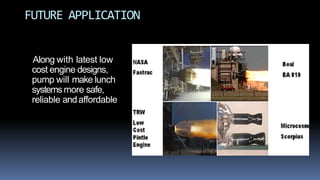
FUTURE APPLICATION
Along with latest low
cost engine designs,
pump will make lunch
systemsmore safe,
reliable andaffordable
CONCLUSION
• Themost significance of property of Piston lesspump that makes
them different from that of turbo pump ,is the absenceof piston.
• Thisis the most unique technique. In this ,no. of rotatingparts is very
less ascompared to that of turbo pump. Also, it’s installation is very
easy.and moreover, it is light weight than turbo pump. So,it hasless
lossesand improves, rather increases efficiency of engine.Also, it is
much economical than turbo pump.
ANY QUERIES
20
THANK YOU

Pistonless pump ppt

  • 1.
    Seminar Report Presentation on PISTON LESSPUMP Submittedby – Simranjeet Singh B.Tech ME-57 1612240198
  • 2.
    INTRODUCTION Pump is adevice which converts mechanical energy into hydraulic energy. Principle: A partial vacuum created when internal parts of pump receives mechanical energy .  NASA have developed a Low cost rocket fuel pump which has Comparable performance to turbo pump at 80-90% lower cost.  A turbo pump design requires a large engineering effort and is expensive to mfg. and test. This pump saves up to 90% of the mass of the tanks as compared to a pressure fed system. . By this pump the rocket does not have to carry heavy load and can travel with very high speed.
  • 3.
    Continued- • APiston lesspumpis atype of pump designed to move fluids without any moving parts other than three chamber valves. • Thispump provides increased design flexibility & increase damageand fault tolerance. • Absenceof piston leads to lessfriction losses & hence improves efficiency of engineconsiderably.
  • 4.
    WHYPISTONLESSPUMP?? • Turbo pumpshave a reputation for being extremely hard to design to get optimum performance • Lowefficiency –ONLY55% • Weight of pump is high hence Undesirable to use. TURBO PUMP SETUP
  • 5.
    NECESSITY • The turbopumps used in rocket are very heavy, containing many rotating parts by which there are more frictional losses which more consumption of fuel there by decreasingthe efficiency of the engine . • Since the rocket has to remain stable in the space, is difficult and require complex methods for it. If this pump gets any fault then its reappearance requires long time. So, there must be such a device which overcomes all the drawbacks of the turbo pump. • ThePistonless pump isthe solution for the problems faced by usingturbo pumps.
  • 6.
    DIFFERENCE BETWEEN TURBO& PISTONLESS PUMP TURB O PUMP Piston Less PUMP
  • 7.
    WORKING OF PISTONLESS PUMP(Rocket engine) It consists of main tank and Two pumping chambers . The pump starts with both chambers filled. Each one being alternately refilled and pressurized . One chamber is pressurized, and fluid is delivered to the rocket engine fromthat chamber(Step 1).
  • 8.
     Once thelevel gets low in one chamber, the other chamber is pressurized;
  • 9.
     Flow isthereby established from both period sides until during a short full flow is established chamber. from Then the other the nearly empty chamber is vented and refilled.
  • 10.
     Finally thecycle repeats. This results in steady flow and pressure. The pump is powered by pressurized gas which directly acts on the fluid
  • 11.
    Working model videoof piston less pump
  • 12.
    FLOW AND PRESSUREDATA FORROCKETFUEL PUMP
  • 13.
    DUAL PISTONLESS PUMP NASAhas designed, built and tested a simple, light weight pump (dual piston less pump) for use in liquid propelled rocket where a reliable pump with minimal moving parts is needed.  This pump has the potential to reduce the cost and increase the reliability of rocket fuel pumps by a factor of 20 to 100.
  • 14.
    Safety and Reliability Thistype of pump is not new in fact it has been used to pump groundwater out of basements for over 100 years, where reliability is critical.The present design operates much more quickly and works in space and in a zero gee environment, but the key to reliability is the slow moving parts and wide operational tolerances, which allow the pump to work regardless of contamination, leakage or sensor failures. A complete analysis has shown that many of the failure modes of the pump involve reduction in performance and no single point failure can cause explosion or fire. If the valves on one of the chambers fail, there will be a few seconds in which to execute a safe shutdown of the affected engine
  • 15.
    APPLICATIONS • Deep spacepropulsion • X Price vehicle fuel pump
  • 16.
    ADVANTAGES • All thehardware in the pump consists of pressure vesselsothe weight is low. • The pump can be scaled up or down with similar performance and minimal redesign issues. • Low risk development; pump technology has been demonstrated and prototypes have been built andtested. • Themanufacturing tolerances need not be tight. • Less movingparts ,hence lubrication required is quite low. • Designis simple compared to turbo pumps.
  • 17.
    DISADVANTAGES •They cannot pumpto higher pressure than drive gas (area ratio is 1:1) •They cannot use either a staged combustion or expander cycle. •A gas generator cycle is also difficult to integrate with the piston less pump. •The generated gas must be chemically compatible with both the propellants. •This gas generator lowers the Ignition start period of the engine
  • 18.
    FUTURE APPLICATION Along withlatest low cost engine designs, pump will make lunch systemsmore safe, reliable andaffordable
  • 19.
    CONCLUSION • Themost significanceof property of Piston lesspump that makes them different from that of turbo pump ,is the absenceof piston. • Thisis the most unique technique. In this ,no. of rotatingparts is very less ascompared to that of turbo pump. Also, it’s installation is very easy.and moreover, it is light weight than turbo pump. So,it hasless lossesand improves, rather increases efficiency of engine.Also, it is much economical than turbo pump.
  • 20.
  • 21.

Editor's Notes

  • #3 ‘;g,df’g,df