➢ Characteristics oflaser
➢ Absorption and emission of radiations by matter
➢ Population inversion in laser
➢ Basic components of laser system.
➢ Optical resonator and Q value,
➢ Threshold condition for sustaining of laser action,
➢ Typical lasers
➢ Working principle of laser
➢ Application of lasers.
Syllabus
PP
3.
❑ In 1917,Albert Einstein proposes the process of stimulated
emission of radiation where electrons at higher energy states can be
stimulated to emit radiation of a specific wavelength.
❑ N. Basov, A. m. Prokhorov and C.H. Townes independently
discovered similar phenomenon in the areas of microwaves
known as MASER or Microwave Amplification by
Stimulated Emission of Radiation in 1954.
❑ Subsequently Townes and A. L. Shawlow suggested the
possibility of similar stimulated emission in case of visible light
❑ Finally optical LASER was discovered by T. H. Maiman in 1960.
Discovery of LASER
PP
❑ Monochromaticity:
LASER ishighly monochromatic radiation. LASER beam has very narrow line width.
❑ Directionality
LASER beam proceeds only along a single direction as the photons travels along the
optical axis of the system. LASER beams are collimated.
νo
Intensity
Frequency Frequency
Intensity
νo
Δν = Line width of the emission
Δν > 0 Δν is very small
Characteristics of LASER
The said four striking features of laser are
(a) high monochromaticity: It consist of one color or wavelength.
(b)high directionality or low divergence:
(c) high degree of coherence:
(d)high brightness (or high-power density)
Δν
PP
7.
LASER is coherentradiation. The beam of light waves are in same phase.
Coherent waves In Coherent waves
LASER beams are highly intense. The beam is narrow hence it is
concentrated in a small region.
▪ Coherence time (τc): Coherence time refers to the time
duration over which a wave maintains a predictable phase
relationship.
▪ Coherence length(lc): It represents the maximum distance
over which a wave remains phase-coherent.
linewidth
=
❑ Coherence
❑Intensity
PP
𝑙𝑐 = 𝑐′
𝜏𝑐; where 𝑐′
= Τ
𝑐
𝑛
𝜏𝑐 =
1
∆𝜈
;
❑ Population Inversion:It is a state of achieving more number of
atoms in excited state compared to ground state. It is an essential
condition for producing laser beam.
❑ Life Time: The limited time for which a atom remains in the excited
is known as life time. It is about a nano second.
❑ Metastable state: It is an energy level in an atomic system where
the life time of atoms is very large (of the order 10−3 to 10−2
seconds). It helps in achieving the population inversion.
❑ Lasing: The process which leads to emission of stimulated photons
after establishing the population inversion is referred as lasing.
BASICS CONCEPTS
PP
13.
❑ What isa Metastable State?
A metastable state is an excited state where atoms remain for a longer time before
transitioning to a lower state.
❑ Role of Metastable State in Population Inversion
✓ Normally, more atoms are in the lower energy state (Boltzmann distribution).
✓ To achieve lasing, we need population inversion, where more atoms are in the excited
state than the ground state.
✓ The metastable state allows atoms to stay excited longer, increasing the probability of
stimulated emission.
𝑇 = 10−3
𝑠
𝑇 = 10−8
𝑠
PP
14.
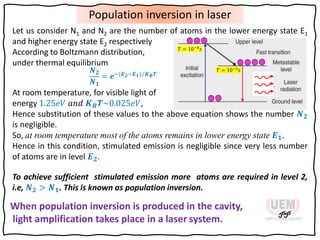
Population inversion inlaser
Let us consider N1 and N2 are the number of atoms in the lower energy state E1
and higher energy state E2 respectively
According to Boltzmann distribution,
under thermal equilibrium
At room temperature, for visible light of
energy 1.25𝑒𝑉 𝑎𝑛𝑑 𝑲𝑩𝑻~0.025𝑒𝑉,
Hence substitution of these values to the above equation shows the number 𝑵𝟐
is negligible.
So, at room temperature most of the atoms remains in lower energy state 𝑬𝟏.
Hence in this condition, stimulated emission is negligible since very less number
of atoms are in level 𝑬𝟐.
To achieve sufficient stimulated emission more atoms are required in level 2,
i.e, 𝑵𝟐 > 𝑵𝟏. This is known as population inversion.
When population inversion is produced in the cavity,
light amplification takes place in a laser system.
𝑵𝟐
𝑵𝟏
= 𝒆− Τ
(𝑬𝟐−𝑬𝟏) 𝑲𝑩𝑻
𝑇 = 10−3
𝑠
𝑇 = 10−8
𝑠
PP
15.
The threshold conditionfor sustaining laser action refers to the
minimum requirements that must be met for a laser to achieve
continuous stimulated emission. This condition is determined by the
balance between gain and losses in the laser cavity.
The density of atoms in the higher energy state (i.e., excited state),
when population inversion is achieved, is called population inversion
density. Different materials have different threshold values of
population inversion density as it is related to the intrinsic properties
of the material concerned.
Threshold condition for sustaining of laser action
PP
16.
Optical Resonator
Active MediumPumping Source
LASER beam
Active Medium
R1
R2
Pumping Source
R2 = 100 % Reflecting R1 = Partially transparent
Active medium is placed
between a pair of mirror .
Such a closed system is
called Optical Resonator
Basic components of laser system.
PP
17.
So, for aresonator 𝑳 = 𝒎. Τ
𝝀 𝟐 where, m = 1, 2, 3,….
In terms of frequency,
Where, 𝐜 is the velocity of light in free space;
𝜇 is the refractive index of the active medium
Thus, in resonant cavity mode, one can choose a distinct frequency of the emitted radiation.
The frequency separation between two consecutive modes is
Broad emission lines Narrow cavity modes
Optical Resonators
𝒗𝒎 =
ൗ
𝒄
𝝁
𝝀
=
𝒎. 𝒄
𝟐𝑳𝝁
𝜟𝝂 = 𝒗𝒎+𝟏 − 𝒗𝒎 =
𝒄
𝟐𝑳𝝁
PP
18.
The resonator doesnot have sharp line resonant mode.
In fact, it has a finite, though small, frequency spread or frequency band. The various
losses which are involved with the modes in cavity are linked to this frequency band.
The usual losses are principally due to absorption, scattering and diffraction.
A measure of these losses can be expressed in terms of a factor known as quality
factor Q or the Q-value of the cavity. Q is defined as
in the mode under consideration.
Another alternative expression for the quality factor Q is given by
In high-quality ∆𝑊 is the line width, so that a high-quality factor Q implies a low loss
and narrow width of a mode.
𝑄 = 2𝜋
Maximum energy stored per cycle in the concerned mode
Energy dissipated per cycle in the concerned mode
Q-value or Quality Factor
𝑄 =
𝑾
∆𝑾
PP
19.
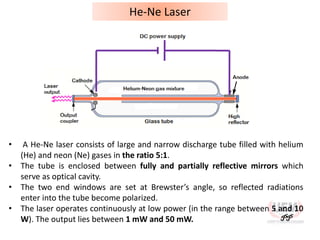
• A He-Nelaser consists of large and narrow discharge tube filled with helium
(He) and neon (Ne) gases in the ratio 5:1.
• The tube is enclosed between fully and partially reflective mirrors which
serve as optical cavity.
• The two end windows are set at Brewster’s angle, so reflected radiations
enter into the tube become polarized.
• The laser operates continuously at low power (in the range between 5 and 10
W). The output lies between 1 mW and 50 mW.
He-Ne Laser
PP
20.
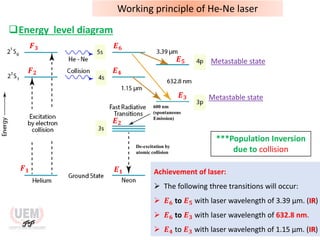
Working principle ofHe-Ne laser
𝑭𝟏
𝑭𝟐
𝑬𝟔
𝑭𝟑
𝑬𝟓
𝑬𝟒
𝑬𝟑
𝑬𝟐
𝑬𝟏
De-excitation by
atomic collision
600 nm
(spontaneous
Emission)
Achievement of laser:
➢ The following three transitions will occur:
➢ 𝑬𝟔 to 𝑬𝟓 with laser wavelength of 3.39 μm. (IR)
➢ 𝑬𝟔 to 𝑬𝟑 with laser wavelength of 632.8 nm.
➢ 𝑬𝟒 to 𝑬𝟑 with laser wavelength of 1.15 μm. (IR)
❑Energy level diagram
***Population Inversion
due to collision
Metastable state
Metastable state
PP
21.
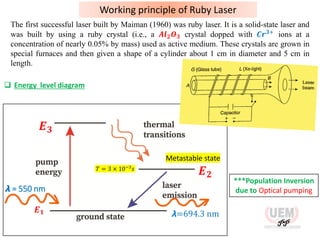
Working principle ofRuby Laser
The first successful laser built by Maiman (1960) was ruby laser. It is a solid-state laser and
was built by using a ruby crystal (i.e., a 𝑨𝒍𝟐𝑶𝟑 crystal dopped with 𝑪𝒓𝟑+ ions at a
concentration of nearly 0.05% by mass) used as active medium. These crystals are grown in
special furnaces and then given a shape of a cylinder about 1 cm in diameter and 5 cm in
length.
𝞴 = 550 nm
𝞴=694.3 nm
𝑇 = 3 × 10⁻³
𝑠
𝑬𝟑
𝑬𝟏
𝑬𝟐
Metastable state
❑ Energy level diagram
***Population Inversion
due to Optical pumping
PP
22.
• LASER isused in micro welding, cutting, and ablation of materials.
• LASER is highly potential in different medical applications such as
microsurgery of eye.
• LASER beam is used in cutting holes in diamonds and hard steel.
• LASER is used in defense applications.
• Tunable LASERS used in holography.
• LASER is highly potential of telecommunication applications.
• It is used to study Non-Linear optics.
• It has promising applications in the fields of Microscopy and imaging,
Astrophysics, Geology, Seismology, Space technology, Remote
sensing , Laser Cooling etc.
Applications of LASER
PP
23.
Find the differenceof energy between two energy levels of neon atom if the
transition between these levels gives a photon of wavelength 632.8 nm.
Also calculate the number of photons emitted per second to give a power output of
2mW.
Example 5.1:
PP
24.
A ruby laseremits a radiation of 694 nm wavelength. Calculate the
coherence length, band width and line width if the duration of the
pulses is 0.1 ns.
Example 5.5:
PP