Laser Cladding for Valve Manufacturing
LCV NV
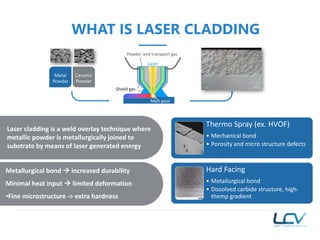
Thermo Spray (ex. HVOF)
• Mechanical bond
• Porosity and micro structure defects
Hard Facing
• Metallurgical bond
• Dissolved carbide structure, high-
themp gradient
WHAT IS LASER CLADDING
Metal
Powder
Ceramic
Powder
Powder and transport gas
Laser
Melt pool
Shield gas
Laser cladding is a weld overlay technique where
metallic powder is metallurgically joined to
substrate by means of laser generated energy
Metallurgical bond  increased durability
Minimal heat input  limited deformation
•Fine microstructure -> extra hardness
3
FEATURES
STELLITE HARDFACING with increased hardness (50HRC)
INCONEL WELDOVERLAYS with minimal dillution (0,1MM)
CARBIDE COATINGS with increased wear resistance (4X better compared to HVOF)
Value Proposition
BENEFITS
IMPROVED QUALITY - extra hardness & wear resistance, minimal heat input & dillution
COST REDUCTION – thin layer material saving, fast & automated application process
SCALABLE – consistent high quality for 1 to 100,000 parts
VALVE
APPLICATIONS
5
STELLITE HARDFACING
ADVANTAGES
• High Speed Setting -> cost efficient
• Thin layers -> cost saving
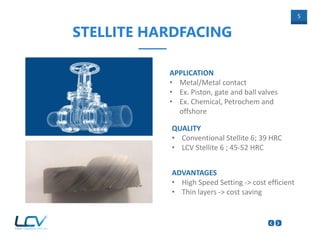
APPLICATION
• Metal/Metal contact
• Ex. Piston, gate and ball valves
• Ex. Chemical, Petrochem and
offshore
QUALITY
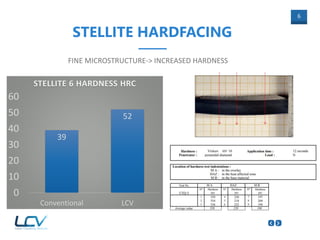
• Conventional Stellite 6; 39 HRC
• LCV Stellite 6 ; 45-52 HRC
6
STELLITE HARDFACING
FINE MICROSTRUCTURE-> INCREASED HARDNESS
39
52
0
10
20
30
40
50
60
Conventional LCV
STELLITE 6 HARDNESS HRC
7
STELLITE HARDFACING
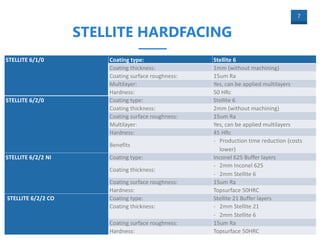
STELLITE 6/1/0 Coating type: Stellite 6
Coating thickness: 1mm (without machining)
Coating surface roughness: 15um Ra
Multilayer: Yes, can be applied multilayers
Hardness: 50 HRc
STELLITE 6/2/0 Coating type: Stellite 6
Coating thickness: 2mm (without machining)
Coating surface roughness: 15um Ra
Multilayer: Yes, can be applied multilayers
Hardness: 45 HRc
Benefits
- Production time reduction (costs
lower)
STELLITE 6/2/2 NI Coating type: Inconel 625 Buffer layers
Coating thickness:
- 2mm Inconel 625
- 2mm Stellite 6
Coating surface roughness: 15um Ra
Hardness: Topsurface 50HRC
STELLITE 6/2/2 CO Coating type: Stellite 21 Buffer layers
Coating thickness: - 2mm Stellite 21
- 2mm Stellite 6
Coating surface roughness: 15um Ra
Hardness: Topsurface 50HRC
8
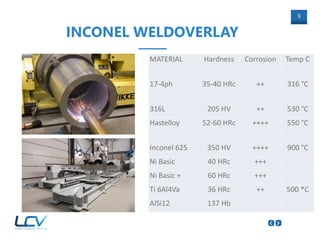
INCONEL WELDOVERLAY
ADVANTAGES
• High Speed Setting -> cost efficient
• Thin layers -> cost saving
QUALITY
• Minimal heat input -> reduced deformation
• Hardness
• Conventional Inconel 625; 40 HRC
• LCV Inconel + ; 50 HRC
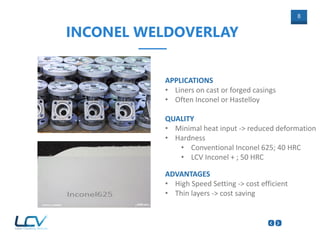
APPLICATIONS
• Liners on cast or forged casings
• Often Inconel or Hastelloy
9
INCONEL WELDOVERLAY
MATERIAL Hardness Corrosion Temp C
17-4ph 35-40 HRc ++ 316 °C
316L 205 HV ++ 530 °C
Hastelloy 52-60 HRc ++++ 550 °C
Inconel 625 350 HV ++++ 900 °C
Ni Basic 40 HRc +++
Ni Basic + 60 HRc +++
Ti 6Al4Va 36 HRc ++ 500 *C
AlSi12 137 Hb
10
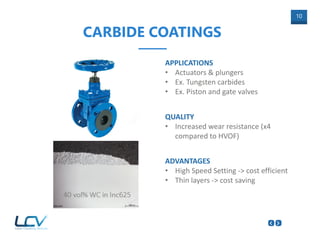
CARBIDE COATINGS
ADVANTAGES
• High Speed Setting -> cost efficient
• Thin layers -> cost saving
QUALITY
• Increased wear resistance (x4
compared to HVOF)
APPLICATIONS
• Actuators & plungers
• Ex. Tungsten carbides
• Ex. Piston and gate valves
11
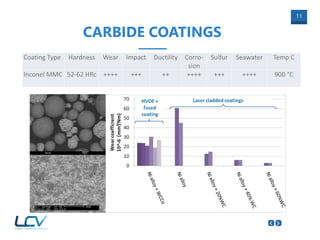
CARBIDE COATINGS
Coating Type Hardness Wear Impact Ductility Corro-
sion
Sulfur Seawater Temp C
Inconel MMC 52-62 HRc ++++ +++ ++ ++++ +++ ++++ 900 °C
12
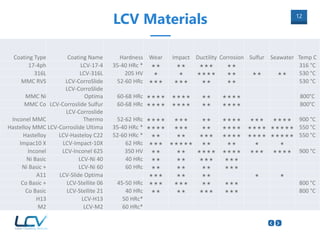
LCV Materials
Coating Type Coating Name Hardness Wear Impact Ductility Corrosion Sulfur Seawater Temp C
17-4ph LCV-17-4 35-40 HRc *     316 °C
316L LCV-316L 205 HV       530 °C
MMC RVS LCV-CorroSlide 52-60 HRc     530 °C
MMC Ni
LCV-CorroSlide
Optima 60-68 HRc     800°C
MMC Co LCV-Corroslide Sulfur 60-68 HRc     800°C
Inconel MMC
LCV-Corroslide
Thermo 52-62 HRc       900 °C
Hastelloy MMC LCV-Corroslide Ultima 35-40 HRc *       550 °C
Hastelloy LCV-Hasteloy C22 52-60 HRc *       550 °C
Impac10 X LCV-Impact-10X 62 HRc      
Inconel LCV-Inconel 625 350 HV       900 °C
Ni Basic LCV-Ni 40 40 HRc    
Ni Basic + LCV-Ni 60 60 HRc    
A11 LCV-Slide Optima     
Co Basic + LCV-Stellite 06 45-50 HRc     800 °C
Co Basic LCV-Stellite 21 40 HRc     800 °C
H13 LCV-H13 50 HRc*
M2 LCV-M2 60 HRc*
13
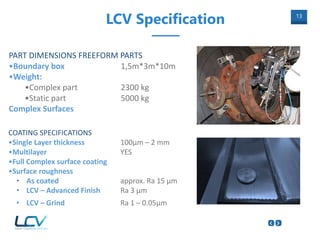
LCV Specification
PART DIMENSIONS FREEFORM PARTS
•Boundary box 1,5m*3m*10m
•Weight:
•Complex part 2300 kg
•Static part 5000 kg
Complex Surfaces
COATING SPECIFICATIONS
•Single Layer thickness 100µm – 2 mm
•Multilayer YES
•Full Complex surface coating
•Surface roughness
• As coated approx. Ra 15 µm
• LCV – Advanced Finish Ra 3 µm
• LCV – Grind Ra 1 – 0.05µm
14
Why Laser Cladding Venture
Leading capacity  from 1 to 10,000 parts
Productivity leader  consistent competitive pricing
Unique freeform capability  complex shapes, internal and external cladding
Full project management  easy to do business with
Focus on quality reliability throughout
15
CONTACT
SALES
JAN LAMBRECT
CEO
Jan.Lambrecht@lcv.be
+32 89 65 10 22
QUALITY
TOM DE BRUYNE
COO
Tom.De.Bruyne@lcv.be
+32 89 65 10 22
ENGINEERING
STIJN CLIJSTERS
CTO
Stijn.Clijsters@lcv.be
+32 89 65 10 22
PRODUCTION
EVERT JANS
PM
Evert.Jans@lcv.be
+32 89 65 10 22
Thank You
Address
Laser Cladding Venture nv
Nijverheidslaan 1500
3660 Opglabbeek
Belgium
Phone & E-mail
Tel.: 32 89 65 10 22
E-mail: info@lcv.be
Website: http://www.lcv.be/

Laser cladding applications for valve manufacturing

  • 1.
    Laser Cladding forValve Manufacturing LCV NV
  • 2.
    Thermo Spray (ex.HVOF) • Mechanical bond • Porosity and micro structure defects Hard Facing • Metallurgical bond • Dissolved carbide structure, high- themp gradient WHAT IS LASER CLADDING Metal Powder Ceramic Powder Powder and transport gas Laser Melt pool Shield gas Laser cladding is a weld overlay technique where metallic powder is metallurgically joined to substrate by means of laser generated energy Metallurgical bond  increased durability Minimal heat input  limited deformation •Fine microstructure -> extra hardness
  • 3.
    3 FEATURES STELLITE HARDFACING withincreased hardness (50HRC) INCONEL WELDOVERLAYS with minimal dillution (0,1MM) CARBIDE COATINGS with increased wear resistance (4X better compared to HVOF) Value Proposition BENEFITS IMPROVED QUALITY - extra hardness & wear resistance, minimal heat input & dillution COST REDUCTION – thin layer material saving, fast & automated application process SCALABLE – consistent high quality for 1 to 100,000 parts
  • 4.
  • 5.
    5 STELLITE HARDFACING ADVANTAGES • HighSpeed Setting -> cost efficient • Thin layers -> cost saving APPLICATION • Metal/Metal contact • Ex. Piston, gate and ball valves • Ex. Chemical, Petrochem and offshore QUALITY • Conventional Stellite 6; 39 HRC • LCV Stellite 6 ; 45-52 HRC
  • 6.
    6 STELLITE HARDFACING FINE MICROSTRUCTURE->INCREASED HARDNESS 39 52 0 10 20 30 40 50 60 Conventional LCV STELLITE 6 HARDNESS HRC
  • 7.
    7 STELLITE HARDFACING STELLITE 6/1/0Coating type: Stellite 6 Coating thickness: 1mm (without machining) Coating surface roughness: 15um Ra Multilayer: Yes, can be applied multilayers Hardness: 50 HRc STELLITE 6/2/0 Coating type: Stellite 6 Coating thickness: 2mm (without machining) Coating surface roughness: 15um Ra Multilayer: Yes, can be applied multilayers Hardness: 45 HRc Benefits - Production time reduction (costs lower) STELLITE 6/2/2 NI Coating type: Inconel 625 Buffer layers Coating thickness: - 2mm Inconel 625 - 2mm Stellite 6 Coating surface roughness: 15um Ra Hardness: Topsurface 50HRC STELLITE 6/2/2 CO Coating type: Stellite 21 Buffer layers Coating thickness: - 2mm Stellite 21 - 2mm Stellite 6 Coating surface roughness: 15um Ra Hardness: Topsurface 50HRC
  • 8.
    8 INCONEL WELDOVERLAY ADVANTAGES • HighSpeed Setting -> cost efficient • Thin layers -> cost saving QUALITY • Minimal heat input -> reduced deformation • Hardness • Conventional Inconel 625; 40 HRC • LCV Inconel + ; 50 HRC APPLICATIONS • Liners on cast or forged casings • Often Inconel or Hastelloy
  • 9.
    9 INCONEL WELDOVERLAY MATERIAL HardnessCorrosion Temp C 17-4ph 35-40 HRc ++ 316 °C 316L 205 HV ++ 530 °C Hastelloy 52-60 HRc ++++ 550 °C Inconel 625 350 HV ++++ 900 °C Ni Basic 40 HRc +++ Ni Basic + 60 HRc +++ Ti 6Al4Va 36 HRc ++ 500 *C AlSi12 137 Hb
  • 10.
    10 CARBIDE COATINGS ADVANTAGES • HighSpeed Setting -> cost efficient • Thin layers -> cost saving QUALITY • Increased wear resistance (x4 compared to HVOF) APPLICATIONS • Actuators & plungers • Ex. Tungsten carbides • Ex. Piston and gate valves
  • 11.
    11 CARBIDE COATINGS Coating TypeHardness Wear Impact Ductility Corro- sion Sulfur Seawater Temp C Inconel MMC 52-62 HRc ++++ +++ ++ ++++ +++ ++++ 900 °C
  • 12.
    12 LCV Materials Coating TypeCoating Name Hardness Wear Impact Ductility Corrosion Sulfur Seawater Temp C 17-4ph LCV-17-4 35-40 HRc *     316 °C 316L LCV-316L 205 HV       530 °C MMC RVS LCV-CorroSlide 52-60 HRc     530 °C MMC Ni LCV-CorroSlide Optima 60-68 HRc     800°C MMC Co LCV-Corroslide Sulfur 60-68 HRc     800°C Inconel MMC LCV-Corroslide Thermo 52-62 HRc       900 °C Hastelloy MMC LCV-Corroslide Ultima 35-40 HRc *       550 °C Hastelloy LCV-Hasteloy C22 52-60 HRc *       550 °C Impac10 X LCV-Impact-10X 62 HRc       Inconel LCV-Inconel 625 350 HV       900 °C Ni Basic LCV-Ni 40 40 HRc     Ni Basic + LCV-Ni 60 60 HRc     A11 LCV-Slide Optima      Co Basic + LCV-Stellite 06 45-50 HRc     800 °C Co Basic LCV-Stellite 21 40 HRc     800 °C H13 LCV-H13 50 HRc* M2 LCV-M2 60 HRc*
  • 13.
    13 LCV Specification PART DIMENSIONSFREEFORM PARTS •Boundary box 1,5m*3m*10m •Weight: •Complex part 2300 kg •Static part 5000 kg Complex Surfaces COATING SPECIFICATIONS •Single Layer thickness 100µm – 2 mm •Multilayer YES •Full Complex surface coating •Surface roughness • As coated approx. Ra 15 µm • LCV – Advanced Finish Ra 3 µm • LCV – Grind Ra 1 – 0.05µm
  • 14.
    14 Why Laser CladdingVenture Leading capacity  from 1 to 10,000 parts Productivity leader  consistent competitive pricing Unique freeform capability  complex shapes, internal and external cladding Full project management  easy to do business with Focus on quality reliability throughout
  • 15.
    15 CONTACT SALES JAN LAMBRECT CEO Jan.Lambrecht@lcv.be +32 8965 10 22 QUALITY TOM DE BRUYNE COO Tom.De.Bruyne@lcv.be +32 89 65 10 22 ENGINEERING STIJN CLIJSTERS CTO Stijn.Clijsters@lcv.be +32 89 65 10 22 PRODUCTION EVERT JANS PM Evert.Jans@lcv.be +32 89 65 10 22
  • 16.
    Thank You Address Laser CladdingVenture nv Nijverheidslaan 1500 3660 Opglabbeek Belgium Phone & E-mail Tel.: 32 89 65 10 22 E-mail: info@lcv.be Website: http://www.lcv.be/