larynx
Dr Somnath Saha
EMBRYOLOGY
 The supraglottic larynx
is derived from the
buccopharyngeal
primordium, which
develops from the third
and fourth branchial
arches.
EMBRYOLOGY
 The glottis and
subglottis are derived
from the
tracheobronchial
primordium from the
sixth branchial arch and
are formed by the union
of lateral furrows that
develop on each side of
the tracheobronchial
primordium. Therefore
the larynx has a dual
blood supply and
lymphatic drainage.
SUBSITES Site Subsite
Supraglottis
Suprahyoid epiglottis
Infrahyoid epiglottis
Aryepiglottic folds, right and left (laryngeal surfaces)
Arytenoids, right and left
Ventricular bands, right and left
Glottis
True vocal
cords, right and
left (including
the anterior
and posterior
commissures)
Subglottis
No separate
subsites
defined
 The supraglottis is composed of
the suprahyoid and infrahyoid
epiglottis (both the lingual and
the laryngeal surfaces),
aryepiglottic folds (laryngeal
surfaces only), arytenoids, and
ventricular bands (false vocal
cords).
 The boundary between the
suprahyoid and infrahyoid
epiglottis is a horizontal plane
passing through the hyoid
bone.
 The inferior limit of the
supraglottis is a horizontal
plane through the lateral margin
of the ventricle at its junction
with the superior surface of the
true vocal cord.
 The glottis is composed of
the true vocal cords (both
the superior and inferior
surfaces) and includes the
anterior and posterior
commissures. The inferior
boundary of the glottis is a
horizontal plane 1 cm
inferior to the inferior limit of
the supraglottis (defined as
the lateral margin of the
ventricle at its junction with
the superior surface of the
vocal cord). The subglottis
extends from the inferior
limit of the glottis to the
inferior edge of the cricoid
cartilage
LARYNGEAL MEMBRANES
 Cricovocal membrane:
triangular fibroelastic
memb—Upper border is
free—Stretches between
middle of thyroid angle
to the VP --forms –
VOCAL LIG. Lower
border attached to arch
of cricoid cartilage—Ant
end moves upward &
medially to meet its
fellow from opposite side
CONUS ELASTICUS –
resist extra laryn spread
of glottic &subglottic ca
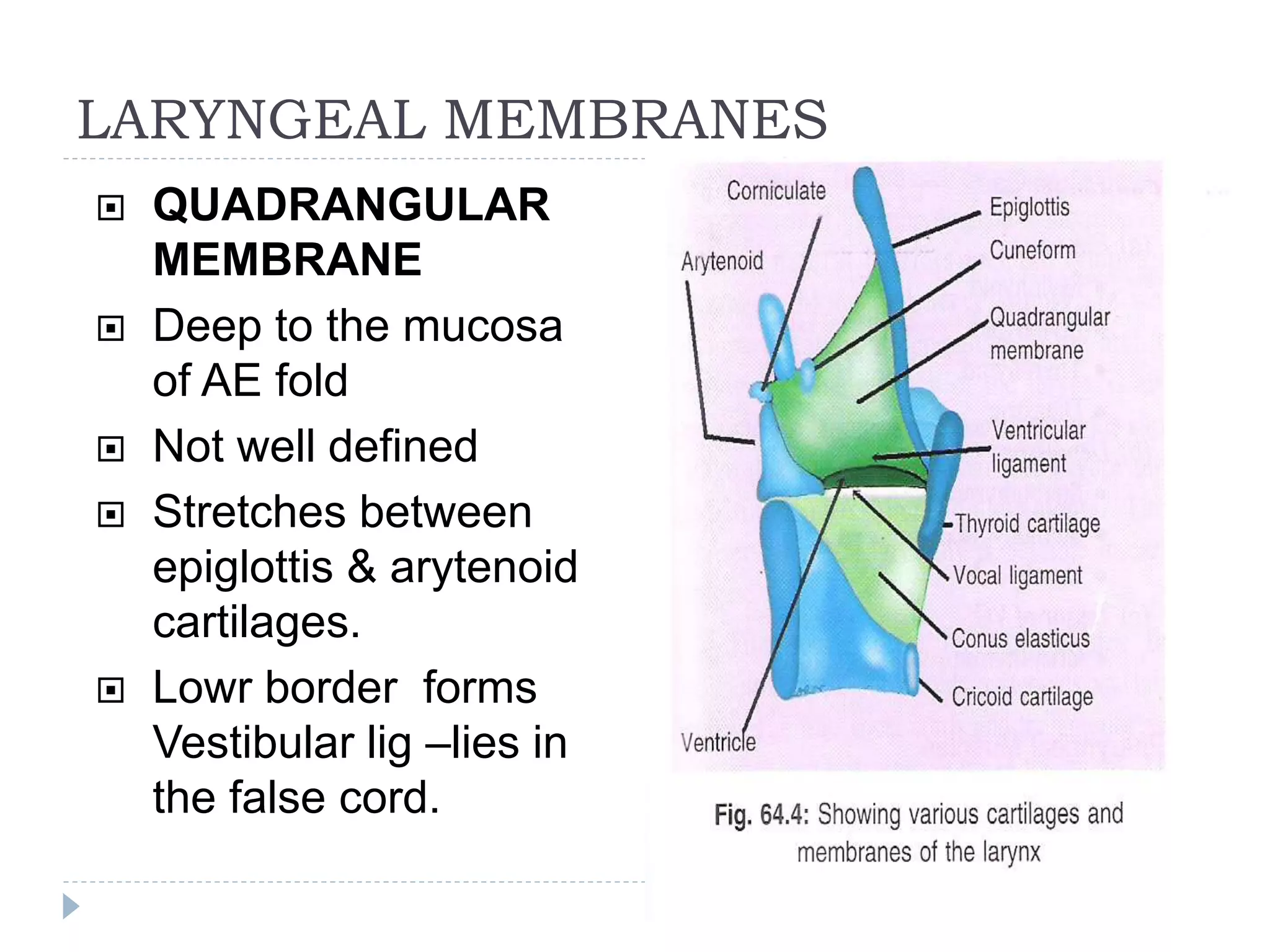
LARYNGEAL MEMBRANES
 QUADRANGULAR
MEMBRANE
 Deep to the mucosa
of AE fold
 Not well defined
 Stretches between
epiglottis & arytenoid
cartilages.
 Lowr border forms
Vestibular lig –lies in
the false cord.
CAVITY OF THE LARYNX
 Ventricle/Sinus of
larynx
 Deep illiptical space
betw Vestibular & vocal
folds.
 Extend a short distance
above & lateral to
vestibular folds
 Saccule –a mucous
diverticulum from ant
part of ventricular cavity
extend upwords betw
VF & Thyroid lamina---
Laryngocele
 Absence of QM &CVM.
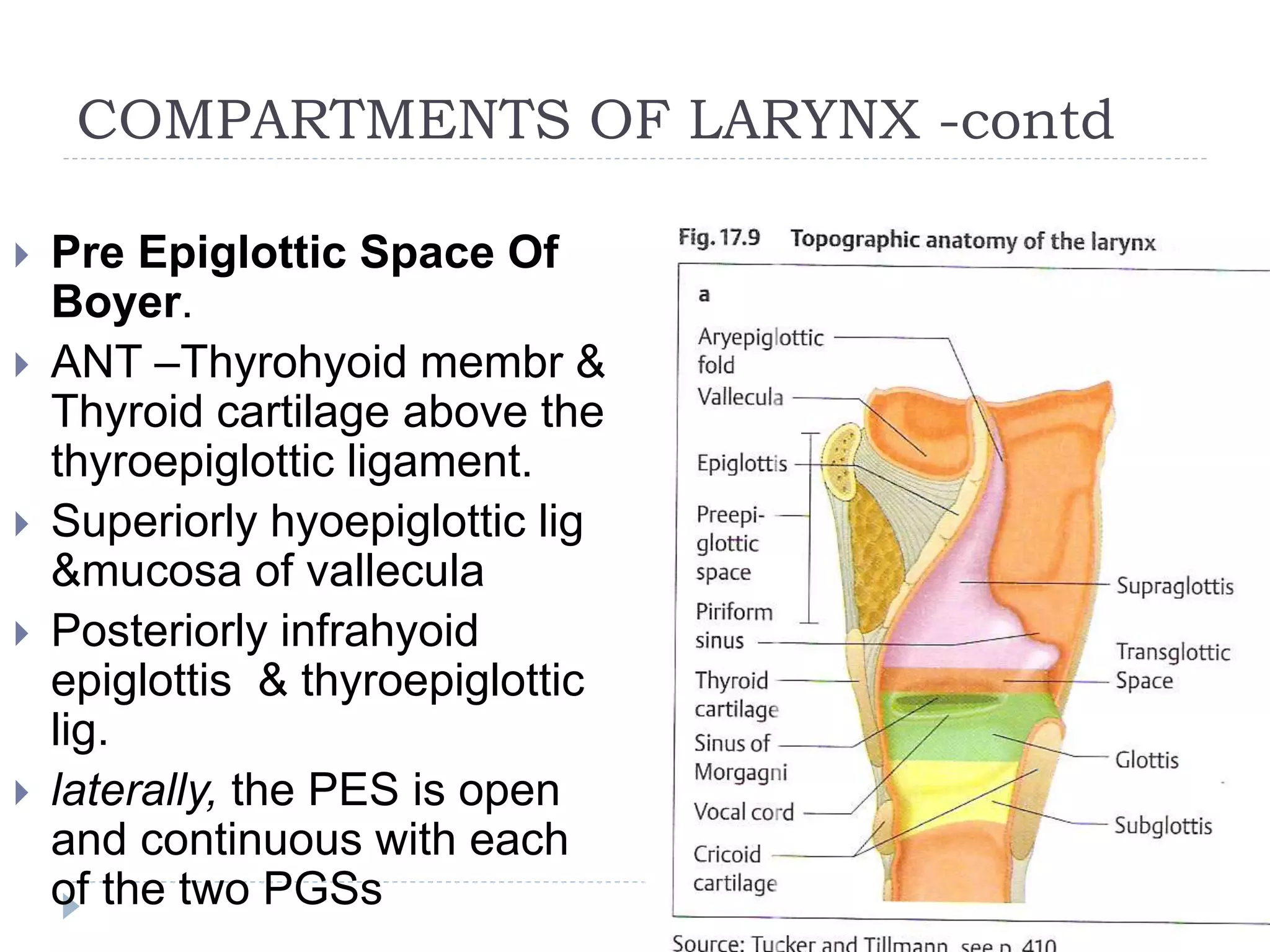
COMPARTMENTS OF LARYNX -contd
 Pre Epiglottic Space Of
Boyer.
 ANT –Thyrohyoid membr &
Thyroid cartilage above the
thyroepiglottic ligament.
 Superiorly hyoepiglottic lig
&mucosa of vallecula
 Posteriorly infrahyoid
epiglottis & thyroepiglottic
lig.
 laterally, the PES is open
and continuous with each
of the two PGSs
The PES contains fat and areolar
tissue[7] and is frequently invaded
by tumors because the cartilage of
the epiglottis has multiple small
fenestrations through which
cancers arising from the infrahyoid
epiglottis may pass. Superiorly, the
hyoepiglottic ligament provides a
barrier to spread of tumor to the
tongue base (Fig. 107-3). The
lymphatics of the PES drain
through the thyrohyoid membrane,
spreading to lymph nodes on both
sides of the neck, primarily in
zones II and III (Fig. 107-4).[5]
Supraglottic tumors with PES
involvement are staged as T3
Transglottic tumour
 a tumor that crosses the ventricle in a vertical
direction
 Tumors can become transglottic in four ways: by
crossing the ventricle directly; by crossing at the
anterior commissure; by spreading through the
paraglottic space; and by spreading along the
arytenoid cartilage posterior to the ventricle

Larynx

  • 1.
  • 2.
    EMBRYOLOGY  The supraglotticlarynx is derived from the buccopharyngeal primordium, which develops from the third and fourth branchial arches.
  • 3.
    EMBRYOLOGY  The glottisand subglottis are derived from the tracheobronchial primordium from the sixth branchial arch and are formed by the union of lateral furrows that develop on each side of the tracheobronchial primordium. Therefore the larynx has a dual blood supply and lymphatic drainage.
  • 4.
    SUBSITES Site Subsite Supraglottis Suprahyoidepiglottis Infrahyoid epiglottis Aryepiglottic folds, right and left (laryngeal surfaces) Arytenoids, right and left Ventricular bands, right and left Glottis True vocal cords, right and left (including the anterior and posterior commissures) Subglottis No separate subsites defined
  • 5.
     The supraglottisis composed of the suprahyoid and infrahyoid epiglottis (both the lingual and the laryngeal surfaces), aryepiglottic folds (laryngeal surfaces only), arytenoids, and ventricular bands (false vocal cords).  The boundary between the suprahyoid and infrahyoid epiglottis is a horizontal plane passing through the hyoid bone.  The inferior limit of the supraglottis is a horizontal plane through the lateral margin of the ventricle at its junction with the superior surface of the true vocal cord.
  • 6.
     The glottisis composed of the true vocal cords (both the superior and inferior surfaces) and includes the anterior and posterior commissures. The inferior boundary of the glottis is a horizontal plane 1 cm inferior to the inferior limit of the supraglottis (defined as the lateral margin of the ventricle at its junction with the superior surface of the vocal cord). The subglottis extends from the inferior limit of the glottis to the inferior edge of the cricoid cartilage
  • 7.
    LARYNGEAL MEMBRANES  Cricovocalmembrane: triangular fibroelastic memb—Upper border is free—Stretches between middle of thyroid angle to the VP --forms – VOCAL LIG. Lower border attached to arch of cricoid cartilage—Ant end moves upward & medially to meet its fellow from opposite side CONUS ELASTICUS – resist extra laryn spread of glottic &subglottic ca
  • 8.
    LARYNGEAL MEMBRANES  QUADRANGULAR MEMBRANE Deep to the mucosa of AE fold  Not well defined  Stretches between epiglottis & arytenoid cartilages.  Lowr border forms Vestibular lig –lies in the false cord.
  • 9.
    CAVITY OF THELARYNX  Ventricle/Sinus of larynx  Deep illiptical space betw Vestibular & vocal folds.  Extend a short distance above & lateral to vestibular folds  Saccule –a mucous diverticulum from ant part of ventricular cavity extend upwords betw VF & Thyroid lamina--- Laryngocele  Absence of QM &CVM.
  • 10.
    COMPARTMENTS OF LARYNX-contd  Pre Epiglottic Space Of Boyer.  ANT –Thyrohyoid membr & Thyroid cartilage above the thyroepiglottic ligament.  Superiorly hyoepiglottic lig &mucosa of vallecula  Posteriorly infrahyoid epiglottis & thyroepiglottic lig.  laterally, the PES is open and continuous with each of the two PGSs
  • 11.
    The PES containsfat and areolar tissue[7] and is frequently invaded by tumors because the cartilage of the epiglottis has multiple small fenestrations through which cancers arising from the infrahyoid epiglottis may pass. Superiorly, the hyoepiglottic ligament provides a barrier to spread of tumor to the tongue base (Fig. 107-3). The lymphatics of the PES drain through the thyrohyoid membrane, spreading to lymph nodes on both sides of the neck, primarily in zones II and III (Fig. 107-4).[5] Supraglottic tumors with PES involvement are staged as T3
  • 15.
    Transglottic tumour  atumor that crosses the ventricle in a vertical direction  Tumors can become transglottic in four ways: by crossing the ventricle directly; by crossing at the anterior commissure; by spreading through the paraglottic space; and by spreading along the arytenoid cartilage posterior to the ventricle