Language
Learning
Strategies
Moving on
from KS3
vocabulary
REVISION TECHNIQUES
Scientists did a meta analysis (an analysis of the research
of many scientists) on revision. They found that some
techniques were low impact (they resulted in little recall),
some had a moderate impact and some were high
impact.
Low impact – highlighting.
But what if it is made more meaningful?
Specific marking to reduce the ‘sea of
red’ effect
Students become more aware of what
their errors are
Homework is then redrafted into
OneNote so all students and teachers
have a synced copy
Language Assistant can work directly in
students notes in one-to-one speaking
sessions with them
AVOCADO
Adjectives
Variety
Opinions
Connectives
Adverbs
Description
Originality
6Ws
Who?
What?
Where?
When?
Why?
How?
OJ
Things to include
 Detailed information (6Ws)
 OJ (Opinions with Justifications)
 PEE paragraphs (Point, Evidence,
Explanation)
 Comparatives & Superlatives
 Complex Connectives (see displays)
 Variety of tenses
 Variety of pronouns
 Qualifiers adding detail to your
adjectives
 Synonyms ≠ Antonyms
 Quality not Quantity
 Adapt class examples, do not copy!
 Make sure there is no repetition
 Is it your BEST work?
Past Present Future
X
Imperfect
(repeated
action)
Preterite
(completed
action)
Conditional
Present situation
and description
Description of
what would or
could happen
Description of
what will happen
Now
Ingredients for an excellent piece of work
Check carefully for
 Spelling - including accents
á é í ó ú ñ ü
 Gender of nouns and adjectives that
agree and whether it should be
singular or plural
 Word order – nouns before adjectives
 Punctuation
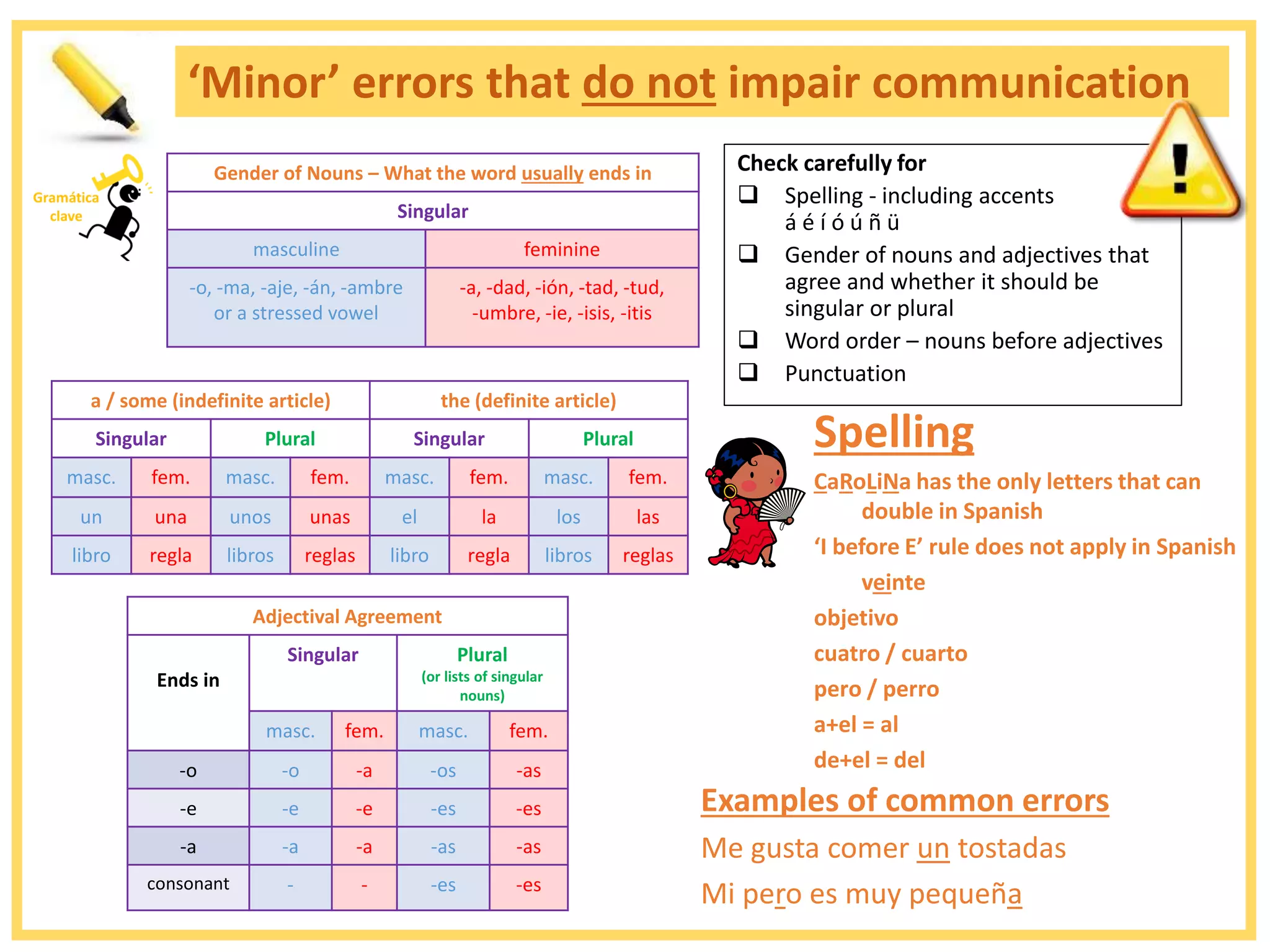
‘Minor’ errors that do not impair communication
Gender of Nouns – What the word usually ends in
Singular
masculine feminine
-o, -ma, -aje, -án, -ambre
or a stressed vowel
-a, -dad, -ión, -tad, -tud,
-umbre, -ie, -isis, -itis
Spelling
CaRoLiNa has the only letters that can
double in Spanish
‘I before E’ rule does not apply in Spanish
veinte
objetivo
cuatro / cuarto
pero / perro
a+el = al
de+el = del
Examples of common errors
Me gusta comer un tostadas
Mi pero es muy pequeña
a / some (indefinite article) the (definite article)
Singular Plural Singular Plural
masc. fem. masc. fem. masc. fem. masc. fem.
un una unos unas el la los las
libro regla libros reglas libro regla libros reglas
Adjectival Agreement
Ends in
Singular Plural
(or lists of singular
nouns)
masc. fem. masc. fem.
-o -o -a -os -as
-e -e -e -es -es
-a -a -a -as -as
consonant - - -es -es
Check carefully for
 Verb endings on
regular verbs
 Irregular verbs – use the verb
wheels and verb displays or the
middle section in the dictionary
 Incorrect personal pronoun
 Incorrect tense – past, present,
future, conditional
 Is it the second verb in the
sentence - should you be using
an infinitive?
 Verbs in the infinitive or
conjugated for the correct person
and tense
 Singular or plural incorrectly used
 Confusion of time sequencer and
verb tense
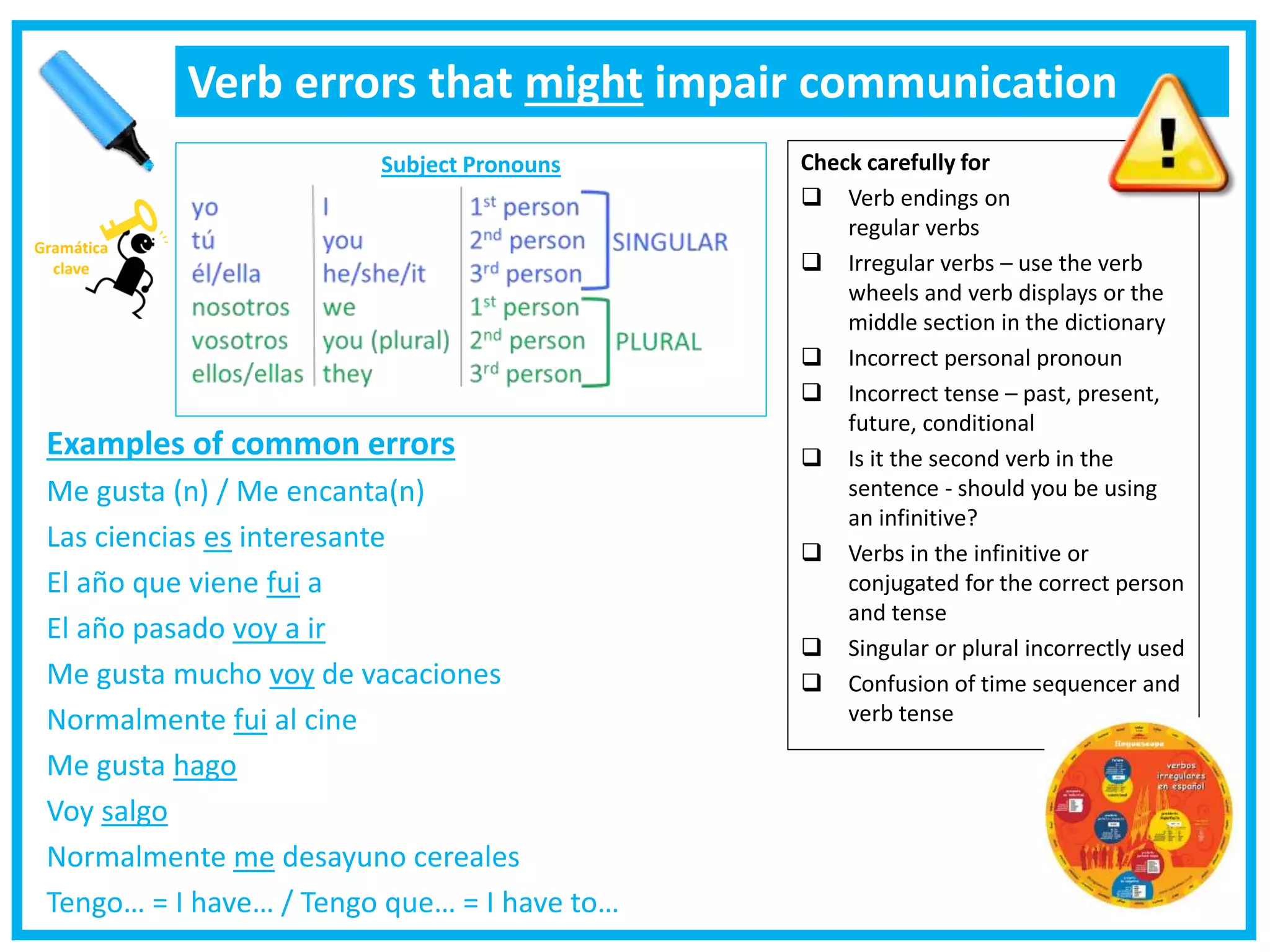
Verb errors that might impair communication
Examples of common errors
Me gusta (n) / Me encanta(n)
Las ciencias es interesante
El año que viene fui a
El año pasado voy a ir
Me gusta mucho voy de vacaciones
Normalmente fui al cine
Me gusta hago
Voy salgo
Normalmente me desayuno cereales
Tengo… = I have… / Tengo que… = I have to…
Subject Pronouns
Check carefully for
 Incomplete sentences -
missing words
especially verbs
 False friends
 A guess from an
English word
 Words you often forget
or make mistakes with
 Some accents can
change the meaning of
a word completely
 Does each sentence
make sense? Have you
contradicted yourself
or lost the meaning?
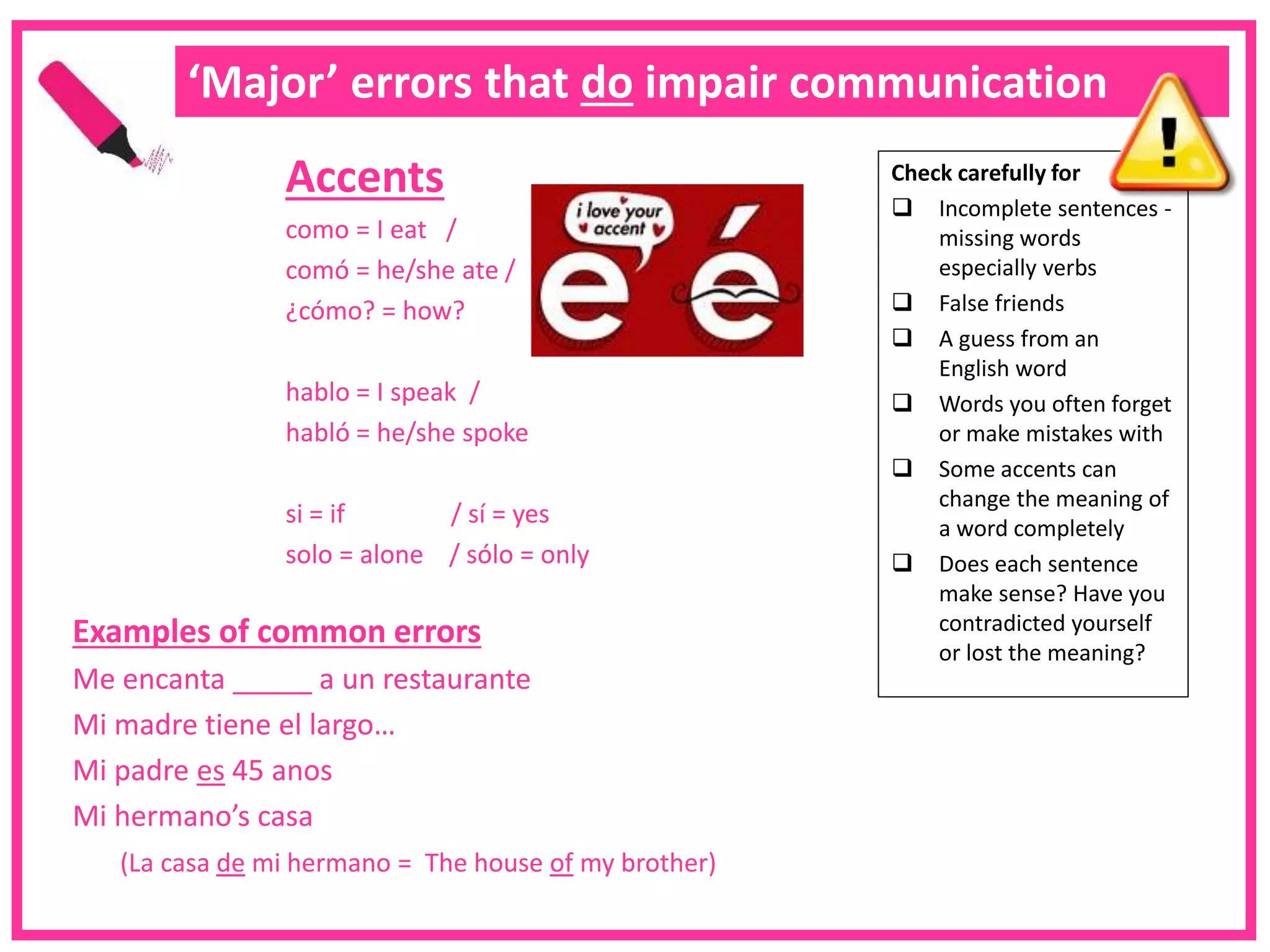
‘Major’ errors that do impair communication
Examples of common errors
Me encanta _____ a un restaurante
Mi madre tiene el largo…
Mi padre es 45 anos
Mi hermano’s casa
(La casa de mi hermano = The house of my brother)
Accents
como = I eat /
comó = he/she ate /
¿cómo? = how?
hablo = I speak /
habló = he/she spoke
si = if / sí = yes
solo = alone / sólo = only
SpanishCorrectionMat
High impact strategies
• Practice testing - Self-testing to check knowledge -
especially using flash cards
• Distributed practice - spreading out study over
time
Self testing: The Leitner Box
Making the cards themselves is low impact so it can help to download a set of
cards or buy them. Leitner suggests you split the cards into 4 piles depending
on how confident you are, but 3 might be simpler:
Red – I don’t remember any of this
Amber – I know some of this
Green – I know this really well.
Self testing: The Leitner Box
Leitner theorised that students tend to spend more time going over what they
already know – it makes them feel good. Instead, prioritise the cards as follows:
For every hour of revision:
Red – Spend 30 minutes revising these cards
Amber – Spend 20 minutes revising these cards
Green – Spend 10 minutes revising these cards.
As you get more confident, red cards move to amber and amber cards move to
green.
Why not try this technique for your next test and see if your grade improves?
Example flashcard
Simple heading linked
directly to exam specification
The text can be covered over when
self testing. It is separated into bullet
points to make it clearer.
Flashcards
Sticky Notes
IR
(Preterito)
fui
fuiste
fue
fuimos
fuisteis
fueron
TO GO
(Preterite)
I went
you went
he/she went
we went
you went
they went
IR
(Presente)
voy
vas
va
vamos
vais
van
TO GO
(Present)
I go
you go
he/she goes
we go
you go
they go
SER
(Preterito)
fui
fuiste
fue
fuimos
fuisteis
fueron
TO BE
(Preterite)
I was
you were
he/she was
we were
you were
they were
SER
(Presente)
soy
eres
es
somos
sois
son
TO BE
(Present)
I am
you are
he/she is
we are
you are
they are
SER
(Futuro inmediato)
voy
vas
va
vamos
vais
van
TO GO
(Near future)
I am going
you are going
he/she is going
we are going
you are going
they are going
IR
(Futuro inmediato)
voy
vas
va
vamos
vais
van
TO GO
(Near future)
I am going
you are going
he/she is going
we are going
you are going
they are going
to
go
a
ir
a
ser
to
be
IR y SER ¡Ojo! Usted uses the 3rd person singular
Ustedes uses the 3rd person plural
SER
(Presente)
soy
eres
es
somos
sois
son
TO BE
(Present)
I am
you are
he/she is
we are
you are
they are
IR
(Futuro inmediato)
voy
vas
va
vamos
vais
van
TO GO
(Near future)
I am going
you are going
he/she is going
we are going
you are going
they are going
SER
(Preterito)
fui
fuiste
fue
fuimos
fuisteis
fueron
TO BE
(Preterite)
I was
you were
he/she was
we were
you were
they were
IR
(Presente)
voy
vas
va
vamos
vais
van
TO GO
(Present)
I go
you go
he/she goes
we go
you go
they go
to
go
a
ir
Repaso de los Verbos
__________
(_________)
__________
__________
__________
__________
__________
__________
__________
(_________)
__________
__________
__________
__________
__________
__________
__________
(_________)
__________
__________
__________
__________
__________
__________
__________
(_________)
__________
__________
__________
__________
__________
__________
__________
(_________)
__________
__________
__________
__________
__________
__________
__________
(_________)
__________
__________
__________
__________
__________
__________
__________
(_________)
__________
__________
__________
__________
__________
__________
__________
(_________)
__________
__________
__________
__________
__________
__________
__________
(_________)
__________
__________
__________
__________
__________
__________
__________
(_________)
__________
__________
__________
__________
__________
__________
__________
(_________)
__________
__________
__________
__________
__________
__________
__________
(_________)
__________
__________
__________
__________
__________
__________
¡Ojo! Usted uses the 3rd person singular
Ustedes uses the 3rd person plural
Escuchar F / H
Hablar
Leer
Escribir

Language learning strategies

  • 1.
  • 2.
  • 3.
    REVISION TECHNIQUES Scientists dida meta analysis (an analysis of the research of many scientists) on revision. They found that some techniques were low impact (they resulted in little recall), some had a moderate impact and some were high impact. Low impact – highlighting. But what if it is made more meaningful?
  • 4.
    Specific marking toreduce the ‘sea of red’ effect Students become more aware of what their errors are Homework is then redrafted into OneNote so all students and teachers have a synced copy Language Assistant can work directly in students notes in one-to-one speaking sessions with them
  • 6.
    AVOCADO Adjectives Variety Opinions Connectives Adverbs Description Originality 6Ws Who? What? Where? When? Why? How? OJ Things to include Detailed information (6Ws)  OJ (Opinions with Justifications)  PEE paragraphs (Point, Evidence, Explanation)  Comparatives & Superlatives  Complex Connectives (see displays)  Variety of tenses  Variety of pronouns  Qualifiers adding detail to your adjectives  Synonyms ≠ Antonyms  Quality not Quantity  Adapt class examples, do not copy!  Make sure there is no repetition  Is it your BEST work? Past Present Future X Imperfect (repeated action) Preterite (completed action) Conditional Present situation and description Description of what would or could happen Description of what will happen Now Ingredients for an excellent piece of work
  • 7.
    Check carefully for Spelling - including accents á é í ó ú ñ ü  Gender of nouns and adjectives that agree and whether it should be singular or plural  Word order – nouns before adjectives  Punctuation ‘Minor’ errors that do not impair communication Gender of Nouns – What the word usually ends in Singular masculine feminine -o, -ma, -aje, -án, -ambre or a stressed vowel -a, -dad, -ión, -tad, -tud, -umbre, -ie, -isis, -itis Spelling CaRoLiNa has the only letters that can double in Spanish ‘I before E’ rule does not apply in Spanish veinte objetivo cuatro / cuarto pero / perro a+el = al de+el = del Examples of common errors Me gusta comer un tostadas Mi pero es muy pequeña a / some (indefinite article) the (definite article) Singular Plural Singular Plural masc. fem. masc. fem. masc. fem. masc. fem. un una unos unas el la los las libro regla libros reglas libro regla libros reglas Adjectival Agreement Ends in Singular Plural (or lists of singular nouns) masc. fem. masc. fem. -o -o -a -os -as -e -e -e -es -es -a -a -a -as -as consonant - - -es -es
  • 8.
    Check carefully for Verb endings on regular verbs  Irregular verbs – use the verb wheels and verb displays or the middle section in the dictionary  Incorrect personal pronoun  Incorrect tense – past, present, future, conditional  Is it the second verb in the sentence - should you be using an infinitive?  Verbs in the infinitive or conjugated for the correct person and tense  Singular or plural incorrectly used  Confusion of time sequencer and verb tense Verb errors that might impair communication Examples of common errors Me gusta (n) / Me encanta(n) Las ciencias es interesante El año que viene fui a El año pasado voy a ir Me gusta mucho voy de vacaciones Normalmente fui al cine Me gusta hago Voy salgo Normalmente me desayuno cereales Tengo… = I have… / Tengo que… = I have to… Subject Pronouns
  • 9.
    Check carefully for Incomplete sentences - missing words especially verbs  False friends  A guess from an English word  Words you often forget or make mistakes with  Some accents can change the meaning of a word completely  Does each sentence make sense? Have you contradicted yourself or lost the meaning? ‘Major’ errors that do impair communication Examples of common errors Me encanta _____ a un restaurante Mi madre tiene el largo… Mi padre es 45 anos Mi hermano’s casa (La casa de mi hermano = The house of my brother) Accents como = I eat / comó = he/she ate / ¿cómo? = how? hablo = I speak / habló = he/she spoke si = if / sí = yes solo = alone / sólo = only
  • 10.
  • 11.
    High impact strategies •Practice testing - Self-testing to check knowledge - especially using flash cards • Distributed practice - spreading out study over time
  • 12.
    Self testing: TheLeitner Box Making the cards themselves is low impact so it can help to download a set of cards or buy them. Leitner suggests you split the cards into 4 piles depending on how confident you are, but 3 might be simpler: Red – I don’t remember any of this Amber – I know some of this Green – I know this really well.
  • 13.
    Self testing: TheLeitner Box Leitner theorised that students tend to spend more time going over what they already know – it makes them feel good. Instead, prioritise the cards as follows: For every hour of revision: Red – Spend 30 minutes revising these cards Amber – Spend 20 minutes revising these cards Green – Spend 10 minutes revising these cards. As you get more confident, red cards move to amber and amber cards move to green. Why not try this technique for your next test and see if your grade improves?
  • 14.
    Example flashcard Simple headinglinked directly to exam specification The text can be covered over when self testing. It is separated into bullet points to make it clearer.
  • 15.
  • 16.
  • 17.
    IR (Preterito) fui fuiste fue fuimos fuisteis fueron TO GO (Preterite) I went youwent he/she went we went you went they went IR (Presente) voy vas va vamos vais van TO GO (Present) I go you go he/she goes we go you go they go SER (Preterito) fui fuiste fue fuimos fuisteis fueron TO BE (Preterite) I was you were he/she was we were you were they were SER (Presente) soy eres es somos sois son TO BE (Present) I am you are he/she is we are you are they are SER (Futuro inmediato) voy vas va vamos vais van TO GO (Near future) I am going you are going he/she is going we are going you are going they are going IR (Futuro inmediato) voy vas va vamos vais van TO GO (Near future) I am going you are going he/she is going we are going you are going they are going to go a ir a ser to be IR y SER ¡Ojo! Usted uses the 3rd person singular Ustedes uses the 3rd person plural
  • 18.
    SER (Presente) soy eres es somos sois son TO BE (Present) I am youare he/she is we are you are they are IR (Futuro inmediato) voy vas va vamos vais van TO GO (Near future) I am going you are going he/she is going we are going you are going they are going SER (Preterito) fui fuiste fue fuimos fuisteis fueron TO BE (Preterite) I was you were he/she was we were you were they were IR (Presente) voy vas va vamos vais van TO GO (Present) I go you go he/she goes we go you go they go to go a ir
  • 19.
    Repaso de losVerbos __________ (_________) __________ __________ __________ __________ __________ __________ __________ (_________) __________ __________ __________ __________ __________ __________ __________ (_________) __________ __________ __________ __________ __________ __________ __________ (_________) __________ __________ __________ __________ __________ __________ __________ (_________) __________ __________ __________ __________ __________ __________ __________ (_________) __________ __________ __________ __________ __________ __________ __________ (_________) __________ __________ __________ __________ __________ __________ __________ (_________) __________ __________ __________ __________ __________ __________ __________ (_________) __________ __________ __________ __________ __________ __________ __________ (_________) __________ __________ __________ __________ __________ __________ __________ (_________) __________ __________ __________ __________ __________ __________ __________ (_________) __________ __________ __________ __________ __________ __________ ¡Ojo! Usted uses the 3rd person singular Ustedes uses the 3rd person plural
  • 20.
    Escuchar F /H Hablar Leer Escribir