









I speak Spanish
(Yo) hablo español
Lesson 7 | Which languages do you speak?
¡Hola!
Lesson 7 on Basic Spanish!
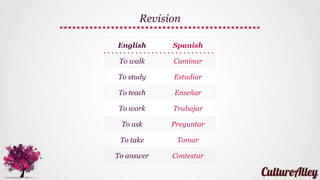
Revision
English Spanish
To walk Caminar
To study Estudiar
To teach Enseñar
To work Trabajar
To ask Preguntar
To take Tomar
To answer Contestar
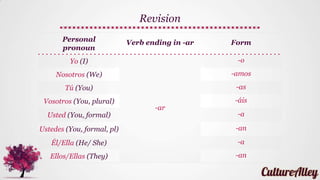
Revision
Personal
pronoun
Verb ending in -ar Form
Yo (I)
-ar
-o
Nosotros (We) -amos
Tú (You) -as
Vosotros (You, plural) -áis
Usted (You, formal) -a
Ustedes (You, formal, pl) -an
Él/Ella (He/ She) -a
Ellos/Ellas (They) -an
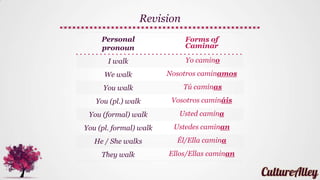
Revision
Personal
pronoun
Forms of
Caminar
I walk Yo camino
We walk Nosotros caminamos
You walk Tú caminas
You (pl.) walk Vosotros camináis
You (formal) walk Usted camina
You (pl. formal) walk Ustedes caminan
He / She walks Él/Ella camina
They walk Ellos/Ellas caminan
Revision
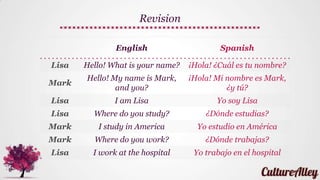
English Spanish
Lisa Hello! What is your name? ¡Hola! ¿Cuál es tu nombre?
Mark
Hello! My name is Mark,
and you?
¡Hola! Mi nombre es Mark,
¿y tú?
Lisa I am Lisa Yo soy Lisa
Lisa Where do you study? ¿Dónde estudias?
Mark I study in America Yo estudio en América
Mark Where do you work? ¿Dónde trabajas?
Lisa I work at the hospital Yo trabajo en el hospital
1 Bridging the language gap
Lesson objectives
Today, we will learn how to overcome
language difficulties when at a new place
So let's get started...
What’s in store today?
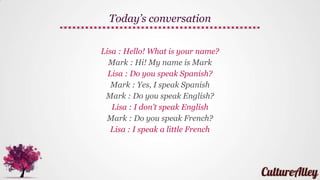
Lisa : Hello! What is your name?
Mark : Hi! My name is Mark
Lisa : Do you speak Spanish?
Mark : Yes, I speak Spanish
Mark : Do you speak English?
Lisa : I don’t speak English
Mark : Do you speak French?
Lisa : I speak a little French
Today’s conversation
Let’s break this conversation down and
learn to translate it step by step
Today’s conversation
What you already know!
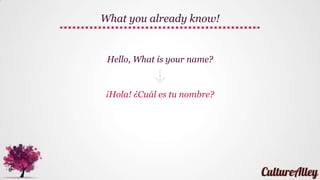
Hello, What is your name?
¡Hola! ¿Cuál es tu nombre?
What you already know!
Hi! My name is Mark
¡Hola! Mi nombre es Mark
Now, if you're new in a Spanish speaking
country, it is important to understand how
to ask and answer questions related to
which languages one speaks
Bridging the language gap
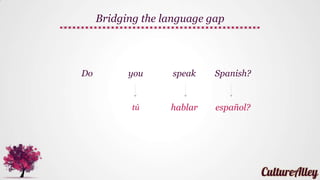
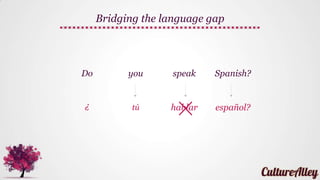
Do you speak Spanish?
tú hablar español?
'Do' is not translated here
This is because to form a question for the
statement 'You speak Spanish' we just add
¿? before and after the statement so 'do'
doesn't need to be translated separately
Did you notice?
Bridging the language gap
Do you speak Spanish?
¿ tú hablar español?
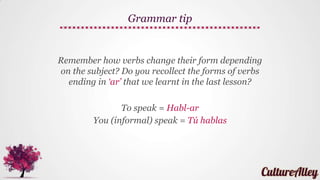
Remember how verbs change their form depending
on the subject? Do you recollect the forms of verbs
ending in ‘ar’ that we learnt in the last lesson?
To speak = Habl-ar
You (informal) speak = Tú hablas
Grammar tip
Bridging the language gap
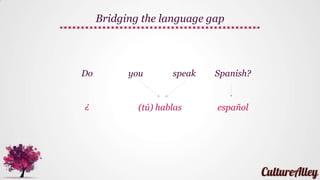
Do you speak Spanish?
¿ (tú) hablas español
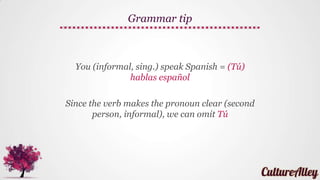
You (informal, sing.) speak Spanish = (Tú)
hablas español
Since the verb makes the pronoun clear (second
person, informal), we can omit Tú
Grammar tip
You speak Spanish = Hablas español
Remember, to turn it into a question we just
put ¿ ?
Hence,
Do you speak Spanish? = ¿Hablas español?
Grammar tip
So our question translates as...
Do you speak Spanish?
¿Hablas español?
You (informal, sing.) speak Spanish =
(Tú) hablas español
However!
You (formal, sing.) speak Spanish =
Usted habla español
Now, while we could omit Tú, we cannot omit 'Usted'
as it is not obvious
Habla could associate with 'usted/él/ella' hence to be
clear it is essential to use the pronoun
Grammar tip
Do you remember that we never capitalize
language names in Spanish?
Hence, español is written with a small ‘e’
Grammar tip
Alright, now that you know how to ask
someone if they speak a particular
language, let’s also learn how you would
answer that question
Moving on…
For answering questions two important
words to learn are 'yes' and 'no'
Yes = Sí
No = No
Saying no is always easy right? :)
Grammar tip
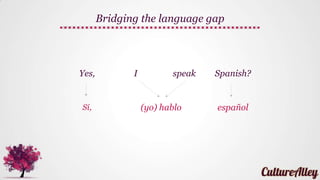
Bridging the language gap
Yes, I speak Spanish?
Sí, (yo) hablo español
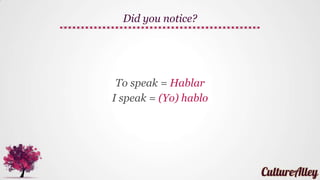
Did you notice?
To speak = Hablar
I speak = (Yo) hablo
Bridging the language gap
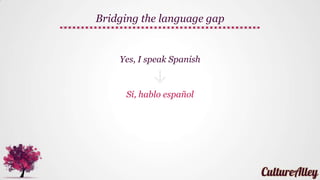
Yes, I speak Spanish
Sí, hablo español
Bridging the language gap
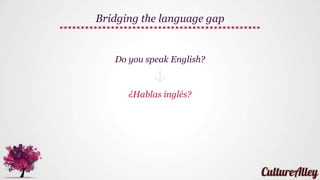
Do you speak English?
¿Hablas inglés?
Bridging the language gap
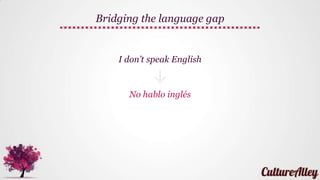
I don’t speak English
No hablo inglés
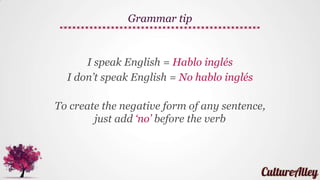
I speak English = Hablo inglés
I don’t speak English = No hablo inglés
To create the negative form of any
sentence, just add ‘no’ before the verb
Grammar tip
Bridging the language gap
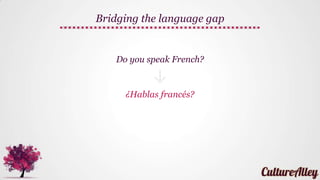
Do you speak French?
¿Hablas francés?
Bridging the language gap
I speak a little French
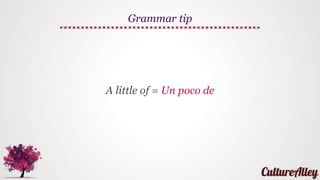
A little of = Un poco de
Grammar tip
Bridging the language gap
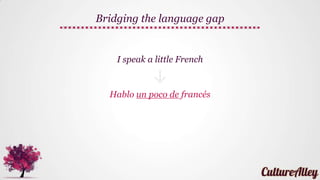
I speak a little French
Hablo un poco de francés
1 2 3
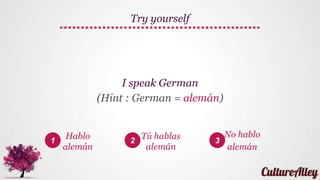
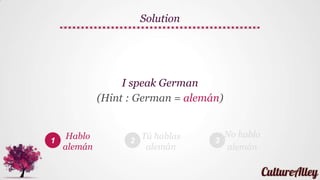
I speak German
(Hint : German = alemán)
Try yourself
Hablo
alemán
Tú hablas
alemán
No hablo
alemán
1 2 3
Solution
I speak German
(Hint : German = alemán)
Hablo
alemán
Tú hablas
alemán
No hablo
alemán
1 2 3
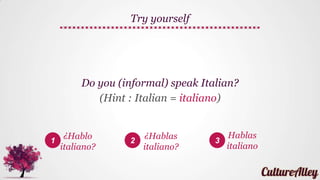
Do you (informal) speak Italian?
(Hint : Italian = italiano)
Try yourself
¿Hablo
italiano?
¿Hablas
italiano?
Hablas
italiano
1 2 3
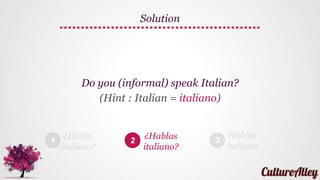
Do you (informal) speak Italian?
(Hint : Italian = italiano)
Solution
¿Hablo
italiano?
Hablas
italiano
¿Hablas
italiano?
1 2 3
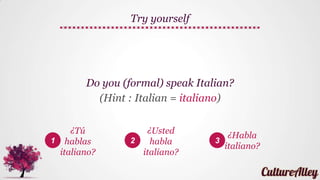
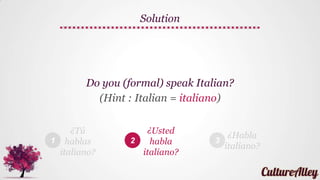
Do you (formal) speak Italian?
(Hint : Italian = italiano)
Try yourself
¿Tú
hablas
italiano?
¿Usted
habla
italiano?
¿Habla
italiano?
1 2 3
Do you (formal) speak Italian?
(Hint : Italian = italiano)
Solution
¿Tú
hablas
italiano?
¿Habla
italiano?
¿Usted
habla
italiano?
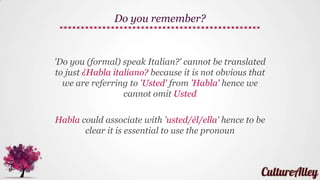
'Do you (formal) speak Italian?' cannot be translated
to just ¿Habla italiano? because it is not obvious that
we are referring to 'Usted' from 'Habla' hence we
cannot omit Usted
Habla could associate with 'usted/él/ella' hence to be
clear it is essential to use the pronoun
Do you remember?
1 2 3
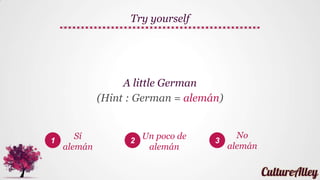
A little German
(Hint : German = alemán)
Try yourself
Sí
alemán
Un poco de
alemán
No
alemán
1 2 3
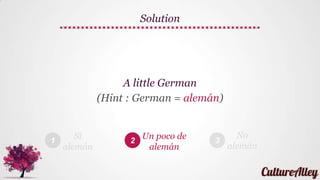
A little German
(Hint : German = alemán)
Solution
Sí
alemán
No
alemán
Un poco de
alemán
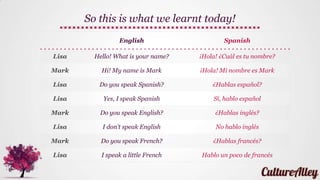
So this is what we learnt today!
English Spanish
Lisa Hello! What is your name? ¡Hola! ¿Cuál es tu nombre?
Mark Hi! My name is Mark ¡Hola! Mi nombre es Mark
Lisa Do you speak Spanish? ¿Hablas español?
Lisa Yes, I speak Spanish Sí, hablo español
Mark Do you speak English? ¿Hablas inglés?
Lisa I don’t speak English No hablo inglés
Mark Do you speak French? ¿Hablas francés?
Lisa I speak a little French Hablo un poco de francés
Culture Leaf
Spanish is spoken across a lot of countries including Spain
and countries in Latin America
While a lot of cultural aspects are similar, each country has
some cultural nuances of it’s own…
As part of the ‘Culture leaf’ series, we will give you cultural
tips relevant to several Spanish countries – and tell you
what works best in which!
Today our cultural voyage takes us to Argentina!
Culture leaf
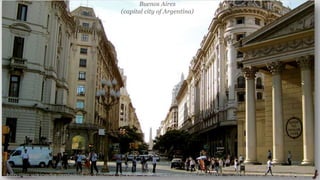
http://en.wikipedia.org/wiki/File:Avenida_Roque_S%C3%A1enz_Pe%C3%B1a_%28Diagonal_Norte%29.jpg
Buenos Aires
(capital city of Argentina)
Culture leaf - Argentina
Argentina is a unique country, most of the locals
came from France, Italy or Spain, so their etiquettes
and traditions are shaped by the cultures
of those countries
Dress well, Argentina is a very fashion
conscious country!
Conservative and modest clothing is ideal
Ensure you dress up for a night in the town
or if going for a Tango dance party!
Culture leaf – Dressing in Argentina
Don’t wear clothes that are ripped or baggy if you
want to blend in with the locals
Avoid flip-flops for this reason...
Avoid wearing soccer jerseys of rivals
Argentineans are serious soccer fans, so wearing a
rival’s jersey can mean asking for trouble!
Culture leaf – Dressing in Argentina
Cross your fork and knife to show that you are
finished eating
Remember that dinner is had late in Argentina;
people will usually have dinner at 9 or 10 pm
It’s okay show up between 30 to 60 minutes late if
invited to a party!
Culture leaf – Dining in Argentina
Don’t pour wine for others, if you can avoid it
There is a ritual associated with pouring wine in
Argentina, so it’s best to let an Argentinean do it…
Don't talk about business during a meal unless an
Argentinean business associate brings it up first
Culture leaf – Dining in Argentina
Don’t give clothes or other items that might be
considered personal
Open your gift right away and show your gratitude
Give gifts such as flowers, candies, pastries,
chocolates or imported liquor
Culture leaf – Gifting in Argentina
Don’t be late, but expect to be kept waiting at times
Make small talk before discussing business
Expect several meetings to take place before a
decision is made
Culture leaf – Business in Argentina
In the next lesson, we will learn forms of
verbs ending in 'ir' and ‘er’ and some
examples and conversations around them!
What’s next?
Content
Team CultureAlley, Okairy Zuñiga
http://www.vayama.com/etiquette/argentina
Content
Jorge Garcia Rey
Credits
See you at the Alley!
Lesson 8 | Regular verbs ending in ‘er’
and ‘ir’

Basic Spanish | Lesson 7 | Which languages do you speak?

  • 1.
    I speak Spanish (Yo)hablo español Lesson 7 | Which languages do you speak?
  • 3.
    ¡Hola! Lesson 7 onBasic Spanish!
  • 4.
    Revision English Spanish To walkCaminar To study Estudiar To teach Enseñar To work Trabajar To ask Preguntar To take Tomar To answer Contestar
  • 5.
    Revision Personal pronoun Verb ending in-ar Form Yo (I) -ar -o Nosotros (We) -amos Tú (You) -as Vosotros (You, plural) -áis Usted (You, formal) -a Ustedes (You, formal, pl) -an Él/Ella (He/ She) -a Ellos/Ellas (They) -an
  • 6.
    Revision Personal pronoun Forms of Caminar I walkYo camino We walk Nosotros caminamos You walk Tú caminas You (pl.) walk Vosotros camináis You (formal) walk Usted camina You (pl. formal) walk Ustedes caminan He / She walks Él/Ella camina They walk Ellos/Ellas caminan
  • 7.
    Revision English Spanish Lisa Hello!What is your name? ¡Hola! ¿Cuál es tu nombre? Mark Hello! My name is Mark, and you? ¡Hola! Mi nombre es Mark, ¿y tú? Lisa I am Lisa Yo soy Lisa Lisa Where do you study? ¿Dónde estudias? Mark I study in America Yo estudio en América Mark Where do you work? ¿Dónde trabajas? Lisa I work at the hospital Yo trabajo en el hospital
  • 8.
    1 Bridging thelanguage gap Lesson objectives
  • 9.
    Today, we willlearn how to overcome language difficulties when at a new place So let's get started... What’s in store today?
  • 10.
    Lisa : Hello!What is your name? Mark : Hi! My name is Mark Lisa : Do you speak Spanish? Mark : Yes, I speak Spanish Mark : Do you speak English? Lisa : I don’t speak English Mark : Do you speak French? Lisa : I speak a little French Today’s conversation
  • 11.
    Let’s break thisconversation down and learn to translate it step by step Today’s conversation
  • 12.
    What you alreadyknow! Hello, What is your name? ¡Hola! ¿Cuál es tu nombre?
  • 13.
    What you alreadyknow! Hi! My name is Mark ¡Hola! Mi nombre es Mark
  • 14.
    Now, if you'renew in a Spanish speaking country, it is important to understand how to ask and answer questions related to which languages one speaks Bridging the language gap
  • 15.
    Bridging the languagegap Do you speak Spanish? tú hablar español?
  • 16.
    'Do' is nottranslated here This is because to form a question for the statement 'You speak Spanish' we just add ¿? before and after the statement so 'do' doesn't need to be translated separately Did you notice?
  • 17.
    Bridging the languagegap Do you speak Spanish? ¿ tú hablar español?
  • 18.
    Remember how verbschange their form depending on the subject? Do you recollect the forms of verbs ending in ‘ar’ that we learnt in the last lesson? To speak = Habl-ar You (informal) speak = Tú hablas Grammar tip
  • 19.
    Bridging the languagegap Do you speak Spanish? ¿ (tú) hablas español
  • 20.
    You (informal, sing.)speak Spanish = (Tú) hablas español Since the verb makes the pronoun clear (second person, informal), we can omit Tú Grammar tip
  • 21.
    You speak Spanish= Hablas español Remember, to turn it into a question we just put ¿ ? Hence, Do you speak Spanish? = ¿Hablas español? Grammar tip
  • 22.
    So our questiontranslates as... Do you speak Spanish? ¿Hablas español?
  • 23.
    You (informal, sing.)speak Spanish = (Tú) hablas español However! You (formal, sing.) speak Spanish = Usted habla español Now, while we could omit Tú, we cannot omit 'Usted' as it is not obvious Habla could associate with 'usted/él/ella' hence to be clear it is essential to use the pronoun Grammar tip
  • 24.
    Do you rememberthat we never capitalize language names in Spanish? Hence, español is written with a small ‘e’ Grammar tip
  • 25.
    Alright, now thatyou know how to ask someone if they speak a particular language, let’s also learn how you would answer that question Moving on…
  • 26.
    For answering questionstwo important words to learn are 'yes' and 'no' Yes = Sí No = No Saying no is always easy right? :) Grammar tip
  • 27.
    Bridging the languagegap Yes, I speak Spanish? Sí, (yo) hablo español
  • 28.
    Did you notice? Tospeak = Hablar I speak = (Yo) hablo
  • 29.
    Bridging the languagegap Yes, I speak Spanish Sí, hablo español
  • 30.
    Bridging the languagegap Do you speak English? ¿Hablas inglés?
  • 31.
    Bridging the languagegap I don’t speak English No hablo inglés
  • 32.
    I speak English= Hablo inglés I don’t speak English = No hablo inglés To create the negative form of any sentence, just add ‘no’ before the verb Grammar tip
  • 33.
    Bridging the languagegap Do you speak French? ¿Hablas francés?
  • 34.
    Bridging the languagegap I speak a little French
  • 35.
    A little of= Un poco de Grammar tip
  • 36.
    Bridging the languagegap I speak a little French Hablo un poco de francés
  • 37.
    1 2 3 Ispeak German (Hint : German = alemán) Try yourself Hablo alemán Tú hablas alemán No hablo alemán
  • 38.
    1 2 3 Solution Ispeak German (Hint : German = alemán) Hablo alemán Tú hablas alemán No hablo alemán
  • 39.
    1 2 3 Doyou (informal) speak Italian? (Hint : Italian = italiano) Try yourself ¿Hablo italiano? ¿Hablas italiano? Hablas italiano
  • 40.
    1 2 3 Doyou (informal) speak Italian? (Hint : Italian = italiano) Solution ¿Hablo italiano? Hablas italiano ¿Hablas italiano?
  • 41.
    1 2 3 Doyou (formal) speak Italian? (Hint : Italian = italiano) Try yourself ¿Tú hablas italiano? ¿Usted habla italiano? ¿Habla italiano?
  • 42.
    1 2 3 Doyou (formal) speak Italian? (Hint : Italian = italiano) Solution ¿Tú hablas italiano? ¿Habla italiano? ¿Usted habla italiano?
  • 43.
    'Do you (formal)speak Italian?' cannot be translated to just ¿Habla italiano? because it is not obvious that we are referring to 'Usted' from 'Habla' hence we cannot omit Usted Habla could associate with 'usted/él/ella' hence to be clear it is essential to use the pronoun Do you remember?
  • 44.
    1 2 3 Alittle German (Hint : German = alemán) Try yourself Sí alemán Un poco de alemán No alemán
  • 45.
    1 2 3 Alittle German (Hint : German = alemán) Solution Sí alemán No alemán Un poco de alemán
  • 46.
    So this iswhat we learnt today! English Spanish Lisa Hello! What is your name? ¡Hola! ¿Cuál es tu nombre? Mark Hi! My name is Mark ¡Hola! Mi nombre es Mark Lisa Do you speak Spanish? ¿Hablas español? Lisa Yes, I speak Spanish Sí, hablo español Mark Do you speak English? ¿Hablas inglés? Lisa I don’t speak English No hablo inglés Mark Do you speak French? ¿Hablas francés? Lisa I speak a little French Hablo un poco de francés
  • 47.
  • 48.
    Spanish is spokenacross a lot of countries including Spain and countries in Latin America While a lot of cultural aspects are similar, each country has some cultural nuances of it’s own… As part of the ‘Culture leaf’ series, we will give you cultural tips relevant to several Spanish countries – and tell you what works best in which! Today our cultural voyage takes us to Argentina! Culture leaf
  • 49.
  • 50.
    Culture leaf -Argentina Argentina is a unique country, most of the locals came from France, Italy or Spain, so their etiquettes and traditions are shaped by the cultures of those countries
  • 51.
    Dress well, Argentinais a very fashion conscious country! Conservative and modest clothing is ideal Ensure you dress up for a night in the town or if going for a Tango dance party! Culture leaf – Dressing in Argentina
  • 52.
    Don’t wear clothesthat are ripped or baggy if you want to blend in with the locals Avoid flip-flops for this reason... Avoid wearing soccer jerseys of rivals Argentineans are serious soccer fans, so wearing a rival’s jersey can mean asking for trouble! Culture leaf – Dressing in Argentina
  • 53.
    Cross your forkand knife to show that you are finished eating Remember that dinner is had late in Argentina; people will usually have dinner at 9 or 10 pm It’s okay show up between 30 to 60 minutes late if invited to a party! Culture leaf – Dining in Argentina
  • 54.
    Don’t pour winefor others, if you can avoid it There is a ritual associated with pouring wine in Argentina, so it’s best to let an Argentinean do it… Don't talk about business during a meal unless an Argentinean business associate brings it up first Culture leaf – Dining in Argentina
  • 55.
    Don’t give clothesor other items that might be considered personal Open your gift right away and show your gratitude Give gifts such as flowers, candies, pastries, chocolates or imported liquor Culture leaf – Gifting in Argentina
  • 56.
    Don’t be late,but expect to be kept waiting at times Make small talk before discussing business Expect several meetings to take place before a decision is made Culture leaf – Business in Argentina
  • 57.
    In the nextlesson, we will learn forms of verbs ending in 'ir' and ‘er’ and some examples and conversations around them! What’s next?
  • 58.
    Content Team CultureAlley, OkairyZuñiga http://www.vayama.com/etiquette/argentina Content Jorge Garcia Rey Credits
  • 59.
    See you atthe Alley!
  • 60.
    Lesson 8 |Regular verbs ending in ‘er’ and ‘ir’