Decoding Truth: Understanding
Analytic, Synthetic,
Contradictory, Ambiguous, and
Equative Sentences
 Understanding analytic and synthetic
sentences is essential for decoding truth.
 Analytic sentences are true by definition,
while synthetic sentences require empirical
evidence.
 Contradictory and ambiguous sentences
pose challenges in interpretation.
 Equative sentences express equality.
Analytic
Sentences
Analytic sentences are true as a result of the
senses of words in it, such as 'All bachelors
are unmarried' or ‘All elephants are animals.’
These sentences do not require empirical
evidence for verification.
They give us information about the world and
they are true all the time.
Understanding the nature of analytic
sentences is crucial for logical reasoning and
critical thinking.
Synthetic Sentences
Synthetic sentences require empirical
evidence for verification, such as Salim is
from Noakhali.' These sentences are
contingent on empirical observations and are
essential for scientific inquiry and
knowledge acquisition.
It can be either true or false, but there’s no
contradiction in the meaning.
Contradictory Sentences
Identifying and resolving contradictory sentences is
crucial for logical coherence.
These sentences assert opposite claims as a result of
the senses of words in it, posing challenges in
determining truth.
Understanding the nature of contradictions is essential
for rational discourse and argumentation.
Example: My sister is jealous of me because I'm an
only child.
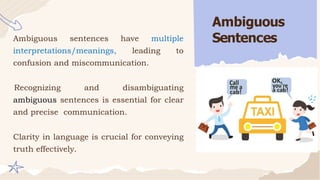
Ambiguous
Sentences
Ambiguous sentences have multiple
interpretations/meanings, leading to
confusion and miscommunication.
Recognizing and disambiguating
ambiguous sentences is essential for clear
and precise communication.
Clarity in language is crucial for conveying
truth effectively.
Equative Sentences
A kind of sentence which is used to assert the
identity of the referents of two referring
expressions, to find out if these two R.E.s have
the same referent or not.
Understanding equative sentences is essential
for comparing and establishing relationships
between entities.
The reversal test helps to identify such
sentences.
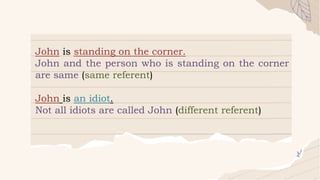
John is standing on the corner.
John and the person who is standing on the corner
are same (same referent)
John is an idiot.
Not all idiots are called John (different referent)
Logical Analysis
Applying logical analysis to different
types of sentences is crucial for
decoding truth.
By understanding the nature of
sentences, we can discern truth from
falsehood and engage in rational
discourse.

Decoding Truth Understanding-Semantics.pptx

  • 1.
    Decoding Truth: Understanding Analytic,Synthetic, Contradictory, Ambiguous, and Equative Sentences
  • 2.
     Understanding analyticand synthetic sentences is essential for decoding truth.  Analytic sentences are true by definition, while synthetic sentences require empirical evidence.  Contradictory and ambiguous sentences pose challenges in interpretation.  Equative sentences express equality.
  • 3.
    Analytic Sentences Analytic sentences aretrue as a result of the senses of words in it, such as 'All bachelors are unmarried' or ‘All elephants are animals.’ These sentences do not require empirical evidence for verification. They give us information about the world and they are true all the time. Understanding the nature of analytic sentences is crucial for logical reasoning and critical thinking.
  • 4.
    Synthetic Sentences Synthetic sentencesrequire empirical evidence for verification, such as Salim is from Noakhali.' These sentences are contingent on empirical observations and are essential for scientific inquiry and knowledge acquisition. It can be either true or false, but there’s no contradiction in the meaning.
  • 5.
    Contradictory Sentences Identifying andresolving contradictory sentences is crucial for logical coherence. These sentences assert opposite claims as a result of the senses of words in it, posing challenges in determining truth. Understanding the nature of contradictions is essential for rational discourse and argumentation. Example: My sister is jealous of me because I'm an only child.
  • 6.
    Ambiguous Sentences Ambiguous sentences havemultiple interpretations/meanings, leading to confusion and miscommunication. Recognizing and disambiguating ambiguous sentences is essential for clear and precise communication. Clarity in language is crucial for conveying truth effectively.
  • 7.
    Equative Sentences A kindof sentence which is used to assert the identity of the referents of two referring expressions, to find out if these two R.E.s have the same referent or not. Understanding equative sentences is essential for comparing and establishing relationships between entities. The reversal test helps to identify such sentences.
  • 8.
    John is standingon the corner. John and the person who is standing on the corner are same (same referent) John is an idiot. Not all idiots are called John (different referent)
  • 9.
    Logical Analysis Applying logicalanalysis to different types of sentences is crucial for decoding truth. By understanding the nature of sentences, we can discern truth from falsehood and engage in rational discourse.