ToK – Areas of Knowledge
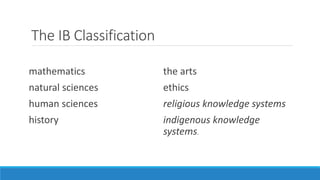
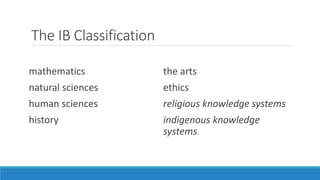
The IB Classification 
mathematics 
natural sciences 
human sciences 
history 
the arts 
ethics 
religious knowledge systems 
indigenous knowledge 
systems.
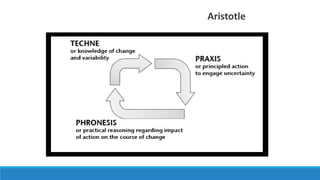
Aristotle
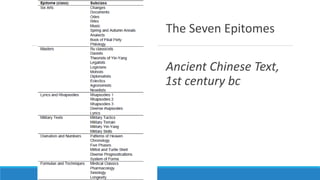
The Seven Epitomes 
Ancient Chinese Text, 
1st century bc
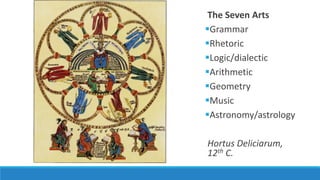
The Seven Arts 
Grammar 
Rhetoric 
Logic/dialectic 
Arithmetic 
Geometry 
Music 
Astronomy/astrology 
Hortus Deliciarum, 
12th C.
The Seven Arts 
Grammar, rhetoric, 
logic/dialectic, 
arithmetic, 
geometry, music, 
and 
astronomy/astrology 
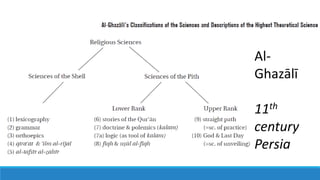
Al- 
Ghazālī 
11th 
century 
Persia 
Hortus Deliciarum, 
12th C.
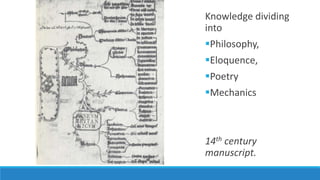
Knowledge dividing 
into 
Philosophy, 
Eloquence, 
Poetry 
Mechanics 
14th century 
manuscript.
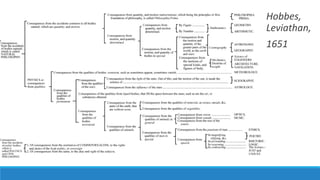
Hobbes, 
Leviathan, 
1651
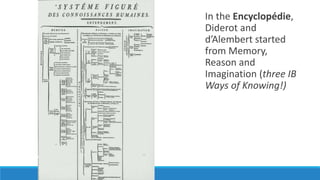
In the Encyclopédie, 
Diderot and 
d’Alembert started 
from Memory, 
Reason and 
Imagination (three IB 
Ways of Knowing!)
S T Coleridge 
Pure Sciences 
Mixed and applied 
sciences 
Biographical and 
histrorical 
Miscellaneous and 
lexographical
The IB Classification 
mathematics 
natural sciences 
human sciences 
history 
the arts 
ethics 
religious knowledge systems 
indigenous knowledge 
systems.
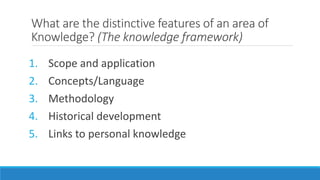
What are the distinctive features of an area of 
Knowledge? (The knowledge framework) 
1. Scope and application 
2. Concepts/Language 
3. Methodology 
4. Historical development 
5. Links to personal knowledge
Some questions for discussion 
1. What are the implications of claiming that the division of knowledge into disciplines and the 
division of the world into countries on a map are both artificial? (adapted from an old ToK 
essay title ) 
2. Do all areas of knowledge use the same kind of language? And what are the consequences of 
your answer? Consider this: «The vocabulary we have does more than communicate our 
knowledge; it shapes what we can know». (apparently a quotation from Aristotle used in a 
recent essay title) 
3. To what extent are the various areas of knowledge defined by their methodologies rather 
than their content? (Recent essay title) 
4. To what extent has knowledge in the AoK changed over time? What might it take to convince 
a person to discard and replace knowledge? (Gist of 2014 essay title) 
5. What are the implications of this famous quotation? «Every man gets a narrower and 
narrower field of knowledge in which he must be an expert in order to compete with other 
people. The specialist knows more and more about less and less» (Konrad Lorenz)

ToK - Areas of Knowledge

  • 1.
    ToK – Areasof Knowledge
  • 2.
    The IB Classification mathematics natural sciences human sciences history the arts ethics religious knowledge systems indigenous knowledge systems.
  • 3.
  • 4.
    The Seven Epitomes Ancient Chinese Text, 1st century bc
  • 5.
    The Seven Arts Grammar Rhetoric Logic/dialectic Arithmetic Geometry Music Astronomy/astrology Hortus Deliciarum, 12th C.
  • 6.
    The Seven Arts Grammar, rhetoric, logic/dialectic, arithmetic, geometry, music, and astronomy/astrology Al- Ghazālī 11th century Persia Hortus Deliciarum, 12th C.
  • 7.
    Knowledge dividing into Philosophy, Eloquence, Poetry Mechanics 14th century manuscript.
  • 8.
  • 9.
    In the Encyclopédie, Diderot and d’Alembert started from Memory, Reason and Imagination (three IB Ways of Knowing!)
  • 10.
    S T Coleridge Pure Sciences Mixed and applied sciences Biographical and histrorical Miscellaneous and lexographical
  • 11.
    The IB Classification mathematics natural sciences human sciences history the arts ethics religious knowledge systems indigenous knowledge systems.
  • 12.
    What are thedistinctive features of an area of Knowledge? (The knowledge framework) 1. Scope and application 2. Concepts/Language 3. Methodology 4. Historical development 5. Links to personal knowledge
  • 13.
    Some questions fordiscussion 1. What are the implications of claiming that the division of knowledge into disciplines and the division of the world into countries on a map are both artificial? (adapted from an old ToK essay title ) 2. Do all areas of knowledge use the same kind of language? And what are the consequences of your answer? Consider this: «The vocabulary we have does more than communicate our knowledge; it shapes what we can know». (apparently a quotation from Aristotle used in a recent essay title) 3. To what extent are the various areas of knowledge defined by their methodologies rather than their content? (Recent essay title) 4. To what extent has knowledge in the AoK changed over time? What might it take to convince a person to discard and replace knowledge? (Gist of 2014 essay title) 5. What are the implications of this famous quotation? «Every man gets a narrower and narrower field of knowledge in which he must be an expert in order to compete with other people. The specialist knows more and more about less and less» (Konrad Lorenz)