FUNCTIONS OF
COMMUNICATION
Ms. Shayne Arnejo
At the end of the
lesson, the learners
will be able to:
• recognize the different functions
of communication
• draw out communication that
involves the functions of
communication
refers to how humans use language for different purposes
Communication as a human activity always serves a
function. With this idea in mind, Jakobson,
Halliday and Mallinowsi categorized these uses or
functions into:
Functions of Communication
• Regulation/Control
• Social Interaction
• Motivation
• Emotional Expression
• Information
REGULATION/CONTROL
Communication can be used to control behavior or regulate the
nature and amount of activities humans engage in
It ranges from simple requests to laws
governing countries and large territories
BASIC FORMS
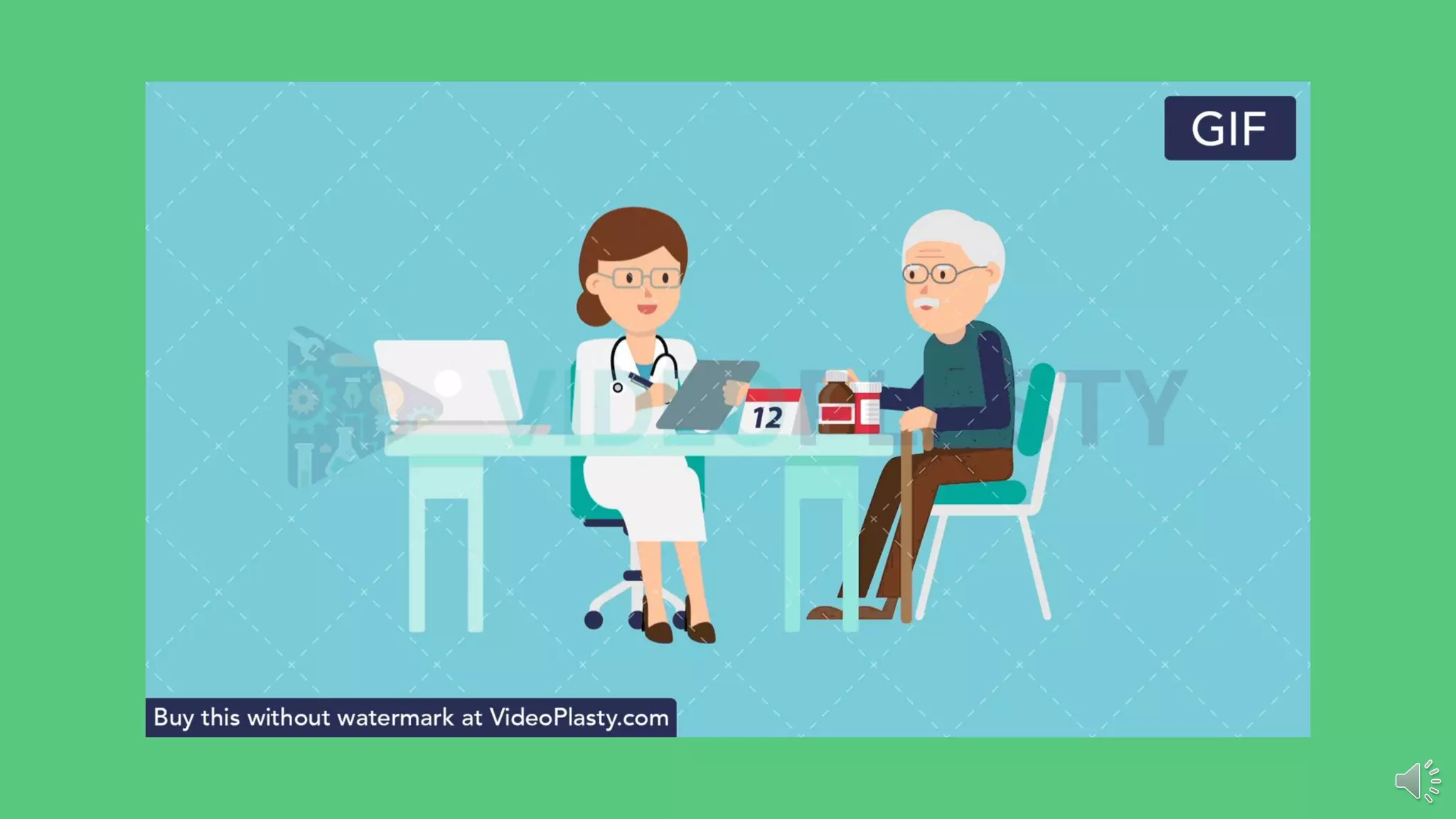
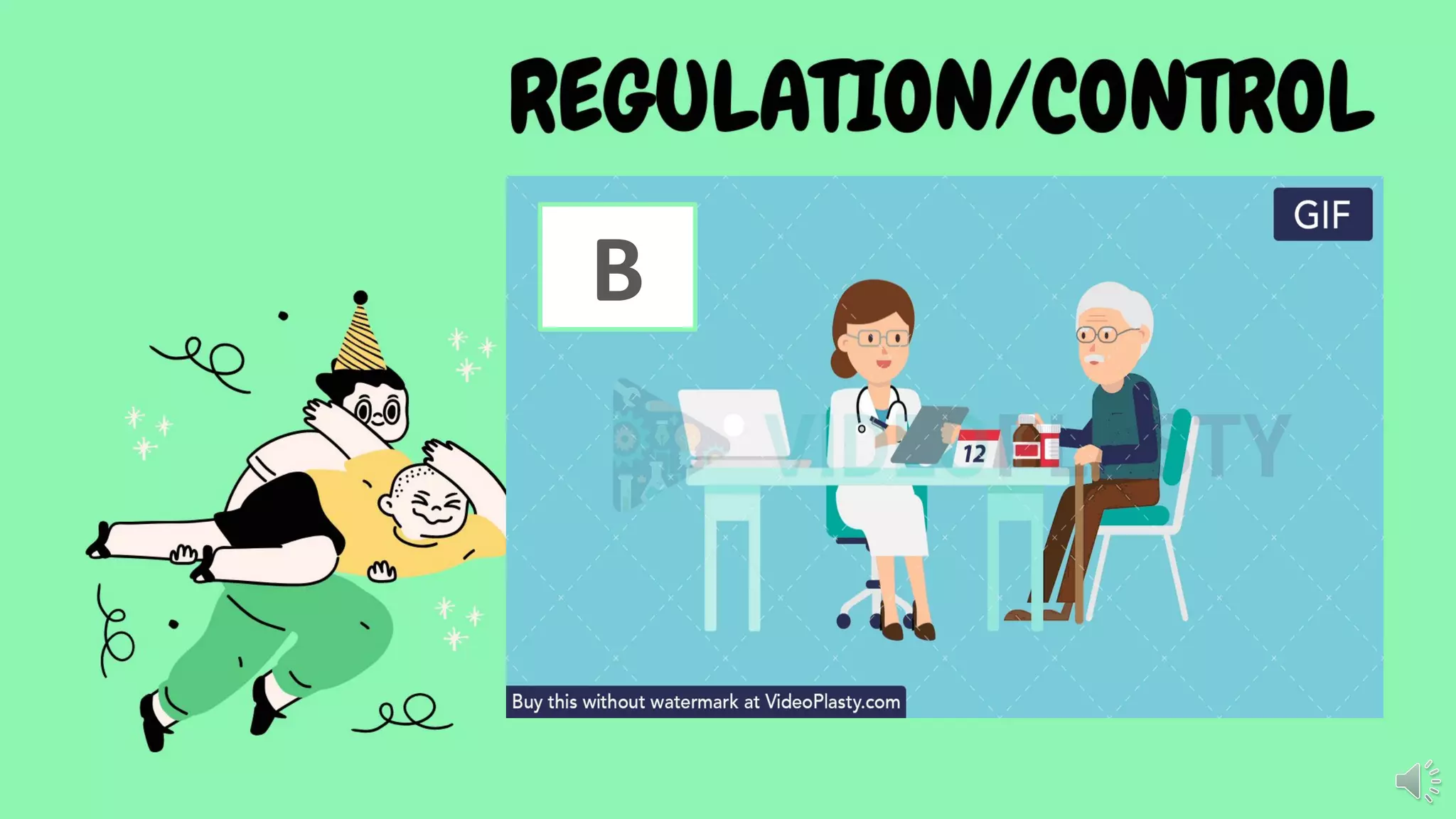
• doctor's prescription
• parents' instruction to their children
• friends giving advice on what course of
action to take
• scolding
• employers' orders to their employees
• customers making orders
REGULATION/CONTROL
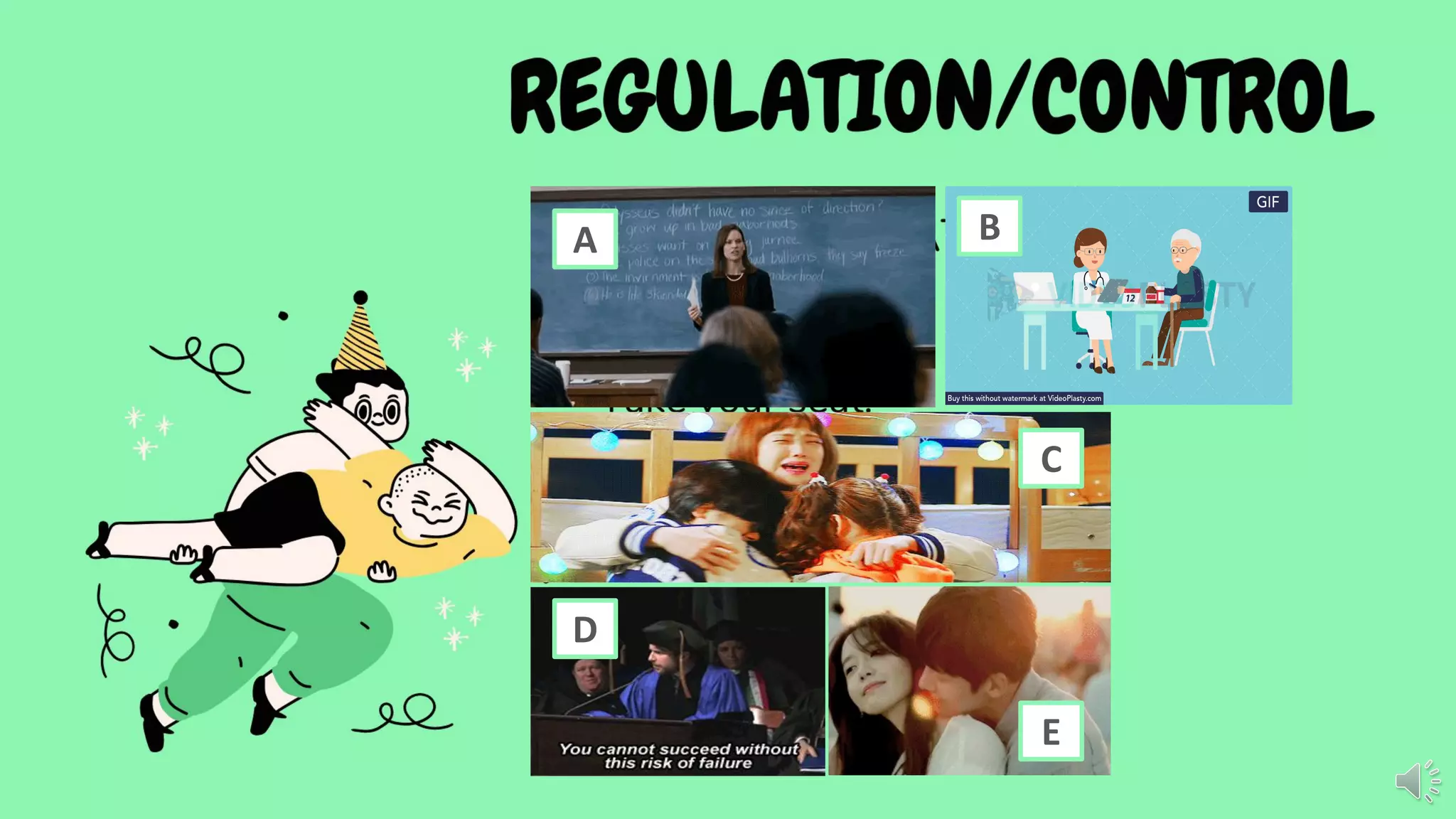
DECLARATIVE STATEMENTS
• Please come in.
• Get a chair.
• Take your seat.
• Run.
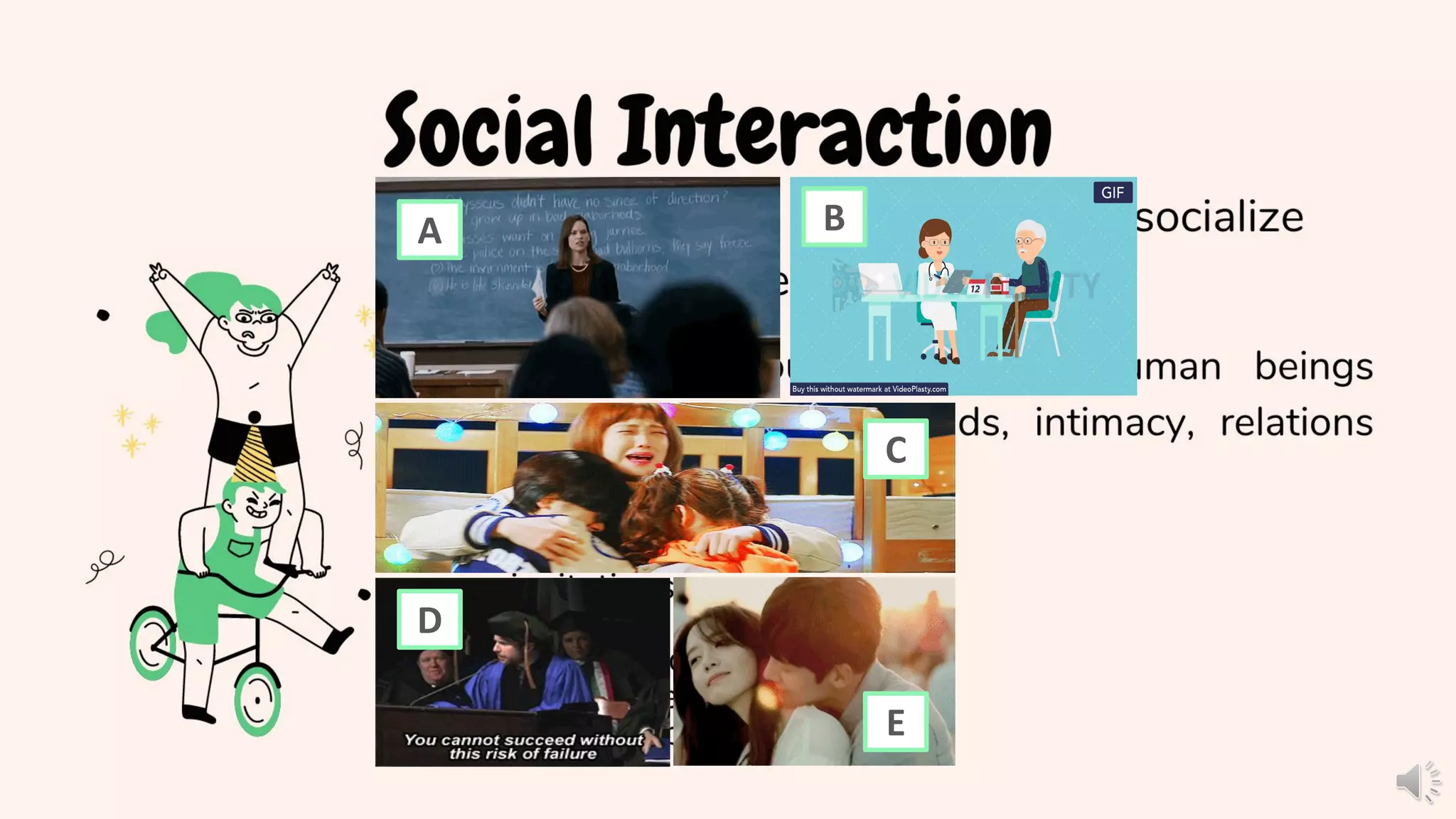
A B
C
D
E
REGULATION/CONTROL
COMMANDS OR IMPERATIVES
• Please come in.
• Get a chair.
• Take your seat.
• Run.
RHETORICAL QUESTIONS
• Why don't we go to the lobby now?
• Can you pass the salt?
• Can I have a moment of silence?
B
REGULATION/CONTROL
COMMANDS OR IMPERATIVES
• Please come in.
• Get a chair.
• Take your seat.
• Run.
RHETORICAL QUESTIONS
• Why don't we go to the lobby now?
• Can you pass the salt?
• Can I have a moment of silence?
REGULATION/CONTROL
DECLARATIVE STATEMENTS
• Please come in.
• Get a chair.
• Take your seat.
• Run.
Social Interaction
In this function, we use language to socialize
or interact with other people.
In their daily course of living, human beings
develop and maintain bonds, intimacy, relations
and associations.
BASIC FORMS
• invitations
• greetings
• appreciations
• encouragements
• marriage proposals
Social Interaction
In this function, we use language to socialize
or interact with other people.
In their daily course of living, human beings
develop and maintain bonds, intimacy, relations
and associations.
BASIC FORMS
• invitations
• greetings
• appreciations
• encouragements
• marriage proposals
A B
C
D
E
Social Interaction
In this function, we use language to socialize
or interact with other people.
In their daily course of living, human beings
develop and maintain bonds, intimacy, relations
and associations.
BASIC FORMS
• invitations
• greetings
• appreciations
• encouragements
• marriage proposals
E
Social Interaction
For example
"Will you marry me?"
"Would you like some coffee, tea, or me?"
"Hi!" or "Hello!"
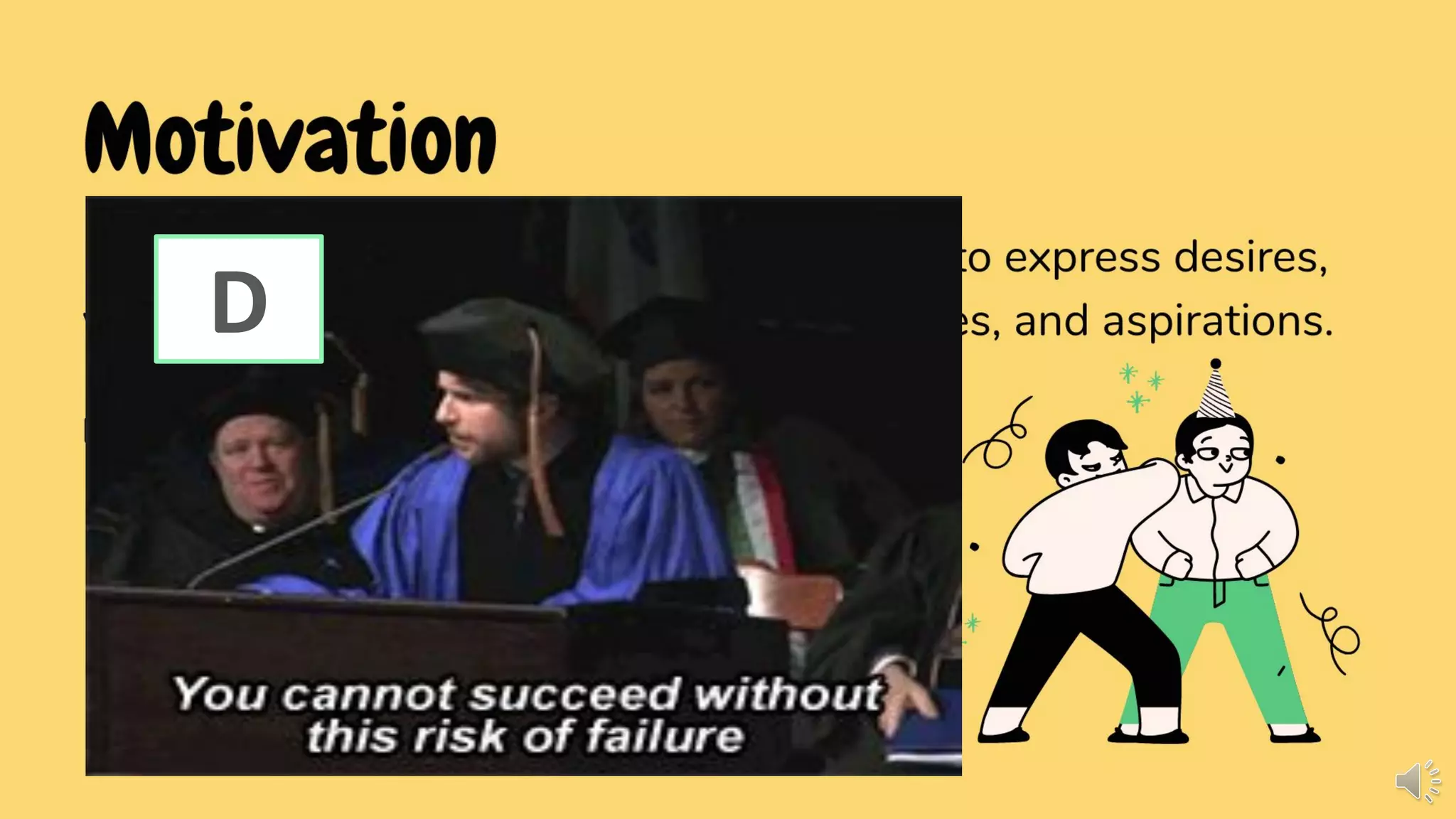
Motivation
Motivation as a function of communication to express desires,
wants, likes and dislikes, inclinations, choices, and aspirations.
BASIC FORMS
• Expressing one's ambitions (I dream of...)
• Talking about preferences (This is better
than that)
• Ordering in a fast food restaurant (I want...)
• Asking for milk (Can I...?)
• Making petitions
• Expressing a need (I need...)
Motivation as a function of communication uses language to encourage,
inspire, and influence, as well as motivate people to believe you or take
your side. It expresses aspirations, desires, and inclinations.
Motivation
Motivation as a function of communication to express desires,
wants, likes and dislikes, inclinations, choices, and aspirations.
BASIC FORMS
• Expressing one's ambitions (I dream of...)
• Talking about preferences (This is better
than that)
• Ordering in a fast food restaurant (I want...)
• Asking for milk (Can I...?)
• Making petitions
• Expressing a need (I need...)
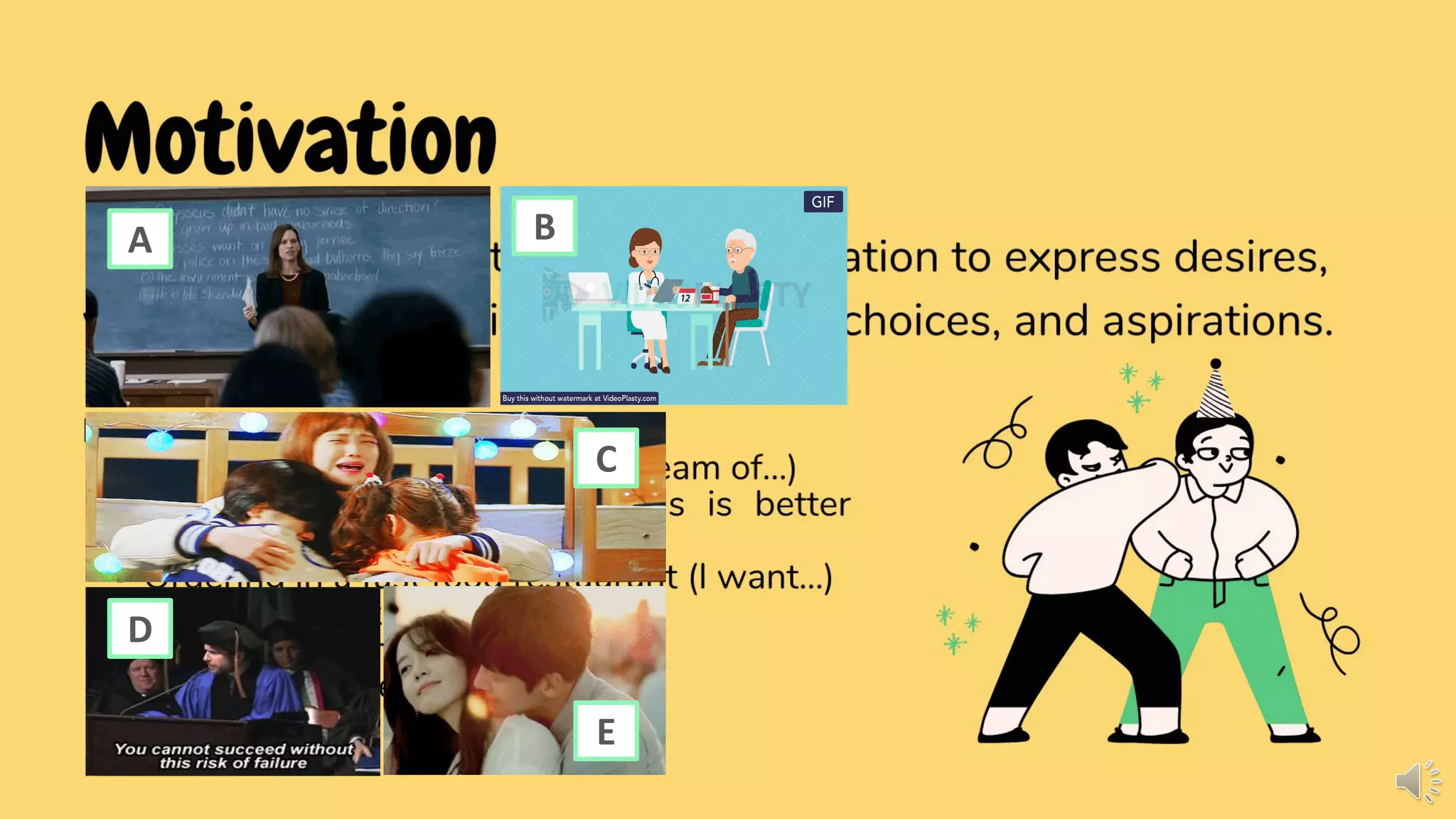
A B
C
D
E
Motivation
Motivation as a function of communication to express desires,
wants, likes and dislikes, inclinations, choices, and aspirations.
BASIC FORMS
• Expressing one's ambitions (I dream of...)
• Talking about preferences (This is better
than that)
• Ordering in a fast food restaurant (I want...)
• Asking for milk (Can I...?)
• Making petitions
• Expressing a need (I need...)
D
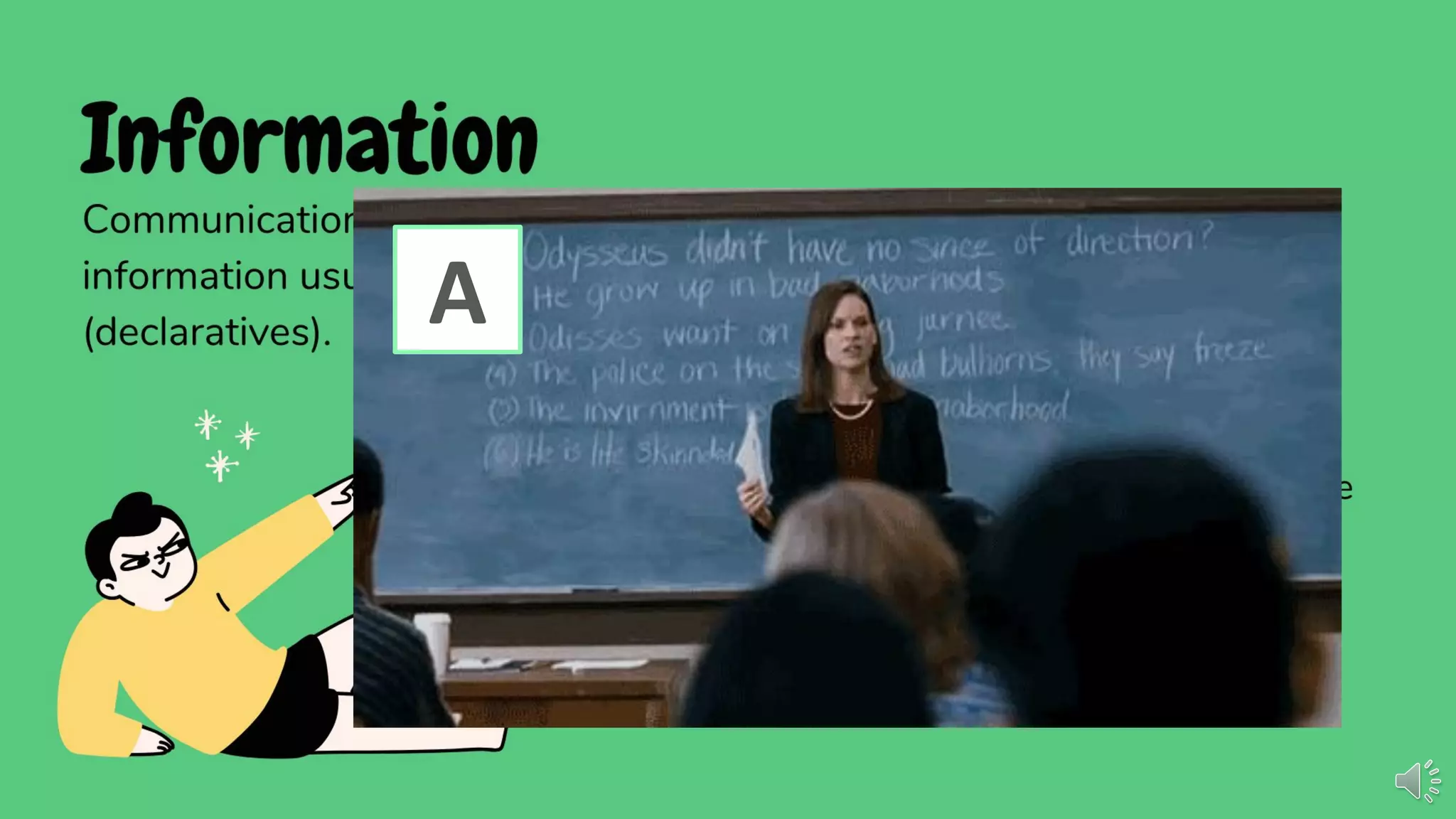
Information
Communication can be used in giving and getting information. Giving
information usually comes in the form of statements or facts
(declaratives).
BASIC FORMS
• I have three sisters.
• For every action, there is a reaction.
• Did you know that some earphones can be
used as microphones?
• Where is Mrs. Ching?
• Did it rain last night?
• Is it windy outside?
• Show me how to tie a knot.
• I don't know where to find the city hall.
Information
Communication can be used in giving and getting information. Giving
information usually comes in the form of statements or facts
(declaratives).
BASIC FORMS
• I have three sisters.
• For every action, there is a reaction.
• Did you know that some earphones can be
used as microphones?
• Where is Mrs. Ching?
• Did it rain last night?
• Is it windy outside?
• Show me how to tie a knot.
• I don't know where to find the city hall.
A B
C
D
E
Information
Communication can be used in giving and getting information. Giving
information usually comes in the form of statements or facts
(declaratives).
BASIC FORMS
• I have three sisters.
• For every action, there is a reaction.
• Did you know that some earphones can be
used as microphones?
• Where is Mrs. Ching?
• Did it rain last night?
• Is it windy outside?
• Show me how to tie a knot.
• I don't know where to find the city hall.
A
Emotional Expression
This function refers to the use of language to express love,
joy, fear, anger, hope, or any other emotion.
Humans always need to express their emotion
verbally and nonverbally. We feel about tpeople
and ourselves and the expression of it is natural
and important.
Emotional Expression
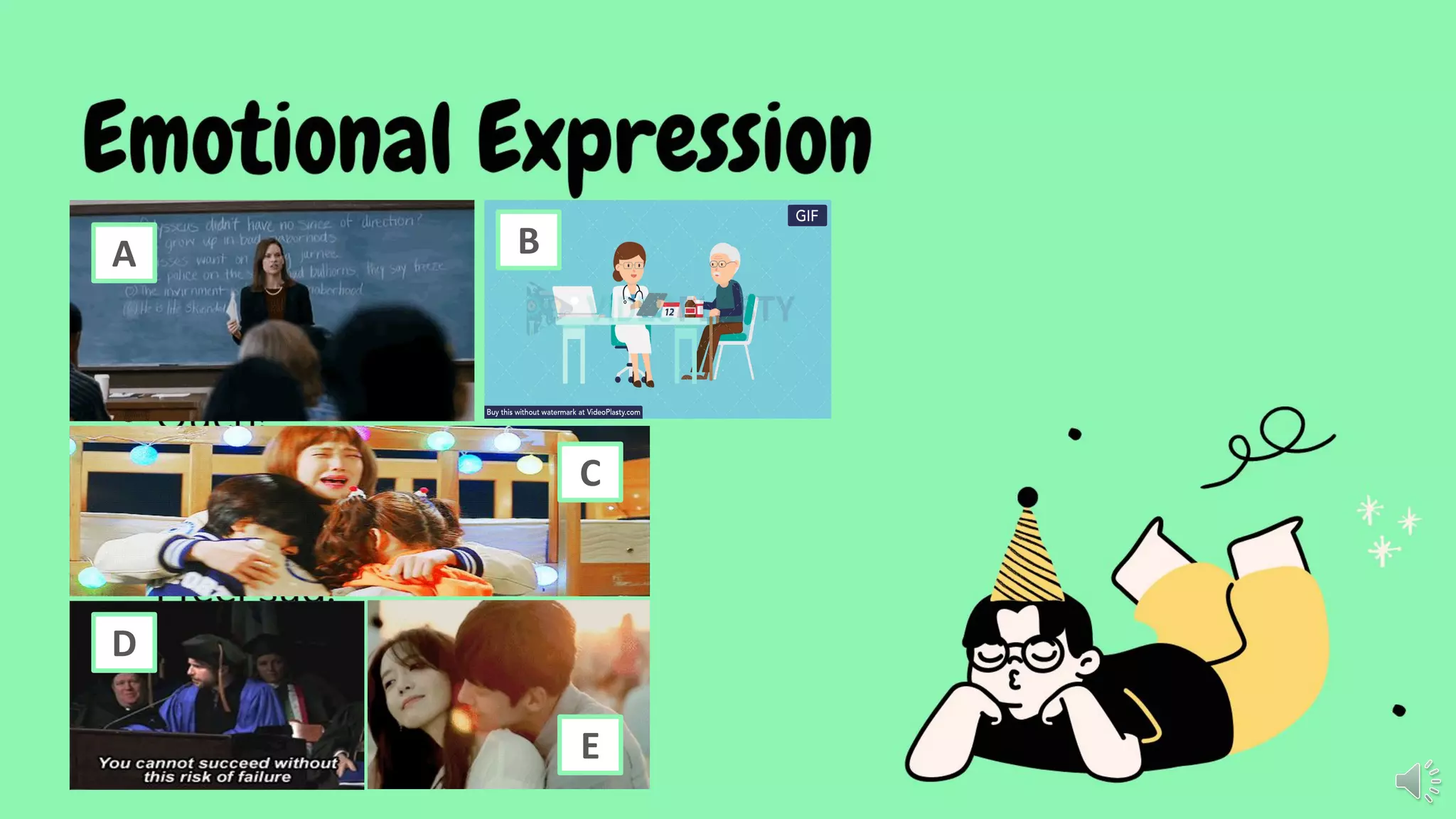
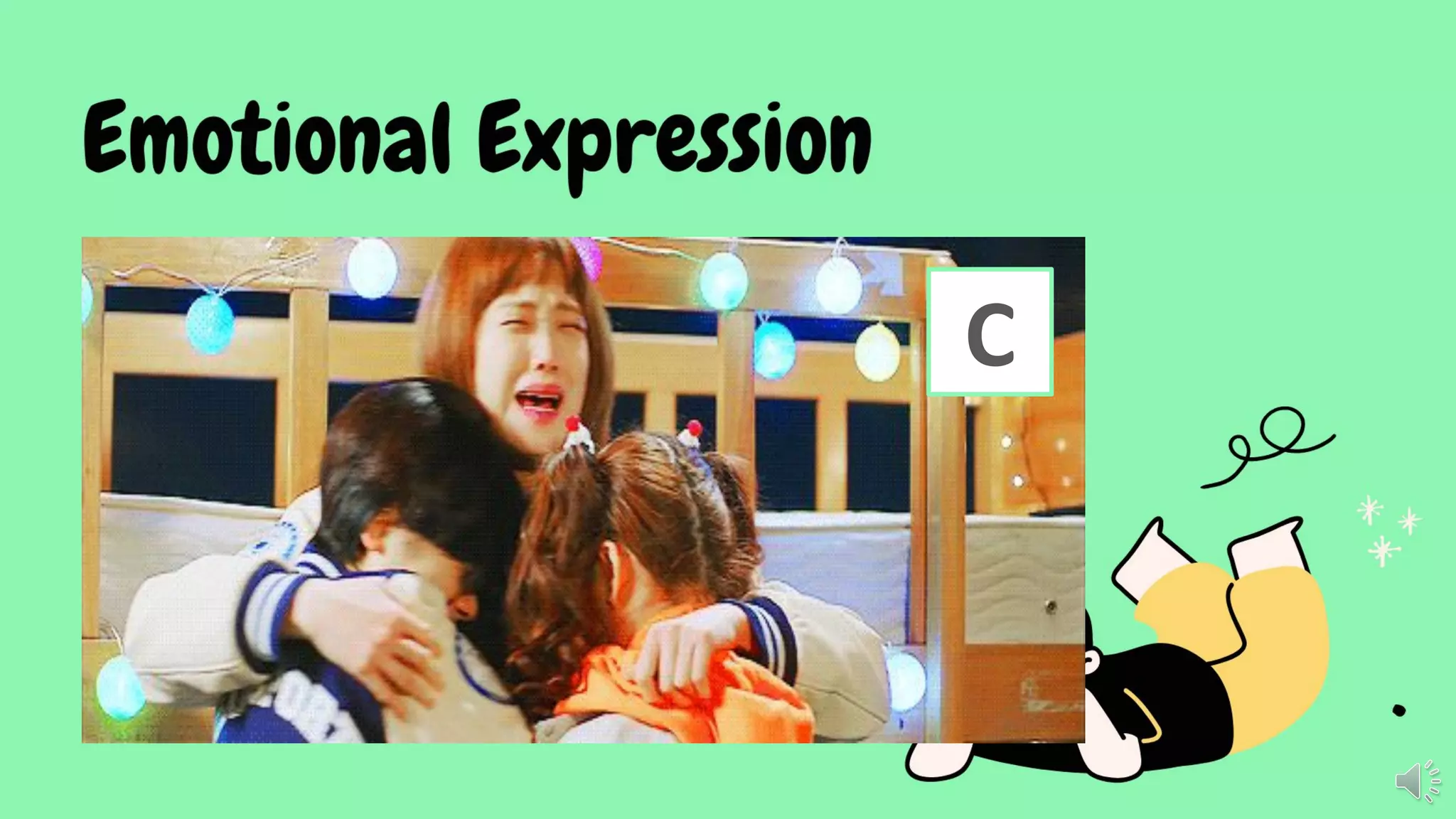
BASIC FORMS
• Yes!
• Oh no!
• Ouch!
• Expletives
• Really?
• That's exciting!
• I feel sad.
A B
C
D
E
Emotional Expression
BASIC FORMS
• Yes!
• Oh no!
• Ouch!
• Expletives
• Really?
• That's exciting!
• I feel sad.
C
Emotional Expression
BASIC FORMS
• Yes!
• Oh no!
• Ouch!
• Expletives
• Really?
• That's exciting!
• I feel sad.
In communicating, we get to identify or
exhibit the functions effectively through
nonverbal cues.
What nonverbal cues do we know of?
ACTIVITY TIME!
Movie Reference ft. Wheel Picker
VIDEO REFERENCE ACTIVITY + TRADE TIME
Why do you think there's
a need to express oneself
authentically when
communicating?
“I know
that you can do all
things; no purpose
of yours can be
thwarted”
Job 42:2
Quiz
Directions: Instruction: Identify which function of
communication is used in these
situations/statements.
Assignment
Write a 250-word reflective essay regarding
the speech of Sever Suzuki during the UN
Conference. In your essay, the content
must also be able to discuss the following:
1. What functions of communication are being
addressed in the speech?
2. What are your takeaways from Sever Suzuki’s
speech during the United Nation’s Conference?
Your reflective essay will be graded according
1. Group yourselves into 10 teams.
2. Discuss and prepare a 3-minute
role play activity that shows real
life examples of the different
Functions of Communication.
Regulation/Control – Grp 1 & 6
Social Interaction – Grp 2 & 7
Motivation – Grp 3 & 8
Information – Grp 4 & 9
Emotional Expression – Grp 5 &

2.-Functions-of-Communication.pptx.pdf

  • 7.
  • 8.
    At the endof the lesson, the learners will be able to: • recognize the different functions of communication • draw out communication that involves the functions of communication
  • 9.
    refers to howhumans use language for different purposes Communication as a human activity always serves a function. With this idea in mind, Jakobson, Halliday and Mallinowsi categorized these uses or functions into: Functions of Communication
  • 10.
    • Regulation/Control • SocialInteraction • Motivation • Emotional Expression • Information
  • 11.
    REGULATION/CONTROL Communication can beused to control behavior or regulate the nature and amount of activities humans engage in It ranges from simple requests to laws governing countries and large territories BASIC FORMS • doctor's prescription • parents' instruction to their children • friends giving advice on what course of action to take • scolding • employers' orders to their employees • customers making orders
  • 12.
    REGULATION/CONTROL DECLARATIVE STATEMENTS • Pleasecome in. • Get a chair. • Take your seat. • Run. A B C D E
  • 13.
    REGULATION/CONTROL COMMANDS OR IMPERATIVES •Please come in. • Get a chair. • Take your seat. • Run. RHETORICAL QUESTIONS • Why don't we go to the lobby now? • Can you pass the salt? • Can I have a moment of silence? B
  • 14.
    REGULATION/CONTROL COMMANDS OR IMPERATIVES •Please come in. • Get a chair. • Take your seat. • Run. RHETORICAL QUESTIONS • Why don't we go to the lobby now? • Can you pass the salt? • Can I have a moment of silence?
  • 15.
    REGULATION/CONTROL DECLARATIVE STATEMENTS • Pleasecome in. • Get a chair. • Take your seat. • Run.
  • 16.
    Social Interaction In thisfunction, we use language to socialize or interact with other people. In their daily course of living, human beings develop and maintain bonds, intimacy, relations and associations. BASIC FORMS • invitations • greetings • appreciations • encouragements • marriage proposals
  • 17.
    Social Interaction In thisfunction, we use language to socialize or interact with other people. In their daily course of living, human beings develop and maintain bonds, intimacy, relations and associations. BASIC FORMS • invitations • greetings • appreciations • encouragements • marriage proposals A B C D E
  • 18.
    Social Interaction In thisfunction, we use language to socialize or interact with other people. In their daily course of living, human beings develop and maintain bonds, intimacy, relations and associations. BASIC FORMS • invitations • greetings • appreciations • encouragements • marriage proposals E
  • 19.
    Social Interaction For example "Willyou marry me?" "Would you like some coffee, tea, or me?" "Hi!" or "Hello!"
  • 20.
    Motivation Motivation as afunction of communication to express desires, wants, likes and dislikes, inclinations, choices, and aspirations. BASIC FORMS • Expressing one's ambitions (I dream of...) • Talking about preferences (This is better than that) • Ordering in a fast food restaurant (I want...) • Asking for milk (Can I...?) • Making petitions • Expressing a need (I need...) Motivation as a function of communication uses language to encourage, inspire, and influence, as well as motivate people to believe you or take your side. It expresses aspirations, desires, and inclinations.
  • 21.
    Motivation Motivation as afunction of communication to express desires, wants, likes and dislikes, inclinations, choices, and aspirations. BASIC FORMS • Expressing one's ambitions (I dream of...) • Talking about preferences (This is better than that) • Ordering in a fast food restaurant (I want...) • Asking for milk (Can I...?) • Making petitions • Expressing a need (I need...) A B C D E
  • 22.
    Motivation Motivation as afunction of communication to express desires, wants, likes and dislikes, inclinations, choices, and aspirations. BASIC FORMS • Expressing one's ambitions (I dream of...) • Talking about preferences (This is better than that) • Ordering in a fast food restaurant (I want...) • Asking for milk (Can I...?) • Making petitions • Expressing a need (I need...) D
  • 23.
    Information Communication can beused in giving and getting information. Giving information usually comes in the form of statements or facts (declaratives). BASIC FORMS • I have three sisters. • For every action, there is a reaction. • Did you know that some earphones can be used as microphones? • Where is Mrs. Ching? • Did it rain last night? • Is it windy outside? • Show me how to tie a knot. • I don't know where to find the city hall.
  • 24.
    Information Communication can beused in giving and getting information. Giving information usually comes in the form of statements or facts (declaratives). BASIC FORMS • I have three sisters. • For every action, there is a reaction. • Did you know that some earphones can be used as microphones? • Where is Mrs. Ching? • Did it rain last night? • Is it windy outside? • Show me how to tie a knot. • I don't know where to find the city hall. A B C D E
  • 25.
    Information Communication can beused in giving and getting information. Giving information usually comes in the form of statements or facts (declaratives). BASIC FORMS • I have three sisters. • For every action, there is a reaction. • Did you know that some earphones can be used as microphones? • Where is Mrs. Ching? • Did it rain last night? • Is it windy outside? • Show me how to tie a knot. • I don't know where to find the city hall. A
  • 26.
    Emotional Expression This functionrefers to the use of language to express love, joy, fear, anger, hope, or any other emotion. Humans always need to express their emotion verbally and nonverbally. We feel about tpeople and ourselves and the expression of it is natural and important.
  • 27.
    Emotional Expression BASIC FORMS •Yes! • Oh no! • Ouch! • Expletives • Really? • That's exciting! • I feel sad. A B C D E
  • 28.
    Emotional Expression BASIC FORMS •Yes! • Oh no! • Ouch! • Expletives • Really? • That's exciting! • I feel sad. C
  • 29.
    Emotional Expression BASIC FORMS •Yes! • Oh no! • Ouch! • Expletives • Really? • That's exciting! • I feel sad.
  • 30.
    In communicating, weget to identify or exhibit the functions effectively through nonverbal cues. What nonverbal cues do we know of?
  • 31.
    ACTIVITY TIME! Movie Referenceft. Wheel Picker VIDEO REFERENCE ACTIVITY + TRADE TIME
  • 32.
    Why do youthink there's a need to express oneself authentically when communicating?
  • 33.
    “I know that youcan do all things; no purpose of yours can be thwarted” Job 42:2
  • 34.
    Quiz Directions: Instruction: Identifywhich function of communication is used in these situations/statements.
  • 35.
    Assignment Write a 250-wordreflective essay regarding the speech of Sever Suzuki during the UN Conference. In your essay, the content must also be able to discuss the following: 1. What functions of communication are being addressed in the speech? 2. What are your takeaways from Sever Suzuki’s speech during the United Nation’s Conference? Your reflective essay will be graded according 1. Group yourselves into 10 teams. 2. Discuss and prepare a 3-minute role play activity that shows real life examples of the different Functions of Communication. Regulation/Control – Grp 1 & 6 Social Interaction – Grp 2 & 7 Motivation – Grp 3 & 8 Information – Grp 4 & 9 Emotional Expression – Grp 5 &