• Land capability classification (LCC) may be defined as a system of
grouping land in to various classes based on inherent limitations
imposed on sustained use by soil attributes, topography, drainage and
climate.
• The guiding principle underlying LCC is “use land according to its
capability and treat it as per its need”.
• It was developed by USDA.
• It is based on the degree or magnitude of problem and recognized in
the land
The Capability Classification provides three major categories of
soil grouping:
(i) Capability unit,
(ii) Capability sub-classes, and
(iii) Capability classes.
The land capability classes are further sub-divided on the basis of
the limitations operating on the land.
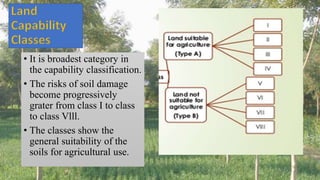
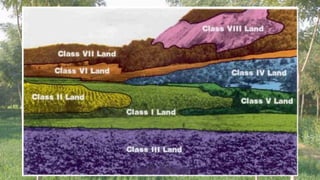
• It is broadest category in
the capability classification.
• The risks of soil damage
become progressively
grater from class I to class
to class Vlll.
• The classes show the
general suitability of the
soils for agricultural use.
Very slight to negligible limitations – no special land management
practices required.
• Very good cultivable, uniform deep fertile, nearly level productive
land
• It has good drainage, with sufficient water holding capacity to
supply growing crops and pastures.
• Soils in this class are suited for a variety of crops, including wheat,
barely, cotton, maize, tomato and bean.
Description
• Class 1 is prime agricultural land.
• It is capable of most rural land uses and land management practices and
the few minor limitations can be very readily managed in this class.
• The soils have sufficient clay content to inhibit wind erosion and offer
some resistance to soil structure.
• However, under very intense use, some structure breakdown can occur and
this can be management by reducing tillage and adding organic matter.
• Flooding is sometimes a problem on this land class adjacent to major rivers
and streams
characters
• Soil texture: sandy loam, loam, silty loam, sandy clay loam,
silty clay loam, and clay loam.
• Soil depth: more than 150 cm
• Land slope : 0-1%
• Erosion status: no erosion.
• Soil color: green
• OC : more than 1%
• EC: less than 1ds/m
Land management considerations:
• No special land management practices to control water and wind erosion
are required.
• Some land management practices that preserves soil structure and
chemical fertility are required.
• This land is free of rock and large stones that would restrict farm
machinery operations.
• The soils generally have good buffering capacity against soil acidity and
no specific management practices to control soil acidity are required.
Definition
• Slight but significant limitations – can be managed by readily
available, easily implemented management practices.
• Good cultivable land .
• It is subject to occasional overland flow, so it may require drainage
and special tillage practices to control erosion.
• Moderate risk of damage when cultivated, so use crop rotations.
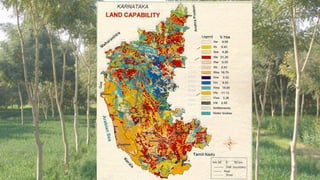
• In Karnataka class II include 3548.9 ha and covers 18.6% area
• Description:
• Land in this class is capable of a wide range of land uses and land
management practices (intensive cropping with cultivations,
grazing, forestry and nature conservation).
• land is very good cropping land with fertile soils with low slopes
(1% to 3%).
• uses include vegetable and horticultural production and a range of
crops including cereals, oilseeds and pulses.
• It has a high potential for agricultural production on fertile soils
similar to Class 1, but has some restrictions on land use due to
slight limitations.
Characters
• Soil texture: loamy sandy, sandy clay and silt clay.
• Soil depth: 150-100 cm
• Land Slope: 1-3%
• Erosion status : sheet, rill and gully .
• Soil color is yellow
• OC : 0.75 – 1%
• EC : 2-4ds/m
Land management considerations :
• This land can be subject to sheet, rill and gully erosion as well as wind
erosion, these limitations can be controlled by tillage practices and
conservation farming practices. These include retaining stubble,
reducing tillage, sowing with minimum disturbance , drainage and
rotating pastures.
• Windbreaks and ground cover should be retained in areas prone to wind
erosion.
• Salinity and alkalinity can be a slight hazard, so pH levels should be
monitored regularly.
• http://raitamitra.kar.nic.in/agriprofile/land.html
• Fundamentals of soil science : by Anil Rana
• Slide share.
• Agriglance.
PRESENTED BY:
ABEER ALI
UHS16UG3006
III B.Sc. (Hort)

Land use pattern classification

  • 2.
    • Land capabilityclassification (LCC) may be defined as a system of grouping land in to various classes based on inherent limitations imposed on sustained use by soil attributes, topography, drainage and climate. • The guiding principle underlying LCC is “use land according to its capability and treat it as per its need”. • It was developed by USDA. • It is based on the degree or magnitude of problem and recognized in the land
  • 4.
    The Capability Classificationprovides three major categories of soil grouping: (i) Capability unit, (ii) Capability sub-classes, and (iii) Capability classes. The land capability classes are further sub-divided on the basis of the limitations operating on the land.
  • 5.
    • It isbroadest category in the capability classification. • The risks of soil damage become progressively grater from class I to class to class Vlll. • The classes show the general suitability of the soils for agricultural use.
  • 6.
    Very slight tonegligible limitations – no special land management practices required. • Very good cultivable, uniform deep fertile, nearly level productive land • It has good drainage, with sufficient water holding capacity to supply growing crops and pastures. • Soils in this class are suited for a variety of crops, including wheat, barely, cotton, maize, tomato and bean.
  • 7.
    Description • Class 1is prime agricultural land. • It is capable of most rural land uses and land management practices and the few minor limitations can be very readily managed in this class. • The soils have sufficient clay content to inhibit wind erosion and offer some resistance to soil structure. • However, under very intense use, some structure breakdown can occur and this can be management by reducing tillage and adding organic matter. • Flooding is sometimes a problem on this land class adjacent to major rivers and streams
  • 8.
    characters • Soil texture:sandy loam, loam, silty loam, sandy clay loam, silty clay loam, and clay loam. • Soil depth: more than 150 cm • Land slope : 0-1% • Erosion status: no erosion. • Soil color: green • OC : more than 1% • EC: less than 1ds/m
  • 9.
    Land management considerations: •No special land management practices to control water and wind erosion are required. • Some land management practices that preserves soil structure and chemical fertility are required. • This land is free of rock and large stones that would restrict farm machinery operations. • The soils generally have good buffering capacity against soil acidity and no specific management practices to control soil acidity are required.
  • 11.
    Definition • Slight butsignificant limitations – can be managed by readily available, easily implemented management practices. • Good cultivable land . • It is subject to occasional overland flow, so it may require drainage and special tillage practices to control erosion. • Moderate risk of damage when cultivated, so use crop rotations. • In Karnataka class II include 3548.9 ha and covers 18.6% area
  • 12.
    • Description: • Landin this class is capable of a wide range of land uses and land management practices (intensive cropping with cultivations, grazing, forestry and nature conservation). • land is very good cropping land with fertile soils with low slopes (1% to 3%). • uses include vegetable and horticultural production and a range of crops including cereals, oilseeds and pulses. • It has a high potential for agricultural production on fertile soils similar to Class 1, but has some restrictions on land use due to slight limitations.
  • 13.
    Characters • Soil texture:loamy sandy, sandy clay and silt clay. • Soil depth: 150-100 cm • Land Slope: 1-3% • Erosion status : sheet, rill and gully . • Soil color is yellow • OC : 0.75 – 1% • EC : 2-4ds/m
  • 14.
    Land management considerations: • This land can be subject to sheet, rill and gully erosion as well as wind erosion, these limitations can be controlled by tillage practices and conservation farming practices. These include retaining stubble, reducing tillage, sowing with minimum disturbance , drainage and rotating pastures. • Windbreaks and ground cover should be retained in areas prone to wind erosion. • Salinity and alkalinity can be a slight hazard, so pH levels should be monitored regularly.
  • 19.
    • http://raitamitra.kar.nic.in/agriprofile/land.html • Fundamentalsof soil science : by Anil Rana • Slide share. • Agriglance.
  • 20.