
TOPIC :
LAND CAPABILITY
CLASSIFICATION
Land
The surface of the earth
not covered with water
Maybe temporarily or
permanently covered with
water
A pond for aquaculture is
considered land
Land Capability
Suitability of land for
agricultural uses.
Usage should not cause
damage to the land
although nutrients maybe
removed
DEFINITION :
Land capability classification is a system of grouping
soils primarily on the basis of to produce common
cultivated crops and pasture plants without deteriorating
over a long period of time
LAND CAPABILITY CLASSIFICATION
Land Capability Classification:
Assigning a
number to land
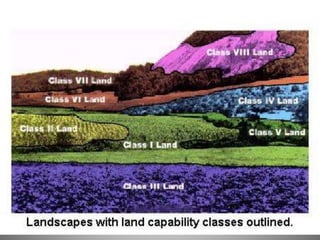
Eight classes used
I to VIII with I
being the best
arability
Class I to IV can be
cultivated
V to VIII tend to
have high slope or
low and wet
CLASSES (CLASSIFICATION ) :
Class I - Very good land
Very few limitations
deep soil and nearly level
can be cropped every year as long as land is taken care
of
Class II - Good land
has deep soil
may require moderate attention to conservation
practices
Class III - moderately good land
crops must be more carefully selected
often gently sloping hills
terraces and strip cropping are more often used
Class IV - fairly good land
lowest class cultivated
on hills with more slope than class III
Class V - Unsuited for cultivation
can be used for pasture crops and cattle grazing, hay
crops or tree farming
often used for wildlife or recreation areas
Class VI - Not suited for row crops
too much slope
usually damaged by erosion with gullies
can be used for trees, wildlife habitat, and recreation
Class VII - Highly unsuited for
cultivation
has severe limitations
permanent pastures, forestry, wildlife
slope is usually over 12 percent
large rock surfaces and boulders may be found
very little soil present
Class VIII
Cannot be used for row crops or other crops often
lowland
covered with water
soil maybe wet or high in clay
aquatic crops maybe grown there
used for waterfowl habitat
Subclass e is made up of soils for which the susceptibility to
erosion is
the dominant problem or hazard affecting their use. Erosion
susceptibility and past erosion damage are the major soil factors that
affect soils in this subclass.
Subclass w is made up of soils for which excess water is the
dominant
hazard or limitation affecting their use. Poor soil drainage, wetness,
a
high water table, and overflow are the factors that affect soils in this
subclass.
SUBCLASSES :
Subclass s is made up of soils that have soil limitations within the
rooting zone, such as shallowness of the rooting zone, stones, low
moisture-holding capacity, low fertility that is difficult to correct,
and
salinity or sodium content.
Subclass c is made up of soils for which the climate (the
temperature
or lack of moisture) is the major hazard or limitation affecting their
use
General Info you need to
know :
Classification is made for agricultural
purposes
3 major categories of soil groupings:
capability unit, capability subclass,
capability class
Arable-means can be used for crops

Land capability classification

  • 2.
  • 3.
    Land The surface ofthe earth not covered with water Maybe temporarily or permanently covered with water A pond for aquaculture is considered land
  • 4.
    Land Capability Suitability ofland for agricultural uses. Usage should not cause damage to the land although nutrients maybe removed
  • 5.
    DEFINITION : Land capabilityclassification is a system of grouping soils primarily on the basis of to produce common cultivated crops and pasture plants without deteriorating over a long period of time LAND CAPABILITY CLASSIFICATION
  • 6.
    Land Capability Classification: Assigninga number to land Eight classes used I to VIII with I being the best arability Class I to IV can be cultivated V to VIII tend to have high slope or low and wet
  • 7.
    CLASSES (CLASSIFICATION ): Class I - Very good land Very few limitations deep soil and nearly level can be cropped every year as long as land is taken care of Class II - Good land has deep soil may require moderate attention to conservation practices
  • 8.
    Class III -moderately good land crops must be more carefully selected often gently sloping hills terraces and strip cropping are more often used Class IV - fairly good land lowest class cultivated on hills with more slope than class III Class V - Unsuited for cultivation can be used for pasture crops and cattle grazing, hay crops or tree farming often used for wildlife or recreation areas
  • 9.
    Class VI -Not suited for row crops too much slope usually damaged by erosion with gullies can be used for trees, wildlife habitat, and recreation Class VII - Highly unsuited for cultivation has severe limitations permanent pastures, forestry, wildlife slope is usually over 12 percent large rock surfaces and boulders may be found very little soil present
  • 10.
    Class VIII Cannot beused for row crops or other crops often lowland covered with water soil maybe wet or high in clay aquatic crops maybe grown there used for waterfowl habitat
  • 12.
    Subclass e ismade up of soils for which the susceptibility to erosion is the dominant problem or hazard affecting their use. Erosion susceptibility and past erosion damage are the major soil factors that affect soils in this subclass. Subclass w is made up of soils for which excess water is the dominant hazard or limitation affecting their use. Poor soil drainage, wetness, a high water table, and overflow are the factors that affect soils in this subclass. SUBCLASSES :
  • 13.
    Subclass s ismade up of soils that have soil limitations within the rooting zone, such as shallowness of the rooting zone, stones, low moisture-holding capacity, low fertility that is difficult to correct, and salinity or sodium content. Subclass c is made up of soils for which the climate (the temperature or lack of moisture) is the major hazard or limitation affecting their use
  • 14.
    General Info youneed to know : Classification is made for agricultural purposes 3 major categories of soil groupings: capability unit, capability subclass, capability class Arable-means can be used for crops