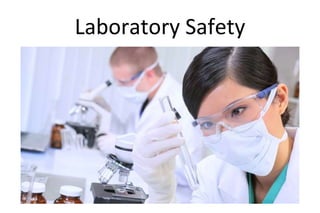
Laboratory Safety
Hierarchy of Controls
Methods of controlling hazards in the laboratory workplace,
prioritizing measures which eliminate hazards over those
that require workers to protect themselves from exposure.
• Engineering Controls: Making changes to the work
environment to reduce work-related hazards. These
permanent changes reduce exposure to hazards and do
not rely on worker behavior.
• Administrative Controls: Modifying workers’ work
schedules and tasks in ways that minimizes their
exposure to workplace hazards.
• Work Practices: Procedures for safe and proper work
that are used to reduce the duration, frequency or
intensity of exposure to a hazard.
• Personal Protective Equipment: Protective gear
needed to keep workers safe while performing their
jobs.
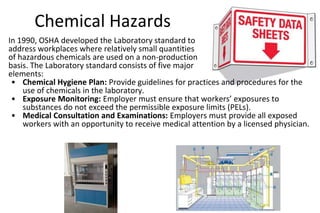
Chemical Hazards
In 1990, OSHA developed the Laboratory standard to
address workplaces where relatively small quantities
of hazardous chemicals are used on a non-production
basis. The Laboratory standard consists of five major
elements:
• Chemical Hygiene Plan: Provide guidelines for practices and procedures for the
use of chemicals in the laboratory.
• Exposure Monitoring: Employer must ensure that workers’ exposures to
substances do not exceed the permissible exposure limits (PELs).
• Medical Consultation and Examinations: Employers must provide all exposed
workers with an opportunity to receive medical attention by a licensed physician.
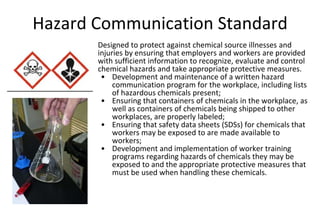
Hazard Communication Standard
Designed to protect against chemical source illnesses and
injuries by ensuring that employers and workers are provided
with sufficient information to recognize, evaluate and control
chemical hazards and take appropriate protective measures.
• Development and maintenance of a written hazard
communication program for the workplace, including lists
of hazardous chemicals present;
• Ensuring that containers of chemicals in the workplace, as
well as containers of chemicals being shipped to other
workplaces, are properly labeled;
• Ensuring that safety data sheets (SDSs) for chemicals that
workers may be exposed to are made available to
workers;
• Development and implementation of worker training
programs regarding hazards of chemicals they may be
exposed to and the appropriate protective measures that
must be used when handling these chemicals.
Biological Hazards
Many laboratory workers encounter daily exposure to
biological hazards. These hazards are present in various
sources throughout the laboratory such as blood and body
fluids, culture specimens, body tissue and cadavers, and
laboratory animals, as well as other workers.
• Biological Agents and Biological Toxins: such as
anthrax, botulism, molds and fungi, ricin, SARS,
smallpox, etc.
• Bloodborne Pathogens: According to the CDC more
than 200 diseases can be transmitted from exposure to
blood, but the most serious are hepatitis B, hepatitis C,
and HIV. Employers must develop a written Exposure
Control Plan, provide training to exposed workers, and
use Standard Precautions when dealing with blood and
other potentially infectious materials (OPIM).
Biological Hazards
Employers must ensure that workers are
trained and prohibited from engaging in the
following activities:
• Mouth pipetting/suctioning of blood or
OPIM;
• Eating, drinking, smoking, applying
cosmetics or lip balm, or handling contact
lenses in work areas where there is a
reasonable likelihood of occupational
exposure to blood or OPIM; and
• Storage of food or drink in refrigerators,
freezers, shelves, cabinets or on
countertops or benchtops where blood
or OPIM are present.
Biological Hazards
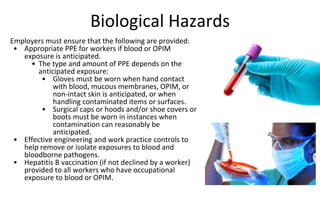
Employers must ensure that the following are provided:
• Appropriate PPE for workers if blood or OPIM
exposure is anticipated.
• The type and amount of PPE depends on the
anticipated exposure:
• Gloves must be worn when hand contact
with blood, mucous membranes, OPIM, or
non-intact skin is anticipated, or when
handling contaminated items or surfaces.
• Surgical caps or hoods and/or shoe covers or
boots must be worn in instances when
contamination can reasonably be
anticipated.
• Effective engineering and work practice controls to
help remove or isolate exposures to blood and
bloodborne pathogens.
• Hepatitis B vaccination (if not declined by a worker)
provided to all workers who have occupational
exposure to blood or OPIM.
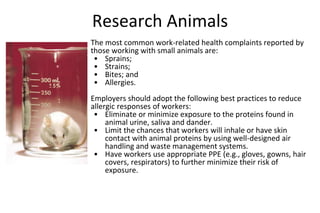
Research Animals
The most common work-related health complaints reported by
those working with small animals are:
• Sprains;
• Strains;
• Bites; and
• Allergies.
Employers should adopt the following best practices to reduce
allergic responses of workers:
• Eliminate or minimize exposure to the proteins found in
animal urine, saliva and dander.
• Limit the chances that workers will inhale or have skin
contact with animal proteins by using well-designed air
handling and waste management systems.
• Have workers use appropriate PPE (e.g., gloves, gowns, hair
covers, respirators) to further minimize their risk of
exposure.
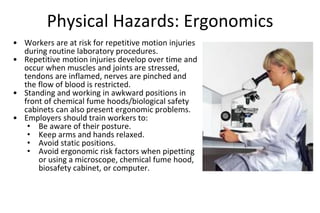
Physical Hazards: Ergonomics
• Workers are at risk for repetitive motion injuries
during routine laboratory procedures.
• Repetitive motion injuries develop over time and
occur when muscles and joints are stressed,
tendons are inflamed, nerves are pinched and
the flow of blood is restricted.
• Standing and working in awkward positions in
front of chemical fume hoods/biological safety
cabinets can also present ergonomic problems.
• Employers should train workers to:
• Be aware of their posture.
• Keep arms and hands relaxed.
• Avoid static positions.
• Avoid ergonomic risk factors when pipetting
or using a microscope, chemical fume hood,
biosafety cabinet, or computer.
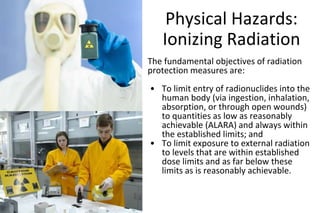
Physical Hazards:
Ionizing Radiation
The fundamental objectives of radiation
protection measures are:
• To limit entry of radionuclides into the
human body (via ingestion, inhalation,
absorption, or through open wounds)
to quantities as low as reasonably
achievable (ALARA) and always within
the established limits; and
• To limit exposure to external radiation
to levels that are within established
dose limits and as far below these
limits as is reasonably achievable.
Physical Hazards: Ionizing Radiation
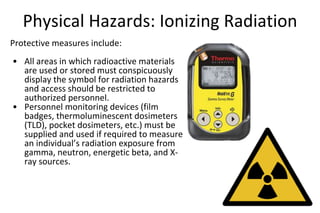
Protective measures include:
• All areas in which radioactive materials
are used or stored must conspicuously
display the symbol for radiation hazards
and access should be restricted to
authorized personnel.
• Personnel monitoring devices (film
badges, thermoluminescent dosimeters
(TLD), pocket dosimeters, etc.) must be
supplied and used if required to measure
an individual’s radiation exposure from
gamma, neutron, energetic beta, and X-
ray sources.
Physical Hazards:
Non-Ionizing Radiation
Non-ionizing radiation is described as a series of energy
waves composed of oscillating electric and magnetic
fields traveling at the speed of light. Non-ionizing
radiation is found in a wide range of occupational
settings and can pose a considerable health risk to
potentially exposed workers if not properly controlled.
Types of non-ionizing radiation include:
• Extremely Low Frequency Radiation (ELF)
• Radiofrequency and Microwave Radiation
• Infrared Radiation (IR)
• Visible Light Radiation
• Ultraviolet Radiation (UV)
• Laser Hazards
Physical Hazards: Noise Exposure
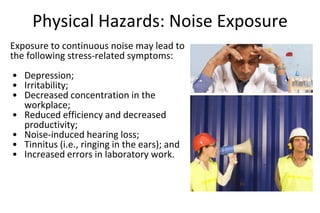
Exposure to continuous noise may lead to
the following stress-related symptoms:
• Depression;
• Irritability;
• Decreased concentration in the
workplace;
• Reduced efficiency and decreased
productivity;
• Noise-induced hearing loss;
• Tinnitus (i.e., ringing in the ears); and
• Increased errors in laboratory work.
Physical Hazards: Noise Exposure
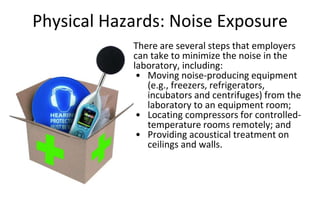
There are several steps that employers
can take to minimize the noise in the
laboratory, including:
• Moving noise-producing equipment
(e.g., freezers, refrigerators,
incubators and centrifuges) from the
laboratory to an equipment room;
• Locating compressors for controlled-
temperature rooms remotely; and
• Providing acoustical treatment on
ceilings and walls.
15
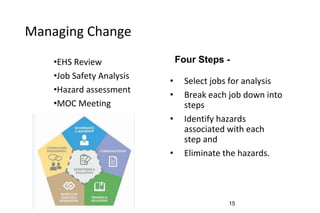
Managing Change
•EHS Review
•Job Safety Analysis
•Hazard assessment
•MOC Meeting
• Select jobs for analysis
• Break each job down into
steps
• Identify hazards
associated with each
step and
• Eliminate the hazards.
Four Steps -
16
Lab Safety Training
•Lab Safety Institute – 24 hr training program. Topics include:
Biological and animal
hazards
Handling glassware
PPE
Chemical storage
Ventilation
Compressed gases
Bloodborne pathogens
Radiation
Disposal of chemicals
Electrical safety
and more!
Great outline for initial training!
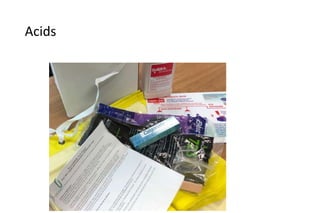
Acids
18
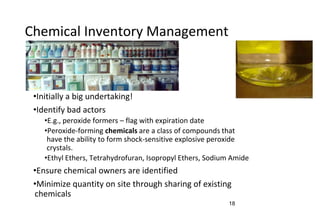
Chemical Inventory Management
•Initially a big undertaking!
•Identify bad actors
•E.g., peroxide formers – flag with expiration date
•Peroxide-forming chemicals are a class of compounds that
have the ability to form shock-sensitive explosive peroxide
crystals.
•Ethyl Ethers, Tetrahydrofuran, Isopropyl Ethers, Sodium Amide
•Ensure chemical owners are identified
•Minimize quantity on site through sharing of existing
chemicals
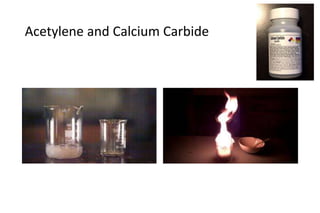
Acetylene and Calcium Carbide
20
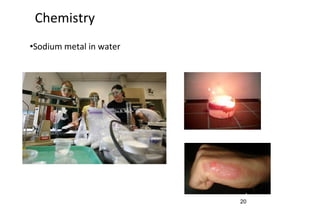
Chemistry
•Sodium metal in water
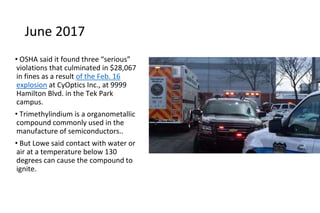
June 2017
• OSHA said it found three “serious”
violations that culminated in $28,067
in fines as a result of the Feb. 16
explosion at CyOptics Inc., at 9999
Hamilton Blvd. in the Tek Park
campus.
• Trimethylindium is a organometallic
compound commonly used in the
manufacture of semiconductors..
• But Lowe said contact with water or
air at a temperature below 130
degrees can cause the compound to
ignite.
22
Highly publicized laboratory fatalities
•Sheri Sangji, a student at UCLA, died from burns sustained in a chemical
fire. She was working with t-butyl lithium, a highly flammable compound
that spontaneously burns upon exposure to air. The plunger on the syringe
she was using dislodged and the compound ignited and engulfed her
clothing. The lack of a lab coat was the single most significant factor in the
severity of the burns that led to her death.
•Dartmouth professor Karen Wetterhahn died in 1997 after spilling a few
drops of dimethylmercury on her latex gloves. Tests later showed this
material would penetrate the gloves within 15 seconds and be absorbed
through the skin.
23
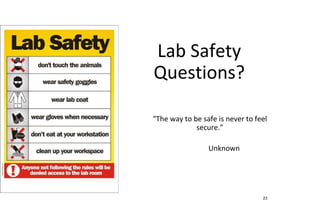
Lab Safety
Questions?
“The way to be safe is never to feel
secure.”
Unknown

Laboratory safety 2019

  • 1.
  • 2.
    Hierarchy of Controls Methodsof controlling hazards in the laboratory workplace, prioritizing measures which eliminate hazards over those that require workers to protect themselves from exposure. • Engineering Controls: Making changes to the work environment to reduce work-related hazards. These permanent changes reduce exposure to hazards and do not rely on worker behavior. • Administrative Controls: Modifying workers’ work schedules and tasks in ways that minimizes their exposure to workplace hazards. • Work Practices: Procedures for safe and proper work that are used to reduce the duration, frequency or intensity of exposure to a hazard. • Personal Protective Equipment: Protective gear needed to keep workers safe while performing their jobs.
  • 3.
    Chemical Hazards In 1990,OSHA developed the Laboratory standard to address workplaces where relatively small quantities of hazardous chemicals are used on a non-production basis. The Laboratory standard consists of five major elements: • Chemical Hygiene Plan: Provide guidelines for practices and procedures for the use of chemicals in the laboratory. • Exposure Monitoring: Employer must ensure that workers’ exposures to substances do not exceed the permissible exposure limits (PELs). • Medical Consultation and Examinations: Employers must provide all exposed workers with an opportunity to receive medical attention by a licensed physician.
  • 4.
    Hazard Communication Standard Designedto protect against chemical source illnesses and injuries by ensuring that employers and workers are provided with sufficient information to recognize, evaluate and control chemical hazards and take appropriate protective measures. • Development and maintenance of a written hazard communication program for the workplace, including lists of hazardous chemicals present; • Ensuring that containers of chemicals in the workplace, as well as containers of chemicals being shipped to other workplaces, are properly labeled; • Ensuring that safety data sheets (SDSs) for chemicals that workers may be exposed to are made available to workers; • Development and implementation of worker training programs regarding hazards of chemicals they may be exposed to and the appropriate protective measures that must be used when handling these chemicals.
  • 5.
    Biological Hazards Many laboratoryworkers encounter daily exposure to biological hazards. These hazards are present in various sources throughout the laboratory such as blood and body fluids, culture specimens, body tissue and cadavers, and laboratory animals, as well as other workers. • Biological Agents and Biological Toxins: such as anthrax, botulism, molds and fungi, ricin, SARS, smallpox, etc. • Bloodborne Pathogens: According to the CDC more than 200 diseases can be transmitted from exposure to blood, but the most serious are hepatitis B, hepatitis C, and HIV. Employers must develop a written Exposure Control Plan, provide training to exposed workers, and use Standard Precautions when dealing with blood and other potentially infectious materials (OPIM).
  • 6.
    Biological Hazards Employers mustensure that workers are trained and prohibited from engaging in the following activities: • Mouth pipetting/suctioning of blood or OPIM; • Eating, drinking, smoking, applying cosmetics or lip balm, or handling contact lenses in work areas where there is a reasonable likelihood of occupational exposure to blood or OPIM; and • Storage of food or drink in refrigerators, freezers, shelves, cabinets or on countertops or benchtops where blood or OPIM are present.
  • 7.
    Biological Hazards Employers mustensure that the following are provided: • Appropriate PPE for workers if blood or OPIM exposure is anticipated. • The type and amount of PPE depends on the anticipated exposure: • Gloves must be worn when hand contact with blood, mucous membranes, OPIM, or non-intact skin is anticipated, or when handling contaminated items or surfaces. • Surgical caps or hoods and/or shoe covers or boots must be worn in instances when contamination can reasonably be anticipated. • Effective engineering and work practice controls to help remove or isolate exposures to blood and bloodborne pathogens. • Hepatitis B vaccination (if not declined by a worker) provided to all workers who have occupational exposure to blood or OPIM.
  • 8.
    Research Animals The mostcommon work-related health complaints reported by those working with small animals are: • Sprains; • Strains; • Bites; and • Allergies. Employers should adopt the following best practices to reduce allergic responses of workers: • Eliminate or minimize exposure to the proteins found in animal urine, saliva and dander. • Limit the chances that workers will inhale or have skin contact with animal proteins by using well-designed air handling and waste management systems. • Have workers use appropriate PPE (e.g., gloves, gowns, hair covers, respirators) to further minimize their risk of exposure.
  • 9.
    Physical Hazards: Ergonomics •Workers are at risk for repetitive motion injuries during routine laboratory procedures. • Repetitive motion injuries develop over time and occur when muscles and joints are stressed, tendons are inflamed, nerves are pinched and the flow of blood is restricted. • Standing and working in awkward positions in front of chemical fume hoods/biological safety cabinets can also present ergonomic problems. • Employers should train workers to: • Be aware of their posture. • Keep arms and hands relaxed. • Avoid static positions. • Avoid ergonomic risk factors when pipetting or using a microscope, chemical fume hood, biosafety cabinet, or computer.
  • 10.
    Physical Hazards: Ionizing Radiation Thefundamental objectives of radiation protection measures are: • To limit entry of radionuclides into the human body (via ingestion, inhalation, absorption, or through open wounds) to quantities as low as reasonably achievable (ALARA) and always within the established limits; and • To limit exposure to external radiation to levels that are within established dose limits and as far below these limits as is reasonably achievable.
  • 11.
    Physical Hazards: IonizingRadiation Protective measures include: • All areas in which radioactive materials are used or stored must conspicuously display the symbol for radiation hazards and access should be restricted to authorized personnel. • Personnel monitoring devices (film badges, thermoluminescent dosimeters (TLD), pocket dosimeters, etc.) must be supplied and used if required to measure an individual’s radiation exposure from gamma, neutron, energetic beta, and X- ray sources.
  • 12.
    Physical Hazards: Non-Ionizing Radiation Non-ionizingradiation is described as a series of energy waves composed of oscillating electric and magnetic fields traveling at the speed of light. Non-ionizing radiation is found in a wide range of occupational settings and can pose a considerable health risk to potentially exposed workers if not properly controlled. Types of non-ionizing radiation include: • Extremely Low Frequency Radiation (ELF) • Radiofrequency and Microwave Radiation • Infrared Radiation (IR) • Visible Light Radiation • Ultraviolet Radiation (UV) • Laser Hazards
  • 13.
    Physical Hazards: NoiseExposure Exposure to continuous noise may lead to the following stress-related symptoms: • Depression; • Irritability; • Decreased concentration in the workplace; • Reduced efficiency and decreased productivity; • Noise-induced hearing loss; • Tinnitus (i.e., ringing in the ears); and • Increased errors in laboratory work.
  • 14.
    Physical Hazards: NoiseExposure There are several steps that employers can take to minimize the noise in the laboratory, including: • Moving noise-producing equipment (e.g., freezers, refrigerators, incubators and centrifuges) from the laboratory to an equipment room; • Locating compressors for controlled- temperature rooms remotely; and • Providing acoustical treatment on ceilings and walls.
  • 15.
    15 Managing Change •EHS Review •JobSafety Analysis •Hazard assessment •MOC Meeting • Select jobs for analysis • Break each job down into steps • Identify hazards associated with each step and • Eliminate the hazards. Four Steps -
  • 16.
    16 Lab Safety Training •LabSafety Institute – 24 hr training program. Topics include: Biological and animal hazards Handling glassware PPE Chemical storage Ventilation Compressed gases Bloodborne pathogens Radiation Disposal of chemicals Electrical safety and more! Great outline for initial training!
  • 17.
  • 18.
    18 Chemical Inventory Management •Initiallya big undertaking! •Identify bad actors •E.g., peroxide formers – flag with expiration date •Peroxide-forming chemicals are a class of compounds that have the ability to form shock-sensitive explosive peroxide crystals. •Ethyl Ethers, Tetrahydrofuran, Isopropyl Ethers, Sodium Amide •Ensure chemical owners are identified •Minimize quantity on site through sharing of existing chemicals
  • 19.
  • 20.
  • 21.
    June 2017 • OSHAsaid it found three “serious” violations that culminated in $28,067 in fines as a result of the Feb. 16 explosion at CyOptics Inc., at 9999 Hamilton Blvd. in the Tek Park campus. • Trimethylindium is a organometallic compound commonly used in the manufacture of semiconductors.. • But Lowe said contact with water or air at a temperature below 130 degrees can cause the compound to ignite.
  • 22.
    22 Highly publicized laboratoryfatalities •Sheri Sangji, a student at UCLA, died from burns sustained in a chemical fire. She was working with t-butyl lithium, a highly flammable compound that spontaneously burns upon exposure to air. The plunger on the syringe she was using dislodged and the compound ignited and engulfed her clothing. The lack of a lab coat was the single most significant factor in the severity of the burns that led to her death. •Dartmouth professor Karen Wetterhahn died in 1997 after spilling a few drops of dimethylmercury on her latex gloves. Tests later showed this material would penetrate the gloves within 15 seconds and be absorbed through the skin.
  • 23.
    23 Lab Safety Questions? “The wayto be safe is never to feel secure.” Unknown