Label Distribution Protocols
• LDP: hop-by-hop routing
• RSVP-TE: explicit routing
• CR-LDP: another explicit routing protocol,
no longer under development.
• LDP
– LDP peers: two LSRs that use LDP to exchange
label/FRC mapping information.
– Four types of LDP messages:
• Discovery messages for announcing and maintaining the
presence of an LSR in a network.
• Session message for establishing, maintaining, or terminating
session between LDP peers.
• Advertisement messages for creating, changing, or deleting
label mapping for FEC.
• Notification messages for distributing advisory information
and error information.
– Discovery messages are sent as UDP packets to LDP
port at the all-router-on-this-subnet group multicast
address. After a session is established, all messages are
exchanged using TCP.
• LDP discovery: two mechanisms
– Discover LSR neighbors that are directed connected
• Send LDP Link Hello messages on each interface.
• UDP packets addressed to LDP discovery port with the all-
routers-on-this-subnet group multicast address.
– Discover LSR neighbors that are remotely connected.
• Send Targeted Hello messages to a specific IP address at the
LDP discovery port.
– When a LSR want to establish a peer relationship, it
will reply.
– The exchanges of Hello messages establish the
adacency.
• LDP session management
– After two LSRs establishes the adjacency, they can set
up TCP connections and start the initialization process.
• Negotiation of protocol version. Label distribution method,
timer values, VPI/VCI ranges for label-controlled ATM.
– Hello and Keepalive messages are sent periodically.
• Label distribution and management
– downstream on demand and downstream unsolicited.
– Configurable options: Independent LSPs setup or in order LSP
setup.
• Independent LSP setup: LSRs may advertise label mappings to its
neighbors at any time
• In order LSP setup: LSP setup from egress to ingress. An LSR may
send a label mapping for a FEC only when (1) the LSR has a label
mapping for the FEC for the nexthop, or (2) the LSR is the egress for
the FEC.
• FEC to LSP mapping
– A LSR requests a label mapping from a neighboring
LSR when it needs one and advertise the label mapping
when I wants the neighbor to use a label.
– Two types of FECs in LDP: address prefix and host
address.
– Special things must be done to deal with loops.
• LDP identifiers:
– An LSR may have multiple label spaces (one for each
interface). It must identify the label spaces with LDP
identifiers.
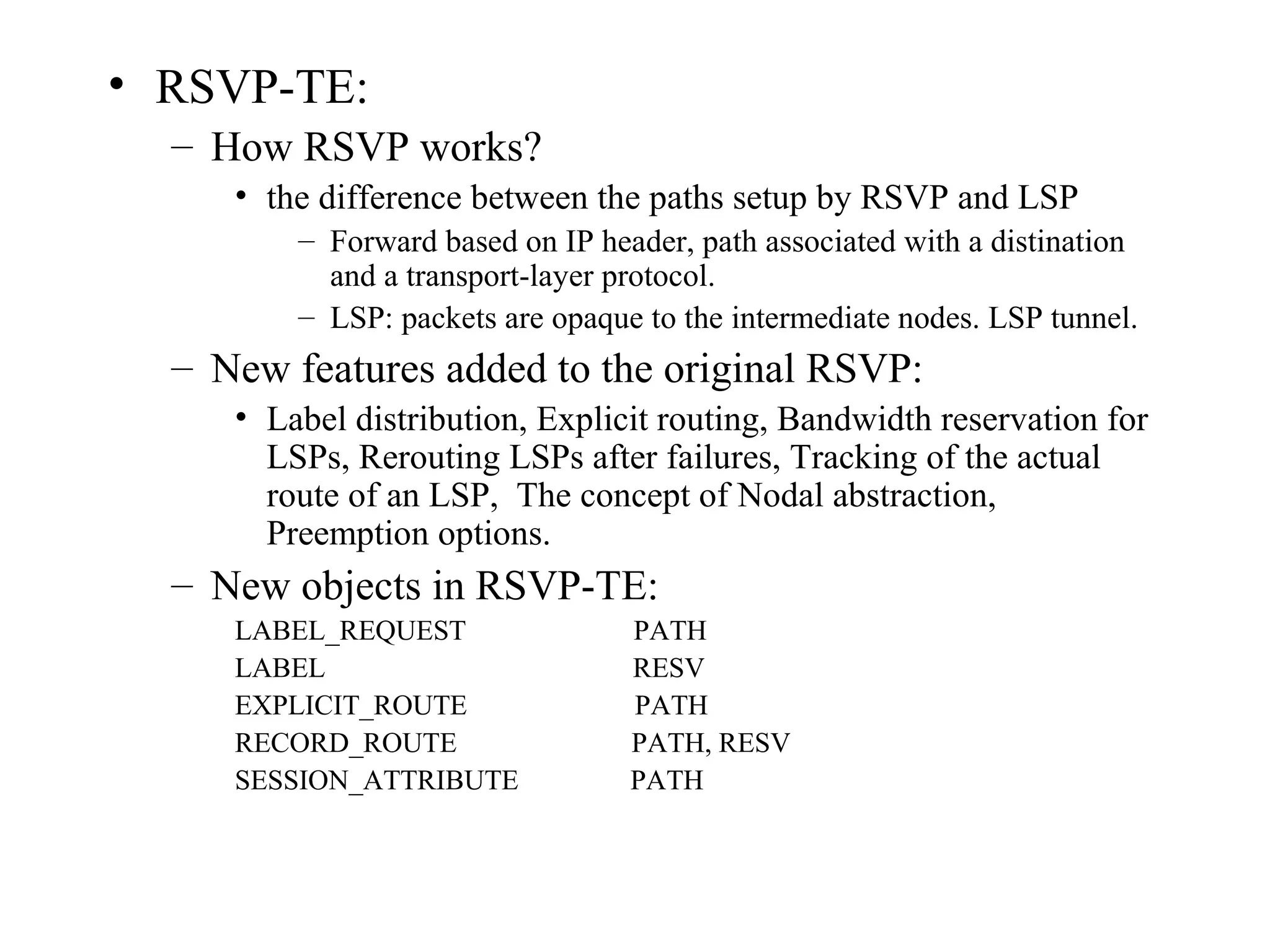
• RSVP-TE:
– How RSVP works?
• the difference between the paths setup by RSVP and LSP
– Forward based on IP header, path associated with a distination
and a transport-layer protocol.
– LSP: packets are opaque to the intermediate nodes. LSP tunnel.
– New features added to the original RSVP:
• Label distribution, Explicit routing, Bandwidth reservation for
LSPs, Rerouting LSPs after failures, Tracking of the actual
route of an LSP, The concept of Nodal abstraction,
Preemption options.
– New objects in RSVP-TE:
LABEL_REQUEST PATH
LABEL RESV
EXPLICIT_ROUTE PATH
RECORD_ROUTE PATH, RESV
SESSION_ATTRIBUTE PATH
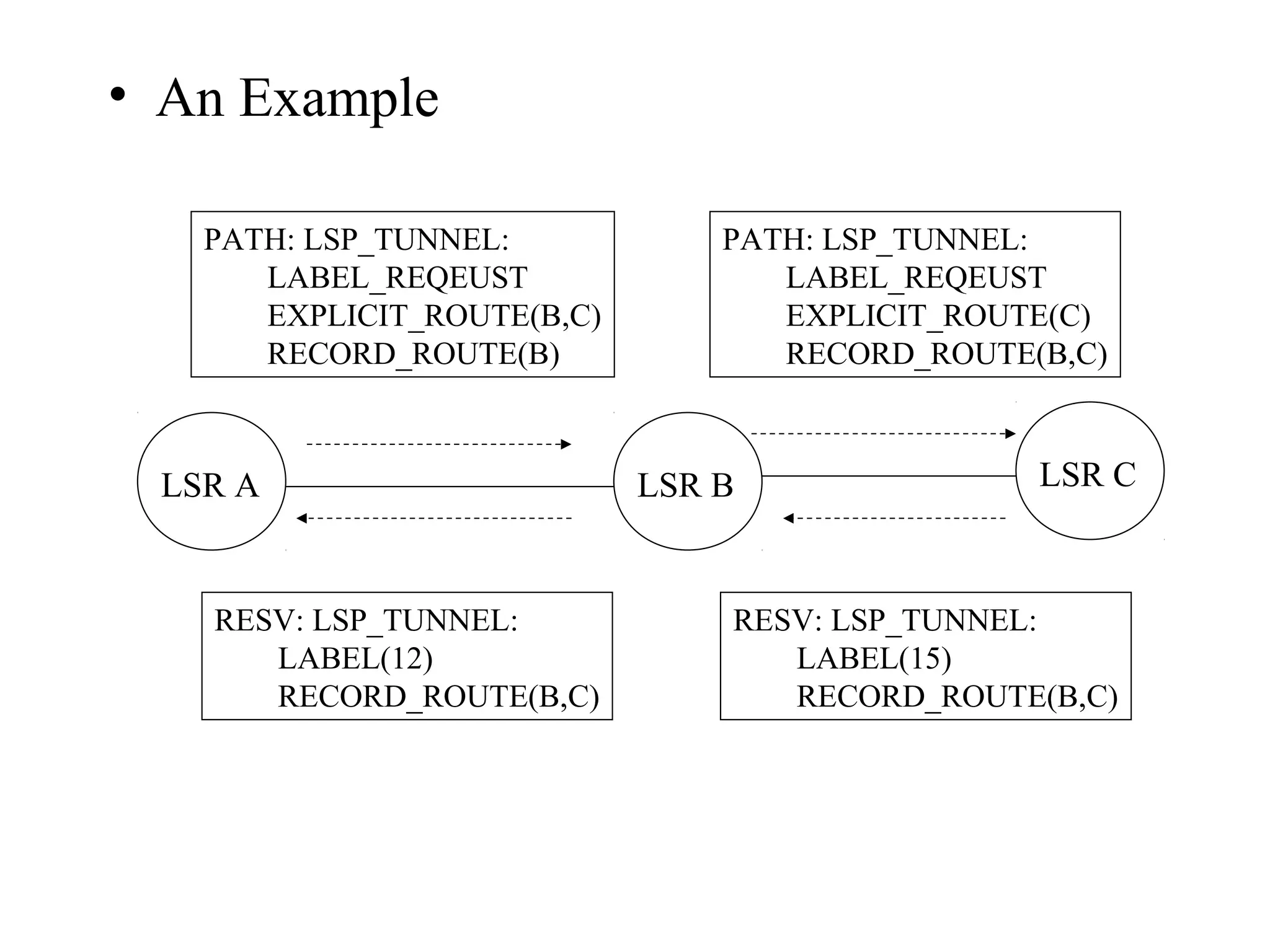
• An Example
PATH: LSP_TUNNEL:
LABEL_REQEUST
EXPLICIT_ROUTE(B,C)
RECORD_ROUTE(B)
PATH: LSP_TUNNEL:
LABEL_REQEUST
EXPLICIT_ROUTE(C)
RECORD_ROUTE(B,C)
LSR A LSR B LSR C
RESV: LSP_TUNNEL:
LABEL(15)
RECORD_ROUTE(B,C)
RESV: LSP_TUNNEL:
LABEL(12)
RECORD_ROUTE(B,C)

Label Distribution Protocols for MPLS FEC

  • 1.
    Label Distribution Protocols •LDP: hop-by-hop routing • RSVP-TE: explicit routing • CR-LDP: another explicit routing protocol, no longer under development.
  • 2.
    • LDP – LDPpeers: two LSRs that use LDP to exchange label/FRC mapping information. – Four types of LDP messages: • Discovery messages for announcing and maintaining the presence of an LSR in a network. • Session message for establishing, maintaining, or terminating session between LDP peers. • Advertisement messages for creating, changing, or deleting label mapping for FEC. • Notification messages for distributing advisory information and error information. – Discovery messages are sent as UDP packets to LDP port at the all-router-on-this-subnet group multicast address. After a session is established, all messages are exchanged using TCP.
  • 3.
    • LDP discovery:two mechanisms – Discover LSR neighbors that are directed connected • Send LDP Link Hello messages on each interface. • UDP packets addressed to LDP discovery port with the all- routers-on-this-subnet group multicast address. – Discover LSR neighbors that are remotely connected. • Send Targeted Hello messages to a specific IP address at the LDP discovery port. – When a LSR want to establish a peer relationship, it will reply. – The exchanges of Hello messages establish the adacency.
  • 4.
    • LDP sessionmanagement – After two LSRs establishes the adjacency, they can set up TCP connections and start the initialization process. • Negotiation of protocol version. Label distribution method, timer values, VPI/VCI ranges for label-controlled ATM. – Hello and Keepalive messages are sent periodically. • Label distribution and management – downstream on demand and downstream unsolicited. – Configurable options: Independent LSPs setup or in order LSP setup. • Independent LSP setup: LSRs may advertise label mappings to its neighbors at any time • In order LSP setup: LSP setup from egress to ingress. An LSR may send a label mapping for a FEC only when (1) the LSR has a label mapping for the FEC for the nexthop, or (2) the LSR is the egress for the FEC.
  • 5.
    • FEC toLSP mapping – A LSR requests a label mapping from a neighboring LSR when it needs one and advertise the label mapping when I wants the neighbor to use a label. – Two types of FECs in LDP: address prefix and host address. – Special things must be done to deal with loops. • LDP identifiers: – An LSR may have multiple label spaces (one for each interface). It must identify the label spaces with LDP identifiers.
  • 6.
    • RSVP-TE: – HowRSVP works? • the difference between the paths setup by RSVP and LSP – Forward based on IP header, path associated with a distination and a transport-layer protocol. – LSP: packets are opaque to the intermediate nodes. LSP tunnel. – New features added to the original RSVP: • Label distribution, Explicit routing, Bandwidth reservation for LSPs, Rerouting LSPs after failures, Tracking of the actual route of an LSP, The concept of Nodal abstraction, Preemption options. – New objects in RSVP-TE: LABEL_REQUEST PATH LABEL RESV EXPLICIT_ROUTE PATH RECORD_ROUTE PATH, RESV SESSION_ATTRIBUTE PATH
  • 7.
    • An Example PATH:LSP_TUNNEL: LABEL_REQEUST EXPLICIT_ROUTE(B,C) RECORD_ROUTE(B) PATH: LSP_TUNNEL: LABEL_REQEUST EXPLICIT_ROUTE(C) RECORD_ROUTE(B,C) LSR A LSR B LSR C RESV: LSP_TUNNEL: LABEL(15) RECORD_ROUTE(B,C) RESV: LSP_TUNNEL: LABEL(12) RECORD_ROUTE(B,C)